Search This Blog

Wednesday, January 10, 2024

Expiry Of Fed Bank Bailout Facility Strengthens Calls For Earlier Rate-Cut

 by Simon White, Bloomberg macro strategist,

The Federal Reserve is likely to retire the Bank Term Funding Program in March. This would entail an additional ongoing headwind for reserves, and thus liquidity, through 2024. At the margin, this adds weight to the case for the Fed cutting interest rates sooner in the year.

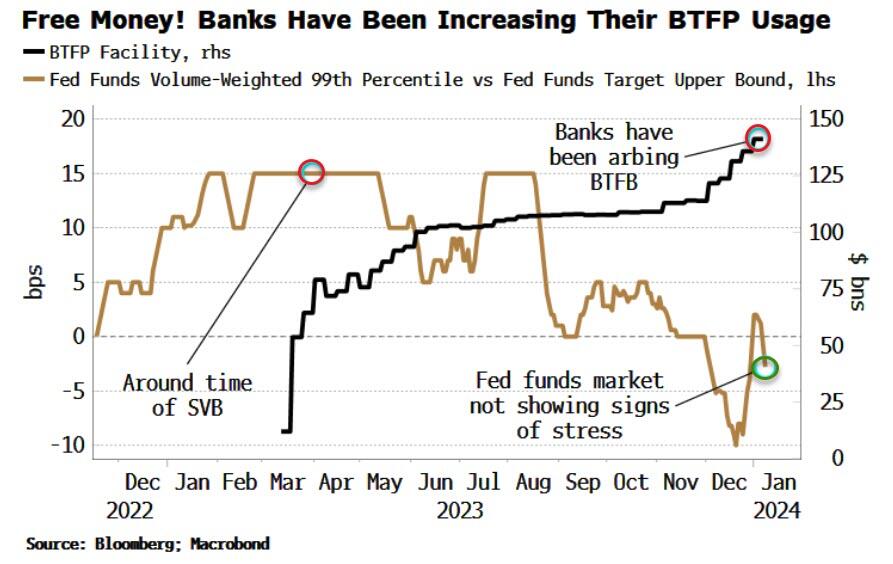
The BTFP was created in the wake of the SVB crisis to help struggling banks get access to liquidity when bond prices were dropping. However, its use in recent months has jumped to over $140 billion. That is not, however, a sign of banking stress.

The chart below shows the usage of the BTFP along with the rate paid at the 99th percentile in the fed funds market relative to the upper bound of the range for fed funds.

As can be seen, this is under zero, i.e. banks are not having to pay up to get liquidity.

This is in stark contrast to last March at the time of SVB’s fall when some banks were having to pay 15 bps above the fed funds upper bound for liquidity.

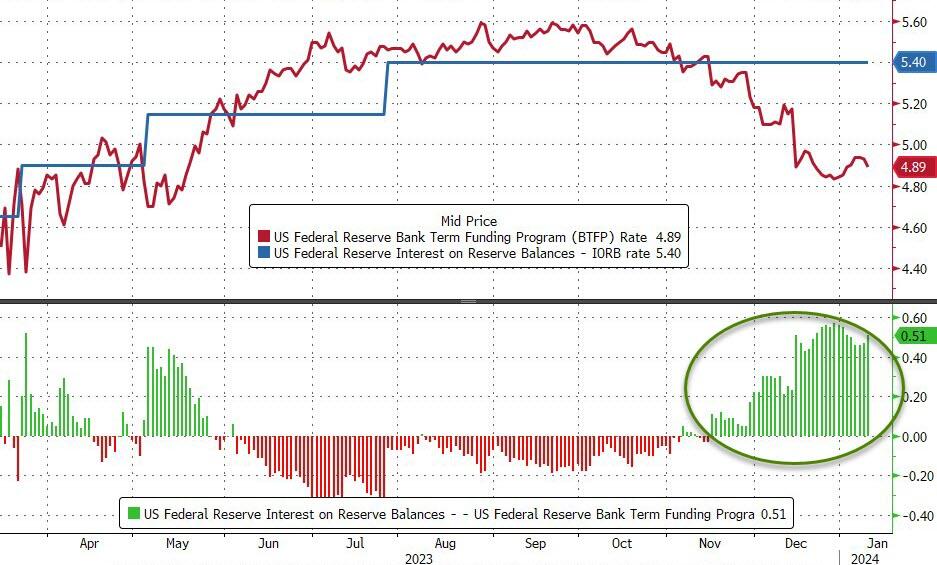
This time the rise in BTFP usage is good old-fashioned arbitrage. After the Fed’s pivot, term rates have come down relative to the policy rate. The cost to use the BTFP is 1y OIS + 10 bps, which is ~4.90%. Banks can post USTs at par as collateral, borrow at this rate, then deposit the funds back at the Fed at the IORB rate (interest on reserve balances), i.e. 5.40%, for a juicy risk-free profit.

This is not good optics, so it is unlikely the program will be renewed when it is due to expire on March 11. Michael Barr, the Fed’s vice chair for supervision, hinted as much on Tuesday when he emphasized the BTFP is an “emergency program.”

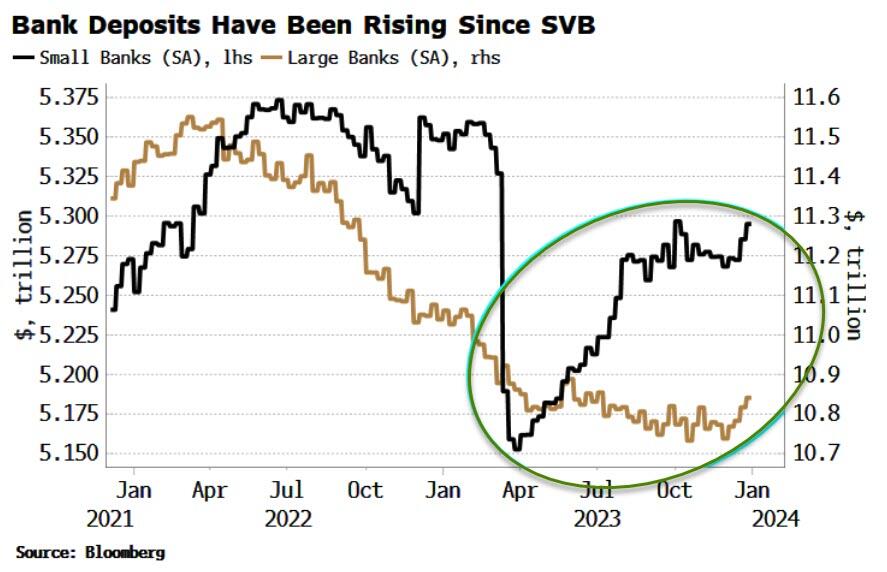
And it seems clear the emergency is over. Deposits of small banks (for whom the program was aimed at) have been rising since their drop after SVB’s collapse (both on a seasonally and non-seasonally adjusted basis). That, along with the quiescent fed funds market, suggests banks are not facing stress. Furthermore, the Fed’s pivot has also increased collateral values, making banks’ hold-to-maturity portfolios less underwater.

The BTFP’s expiry would mean another ongoing drain on reserves as the loans expire over the year.

With the Fed now seemingly focused on liquidity in this new paradigm, this adds to reasons why the central bank may cut earlier in the year.

The market is currently pricing 17 bps of cuts for the March 20 meeting, so that’s not an attractive risk-reward, but at under ~7 bps or so that proposition changes – more so if the BTFP is no more.

https://www.zerohedge.com/markets/expiry-fed-bank-bailout-facility-strengthens-calls-earlier-rate-cut

Doocy Questions Potential Cover-Up Over Biden's Health

 by Paul Joseph Watson via Modernity.news,

Fox News reporter Peter Doocy reacted to the revelation that the Pentagon had kept secret details of the Defense Secretary’s cancer treatment by asking if there could be a cover-up surrounding Biden’s health.

We’re only now learning, weeks later, that Lloyd Austin was admitted to Walter Reed National Military Medical Center on December 22 to be treated for prostate cancer.

Austin underwent a “minimally invasive surgical procedure called a prostatectomy to treat and cure prostate cancer,” according to the hospital.

However, the Pentagon only revealed what happened yesterday after days of speculation and criticism.

Doocy grilled National Security Council Coordinator for Strategic Communications John Kirby on the issue during a press conference, demanding to know, “Why should we believe anything this administration tells us about anything ever again?”

Kirby acknowledged the Pentagon had faced a “challenge to credibility” by failing to quickly reveal the details of Austin’s treatment.

Doocy shot back by asking, “If the administration’s going to go to such great lengths to keep secrets about the defense secretary’s health, how can anybody be certain that the administration would not go to the same lengths to keep secret problems with President Biden’s health in the future?”

Kirby began another ramble which suggested he wasn’t going to directly answer the question, to which Doocy responded, “He’s 81-years-old.”

The former admiral then admitted he didn’t know why information about Austin’s health wasn’t “shared,” but still insisted that it wasn’t a deliberate cover-up.

As we highlighted yesterday, JP Morgan Asset Management strategist Michael Cembalest predicted that Joe Biden will drop out of the 2024 election due to poor health.

Biden looked lost again after arriving in Delaware for a speech this past weekend and had to be carefully led off stage by his wife, an appearance that was seemingly his only activity in over a fortnight.

https://www.zerohedge.com/political/doocy-questions-potential-cover-over-bidens-health

Clearmind Medicine Completed Type A Meeting with the FDA

 Clearmind Medicine Inc. (Nasdaq, CSE: CMND), (FSE: CWY) (“Clearmind” or the "company"), a biotech company focused on discovery and development of novel psychedelic-derived therapeutics to solve major under-treated health problems, today announced it has completed a Type A meeting with the U.S. Food and Drug Administration (FDA) to discuss  the Company’s clinical trial of its proprietary MEAI-based, CMND-100 compound, for the treatment of Alcohol Use Disorder treatment (AUD) using its novel psychedelic- based therapy.

"We're pleased to report we recently met with the FDA to align on the content of our IND resubmission for CMND-100," said Dr. Adi Zuloff-Shani, CEO of Clearmind Medicine. “The meeting was informative and productive, and we’re eager to advance the U.S. regulatory process and potentially bring a new hope for millions suffering from AUD by providing an innovative approach to overcome the challenges associated with the current available treatments to date."

The active ingredient in CMND-100 is MEAI (5-methoxy-2-aminoindane), a novel psychoactive molecule that has been reported to reduce the desire to consume alcoholic beverages while exerting a euphoric alcohol-like experience. MEAI was found to interact with the serotonergic receptors 5-HT1a, 5-HT2a and 5-HT2b. The serotonergic system is considered to play a key role in the regulation of alcohol intake, reward, preference, and dependence. MEAI was also found to interact with the alpha-2-adrenergic receptors α2A, α2B and α2C and the plasma membrane monoamine transporters for dopamine (DAT), norepinephrine (NET) and serotonin (SERT); these are believed to participate in mediating alcohol drinking behavior, and therefore could constitute important molecular targets for interventions that target drugs of abuse such as alcohol.

https://finance.yahoo.com/news/clearmind-medicine-completed-type-meeting-121800958.html

Drugs group Sanofi makes Olympic jump in rebrand bid

 Sanofi is hoping that by sponsoring the Olympic Games it can attract new talent, reward existing staff and shake off the French drugmaker's conservative image.

The 2024 Games has gained other new partners from the host nation France, including luxury goods giant LVMH and supermarket group Carrefour.

Sanofi, which some estimate is spending tens of millions of euros on the Paris Games, says it has sometimes struggled to convince prospective young data managers and data scientists that a pharmaceuticals company is a "cool" place to work.

"We're using the Olympics to show that we are," said Josep Catlla, head of corporate affairs at Sanofi, which is also supporting popular French breakdancer Dany Dann.

The median age of Olympics viewers is rising, data firms have said, and the International Olympic Committee has been trying to drum up Gen Z and Millennial interest through social media campaigns as younger audiences move away from TV, and by introducing newer sports such as breakdancing and skateboarding.

Sanofi is financially supporting 14 individuals in Paris, including British Paralympic swimmer Ellie Challis, in a team comprising an equal number of men and women, and an equal number of Olympic and Paralympic athletes.

"We're playing into the diversity aspect," Catlla said.

Sanofi is also bringing more than 8,000 employees to the Games as volunteers or through internal rewards programmes.

It declined to give details of how much it is spending, saying it is "putting as much money back into our employees as we have paid to the games organizer".

Olympic sponsorship fees alone are between 80 million euros ($87.5 million) and 150 million euros, French media reports have said.

Nick Blenkarne, head of strategy at branding agency Imagination in London, said Sanofi is likely to be looking at its "expensive" sponsorship through several lenses.


Tuesday, January 9, 2024

US, UK forces shoot down Houthi missiles, drones in Red Sea -US military

 U.S. and UK forces shot down 21 drones and missiles fired by Yemen-based Houthis on Tuesday into the Southern Red Sea towards international shipping lanes, the U.S. military's Central Command said.

U.S. Central Command said there were no injuries or damage reported, adding that this was the 26th Houthi attack on commercial shipping lanes in the Red Sea since Nov. 19.

Iranian-backed Houthi militants have stepped up attacks on commercial vessels in the Red Sea in protest against Israel's war in Gaza. Various shipping lines have suspended operations, instead taking the longer journey around Africa.

The Houthis have vowed to continue attacks until Israel halts the conflict in Gaza, and warned that it would attack U.S. warships if the militia group itself was targeted.

U.S. Central Command said 18 drones, two anti-ship cruise missiles and one anti-ship ballistic missile were shot down by U.S. and British forces.

https://news.yahoo.com/us-uk-forces-shoot-down-020421570.html

Bending Patent System to Head Off Competition Long-Term

 AbbVie’s Humira, an injectable biologic for treating the symptoms of rheumatoid arthritis, is one of the best-selling drugs worldwide with over $20 billion in sales in 2022. Humira also stands out for a different reason: more ancillary patents have been filed for it with the U.S. Patent and Trademark Office (PTO) than for any other drug, according to a recent analysis. Such patents enable companies to keep an exclusive grip on the market for long after their primary patent expires, authors of the analysis say, maintaining the typically high prices of their brand-name drugs.

“The USPTO grants primary patents to incentivize innovation, and [typically grants] twenty years of market exclusivity,” said S. Sean Tu, professor of law at West Virginia University College of Law and the co-author of two November Journal of American Medical Association (JAMA) publications looking at what the authors call patent gamesmanship by Big Pharma. Given their financial interest in preserving the profits garnered by their drugs, biopharma companies find loopholes in the patent system to extend the intellectual property (IP) lifecycle of their drugs and deter competition from entering the market, Tu told BioSpace in an interview.

“Patents should last for a limited time, after that, competitors should enter the market and drive down the price of a drug,” wrote Robin Feldman, a professor of law at University of California Hastings College of Law who did not participate in either of the JAMA studies, in an email to BioSpace. “But that is not what’s happening in the pharmaceutical markets. Companies have become adept at piling new protections onto existing patents.”

Frequently, as the primary patent nears expiration, companies make slight modifications to a drug’s dosage, formulation or mode of delivery to obtain ancillary product patents. “EpiPen is a classic example of misusing [device] patents,” Tu said, with the introduction of a retractable needle extending market exclusivity by 15 years.

Such secondary patents do not have the innovation value of primary patents, which reward the discovery of novel therapeutic agents, and may be of questionable validity, Feldman said. However, it takes time and money to legally challenge patents.

Biologics manufacturers are especially notorious for laying ancillary patents on top of primary patents to extend market exclusivity, Tu said. In many cases, “Ancillary product patents cover critical aspects of the biologic that are important for the efficacious functioning of the drug,” he noted. Such patents cover key biochemical features like glycosylation profiles (carbohydrate molecules attached to the protein) or oxidation profiles (free radical–induced modifications to the protein structure), which influence the structure, stability and biological activity of the therapeutic. Instead of filing such product features in the primary patent, Tu explained, companies often keep them confidential, then file the features as ancillary patents close to the expiration date of the primary patent. “Ancillary product patents were usually filed 18 years after the primary patents were filed and extend [patent protection] by ten to fifteen years,” Tu said.

The Worst Offenders

In the JAMA analysis, Tu and his co-authors name 12 biologics companies involved in litigation against competing biosimilar companies. Of these, four companies had active ancillary patents protecting their biologic from market competition. AbbVie topped the list with 15 ancillary patents on Humira. Regeneron’s Eylea, Johnson & Johnson’s Epogen/Procrit and Genenetch’s Herceptin were similarly protected by ancillary patents that enabled the companies’ suits against their competitors.

The practice of filing ancillary patents to extend the IP lifecycle of a drug is legal. However, in rare cases pharmaceutical companies withhold or misrepresent information presented to the PTO when filing primary or ancillary patents. Such fraudulent practices are known as inequitable conduct and can lead to invalidation of patents, Tu and colleagues noted in their second JAMA article.

In 2014, for example, Belcher Pharmaceuticals LLC filed a patent for an injectable l-epinephrine formulation that the company claimed had a new pH range that improved stability of the product. The previous year, however, Belcher had submitted two published references to the FDA seeking a literature-based new drug application (NDA).

When Hospira Inc. filed an NDA for its l-epinephrine formulation in 2017, Belcher filed a patent infringement suit against Hospira. In a twist of events, it emerged during the trial that Belcher engaged in inequitable conduct by withholding material information at the time it filed the primary patent, and the patent was rendered unenforceable in 2021. “The case demonstrates two of the most common methods employed in such cases: intentional deceit and withholding key reference publications,” Tu said.

According to the JAMA analyses, in every case of biopharma companies accumulating ancillary patents to squeeze out competition, and in every case of inequitable conduct, the FDA had the requisite information to show the patent filing was not justified—information that was not available to the PTO. The FDA could not release such information because it is protected as trade secrets.

Tu and his co-authors on the two JAMA papers concluded that close collaboration and information exchange between the PTO and the FDA may deter pharma and biotech companies from using ancillary patents to extend the IP lifecycle of their drugs, facilitate early market entry of biosimilars, and prevent the approval of invalid patent applications. In a step in that direction, President Joe Biden in 2021 signed an executive order mandating increased correspondence between the FDA and PTO.

“Communications between the FDA and PTO could reduce the number invalid patents,” said Arti Rai, a professor of law at Duke Law School who was not an author of the JAMA analyses but was involved in drafting the executive order. Such collaboration during the patent application process could, experts told BioSpace, help return the patent system to accomplishing its original mandate: incentivizing medical innovations and fostering their equitable distribution to American patients most in need of life-saving treatments.

https://www.biospace.com/article/companies-bend-patent-system-to-head-off-competition-long-term-analysis/

'Plastic Chemicals Causing Infertility, Diabetes 'Widespread' In Common Foods: Report'

 by Naveen Athrappully via The Epoch Times (emphasis ours),

Many of the foods consumed by Americans are contaminated with harmful plastic chemicals that contribute to health complications like diabetes, cardiovascular disorders, and infertility, said a recent report by the nonprofit group Consumer Reports (CR)

CR tested 85 food items from 11 categories—beverages, canned beans, condiments, dairy, fast food, grains, infant food, meat and poultry, packaged fruits and vegetables, prepared meals, and seafood, according to the Jan. 4 reportResearchers examined the presence of plasticizers—a chemical used to boost the durability of plastics. The group analyzed two to three samples from each food item, looking for two types of common plasticizers—bisphenols and phthalates—as well as some of their substitutes.

They found that these chemicals remained “widespread” in our food products despite “growing evidence” of health risks. CR discovered that 79 percent of tested samples had bisphenols while 84 out of 85 items had phthalates.

Exposure to such plasticizers can cause severe health issues, like for example in children, bisphenol A (BPA) exposure can negatively affect the brain and prostate glands as well as their behavior. BPA has also been linked with type 2 diabetes, cardiovascular diseases, and high blood pressure.

Phthalates have been associated with obesity, type 2 diabetes, lower sperm motility and concentration, early puberty in girls, and cancer.

Both bisphenols and phthalates have been shown to be endocrine disruptors, meaning they can interfere with the generation and regulation of hormones. Disruptions to hormone levels can lead to cardiovascular disease, infertility, diabetes, and neurodevelopmental disorders.

Exposure to these chemicals can come from the environment, food, and packaging, right from dust in the house to the printed receipt from a grocery store.

CR found that the levels of BPA and other bisphenols were “notably lower” compared to when the group last tested for BPA in 2009. This suggested that “we are at least moving in the right direction on bisphenols,” said James E. Rogers, who oversees product safety testing at the organization.

However, there wasn’t “any good news” on phthalates. Not only were they present in almost all foods, but their levels were also “much higher” compared to bisphenols.

Some of the top food items with the highest level of phthalate contamination as discovered by CR’s tests are as follows:

  • Beverages: Brisk Iced Tea Lemon, Coca-Cola Original, Lipton Diet Green Tea Citrus, and Poland Spring 100 percent natural spring water.
  • Canned Beans: Hormel Chili with Beans, Bush’s Chili Red Beans Mild Chili Sauce, and Great Value (Walmart) Baked Beans Original.
  • Condiments: Mrs. Butterworth’s Syrup Original and Hunt’s Tomato Ketchup.
  • Dairy: Fairlife Core Power High Protein Milk Shake Chocolate, SlimFast High Protein Meal Replacement Shake Creamy Chocolate, Yoplait Original Low Fat Yogurt, and Tuscan Dairy Farms Whole Milk.
  • Fast Food: Wendy’s Crispy Chicken Nuggets, Moe’s Southwest Grill Chicken Burrito, Chipotle Chicken Burrito, Burger King Whopper With Cheese, Burger King Chicken Nuggets, and Wendy’s Dave’s Single With Cheese.
  • Grains: General Mills Cheerios Original and Success 10 Minute Boil-in-Bag White Rice.
  • Infant Food: Gerber Mealtime for Baby Harvest Turkey Dinner, Similac Advance Infant Milk-Based Powder Formula, Beech-Nut Fruities Pouch Pear, Banana & Raspberries, and Gerber Cereal for Baby Rice.
  • Meat and Poultry: Perdue Ground Chicken Breast, Trader Joe’s Ground Pork 80% Lean 20% Fat, Premio Foods Sweet Italian Sausage, and Libby’s Corned Beef.
  • Packaged Fruits and Vegetables: Del Monte Sliced Peaches in 100% Fruit Juice, Green Giant Cream Style Sweet Corn, and Del Monte Fresh Cut Italian Green Beans.
  • Prepared Meals: Annie’s Organic Cheesy Ravioli, Chef Boyardee Beefaroni Pasta in Tomato and Meat Sauce, Banquet Chicken Pot Pie, Campbell’s Chunky Classic Chicken Noodle Soup, and Chef Boyardee Big Bowl Beefaroni Pasta in Meat Sauce.
  • Seafood: Chicken of the Sea Pink Salmon in Water Skinless Boneless, King Oscar Wild Caught Sardines in Extra Virgin Olive Oil, and Snow’s Chopped Clams.

Some of these foods had far higher levels of phthalates compared to others.

For instance, Annie’s Organic Cheesy Ravioli had 53,579 nanograms of phthalates per serving, which is more than double what was found in Chicken of the Sea Pink Salmon in Water Skinless Boneless, Moe’s Southwest Grill Chicken Burrito, Burger King Whopper With Cheese, and Fairlife Core Power High Protein Milk Shake Chocolate.

Dangerous Chemicals, Autism

CR pointed out that regulators from the European Union and the United States have set a threshold for BPA and some of the phthalates. None of the 85 food items exceeded these limits. However, this doesn’t mean that the tested foods are safe for consumption.

Many of these thresholds do not reflect the most current scientific knowledge, and may not protect against all the potential health effects,” said Tunde Akinleye, the CR scientist who oversaw the tests. “We don’t feel comfortable saying these levels are okay. … They’re not.”

For instance, some studies have associated high blood pressure, insulin resistance, and reproductive issues with phthalates even when the level of the plasticizer was below the thresholds set by European and American authorities, CR noted.

Because people can be exposed in a wide range of ways, it can be difficult to quantify a safe limit for the chemicals in any single food.

The more we learn about these chemicals, including how widespread they are, the more it seems clear that they can harm us even at very low levels,” said Mr. Akinleye.

study published in September found that BPA was directly linked to two key disorders during childhood—autism and attention-deficit/hyperactivity disorder (ADHD). In children with these conditions, the body’s ability to detoxify BPA was found to be reduced.

Bisphenol-S (BPS), a BPA substitute, was found to potentially increase the risk of cardiovascular disease according to a 2022 study. “Although BPA, BPS, and BPF share similar chemical properties, BPS and BPF are not safe alternatives for BPA,” it warned.

A study published at the National Library of Medicine in June 2022 found that phthalates in high concentrations in certain medications could raise the risk of childhood cancer.

Overall, childhood phthalate exposure was associated with a 20 percent higher risk of childhood cancer. The risk of developing lymphoma or blood cancer doubled while the risk of developing osteosarcoma, a bone cancer, rose by almost three times.

https://www.zerohedge.com/medical/plastic-chemicals-causing-infertility-diabetes-found-widespread-common-food-items-report