Search This Blog

Wednesday, January 10, 2024

Citi Records $1.3 Billion Reserve Build for Argentina, Russia


Citigroup Inc. recorded a $1.3 billion reserve build tied to its exposure in Argentina and Russia, it said Wednesday in a filing.

The bank also said it took an approximate $880 million hit in the fourth quarter as a result of recent devaluations to the Argentine peso. Additionally, Citigroup said it would take about $780 million in restructuring charges in the period tied to its global overhaul.

https://www.bloomberg.com/news/articles/2024-01-10/citi-records-1-3-billion-reserve-build-for-argentina-russia

'SEC Approves Spot Bitcoin ETF (For Real This Time), Will Begin Trading Tomorrow'

 Following yesterday's false start, it appears the SEC has now officially approved a spot Bitcoin ETF... and screwed-up the release AGAIN!

The SEC dropped the following at this link... "Order Granting Accelerated Approval"

Then pulled the link.

So another false start, but...

As Bloomberg's James Seyffart noted:

"It certainly looks like the #Bitcoin ETF Approval order had hit the SEC website."

Adding that

"Can pretty much guarantee that the SEC did not intend for anyone outside the SEC to get their hands on this document/link yet

I can confirm that I downloaded the document from the http://SEC.gov website. And its an approval order. Assume the SEC will repost shortly."

And Bloomberg's Eric Balchunas summed it up perfectly:

"It's over, thank god!"

ETF Store's Nate Geraci seemed confident:

Grayscale confirmed:

I am happy to confirm that the Grayscale team has received necessary regulatory approvals to uplist GBTC to NYSE Arca, and we will share a press release with additional information shortly."

There are more than a dozen applications pending with the SEC:

iShares Bitcoin Trust (BlackRock)

Jane Street Capital, JP Morgan Securities, Macquarie Capital, and Virtu Americas have all been named as authorized participants for BlackRock's Bitcoin ETF.

VanEck Bitcoin Trust (VanEck)

Jane Street Capital, Virtu Americas LLC, and ABN AMRO Clearing have all signed agreements to act as authorized participants.

Franklin Bitcoin ETF (Franklin Templeton)

Jane Street Capital and Virtu Americas have each signed authorized participant agreements with Templeton.

Fidelity Wise Origin Bitcoin Trust (Fidelity)

Fidelity names Jane Street Capital, JP Morgan Securities, Macquarie Capital, and Virtu Americas LLC as authorized participants for its Bitcoin ETF.

Valkyrie Bitcoin Fund (Valkyrie)

Jane Street Capital and Cantor Fitzgerald & Co. have signed authorized participant agreements with Valkyrie.

WisdomTree Bitcoin Fund (WisdomTree)

The latest filing from WisdomTree shows lists Jane Street Capital, Macquarie Capital, and Virtu Americas as authorized participants.

Invesco Galaxy Bitcoin Fund (Invesco, Galaxy Digital)

JP Morgan Securities, Virtu Americas, Jane Street Capital, and Marex Capital Markets Inc. have all signed authorized participant agreements with Inveso.

Bitwise Bitcoin ETF (Bitwise)

Jane Street Capital, Macquarie Capital, and Virtu Americas have signed on to be authorized participants for Bitwise's Bitcoin ETF.

Grayscale Bitcoin Trust (Grayscale)

Jane Street Capital, Virtu Americas, Macquarie Capital, and ABN AMRO Clearing have all signed authorized participant agreements with Grayscale.

ARK 21Shares Bitcoin ETF (ARK Invest, 21Shares)

Jane Street Capital, Macquarie Capital, and Virtu Americas will be authorized participants for ARK's Bitcoin ETF.

And they all appear to be approved...

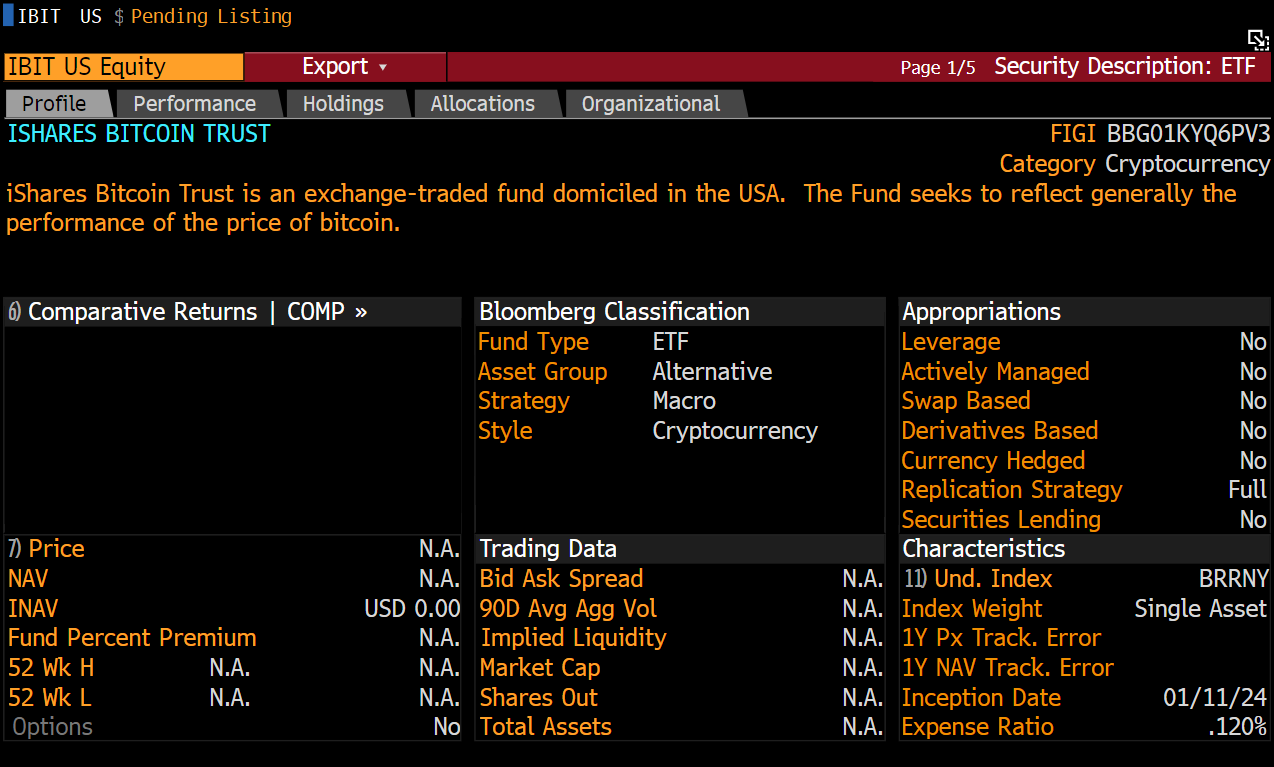
And the big one (IBIT) is already on Bloomberg:
Additionally, good news for investors is that an apparent 'fee war' has broken out among ETF providers, according to Bloomberg Intelligence ETF Analyst James Seyffart.

“That's going to trickle into the crypto ecosystem,” he told Coinage in a Monday interview.

“Look for commissions on some of these platforms that are typically trading [Bitcoin] to start tightening in competition with these ETFs once they're launched.”

As we noted after last night's false start, ETFs could technically start trading tomorrow since the Cboe BZX Exchange earlier gave notice of approved securities listings from several asset managers.

In Jan. 10 letters filed with the SEC, Cboe said it had approved spot BTC ETF offerings from ARK 21Shares, Invesco Galaxy, Fidelity, VanEck, WisdomTree and Franklin Templeton. The deadline for final approval or denial of the spot Bitcoin ETF from ARK 21Shares is Jan. 10, leading to speculation that the SEC may approve multiple offerings from asset managers simultaneously.

“In order to facilitate timely listing, the Exchange requests acceleration of registration of these securities under Rule 12d1-2 of the Securities Exchange Act of 1934, as amended,” said the Cboe.

SEC Chair Gary Gensler followed up the official SEC approval statement with his own, full of more cover-your-ass comments distancing himself from crypto, and a lot of 'coping' and 'seething'...

Here's the highlights (lowlights): 

Though we’re merit neutral, I’d note that the underlying assets in the metals ETPs have consumer and industrial uses, while in contrast bitcoin is primarily a speculative, volatile asset that’s also used for illicit activity including ransomware, money laundering, sanction evasion, and terrorist financing.

...

Today’s action does not approve or endorse crypto trading platforms or intermediaries, which, for the most part, are non-compliant with the federal securities laws and often have conflicts of interest.

...

While we approved the listing and trading of certain spot bitcoin ETP shares today, we did not approve or endorse bitcoin. Investors should remain cautious about the myriad risks associated with bitcoin and products whose value is tied to crypto.

TL/DR: "please dont fire me, pocahontas"

The reaction in crypto appears to be reflective of what we suggested last night...

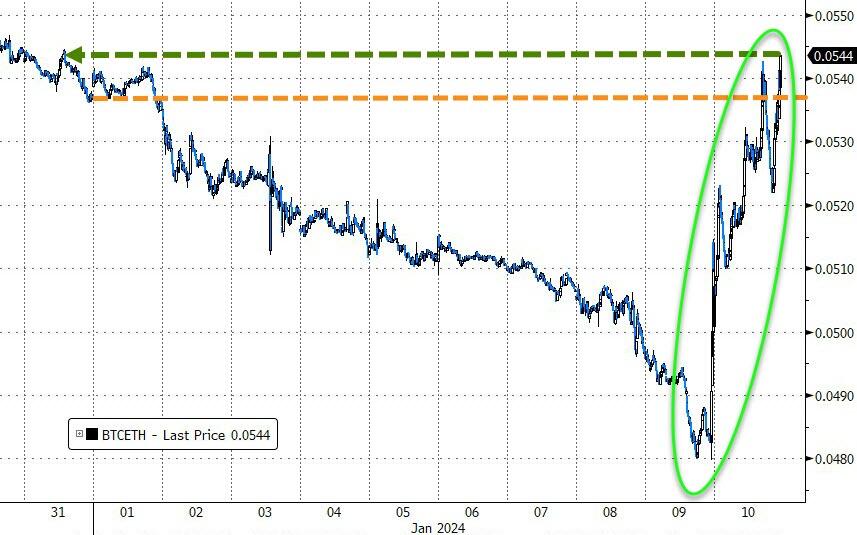
As ETH rallies hard relative to BTH, trading up above $2500...

...erasing all of the YTD relative weakness...
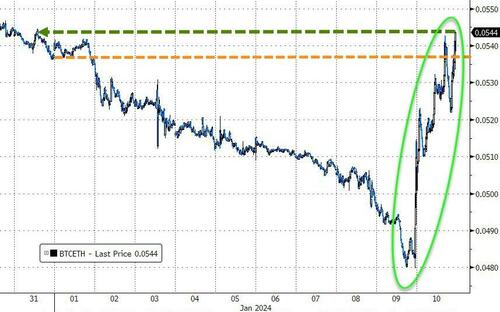
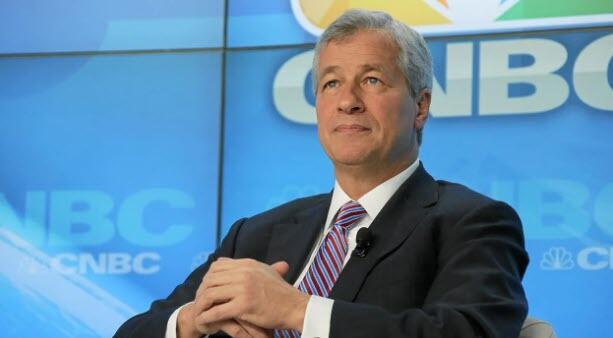
Meanwhile, during an interview with Fox's Maria Bartiromo, JPMorgan CEO Jamie Dimon reiterated his long-held belief that crypto is fraud:

“The actual use cases are sex trafficking, tax avoidance, anti-money laundering, terrorism financing,” Dimon said.

“I’ve always said Bitcoin doesn’t have value.”

Which is ironic given that global investment giant BlackRock named JP Morgan as an active participant in its pending ETF filing with the SEC.

Finally, on a side note, the desperation of the mainstream media to somehow blame Elon Musk, or X, for the SEC's utter lack of professionalism is [insert word that implies amazement but not shock because this is exactly what we thought would happen].

As we detailed earlier, with fingers being pointed and blame being apportioned for the SEC screw-up, X's Safety team have provided a rather awkward statement on the results of their probe of the breach.

We can confirm that the account @SECGov was compromised and we have completed a preliminary investigation.

Based on our investigation, the compromise was not due to any breach of X’s systems, but rather due to an unidentified individual obtaining control over a phone number associated with the @SECGov account through a third party.

We can also confirm that the account did not have two-factor authentication enabled at the time the account was compromised.

We encourage all users to enable this extra layer of security.

And there it is, just as the mainstream establishment would have loved to blame Elon Musk, or X, it turns out the world's leading securities regulator was incapable of utilizing two-factor authentication on an account that by all standards can be extremely market-moving in its capabilities.

Of course, these FACTS did not stop 'journalists' running with the narrative that it's all Elon's fault...

The SEC said on Wednesday that the FBI was probing the incident.

Sigh...

https://www.zerohedge.com/crypto/sec-approves-spot-bitcoin-etf-real-time

Invasive Procedures and Complications Follow Lung Cancer Screening


TOPLINE:

After lung cancer screening (LCS), imaging and invasive procedures were performed 31.9% and 2.8% of the time, respectively. Complications during invasive procedures occurred in 30.6% of cases. 

METHODOLOGY:

  • Researchers analyzed data from 9266 patients aged 55-80 years who completed at least one LCS with low-dose CT (LDCT) between 2014 and 2018.
  • This study used data from the PROSPR Lung Consortium.
  • Results were compared with findings from the National Lung Screening Trial (NLST), a large study of smokers published in 2011.

TAKEAWAY:

  • In total, 2956 patients (31.9%) underwent follow-up imaging, including CT, LDCT, MRI, or PET; 180 (0.02%) had invasive procedures, including needle biopsy, bronchoscopy, mediastinoscopy or mediastinotomy, or thoracoscopy.
  • Within 30 days after an invasive diagnostic procedure, 55 of 180 patients (30.6%) experienced complications; 20.6% were major, 8.3% were intermediate, and 1.7% were minor.
  • Complication rates after invasive procedures were higher in PROSPR than the NLST (30.6% vs 17.7%).
  • Compared with all patients, those with an abnormal LCS were slightly older, more likely to currently smoke, reported more packs of cigarettes smoked daily, and had more comorbid conditions.
  • In 2013, the US Preventive Services Task Force recommended annual LCS for certain people who smoke, on the basis of findings from the NLST.

IN PRACTICE:

"We observed higher rates of both invasive procedures and complications than those observed in NLST, highlighting the need for practice-based strategies to assess variations in the quality of care and to prioritize LCS among those patients most likely to receive a net benefit from screening in relation to potential complications and other harms," the researchers wrote. 

SOURCE:

Katharine A. Rendle, PhD, MSW, MPH, with Perelman School of Medicine, University of Pennsylvania, is the study's corresponding author. The study was published online in Annals of Internal Medicine.

LIMITATIONS:

This study was retrospective, and data were analyzed using procedural coding. In addition, the NLST based abnormal findings on different criteria from those used in clinical practice (Lung-RADS), making direct comparison of patients difficult. Patients in PROSPR were older, more likely to be currently smoking, and had higher rates of comorbid conditions compared with patients in the NLST. 

DISCLOSURES:

This study was supported by grants from the National Cancer Institute and the Gordon and Betty Moore Foundation.

https://www.medscape.com/viewarticle/invasive-procedures-and-complications-follow-lung-cancer-2024a10000oi

500-mg Calcium Pill Protects Against Preeclampsia, Researchers Say

 Taking 500 mg of calcium a day reduces the likelihood of pregnant women developing preeclampsia in pregnant women as much as higher doses, according to a study in The New England Journal of Medicine published on January 11. 

The study also shows that the lower dose of calcium protects against preterm birth almost as well as the higher dose recommended by the World Health Organization (WHO). 

Preeclampsia complicates up to 8% of pregnancies and may contribute to 45,000 maternal deaths globally every year. The US Centers for Disease Control and Prevention estimates that preeclampsia occurs in about 1 in 25 pregnancies, and Black women are 60% more likely to develop the condition than are White women.

Calcium supplementation reduces the risks for preeclampsia, per WHO guidelines. 

The WHO has recommended between 1500 mg and 2000 mg of calcium supplementation daily along with one 30-60 mg iron pill for pregnant women who receive insufficient calcium in their diets, which the WHO says generally occurs in lower-income nations and not wealthier nations, such as the United States. 

This dosage amounts to a minimum of three calcium pills per day because the dietary supplements generally come from suppliers in 500-mg doses. Researchers say the supplements are too expensive for many health authorities of low- and middle-income nations to provide, and that taking so many pills presents a barrier to use even if they were plentiful. In countries such as Tanzania and India, Sudfeld explained, governments generally distribute supplements like calcium for free at health clinics.

The WHO recommendation is "not implemented many places," said study author Christopher Sudfeld, ScD, associate professor of global health and nutrition at Harvard University's T.H. Chan School of Public Health, in Boston. Due to the cost, Tanzania has never implemented WHO's calcium recommendation, Sudfeld said, providing only the iron pill. 

The randomized double-blinded study included 11,000 pregnant women in Tanzania and 11,000 pregnant women in India. None had yet given birth, which increased their risk for preeclampsia. All participants were older than 18 years and were less than 20 weeks pregnant, according to their most recent menstrual date. Half of participants received the three daily 500-mg calcium pills recommended by WHO; the other half received a single calcium pill and two placebo pills. 

Researchers measured blood pressure and urine protein levels starting at 20 weeks of gestation, at delivery, and 6 weeks after giving birth. 

Regardless of how much calcium people consumed daily, preeclampsia occurred approximately 3% of both the 500-mg and 1500-mg groups. Similar rates of preterm births occurred in both groups, although in Tanzanian, women in the 500-mg arm were somewhat more likely to give birth early. 

"We're working with governments but we're also going to disseminate the results to WHO, so that they can do their process for the next antenatal care guidelines, to potentially change the global guidelines," to support a lower calcium supplement target, Sudfeld said. 

Does Calcium Actually Prevent Preeclampsia?

But Ahizechukwu Eke, MD, PhD, MPH, a pharmacologist who practices maternal fetal medicine at Johns Hopkins Medicine in Baltimore, questioned whether calcium really works to prevent preeclampsia. 

Eke said that the causes of preeclampsia are multifactorial, and researchers have yet to definitively demonstrate the mechanism of action by which calcium works to prevent the condition. One hypothesis is that calcium reduces the amount of contractions in a woman's uterus, thereby lowering blood pressure. 

Low-dose aspirin is also used to prevent preeclampsia, and Eke said that the pharmacokinetic pathway by which this drug inhibits preeclampsia is more clear.

"I'm not saying we should stop using calcium, far from it," Eke said. But as calcium supplementation to prevent preeclampsia continues, Eke called for pharmacokinetic studies to explore whether and how calcium works.

Sudfeld and Eke report no relevant financial relationships.

https://www.medscape.com/viewarticle/calcium-pill-500-mg-protects-against-preeclampsia-2024a10000p9

JPM24: On label expansions, launches, AZ plots course toward 'industry-leading growth' by 2030

 With a late-stage pipeline spanning more than 120 clinical trials and a firm grasp of five major disease areas, AstraZeneca appears confident heading into 2024. But the drugmaker also has its sights set on a farther goalpost: 2030.

By that year, AZ aims to deliver “industry-leading growth” and be at least a top-3 player in each of its five focus areas. Those fields are oncology, cardiovascular disease, renal and metabolism (CVRM), respiratory and immunology (R&I), vaccines and immunotherapies (V&I) and rare diseases.

If certain analyst models don’t paint the same rosy long-term picture, that's because new indications and the 15 new meds AZ plans to market by 2030 aren’t factored into the analyses, Chief Financial Officer Aradhana Sarin said during a presentation (PDF) at the 42nd annual J.P. Morgan Healthcare Conference.

“We know not everything’s gonna work out,” the CFO acknowledged. “But I think there are multiple elements where I don’t think we still get credit.”

Some analysts have, however, tracked a strong outlook for AZ until the end of the decade. TD Cowen projects the company will deliver sales growth of 8% through the rest of the decade, which would likely place AZ ahead of all but two of its peers, the analysts wrote in a Q3 Pharma Pulse report.

In the shorter term, AZ aims to deliver double-digit growth rates, on average, from 2021 to 2025. The drugmaker is “very much on track” to meet that goal, Sarin said.

Meanwhile, recent deals have expanded AstraZeneca’s reach across its disease areas. For one, the company’s recent licensing deal with Eccogene could give it a slice of the hot obesity market, the company figures.

In November, AstraZeneca shelled out $185 million, plus up to $1 billion in future milestone payments, for Eccogene's oral GLP-1 prospect.

Shortly after bringing the GLP-1 into its fold, the company turned to another growing market with a respiratory syncytial virus (RSV) acquisition.

Buying vaccine maker Icosavax cushions AstraZeneca’s limited vaccine portfolio with Icosavax’s lead candidate, a combination RSV and human metapneumovirus (hMPV) vaccine dubbed IVX-A12. While AZ has already made an entrance in the RSV space with its Sanofi-partnered infant immunization antibody Beyfortus, the vaccine arena represents an entirely different opportunity for the company. 

The deals were just two of the several AstraZeneca inked last year. Only time will tell if the trend will continue into the New Year, as AZ doesn't "need to do anything,” Sarin stressed.

“But as that strategy evolves, these things happen," Sarin explained.

https://www.fiercepharma.com/pharma/jpm24-astrazeneca-talks-roadmap-industry-leading-2030-growth-delves-deeper-obesity-strategy

JPM24, Day 3: CRISPR CEO touts global potential of Casgevy; Alkermes enters new phase

 Despite the much-anticipated entrance of a longer-acting product to compete with AbbVie’s Botox in the cosmetic market, the Illinois-based drugmaker is not seeing any evidence of sales erosion, AbbVie said Wednesday.

The pharma giant also addressed its recent acquisitions of antibody-drug conjugate biotech ImmunoGen and neuroscience specialist Cerevel. With both deals, AbbVie is targeting “long-term growth,” chief operating officer Rob Michael said during the event.

“Even though these two deals will add some level of revenue this decade, it wasn’t really about that. It was more about the next decade,” Michael said. “We have clear line of sight for this decade with our current portfolio. We didn’t need to go outside to supplement that.”

Going forward, the company will target “early-stage opportunities that will be smaller in size," Michael added.


UPDATED: Wednesday, Jan. 10 at 12:10 p.m. ET

Emboldened by the recent approval of Vertex-partnered gene therapy Casgevy, CRISPR Therapeutics CEO Samarth Kulkarni opined over humanity’s ability to edit its own genome and fix its own diseases as “another form of singularity” at this year’s J.P. Morgan Healthcare Conference.

Late last year, Vertex and CRISPR’s medicine racked up approvals in sickle cell disease (SCD) in Europe, the United Kingdom and the U.S. And while there’s already a “robust support system” for Casgevy in the States, the advanced therapeutic has significant potential abroad as well, Kulkarni explained.

“There are a tremendous number of patients that suffer from both severe sickle cell disease and thalassemia in the Middle East, in parts of Europe and in Asia,” he said. Meanwhile, more approvals are already coming in in places like Saudi Arabia and Bahrain, where the “unmet need is very high.”


UPDATED: Wednesday, Jan. 10 at 11:40 a.m. ET

Alexander Hardy, formerly the CEO at Genentech, is five weeks into his new job as CEO at BioMarin and made his priorities clear Tuesday at theJ.P. Morgan Healthcare Conference. Hardy’s primary mission will be to maximize the commercial potential of dwarfism drug Voxzogo, which has the potential to increase its patient pool from 21,000 to 600,000.

Secondly, Hardy is focused on the launch of newly approved hemophilia A gene therapy Roctavian. Thirdly, Hardy will have to make tough decisions as the company looks to cut its R&D spend.Story


UPDATED: Wednesday, Jan. 10 at 9:40 a.m. ET

After the most transformational year Alkermes' history, the company is stripped down and anxious to carry on in its new role as a pure-play neuroscience specialist. In an interview with Fierce Pharma, chief operating officer Blair Jackson described last year as "a year of resetting and clearing the decks and simplifying the story."

Specifically, the company spun off its oncology division and sold a plant in Ireland, among other developments. Now, the company is focused on the launch of Lybalvi and a mid-stage pipeline candidate. Story

https://www.fiercepharma.com/pharma/jpm24-day-3-abbvie-amarin-and-more

AbbVie launches pump-based Parkinson’s drug in EU

 AbbVie has launched its Produodopa therapy for Parkinson’s disease onto the market in the EU, becoming the first and only 24-hour levodopa-based subcutaneous infusion therapy for the neurodegenerative disorder.

Produodopa (foslevodopa/foscarbidopa; formerly ABBV-951) has been approved in the EU since 2022, but AbbVie held off on launch until it also got the green light from the European Commission for its Vyafuser pump device – developed in partnership with Phillips-Medisize – last November.

The Vyafuser pump maintains a continuous, steady flow of the drug throughout the day and can be refilled at home by patients or their carers. It is used to deliver drugs that replace the dopamine neurotransmitter which becomes deficient in Parkinson’s, leading to symptoms like tremor, stiffness, and slowness of movement, as well as mental health and cognitive problems.

While patients with Parkinson’s initially start taking oral drugs like levodopa and carbidopa to manage symptoms, these often fail to control symptoms throughout a 24-hour period and tend to lose their efficacy as the disease progresses.

Produodopa uses prodrugs of the two active ingredients and this – coupled with the pump system – can help increase the “on “ time patients have without dyskinesia – in other words, the period where muscle symptoms associated with Parkinson’s are controlled without involuntary, uncontrolled movements – as well as a reduction in “off “ time, when symptoms re-emerge, according to the results of clinical trials.

AbbVie already sells another long-acting treatment called Duopa, which delivers carbidopa and levodopa in an intestinal gel form via a gastric tube and pump, but that requires a surgical procedure to install and can cause discomfort to users.

Despite that, it still brings in around $500 million a year for AbbVie and the company reckons Produodopa could do even better and broach the $1 billion-a-year barrier. To hit that target it will likely need to get approval in the US as well, however, and last year the FDA rejected the drug with a request for more data.

GlobalData analyst Christie Wong said Produodopa’s nearest rival at the moment is Britannia Pharmaceuticals’ continuous subcutaneous infusion of apomorphine delivered using the Apo-go pump, which has been available in Europe for around 20 years.

She said however that doctors have expressed a preference “for levodopa formulations as it is the naturally occurring precursor to dopamine that is converted in the brain. As such, Produodopa is expected to be the first-choice subcutaneous delivery system.”

Wong also noted that Mitsubishi Tanabe is also developing its ND0612 continuous, subcutaneous levodopa/carbidopa delivery system developed by its NeuroDerm subsidiary – acquired for $1.1 billion in 2017 – which she thinks could launch in Europe in the middle of next year.

AbbVie may still have an edge however, as ND-0612 requires two injection entry points compared to Produodopa’s one, and AbbVie’s product may offer greater dosing flexibility, allowing higher concentrations of levodopa to be administered.

Pricing may also be a factor, but that will not be established in the EU until pricing negotiations have taken place with national authorities. The therapy has already been recommended for NHS use in England by health technology assessment (HTA) agency NICE for patients who cannot have apomorphine, with a list price £84.70 per vial ahead of discounts.

https://pharmaphorum.com/news/abbvie-launches-pump-based-parkinsons-drug-eu