Search This Blog

Sunday, March 3, 2024

Israeli military review of Gaza aid convoy deaths finds most killed in stampede

 Israel's military said on Sunday most of the Palestinians killed last week as crowds massed near an aid convoy in Gaza died in a stampede but local health officials said casualties brought into hospitals had been hit by large-calibre ammunition.

Pressure has mounted on Israel over the deaths of dozens of Palestinians during a confused incident in the Gaza Strip on Thursday in which crowds surrounded a convoy of aid trucks and soldiers opened fire, with several countries backing a U.N. call for an inquiry.

Palestinian health officials say more than 100 people were killed in the incident in the early hours of the morning, most of them shot by Israeli troops. Israeli officials have dismissed the figures given by the Palestinians but have not offered any estimates of their own.

On Sunday, Israel's main military spokesman Rear Admiral Daniel Hagari announced the result of a preliminary review which repeated earlier Israeli statements that most of those killed had been trampled underfoot as crowds rushed the aid trucks.

In addition "several individuals" were targeted as troops fired on people who approached them in the aftermath in a manner that suggested an immediate threat, he said, adding that an independent inquiry had been opened but giving no details.

Muatasem Salah, a member of the Emergency Committee at the Ministry of Health in Gaza, said there were more than 1,000 casualties, dead and wounded, from the incident and he dismissed the findings of the Israeli review.

"Any attempt to claim that people were martyred due to overcrowding or being run over is incorrect. The wounded and martyrs are the result of being shot with heavy-calibre bullets," he told Reuters.

Giorgios Petropoulos, head of the Gaza sub-office of the UN Co-ordinator for Humanitarian Affairs (OCHA), who visited Gaza's Shifa hospital on Thursday and Sunday, said he had seen "a huge, overrun emergency department" at the hospital where many of the wounded were treated.

"There were a lot of heavy injuries, there were many, many surgeries," he told Reuters. "One surgeon told me he had to do 18 surgeries just the first night."

He said he had seen five or six people with bullet wounds including a young man shot in the right side of the chest who had taken himself to hospital as there were no ambulances. In addition, a smaller number of people had injuries consistent with falling over or being trampled in the dark.

Many of Israel's closest allies, including the United States, have called for an inquiry into the incident, which underscored the dire humanitarian crisis in Gaza and the increasingly chaotic conditions in which the small amount of aid reaching the enclave is being distributed.

International aid organizations have warned that hundreds of thousands of people in Gaza are facing the threat of famine, some five months after Israeli troops launched their invasion following the Hamas-led attack on Israel on Oct. 7.

The attack, which killed some 1,200 Israelis and foreigners, was the deadliest single-day incident in Israel's 75 year history and Israel has responded with a relentless assault that has so far killed more than 30,000 Palestinians, according to Palestinian figures.

As the diplomatic fallout spread, the military said it had launched a more thorough examination of the incident to be handled by "an independent, professional and expert body" which will share its findings as early as in the coming days.

Hagari's remarks suggested that some of the dead had been killed by Israeli fire after soldiers fired initial warning shots but he gave no details or figures.

"Following the warning shots fired to disperse the stampede and after our forces had started retreating, several looters approached our forces and posed an immediate threat to them. According to the initial review, the soldiers responded toward several individuals," he said.

https://www.yahoo.com/news/israeli-military-review-gaza-aid-100841657.html

South Korea police launch raid on doctors' association over walkout

 South Korean police launched a raid on Friday targeting officials of the Korean Medical Association, as authorities step up pressure to end a walkout by trainee doctors protesting against plans to reform the health system.

The raid comes ahead of a mass demonstration in Seoul planned for Sunday by doctors, after the walkout, which began on Feb. 20, disrupted major hospitals, forcing some to turn away patients and cancel surgeries and other medical procedures.

"Doctors are enraged by the government's absurd behavior," the KMA, which represents private practitioners, said in a statement after the raid on the leaders of its emergency committee.

"The government has clearly shown that doctors in South Korea cannot enjoy freedom."

It denied having encouraged the trainee doctors to resign, saying they had left their posts of their own volition.

Health ministry data showed more than two-thirds of the trainee doctors, or nearly 9,000, had ignored a government deadline to return to work by Thursday or face punishment.

They are protesting against a plan to increase medical school admissions by 2,000 starting from 2025, which the government says is vital to remedy a shortage of doctors in one of the world's fastest-ageing societies.

The young doctors say they are overworked and underpaid, however, and the priority should be to improve their pay and working conditions instead.

Seoul police investigators raided the offices of five current and former KMA officials to collect evidence from their mobile telephones and computers, the Yonhap news agency said.

The health ministry told police this week of accusations that the officials had sought to obstruct business activity and were abetting the strike as well as defying the order to return to work, the agency added.

Police in the capital did not immediately respond to a request for comment.

During a visit to a veterans hospital in Seoul, Prime Minister Han Duck-soo pledged on Friday to ensure there was no disruption to services for veterans of the military.

The health ministry posted an order on its website urging 13 of the striking doctors to return to work or face criminal charges.

The government can order doctors back to work in case of grave risk to lives and public health.

Flouting such orders could lead to suspension of medical licences for up to a year, as well as three years in jail or a fine of 30 million won ($22,000).

https://www.yahoo.com/news/south-korea-police-launch-raid-105049563.html

Zurich steps up security at Jewish sites after possible antisemitic attack

 Police have stepped up security measures at Jewish sites in Zurich following a serious knife attack on an orthodox Jewish man in the Swiss city overnight, local police said on Sunday.

Police said they had taken action after a 15-year-old Swiss youth was arrested for inflicting "life-threatening" injuries on the 50-year-old Jewish man in central Zurich on Saturday night.

A Zurich police statement said it was not clear what sparked the attack, but that investigations were "explicitly including the possibility of a crime motivated by antisemitism."

The extra security was put in place for "specific locations with a Jewish connection," police said, following discussions with local Jewish organisations. They gave no further details.

Jonathan Kreutner, general secretary of the Swiss Federation of Jewish Communities (SIG), told Swiss television that physical attacks on Jewish people in the country were rare.

"A case like this is really a new dimension," he said.

Concern about the risk of antisemitic behaviour in Switzerland has grown since the attacks by Hamas gunmen on southern Israel on Oct. 7 and subsequent campaign against the Islamist group by the Israeli government in Gaza.

Last month, the SIG raised concern about attitudes to Jewish people after local media reported police had opened an investigation into a sign in Hebrew displayed by a business in Davos which declared Jews were barred from renting ski gear.

https://www.yahoo.com/news/zurich-steps-security-jewish-sites-150813533.html

Israel reported to boycott ceasefire talks in Cairo

 Israel boycotted Gaza ceasefire talks in Cairo on Sunday after Hamas rejected its demand for a complete list naming hostages that are still alive, an Israeli newspaper reported.

A Hamas delegation arrived in Cairo for the talks, billed as a possible final hurdle before an agreement that would halt the fighting for six weeks. But by early evening there was no sign of the Israelis.

"There is no Israeli delegation in Cairo," Ynet, the online version of Israel's Yedioth Ahronoth newspaper, quoted unidentified Israeli officials as saying. "Hamas refuses to provide clear answers and therefore there is no reason to dispatch the Israeli delegation."

Washington has insisted the ceasefire deal is close and should be in place in time to halt fighting by the start of Ramadan, a week away. But the warring sides have given little sign in public of backing away from previous demands.

After the Hamas delegation arrived, a Palestinian official told Reuters the deal was "not yet there". From the Israeli side, there was no official comment.

One source briefed on the talks had said on Saturday that Israel could stay away from Cairo unless Hamas first presented its full list of hostages who are still alive. A Palestinian source told Reuters Hamas had so far rejected that demand.

In past negotiations Hamas has sought to avoid discussing the wellbeing of individual hostages until after terms for their release are set.

A U.S. official told reporters on Saturday: "The path to a ceasefire right now literally at this hour is straightforward. And there's a deal on the table. There's a framework deal."

Israel had agreed to the framework and it was now up to Hamas to respond, the U.S. official said.

An agreement would bring the first extended truce of the war, which has raged for five months so far with just a week-long pause in November. Dozens of hostages held by the militants would be freed in return for hundreds of Palestinian detainees.

Aid would be ramped up for Gazans pushed to the verge of famine. Fighting would cease in time to head off a massive planned Israeli assault on Rafah, where more than half of Gaza's 2.3 million people are penned in against the enclave's southern border fence abutting Egypt. Israeli forces would pull back from some areas and let Gazans return to abandoned homes.

But the proposal appears to stop short of fulfilling the main Hamas demand for a permanent end to the war, while also leaving unresolved the fate of more than half of the more than 100 remaining hostages - including Israeli men not covered by terms to free women, children, the elderly and wounded.

Egyptian mediators have suggested those issues could be set aside for now, with assurances to resolve them in later stages. A Hamas source told Reuters the militants were still holding out for a "package deal".

OVERNIGHT AIRSTRIKE

At a morgue outside a Rafah hospital on Sunday morning, women wept and wailed beside rows of bodies of the Abu Anza family, 14 of whom were killed in their home in airstrike overnight. Relatives opened a black plastic body bag to kiss the face of a dead schoolgirl in a torn sweatshirt and pink unicorn pyjamas.

Later, the bodies were brought to a graveyard and buried, including two infant twins, a boy and a girl, passed down in white bundles and placed in the ground.

"My heart is gone," wailed their mother, Rania Abu Anza, who also lost her husband in the attack. "I haven't had enough time with them."

Gaza authorities said at least eight people were killed on Sunday when a truck carrying food aid from a Kuwaiti charity was hit by an air strike. There was no immediate Israeli comment.

The war was unleashed in October after Hamas fighters stormed through Israeli towns killing 1,200 people and capturing 253 hostages, according to Israeli tallies. Since then, Israeli forces have killed more than 30,000 Palestinians, according to Gaza health authorities, with thousands more dead feared unrecovered under rubble.

Swathes of the Gaza Strip have been laid to waste, nearly the entire population has been made homeless, and the United Nations estimates a quarter of Gazans are on the verge of famine.

Residents described heavy bombardment overnight of Khan Younis, the main southern Gaza city, just to the north of Rafah. Further north, where aid no longer reaches, Gaza health authorities said 15 children had now died of malnutrition or dehydration inside the Kamal Adwan hospital where there was no power for the intensive care unit. Staff fear for the lives of six more children there.

Washington dropped 38,000 meals from military aircraft into Gaza on Saturday, though aid agencies say this was only enough to have a marginal impact given the scale of the need.

The final days leading up to the anticipated truce have been exceptionally bloody, with talks overshadowed last week by the deaths of 118 people and wounding of hundreds more near a food convoy.

Israel said on Sunday its initial review of the incident had found that most of those killed or wounded had died in a stampede. Military spokesman Daniel Hagari said Israeli troops at the scene initially fired only warning shots, though they later shot at some "looters" who "approached our forces and posed an immediate threat".

Muatasem Salah, a member of the Emergency Committee at the Ministry of Health in Gaza, told Reuters the Israeli account was contradicted by machine gun wounds.

"The wounded and martyrs are the result of being shot with heavy-calibre bullets," he said. "Any attempt to claim that people were martyred due to overcrowding or being run over is incorrect."

https://www.yahoo.com/news/talks-gaza-truce-expected-offensive-011343029.html

'Hangovers suddenly worse? Researchers think COVID could be the cause'

 Can’t handle your booze like you used to? You might have COVID-19 to blame, according to researchers at Stanford University.

An article recently published by specialists at Stanford’s Post-Acute COVID-19 Syndrome Clinic presented evidence of a possible relationship between SARS-CoV-2 infection and increased alcohol sensitivity. Specifically, a number of patients at Stanford’s clinic reported feeling significantly worse symptoms of fatigue, headaches and hangovers after drinking — with one woman claiming she “couldn’t move” after a glass of wine, according to the peer-reviewed article.

The authors were quick to note that no definitive link between COVID and alcohol sensitivity can be established without further study, but such a relationship wouldn’t be unheard of, according to the researchers.

“There have been reported cases already, on how prevalent this is in patients with chronic fatigue,” Dr. Hector Bonilla, an administrator at Stanford’s Post-Acute COVID-19 Clinic, told Nexstar.

Patients with chronic fatigue, or myalgic encephalomyelitis/chronic fatigue syndrome (ME/CFS), often experience similar symptoms to those experiencing the effects of long COVID, Stanford’s article noted. Increased sensitivity to alcohol has also been observed in patients with ME/CFS, at least anecdotally, since the mid-19th century, U.K. researchers wrote in a 2004 article cited by Stanford.

The causes of ME/CFS have not been clearly identified, though a 2023 study published in the medical journal Frontiers in Medicine suggested similar pathophysiologies (the mechanisms associated with the illnesses and their effects on the body) for both long COVID and ME/CFS.

Both illnesses also share “considerable similarities” when it comes to symptoms, the researchers noted.

While the causes of ME/CFS are largely unknown, patients with it later experienced worsening symptoms after being infected by COVID. And these symptoms can often include increased sensitivity to alcohol — a symptom that ME/CFS associations in the U.S. and abroad call “more likely” and “very characteristic.”

However, in the four case studies presented by Stanford, some patients had no history of ME/CFS, and one patient had no previous medical issues at all. That patient, a 60-year-old man, reported several long COVID symptoms following infection, including what he believed to be alcohol-induced headaches “characterized by a squeezing sensation at the top and back of the head” — when before, he never had an issue drinking alcohol. Another woman, 40, said she could previously drink seven cocktails in one night with no serious repercussions, but post-COVID, she experiences “terrible” effects after just one drink, including worsened hangovers and long COVID symptoms.

“[We] see the patients in the clinic and they talk to you, they tell you these things,” Bonilla said.

hangover
Can’t handle your booze like you used to? You might have COVID-19 to blame, according to researchers at Stanford University. (Getty Images)

Stanford’s researchers outlined several mechanisms that might explain why such symptoms could occur, with most focusing on the way the immune system processes inflammation after a virus.

Bonilla, speaking with Nexstar, said viruses like COVID can also weaken the blood-brain barrier — a lining of cells in the brain’s blood vessels that helps keep pathogens out — making it more susceptible to the effects of alcohol.

“When the brain barrier is exposed, it means the brain is more susceptible to things happening in the body,” Bonilla said. “So any inflammatory responses can amplify. Alcohol, drugs … some [patients] are also very susceptible to medications, even tiny doses.”

That’s just one possibility, of course. Researchers have also learned that COVID can cause imbalances with a patient’s gut microbiomes, which may interfere with a number of important functions, and possibly how the body processes alcohol. But Dr. Robert Groysman, of the COVID Institute in Irving, Texas, told Nexstar that he believes increased alcohol sensitivity stems from damage to the body’s energy-producing mitochondria in the liver.

“I believe it’s just that the liver is not capable of processing the alcohol the same way as it did before,” Groysman said. “These toxins are not metabolizing properly.”

Mitochondria, which are responsible for providing cells with their energy, can take a serious hit during — and long after — a COVID infection, as noted by the National Institutes of Health. And if the liver’s enzymes can’t rely on mitochondria to fuel the organ’s important processes, the ability to metabolize toxins is inhibited.

“You need to have energy generated in order for these enzymes to work,” Groysman said. “And if there’s a decrease in the amount of energy available, these enzymes don’t function well.”

Unfortunately, the exact causes of alcohol sensitivity in long-COVID patients are not something that many researchers have studied intensely, as the subject of alcohol sensitivity is probably “not a priority” for the groups that fund research into COVID and ME/CFS, according to Bonilla.

After all, alcohol — unlike certain treatments or therapies for post-COVID illness — is not exactly a necessity.

“[There’s] not a lot of long-term or follow-up studies for things like that,” Bonilla said.

https://thehill.com/homenews/nexstar_media_wire/4504992-hangovers-suddenly-worse-researchers-think-covid-could-be-the-cause/

Mystery Whale Has Quietly Accumulated Over $3 Billion In Bitcoin In 15 Months

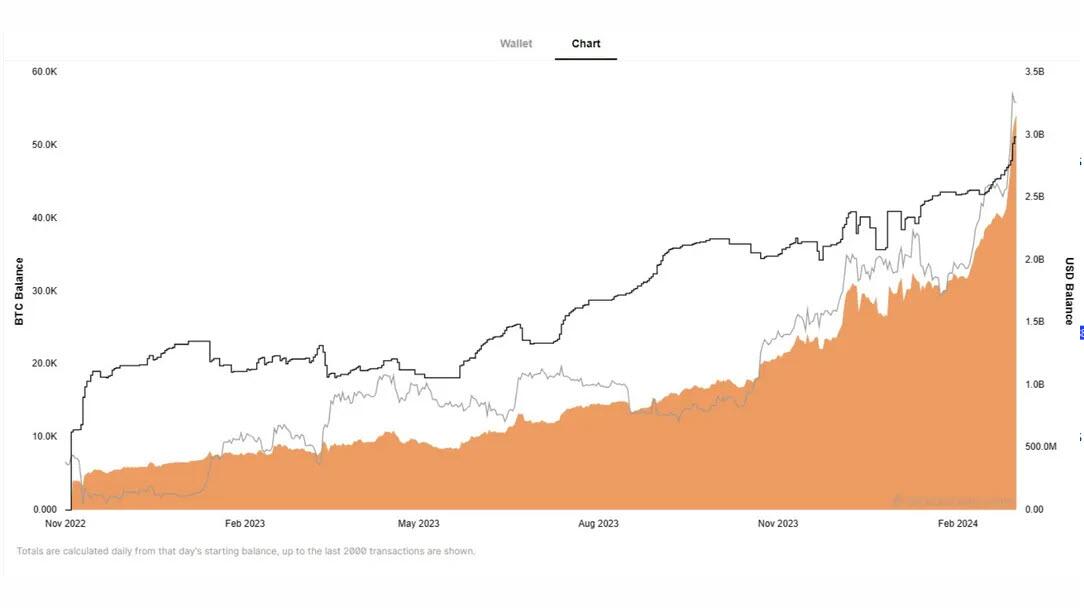
 A mysterious Bitcoin buyer has quietly amassed billions worth of bitcoin over the past two years making the unknown address one of the largest single holders of the cryptocurrency as the race to a new all-time high continues. According to data from Bitinfocharts, after patiently buying bitcoin almost daily since November 2022, the whale’s wallet now holds over 54,164 BTC, worth around $3.2 billion, according to Decrypt.

This whale, dubbed “Mr. 100” due to his purchases of an average of 100 bitcoin per day since November 2022, may not be a single investor, and could belong to an investment fund or one of the big banks behind one of the several spot Bitcoin ETFs now available, although some are skeptical.

“It's definitely possible, but I would say unlikely,” Amberdata Director of Research Chris Martin told Decrypt. “All of the ETFs have publically shared their addresses, so it would be strange to me if they didn't share this one.”


According to Amberdata, the wallet has been accumulating Bitcoin since November 2022, using Binance and KuCoin.

While the US Government has also accumulated an huge amount of Bitcoin - estimated to now be worth over $12 billion -Martin doesn’t see the Biden Administration being behind the address. One tell: the digital assets are coming from Binance and KuCoin,

“It might be safe to rule out a U.S. entity or bank,” Martin said. “I wouldn’t be surprised if it's a fund of some kind.”

Hong Kong is said to be mulling 31 applications for crypto custodians, he noted. A recent expose from Reuters echoed what we first said back in September 2015 (when we recommended buying bitcoin at a price of $230), namely that a silent flood of Chinese buying may be one of the core drivers behind the recent meltup. "Mr. 100" may just be one of them. 

Martin also said he does not believe the wallet is someone loading up in preparation for the upcoming Bitcoin halving in April.

“I would say not—they could just be supporting the price run-up rather than accumulating tokens for a specific event,” he said.

“I think it's interesting that they've generally received the same amount on every transaction—about 100 BTC—throughout their existence,” Martin added. “Why they chose 100 BTC is beyond me... possibly a limitation of their funding source.”

While speculation around the identity of “Mr. 100” whale remains, sentiment in the cryptocurrency market is riding high, and the countless entities loading up on Bitcoin - especially in the recently launched ETFs - point to signs that the bull market is indeed back and running.

The mystery whale isn't the only that has been making waves in recent days: in April, a wallet from the early days of Bitcoin moved over $11 million in BTC after being dormant for 12 years. That same week, another Bitcoin wallet moved $8 million in BTC after ten years of inactivity. In November, another Bitcoin whale made waves after analysts discovered wallet holding $450 million in Bitccoin.

https://www.zerohedge.com/markets/mystery-whale-has-quietly-accumulated-over-3-billion-bitcoin-15-months

Blackrock Abandons ESG Investing, It’s Now Transition Investing, But Is it Different?

 Climate investing is still booming at BlackRock, but don’t call it ESG.

Blackrock, the world’s biggest asset manager abandoned ESG investing after a wave of complaints against “woke capitalism” that made the term politically toxic.

Please note, BlackRock CEO Larry Fink Is Doing ‘Transition Investing’ Now.

BlackRock is still wagering that fighting climate change will be a generational investment opportunity—but the company is no longer pushing for changes in corporate behavior, talking about hard-to-quantify social issues or actively promoting ESG investing criteria. Instead, it is directing billions of client dollars toward infrastructure projects that will help speed the transition from fossil fuels.

“Transition investing is specific and concrete. Clients know what we’re talking about,” said Mark Wiedman, who is head of the global client business at BlackRock and a potential successor to Fink. “ESG as a category is a vague grab bag for many clients.”

BlackRock is joining investors such as Brookfield Asset Management in betting on clean-energy infrastructure projects. It doubled down with its recent $12.5 billion deal to buy Global Infrastructure Partners, an infrastructure fund manager that owns and operates energy, transportation, and waste and water companies around the world.

BlackRock’s infrastructure funds have invested in solar power, natural gas made from food waste and cow manure and removing carbon from the atmosphere.

The criticism of Fink started building in 2020, when he wrote in his widely read letter to CEOs that “climate risk is investment risk.” He said BlackRock would be disposed to vote against management and boards at companies that weren’t making progress on sustainability-related practices. The company’s colossal index-fund business makes it among the three largest shareholders in most companies in the S&P 500, so it wields vast shareholder voting power.

A year later, Fink upped the ante when he wrote that BlackRock was “focused on racial equity and social justice in our investment and stewardship activities” and that “advancing a more equitable and inclusive environment” would require going beyond just examining its own culture and talent practices.

The backlash was swift. Even Berkshire Hathaway’s Charlie Munger said: “I think the world of Fink, but I am not sure I want him to be my emperor.”

Conservative activist Leonard Leo financed a multimillion-dollar campaign to stoke opposition to ESG. It led to jabs from Republican presidential candidates and efforts by some Republican states to ban BlackRock from doing business there.

ESG is unquestionably in a death spiral,” said Terrence Keeley, who ran BlackRock’s official institutions group until 2022 and has since published a book criticizing ESG investing. “BlackRock is logically prioritizing decarbonization because it is a win-win-win. Good for the environment, good for investors and good for BlackRock shareholders.”

ESG is Out, Transition Investing Is In

So it’s good riddance to ESG investing, hello to transition investing.

Blackrock’s investment focus did not change. But its woke push for racial equity and social justice in investment and stewardship activities did.

Biden Weighs Banning Natural Gas Exports

Meanwhile, please note Biden Weighs Banning Natural Gas Exports to Save the Climate

The climate fear mongers are pressuring Biden to ban natural gas exports. Let’s discuss the ramifications.

Russia will sell more natural gas as a result.

Reducing exports does not change global demand. It will only shift the source of the supply.

Biden Promotes Climate Change at the Expense of More Global Poverty

More importantly, please note Biden Promotes Climate Change at the Expense of More Global Poverty

The mad rush to deal with climate change, even if it works (it won’t), has a nasty tradeoff (more global poverty). Click on link for details.

https://mishtalk.com/economics/blackrock-says-goodbye-esg-investing-hello-transition-investing-but-is-it-different/