Acquisition will create phage therapy company with an advanced pipeline with two Phase 2 assets, BX004 for the treatment of chronic pulmonary infections in cystic fibrosis (“CF”) patients and BX211for the treatment of diabetic foot osteomyelitis (“DFO”)
Concurrently with entering into the definitive merger agreement, BiomX entered into a definitive agreement for a private placement financing of $50 million that will be used to advance two lead product candidates through Phase 2 clinical readouts in 2025
Aptorum Group Limited (Nasdaq: APM), a clinical stage biopharmaceutical company (“Aptorum”), and privately-held YOOV Group Holding Ltd. (“YOOV”) jointly announced today that they entered into an Agreement and Plan of Merger (as it may be amended from time to time, the “Merger Agreement”). The Merger Agreement was approved by Aptorum’s and YOOV’s boards of directors (each board of directors, the “Board”), respectively. If the Merger Agreement is approved by Aptorum’s and YOOV’s shareholders (and the other closing conditions are satisfied or waived in accordance with the Merger Agreement), and upon consummation of the transactions contemplated by the Merger Agreement (the “Closing”, and the date of the Closing, the “Closing Date”), a wholly-owned subsidiary of Aptorum organized under the laws of the British Virgin Islands (“Merger Sub”) will merge with and into YOOV (collectively, the “Merger”).
In addition, on March 1, 2024, Aptorum, its major shareholder, Jurchen Investment Corporation (“Jurchen”), which is controlled by Ian Huen, Executive Director and Chief Executive Officer of Aptorum, and Aptorum Therapeutics Limited (“ATL”), a wholly-owned subsidiary of Aptorum have entered into a split-off agreement (the “Split-Off Agreement”). Pursuant to the Split-Off Agreement, Aptorum will assign and transfer the assets and liabilities of its legacy business to ATL, and Jurchen will acquire 100% issued and outstanding shares of ATL from Aptorum and surrender certain ordinary shares of Aptorum held by Jurchen to Aptorum (the “Separation”). The Separation will become effective immediately following completion of the Merger. The Separation and the Merger are referred hereto as the “Proposed Transactions.” Aptorum upon the Closing is referred to herein as the “combined company.”
Merger Consideration
Upon completion of the Merger, the existing Aptorum shareholders and existing YOOV shareholders expect to own approximately 10% and 90%, respectively, of the outstanding shares of the combined company. Aptorum agreed to issue Class A ordinary shares, par value $0.00001 each (the “Class A ordinary shares”), and Class B ordinary shares, par value $0.00001 each (the “Class B ordinary shares”), to YOOV’s shareholders. The total number of ordinary shares of Aptorum to be issued in the merger equals the number of aggregate fully diluted shares of YOOV multiply by the “Conversion Ratio.” The Conversion Ratio is calculated by dividing (i) Aptorum’s outstanding Class A ordinary shares and Class B ordinary shares multiplied by nine (ii) by the aggregate fully diluted shares of YOOV.
This Merger is considered to be a “reverse merger” because the shareholders of YOOV will own more than a majority of the outstanding ordinary shares of the combined company following the Merger. As such, the Merger is subject to NASDAQ’s approval of the combined company’s initial listing application.
Bayer on Tuesday said it won a trial in a lawsuit brought by a retired postal service worker in Pennsylvania who alleged he developed non-Hodgkins lymphoma from using the company's Roundup weedkiller.
In addition to the jury verdict in the Philadelphia Court of Common Pleas, Bayer said a California farmer, who said he contracted the same type of cancer from exposure to the product, and his wife on Tuesday voluntarily dropped their lawsuit while a trial was underway in the in state court in Sonoma County, California.
"We continue to stand behind the safety of Roundup and will confidently defend the safety of our products and our good faith actions in any future litigation," Bayer said in a statement.
Scott Love, a lawyer for Carl Kline, the plaintiff in the Pennsylvania case, said the jury had not been allowed to hear key evidence, including a finding by a World Health Organization body that glyphosate, Roundup's active ingredient, was likely capable of causing cancer.
A lawyer for the California plaintiffs, Michael and Bobbie Meyer, did not immediately respond to requests for comment. It was not immediately clear why the Meyers dropped their case.
Tuesday's victories come on the heels of another trial win for the company in Arkansas on Friday. Bayer has now prevailed in 13 of the last 20 Roundup trials, while plaintiffs have scored large verdicts totaling more than $4 billion, including $2.25 billion in a single case in January.
The company is appealing its trial losses, which include large punitive damages awards that are likely to be reduced because they exceed U.S. Supreme Court guidance.
Around 165,000 claims have been brought in the U.S. against Bayer over Roundup, which the company acquired as part of its $63 billion purchase of U.S. agrochemical company Monsanto in 2018. Many were resolved as part of a $9.6 billion settlement in 2020, but about 54,000 remain.
Bayer CEO Bill Anderson told investors in a call on Tuesday that he was "considering every possible means to bring closure" to the litigation, including solutions "outside the courtroom," though he did not offer details.
The company phased out sales of glyphosate products for home use last year, though it still sells other formulations under the Roundup name.
Though the Inflation Reduction Act ostensibly aims to help millions of Americans by reducing prescription drug prices, the law might unintentionally discourage pharmaceutical companies from pursuing post-approval small molecule drug research, according to astudypublished inThe American Journal of Managed Care last month. This, the authors suggest, could reduce a given medication’s odds of being studied and approved as a treatment for conditions other than its initial purpose.
The IRA’s Medicare Drug Price Negotiation Program requires the U.S. Department of Health and Human Services (HHS) to negotiate “maximum fair prices” with drug manufacturers for certain brand-name, small molecule drugs covered under Medicare Part D. This allowance begins seven years after a drug’s approval; at nine years, the negotiated drug price kicks in. Gaining the FDA’s green light for additional indications would not extend the drug’s grace period of protection from negotiations, effectively limiting the drug’s profitability.
Experts at the National Pharmaceutical Council (NPC), an industry–funded policy research organization, investigated 50 drugs with the highest gross spending by Medicare Part D in 2020 and found that when additional clinical trials or real-world evidence was needed, subsequent approvals took an average of 7.5 years—meaning they would occur after the drug could be targeted for price negotiations.
Drug developers “should consider that the ‘clock’ toward anticipated price erosion, previously associated with the loss of patent exclusivity, begins under the IRA with the first FDA approval regardless of indication incidence or prevalence,” the authors wrote in the study. “Because under the IRA drugs become eligible for selection 7 years after the initial approval, the law may create an incentive to submit larger indications first to avoid starting the 7-year clock with a very rare indication.”
Drugmakers Often Seek Additional Approvals
Of the 50 drugs covered in the NPC’s study, 30 were small molecule drugs that had been green-lighted for 76 subsequent indications, accounting for 72% of all indications in the study sample.
“The cheapest way to develop a new treatment is to develop an indication for an existing treatment,” Kirsten Axelsen, senior policy advisor to DLA Piper’s life sciences division, told BioSpace. “It’s also good for patients. Launching a new drug requires years of collecting safety and efficacy information that ultimately serves new patient populations.”
Upon examining the indications and timelines associated with each of these drugs, the researchers found that, on average, subsequent indications received FDA approval 5.4 years after the initial indication did. While approvals based on initial pre-approval clinical trials took an average of only 2.9 years following initial FDA approval, those that required whole new trials or postmarket data took 7.5 years. A majority (55.8%) didn’t get the green light until after that critical 7-year mark.
Study co-author and NPC senior director of research Julie Patterson told BioSpace that, had a policy like the IRA been enacted earlier, some of the subsequent indications found in her team’s study might have been affected by the IRA. “Rivaroxaban’s indication to reduce the risk of major cardiovascular events in patients with coronary artery disease was approved over seven years after the drug’s initial approval,” she said. “Empagliflozin’s indications in heart failure were approved over seven years after the drug was first approved.”
How Will Changes in Subsequent Small Molecule R&D Play Out?
Because the IRA specifically targets small molecule drugs, Axelsen and the study’s authors expect its inadvertent effects on R&D to disproportionately impact Medicare Part D enrollees with severe, often age-related conditions. Not only can small molecule drugs be administered orally, making them convenient to take at home or on the go, they possess properties that make them more biologically viable for certain conditions. Small molecules’ ability to cross the blood-brain barrier and penetrate cellular membranes makes drugs from this category vital for patients experiencing cancer, cardiovascular disease or central nervous system disorders.
Patterson shared how the IRA, though well-intentioned, might have negative effects on seniors’ out-of-pocket drug expenses. “When Americans talk about the cost of prescription medications, they are usually talking about the amount they are asked to pay at the pharmacy counter, which is a function of benefit design,” Patterson said. While some parts of the IRA are expected to address this, some are concerned that insurance plans will adjust relevant drugs’ formulary tier to compensate for financial losses, thus restricting access all over again—“the opposite of what the program intends to do,” Patterson said.
According to Axelsen, it might have been more productive for the IRA to set its price negotiation target at 13 years after FDA approval, not 7 years. It’s typically at the 13-year mark that generics enter the market, sharply reducing a name-brand drug’s profitability. A strategy like this one “wouldn’t have destroyed businesses’ incentives” while still allowing the government to “flex its muscles” regarding drug prices, Axelsen said.
The law does give biologics an extra four years over small molecule drugs before being potentially subject to drug price negotiations, which critics fear will disincentivize small molecule drug development altogether. For example, Pfizer recently pivoted away from small molecule drugs and toward biologics—a decision motivated in part by the IRA. Still, seven years is barely half the exclusive lifespan of small molecule drugs.
“Cutting off the back half of a drug’s sales curve by forcing what could function like an early loss of exclusivity event doesn’t bode well for doing additional clinical research,” study co-author and NPC CEO John O’Brien told BioSpace. “The analytics behind these decisions are different for each drug. So while we haven’t modeled these shifts, it is something we will be watching closely.”
The ripe smell of garbage baking in the tropical sun mixed with the stench of human waste is one of the first things visitors notice at Bajo Chiquito, one of four large migrant camps in the Darién Gap.
The next is a sea of weary migrants, who hiked from Colombia along the infamous jungle trail, lined up to be processed by Panamanian officials.
One young boy in line with a furrowed brow seems worried. Others stare blankly at ramshackle buildings slapped together with wood, tin, and cinder blocks. They wait patiently in the brutal heat and humidity.
Most of them are coming to the United States aided by the United Nations, its nongovernmental partners, and regimes hostile to the United States.
Experts have said the migrants are being used as a weapon, just as deadly as a missile aimed straight at the United States.
Mass migration is being “weaponized” to overwhelm and destabilize the United States and ultimately break it apart, according to Joseph Humire, who studies unconventional warfare and is the executive director of the Center for a Secure Free Society.
“That’s why I think the term ‘invasion’ is appropriate,” Mr. Humire told The Epoch Times.
Migrant Pawns
Last year, a record 500,000 migrants traveled through the Darién Gap, documents show.
In February, The Epoch Times visited all four migrant camps in Panama: Lajas Blancas, Bajo Chiquito, San Vicente, and Canaán Membrillo.
A canoe operated by the Embera arrives at Bajo Chiquito in Panama on Feb. 18, 2024. The town is a transit point for migrants arriving from the Darién jungle and moving farther into Panama. (The Epoch Times)
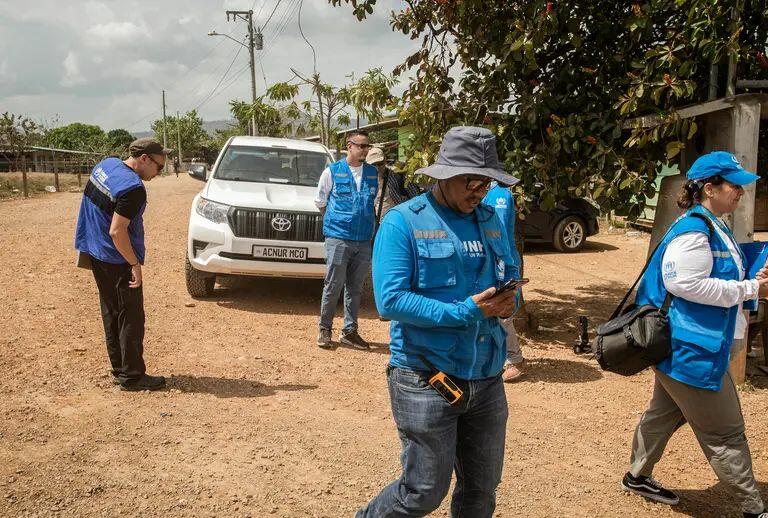
The United Nations and related nongovernmental organizations (NGOs), which receive millions of U.S. taxpayer dollars, have made mass migration easier by facilitating and augmenting migrant movement with food, shelter, and water.
Reporters spoke with migrants from China, Somalia, Venezuela, Ecuador, and Colombia and others who hiked out of the treacherous jungle leading from Colombia into Panama.
Many at the camps suffered from injuries and illnesses such as trench foot and broken limbs. Several complained that the water was untreated at the camps run by the NGOs and that they lacked essential items such as diapers. One migrant told The Epoch Times that food supplied at the camps was stale or spoiled, so he spent $7 to buy a meal from a local vendor.
Others said they were stranded at the camps because they were robbed during their journey or couldn’t pay the $60 needed for the bus ride north.
U.N. refugee agency personnel arrive at the San Vicente migrant camp in the Darien Gap, Panama, on Feb. 20, 2024. (Bobby Sanchez for The Epoch Times)
The number of illegal immigrants entering the United States has surged under the Biden administration as policies from the Trump era have been reversed or eliminated.
Illegal immigrant encounters at U.S. borders in fiscal 2022 totaled more than 2.7 million nationwide, according to CBP data.
By 2023, that number topped 3.2 million.
The numbers also correspond with President Joe Biden’s renewed pledge to support the U.N.’s Global Compact for Safe, Orderly, and Regular Migration—a 2018 plan to manage global migration that was approved by 152 nations.
“The Biden–Harris Administration is committed to safe, orderly, and humane migration around the world, including to the United States,” a government statement in December 2021 read. The United States had voted against the compact under President Donald Trump.
Most migrants are oblivious to their role as human ammunition, according to Trevor Loudon, an expert on communist regimes and host of EpochTV’s “Counterpunch.”
The U.N. and NGO workers at the City of Knowledge in Panama—which was once part of the U.S. military base given to Panama—have exposed migrants to violence, injury, death, and disease, he said.
“These bureaucrats with fat salaries, eating at nice local restaurants, are having a great old time facilitating one of the biggest crimes against humanity that’s ever been perpetrated,” Mr. Loudon said.
Panama’s former border director Oriel Ortega told The Epoch Times the NGOs should be educating and helping migrants in their own countries instead of facilitating migration.
The Epoch Times knocked on multiple U.N. agency doors at the City of Knowledge complex while in Panama in an unsuccessful attempt to interview officials with the U.N. and HIAS, founded as the Hebrew Immigrant Aid Society.
At one U.N. office, reporters could see workers through blinds scrambling to hide after The Epoch Times knocked and rang the doorbell repeatedly.
Migrants said the trek through dense rainforest, steep mountains, thick mud, and swamps was exhausting and dangerous.
They told stories of murder, rape, and desperation.
Estimates of deaths reported by NGOs are probably low. The American Red Cross reported that 60 people died crossing the Darién Gap during the first half of 2023, but anecdotal information from people who have been in the jungle put that number in the hundreds or thousands each year.
Michael Yon, a war correspondent who has been reporting on the flood of migrants moving through the jungle into Panama, told The Epoch Times he estimates that about 1 percent of those making the journey die.
At the Bajo Chiquito camp on Feb. 18, one Venezuelan migrant sitting under the shade of a tin roof shelter counted himself as lucky.
He was only robbed during the journey through the Darién Gap that he described as “hell” through an interpreter.
He witnessed a man who was stoned and then shot in the head for trying to protect his wife from being gang raped, he said.
“He went to go defend the girl,” he said.
Close by, a Venezuelan woman, Fabiola Suarez, appeared despondent. She had hiked through the Darién Gap to reunite with her husband in Colorado.
A family from Venezuela rests at Lajas Blancas after crossing the Darien Gap to Panama on Feb. 17, 2024. (Bobby Sanchez for The Epoch Times)
She, too, counted herself as lucky.
She was almost raped by criminals preying on migrants, but there were enough people in her group to stave off an attack, she said.
“There was a lot in the group, so they didn’t,” she said through an interpreter.
Dripping with sweat, Gustavo Toala emerged from the Darién jungle trail on Feb. 17 with only the clothes on his back—and a cellphone in his hand.
Everyone had cellphones, a lifeline for many at the camps.
He and two companions from Ecuador trudged over a rudimentary bridge into Lajas Blancas camp, looking exhausted after a five-hour walk from camp Bajo Chiquito.
Mr. Toala said through an interpreter that he and his two companions started as a group of 12, but they got separated during the journey.
He had been traveling for almost two weeks, hoping for a better life in the United States.
He left because of the high crime rate in Ecuador and the inability of small business owners to make a living due to extortion, he said.
With no map and little water, he blindly followed other migrants through the Darién Gap, where robbery, rape, and death await many.
He hoped to catch a bus to Costa Rica next.
At Lajas Blancas, migrants have access to a number of large maps provided by NGOs that display detailed migration routes heading to the United States.
One map is from HIAS, which recently received $11 million from the U.S. in two grants awarded specifically to go to Latin American migrants.
One HIAS map shows the migration route from Colombia to Costa Rica, including detailed bus stops, temperatures, altitudes, and “migration kiosk” locations.
The Houthis are currently threatening to unleash more 'painful' attacks on Red Sea shipping. "Yemeni naval forces are closely monitoring all movements in the Red and Arabian Seas and our appropriate responses will make anybody found to be involved in such operations regret their allegiance to America and Britain," a Houthi military spokesman said Tuesday.
Nadwa Al-Dawsari, an analyst with the Middle East Institute in Washington, has described that the US/UK-led Operation Prosperity Guardian has essentially failed. "The Houthis feel confident. They were never held accountable for any of their violations, including attacks on the Red Sea."
And now the Iran-linked Houthis are so confident that they have announced a new system for entry into the Red Sea which they are unilaterally imposing.
"Ships will have to obtain a permit from Yemen’s Houthi-controlled Maritime Affairs Authority before entering Yemeni waters," according to a Monday statement of Houthi Telecommunications Minister, Misfer Al-Numair.
"(We) are ready to assist requests for permits and identify ships with the Yemeni Navy, and we confirm this is out of concern for their safety," the minister said further, in an official statement carried by the Houthi-run Al Masirah TV.
The territorial waters affected by the Yemeni order extend halfway out into the 20-km (12-mile) wide Bab Al-Mandab Strait, the narrow mouth of the Red Sea through which around 15 per cent of the world’s shipping traffic passes on its way to or from the Suez Canal.
In normal times, more than a quarter of global container cargo – including apparel, appliances, auto parts, chemicals and agricultural products, like coffee – move via the Suez Canal.
Previously the Houthis have said that Russia and China owned vessels would receive safe passage, but foreign tankers headed to Israeli ports risk coming under attack.
Washington officials have already expressed doubt over the new offer of permits, saying that even permitted ships could likely face missile or drone attack.
Former US Defense Secretary, Robert Gates told a shipping industry conference that even if the Gaza war were to stop, "They [Houthis] may decide that they like the idea of controlling the amount of shipping going through the Red Sea, and will continue this for an indefinite period of time."
In the early morning hours of Tuesday, US Central Command posted on social media platform X that MSC Sky II, a container ship operated by MSC Mediterranean Shipping Co., was damaged in a missile attack about 90 miles southeast of the Yemeni city of Aden, as part of the latest Houthi aggression.
An exchange of Palestinian prisoners and Israeli hostages in Gaza can only happen after a ceasefire, senior Hamas officialOsama Hamdansaid on Tuesday, as ceasefire talks in Cairo between Hamas, Egypt and Qatar continued with no sign of a breakthrough.
Hamdan, speaking at a press conference in Beirut, repeated his group's conditions for a deal; an end to Israel's military offensive, a withdrawal of Israeli forces from the Gaza Strip, and the return of displaced Palestinians to homes they have fled in other parts of Gaza.
"In the past two days, the movement presented its position on the proposal put forward by the brotherly Qatari and Egyptian mediators. We reaffirmed our conditions for a ceasefire: a full pullout from the Strip and the return of the displaced from areas they left, in particular in the north," he said.
The humanitarian situation is particularly dire in northern Gaza, where hundreds of thousands of residents are believed to have remained despite Israeli orders to evacuate.
The United Nations has been unable to deliver food aid to the north since Jan. 23. Israeli authorities have denied access to U.N. aid convoys, which their troops have fired on.
The United States on Saturday carried out the first of what it said would be a series of humanitarian air drops of food into Gaza.
But Hamdan told reporters: "We say to Washington, what is more important than sending aid is stopping its supply of weapons to Israel."