Search This Blog

Wednesday, March 6, 2024

'Biden to focus on drug prices, health costs during State of the Union'

 President Biden plans to call on Congress to double down on Medicare’s new power to negotiate drug prices during Thursday night’s State of the Union address and dramatically expand the number of drugs that will be eligible, the White House said. 

Medicare will eventually be able to negotiate the prices of 20 drugs under the current law, but White House officials told reporters Wednesday that Biden will propose expanding that number to 50 and bringing more drugs into the program sooner.  

Biden will also propose extending Medicare’s $2,000 annual cap on out-of-pocket drug costs to people with commercial insurance, officials said, as well as the law’s penalty for drugmakers who raise prices faster than the rate of inflation.  

“What’s good for seniors on the $2,000 cap is good for all Americans,” White House Domestic Policy Advisor Neera Tanden said on a call with reporters. 

Biden will also ask lawmakers to extend a $35-per-month cost cap for insulin to the commercial market. There are bipartisan Senate bills that would accomplish that, but they have not been brought to the floor since they were introduced nearly two years ago.  

The proposals would represent a major expansion of the Inflation Reduction Act. While the law was sweeping, many of its biggest health provisions only apply to Medicare rather than the commercial market, because Democrats had to scale it back in order to pass it through the Senate.  

The policies that the president is set to pitch to Congress represent the Biden campaign’s effort to remind voters of the administration’s actions to lower health costs, even though many of the biggest wins won’t take effect this year, while also trying to showcase a path forward for the next four years.  

The administration is focusing on pocketbook issues aimed at helping families keep expenses in check and tying health policies to Biden’s economic successes.

Still, the policies represent a wish list and are not likely to be enacted with Republicans in control of the House. 

https://thehill.com/policy/healthcare/4513793-biden-to-focus-on-drug-prices-health-costs-during-state-of-the-union/

Fatalities Reported, Crew Abandons Ship After Houthi Missile Attack; US & Allies Sending Warships

 Attacks on commercial vessels in the Red Sea continue to escalate and risk sparking a regional conflict as President Biden's Operation Prosperity Guardian to shield ships from Iran-backed Houthi attacks miserably fails. The latest incident involves a commodity ship hit by at least one anti-ship ballistic missile in the Gulf of Aden, close to the Bab al-Mandab Strait, marking the first fatality of crew members of the multi-month Red Sea crisis. 

"Two killed and six injured in a Houthi missile strikes on the MV True Confidence, a Liberian-owned vessel, in the Red Sea today, per two US officials," Politico's Pentagon reporter Lara Seligman posted on X. 

Seligman said, "These are the first fatalities of the Houthi campaign against international shipping since November."


A US Department of Defense source told the journalist that "no Americans were on board" the vessel at the time of the incident. 

"The 23 crew members were forced to abandon the ship, which was damaged but has not sunk yet," she said.

Seligman added: "Coalition warships have responded and are assessing the situation," including an "American guided-missile cruiser." 

Maritime tracking data via Bloomberg shows True Confidence abruptly turned before the Bab al-Mandab Strait on Tuesday, around 1900 local time. There is reason to believe the missile attack was around that time. 

Responding to the latest vessel incident, David Asher, a senior fellow at Hudson Institute, explained: 

"The Houthis are bought, paid for, and directed by Tehran, and are upping the terrorist ante by seeking to shut down the Red Sea. Tehran sees weakness in the US government and indifference among the Europeans (who rely on these cargos). It's a recipe for a widening zone of conflict that likely will spread into the Persian Gulf." 

The rapidly expanding Red Sea crisis comes days after the bulk carrier Rubymar sunk after being hit by missiles last month, and a suspected Iranian 'spy ship' was lingering around the area where undersea communications were severed

https://www.zerohedge.com/geopolitical/first-fatalities-reported-after-houthi-missile-attack-damages-ship

FDA Approves Pfizer's Besponsa for Pediatric Leukemia, Expanding Treatment Horizons

 On Wednesday, the U.S. Food and Drug Administration (FDA) granted Pfizer's antibody-drug conjugate, inotuzumab ozogamicin, marketed as Besponsa, an additional indication for treating children with a specific form of leukemia. Initially approved in 2017 for adults with relapsed or refractory B-cell precursor acute lymphoblastic leukemia (ALL), the most prevalent type of ALL, this latest approval extends its use to children aged one year and above with CD-22 positive R/R B-cell precursor ALL.

The FDA's decision was influenced by compelling data from a 52-patient open-label study, which showed that Besponsa led to a 42% complete remission (CR) rate with a median CR duration of 8.2 months. This approval marks a significant advance in pediatric oncology, offering new hope to children battling this aggressive form of leukemia. The safety and effectiveness of Besponsa in treating pediatric patients have now been recognized, paving the way for its use in a younger demographic.

The recent approval of Besponsa for pediatric use highlights Pfizer's ongoing commitment to the antibody-drug conjugate (ADC) space. Following its acquisition of ADC drug developer Seagen in December for $43B, Pfizer has continued to strengthen its position in this innovative field of cancer treatment. The company's efforts in developing and acquiring advanced cancer therapies underscore its role as a leader in oncology.

This development is more than just a regulatory milestone; it represents a leap forward in pediatric cancer care, offering a targeted therapy option for a vulnerable patient population. The approval of Besponsa for children with CD-22 positive R/R B-cell precursor ALL could potentially lead to improved survival rates and quality of life for these patients. It also signals a growing interest in the development of more specialized treatments for pediatric cancers, reflecting a broader trend towards personalized medicine.

As Pfizer continues to explore the therapeutic potential of antibody-drug conjugates, the FDA's approval of Besponsa for pediatric leukemia is a critical step forward in the fight against cancer. It not only provides a new treatment option for children with this challenging disease but also highlights the importance of continued innovation and investment in oncology research. The implications of this approval extend beyond the immediate benefits to patients, suggesting a promising future for ADC therapies in pediatric oncology.

https://bnnbreaking.com/breaking-news/health/fda-approves-pfizers-besponsa-for-pediatric-leukemia-expanding-treatment-horizons

Pentagon Blames 'Intel Gap' For Failure To Stop Yemen's Red Sea Ops

 Via The Cradle

US defense officials have blamed "insufficient intelligence" for Washington's abortive airstrike campaign against Yemen, which started in mid-January and has so far failed to deter Yemen's Houthi armed forces from attacking US, UK, and Israeli-linked vessels in the Red Sea in support of Palestine.

During a congressional hearing on US operations in the Red Sea last week, US Deputy Assistant Secretary of Defense for West Asia, Daniel B. Shapiro, revealed Washington "did not know" the full capacity of the Yemeni arsenal used for its operations in the Red Sea, adding that the White House was "working to gather that intelligence."

He added that, while the Pentagon had “a good sense” of what US-led attacks have allegedly destroyed, officials did not “fully know the denominator” – meaning the reality of Yemen's military capabilities.

According to current and former US officials who spoke with the Financial Times (FT), US intelligence agencies saw a "drop-off" in Yemen operations during the governments of former presidents  Barack Obama and Donald Trump.
"Because Yemen went down as a priority, so did our intelligence focus there," Mick Mulroy, a former senior Pentagon official and CIA officer, told the British news outlet.

CIA operations in Yemen were also affected after the Ansarallah-led government shut down the US embassy in Sanaa.

"Reporting on a country from afar or offshore is inherently challenging, and doubly so for a country that has seen so much churn over the past 10 years," Ted Singer, a recently retired senior CIA official, said.

Although hundreds of US-led airstrikes have hit the Arab world's poorest country since January, Yemeni leaders maintain that no amount of hostilities will deter them from continuing their Red Sea operations until Israel puts an end to the genocide of Palestinians in Gaza.

"The US, Britain, and Israel must realize that the policies of demarcation and assertion of hegemonic influence on international waters are obsolete and no more favorable … As long as the Zionists’ atrocities continue in Gaza, we will continue our operations against the usurping entity," Defense Minister Major General Mohammed al-Atifi said on February 26.

Yesterday saw more attempted direct attacks on US warships...

As US intelligence agencies scramble to discover the reality of Yemen's military arsenal, White House lawyers are in a rush to find legal loopholes to justify a new war in West Asia.

https://www.zerohedge.com/geopolitical/pentagon-blames-intel-gap-failure-stop-yemens-red-sea-ops

Beige Book: Consumer Spend Slows Due To "Heightened Price Sensitivity"; Mounting CRE Fears

 One month after the lukewarm January Beige Book found "little or no change" In US economic activity, which in turn followed the fare more downbeat November Beige Book found which economic activity was "slowing", moments ago the Fed released the latest, March, Beige Book in which we find more green shoots glimmers as economic activity "increased slightly", on balance, since early January, with eight Districts reporting slight to modest growth in activity, three others reporting no change, and one District noting a slight softening. Oddly enough, the Fed found a modest acceleration in economic activity even though "consumer spending, particularly on retail goods, inched down in recent weeks." To justify this assessment, the Fed mentioned several reports which cited heightened price sensitivity by consumers and noted that households continued to trade down and to shift spending away from discretionary goods.

Taking a closer look at various economic segments, we find the following notable recent developments:

  • Activity in the leisure and hospitality sector varied by District and segment; while air travel was robust overall, demand for restaurants, hotels, and other establishments softened due to elevated prices, as well as to unusual weather conditions in certain regions.
  • Manufacturing activity was largely unchanged, and supply bottlenecks normalized further. Nevertheless, delivery delays for electrical components continued.
  • Ongoing shipping disruptions in the Red Sea and Panama Canal did not generally have a notable impact on businesses during the reporting period, although some contacts reported rising pressures on international shipping costs.
  • Several reports highlighted a pickup in demand for residential real estate in recent weeks, largely owing to some moderation in mortgage rates, but noted that limited inventories hindered actual home sales. 
  • Commercial real estate activity was weak, particularly for office space, although there were reports of robust demand for new data centers, industrial and manufacturing spaces, and large infrastructure projects.
  • Loan demand was stable to down, and credit quality was generally healthy despite a few reports of rising delinquencies.

Unlike the recent ISM reports, both mfg and services, the Fed found that employment "rose at a slight to modest pace in most Districts" while labor market tightness eased further, with nearly all Districts highlighting some improvement in labor availability and employee retention. Some more labor market details:

  • Businesses generally found it easier to fill open positions and to find qualified applicants, although difficulties persisted attracting workers for highly skilled positions, including health-care professionals, engineers, and skilled trades specialists such as welders and mechanics.
  • Wages grew further across Districts, although several reports indicated a slower pace of increase. Employee expectations of pay adjustments were reportedly more in line with historical averages

And in bad news for those expecting a soft landing, the Fed cautioned that price pressures persisted during the reporting period, although several Districts reported some degree of moderation in inflation. Furthermore, while contacts highlighted increases in freight costs and several insurance categories, including employer-sponsored health insurance, businesses found it harder to pass through higher costs to their customers, who became increasingly sensitive to price changes. The good news is that the cost of many manufacturing and construction inputs, such as steel, cement, paper, and fuel, reportedly fell in recent weeks. 

Looking ahead, the Fed said that "the outlook for future economic growth remained generally positive, with contacts noting expectations for stronger demand and less restrictive financial conditions over the next 6 to 12 months." Boy are they in for a surprise.

Turning to the specific regional Feds, we found these summaries notable:

  • Boston: Economic activity increased at a slow pace, and employment gains were modest. Output prices increased slightly, and wage growth held steady at a moderate pace. Residential realtors expressed growing optimism as both property listings and pending home sales increased. Uncertainty persisted concerning the fate of maturing office property loans, but the outlook for the sector did not worsen.
  • New York: Regional economic activity flattened after a period of sustained weakness. Labor market conditions remained solid as employment grew slightly and wage growth picked up to a moderate pace. Labor demand and labor supply continued to come into better balance. Consumer spending declined modestly. The pace of selling price increases remained modest.
  • Philadelphia: Business activity resumed a slight decline during the current Beige Book period—as it had for most of 2023. Employment grew slightly, and labor availability improved. Wage and price inflation subsided further, but housing affordability continues to squeeze consumers, especially those in lower-income households. Generally, sentiment improved, but firms remained cautious with subdued expectations for future growth.
  • Cleveland: District business activity increased slightly. Some firms noted increased labor availability, reduced turnover, and easing wage pressures. Cost and price pressures changed little. Some manufacturers raised prices to cover higher costs, while some restauranteurs planned to absorb them. Business services firms continued to raise rates based on market conditions.
  • Richmond: The regional economy saw little growth, overall. Consumer spending softened slightly as poor weather conditions over the last several weeks led to reduced sales. Imports and shipments of consumer goods picked up as retailers replenished inventories. Domestic manufacturing softened, however. Real estate market activity improved slightly. Nonfinancial service demand was unchanged. Employment rose and price growth was unchanged, keeping inflation moderately elevated.
  • Atlanta: Economic activity was little changed. Labor markets and wage pressures eased. Nonlabor costs moderated, on balance. Consumers remained cost conscious, and higher prices squeezed household budgets. Travel and tourism remained strong. Home sales declined. Commercial real estate conditions slowed. Transportation activity was mixed. Manufacturing slowed somewhat. Overall loan demand declined.
  • Chicago: Economic activity increased modestly. Employment increased modestly; nonbusiness contacts saw a modest increase in activity; business spending increased slightly; manufacturing activity was flat; and construction and real estate and consumer spending declined slightly. Prices and wages rose moderately, while financial conditions tightened modestly. Prospects for 2024 farm income deteriorated some.
  • St. Louis: Economic activity has increased slightly since our previous report. Contacts reported that consumer demand slowed beyond seasonal norms. While labor markets remain tight overall, an increasing number of firms reported being fully staffed or overstaffed relative to consumer demand. Price growth has slowed in recent months. Contacts reported a mixed outlook for the coming year, although the outlook has improved since mid-December.
  • Minneapolis: District economic activity was up slightly. Employment grew some, but labor demand softened. Wage pressures continued to moderate, and prices rose modestly. Consumer spending declined slightly, thanks to slow winter tourism. Commercial construction remained slow, but some markets saw single-family activity improve. Manufacturing, mining, and energy activity increased.
  • Kansas City: Economic activity in the Tenth District was stable. Job gains were modest, and wage growth, while elevated, was tied closer to worker performance. Price sensitivity rose among consumers, even as prices rose moderately. Commercial real estate contacts indicated skepticism around recent appraisals of property valuation, not wanting to be in a position of trying to "catch a falling knife."
  • Dallas: Economic activity expanded modestly, with most sectors holding steady or experiencing slight to modest growth. Wage growth was moderate, and input cost and selling price growth was generally at or below average. Texas firms were more bullish on demand expectations than late last year, with more than half of the firms' expecting increases over the next six months. Outlooks overall were less pessimistic.
  • San Francisco: Economic activity grew slightly, employment levels rose slightly, and price and wage growth eased. Retail sales were stable, and demand for services grew modestly. Demand for manufactured products changed little, and conditions in agriculture were stable. Real estate activity rose slightly overall. Financial sector conditions were little changed.

One particular highlight: The Atlanta Fed notes said that "commercial real estate conditions slowed", while the Kansas City Fed said that "Commercial real estate contacts indicated skepticism around recent appraisals of property valuation, not wanting to be in a position of trying to “catch a falling knife.

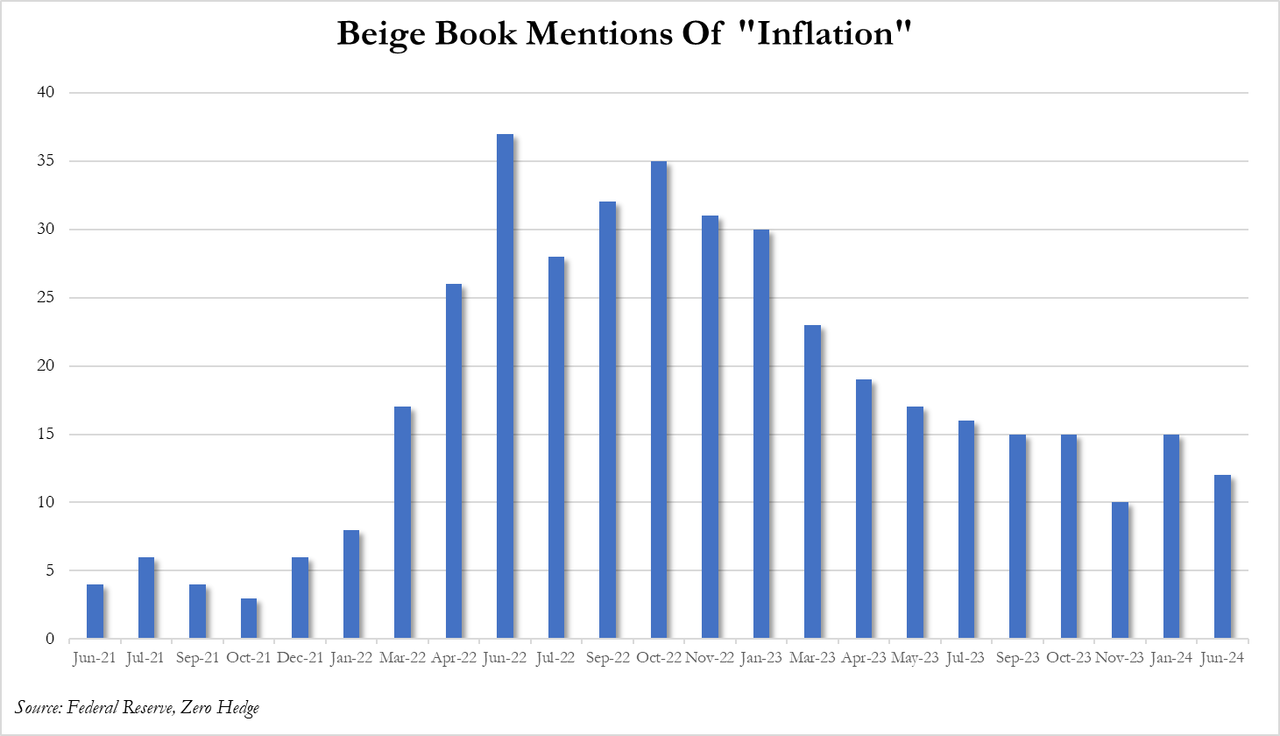
Finally, taking a visual approach to the data, we find that after mentions of inflation dropped to 10, or the lowest since Jan 2022 in November, before rebounding in January to 15, in March the number of mentions dipped again, this time to 12, suggesting that prices may indeed be resuming their grind lower.

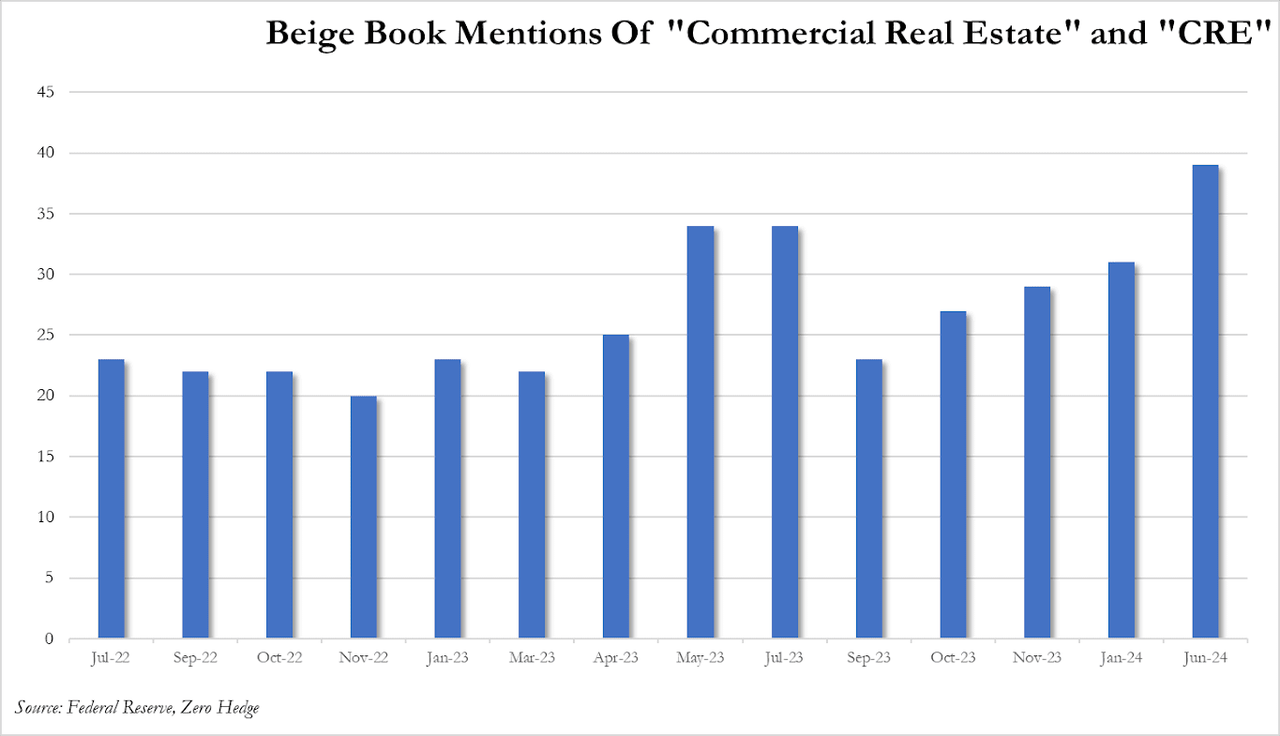
And speaking of commercial real estate, while Powell is doing his best to pretend that there is nothing to worry about, today's bailout of NYCB notwithstanding, the Fed itself is clearly worried as shown in the chart below which summarizes all mentions of "commercial real estate" and "CRE" in the latest beige book.

More in the full Beige Book (link).

https://www.zerohedge.com/markets/beige-book-warns-consumer-spending-slowing-due-heightened-price-sensitivity-mounting-cre

Gilead tries new triple-target T-cell engagers in $1.5B-plus Merus collab

 Bispecific T-cell engagers are just now stepping into the oncology spotlight, but that’s not stopping one pharma company from investigating the next frontier of the modality.

Gilead and Merus have inked a partnership worth more than $1.5 billion to discover trispecific T-cell engagers, the companies announced Wednesday. In exchange for $56 million in upfront cash plus a $25 million equity investment from Gilead, Merus will lead early-stage research on two programs, with the potential for a third.

Gilead will decide whether to license any of the programs once they pass a designated research checkpoint, after which the Foster City Pharma can take over development and commercialization work. 

Merus stands to make $1.5 billion in milestone payments across all the potential programs, and can opt into a 50-50 profit-sharing agreement for the third program rather than earn biobucks, if that’s pursued. 

“We are now looking ahead to the development of additional multispecific antibodies capable of driving robust anti-tumor immune responses with an improved efficacy and safety profile,” Flavius Martin, M.D., Gilead’s EVP and head of research, said in a release.

Bispecific T-cell engagers have been a blooming class of cancer treatments as of late, showing considerable promise in treating small cell lung cancer, for which there have been few major breakthroughs. Amgen has been one of the leaders among the larger pharmas with its BiTE platform and accompanying candidates led by FDA-approved Blincyto and clinical-stage tarlatamab. Merck & Co. also recently invested heavily, buying Harpoon Therapeutics for $680 million.

Gilead already has a phase 1-stage bispecific T-cell engager in its pipeline, but it's aimed at treating HIV, not cancer. 

Both Gilead and Merus are looking to rebound after safety concerns have arisen in parts of their oncology work. Merus saw its share price decline in December after the company revealed three deaths in an open-label phase 1/2 study testing MCLA-129 as a lung cancer treatment. The safety profile threw cold water on what was otherwise high disease control rates, namely in the first-line setting when combined with AstraZeneca’s Tagrisso. 

Meanwhile, Gilead’s CD47 drug magrolimab has struggled to find its footing. The pharma recently elected to end development of the antibody as a treatment for blood cancer after reported deaths and has paused solid tumor trials following a partial FDA hold. Gilead has said it's reviewing the risk-benefit profile across all the impacted studies. 

https://www.fiercebiotech.com/biotech/gilead-tries-new-triple-target-t-cell-engagers-15b-plus-merus-collab

Group Suing Over Pfizer Diversity Fellowship Program Loses US Appeal

 A U.S. appeals court on Wednesday upheld the dismissal of a lawsuit by a conservative group opposed to diversity initiatives in medicine that challenged a Pfizer fellowship program designed to boost the pipeline of Black, Latino and Native American people leadership positions at the drugmaker.

The New York-based 2nd U.S. Circuit Court of Appeals ruled that the Virginia-based non-profit organization Do No Harm lacked standing to challenge the drugmaker's program, saying "it did not identify by name a single member injured by Pfizer's alleged discrimination."

Pfizer in a statement welcomed the ruling, saying it was an "equal opportunity employer and is proud of its commitment to diversity, equity and inclusion."

Do No Harm did not immediately respond to requests for comment. The group said it counts doctors, medical students and others as members and aims "to protect healthcare from radical, divisive and discriminatory ideologies."

It sued Pfizer in 2022 over the company's Breakthrough Fellowship Program, which aimed to increase the pipeline of Black, Latino and Native American leaders, arguing it discriminated against white and Asian-American applicants.

Pfizer altered the program's criteria while the case was pending and now anyone can apply.

The lawsuit was filed a month before the U.S. Supreme Court heard arguments in cases in which its conservative majority would later in June 2023 declare unlawful race-conscious college admissions policies used by Harvard University and the University of North Carolina.

That decision, while focused on college admissions, has prompted a wave of lawsuits challenging diversity programs at companies, some of which have since altered their policies.

The lawsuit against Pfizer claimed its program violated laws including Section 1981 of the Civil Rights Act of 1866, which bars racial bias in contracting, and Title VI of the Civil Rights Act of 1964, which protects employees and job applicants from racial discrimination.

In Wednesday's opinion, U.S. Circuit Judge Beth Robinson said that Do No Harm claimed to have standing to challenge the program because two anonymous white or Asian-American members of the group claimed they could not apply to the fellowship.

But Robinson, an appointee of Democratic President Joe Biden, said Do No Harm never disclosed the identities of either member to the court and that a lower court judge as a result rightly concluded it failed to establish standing.

Two other 2nd Circuit judges agreed to affirm the case's dismissal. One of them, U.S. Circuit Judge Richard Wesley, an appointee of Republican former President George W. Bush, only partially concurred, saying the two other judges went too far by imposing a rule requiring associations to name their members to prove standing.