Search This Blog

Thursday, March 7, 2024

Japan's Eisai says US introduction of Alzheimer's drug Leqembi slower than expected

 Japanese drugmaker Eisai on Thursday said the distribution of its Alzheimer's drug Leqembi in the United States has proceeded slower than it expected.

The company expects to reach 90% of its target for integrated delivery networks (IDNs) used to administer the drug in the U.S. in the fiscal year ending this month, Chief Executive Haruo Naito said.

"In the United States, in comparison to what we have expected, it may be taking slightly more time," Naito said at a briefing in Tokyo. "We are confident that we are on a good trajectory."

Leqembi is an antibody designed to remove sticky deposits of a protein called amyloid beta from the brains of Alzheimer's patients. It is the first treatment shown to slow progression of Alzheimer's when administered in the earlier stages of the disease.

The drug was approved in the U.S. and Japan last year, and it is under review in Europe. Eisai is aiming to introduce Leqembi in China this year following approval by regulators there in January.

The drug's debut in Japan has progressed smoothly, Naito said, and the company is ramping up production ahead of a planned July launch in China.

The Chinese system for diagnosis and treatment of Alzheimer's is unique and could serve as a model for expansion in India along with other markets in Asia and Africa, Naito said.

https://finance.yahoo.com/news/japans-eisai-says-us-introduction-083620319.html

ITF Gears Up for FDA Decision in Expanding DMD Market

 The Muscular Dystrophy Association’s annual conference is taking place this week amid an expanding Duchenne muscular dystrophy treatment market. Sarepta Therapeutics recently reported strong demand for its gene therapy Elevidys, and Catalyst Pharmaceuticals is anticipating a first-quarter 2024 launch for the recently approved Agamree. Many other companies also hope to step into the fray, among them ITF Therapeutics. 

ITF, the newly minted U.S. subsidiary of Italian pharmaceutical company Italfarmaco Group, is gearing up for a March 21 FDA PDUFA date for its Duchenne muscular dystrophy (DMD) hopeful, givinostat. Italfarmaco had expected a decision by Dec. 21, 2023, but in November, the regulator extended the review period by three months. The company is banking on Phase III data showing that givinostat could reduce decline in mobility and muscle function, shared in two posters at this week’s conference.

Givinostat, a small molecule that acts by inhibiting histone deacetylases (HDACs), met the trial’s primary endpoint of mean time change from baseline to 18 months in the four-stair climb, Matt Trudeau, head of ITF, told BioSpace. The trial, which consisted of 179 ambulant boys with DMD who were six years and older, randomized patients into an active arm that received givinostat plus the current standard of care—steroids—and a placebo arm that received steroids alone.

HDACs are a group of enzymes that modulate gene and protein expression in the muscle, Trudeau told BioSpace in an email. “Deregulation of HDACs is a major consequence of the lack of dystrophin associated with DMD,” he explained. “We believe givinostat’s mode of action has the potential to inhibit HDAC pathological overactivity and thereby impact the cascade of events leading to muscle damage which, in turn, may counteract disease pathology and slow muscle deterioration.” 

Craig McDonald, chair of the Department of Physical Medicine & Rehabilitation at UC Davis Health and the lead U.S. investigator on givinostat’s Phase III trial, added that the drug also appears to have affected DNA methylation and gene expression in the muscle.

McDonald has treated nine patients with givinostat. “I’ve been really quite impressed with how they’ve done over time,” he told BioSpace.

An Evolving Treatment Landscape

If givinostat does win approval, it will be entering a growing market. Last June, the FDA approved Sarepta’s Elevidys as the first-ever gene therapy for DMD, despite its missing the primary functional endpoint in a randomized trial. Elevidys was greenlit under the FDA’s accelerated pathway for four- to five-year-old patients who are able to walk—but not all ambulatory patients, the indication the company had sought. Four months later, in October 2023, the therapy again failed to hit the primary efficacy endpoint in a Phase III confirmatory trial. 

Jeff Chamberlain, president of the American Society for Gene and Cell Therapy and the McCaw Chair in Muscular Dystrophy at the University of Washington School of Medicine, told BioSpace that the gene therapies currently in development are only somewhat effective.

“It’s far from a cure,” Chamberlain said. “With [Elevidys], we’re seeing most of the boys are doing better, but they’re not doing as much better as we were hoping they would. I think it’s fairly effective in slowing down the progression of the dystrophy, and some of the patients are showing increased strength, but a lot of them are not.” 

In animal models, Elevidys and other AAV-microdystrophin gene therapies currently in development are “very powerful and potent,” having a profound effect on the disease, Chamberlain said. He conjectured that they may not work as well in human patients, however, because “the AAV delivery vehicles are just not as efficient in human muscle as they were in the animal models.”

Meanwhile, Santhera Pharmaceuticals last fall won the FDA’s nod for Agamree, an oral suspension steroid that is indicated for DMD patients aged two years and older. Catalyst Pharmaceuticals, which will commercialize the drug in North America, anticipates launching it by the end of this month.

“I think that’s a really exciting and important development,” Chamberlain said. Steroid hormones can be used in conjunction with gene therapies to help reduce some of the inflammatory side effects caused by the high-dose vectors, he noted, but they have side effects of their own, including hyperactivity and weight gain. “[Agamree] was designed . . . to maintain all the benefits of a traditional steroid hormone while removing the parts of the molecule” that cause the side effects, Chamberlain said.

Michael Kelly, chief scientific advisor at CureDuchenne, which provided early financial backing for Agamree’s development, said he is “delighted” with the drug because it gives patients another choice alongside currently available steroids prednisone and deflazacort.

In terms of givinostat, Kelly said “it has clearly shown benefits in clinical trials. Patients we’ve talked to that have participated in those trials really continue to speak out highly in support of it. We’re hopeful that the agency will look upon this favorably.” 

The Diverse DMD Pipeline

As the recent approvals demonstrate, there’s more than one way to treat DMD. Ten years ago, steroids were the standard treatment, Trudeau said. “Today, the pipeline is quite rich.”

Kelly noted that there are several companies expecting data this year. On the gene therapy front, he highlighted Pfizer’s mini-dystrophin gene therapy fordadistrogene movaparvovec, for which Phase III data are anticipated in the second half of 2024, and REGENXBIO, which on Tuesday reported safety and efficacy data from the first patient to receive a higher dose level of its one-time gene therapy RGX-202 in a Phase I/II trial.

The 12-year-old patient had robust microdystrophin expression of 75.7% compared to someone without DMD at three months, according to the press release. At 10 weeks, the investigators observed a 77% reduction from baseline in serum creatinine kinase (CK) levels, which are associated with muscle injury and are uniformly elevated in patients with DMD. REGENXBIO is on track to launch a pivotal trial in the second half of this year, according to the press release.

Kelly also anticipates an exciting year for exon-skipping approaches, which he said involve a “much larger transcript of dystrophin.” In this space, he noted Dyne Therapeutics, Avidity Biosciences and Entrada Therapeutics, all of which have therapies in clinical trials. “We might expect if we’re able to put in dystrophin with much more efficacy and higher levels, that the benefit might be greater,” he said.

While there is no shortage of DMD therapies coming down the pike, Trudeau said, “every therapy that comes into this space is good news for these patients. Every new modality is important.”

https://www.biospace.com/article/itf-gears-up-for-fda-decision-in-expanding-dmd-market-/

Wednesday, March 6, 2024

'Biden to propose expanding Medicare drug price negotiation in State of the Union'

 President Biden wants to more than double the size of Medicare’s new drug price negotiation program and will preview the plan in his State of the Union address, the White House announced Wednesday.

While the current program will eventually allow Medicare to negotiate the prices of up to 20 drugs per year, Biden will propose increasing that number to 50, and bringing more drugs into the negotiation process sooner.

The expansion is one of several appeals Biden will make to Congress to build on health care measures to lower prescription drug costs and protect patients from surprise medical bills, the White House said. The policies have little chance of being enacted with a Republican House of Representatives this year.

The proposal to go bigger is the pharmaceutical industry’s worst nightmare: Companies long feared Democrats’ creation of the negotiation program would be a slippery slope that would lead to deeper cuts. It’s also a tightrope walk for Biden, who is simultaneously trying to build awareness that his administration passed drug pricing policies, even though the biggest ones haven’t gone into effect yet, and pitch a vision to go even further if voters reelect him for a second term.

Most of the Inflation Reduction Act’s drug pricing policies only apply to the Medicare program. Biden will propose that lawmakers expand the law’s $2,000 annual cap on out-of-pocket drug costs and penalties for drug price hikes to apply to patients with insurance through their jobs, not just Medicare.

“What’s good for seniors on the $2,000 cap is good for all Americans,” said White House Domestic Policy Advisor Neera Tanden on a call with reporters.

Biden will also ask lawmakers to extend a $35-per-month cost cap for insulin to the commercial market, a policy that Senate Majority Leader Chuck Schumer (D-N.Y.) has promised to bring up for a vote for nearly two years, but has not.

He also wants to build on a law passed in 2020 to protect consumers from surprise medical bills. While the law provided new protections in many situations, it did not apply to bills from ground ambulances, which Biden will propose codifying.

Biden will also call to close the Medicaid coverage gap in states that have chosen not to expand Medicaid despite federal funding offers. Sen. Raphael Warnock (D-Ga.) is bringing a guest to the speech who is a former emergency room nurse who now falls into the coverage gap.

https://www.statnews.com/2024/03/06/medicare-drug-price-negotiation-state-of-the-union/

Pro-Choice Democrats Fight To Make Abortion the Only Option

 At the State of the Union address this week, President Biden and the Democrats intend to leverage a tragic situation involving a woman who suffered a medical emergency during her pregnancy in order to advance their own abortion agenda. My heart goes out to this mother and any other mother experiencing a similar situation. It is heartbreaking to lose a child under any circumstances. But while President Biden exploits this tragedy for political gain, one critical piece of information you won’t hear during his address is that all state pro-life protections have provisions to protect mothers experiencing medical emergencies.

Unfortunately, Biden and the Democrats think it is more politically expedient to scare women into believing they cannot access the care that they need than to roll up their sleeves and help the majority who want to parent. Peer-reviewed research found nearly 70% of post-abortive women describe their abortions as inconsistent with their own values and preferences, with one in four describing their abortions as unwanted or coerced. What are Biden and the Democrats doing to address this epidemic? They are peddling ever more abortion for any reason, past the point at which unborn children can feel pain and indeed at any time during a pregnancy. Theirs is North Korea and China-style abortion policy – and it utterly fails to align with the compassion and aid Americans desire for women facing difficult pregnancies.

Meanwhile, the pro-life community has quietly built a vast network of charitable organizations across the nation that exist to address the needs of pregnant women who want to keep their babies but lack resources. In 2022 alone, pregnancy resource centers met with clients over 16 million times and delivered services with an estimated total value of at least $358 million. They saw almost 975,000 new clients and provided pregnancy tests, ultrasounds, parenting education programs, baby diapers, wipes, formula, clothing, and much more – all at no cost. These pregnancy resource centers not only meet the material needs of women, they can quite literally save their lives.

That is what happened in the case of survivor Jean Marie Davis, who had been trafficked for nearly three decades in 33 states when an unintended pregnancy became the impetus for her escape. With no money and running from a pimp who was trying to kill her, Jean Marie had almost nowhere to turn. After endless calls, she was finally connected to a pregnancy resource director who changed everything. Jean Marie ultimately escaped a life of drugs, violence, and serial abuse, without sacrificing the son she loves, and today she helps women in similar circumstances by running a pregnancy resource center of her own.

Hundreds of maternity homes across the nation also provide pregnant women in need with long-term housing and the material, medical, educational, and emotional resources to transform their lives and live their dreams. Rachel already had a young child, but her partner had turned abusive toward her, and then she found out she was pregnant again. She knew for the sake of her children she had to leave but had no vehicle and nowhere to turn until she found a maternity home which agreed to help. That home provided a safe and loving environment – plus all the resources Rachel needed to heal and thrive. While there, she pursued her education in the medical field and is now a registered nurse working at a local hospital. 

Now if Biden and the Democrats have their way, the charitable organizations that stepped in to help Jean Marie, Rachel, and the countless other women who come to them because they want to keep their children would no longer exist. From overt calls to “shut them down,” to an HHS proposal to revoke any public funding for these centers, to the DOJ’s refusal to protect them from the massive wave of disturbing pro-abortion violence post-Dobbs, the message is clear: For Democrats, abortion is the only option.

While the president and Democrats say they care about women, their actions speak otherwise.

Marjorie Dannenfelser is president of Susan B. Anthony Pro-Life America and author of “Life is Winning: Inside the Fight for Unborn Children and Their Mothers.” 

https://www.realclearpolitics.com/articles/2024/03/06/pro-choice_democrats_fight_to_make_abortion_the_only_option_150603.html

Terror Threat? NYC Mobilizing 1,000 National Guard Troops In Subways

 New York Governor Kathy Hochul is mobilizing 1,000 National Guard troops and State Police officers across New York City's subway system in a show of force meant as a warning to criminals who have been terrorizing passengers. 

Gov. Hochul announced earlier today that 750 guardsmen and 250 law enforcement officers would be deployed across "the city's busiest transit stations" amid out-of-control violent crime. 

WuXi AppTec, WuXi Bio Tumble After US Panel Advances Ban Bill


  • Both companies have lost almost 40% in Hong Kong this year
  • WuXi Bio denies CEO has ties to military-linked institution

WuXi AppTec Co. tumbled after a US Senate committee advanced a bill Wednesday that may ban Chinese biotech firms and some others from federal contracts.

WuXi AppTec plunged as much as 21%, while its sister company WuXi Biologics Cayman Inc. dropped 19%. Both stocks have lost close to 40% so far this year, making them the worst performers on the benchmark Hang Seng Index.

https://www.bloomberg.com/news/articles/2024-03-07/wuxi-apptec-drops-as-us-senate-panel-advances-bill-banning-deals

"Notable Milestone": American FICO Credit Scores Decline First Time In Decade

 Although the Biden administration claims that the American consumer is humming on all cylinders, the Federal Reserve's Beige Book in March painted a much different story in the report released on Wednesday. It showed consumers are cutting back on spending and becoming more cost-conscious due to the increasing pressures of elevated inflation.

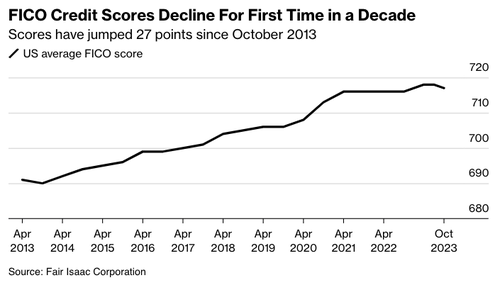
A new report by Fair Isaac Corp., the Montana-based creator of the FICO credit score, shows consumers missing more credit card payments and taking on more debt. This has led to the average consumer credit score reversing for the first time in a decade.

Blomberg first reported that the average FICO credit score for Americans fell by one point in October to 717 from 718 in July. Despite being a minor change, this marks the first decline in a decade.

Source: Bloomberg

"It's a notable milestone that we've seen the average score decrease," said Ethan Dornhelm, vice president of scores and predictive analytics at FICO, adding, "This isn't a blinking red light, but it certainly is a yellow light."

According to Bloomberg, the 30-day-or-more delinquency rate increased to 18% of the population - up about 4% since April - and comes in an environment of rising delinquencies for credit cards, auto loans, and mortgages. Credit card utilization also rose higher in October, up to 35% from 34% in April, while the average credit card balance in October jumped 5.9% to $7,306. 

A separate report showed how non-revolving credit growth stumbled under high interest rates in early February.

The average rate across all commercial banks on all credit card amounts hit a new record high of 21.47% in the fourth quarter of 2023.

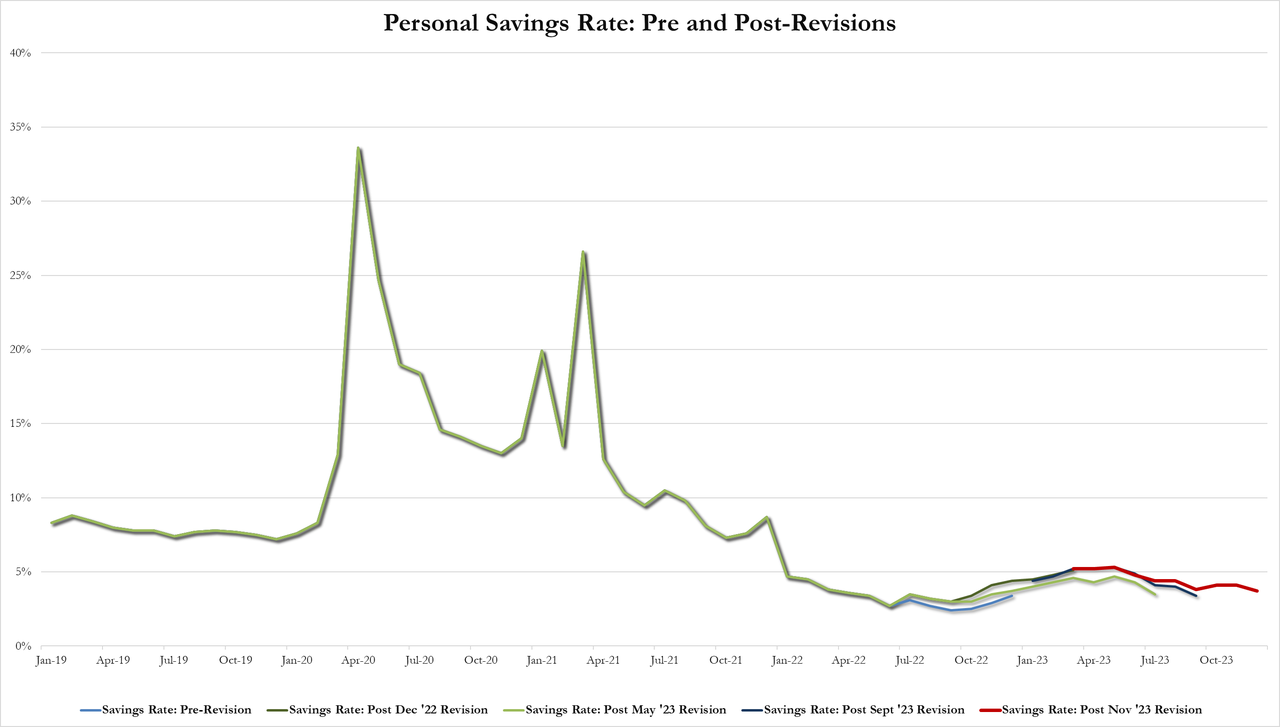
Meanwhile, the personal savings rate has collapsed. 

Another concerning piece of consumer data comes from Credit Managers' survey that shows the rate of rejections for credit applications and the number of accounts moved to 'collections' is surging back to near GFC levels.

... and about that 'strong consumer' narrative the Biden administration keeps pushing in corporate media. 

https://www.zerohedge.com/personal-finance/notable-milestone-american-fico-credit-scores-decline-first-time-decade