Search This Blog

Wednesday, December 4, 2024

'Large number' of Americans' metadata stolen by Chinese hackers, senior official says

 A "large number" of Americans' metadata has been stolen in the cyberespionage campaign carried out by a Chinese hacking group dubbed "Salt Typhoon," a senior U.S. official told journalists on Wednesday.

In a call with reporters, the official declined to provide specific numbers but said that China's access to America's telecommunications networks was potentially broad and that there was a risk of "ongoing compromise."

The official said the White House had made tackling the Salt Typhoon hackers a priority for the federal government and that President Joe Biden had been briefed several times on the intrusions.

https://www.xm.com/au/research/markets/allNews/reuters/large-number-of-americans-metadata-stolen-by-chinese-hackers-senior-official-says-53981669

French Government Falls As PM Barnier Loses Confidence Vote

 What seemed like a foregone conclusion is now confirmed - French PM Barnier just lost a no-confidence vote (with 331 votes - 288 was needed) forcing his government's resignation and Macron to appoint a new premier

The debate before the vote was lively with RN's Le Pen blasting Barnier's budget and making it clear he was dead in the water.

“It’s the end of this ephemeral government,” Le Pen declares.

Much of her comments are focused on taxes in Barnier’s budget, saying it was "all about taxes, taxes and more taxes."

“Where’s all the money? The French want to know,” she said.

To those who think I’m intent on choosing a policy of disaster through a vote of no confidence, I want to tell them that the disastrous policy would be not to censure such a budget, such a government," Le Pen says.

Boris Vallaud, the head of the Socialists in parliament called Barnier’s budget “unjust and inefficient" and confirmed he would vote against Barnier.

France unbowed's Coquerel slammed the government for not making enough compromises on the budget and confirms his party is supporting the no-confidence motion put forth by the leftist coalition.

The prime minister notes that the same issues will confront the next government if his is toppled, saying he would have “liked to have distributed money even though there isn’t any.”

“This won’t disappear with the magic of a no-confidence motion.”

What happens next?

  • First, Barnier would tender the resignation of the government; his outgoing cabinet would remain in place with limited powers to manage current affairs.

  • This caretaker administration continues until Macron appoints a new premier. There is no constitutional time limit for this decision -- and it took Macron nearly two months to select Barnier.

  • During the interregnum, the government would likely rely on untested emergency legislation to collect taxes and deliver vital spending.

  • Once named, a new prime minister would propose a cabinet to be appointed by the president, and that new government would present a 2025 budget to parliament

Macron has a history of finding unexpected people to be prime minister - and of changing his mind at last minute.

Here are some names circulating in Paris that could become the next premier:

  • Bernard Cazeneuve, 61: Former French prime minister and interior minister under Socialist President Francois Hollande. Already considered as a possible PM this summer, picking him could help Macron fracture the left-wing bloc by capitalizing on Cazeneuve’s ties to his former party.

  • Sébastien Lecornu, 38: A skilled politician who in 2022 became the youngest defense minister since the French Revolution. He’s a Macron loyalist who’s originally from the center-right Republicans party.

  • François Bayrou, 73: The veteran centrist leads the MoDem party, a key ally for Macron in parliament. Currently the high commissioner for government planning, Bayrou supports proportional representation in parliamentary elections, which has also been a request of the National Rally.

  • Jean Castex, 59: A former prime minister under Macron known for his southern French accent and management skills. He is currently the head of the RATP, the state-owned company that operates the Paris metro.

On whether Macron should remain in office, Le Pen said that “it’s up to his conscience to decide whether he can sacrifice public action and the fate of France to his own pride.” She added:

“If he decides to stay, he will be forced to acknowledge that he is the President of a Republic that is no longer entirely at peace with itself.”

He can serve out his full term until 2027 and said only yesterday that this is exactly what he plans to do.

“I’ve been elected twice by the French people, and I’m extremely proud of that,” Macron said during a trip to Saudi Arabia.

“I’ll honor that trust with all my energy, right up to the last second.”

The euro was at the highs of the day ahead of the vote (which makes all the sense in the world to someone), but dropped on the inevitable result...

Spreads were near the lows of the day ahead of the vote, but started to creep higher as the debate neared the end. The bond markets closed before the vote...

Aberdeen Investments' Alex Everett suggests that French 10-year yields would likely move toward 100 basis points over Germany, notably above current levels, citing "continued malaise, a dearth of decision making and insufficient progress toward debt sustainability."

https://www.zerohedge.com/political/le-pen-declares-end-ephemeral-government-french-pm-barnier-loses-confidence-vote

Wife of slain CEO Brian Thompson, said her husband did not alter his travel plans in spite of threats

 The wife of Brian Thompson, the UnitedHealth Group CEO who was shot to death outside a Midtown Manhattan hotel, said her husband had been receiving threats prior to the attack.

Thompson's wife, Paulette, told NBC News that she was informed by the New York Police Department that the attack on her husband was planned.

“Yes, there had been some threats basically I don’t know, a lack of coverage? I don’t know details,” Paulette Thompson told NBC News. “I just know that he said there were some people that had been threatening him.”

Despite the threats, Paulette says her husband did not alter his travel plans.

“I can’t really give a thoughtful response right now,” she told NBC News. “I just found this out and I’m trying to console my children.”

An NYPD spokesperson told PEOPLE that police responded to a call at about 6:40 a.m. outside 1335 Sixth Avenue, the address of the New York Hilton Midtown. A 50-year-old man was shot in the chest, police said, and was later pronounced dead at the hospital.

UnitedHealth confirmed that Thompson was the victim.

The NYPD says they are still searching for the masked shooter, who the department says fled north on Sixth Avenue on an electric Citibike.

Thompson joined UnitedHealth Group in 2004, according to his company bio.

“We are deeply saddened and shocked at the passing of our dear friend and colleague Brian Thompson, the CEO of UnitedHealthcare," the company said in a statement. "Brian was a highly respected colleague and friend to all who worked with him. We are working closely with the New York Police Department and ask for your patience and understanding during this difficult time. Our hearts go out to Brian’s family and all who were close to him.”

https://people.com/slain-unitedhealth-ceo-s-wife-says-he-received-threats-before-his-murder-8756031

Unexpectedly Hawkish Beige Book Finds Econ Activity "Rose" In Most Districts, "Slowness" Tumbles

 Back in September, the otherwise sleepy and mostly boring report that is the Fed's Beige Book report (which nobody otherwise reads due to its sheer size and dismal signal-to-noise ratio) got a sudden boost of notoriety and popularity when none other than Jerome Powell explained after the Fed's 50bps rate cut, that he had been closely following the Beige Book which had emerged as a driving force behind the Fed's unexpected "jumbo" 50bps rate cut. And unlike others, we actually do read the Beige Book, which is why two weeks before the FOMC rate cut we titled our analysis of the latest report as follows: "Ugly Beige Book Reveals Economic Activity "Flat Or Declining", Consumer Spending Slowing In Most Districts." So one can see why Powell panicked and why two rate cuts followed in September and November, just days after the election.

Fast forward to today when moments ago the Fed published its latest, December, Beige Book which suggested that a reversal of the sluggish, "flat or declining" conditions observed in September and November is underway, and which together with a strong jobs report on Friday may be sufficient to enable the Fed to pause rate cuts for the foreseeable future, especially now that Donald Trump is in the White House.

According to the Fed's latest report, economic activity "rose slightly in most Districts", a clear improvement from the descriptions used in the previous months, and that "three regions exhibited modest or moderate growth that offset flat or slightly declining activity in two others." Employment levels were flat or up only slightly across districts and prices rose only at a modest pace across Federal Reserve districts.

Reading further, we find yet another indication of the Trump effect, namely that although growth in economic activity was generally small (thank Biden), expectations for growth rose moderately across most geographies and sectors (thanks Trump) and "business contacts expressed optimism that demand will rise in coming months."

Elsewhere, we find that consumer spending was "generally stable" although many consumer-oriented businesses across Districts noted further increases in price sensitivity among consumers, as well as several reports of increased sensitivity to quality. Among the negative aspects, spending on home furnishings was down, which contacts attributed to limited household mobility, while demand for mortgages was low overall, though reports on recent changes in home loan demand were mixed due to volatility in rates. Commercial real estate lending was similarly subdued. Still, contacts generally reported financing remained available.

Turning to capital spending and purchases of raw materials, these were flat or declining in most Districts while sales of farm equipment were a notable headwind to overall investment activity, and several contacts expressed concerns about the future prices of equipment given ongoing weakness in the farm economy.

Energy activity in the oil and gas sector was flat but demand for electricity generation continued to grow at a robust rate. The rise in electricity demand was driven by rapid expansions in data centers and was reportedly planned to be met by investments in renewable generation capacity in coming years.

Some more details from the Beige Book, starting with Labor Markets:

  • Employment levels were flat or up only slightly across Districts.
  • Hiring activity was subdued as worker turnover remained low and few firms reported increasing their headcount.
  • The level of layoffs was also reportedly low. Contacts indicated they expected employment to remain steady or rise slightly over the next year, but many were cautious in their optimism about any pickup in hiring activity.
  • Wage growth softened to a modest pace across most Districts, as did expectations for wage growth in coming months.
  • Job growth and wage growth for entry-level positions and skilled trades were an exception, rising robustly and expected to grow further through next year.

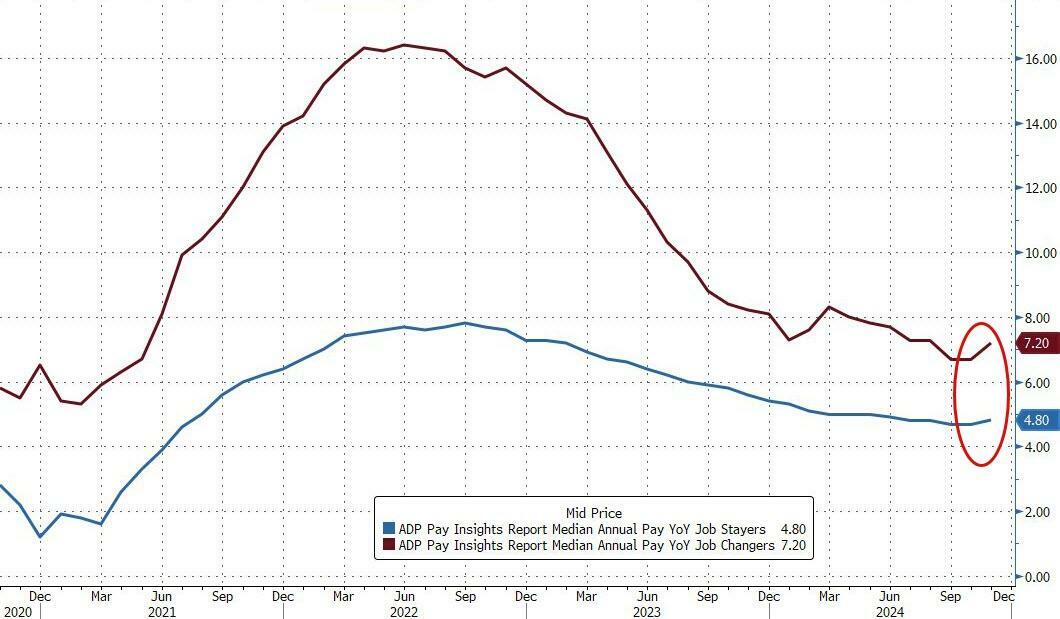
While Friday's jobs report will have more to say about this, today's ADP report which indicated a sharp bounce in wage growth suggests that the Fed is now working on stale wage data.
Turning to prices:

  • Prices rose only at a modest pace across Federal Reserve Districts.
  • Both consumer-oriented and business-oriented contacts reported greater difficulty passing costs on to customers.
  • Input prices were said to be rising faster than selling prices for most businesses, resulting in declining profit margins.
  • Although input prices rose generally, contacts in several Districts noted declines in certain raw materials and non-labor costs.
  • In contrast, rising insurance prices were again reported widely as significant costs pressures for many businesses.
  • Contacts indicated they expect the current pace of price growth to persist, but businesses in several Districts indicated tariffs pose a significant upside risk to inflation.

Here are the main highlights by Fed District

  • Boston: Economic activity was down a bit on balance. Prices increased at a slight pace. Employment held steady despite a slowdown in hiring demand. Consumers held back on restaurant spending. Warm, dry weather crimped demand for selected goods. Commercial real estate contacts perceived stabilization in the office sector. Expectations were mixed, marked by uncertainty among many contacts.
  • New York: On balance, regional economic activity expanded slightly, led by strong growth in the manufacturing sector. Employment in the region grew slightly, and wage growth remained moderate. Commercial real estate markets steadied after a period of weakness, with a pickup in demand in the New York City office market. Selling price increases remained modest.
  • Philadelphia: Business activity edged up in the current Beige Book period after falling slightly last period. Consumer spending was flat overall, but the broader nonmanufacturing sector edged up, and manufacturers reported modest growth. Employment, wages, and prices all rose modestly, but inflation expectations edged higher over concerns about potential tariffs. On average, firms expect moderate economic growth over the next six months.
  • Cleveland: District business activity grew modestly in recent weeks, and contacts expected activity to increase further in the months ahead. Demand for business services remained robust, and nonresidential construction activity increased modestly. Employment levels grew slightly. Overall, contacts indicated that wages, nonlabor input costs, and prices increased modestly.
  • Richmond: The regional economy grew slightly in recent weeks. Some negative impacts from Hurricane Helene and the port worker strike were reported by businesses in affected regions and segments of the economy. Employment was little changed this cycle, while wages grew moderately and price levels were little changed, leading to reports of profit margin compression for businesses.
  • Atlanta: Economic activity in the Sixth District grew. Employment was steady and wages grew slowly. Input costs and prices were little changed. Retail sales improved slightly. Tourism declined modestly. Demand for housing deteriorated. Transportation activity grew slightly. Loan growth was modest. Manufacturing fell, and energy activity grew modestly.
  • Chicago: Economic activity increased slightly. Consumer and business spending rose modestly; employment was up slightly; construction and real estate activity was flat; nonbusiness contacts saw little change in activity; and manufacturing activity decreased modestly. Prices were up modestly, wages rose moderately, and financial conditions loosened slightly. Prospects for 2024 farm income were unchanged.
  • St. Louis: Economic activity across the Eighth District has slightly increased since our previous report. Prices increased moderately, with greater pushback against those price increases. Consumer spending has slightly declined across the income distribution. Contacts expected slight growth in employment, particularly coming from industrial production. The outlook has modestly improved; however, contacts noted that uncertainty about future policies was slowing investment, and businesses were increasing inventories in anticipation of potential import tariffs.
  • Minneapolis: District economic activity increased slightly. Employment grew, but labor demand softened, and turnover was down. Wage growth was moderate, and prices increased slightly. Consumer spending was flat, but tourism increased. Energy, commercial construction, and residential real estate also saw growth while manufacturing and homebuilding decreased.
  • Kansas City: Economic growth was modest and balanced across sectors. Expectations for demand growth were strong and supported plans to increase hiring and capital expenditures. Most contacts indicated they do not plan to raise wages substantially over the next year. Yet, the outlook for consumer spending remained strong, even as customers became more sensitive to prices and quality.
  • Dallas: Economic activity rose moderately over the reporting period. Growth continued in nonfinancial services and resumed in manufacturing and retail. Employment increased, and wage growth ticked up. Outlooks improved, with widespread increases in demand expectations. Interest rate cuts have had an overall positive but mild effect, and contacts were mostly bullish on prospective business conditions under the incoming administration, though some noted worry about potential trade and immigration policy changes.
  • San Francisco: Economic activity was stable. Employment levels were generally unchanged, and wages and prices increased slightly. Retail sales and activity in services sectors changed little. Activity in manufacturing, residential real estate, and financial services increased somewhat, while conditions in commercial real estate were stable. Conditions in agriculture softened slightly

And in keeping with the argument that the Dec Beige Book was much more hawkish than many expected, a quick semantic analysis finds that mentions of "slow" collapsed from 55 in October and an average of 56 in the past year to just 29, the lowest since the covid surge. Meanwhile, "inflation" remained sticky with 12 mentions, up 1 from last month and the highest since April
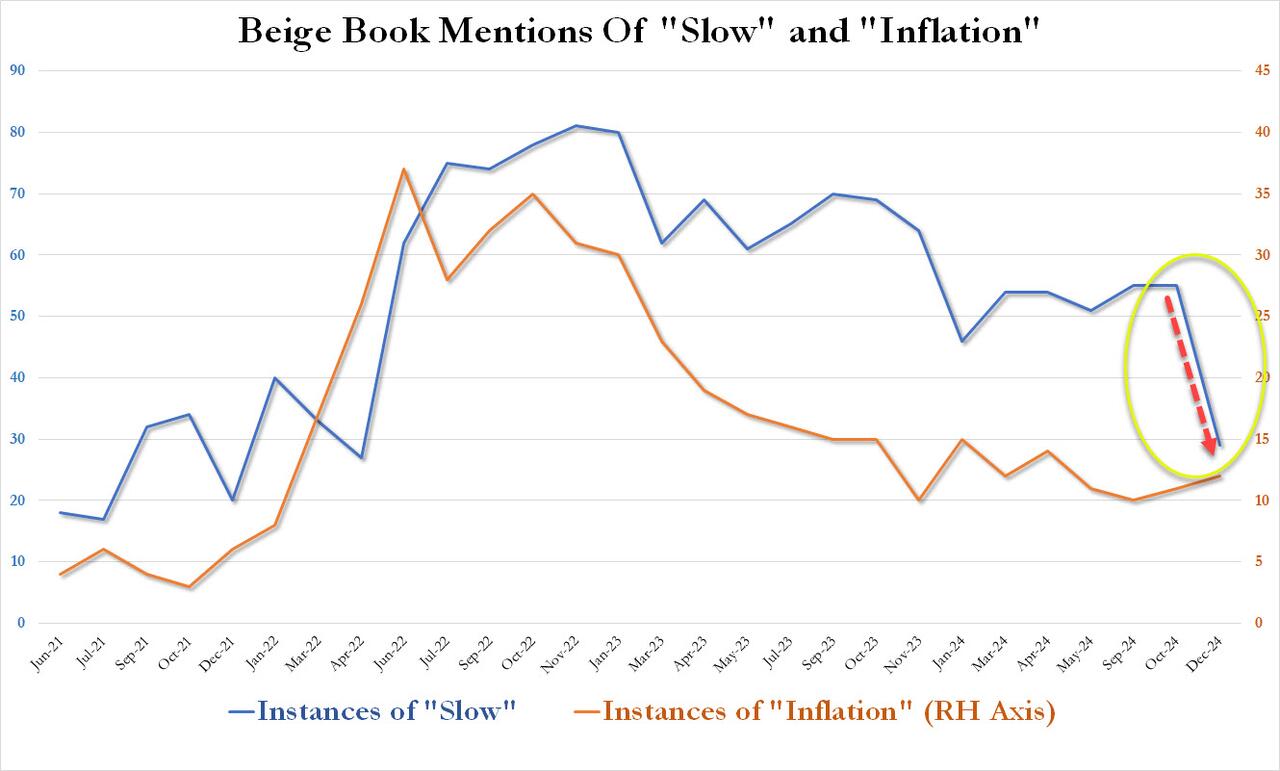
Bottom line: if the September Beige Book is what ultimately tipped the scales for the Fed to cut 50bps, then the December Beige Book is the first solid hint that a Fed pause may take place as soon as this month (which is perfectly understandable since Trump is now in the White House and the Fed will do everything in its power to make his life miserable).

https://www.zerohedge.com/economics/unexpectedly-hawkish-beige-book-finds-economic-activity-rose-most-districts-slowness

Trump nominates Paul Atkins as SEC chair

 President-elect Trump has nominated former Securities and Exchange Commissioner (SEC) Paul Atkins to replace outgoing chair Gary Gensler when he departs on Inauguration Day.  

“Paul is a proven leader for common sense regulations. He believes in the promise of robust, innovative capital markets that are responsive to the needs of Investors, & that provide capital to make our Economy the best in the World,” Trump wrote in a Truth Social post Wednesday.  

The nomination caps off weeks of speculation over who will head up the independent agency following Gensler’s announcement last month he would step down from the post once Trump is sworn into office.  

“He also recognizes that digital assets & other innovations are crucial to Making America Greater than Ever Before,” the president-elect added.  

His nod to Atkins’ embrace of cryptocurrency is the latest signal the incoming Trump administration is expected to be much more friendly to the crypto industry than Gensler, who took a more hardline approach.   

Trump was widely expected to pick a more crypto-friendly candidate after fully embracing the industry during his campaign. Despite previously dismissing crypto as a “scam,” he vowed to make the U.S. the “crypto capital of the planet.” 

Atkins, CEO and founder of financial services consultancy Patomak Global Partners, currently serves as co-chair of the Digital Chamber’s Token Alliance. 

The crypto industry celebrated his nomination Wednesday. Blockchain Association CEO Kristin Smith touted Atkins an “excellent choice.” 

“The past four years under Chair Gensler was a non-stop anti-crypto crusade, leading to an innovation stalemate and incalculable job, talent, and economic losses,” Smith said in a statement. 

“Paul Atkins will offer a new perspective, anchored by a deep understanding of the digital asset ecosystem,” she continued. “We look forward to working with him in his role as SEC chair and ushering in – together – a new wave of American crypto innovation.” 

Outgoing House Financial Services Chairman Patrick McHenry (R-N.C.) similarly highlighted the digital assets industry in celebrating Atkins’ pick. 

“Paul Atkins has the expertise and experience needed to restore faith in the SEC,” McHenry wrote in a post on X. “I’m confident his leadership will lead to clarity for the digital asset ecosystem and ensure U.S. capital markets remain the envy of the world.” 

https://thehill.com/business/5022203-trump-nominates-paul-atkins-as-sec-chair/

Terns Pharmaceuticals target raised to $20 on positive trial data

 Tuesday, Oppenheimer raised the price target on Terns Pharmaceuticals (NASDAQ:TERN) to $20.00 from $17.00, while maintaining an Outperform rating on the stock. According to InvestingPro data, analyst targets for TERN now range from $7.50 to $30.00, with four analysts recently revising earnings estimates upward. The adjustment follows the release of promising interim data from the Phase 1 CARDINAL study of TERN-701, a drug under development for the treatment of Chronic Myeloid Leukemia (CML).

The study's three-month efficacy and safety results showed TERN-701's potential advantages over existing Tyrosine Kinase Inhibitors (TKIs). Notably, the drug demonstrated improved tolerability and a significant reduction of BCR-ABL1 transcripts in patients with high resistance and intolerance to current TKIs, including those who had previously been treated with asciminib. The company maintains strong financial flexibility with a current ratio of 32.99 and more cash than debt on its balance sheet.

The analyst from Oppenheimer expressed confidence in TERN-701's competitive profile and its potential application in earlier treatment settings. The drug's performance at the three-month mark has bolstered expectations for long-term Major Molecular Response (MMR) data, which is anticipated in the fourth quarter of 2025 following a planned dose expansion in the first half of the same year.

The revised price target to $20.00 reflects a more optimistic view of the drug's prospects, with the probability of success now set at 70%. TERN-701 is seen as a key asset for Terns Pharmaceuticals, with the analyst noting that the market has yet to fully recognize its value.

In other recent news, Terns Pharmaceuticals disclosed promising early results from its Phase 1 CARDINAL study of TERN-701, a drug candidate for chronic myeloid leukemia (CML). The study demonstrated encouraging safety and efficacy outcomes in heavily pretreated patients with relapsed or refractory CML. Furthermore, Terns Pharmaceuticals has appointed Heather Turner, former CEO of Carmot Therapeutics, to its Board of Directors.

In response to these developments, several analyst firms, including H.C. Wainwright, Oppenheimer, Mizuho (NYSE:MFG), and Jefferies, have adjusted their ratings and price targets for Terns Pharmaceuticals. Additionally, Terns Pharmaceuticals launched a $125 million stock offering led by Jefferies and TD Cowen to fund the development of key product candidates like TERN-701 and TERN-601.

This article was generated with the support of AI and reviewed by an editor. For more information see our T&C.

https://www.investing.com/news/analyst-ratings/terns-pharmaceuticals-target-raised-to-20-on-positive-trial-data-93CH-3752571

'What Matters for Health: Insurance is Less Important Than You Think'


The Paper

This paper argues that expanding public health insurance has minimal impact on health outcomes and recommends focusing on healthy behaviors and medical innovation for more effective improvements.

Executive Summary

Why We Did This Study

For decades, health policy in the United States has focused on expanding health insurance coverage at enormous cost to taxpayers. Policymakers assumed that coverage would increase access to care, which would improve health. In fact, there is little evidence that expanded government health insurance programs improve most people’s health. Multiple studies show that public insurance expansions increase the amount of health care used. But they generally improve health by much less than is commonly believed. Policymakers need to understand why expanding insurance coverage has had so little impact on health and to focus their efforts on proposals that will successfully improve Americans’ health.

What We Found

Most studies claiming a health benefit for insurance are observational. They may show a correlation between insurance and health outcomes, but they do not establish causation. Observational studies are prone to bias and confounding by unobserved differences between the insured and the uninsured. Evidence from randomized, controlled experiments that avoid these problems indicates that insurance produces little, if any, health benefits. The primary benefits of insurance are to improve people’s sense of well-being, mental health, and
financial security.

There are multiple reasons why insurance coverage has so little effect on health. Public insurance expansions such as those within the Affordable Care Act (ACA) often substitute public insurance for private insurance or replace previously uncompensated care with care that is covered by insurance. In addition, many government insurance programs provide limited access to services and focus on low-benefit care. Health care in general has only a modest impact on health: Estimates suggest it contributes no more than 10-20 percent to determining health outcomes. Some care may actually decrease health by exposing patients to medical errors or to over-diagnoses and misdiagnoses. We conclude that individuals’ health behaviors and medical innovation are far more important contributors to health than insurance coverage.

Why It Matters

Life expectancy gains in the United States have stagnated and mortality rates for the major medical causes of death have continued to rise even as public insurance coverage has expanded. Congress is considering extending those coverage programs. The evidence strongly indicates that this would not be a cost-effective strategy for improving Americans’ health.

Policy Suggestions

Instead of continuing to pursue costly expansions of public health insurance and subsidies to insurers that do little to improve health, policymakers should focus on more effective initiatives such as promoting healthy behaviors and increasing medical innovation.


[MORE]


https://paragoninstitute.org/public-health/what-matters-for-health-insurance-is-less-important-than-you-think/