Search This Blog

Wednesday, December 4, 2024

Britain drug-cost watchdog says it will recommend Lilly obesity drug

 Britain's drugs cost-effectiveness watchdog NICE said on Thursday it will recommend Eli Lilly's LLY.N obesity drug Mounjaro be made available to around 220,000 people in the country via the state health system over the next three years.

Mounjaro launched in the UK in February but has been available only for those paying out-of-pocket mainly through online pharmacies.

NICE, the National Institute for Health and Care Excellence, is recommending Mounjaro, alongside diet and exercise changes, for people with at least one weight-related condition, such as heart disease or type 2 diabetes, and body mass index (BMI), a measure of body fat based on height and weight, of more than 35.

The eligibility guidelines for BMI of more than 35 and a weight-related condition are the same as those issued by NICE in March 2023 for Wegovy, the obesity medication made by rival drugmaker Novo Nordisk NOVOb.CO.

The guidelines mean that about 3.4 million people in England could be eligible to receive Mounjaro through the state-run National Health Service (NHS). Initially, in the first three-year period, those with the highest clinical need will be prioritised, it said.

During those first three years, about 220,000 people are expected to receive the medicine, and NICE will review the situation again within that time.

NICE expects to publish its final guidance on Dec. 23 if no appeals are lodged before then, it said. The first NHS patients will be able to start receiving Mounjaro 90 days after the guidance is published if they are already treated at a specialist NHS weight management service, or from 180 days after if they are not treated in the specialist service, it said.

The criteria means that around 3.4 million people will be eligible to be treated, and therefore the roll out "has to be carefully managed to ensure healthcare professionals can continue to meet the full range of health needs of all their patients", NICE said.

Mounjaro is part of a class of medicines known as GLP-1 analogues originally developed to help control blood sugar in patients with type 2 diabetes but also found to suppress appetite and promote a feeling of fullness. Mounjaro led to an average weight loss of nearly 23% in clinical trials.

Nearly one in three adults are obese in Britain, the highest rate in Europe, according to a 2019 Organisation for Economic Cooperation and Development (OECD) report. That is above the European Union average of 16.5%, according to EU statistics.

Lilly said in a statement that it welcomed NICE's recommendation and understood that it will require a phased rollout

https://www.xm.com/au/research/markets/allNews/reuters/britain-drugcost-watchdog-says-it-will-recommend-lilly-obesity-drug-53981784

Far-right NATO critic seen winning Romanian presidential runoff vote

 Romanians vote in a presidential election runoff on Sunday that could see Calin Georgescu, a far-right critic of NATO, defeat pro-European centrist Elena Lasconi, an outcome that might isolate Romania in the West and erode its support for Ukraine.

The vote is the last of three consecutive ballots for both a new parliament and president in the European Union and NATO member state in which the far right has surged amid deepening distrust in state institutions after multiple economic crises and Russia's full-scale invasion of neighbouring Ukraine.

Polling stations will open at 0500 GMT and close at 1900 GMT, with exit polls on the result to follow quickly.

Georgescu, 62, a self-styled outsider who considers Russian President Vladimir Putin a true leader and patriot, stunned the Romanian mainstream and European allies when he emerged from relative obscurity as the winner of the Nov. 24 first round.

With suspicions of Russian influence swirling - denied by Moscow - and Romania's state security council accusing TikTok of social media manipulation to Georgescu's advantage - denied by TikTok, that first round went into recount but the top court ultimately validated the vote on Monday.

If Georgescu wins on Sunday, analysts say, it would upend Romania's politics, pushing it closer to a belt of states in central and eastern Europe with powerful far-right, Russia-friendly politicians, including Hungary, Slovakia and Austria.

Opinion polls show Georgescu's public support running at nearly 60% but with roughly 40% of voters saying they are undecided, the election is difficult to call, they say.

"It is hard to anticipate the result," said Sergiu Miscoiu, a political science professor at Babes-Bolyai University. "Barring a great mobilisation by the undecided, he will win."

Lasconi, 52, appealed to voters this week to ensure Romania does not change course. "We must choose between NATO protection and Putin's war. We must choose between the EU's prosperity and freedom of movement, or the sound of tanks coming from the Kremlin."

Georgescu cast himself as an outsider fighting a corrupt entrenched political class beholden to foreign interests, a message that resonated with many voters frustrated with mainstream parties consumed by infighting and graft allegations.

"We have relied on others for too long, their decisions, armies, food and economy," he said on social media on Monday. "This must stop."

If elected, he will pick who has the first try at forming a government after the Dec. 1 parliamentary vote.

While the ruling Social Democrat (PSD) finished first with 22.6%, far-right groupings expanded their parliamentary presence and said they want a shot at power.

Mainstream parties, including the PSD and Lasconi's Save Romania Union (USR), are expected to struggle to formulate a policy platform amid disagreements on how to handle the country's vast budget gap - 8% of GDP, the EU's highest.

"2025 will be an extraordinarily difficult year for a governing majority," said Cristian Pirvulescu, a political scientist. "Keeping the president in check is a hard task when you have economic and social turmoil, so it is difficult to believe parliament will mobilise all the instruments it has."

Romania's president has a semi-executive role which includes commanding the armed forces and chairing the council that decides on military aid and defence spending.

The president represents Romania at EU and NATO summits and appoints chief judges, prosecutors and secret service heads. Like Hungary's Viktor Orban has done before, Romania's next president could veto important EU votes that require unanimity.

Since Russia attacked Ukraine in 2022, Romania has helped export millions of tons of Ukrainian grain through its Black Sea port of Constanta, trained Ukrainian fighter pilots and donated a Patriot air defence battery to Kyiv.

Georgescu has not detailed how he would approach those issues and said he does not want Romania to leave NATO or the EU, but that it shouldn't accept decisions "kneeling down".

A devout Orthodox Christian, Georgescu opposes abortion and gay marriage and has a Romania-first approach which includes different taxation for foreign versus local companies. He has praised Romania's brutal 1930s fascist leaders.

https://www.msn.com/en-us/news/world/far-right-nato-critic-seen-winning-romanian-presidential-runoff-vote/ar-AA1vgaiJ

The Green New Scam is Killing Germany

 by Adam Sharp

Germany’s economy is in deep trouble, and Volkswagen is the poster boy.

VW shares are down about 67% from their 2021 peak. Earnings are down 66% over the last year.

And this week 70,000 German VW workers walked off the job. They’re furious over plant closures, layoffs, and salary cuts.

So, what’s the root cause of VW’s woes?

For the last few years, VW has been shifting production to electric vehicles (EVs). This is largely due to EU mandates requiring all cars to be electric by 2035.

At first, the government heavily subsidized EVs. And sales jumped. But now the honeymoon is over.

Let’s just say the transition to “net zero” in Europe is not going well. First of all, there’s not enough energy in the grid to charge all those batteries. And the little electricity available is very expensive.

Electric autos are proving to be far more expensive from start to finish.

I found a comment worth sharing from one angry German reader on the Daily Mail’s coverage of the VW strike.

I live in Berlin. I would estimate 90% of people here live in flats without designated parking places. Does the government seriously expect to provide fast chargers on the streets for these 90%? They just cannot admit they are wrong. EV is fine if you have a garage, but if you live in a flat forget it.

The reader makes an excellent point. Most people have no place to charge an EV. Even if there was enough energy, they’d have to leave charging cables all over the roads. That copper would disappear quickly. This is one of a dozen major flaws with the mandates.

The EU technocrats who pushed these policies did zero real planning. It’s just a pipe dream. They literally saw how well Tesla was doing and said to themselves “We should make everyone do that.” This was the extent of their analysis.

Nord Stream and Nuclear

Germany’s move into electric vehicles is only their latest stumble when it comes to energy policy. They are also shuttering all their nuclear power plants.

And they stood by passively while somebody blew up the Nord Stream gas pipeline from Russia. And even though one of the lines of Nord Stream is still operable, they aren’t utilizing it. There’s dirt cheap natural gas available and they’re choosing to buy imported liquified gas which costs 4x as much.

As a result, energy prices have soared.

Now Germany plans to rely on solar and wind in a country with little sun and inconsistent wind. Oh yeah, they’re also relying on “green hydrogen” to power their industrial economy (spoiler alert: this will also fail).

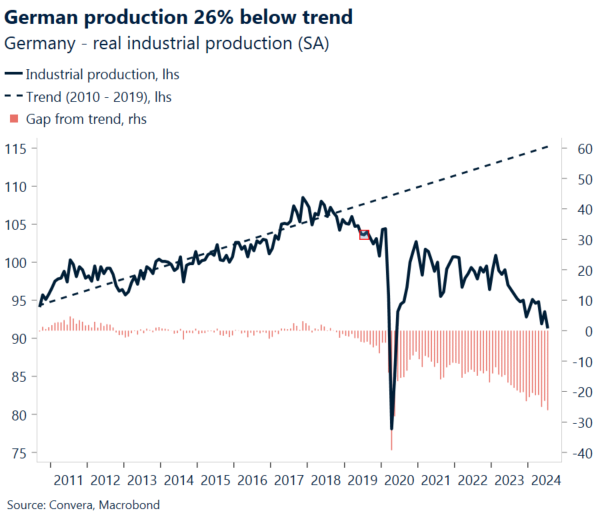
These missteps have been devastating to Germany’s industrial base.

image 1

Source: Convera, Macrobond

Germany is supposed to be the economic engine of Europe. And it was, until 2018. Then the climate mandates and “net zero” rules started rolling in, and it’s been straight downhill since.

Lessons Learned

German workers and citizens appear to be waking up to the scam. The vast majority of people don’t want EVs, and they’re becoming loud about it. A massive political shift is underway throughout Europe.

The EU mandate to ban all gas-powered cars by 2035 is doomed. Regulators are already discussing allowing hybrid vehicles, and they will eventually cave on traditional combustion engines as well. The goals are utterly impossible.

This type of government intervention never goes well. EVs were already growing, finding their own path to realistic adoption levels. Then EU technocrats got involved and spoiled the entire economy. You can’t force industries to do what you want. That should be the lesson here.

Here in the U.S., we’re experiencing our own awakening. President Trump and his team are set to shake things up across the board. De-regulation, energy expansion, and bringing manufacturing home.

In the States at least, the awakening extends far beyond economic issues. As Elon Musk recently posted on X, “Cancel culture has been canceled”. So free speech is making a comeback, too.

And across the world, people are also pushing back against lax immigration policies.

It’s an exciting time. We’ve been on the wrong path for so long, and it seems that’s finally changing.

Who knows, maybe the EU will eventually become investable again. For now, I will continue to avoid the continent, but let’s see what happens over the next few years.

https://dailyreckoning.com/the-green-new-scam-is-killing-germany/

South Korea Martial Law Decree Spotlights Challenge Of Communist Infiltration

 by Eva Fu and Catherine Yang via The Epoch Times (emphasis ours),

A martial law order from South Korean President Yoon Suk Yeol has again put communist influence in the country under the spotlight.

For the first time in nearly four decades, the South Korean leader invoked the authority, accusing the opposing Democratic Party of aligning with communist North Korea. He revoked martial law hours later after parliament voted to lift the order.

South Korea's President Yoon Suk Yeol attends the third session of the G20 Leaders' Meeting in Rio de Janeiro, Brazil, on Nov. 19, 2024. Mauro Pimentel/AFP via Getty Images

“I declare martial law to protect the free Republic of Korea from the threat of North Korean communist forces, to eradicate the despicable pro-North Korean anti-state forces that are plundering the freedom and happiness of our people, and to protect the free constitutional order,” Yoon said in a late-night address on Dec. 3.

He said the political opposition, which dominates the national assembly, was “paralyzing the judiciary by intimidating judges and impeaching a large number of prosecutors” and causing dysfunction in other government sectors as well.

North Korea is far from the only country bringing communist influence over the peninsula.

China, South Korea’s biggest trading partner, has considerable sway.

Opposition Ties to China

Lee Jae-myung, who has likened himself to Sen. Bernie Sanders (I-Vt.) and leads the opposition party, has taken a more friendly stance toward the Chinese regime even as Yoon has tried to steer his country closer to the United States and reverse the country’s yearslong trend of appeasing Beijing.

During a campaign rally in March, Lee criticized Yoon’s approach to China and his comments on the regime’s military encroachment on Taiwan, which the Chinese regime has sought to claim as its own.

Why are you provoking China?” Lee said. “What does the Taiwan issue have to do with South Korea?

A former presidential candidate, Lee was convicted two weeks ago of violating election law and was sentenced to a one-year suspended prison term.

South Korea's main opposition Democratic Party leader Lee Jae-myung (C) walks out from the main conference hall of the National Assembly in Seoul, Korea, after South Korean President Yoon Suk Yeol declared martial law on Dec. 4, 2024. Jung Yeon-je/AFP via Getty Images

Lee lost the 2022 election to Yoon by less than 1 percentage point, making it the closest election in South Korean presidential history.

“It’s a very serious problem that we need to be aware of,” Suzanne Scholte, president of Virginia-based Defense Forum Foundation, previously told The Epoch Times. “A liberal democracy like South Korea almost elected a pro-communist candidate in the last election.”

The concern may be a pressing one if Yoon’s popularity plummets as a result of his emergency declaration. His own political party has disavowed the martial law order and said they would “stop it with the people.”

“Yoon’s political days are likely numbered since the populace will be united in its criticism, and the majority opposition party will seek Yoon’s impeachment,” Bruce Klingner, a veteran at the CIA and the Defense Intelligence Agency who specializes in Korean affairs, told The Epoch Times.

During the brief martial law declaration, Lee called for people in South Korea to descend on the national assembly to protest the order.

Lee’s party won a major legislative victory in April’s general election, winning 175 out of 300 seats to the ruling People Power Party’s 108 seats.

Chinese Regime’s Wide Reach

South Korea is heavily reliant on China for trade and investment, a relationship that has further allowed Chinese authorities to influence its other sectors, including politics.

“Economy, culture, universities, there is no place that hasn’t been penetrated,” a former counter-espionage official, who asked to remain anonymous, previously told The Epoch Times.

Cities in the two countries have signed nearly 700 friendship or sisterhood agreements.

Hundreds of Chinese civil servants were sent to work and train in South Korea through a state-sponsored civil servant exchange program. The Chinese embassy pays for South Korean youths to spend a week in China; it hands them books of Chinese leader Xi Jinping’s speeches to read before they depart and expresses hope that they'll be leaders of future bilateral relations.

Then-China's National People's Congress Standing Committee Chairman Li Zhanshu (L) shakes hands with South Korea's National Assembly Speaker Kim Jin-pyo during a joint press conference at the National Assembly in Seoul, South Korea, on Sept. 16, 2022. Kim Hong-ji/AFP via Getty Images

A mayor for the South Korean city of Gwangju in 2023 tried to build a park to honor the composer of the anthem of the People’s Liberation Army and a marching song for North Korea in order to attract tourists from China.

The subversion by the Chinese Communist Party in Korea is not as well known compared to the threats from North Korea, but “it is extensive, and it is rather deep,” Tara O, author of The Collapse of North Korea, previously told Epoch Times sister media outlet NTD. She said the effort to build the park was “very ironic.”

That is just one of cultural warfare by China,” she said.

Dozens of South Korean media outlets carry articles by the Chinese regime’s propaganda mouthpiece People’s Daily.

South Korea also has the highest number of Confucius Institutes, a Chinese state-funded language education program to promote Beijing’s agenda.

In a previous interview with The Epoch Times, Choi Soo Yong, a retired case officer from the National Intelligence Service, noted that there’s a room dedicated to the collections of works about Xi at the Seoul National University.

By contrast, the university has no memorial to South Korea’s forefathers.

https://www.zerohedge.com/geopolitical/south-korea-martial-law-decree-spotlights-challenge-communist-infiltration

Here's Why Georgia Chose Russia Over The EU

 Via Remix News,

Bordered by Russia to the north and Turkey, Armenia and Azerbaijan to the south, Georgia is taking a sharp turn towards Russia. The government suspended talks on accession to the European Union after the European Parliament resolution on Georgian election fraud. Georgians took to the streets and fierce protests are ongoing; however, looking at the results of the Georgian economy, many things become clear.
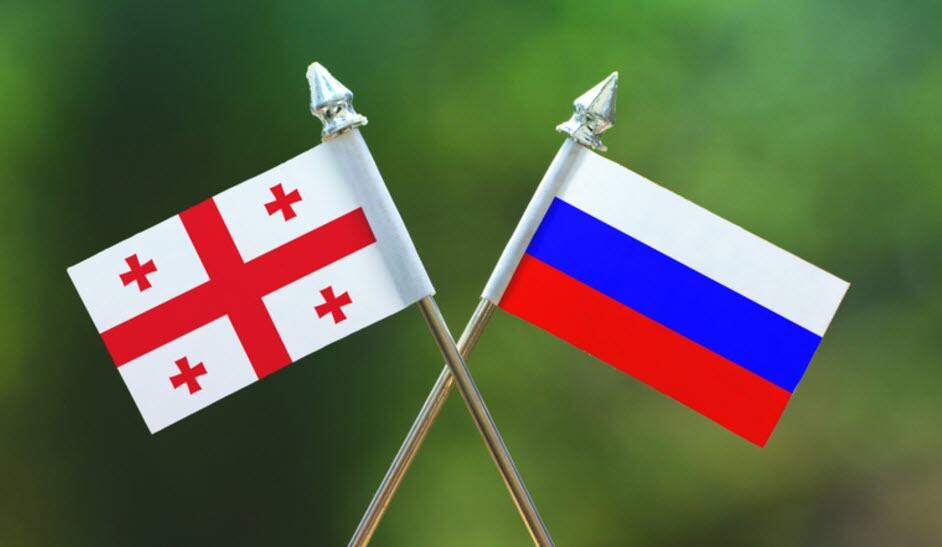
The Georgian Dream party has been ruling Georgia almost independently since 2016, although it has been involved in government since 2012, but then as part of a coalition. It is now facing strong unrest in the country after elections that have been allegedly rigged, at least according to the European Parliament. In response, the Georgian government has suspended the accession process to the European Union for four years 

The sixth-highest economic growth in the world

Looking at the economic results, it must be admitted that during the Georgian Dream government, the country developed economically at a very high rate, one of the highest in the world. This year, according to the IMF’s October forecasts, it will see 7.6 percent GDP growth, which is the sixth-highest growth in the world. In 2023, only 11 countries developed faster than Georgia, including Georgia’s neighbor Armenia.

Since 2016, Georgia has moved from 95th to 75th place in the world in terms of national income per capita, calculated according to purchasing power parity (PPP). Poland is in 42nd place in this ranking.

While in 2016 GDP per capita according to PPP in Georgia amounted to 46 percent of that in Poland, this year it is to be 53 percent. Georgia is quickly catching up with us, although Poland is one of the fastest developing countries in the European Union.

Compared to Russia, this is a jump from 51 to 58 percent, and IMF forecasts say that next year it will exceed 60 percent. The level of Chinese GDP per capita was exceeded by Georgia in 2022, and this year Georgians are expected to exceed 104 percent. With Georgians able to boast about faster development than China, it is certainly a reason for satisfaction among the Georgian population

Their standard of living is improving quite rapidly, but what is driving this improvement? The economy is a good explanation for why the Georgian government chose Russia over the West.

Tourism and new technologies

The fastest growing sector in Georgia is the information and communications sector, which has grown by 260 percent since 2016 in current prices and accounted for 4.1 percent of GDP last year. This year, it grew by 19.8 percent in the second quarter. The growth of this sector in the Georgian economy was clearly helped by emigration from Russia immediately after the outbreak of the full-scale war between Russia and Ukraine. In 2022, the first year of the conflict, the dynamics of this sector amounted to almost 64 percent.

The entertainment and leisure sector, i.e., tourism, is also developing rapidly, with gross income increasing by 176 percent in current prices since 2016; this year it grew by 17.3 percent year-over-year and currently generates 3.5 percent of GDP.

The trade sector is also very dynamic, with a 157 percent increase since 2016 and 8.1 percent this year, which is 12.4 percent of GDP. This is related to the development of tourism and the increase in the wealth of society.

The most important segment in Georgian GDP is still industry, which has grown by 106 percent since 2016, and in the second quarter of this year by 15.9 percent y/y in current prices. It currently accounts for 15.9 percent of GDP.

Based on this data, from the economic perspective, it is industry and its export capabilities that are another reason for the Georgian government to shift its emphasis from the EU to Russia.

Collapse of exports to the EU

With the Covid-19 break in 2020, Georgia’s exports in dollars have been growing steadily. In 2022, they will grow by 31.6 percent y/y to $5.6 billion, and last year they will reach $6.1 billion (+9 percent y/y). However, the growth rate has fallen this year to +5.3 percent y/y, for the 12 months ending in October.

And it fell as a result of the collapse in exports to the EU market, while exports to Russia, despite the weakness of the ruble, grew in dollar terms in 2023 by another 2.3 percent to $657 million. Meanwhile, those to EU countries fell by as much as 18.3 percent to $704 million. In 2024, it looks even worse, with exports to the EU falling by as much as 27.7 percent y/y to $549 million in the 12 months ending in October, while exports to Russia, although they also fell, decreased by only 0.3 percent to $678 million.

Russia has become a more important market for Georgia than the EU, and a place where Russian tourists spend their money. The economic choice for Georgia is quite obvious at the moment.

Even neighboring countries are now larger recipients of Georgian goods than the EU: Azerbaijan ($759 million for the 12 months to October) and Armenia ($641 million). Georgia exports slightly less to Turkey ($475 million). The country’s economic interests are closely linked to the nearby geographical region, not the more distant EU.

Not wine, but KAZ trucks

At the same time, Georgia’s most important export is not the famous Georgian wines, but transport equipment. Its foreign sales increased since 2016 from $151 million per year to $872 million in 2023. What’s more, counting the 12 months to the end of October 2024, it is already as much as $2.5 billion, or as much as 36.4 percent of Georgian exports — according to data from the Georgian Statistical Office.

Of this, as much as $974 million went to Kyrgyzstan this year, and €625 million to Kazakhstan. The surge in exports of transport equipment to these two countries has occurred since 2022, and it is hard not to link this to Russia’s aggression against Ukraine.

In 2021, exports of transport equipment from Georgia to Kazakhstan amounted to $24 million, a year later to $108 million, and this year to October to $625 million. 

To Kyrgyzstan, exports of transport equipment amounted to $2.2 million in 2021, $5.8 million a year later, $66.2 million in 2023, and $127 million in the first 10 months of 2024. It seems that the Georgian economy has been harnessed into Russia’s war machine, and it is benefiting from it.

The largest transport equipment company in Georgia is the Kutaisi-based KAZ truck manufacturer, part of the Georgian Industrial Group holding. This company was founded and is currently headed by David Bezhuashvili (30 percent of shares), a Georgian parliamentarian until 2016, whose brother Gela was even the country’s foreign minister.

Georgian wine is bought by Russians and Poles

When it comes to wine, Russia is also the largest recipient. In the 10 months of this year, out of the $237 million of wine exports, Russians bought $161 million. Interestingly, Poland is the second-largest recipient, but this means imports amounting to only $13 million.

As can be seen from the above, Georgia’s economy benefits from contacts with Russia. Economic links with the European Union are much smaller. At the same time, the data suggests that Georgia is making money from the war in Ukraine, fueling one of the highest economic growth rates in the world. A possible redirection of economic preferences could probably only occur after Turkey’s admission to the EU, which does not seem to be the case in the coming years.

https://www.zerohedge.com/geopolitical/heres-why-georgia-chose-russia-over-eu

Yes, The President Can Deploy Troops To Enforce Immigration Law

 by Patrick O'Malley and Joe Buccino via RealClearDefense,

President-elect Trump’s confirmation last month of his plan to deploy military assets for immigration enforcement sparked a constitutional debate. Legal scholars and commentators quickly declared such action forbidden by long-standing prohibitions on military involvement in domestic law enforcement. But this conventional wisdom misreads both the letter and spirit of American law. A careful examination of a pair of longstanding statutes reveals military support for immigration enforcement is permissible.

The issue hinges on two 19th century laws: the Posse Comitatus Act of 1878 and the Insurrection Act of 1807. When properly understood, both allow the President to use active-duty military forces to support the deportation of illegal immigrants.

Posse Comitatus: A Firewall Between the Military and Law Enforcement

Since our nation's founding, Americans have been wary of standing armies and their role in civilian affairs. Concerns about military involvement in domestic law enforcement dates back to colonial experiences under British rule, particularly the quartering of British troops in civilian homes and their use to enforce British law. This experience was so troubling that it influenced several key elements of the Constitution and Bill of Rights.

The Third Amendment, ratified in 1791, explicitly prohibits American soldiers from occupying private homes inside the county during peacetime. The Posse Comitatus Act of 1878, informed by a distrust of a large military force employed against its citizenry, codified the separation of military and civilian law enforcementThis act established a firewall between military force and civilian law enforcement.

The term “posse comitatus,” Latin for “power of the country,” dates back to the medieval England tradition of local sheriffs organizing citizens to assist in maintaining public order. A form of this practice made its way to the American Old West: sheriffs called for volunteers – “a posse” of the county – to chase down bandits. This power allowed sheriffs to deputize civilians to temporarily suppress lawlessness and maintain order.

The Posse Comitatus Act of 1878 derives its name from this practice with a crucial distinction: it specifically prohibits the military from acting as this civilian force. The law's architects recognized that using soldiers instead of citizens for domestic law enforcement would fundamentally alter the relationship between military power and civil society. They sought to ensure that federal troops were kept out of local law enforcement.

Yet this legislative barrier against using military force for domestic law enforcement is not absolute. Congress regularly makes exceptions, allowing military support to civilian law enforcement for actions such as protecting federal propertyconducting domestic counterterror operationsengaging in counterdrug efforts. In cases related to immigration enforcement, courts have ruled the Posse Comitatus Act only prohibits direct military involvement in law enforcement actions such as detaining citizens. Support activities, from transportation to surveillance, remain legal. This distinction between direct enforcement and support operations provides the legal basis for President-elect Trump's proposed use of military assets in his planned deportation program.

Military Assets Against Illegal Immigration Today: U.S. Troops at the Southwest Border

The military currently provides support for immigration enforcement. Today, roughly 4,000 service members assist Customs and Border Protection along the southwest border. They operate surveillance aircraft, transport Border Patrol personnel, and maintain vehicles. These activities fall within the established legal framework for military support of immigration operations.

The incoming administration has the potential to significantly expand this support role. Military aircraft could transport detainees, military installations could provide temporary housing facilities, and military personnel could assist with administrative and logistical tasks. None of these activities would violate Posse Comitatus because they do not involve direct law enforcement actions.

The Insurrection Act: A Broad Authority for Military Force

But what about using military forces to support law enforcement and enforce the law? This is where the Insurrection Act becomes crucial.

The Insurrection Act, a composite of laws enacted between 1792 and 1807, represents a significant exception to the traditional separation of military and civilian law enforcement in the United States. The act grants presidents extraordinary power to deploy federal troops on American soil—a power that is typically forbidden but also vitally important to the success of federalism.

The act's broad language, largely unchanged since the Civil War, allows presidents to deploy troops whenever they believe domestic unrest, rebellion, or resistance to federal law makes normal enforcement impossible. This extensive authority is rooted in Congress's constitutional power to call forth the militia to “execute the Laws of the Union, suppress Insurrections and repel Invasions,” as described in the Constitution. The act effectively creates a presidential override of the prohibitions against using military forces for domestic law enforcement. What was initially conceived as an emergency power for a young nation now stands as a powerful tool for President-elect Trump, who might see state resistance to federal immigration enforcement as justification for military deployment.

Illegal Immigrant Safe Havens: Local Government Resistance to Federal Law

Some jurisdictions have already declared their intention to resist federal immigration enforcement. Six states have already publicly announced plans to resist President-elect Trump's plan to deport thousands of undocumented immigrants. Under the Insurrection Act, such resistance justifies the use of military force.

The deployment of military forces by a president inside the United States to enforce the law when local governments refuse to do so is not unprecedented. This happened several times during the Civil Rights era, most famously when President Eisenhower invoked the Insurrection Act to send the 101st Airborne to Little Rock in 1957 when state officials obstructed federal desegregation orders. Nearly seven decades later, the principle remains unchanged: local authorities cannot nullify federal law. If they attempt to do so, the President has authority to direct military power to enforce it. Invocation of the Insurrection Act in such an instance would permit American troops to detain undocumented immigrants inside the United States.

The Constitution provides remedies when state and local authorities obstruct federal law enforcement. The incoming administration has legal authority to use military assets to support immigration enforcement. Those who claim otherwise misunderstand both the law and its historical context.

Patrick O'Malley is an attorney in New York and Maryland, a former Assistant District Attorney in Queens County, NY, and a retired U.S. Army Reserve Judge Adjutant General officer who taught National Security Law at the University of Baltimore School of Law.

Joe Buccino is a retired U.S. Army Colonel and the CEO of Vantage + Vox.

https://www.zerohedge.com/political/yes-president-can-deploy-troops-enforce-immigration-law

Cutting Back Blood Pressure Drugs Doesn't Raise Heart-Related Risk, Study Finds

 by Rachel Ann T. Melegrito via The Epoch Times (emphasis ours),

Blood pressure (BP) medications are some of the most overly prescribed medications.

Over 70 percent of adults 60 years and older have high blood pressure, and over half of those take blood pressure medication to prevent cardiovascular events such as heart attacks and strokes. For those who don’t need blood pressure medication, taking these drugs may do more harm than good.

WINDCOLORS/Shutterstock

In a new study challenging decades of medical practice, researchers have suggested that nursing home residents might safely stop or reduce their blood pressure medication use by 30 percent or more without increasing their risk of heart attack or stroke.

Older adults have a higher risk of adverse drug reactions and side effects when taking multiple medications (polypharmacy), as their ability to absorb and eliminate drugs is often impaired. Taking people off these drugs can help reduce the risk of side effects like dizziness and falls and potential interactions associated with polypharmacy.

Doing More Harm Than Good

Published in JAMA Network Open on Nov. 25, the study found that discontinuing nursing home residents’ BP medications or reducing their dosage by at least 30 percent did not lead to hospitalization for heart attack or stroke after two years, compared to those who continued taking their prescriptions.

Researchers analyzed electronic health record data from long-term care residents aged 65 and older admitted to the U.S. Department of Veterans Affairs (VA) community living centers. These residents were taking at least one BP medication. Nearly 18 percent of the roughly 13,000 residents had their BP medications reduced in dosage or frequency for at least two weeks.

Researchers monitored these residents for two years, finding no significant difference in the risk of hospitalization for heart attack or stroke between those who reduced or discontinued their BP medications and those whose prescriptions remained unchanged.

This outcome may be attributed to the side effects of these medications potentially outweighing the benefits of tightly controlled blood pressure, Michelle Odden, who has a doctorate in epidemiology and is an associate professor of epidemiology in the Department of Epidemiology and Population Health at the Stanford University School of Medicine, told The Epoch Times in an email interview.

“The other possibility is that high blood pressure may not be as risky in older people with a lot of health conditions or other conditions such as frailty that require them to live in a nursing home,” she added.

Also, residents who reduced or discontinued their BP medications tended to have slightly lower systolic (the top number) and diastolic (the bottom number) blood pressure levels before going off medications. This group was also on more antihypertensive drugs and had a history of conditions such as diabetes, stroke, kidney failure, and acute kidney injury.

High blood pressure is a significant risk factor for cardiovascular diseases. BP medications may need to be taken for life, especially if lifestyle changes fail to yield adequate results.

Not controlling hypertension can lead to serious complications. For instance, a 20-mmHg increase in systolic blood pressure and a 10-mmHg increase in diastolic blood pressure can double the risk of ischemic heart disease, heart attack, and stroke.

However, previous research has indicated that excessively lowering systolic blood pressure (below 130 mmHg) or excessive use of BP medications may actually harm older adults, particularly those on multiple medications or with preexisting health problems.​

A 2015 investigation found that people with particularly low blood pressure and those taking multiple BP medications faced more than double the risk of death compared to others with high blood pressure, highlighting the dangers of overtreatment in frail populations.

The new study reported that these findings contrast with an earlier Cochrane review. Cochrane is a British nonprofit recognized as the highest standard of evidence-based health care. The review suggested that stopping or reducing BP medications increased the risk of heart attack by 86 percent and stroke by 44 percent. However, the authors stated that the review had weak evidence, noting that the included studies were low-quality, had short follow-up periods, focused solely on discontinuation of diuretic antihypertensive medication, and were conducted over 20 years ago.

Long-Term Use May Lead to Kidney Damage

Apart from preventing cardiovascular disease, BP medications are also prescribed to avoid kidney damage. However, some research has suggested that going on BP medication for the long term may do the reverse and actually cause kidney damage.

study published in Circulation Research in October gave a potential reason for why long-term use of renin-angiotensin system (RAS) inhibitors, a commonly prescribed type of BP medication, may lead to kidney damage.

Renin is a protein that increases blood pressure. Cells in the kidney release renin when blood pressure is low and stop releasing it to lower blood pressure. Renin also activates angiotensin, which constricts blood vessels to increase blood pressure. RAS inhibitors reduce blood pressure by blocking these various biochemical processes.

The research was conducted in mice, and three-dimensional imaging was used to detect changes in the animals’ kidneys.

The researchers found that suppressing renin and angiotensin with antihypertensives caused blood vessels in the kidneys to balloon, causing kidney damage.

We found that RAS inhibition causes widespread vascular disease, impacting all arterioles (tiny blood vessels) and their associated glomeruli (the kidneys’ filtering units),” Dr. Maria Luisa S. Sequeira-Lopez, professor at the University of Virginia School of Medicine and co-author of the study, told The Epoch Times.

Sequeira-Lopez said that RAS inhibition was also linked to increased scarring and inflammation and disorganized nerves in diseased blood vessels.

https://www.zerohedge.com/medical/cutting-back-blood-pressure-drugs-doesnt-raise-heart-related-risk-study-finds