Life sciences company Avantor (NYSE:AVTR) fell short of the market’s revenue expectations in Q4 CY2024, with sales falling 2.1% year on year to $1.69 billion. Its non-GAAP profit of $0.27 per share was 4.5% above analysts’ consensus estimates.
Avantor (AVTR) Q4 CY2024 Highlights:
Revenue: $1.69 billion vs analyst estimates of $1.71 billion (2.1% year-on-year decline, 1.6% miss)
Adjusted EPS: $0.27 vs analyst estimates of $0.26 (4.5% beat)
Adjusted EBITDA: $307.7 million vs analyst estimates of $301.8 million (18.2% margin, 1.9% beat)
Operating Margin: 37.8%, up from 10.6% in the same quarter last year
Free Cash Flow Margin: 8.6%, down from 11.7% in the same quarter last year
Organic Revenue rose 1% year on year (-5.9% in the same quarter last year)
Cyclo Therapeutics (NASDAQ: CYTH)presented positive preliminary data from its ongoing Phase 3 TransportNPC™ open-label sub-study in patients under 3 years old with Niemann-Pick Disease Type C1 (NPC1). The data shows promising results, with 87% of patients (7 of 8) at 24 weeks and 86% (6 of 7) at 48 weeks demonstrating stabilization or improvement in Clinical Global Impression – Change Scale.
The sub-study is part of the company's comprehensive TransportNPC™ pivotal Phase 3 global study evaluating Trappsol® Cyclo™. The main study completed enrollment in May 2024 with 104 patients, and topline data is expected in H1 2025. The safety profile remains consistent with previous findings, with mostly mild (77%) or moderate (22%) adverse effects, and no serious adverse events related to the study drug.
Conduit and Sarborg complete all milestones of Phase I of their AI-driven drug development collaboration, and commence transitioning to Phase II, which will focus on developing personalized software dashboards to enhance efficiency, decision-making, and operational agility of its current and future portfolio
Conduit Pharmaceuticals Inc. (Nasdaq: CDT) (“Conduit” or the “Company”), today announces the successful completion of all milestones in Phase I of its strategic collaboration with Sarborg Limited. This transition to Phase II marks a positive step forward in Conduit’s strategy to explore the integration advanced artificial intelligence (AI) and cybernetics into its drug development processes. With Phase I now complete, the Company is pleased to transition to Phase II, which will focus on the creation of personalized software dashboards to enhance operational efficiency and reporting.
According to the lawsuit, Sanofi has failed to provide partner Regeneron adequate information regarding the sales of Dupixent—including agreements with payers and pharmacy benefit managers that determine pricing and rebates for the drug.
Regeneron revealed in its annual SEC report on Wednesday that it has sued Sanofi, claiming that its Dupixent partner “breached certain provisions” of their agreement around the blockbuster anti-inflammatory drug.
Regeneron claimed in its lawsuit that Sanofi had failed to provide it “full access to material information” regarding Dupixent sales, especially contracts between Sanofi and pharmacy benefit managers and other payers, which include the discounts and rebates that establish the final pricing of Dupixent.
“Because Regeneron and Defendants split Dupixent’s profits in the United States, Regeneron effectively pays for half of these rebates and discounts,” the suit read. “In violation of the Collaboration Agreement, Defendants have stonewalled Regeneron’s repeated requests for full access to the PBM Agreements.”
Additionally, Regeneron claimed that Sanofi has blocked its attempts to “fully audit their books and records related to Dupixent.” Even without access to the PBM Agreements, Regeneron’s independent audit “identified a significant monetary adjustment, many multiples of $75,000, that Defendants owed Regeneron in connection with commercializing Dupixent.” The pharma suggests that it could unearth “even larger errors” when given access to Sanofi’s records.
Regeneron filed its complaint in November last year with an amendment made a month later. The pharma is seeking declaratory judgement, injunctive relief and damages.
BioSpace has reached out to Sanofi for comment and will update this space accordingly.
Dupixent is a powerhouse pharma asset, indicated for atopic dermatitis, asthma, chronic rhinosinusitis with nasal polyps, eosinophilic esophagitis and, most recently, chronic obstructive pulmonary disease. The biologic, a humanized IgG4 monoclonal antibody, works by blocking IL-4 and IL-13 signaling, thus dampening the inflammatory response.
Dupixent is a critical asset for Regeneron. In 2024, the drug emerged as its top-selling product, with more than $14.1 billion in sales, a 22% increase from the year prior. Dupixent beat out other heavy hitters, including the cancer therapy Libtayo and the blockbuster eye franchise Eylea. In 2025, the company is awaiting further regulatory decisions for Dupixent, including for chronic spontaneous urticaria and bullous pemphigoid.
Sanofi and Regeneron’s Dupixent partnership started in 2007, when the French pharma paid $85 million upfront and promised up to $475 million in research funding disbursed in the five years following the contract. In exchange, Sanofi gained the right to co-develop several of Regeneron’s assets, including the candidate that would become Dupixent.
In a mid-stage study, the candidate itolizumab achieved 23.3% clinical remission rate at 12 weeks, numerically better than Humira’s 20% at the same time point.
California biotech Equillium on Thursday unveiled topline Phase II data for its investigational anti-inflammatory therapy itolizumab in moderate to severe ulcerative colitis, touting remission rates that matched AbbVie’s blockbuster Humira.
At 12 weeks, 23.3% of patients in the itolizumab arm reached clinical remission, as defined by having a Total Mayo Score of at most 2 with none of the subscale scores reaching more than 1. Meanwhile, 20% of comparators on Humira reached this endpoint, as did 10% of placebo patients.
Equillium did not reveal its statistical analysis in its news release, promising instead to provide “additional data” at a medical congress later this year.
Clinical response, also measured using Total Mayo Score, was 63.3% in the itolizumab arm and 60% in the Humira group. Placebo comparators hit 46.7% clinical response. Endoscopic remission, as assessed via central endoscopy, was 16.7% in both the itolizumab and Humira cohorts and 6.7% in the placebo group. Equillium also found itolizumab to be safe and well-tolerated.
Chief Scientific Officer Stephen Connelly said in a statement that the biotech is “delighted with the strength of data” from the mid-stage study, which according to him “adds to itolizumab’s critical mass of safety and efficacy data across different patient populations.” Equillium co-sponsored the Phase II study with Biocon Limited.
Itolizumab is an immune-modifying monoclonal antibody that works by targeting the CD6 protein, which in turn reduces the proliferation of effector T cells while preserving regulatory T cells. This binding profile also allows itolizumab to attenuate the secretion of pro-inflammatory cytokines, including TNF-α, interferon-gamma, IL-6 and Il-17.
Additionally, itolizumab prevents the ALCAM protein from interacting with CD6, thus modulating lymphocyte trafficking and impairing the infiltration of effector T cells into inflamed tissues. Aside from ulcerative colitis, Equillium is also studying itolizumab in the Phase III EQUATOR study in acute graft-versus-host disease, for which topline data are expected this quarter.
With Thursday’s readout, Equillium hopes to join the highly competitive ulcerative colitis space—and the anti-inflammatory market more broadly. If all plays out well for the biotech, it could go up against Johnson & Johnson, which in September 2024 won FDA approval for Tremfya, allowing its use in moderate to severe ulcerative colitis.
Another potential competitor is San Francisco’s AltruBio, which in May closed an oversubscribed $225 million Series B to push its ulcerative colitis program into mid-stage studies.
MSD has started a phase 3 trial of ROR1-directed zilovertamab vedotin (zilo-V) as a treatment for previously untreated diffuse large B-cell lymphoma (DLBCL), cementing the antibody-drug conjugate's position at the forefront of experimental therapies against the emerging target.
The waveLINE-010 study is comparing zilo-V in combination with rituximab plus cyclophosphamide, doxorubicin, and prednisone (R-CHP) to rituximab plus cyclophosphamide, doxorubicin, vincristine, and prednisone (R-CHOP), in this common form of non-Hodgkin lymphoma (NHL).
Zilo-V was added to MSD's pipeline when it bought VelosBio for $2.75 billion in late 2020, as part of a drive to build its ADC pipeline, which has since ramped up even further via licensing deals involving Daiichi Sankyo and Kelun-Biotech.
The decision to move the drug into pivotal trials in this indication follows encouraging data in the phase 2 waveLINE-007 study reported at last year's American Society of Haematology (ASH) conference, which showed that the regimen achieved a 100% complete response rate in 15 patients treated with the best performing dose of the ADC.
Most patients (93%) had a duration of response of at least 12 months at the 1.75mg/kg dose of zilo-V, which is what will be tested in the new phase 3 trial, whose primary endpoint will be progression-free survival (PFS), with overall survival among secondary outcome measures. The ADC was associated with dose-limiting toxicities at higher levels, including severe diarrhoea, pneumonia, and febrile neutropenia.
Along with waveLINE-010, MSD (known as Merck & Co in the US and Canada) is also running the phase 2/3 waveLINE-003 study in relapsed or refractory DLBCL.
ROR1 is a cellular protein normally found in embryonic tissues, but absent in adult tissues. It does, however, occur in some malignant cells, raising the prospect of using it to deliver targeted cancer therapy. It is thought to inhibit programmed cell death (apoptosis) that should occur when cells become defective and has been associated with a wide range of solid tumours and haematological cancers.
Zilo-V is one of several anti-ROR1 drugs coming through development, along with CStone Pharma's ADC-based CS5001, which recently started an international phase 1b trial, NovalGen's ROR1xCD3 bispecific antibody NVG-111, and Ipsen/Sutro Biopharma's ADC STRO-003.
Another candidate from Boehringer Ingelheim's 2020 takeover of NBE Therapeutics (NBE-002) has been discontinued, along with CAR-T therapies from Lyell and Oncternal, on toxicity issues.
DLBCL accounts for up to 30% of all NHL cases worldwide, with around 25,000 diagnosed in the US each year. The five-year relative survival rate for this form of lymphoma is 60% to 70%.
About 10 years ago, Louis Sola’s family maritime business was given a concession to build a marina and cruise port on Amador, a causeway located at the Pacific entrance to the Panama Canal.
“This would have been the very first cruise port in the Pacific,” Sola, who now serves as the U.S. Federal Maritime Commission chairman, said.
Everything changed in 2017 when Panama signed on with the Chinese regime’s Belt and Road Initiative. The initiative required the Panamanian government to recognize Taiwan as part of China—much to the surprise and concern of the United States, which has positioned itself as an ally of Taiwan.
Panama then rescinded the concession on the land where the Sola family had planned to spend $30 million on a cruise port.
Instead, Panama nationalized the project, gave a concession to a Chinese company, and paid it $300 million to build the cruise port.
Additionally, the land that would have been used to build a marina was designated as an embassy of the People’s Republic of China.
Eventually, the Solas got the land back, and U.S. and domestic pressure ended the Chinese regime’s plans of building an embassy at Amador.
In the most recent blow to China, Panama’s president announced on Feb. 2 that it will not renew its Belt and Road agreement with the Chinese Communist Party (CCP)—a significant win for President Donald Trump’s pressure campaign.
Beijing’s Influence
Sola’s personal story, told during a Jan. 28 Senate Committee on Commerce, Science, and Transportation hearing, underscores what has become a hot-button topic—Chinese influence at the Panama Canal.
The 100-year-old strategic waterway, largely ignored in U.S. policy for decades, has taken center stage in growing tensions between Beijing and Washington.
Chinese infrastructure and ports on both the Atlantic and Pacific ends of the Panama Canal have some experts concerned that Beijing has de facto control of the strategic waterway, a potential violation of the U.S.–Panama Neutrality Treaty, which places U.S. national security at risk.
While military leaders have raised the alarm over the Chinese regime’s rising influence at the Panama Canal and throughout Latin America, the issue came to the forefront when incoming President Donald Trump announced on social media in December 2024 that the canal was “solely for Panama to manage, not China.”
Trump also complained that U.S. ships, which are the top users of the canal, were being “ripped off” with high fees, another potential violation of the treaty to deal with all nations fairly.
After taking office in January, Trump said the canal was being operated by the Chinese regime and vowed to intervene, prompting denials from Beijing and Panama.
“China is operating the Panama Canal,” Trump said during his inaugural speech. “And we didn’t give it to China. We gave it to Panama, and we’re taking it back.”
National Security Risk
Chinese soldiers don’t have to be on the ground for the CCP to disrupt the canal and jeopardize U.S. national security should the United States be drawn into a conflict with the Chinese regime over Taiwan, according to Andrés Martínez-Fernández, a senior policy analyst for Latin America at the Heritage Foundation.
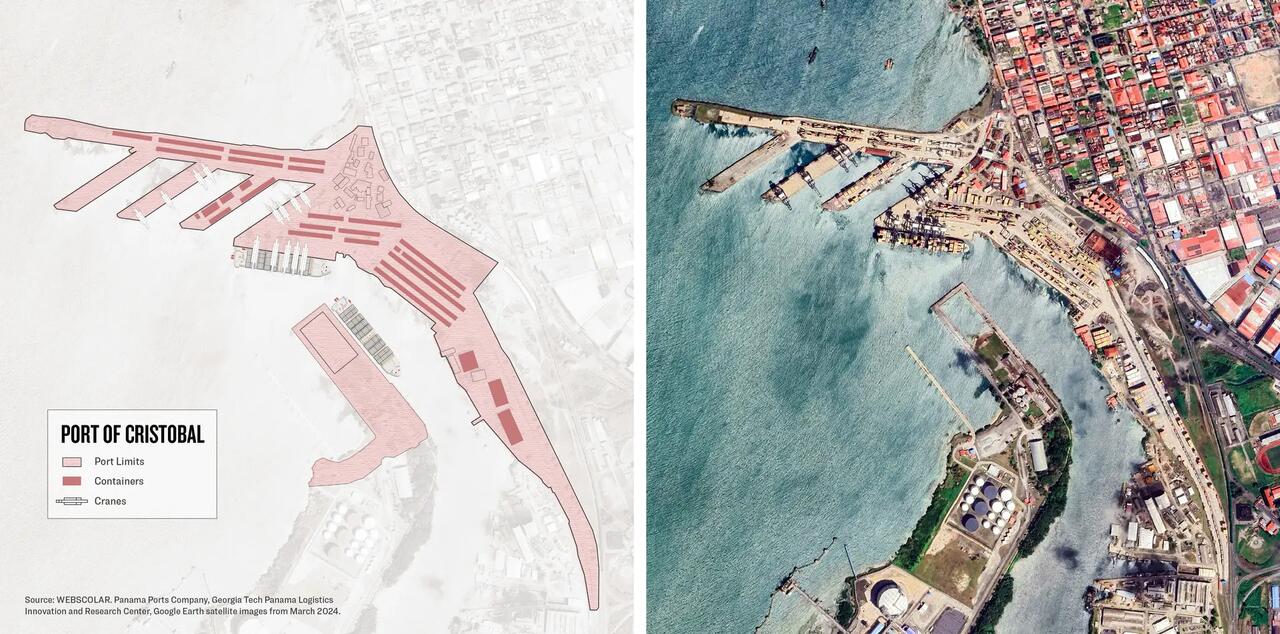
The fact that two of Panama’s five principal ports are controlled by Hong Kong-based CK Hutchison Holdings—at Balboa on the Pacific side and at Cristóbal on the Atlantic side—is a significant concern for some analysts.
Equally worrisome, in 2018 a Chinese consortium headed by China’s state-owned China Harbour Engineering Company and China Communications Construction Company was awarded a $1.4 billion contract for the canal’s fourth bridge.
“The canal is very vulnerable to any kind of sabotage,” Martínez-Fernández told The Epoch Times. “We’re not talking a [Chinese] warship in order to do that.”
The canal has both economic and military significance for the United States because it represents a strategic chokepoint, making it a critical pathway for U.S. warships in the Atlantic and Pacific oceans in the case of military conflict with the Chinese regime.
Some $270 billion of cargo passes through the canal each year, amounting to 5 percent of global maritime trade volume. More than 70 percent of that transits to or from U.S. ports.
The United States handed sovereignty of the Panama Canal to Panama on Dec. 31, 1999, under a treaty signed in 1977 by President Jimmy Carter.
The agreement included the Neutrality Treaty, in which the United States retained the right to use military force to secure the canal from foreign aggression or threats to its neutrality.
For Panama, the canal is part of its national identity and its biggest moneymaker, generating some $28 billion for the country over the past 25 years, according to Panama.
Panamanian President José Raúl Mulino said on Jan. 30 that it would be “impossible” to return the canal to U.S. control and that Panama could not arbitrarily remove concessions from companies linked to China, referring to the Hutchison ports.
However, Panama announced in January that it is auditing the Chinese port concessions.
Panama Ports Co., controlled by CK Hutchison Holdings, was notified of an audit shortly after Trump’s accusations that the CCP controls the waterway, according to the Panama Maritime Authority.
Martínez-Fernández said he believes the most likely diplomatic solution to the U.S. concern over national security will be to reduce Chinese presence along the canal and ports.
“These investments in this infrastructure from China, around the canal, around other parts of the region, the Caribbean, and South America just raise a lot of red flags,” he said.
Meanwhile, the Chinese regime has publicly supported Panama’s ownership and control of the canal, playing on Panama’s national identity and sovereignty to strengthen its political foothold.
Wang Yi, Chinese state councilor and CCP foreign minister, called Panama a “friend and good partner” during a 2021 phone call with Erika Mouynes, the Panamanian foreign minister.
Yi stated that China would “continue to support Panama’s efforts to defend its legitimate rights and interests on the international stage, including Panama’s sovereignty over the canal.”
Neutrality Issue
When flying into Panama, billboards advertising the Bank of China greeted visitors until recently.
According to residents in Panama who spoke with The Epoch Times, the billboards were taken down right before U.S. Secretary of State Marco Rubio met with Panama’s president on Feb. 2.
The billboards highlight Beijing’s influence in Panama, and Trump, in a post on social media shortly before Rubio’s visit, said Panama was attempting to take down 64 percent of signs written in Chinese.
“They are all over the [Panama Canal] Zone because China controls the Panama Canal,” Trump stated on Jan. 28. “Panama is not going to get away with this!”
Although Panama decided not to renew its Belt and Road agreement with China directly after Rubio’s visit, the fact remains that two of Panama’s key ports are controlled by a Hong Kong-based company.
CK Hutchison Holdings first won a bid to operate those two ports in 1997, but since then, Beijing has cracked down on the city’s independence and brought it firmly under the communist regime’s control.