Search This Blog

Thursday, April 17, 2025

Biden Made Over 600 Grants to Stop ‘Disinformation.’ Trump Now Has a Plan for Them

 Near the end of the Biden administration, researchers at the University of California, Irvine, were awarded a $683,000 federal grant to investigate how misinformation and disinformation on social media impact “vaccine acceptance among black and Latinx individuals.” UC Irvine said it would enroll “followers of known vaccine-hesitant influencers” and “develop a tool” to visualize its findings.

The award is among more than 800 federal grants and contracts since 2017, totaling more than $1.4 billion, to help curb speech considered by the U.S. government to be misinformation and disinformation. More than 600 were made during the years when Joe Biden was president.

The Biden years saw heightened public scrutiny of some of these programs, which Republican lawmakers and free speech groups criticized as “censorship” devices in the U.S. That culminated in an executive order from President Donald Trump on his first day in office that accused the government of violating the free-speech rights of Americans “under the guise of combating ‘misinformation,’ ‘disinformation,’ and ‘malinformation.’ ”

But until now, it has not been clear just how much taxpayer money was spent on these programs and how many federal agencies were involved in the effort. Indeed, it was only when The Free Press began contacting agencies for comment about programs listed in federal documents as active that officials in the Trump administration began to scrutinize them more closely—launching investigations and evaluating internal policies.

Since then, federal officials have terminated at least several dozen programs related to misinformation and disinformation, according to documents and interviews.

After The Free Press asked the National Institutes of Health about last year’s grant to UC Irvine, it was canceled. The NIH also canceled a $22.4 million award to progressive Latino advocacy group UnidosUS for a campaign to counter misinformation and disinformation about Covid.

NIH director Jay Bhattacharya sent an email, two days after the agency received The Free Press’s questions, that was marked “URGENT” and instructed employees at the government’s primary funder of medical research to investigate grants and contracts related to “fighting misinformation or disinformation.”

An NIH spokesperson told The Free Press that the agency is “taking action to terminate research funding that is not aligned” with new priorities.

A senior State Department official said the agency “is just getting started” on cuts there.

Secretary of State Marco Rubio has vowed to end “censorship of the American people” by the State Department, and the agency is quickly taking steps to align with that mission. On Wednesday, Rubio placed on leave dozens of full-time staff who had worked at the Global Engagement Center. Republicans had accused the office of censorship under Biden and moved to shut it down in late 2024.

After The Free Press sought comment from the State Department for this article, officials began adding “no-cost amendments” to some awards, requiring the recipients to certify “compliance with applicable federal anti-discrimination laws.”

At the Pentagon, officials are also reviewing all contracts to ensure alignment with Trump’s executive order, a senior Pentagon official told The Free Press.

The official said the Pentagon has begun changing internal terminology that describes certain programs as countering disinformation and misinformation to “countering adversary propaganda and information operations.”

Misinformation is often defined as false or inaccurate information, while disinformation is typically viewed as a form of propaganda that is intended to mislead. The U.S. has funded many anti-disinformation initiatives aimed at repelling interference in U.S. elections by foreign adversaries such as Russia, China, and Iran. Those anti-U.S. efforts include sowing discord on social media.

Trump’s executive order directed the Justice Department to work with other agencies to investigate “the activities of the federal government over the last four years that are inconsistent with the purposes and policies” of Trump’s anti-censorship order.

The edict was the culmination of Republican-led investigations, lawsuits, and other efforts in Congress during the Biden years to block funding to groups the GOP accused of unconstitutionally silencing speech, including theories about a lab leak causing Covid-19 and news reports on Hunter Biden’s laptop.

The largest active anti-misinformation award is a $979 million Pentagon contract with defense company Peraton to help the U.S. military counter foreign adversaries. As part of the program, Peraton is working with the U.S. Central Command to identify threats to U.S. national security, according to a person familiar with the contract. Peraton declined to comment.

“A range of adversaries are actively trying to spread false information to Americans, and part of the job of the government should be to try to stop that,” said Daniel Byman, a professor at Georgetown University’s School of Foreign Service. “I am always surprised that that is a controversial take.”

Critics have said the abundance of federal funding created an opportunity for the recipients of grants and contracts to inject their political views and meddle in U.S. policy.

“A large number of these projects cynically employed the ‘misinformation, disinformation, and malinformation’ framework to counter their political adversaries, with U.S. government funding making it possible,” said Andrew Lowenthal, chief executive of a free speech watchdog group called liber-net.

He is a former research fellow at Harvard University and worked on the Twitter Files, an archive of internal Twitter communications opened up to journalists by Elon Musk to shed light on the social media platform’s content moderation policies.

Liber-net compiled anti-misinformation and anti-disinformation programs into a publicly accessible database. The database offers the fullest picture yet of such programs and includes awards from as long ago as 2010.

While many of the grants have been fully paid out or terminated, others, totaling hundreds of millions of dollars, remain active.

Some of the active awards involve groups criticized by Republicans in recent years for allegedly fueling censorship.

For example, federal documents show $6.8 million in active grants to the University of Washington from the National Science Foundation. UW researchers said “inaccurate or misleading information has emerged as a growing threat to American democracy.” Most of the money is aimed at crafting “literacy resources” that help “rural communities and black, indigenous, and people of color (BIPOC) communities” identify misinformation.

In 2020, the House Judiciary Committee said in a report that a group called the Election Integrity Partnership, which UW co-founded, had “worked with social media companies to censor true information, jokes and satire, and political opinion,” despite its stated purpose to fight misinformation and disinformation.

Victor Balta, a UW spokesman, told The Free Press that the funding has helped support “work to study the ways online rumors spread during crisis events and times of uncertainty, including the 2022 and 2024 U.S. elections, the Lahaina, Maui, wildfire in 2023, and the attempted assassinations of Donald Trump during the 2024 campaign.”

That work included a study that criticized right-wing social media accounts for their “politically-driven villainization” of “professional journalists,” citing Republicans blaming the media for the attempted assassination of Trump in July 2024 at a Butler, Pennsylvania rally.

“To be clear, these projects in no way amount to ‘censorship,’ as they have not contributed to the removal or labeling of social media content,” the spokesman said.

Another award recipient, disinformation tracking company Graphika, also helped launch the Election Integrity Partnership. Graphika holds three contracts worth a total of $5.3 million through the Department of Defense.

Meghan Hermann, a Graphika spokeswoman, said the contracts “relate to technology for analyzing online activity by U.S. adversaries in foreign military theaters.” She said the company isn’t aware of its technology or data being leveraged by the U.S. government for censorship.

Researchers for the Election Integrity Partnership have insisted that it didn’t suppress domestic speech and examined disinformation only related to false election-related claims.

The senior Pentagon official said the contracts are part of the agency’s congressionally authorized mission to counter foreign propaganda.

But the agency is being careful to ensure it is aligned with Trump, the official added.

In Congress, powerful Republican lawmakers are now working with the Trump administration to identify further spending cuts. Jim Jordan, the Ohio Republican who chairs the House Judiciary Committee, told The Free Press some of the awards that are still active “may spark us to do additional things in some of the areas we haven’t quite dug into yet.”

In February, Jordan’s committee said the National Science Foundation funded “artificial intelligence–powered” censorship tools used by social media companies. The NSF previously said it “has no role in content policies or regulations.” It declined to comment for this article.

Brian Mast, a Florida Republican who leads the House Foreign Affairs Committee, said he is helping identify programs to cut as part of a State Department reauthorization process updating its policy priorities for the first time in more than two decades. The GOP-led committee “won’t let unelected bureaucrats waste taxpayer dollars censoring speech or pushing anti-American ideology abroad,” Mast told The Free Press.

This month’s new requirement by the State Department forcing some award recipients to certify “compliance with applicable federal anti-discrimination laws” applies to a $2.6 million grant to a Vermont-based nonprofit organization called World Learning, which said it would “build societal resilience to disinformation/misinformation.” The “no-cost amendment” was also added to a $100,000 grant to Tanzanian website Jamii Forums for fact-checking.

The status of some grants also remains unclear. Washington State’s broadband office was awarded $16 million to help thwart “online misinformation.” A Trump administration official said the money is on hold as part of an investigation into $2.7 billion in Biden-era “digital equity” grants.

But Amelia Lamb, a spokeswoman for the broadband office, told The Free Press, “We haven’t received any notice about potential cancellation and we’re proceeding with business as usual.”

https://www.thefp.com/p/joe-biden-made-600-grants-to-stop-disinformation-misinformation-donald-trump-cancels-awards

Choosing the Diagnosis

 “There are only three things that are important in medicine: diagnosis, diagnosis, diagnosis.”

William Osler, The Principles and Practice of Medicine

Osler’s aphorism about the importance of the diagnosis applies to the electronic health record (EHR) almost as much as it did to doctoring in the late 19th century. Diagnoses have three functions in the EHR: identification of the nature of the patient’s illness, justification for orders, and support for billing. In the best of circumstances one diagnosis would fulfill all three needs; however, order entry and billing level of service have undue influence over our choices. As physicians, we have lost some control over these decisions. We may make the diagnosis in the exam room, but we choose the diagnosis in the EHR. The only way to tolerate the frustration is to be amused.

The pool of ICD-10 diagnoses in the EHR is expansive. Some diagnoses have too many options; others are simply absurd. Pain is the largest category, including every anatomic site and permutation imaginable. There are lists of aggravating and relieving factors, association with bodily functions, attribution to numerous procedures or implantable devices, adherence (or not) to pain management contracts and intensities for every integer on both the verbal and non-verbal pain scales. There are even specific diagnoses for patients who have “deficient knowledge” of their pain, codifying a type of poor historian.

Trauma, in particular, yields a frightening but entertaining litany of injuries. One can scroll through the multitude of body parts from which a patient could suffer a bite, or wound, or retain a foreign body within. There are 67 choices for a stab wound to the ankle.

To the dismay of geriatricians and good fortune for personal injury attorneys, there are scads of ways to fall, from the mundane to the bizarre. Only slipping on a banana peel is missing.

Fall:

on scissors (despite parental admonitions not to run)

downhill (like Jack and Jill)

from a moving sidewalk (Watch your Step!)

off a cliff (“Why don’t you go jump…”)

into a storm drain or manhole cover (Grandma was right next to me…)

from a haystack (but found the needle)

from other gliding type pedestrian conveyance (AI hallucination?)

slipping, tripping, and stumbling (Chaplinesque)

collision with (nonpowered) inflatable craft or other watercraft or object (Huh?)

into a bucket of water causing other injury (circus divers)

assaulted by steam or hot vapors (vegetable cooker with agency?)

slipping on ice (completes the three physical states of H20)

Smoking cessation has some strange entries. I hadn’t felt threatened by former smokers until I saw this list:

Smoking cessation:

former trivial smokers (less than one per day)

tolerant former smokers

aggressive former smokers

militant former smokers

Apparently, there is a continuum of nicotine addiction from tolerance to militancy in former smokers analogous to the stages of quitting. I should tread lightly when reinforcing smoking cessation.

For order entry in our hospital-based internal medicine practice my preferred diagnosis is the one that best reflects my rationale, but sometimes the appropriate diagnosis doesn’t compute. For example, the diagnosis that allows me to order a screening bone density study for osteoporosis is not the intuitive “screening” or “osteoporosis risk” but “asymptomatic postmenopausal status,” a condition that an infinite number of monkeys using AI would never consider. Chest CT for lung cancer screening presents a similar problem. The magic words are “personal history of tobacco use, presenting hazards to health.” Prompting for the USPSTF criteria comes later. Choosing the justification for vaccines is my favorite. “Immunization due” works for all of them. It’s versatile and comes close to two authoritative universal justifications one can only dream about: “Because I said so.” or “Because she needs it.” (Patients who decline immunizations also should have to justify their decisions.)

Billing presents its own problems with diagnoses. We want our group to prosper, but despite innumerable training sessions, most of us are bewildered by the Byzantine criteria for determining the level of service. We do what works. When my documentation is incomplete or lacks the required criteria, I receive a coding query from a billing specialist. It’s often a question about a visit I had long forgotten. A response is mandatory; the message cannot be forwarded or deleted. Often, the question cannot be answered. A few examples:

The patient has had breast, colon and skin cancer, all in remission.

Which is primary?

(“All are primary” is rejected.)

An inpatient had a BUN/creatinine of 30/1.8 mg/dl. The hemoglobin was 11.4 g/dl. The only other data point is a creatinine of 1.1 mg/dl from five years previous.

Is this AKI or CKD?

(Uncertainty is not appreciated.)

A frequent query is the categorization of malnutrition and the repletion of the second tier chemistries, magnesium and phosphate.

Treating starvation and hypophosphatemia must be a billing bonanza.

Artificial intelligence promises to erode our diagnostic autonomy. The diagnostic accuracy of large language models has equaled or outperformed clinicians in recent studies using sample cases. Eventually AI will usurp our role as diagnostician. Technology might not replace us entirely, but it could be the most important thing in medicine.

Todd Stern MD is a general internist at the University of Chicago.

https://www.sensible-med.com/p/choosing-the-diagnosis

Science Subsidy Trap: Why Public Research Funding Needs to End

 The U.S. government spends over $160 billion annually on scientific research. This massive expense is marketed to taxpayers as an investment in groundbreaking research that fuels innovation and discovery. In truth, much of the federal science budget is expended on questionable and even fraudulent research. It’s time we eliminate it.

The academy has been in an uproar since Donald Trump began his second term as president in January. One article after another in seemingly every major science media outlet has lamented the administration’s dramatic cuts to federal science funding, all making essentially the same argument: the administration’s policies “imperil the nation’s health, economy and national security,” as Scientific American put it.

This response is understandable, but it fails to grapple with the rampant fraud, ideological bias and proliferation of low-quality research driving the administration’s cuts to science funding. Much of the academic work taxpayers are forced to fund provides no benefit or, even worse, causes serious harm in a variety of ways. As a result, the cuts to federal science funding need to continue until science is an entirely private enterprise.  

Publicly funded fraud

This is an admittedly radical proposal, but it’s an appropriate response to the systemic failure we need to correct. Taxpayers spend a king’s ransom on science each year yet the return on our investment is underwhelming. 

In September 2024 for example, Science reported that a veteran neuropathologist running the National Institute on Aging's Division of Neuroscience–with an annual budget of $2.6 billion–had probably falsified images in key studies used to justify developing novel drugs for Parkinson’s Disease—an effort that carries an additional price tag of hundreds of millions of dollars. “I’m floored,” Mount Sinai neurologist Samuel Gandy told Science during an interview. “Hundreds of images. There had to have been ongoing manipulation for years.”

Other high-profile fraud cases underscore the problem: take Anil Potti, a Duke University researcher who faked cancer trial data, misleading patients and squandering millions in grants, or the infamous case of Woo-Suk Hwang, whose fabricated stem cell research misled global science for years. And the problem persists. Harvard’s prestigious Dana-Farber Cancer Institute was forced to retract seven studies just last year following the discovery of manipulated images in the research. 

A few bad apples?

Academics who rely on federal grant funding will insist that these fraud cases represent a few bad apples, unfortunate outliers that besmirch the reputations of researchers who do good work. This analysis misses the mark, however. “Fake studies have flooded the publishers of top scientific journals,” The Wall Street Journal reported last May, “leading to thousands of retractions and millions of dollars in lost revenue.” 

The problem is so massive that one Northwestern University researcher called it “an existential crisis” for science in February 2024. Studies estimate that roughly 50% of published research in fields like psychology and biomedicine fails to replicate. A 2015 analysis in PLoS Biology found that irreproducible preclinical research, "with government sources providing the majority of funding," costs $28 billion annually in the U.S. alone. These aren’t outliers but symptoms of a dysfunctional system. 

Tactical science

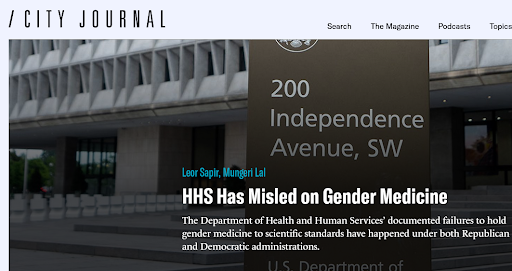
This leads to a related but equally troubling concern: federal funding is often used to advance political causes with zero scientific merit. Examples run the gamut of academic disciplines. From climate change and infectious disease research to pediatrics, there is ample evidence of scientists incorporating ideological dogma into their conclusions. It’s what science policy expert Roger Pielke, Jr. calls tactical science: research “designed and constructed to serve extra-scientific ends, typically efforts to shape public opinion, influence politics, or serve legal action.” Here’s one particularly egregious example:


Ironically, much of this tactical science is used by activists like our new Health and Human Services secretary RFK, Jr. to justify his radical proposals, including chemical regulations the science community opposes. For example, many scientists mocked Kennedy for claiming during his senate confirmation hearing that fluoride is a neurotoxin; few of them stressed that he cited an NIH-funded study from the Journal of the American Medical Association (JAMA), one of the most prestigious peer-reviewed publications in the world.

 It’s the same story with other popular health scares. The ongoing activist campaign against low-risk pesticides? Built on a foundation of sloppy epidemiology heavily funded by the federal government. In one truly galling example, the EPA went to court a few years ago to challenge an insecticide ban that was proposed after EPA-funded research wrongly linked the chemical to health harms in children. 

The examples go on and on: “ultra-processed” food linked to early death; food dyes associated with ADHD in children; PFAS harms infants; BPA causes endocrine disruption; tampons expose women to leadsugar is addictive. If you’re a taxpayer, you paid for all these studies, and they benefit no one except trial lawyers and activist groups who raise money by pushing chemical scares.   

Non-existent benefits of public science funding

The opposition to president Trump’s funding cuts revolves around the claim that government support for science yields clear benefits. But history doesn’t bear out this claim. Biochemist Terrence Kealey, author of the seminal text on this subject, has highlighted a striking piece of evidence at the country level. 

The industrial revolution began in Britain; and the US experienced a similar explosion in industrialization not long after, yet neither country made significant public investment in science during this period, Kealey has pointed out. Meanwhile, the governments of France and Germany poured enormous resources into scientific research yet lagged far behind the Americans and the British in economic development. 

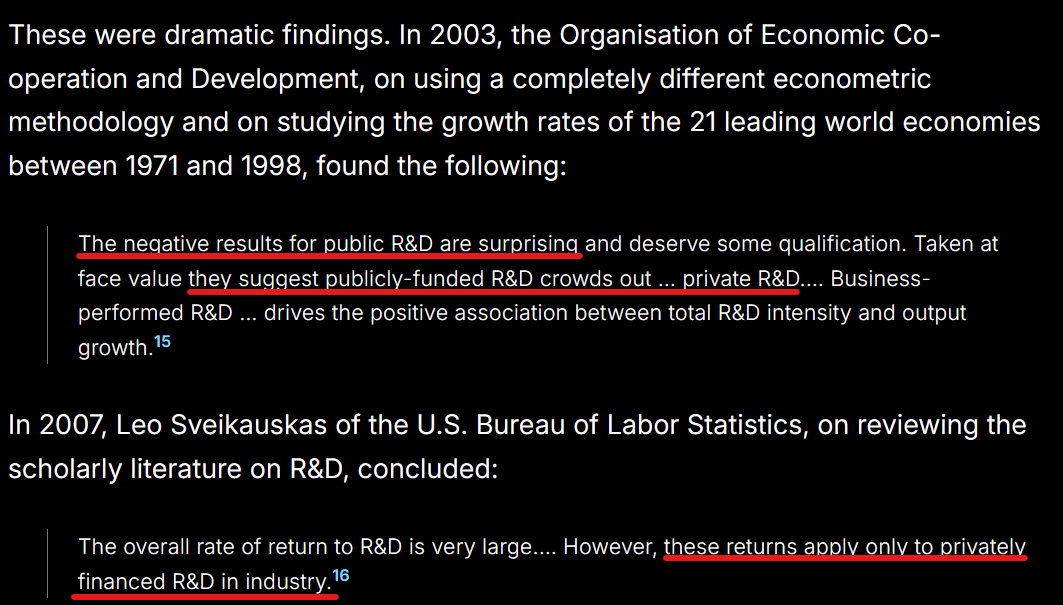
This natural experiment is hard to explain on the view that public support for science is essential. So is the spade of government-sponsored audits examining the supposed economic benefits of public research funding, which “have emerged as the most effective discreditors of the idea,” Kealey argued in a 2021 policy brief for the Cato Institute. Here are the conclusions from just two of those audits:


Importantly, the campaign to ramp up public R&D investment in the US wasn’t driven by a dearth of scientific progress–there was plenty of that at the time–but politics, specifically the fear that America was losing the Cold War. Of course, the Soviet Union was an economic basket case characterized by famine and other horrid deprivations. The US was never at risk of losing the Cold war—meaning the push for expanding public science funding was premised on a falsehood from the beginning.

 What about public goods?

Perhaps the most common objection to this privatization proposal is the assumption that private institutions, corporations and foundations primarily, won’t fund a lot of research because it lacks immediate commercial payoff, and thus governments must step in and support this “public good.” The argument is some 400 years old, but it’s never been compelling. 

Before World War II, private entities drove foundational science. In fact, “private funding was the main and often only support for scientific endeavors” before the 1940s, Nature explained in 2016. Importantly, that observation provided context for the article’s broader thesis: 

“... [T]he stagnation in federal funding since 2003 has led to increasing concerns that science will suffer, because more risky or preliminary projects are not likely to get funded … Money from private foundations can fill this financial gap to a degree” [my emphasis].

High-profile examples of this phenomenon from the past aren't hard to find. The Rockefeller Foundation pioneered infectious disease prevention and treatment in the early 20th century without a dime of public money. “Between 1913 and 1950, the RF invested $100 million in health programs,” University of Geneva historian Ludovic Tournès noted in 2022:

“At first, the Rockefeller Foundation focused on public health issues, especially in Latin America, where in 1916 it conducted surveys in many countries, followed by programs to eradicate diseases such as hookworm, malaria and yellow fever.” 

The foundation’s “main characteristic is that it sprang from, and owes its considerable financial resources to, American capitalism,” Tournès added. This private model delivered results more efficiently than many modern publicly funded programs, supporting the case for privatization.

The simple fact is that private R&D spending dwarfs public investment, with as much as 70 percent of science financed by corporations and charities. In the US, the difference is similarly massive. Of the $892 billion total invested in R&D in 2023, “the business sector funded $673 billion and the federal government funded $164 billion,” the National Science Foundation reported in February.

Creative destruction

Economists often talk about creative destruction, a process by which innovation drives economic growth by creating new industries, products, or methods that displace their obsolete predecessors. The scientific establishment needs to undergo something similar to creative destruction. 

Like the rest of us, academics can convince people to voluntarily pay for their services. Worthwhile research, like innovative crop breeding research or vaccine development, will find private support, as it always has. Academics who study “Decolonial Eco-Queer Theories” will probably have to find new jobs.

Cameron English is a writer, editor and co-host of the Science Facts and Fallacies Podcast. Before joining ACSH, he was managing editor at the Genetic Literacy Project.

https://www.acsh.org/news/2025/04/16/science-subsidy-trap-why-public-research-funding-needs-end-49423

Rethink, recalibrate, and redistribute NIH Funding


Peter J. Pitts

DOI: https://doi.org/10.70542/rcj-japh-art-1yh5z28


Abstract


The National Institutes of Health (NIH) awards billions of dollars in grants for medical research.1 But is the American taxpayer getting the best bang for the buck? Advancing science is a worthy goal, but perhaps the proper goal should be advancing science to advance patient care. That’s basic science and translational research. How can we explain this yawning chasm in program funding? Between 2010-2019, 83% of NIH grants (totaling $156 billion) were for basic research and 17% ($31 billion) were for translational research. Considering this vast financial differential in funding, it’s relevant to consider if the huge differential between basic and translational research is appropriate. Is basic research nearly 50% more important than translational research?

Bessent hosts private talks with banking regulators amid deregulation push

 U.S. Treasury Scott Bessent is privately meeting with banking regulators as he pushes to streamline oversight and ease regulations

https://seekingalpha.com/news/4432332-bessent-hosts-private-talks-with-banking-regulators-amid-deregulation-push---report

Hikma acquires rights to generic version of Novartis' Mekinist

 Trametinib is an orally administered kinase inhibitor used in the treatment of certain cancers. It is the generic version of Mekinist

https://seekingalpha.com/news/4432336-hikma-acquires-rights-to-generic-version-of-novartis-mekinist