Search This Blog

Friday, May 2, 2025

Democrats' disastrous first 100 days

by Kellyanne Conway 

As pundits, pollsters, and op-ed writers turn to their assessment of President Donald Trump’s first 100 days -- an "artificial metric," White House Chief of Staff Susie Wiles once said -- it seems fitting to examine what the Democrats have done (and failed to do) over the same period.

The Democratic Party is in complete disarray. With only 27% saying they view their own party positively, the Democrats are suffering their lowest positive rating in NBC tracking in 35 years. They continue to openly blame, name and shame each other for lying to the nation about Joe Biden’s ability to function as a successful president (and frankly, Kamala Harris’ ability, too), for not stopping Donald J. Trump from winning a second term, and for being a rudderless, leaderless, visionless mess since.

With GOP control of the House, Senate and the White House, Democrats are the party out of power. Yet they are also the party out of touch with most Americans, out of excuses as to why they lost last fall, out of reasons why core Democratic constituencies that went for President Trump in 2024 should give Democrats another look, and often out of their minds in the hateful rhetoric they use.

Lately, the causes and characters they champion include hulking men in girls’ sports and a Salvadorean national "Maryland man" with gang affiliations, whose wife filed abuse charges against him. Because nothing says "we care about women" quite like stuntman and sometime Sen. Chris Van Hollen, D-Md., who has dishonored the memory of constituent Rachel Morin, a mother of five who was raped and murdered in his state by an illegal immigrant, but hightailed it to El Salvador to whine about "due process" for someone whose wife detailed multiple violent assaults.

Van Hollen has been awkward, but not alone. Congressional Democrats like Ayanna Pressley, who have done nothing to prevent or punish anti-Semitism on college campuses, have glorified antisemitic protesters, visited them in ICE detention centers, and referred to them as "political prisoners."

Read On The Fox News App

Same with Teslas. Democrats want to force us all to drive electric vehicles, "EVs," but not if Elon Musk’s company produced it. Those can be destroyed by arsonists.

Democrats’ obsession with Trump continues. He’s persisting while they're resisting. Trump Derangement Syndrome (TDS) is as incurable as it is insatiable. They are fighting the last war and poised to lose it again. They yell "bipartisanship" and vote as a pack. They talk too much and do too little. As President Trump transforms the GOP into the party of the worker, Democrats represent the elite and effete.

With each passing week, the Democratic Party finds new ways to insult, neglect, and alienate Americans, who would prefer they get on board with border security, tax cuts, deregulation, energy independence, minerals deals, trade deals and peace deals.

Democrats seem more focused on running for POTUS in 2028 than on helping the country in 2025. For four years they lied about the president’s acuity and ability. The least they can do for the next four years is lean into a president who is trying to fix what has been broken and tackle what’s been ignored.

As President Trump reflects on promises kept in his first 100 days in office, here are 25 mind-numbing things Democrats did and said in 2025 (so far):

  1. Democrats turned President Trump’s Joint Address to Congress in March into a disjointed political theater. They paddle-waved, stood for no reason, heckled, and even sat stone-faced when a 13-year-old brain cancer patient was named an honorary Secret Service member.

  2. New Jersey Sen. Cory Booker and other Dems held a 12-hour sit-in, – a "moral moment" on a "sacred civil space" – to protest Trump's budget proposal. Preaching to a camera on the Capitol steps while Congress isn’t in session and other folks are in church is weird. Booker, who, like Kamala Harris, received ZERO votes in the 2020 Democrat primaries, seems super bored lately. He spoke for 25 hours on the Senate floor and said precious little.

  3. At a New Hampshire Democratic fundraiser, Illinois Gov. JB Pritzker called for "mass protests," stating Republicans "cannot know a moment of peace," and must be "castigated" and "punished," "feel[ing] in their bones…that we will relegate their portraits to the museum halls reserved for tyrants and traitors." Democrats cannot help but diminish and threaten their opposition, regardless of the consequences.

  4. The Democrats’ remarkable talent for misreading the room was on full display with a painfully awkward "choose your fighter" video that made everyone except their most devoted supporters physically recoil.

  5. Polls show Senate Minority Leader Chuck Schumer has record-low approval ratings in his state of New York, and is under threat by thirsty AOC, who may primary him.

  6. Rep. Jasmine Crockett referred to Texas Gov. Abbott (who is paralyzed and uses a wheelchair) as "Governor Hot Wheels" to ignorant laughter from the audience she was entertaining (not educating). One of the loudest mouths of late showed a lack of civility by making an ableist joke at a human rights event.

  7. In a bold new strategy to clinch back power, Democrats are now funding attacks on...other Democrats. Newly-elected DNC Vice Chair David Hogg pledged $20 million to oust "asleep-at-the-wheel" Democratic incumbents, incurring the ire of an old guard that thought it would be cool to elevate a young guy to "help" them hold onto power.

  8. In a not-so-clever series of coordinated, synchronized videos called "Sh*t That Ain’t True," Democrats accidentally introduced more Americans to President Trump’s policies and achievements.

  9. Ignoring the will of many Americans to toss acronyms like CRT, ESG and DEI in favor of USA, the DNC now insists that "leadership diversity" includes a nonbinary title-holder.

  10. The DNC also kicked off its leadership vote with "land acknowledgement"—that America is "stolen land"—because nothing rallies voters like a guilt trip about their country.

  11. Every DNC Chair candidate explained the 2024 loss not as one of strategic failures or messaging missteps of a deeply unimpressive candidate, but with the shopworn charges of racism and misogyny.

  12. Rep. Jasmine Crockett blamed grocery prices and housing costs, which were stubbornly sky-high during Biden-Harris, on President Trump’s deportations.

  13. 82-year-old Rep. Rosa DeLauro cringingly tried to attract young voters by dropping Gen Z slang terms, instead of dropping interest rates or unemployment rates for them.

  14. In an apparent attempt to get on a watchlist, an illegal activist proudly announced her immigration status, sexual orientation, and protest schedule.

  15. In his first speech since the election, President Joe Biden made reference to "colored kids."

  16. Michigan Gov. Gretchen Whitmer very foolishly tried to take cover behind a stack of blue folders during a press conference with President Trump in the Oval Office.

  17. Former Kamala Harris running mate, Minnesota Gov. Tim Walz openly celebrated Tesla’s stock drop, ignoring the thousands of jobs tied to Tesla and the $400 million loss to Minnesota’s pension fund.

  18. Former House Speaker Nancy Pelosi was visibly upset during President Trump’s Joint Address to Congress when POTUS announced no more men in women’s sports.

  19. The mainstream media spent 64 minutes covering the Kilmar Abrego Garcia story, and ZERO minutes on victims of illegal immigrant crimes or their families.

  20. House Minority Leader Hakeem Jeffries posted a video claiming "the American people are with us" in his opposition to Trump—even though he was standing alone outside the Capitol.

  21. New York Attorney General Letitia James, the top law enforcement officer of the third largest state, who promised to take down Trump, lied that her father was her husband, and she allegedly falsified mortgage documents.

  22. AOC pulled a Kamala (and a Letitia) at a Nampa, Idaho, rally, after sporting a new accent to connect with the crowd. This was part of a "Fighting Oligarchy" tour -- where she and Sen. Bernie Sanders flew on a private jet to bemoan the wealthy.

  23. On "The View," Stephen A. Smith schooled hostile hosts and caused a mini-furor after saying Trump’s win actually counts as a "mandate." Democrats will never win ever again if they don’t acknowledge reality and stop with the same old strategy.

  24. Democrats planned late-night speeches on the floor to mark what they called "100 days of hell." Weaponizing empty gestures by ranting to C-SPAN after bedtime is not an effective strategy. Take my advice: do less complaining and more policy.

  25. In spite of his remarkable accomplishments so far, President Trump’s second term has 92% negative media coverage from ABC, CBS, and other Democrats. It’s no wonder public trust in the mainstream media is the lowest it’s been in over 50 years.

Damodaran: Valuation of the Week #3: Apple

 Valuation of the Week #3: Apple

Background

This week, we start on our first company valuation and I picked a company that is both a favorite of mine and an obsession. It is Apple, a company that I have valued once every three months since 2010. As you look at the valuation, you should be able to follow along with many different themes that we have already started talking about in this class, as well as specific details (like how to estimate equity risk premiums and betas). I have also attached my latest valuation of Apple. Feel free to download the spreadsheet and make it yours.

Story and Numbers

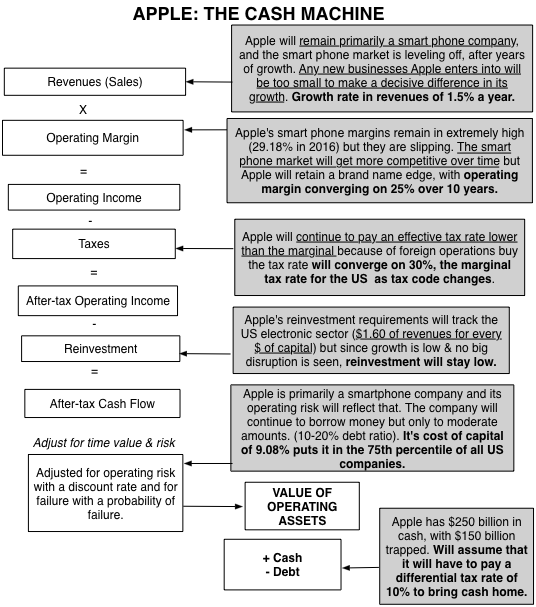
One of the first themes that I introduced for this class was that every valuation is enriched by a story that becomes numbers. For Apple, the story that I have been telling about thec company for the last seven years has been remarkably consistent. In my September 2010 valuation, where I looked at Apple just after it had become the largest market cap company in the world and had come off perhaps the greatest decade of disruption of any company in history (iTunes with music, iPhone and phones, iPad and computers), I had come to conclude that Apple was one of the great cash machines of all time, but that its days of disruption were behind it, partly because Steve Jobs was no longer at the helm but more because of its size. It is so much more difficult for a $600 billion company to create a significant enough disruption to change its earnings, cash flows and value. So, in my story, I see Apple continuing to produce massive cash flows, with little revenue growth and gradually lower margins in the future, as the smartphone business became more competitive. I won't make you read all of the posts that I have on Apple, but let me start with a post that I had in August 2015, when I updated that story (and looked at Facebook and Twitter at the same time.

Narrative Resets: Revisiting a Tech Trio (August 2015)

Once you have read that post, you can move on to a post from February 2016, where I revisited the story after an earnings report from Apple and compared it to Alphabet:

Race to the top: The Duel between Apple and Alphabet (February 2016)

In May 2016, Carl Icahn, a long time bull on Apple sold his shares, and Warren Buffett, a long time avoider of tech companies, bought shares in the company. I looked at how actions by these big name investors changed (or did not change) my story:

Icahn exits, Buffet enters: Whither Apple? (May 2016)

Last week, Apple released its latest 10Q and in conjunction with its latest 10K (Apple's fiscal year end is in September), I now have updated numbers for Apple. Using those numbers, I took at look at my Apple story and guess what? It looks like it did last year, a great cash machine, with flat revenues and declining margins.

Valuation Details

Since the Apple story is a simple one, my valuation reflects the story. The picture below takes my story and converts it into valuation inputs:

Apple Story

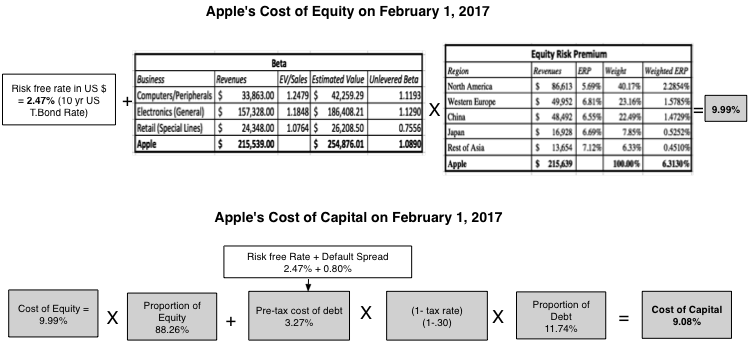
Those valuation inputs are what drive my most recent valuation of Apple, which you can download here. As you browse through the valuation, you may want to pay attention to how the cost of capital is computed for Apple, since I draw on many of the lessons we talked about in class about risk free rates, equity risk premiums and betas (ahead of tomorrow's class.

AppleWACC

Value and Price

The bottom line is that my estimate of value for Apple right now is $129.04, just a hair below its current price of $130.27; a year ago, it was 25% below value and the difference has narrowed. My investment from last year has paid off, but lest it looks easy, my journey with Apple over the last seven years summarizes why making money on valuation takes patience and luck.

valuevsprice

Your turn

Now, its your turn. Your story for Apple may be different from mine and if it is, here is what I want you to do. Take my spreadsheet and use it to reflect your story. So, if you think that Apple can find a disruptive product (electric car, fintech) that can put it back on a growth path, you might use higher revenue growth than I do, though these may be more capital intensive and lower margin businesses. See what you get as a value. When you are ready, the shared google spreadsheet awaits you:

https://docs.google.com/spreadsheets/d/1T8Sj37Y2uBwjT6REYMsVtlneO-Q416dKlBB13rhLijM/edit?usp=sharing

Good luck!

https://pages.stern.nyu.edu/~adamodar/New_Home_Page/Valuationofweek/AppleValuation2017.htm

All The Things People Use AI For In 2025

 Thought leaders dubbed ChatGPT’s emergence - and subsequent generative AI proliferation - as the “fourth industrial age.”

Whether it will re-shape the economy entirely still remains to be seen. But there’s no denying that most people are familiar with, and are actively using AI.

What are they using it for?

This ranking tracks the most popular AI use cases as sourced from an analysis done by Marc Zao-Sanders for Harvard Business Review. He examined thousands of forum posts over the last year in a follow-up to his 2024 analysis.

The top 30 ranks from this report have been visualized in this graphic via Visual Capitalist's Pallavi Rao. Labels have been edited lightly from the source for readability. 

This visualization is part of Visual Capitalist’s AI Week, sponsored by Terzo.

Here’s How Everyone is Using AI in 2025

People are using AI for support (both professional and personal) in 2025

In fact, the top three use cases (therapy, life organization, and finding purpose) all show that AI can assist humans in managing both emotions and their life.

2024Use CaseCategory2025Use CaseCategory
1Generate IdeasContent
Creation
1Therapy & CompanionshipSupport
2Therapy & CompanionshipSupport2Organize LifeSupport
3Specific SearchResearch
& Analysis
3Find PurposeSupport
4Edit textContent
Creation
4Enhance LearningLearning &
Education
5Explore InterestsLearning &
Education
5Generate CodeTechnical
Assistance
6Fun & NonsenseCreativity &
Recreation
6Generate IdeasContent
Creation
7TroubleshootTechnical
Assistance
7Fun & NonsenseCreativity &
Recreation
8Enhance LearningLearning &
Education
8Improve CodeTechnical
Assistance
9Personalize LearningLearning &
Education
9CreativityContent
Creation
10General adviceSupport10Healthy LivingSupport
11Draft emailsContent
Creation
11Interview PreparationLearning &
Education
12ExplainersLearning &
Education
12Generate ImagesCreativity &
Recreation
13Write & Edit RésuméSupport13Specific SearchResearch
& Analysis
14Excel FormulasTechnical
Assistance
14ExplainersLearning &
Education
15Email WritingContent
Creation
15Cooking GuidanceCreativity &
Recreation
16Evaluate CopyResearch
& Analysis
16TroubleshootTechnical
Assistance
17Improve DecisionsResearch
& Analysis
17Personalize LearningLearning &
Education
18TranslationTechnical
Assistance
18Boost ConfidenceSupport
19Improve CodeTechnical
Assistance
19Email WritingContent
Creation
20Draft DocumentContent
Creation
20Explain LegaleseTechnical
Assistance
21Navigate
Personal Disputes
Support21Child EntertainmentCreativity &
Recreation
22Summarize ContentLearning &
Education
22Corporate LLMSupport
23Make a ComplaintSupport23Student EssaysLearning &
Education
24RecommendationsCreativity &
Recreation
24Travel ItinerarySupport
25Cooking GuidanceCreativity &
Recreation
25Childcare HelpCreativity &
Recreation
26Generate AppraisalsContent
Creation
26Medical AdviceSupport
27CreativityContent
Creation
27Navigate Personal DisputesSupport
28Medical AdviceSupport28Generate Legal DocumentContent
Creation
29Generate
Legal Document
Content
Creation
29ConversationsSupport
30Fix CodeTechnical
Assistance
30Anti-trollingContent
Creation

And aside from therapy, these were not the top uses in 2024: which revolved around idea generation and search.

Speaking of AI search, its popularity has fallen 10 spots. People are still interested in learning and making AI explain concepts or add context for them. But they’re not actively looking up information as much.

(This may also be because of Gemini’s integration in Google Search).

AI For Mental Health: Good or Bad?

With mental health support severely underfunded and the Loneliness Epidemic only continuing, it’s no surprise AI has emerged as a viable outlet for people to get some support in their life.

Experts say they can see its usefulness for teaching mindfulness or cognitive behavioral therapy to users.

However, the problem occurs when AI is used as a replacement for actual human relationships, preventing deeper human connections, in turn exacerbating loneliness.

Need More AI Insights? From our AI Week coverage, brought to you by Terzo, check out the Countries Accumulating the Most AI Patents and much more on the AI content hub and discover where the future of AI is going to emerge.


More Climate Litigation Silliness From Academia

 by Jonathan Lesser via RealClearEnergy,

A recent article published in Nature claims that climate liability lawsuits, such as the ones various U.S. states and municipalities continue to pursue, are on rock-solid legal grounds, thanks to the authors’ new research “proving” that the world would be $28 trillion richer today but for carbon emissions from fossil fuels over a 30-year period, 1991 -2020. Ignoring the emissions from developing countries, notably China, which today accounts for one-third of all energy-related greenhouse gas (GHG) emissions, the authors focus instead on oil companies, which they call the “carbon majors” – especially Saudi Aramco, Chevron, ExxonMobil, BP, and Gasprom.

For example, according to the authors Chevron has caused an estimated $2 trillion in damages, and perhaps as much as $3.6 trillion. Exxon Mobil is right behind at $1.9 trillion. Similarly, Saudi Aramco and Gazprom are each responsible for $2 trillion in damages. BP is the laggard, at just under $1.5 trillion in damages. Levying fines of those amounts, which greatly exceed these companies’ market values, would lead to their immediate bankruptcy. While the authors may consider such an outcome a “win,” bankrupting these companies would not change the physical and economic realities that the world depends on fossil fuels and will continue to do so for the foreseeable future. (Moreover, it is not clear who would levy the fines and who would receive the monies received – other than trial lawyers.)

To derive their damage estimates, the authors combine bad science with bad economics. First, they use simplified climate models to predict what average world temperatures would have been had there been no GHG emissions from fossil fuels. Next, they use other models to determine how many fewer extreme heat events, which they define as the hottest five days of each year, there would have been absent GHG emissions from fossil fuels. Finally, they calculate the damages in terms of lost GDP based on a simplistic regression model that assumes lost GDP increases in proportion to the square of temperature increases, and which ignores the myriad other economic factors that affect economic growth. They justify this absurd specification, which has no economic basis, on “peer-reviewed research” – a previous article they published.

The approach used by these authors is a form of “attribution science,” which attempts to link specific weather-related events to GHG emissions. That approach, which was first developed about two decades ago to attribute a 2003 European heat wave to climate change, is statistical legerdemain that depends on counterfactual models, just as the authors use here.

Ironically, the authors acknowledge the benefits of fossil fuels, stating that “fossil fuels have also produced immense prosperity.” Yet, they purposefully ignore those benefits because, as they state, “these companies have already been handsomely paid.” This latter statement reveals further economic ignorance. Without fossil fuels, modern life would be impossible. The benefits of fossil fuels to modern society are probably incalculable, but they far exceed the profits these companies have made, and far exceed the damage estimates the authors calculate.

The authors claim that fossil fuel damages are what economists call an “externality” and that “Courts may need to consider how the benefits of energy use are balanced against its externalities and the potential duty of care these companies have to the public.” (They also raise the discredited claim that oil companies “knew” about climate change and hid the evidence from the public.)

Externalities are a real phenomenon of energy development and use. But in this case the externalities are unobservable and instead estimated based on theoretical models having little accuracy. Moreover, levying penalties to “internalize” an externality that would cause far greater economic losses is unjustified.

Ultimately, this article is simply an advocacy piece for specious lawsuits against oil companies with deep financial pockets. Nature should be ashamed of itself for publishing it.

Jonathan Lesser is a Senior Fellow with the National Center for Energy Analytics. His report, “The Social Cost of Carbon: A Flawed Measure for Energy Policy,” was released on April 23.

https://www.zerohedge.com/energy/more-climate-litigation-silliness-academia

Brain interface allows speech decoding and computer control in ALS patient

 University of California, Davis researchers have developed a brain-computer interface (BCI) that enables computer cursor control and clicking, using neural signals from the speech motor cortex. One participant with amyotrophic lateral sclerosis (ALS) used the interface for daily life activities, including independent control of a personal desktop computer and text entry.

Neurological diseases such as stroke or ALS can interrupt the pathway from the brain to the muscles, causing a loss of movement and communication. ALS progressively destroys upper and lower motor neuron pathways, leaving cognition intact but causing paralysis in all four limbs and significant  impairment.

Brain-computer interfaces are intracortical implanted devices that bypass any disruption by reading neural signals directly from the brain and producing output on the user's behalf. Many BCIs have relied on  from the dorsal motor cortex, a brain region associated with hand and arm movements. When signals are decoded, users can move a  by attempting or imagining limb motion.

In contrast, speech BCIs rely on the ventral precentral gyrus, where neural signals are linked to facial movements and speech articulation. Decoding  from this region enables fast, speech-based communication but has not been shown to support general computer navigation or motion control.

Implantation into both dorsal and ventral areas would be ideal, yet it is considered surgically impractical or infeasible. As a result, users and clinicians must choose between cursor control and speech decoding.

In the study, "Speech motor cortex enables BCI cursor control and click," published in the Journal of Neural Engineering, researchers conducted a single-participant case study to test whether neural activity from the speech motor cortex could support both cursor control and speech decoding with a single implant site.

One participant with ALS, a 45-year-old man with paralysis in all four limbs and difficulty speaking clearly, took part in the research. All sessions were run at the participant's home.

Four 64-electrode arrays were surgically implanted in the ventral precentral gyrus of the participant. Electrode targeting was guided by preoperative MRI and cortical alignment with the Human Connectome Project.

Neural signals were acquired at a sampling rate of 30 kHz and bandpass filtered between 250 and 5,000 Hz. Threshold crossings and spike band power were calculated every millisecond from each electrode. These features were then grouped into 10-millisecond bins, producing a stream of 512-dimensional feature vectors that served as input to the decoding systems.

Three task paradigms were used to evaluate : Radial8 Calibration, Grid Evaluation, and Simultaneous Speech and Cursor. A linear velocity decoder controlled cursor movement, while a separate linear classifier decoded click events.

Decoder parameters were continuously recalibrated using linear regression for velocity and  for click classification with weights updated every few seconds during active control.

Calibration occurred quickly as the participant acquired his first target using neural control within 40 seconds after initiating the system.

During later sessions with optimized settings, the participant used the system to control the cursor with high efficiency, averaging 2.90 bits per second. Earlier sessions showed lower performance, averaging 1.67 bits per second. The highest rate recorded in any single session was 3.16 bits per second. One bit per second corresponds to the ability to make several accurate choices per minute, with higher values indicating faster and more precise control.

Across 1,263 total trials, 1,175 targets were correctly selected, corresponding to 93% accuracy. Eighty-eight incorrect selections occurred, and no trials ended due to timeout. Six clicks were registered on temporarily disabled targets, and 23 clicks occurred outside of any target boundary.

Click classification performance exceeded chance across all four electrode arrays. One well-placed array contributed the most to cursor decoding and closely matched the performance of the full-array decoder.

In sessions involving simultaneous speech and cursor control, median target acquisition time increased to 4.51 seconds. Conditions without speech ranged from 3.37 to 3.51 seconds, illustrating that speech production interfered with the participant's ability to control the cursor, yet did not cause delays in sequential actions. Improvements in decoder design could mitigate interference and enhance future usability.

A single implant site supported both communication and computing functions in an independent home setting, providing a proof of concept for the feasibility of multi-modal BCI systems.

For patients cognitively intact but unable to use their limbs or speak, a neural interface that provides both computer-cursor control and speech decoding can restore crucial channels of communication, independence, and substantially improve quality of life.

More information: Tyler Singer-Clark et al, Speech motor cortex enables BCI cursor control and click, Journal of Neural Engineering (2025). DOI: 10.1088/1741-2552/add0e5. On bioRxiv DOI: 10.1101/2024.11.12.623096


https://medicalxpress.com/news/2025-05-brain-interface-speech-decoding-als.html

US military creates new military zone along border with Mexico

 The U.S. military has created a second military zone along the border with Mexico, adding an area in Texas where troops can temporarily detain migrants or trespassers after another such area was designated in New Mexico last month.

President Donald Trump has launched an aggressive immigration enforcement campaign since taking office, increasing troops at the southern border and pledging to deport millions of immigrants in the United States illegally.

The Trump administration in April said it designated a 170-square-mile (440 square km) strip along the base of New Mexico as a "National Defense Area."

Late on Thursday, the U.S. military said it had established the "Texas National Defense Area" in a 63 mile-long strip running east from the Texas-New Mexico border in El Paso.

U.S. Customs and Border Protection maintains jurisdiction over illegal border crossings in the area and troops would hand over migrants they detained to U.S. Border Patrol or other civilian law enforcement.

So far, 82 migrants have been charged for crossing into the New Mexico military zone, according to the state's U.S. Attorney's Office. U.S. troops have not detained any of them and they were dealt with by CBP officials.

The zone is intended to allow the Trump administration to use troops to detain migrants without invoking the 1807 Insurrection Act that empowers a president to deploy the U.S. military to suppress events such as civil disorder.

Around 11,900 troops are currently on the border. The number of migrants caught crossing illegally in March fell to the lowest level recorded, according to government data.

Texas Governor Gregg Abbott, a Republican, on Thursday posted pictures of razor-wire barrier construction, saying "Texas continues to work with the Trump Administration to stop illegal immigration."

New Mexico Governor Michelle Lujan Grisham has opposed what she calls a "deportation buffer zone," in a March social media post calling it "a waste of resources and military personnel."

The office of New Mexico U.S. Senator Martin Heinrich on Friday said the buffer zone was several miles wide in places, raising concerns for civilians who might accidentally enter it.

"It's much further than just the 60-foot Roosevelt Reservation," Heinrich spokeswoman Caty Payette told Source NM, referring to a strip of federal land running along the border.

https://www.marketscreener.com/news/latest/US-military-creates-new-military-zone-along-border-with-Mexico-49808426/

US agencies open probe after two Washington flights abort landings due to nearby Army helicopter

The National Transportation Safety Board is investigating the aborted landings of two commercial flights approaching Reagan National Airport on Thursday as a US Army Black Hawk helicopter was approaching the Pentagon nearby.

Helicopters near the airport have been under intense scrutiny since the January 29 midair collision of American Airlines Flight 5342 and an Army helicopter from the same unit. The crash killed 67 people.

The Federal Aviation Administration, which is also investigating, said air traffic controllers instructed Delta flight 1671 and Republic flight 5825 “to perform go-arounds at the Reagan Washington National Airport due to a Priority Air Transport helicopter inbound to the Pentagon Army Heliport” around 2:30 p.m. ET on Thursday.

Following the incident, the ranking Democrat who sits on the senate committee overseeing the FAA called on the agency and Secretary of Defense Pete Hegseth, “to give our airspace the security and safety attention it deserves.”

“It is outrageous that only three months after an Army Black Hawk helicopter tragically collided with a passenger jet, the same Army brigade again flew a helicopter too close to passenger jets on final approach at DCA,” said Sen. Maria Cantwell of Washington. “This comes less than a week after this brigade resumed flights in the National Capital Region.”

The closest proximity of the first aircraft, Delta Flight 1671 to the helicopter was “0.89 miles and 400 feet,” according to information the FAA shared with Congress. The second flight, Republic 5825, came within “0.4 miles and 200 feet” of the helicopter.

“It appears the Blackhawk operation did not proceed directly to the Pentagon Heliport,” said a preliminary FAA report shared with members of Congress. “Instead that took a scenic route around the Pentagon versus proceeding directly from the west to the heliport.”

The early FAA report says the helicopter was not in a restricted area put in place by the agency in the days after the January 29 midair collision.

The Black Hawk in question was part of the 12th Aviation Battalion out of Fort Belvoir, Virginia, the same unit involved in the crash over the Potomac.

CNN has reached out to the United States Army for comment.

Flight corridor near airport under scrutiny

Transportation Secretary Sean Duffy, at the NTSB’s recommendation, banned helicopter traffic on a four-mile stretch over the Potomac River following the January crash of the American Airlines flight and the Army helicopter.

Duffy told CNN on Friday the Pentagon may need to look into ground transportation more often, which he said may be a safer option, rather than putting commercial flights at risk. The air traffic controllers did the right thing by diverting the flights, he added.

While the helicopter in Thursday’s incidents was not in the banned area, planes at the airport are stopped for necessary helicopter flights – such as when President Donald Trump leaves the White House on Marine One – which has led to flight delays and diversions.

“We remain concerned about the significant potential for a future midair collision,” NTSB Chair Jennifer Homendy said at a briefing in March.

The collision between American Airlines Flight 5342 and the Army Black Hawk helicopter occurred on January 29 under clear skies over some of the country’s busiest and most tightly controlled airspace.

The passenger jet was moments away from touching down when it was struck on the right side by the military helicopter at an altitude of roughly 300 feet, investigators said. The helicopter was on a training mission.

A preliminary analysis of the flight data and voice recorder on board the Black Hawk indicated its altimeter may have been inaccurate and the pilots may not have heard some calls from the Reagan National Airport control tower, NTSB officials said last month.

Investigators uncovered 15,214 “near miss events” between 2021 and 2024 nationwide where aircraft were within one nautical mile of colliding, with a vertical separation of less than 400 feet. Additionally, there were also 85 cases where two aircraft were separated by less than 1,500 feet, with a vertical separation of less than 200 feet, according to the NTSB.

https://www.yahoo.com/news/ntsb-probing-aborted-landings-reagan-213631036.html