Search This Blog

Saturday, June 7, 2025

"I Just Wish Him Well": Trump And Musk Turn Down The Temperature, But BBB Still Looms

 It was a turbulent week in American politics as the Trump–Musk feud erupted over the 'Big Beautiful Bill' - shattering their alliance with little indication of reconciliation in the near term, though both men appear to have simmered down. 

(ABC News: Brianna Morris-Grant; Reuters: Nathan Howard; Reuters: Kent Nishimura)

Speaking to reporters Friday evening, Trump weighed in on Musk, saying: "I just wish him well." 


Vice President JD Vance weighed in on "This Past Weekend w/Theo Von"

"I’m always going to be loyal to the president and I hope that eventually Elon kind of comes back into the fold," said Vance, adding "Maybe that’s not possible now because he’s gone so nuclear, but I hope it is."

Vance also gave credit to DOGE for rooting out waste, fraud and abuse (which the BBB does nothing about):

Musk Deletes Posts

In the overnight hours, Jerry Dunleavy, chief investigative reporter at Just The News, cited now-deleted X posts from Elon Musk, in which Musk said he would "apologize" to the president for mean tweets "as soon as there is a full dump of the Epstein files." 

It was unclear on Saturday morning whether a genuine détente had developed between Musk and the president, who had feuded throughout the day on Thursday. 

To recap the week (read more here): 

  • Thursday morning, Trump was asked about Musk's opposition to the bill, telling reporters on Thursday that he's 'very disappointed in Elon,' and that Musk only opposes the bill because they eliminated electric vehicle tax credits from it.
  • Trump then suggested he might pull government funding from Musk's companies such as SpaceX, which owns the only operational US spacecraft capable of transporting astronauts to and from the International Space Station.  "The easiest way to save money in our Budget, Billions and Billions of Dollars, is to terminate Elon’s Governmental Subsidies and Contracts. I was always surprised that Biden didn’t do it!" -President Donald Trump via Truth Social

  • Musk went ballistic - announcing he would 'immediately' decommission the Dragon program (which he later walked back Thursday night), proposed a new political party (that's still his pinned post on X), endorsed another Trump impeachment, and said in a now-deleted post Trump is 'in the Epstein files,' which is why they haven't been released. 

The optics of what happened last week between Musk and the president are wild, with Musk standing up for MAGA ideals that Trump campaigned on, and Trump peddling the Big Beautiful Bill Act (BBB) that came from the swamp. 

Musk's key issue is that BBB raises the debt ceiling by another $5 trillion, while - and this part is in contention - the bill either raises the deficit by $2.4 trillion or lowers it by $1.4 trillion, depending on who you believe. We note that it also makes little to no effort to address the waste, fraud, or abuse identified by DOGE. 

What's very concerning about some in the MAGA Republican team is the failure to codify DOGE spending cuts in a way that safeguards taxpayer dollars from wasteful and fraudulent spending. MAGA campaigned on this and has yet to act. 

Musk appears to be set on breaking away from the two-party duopoly and creating a new party.

We're guessing the BBB will still pass - no doubt with some modifications. 

At least it's going to be a quiet weeke-- or not

https://www.zerohedge.com/political/musk-ties-trump-apology-full-dump-epstein-files

Trump Reportedly Urged Sen. Graham To Weaken Russian Sanctions Bill

 by Kyle Anzalone via AntiWar.com,

President Donald Trump is quietly leaning on Senator Lindsey Graham (R-SC) to "water down" the sanctions bill on Russia that could see China and India slapped with 500% tariffs. Trump believes he needs the flexibility to engage in talks with Moscow and Kiev on ending the war in Ukraine. 

According to the Wall Street Journal, Trump wants Sen. Graham to change the provision on sanctioning Russia. The reworded legislation would allow the president to pick and choose who was black listed and make the sanctions less mandatory by changing the word "shall" to "may." The White House is arguing that foreign policy is in the purview of the Executive Branch and Congress cannot tie the President’s hands

If passed into law, the bill would sanction countries that import Russian energy. The primary targets of the blacklist would be China and India. All countries placed on the blacklist would face 500% tariffs. 

Graham, who authored the legislation, has described it as "the most draconian bill I’ve ever seen in my life in the Senate."

The bill, in its current form, has bipartisan support in the Upper Chamber, and over 80 Senators have signed on as cosponsors. The legislation has only been delayed as Republican senators do not want to upset Trump by interfering in negotiations

Trump has stopped short of endorsing the bill, but has used it in an attempt to threaten Russian President Vladimir Putin to quickly come to an agreement with Kiev. 

Advocates of the bill say it will force the Kremlin to end the war. "I have coordinated with the White House on the Russia sanctions bill since its inception. The bill would put Russia on a trade island, slapping 500% tariffs on any country that buys Moscow’s energy products. The consequences of its barbaric invasion must be made real to those that prop it up," Graham wrote last week. Adding, “If China or India stopped buying cheap oil, Mr. Putin’s war machine would grind to a halt.”

Washington and its European partners have announced multiple rounds of sanctions on Russia that were intended to bankrupt Moscow and bring the Kremlin’s invasion to an end. However, Moscow has weathered the Western economic war while boosting its arms production capability. 

Senate Majority Leader John Thune (R-SD) said the bill could be passed by the Upper Chamber this month. House Speaker Mike Johnson (R-LA)  has expressed support for the legislation. 

https://www.zerohedge.com/geopolitical/trump-urges-senator-graham-weaken-russian-sanctions-bill

Want to Fix Medicaid? Look to Milton Friedman

 The House of Representatives narrowly passed the One Big Beautiful Bill Act (HR 119) in dramatic fashion (215-214) last month. Most of the drama was on the Republican side. The House Freedom Caucus favored preserving the 2017 tax cuts but only if there were sufficient budget cuts to pay for it. 

A central sticking point was Medicaid, both in terms of rules and in terms of funding. In the end, the cuts were larger than almost anyone expected, $880 billion over the next 10 years, and all but three House Freedom Caucus members voted yes. Every Democrat voted no.

The Obamacare “expansion” changed the original mission of Medicaid, which was to ensure the working poor and disabled didn’t end up without healthcare insurance. Medicaid had been, up until the Affordable Care Act of 2010, the default form of insurance for anyone who was poor or unable to work. Since then, even the young and perfectly able-bodied can qualify for Medicaid. Adding millions of newly eligible enrollees burned through money that could have been put toward elements of Medicaid’s original mission, things like investing in prenatal care for poor women.

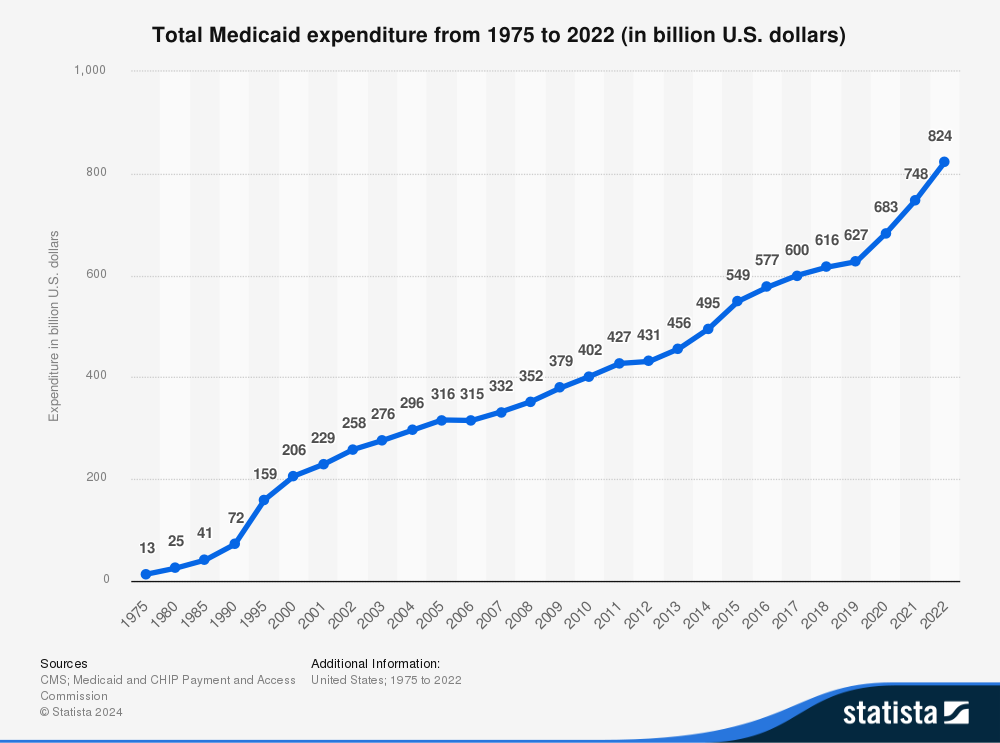
Medicaid’s budget woes worsened with the onset of COVID-19. Spending increased even more rapidly, in part from the absence of normal coverage interruptions that were eliminated during COVID’s continuous enrollment provisions. At the same time, an aging population has led to rapidly rising long-term care costs among the poor elderly. Finally, a Byzantine system of below-market mandated reimbursement rates at the state level has become increasingly onerous to save money, especially in states with ballooning rolls like California, where Medicaid has been opened up to illegal aliens. Below-market mandated rates have caused price-shifting distortions to accumulate, and make the entire healthcare system less efficient.

Medicare monthly enrollment data.cms.gov

Medicaid is an outstanding example of how not to structure a government program. Its daunting complexity results in people frequently migrating into and out of the program (this is especially problematic for programs that provide some kind of insurance because of adverse selection problems). Because it is fundamentally a government bureaucracy, problem-solving is mostly through top-down edicts or acts of Congress. In contrast, in many parts of American society entrepreneurs continuously adapt, adjust, and innovate to deal with new problems and to take advantage of new opportunities to improve service, reduce costs, or both.

The bill now faces an uncertain future in the Senate. Changes to Medicaid are going to produce a political backlash, even in some red states, since there will be political pressure for state governments to pick up the slack. But most importantly, a very large and dysfunctional system will remain intact and dysfunctional.

The problem with Medicaid goes far beyond Medicaid. In a rich society like ours, everyone is going to get a fair amount of healthcare one way or another. We are empathetic, sympathetic, interconnected, and rich, so most of us feel compelled to do something to help the uninsured and those without access to care. If a person is writhing in pain because he can’t get healthcare, most likely neither you nor anyone you know personally would just step over him without concern.

This is the real problem: healthcare in America has effectively become a non-excludable good. A non-excludable good is one we cannot keep others from consuming (e.g., national defense). Long ago, economists worked out why such goods are inevitably underprovided by the private market because of free riding. Since virtually everyone is going to get at least some healthcare when they need it, some take advantage of that by not buying their own health insurance.

Among the many economic challenges specific to healthcare markets, economists of all political stripes agree that this is the deepest problem. Recall that perhaps the biggest bone of contention with Obamacare was the individual mandate, put into the bill specifically to address the free rider problem. Many opposed the individual mandate for a variety of reasons, but did not challenge its premise, which was that there was a deep free rider problem to be dealt with in American healthcare.

The bold — but probably politically impossible — course of action would have been for House Republicans to eliminate the federal role in Medicaid. But if they are not going to return this issue, and its financing, to the states, then rather than further tweaking Medicaid and creating new problems, a better approach would be to find an alternative path to get government out of the business of healthcare for the poor. In short: provide basic healthcare insurance through vouchers. 

To put it simply, eliminate Obamacare, Medicare, and Medicaid and replace them with a national healthcare voucher system. This transformative change for American healthcare could be limited to the level paid for with a national sales tax, and our unfunded liability problems would simply disappear. While, for practical reasons, this would likely have to start at the national level, the goal could be to then spin it off to the states. 

Milton Friedman introduced the idea of using vouchers with respect to education 70 years ago. His ideas were summarily rejected as too naïve, too impractical, and even as irresponsible. Now we are in the midst of an explosion of school choice across the nation. How much better off would we be if we had listened to him long ago?

Friedman did not advocate using a voucher system for healthcare insurance. While his diagnosis of the problems confronting the American healthcare system was unimpeachable, he did not explicitly consider the problem of de facto non-excludability. Since this induces some citizens to save money by not buying healthcare insurance, it guarantees there will always be uninsured citizens. That, in turn, ultimately guarantees some level of government provision of either healthcare or healthcare insurance.

I believe that if he were alive today, Friedman would support vouchers for healthcare insurance. Vouchers provide the government with a means of funding a solution without having the government be the mechanism that provides the solution. As such, it mostly avoids the ever-growing creeping bureaucracies that suppress competition and introduce innumerable distortions and never-ending political opportunism.

We can eliminate Medicaid, Medicare, and Obamacare by implementing a national voucher program for healthcare insurance for all citizens. By structuring the budget process to be self-balancing, we can ensure future generations are no longer saddled with a combination of increasing debt they never agreed to and lower quality of service than those who were responsible for that debt were able to enjoy. 

Ever notice that when the topic is unfunded liabilities, Medicaid is rarely mentioned? Is that because Medicaid is on a healthy budget path? Hardly. Medicaid is not included in such conversations because Medicaid is not a self-funding program in the sense that it does not have its own dedicated payroll tax funding. At the federal level, it is funded out of the general budget.

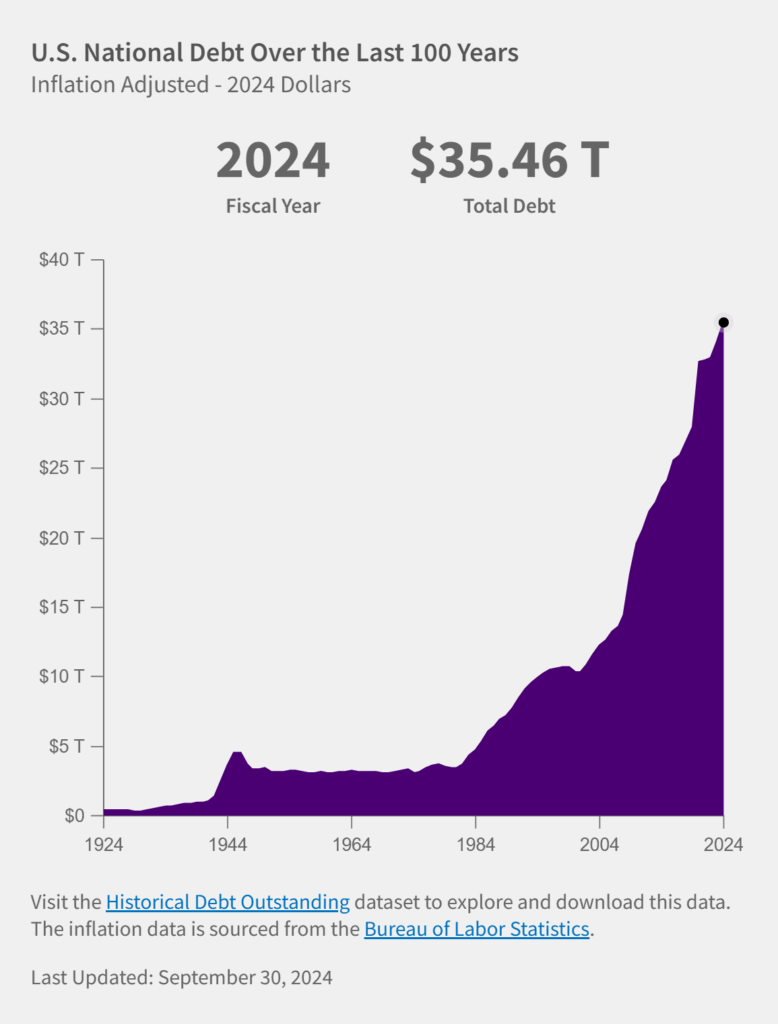
If the federal budget were experiencing year-over-year surpluses, one could argue that it is not burdening future Americans because it is being cross-subsidized. But we are, in fact, experiencing year-over-year deficits, so any dollar the federal government spends on Medicaid is effectively a dollar of additional federal debt at the margin. Rising federal spending on Medicaid equals rising federal debt. 

Historical Debt Outstanding Dataset fiscaldata.treasury.gov

Far from a principled stand or a change in national direction, the latest Republican budget does little more than kick the can down the road — to avoid the political cost of actually doing what is best for the country.

How much more dysfunction and irresponsibility are we going to tolerate so we can pretend that our healthcare system is only for the deserving? We should be honest about the fact that we do, and will continue to, treat everyone. This is nothing to apologize for but it’s something we need to come to grips with.

A voucher program would redirect government power to unleash market competition among healthcare insurers and among healthcare providers. They will hate it. The NEA’s response to school vouchers should tell you everything you need to know.


DOGE’s Next Chore

 Rarely has a federal initiative generated as much controversy, so quickly, as the Elon Musk-launched Department of Government Efficiency. The exposure of major gaps in federal auditing, the widespread fraud enabled by Washington’s lax approach to spending, and the sometimes absurd programs funded by taxpayer dollars has sparked public outrage. DOGE may be overshadowed in the headlines right now by Musk and Donald Trump’s falling out and denouncing of one another, but the effort has set down some important markers.

According to a study last spring by the nonpartisan Government Accountability Office, the federal government loses up to $521 billion annually to fraud. In that context, DOGE’s intense early scrutiny of federal accounts during the second Trump administration marks a crucial first step toward restoring fiscal sanity in Washington.

But fraud does not wholly explain the Washington accountability gap. The federal government is also rife with programs that run for decades, despite little or no success. For years, taxpayers have paid for antipoverty initiatives that don’t reduce poverty, social-welfare plans that don’t improve community flourishing, and job-training initiatives that don’t find people work. In too many cases, Congress finances programs without even asking for measurable results. We already know that some of these efforts have not worked before, yet the government plunges ahead with new spending anyway.

Facing this woeful record, the Trump administration’s long-term task should be to create within DOGE some version of what former Manhattan Institute scholar Jim Manzi called a Federal Experimental Agency, a body that undertakes to rate the effectiveness of government social policy programs in the same way the Congressional Budget Office assesses the budgetary impact of spending on those programs. At the core of this project would be a requirement that any initiative aimed at achieving a social policy goal—whether through legislation or executive order—include clear metrics for its success or failure, along with mechanisms to reduce or eliminate funding for programs that fail to deliver results.

It’s not a new idea. During George W. Bush’s first term, the Office of Management and Budget, under then-director Mitch Daniels, proposed restructuring federal antipoverty grant programs to focus on actually reducing poverty—and directing funds to programs that demonstrated results. Among OMB’s proposals was a requirement that antipoverty funds go only to genuinely distressed neighborhoods—many affluent communities were getting these grants as well—and that recipients be evaluated based on outcomes like reductions in poverty and crime, and increases in local employment.

And concerns about accountability go back even further: a transition team for President-elect Bill Clinton had already criticized the “systematic plunder of many millions of taxpayer dollars” in these same programs.

The response to the Bush proposals from official Washington and from those who received this money was indignation. New York senator Charles Schumer hyperbolically called these grants “the single most important tool that cities like New York have to grow,” while Baltimore’s then-mayor Martin O’Malley compared any attempt to shrink the programs with a terrorist attack on American cities. Studies on how the money was spent in places like New York and Baltimore showed the hollowness of these protests. A Buffalo News investigation published around the same time as Schumer’s comments determined that Buffalo had received more antipoverty funds per capita than any urban area over the last 30 years, though with “scant evidence” of any impact; instead, local politicians had “frittered away much of the money.” Similarly, a report by an economic development consultant on Park Heights and Upton, two Baltimore neighborhoods that had garnered $100 million over 20 years in antipoverty funds, concluded that the communities were “much worse off today” than before the money had come in—another testimony to the relentless decline of that city.

Unfortunately, Bush’s antipoverty-program reform efforts bore little fruit. Resistance in federal Washington was intense, and Bush wasn’t the disrupter that President Trump seems determined to be.

One outcome of a failure to measure the results of such programs is that funding goes on endlessly because it creates its own political constituencies. Antipoverty funds, for instance, have engendered entire political careers in places like New York City, where local activists use the money to build formidable political machines. An exasperated Mayor Ed Koch once summed up the process of turning antipoverty programs into political power when he branded a community activist-turned-legislator as a “poverty pimp.” During Jimmy Carter’s presidency, advocates for antipoverty block-grant funding managed to stave off efforts to kill the controversial federal program by expanding it, so that the money went to projects in more congressional districts—thus garnering more lawmaker support.

With so many Washington patrons, these programs persist despite little evidence that they work. A vivid example from the Biden administration was a $10 billion refunding of the 2009 State Small Business Credit Initiative—a kind of government-backed venture-capital scheme, aimed at firms in “disadvantaged communities” and very small businesses. Congress and the Obama administration launched the program in the same year that they gave us the Dodd-Frank Wall Street Reform and Consumer Protection Act, which imposed major new regulations on banks. Dodd-Frank, ironically, raised lending costs for banks and throttled small-business loans, according to a National Bureau of Economic Research paper. In other words, government launched a program to boost financing for businesses stifled by government regulation.

Biden revived the State Small Business Credit Initiative on the questionable premise that banks avoid lending in disadvantaged areas due to bias against local business owners—even after his administration, along with Trump’s, had already delivered hundreds of billions in Covid aid to small firms. But the deeper problem is often not lender bias but borrower risk. Many small businesses in low-income areas face steep credit challenges—one reason even government-backed lending programs frequently suffer heavy losses. After the Los Angeles riots of 1992, for instance, the federal government allocated $430 million in emergency block-grant funding for small businesses in the affected areas to create economic opportunity and stability. Within just two years, over a third of the funded businesses had failed—triple the projected default rate. A scathing HUD audit found that the plan had created few jobs, and the federal government quietly shut it down.

In today’s Washington, President Trump and DOGE face resistance simply for attempting to build better safeguards against fraud—a revealing commentary on the federal government’s tolerance for waste. That so much money can be recovered through basic oversight points to a deeper problem: a spendthrift culture that treats taxpayer dollars as limitless. Beyond fraud lies a more insidious challenge: rooting out the so-called zombie programs that continue to receive funding long after their usefulness has faded. These initiatives persist by inertia, not merit. A broader reform effort would also require setting clear performance standards for social policy initiatives—and ending funding for those that fail to meet them. This subtler, institutionalized form of waste is no less costly to the American taxpayer.

The Quiet Economic Boom of Trump 2.0

 by Victor Davis Hanson

The Trump budget is making its way through the Senate. And people on both sides of the issue of fiscal sobriety are arguing because the Biden deficit, which is somewhere between $1.9 trillion and $2.1 trillion, doesn’t seem to be radically reduced, given the DOGE cuts are offset by not cutting other programs that came in under Biden.

The Build Back Better and New Green Deal—all of that stuff is not radically cut. And more importantly, there are some tax cuts—things like taxes on tips, the SALT state tax deductions—that suggest that either there won’t be this sizable budget deficit reduction, as promised by the Trump administration, or it won’t occur until later on, or it could get bigger.

But there is a wild card here. And consider that in March through April, all the way into May, we had some monthly data. And income—real income—is substantially up. So is the savings rate. Energy prices are down. The inflation rate came in at April at 2.1%. The economy, according to the Federal Reserve Bank in Atlanta, will not grow at 3.8%, but it could, they think, at an annualized rate of 4.6%.

That’s critical, because in a $33 billion-plus economy, if you get two or three points of additional economic growth, then obviously, you’re going to have more federal revenue. It could be $200 or $300 billion more.

Also, people discounted the Trump tariffs. They said, either one of two things would happen. They would either, and believe it or not, they said the trade deficit might increase because of retaliatory tariffs that would increase faster than ours or decrease trade. But we might be in a recession.

And yet, when you look at the April data, the $160 billion monthly trade deficit has been halved. It’s incredible. It’s almost like the story on the border: That we went from 10,000 people a day to virtually nobody.

So, what does all this mean? We saw these gyrations in the stock market. We read The Wall Street Journal every day: recession, slow growth, market uncertainty, trade wars, recession, but if you actually look at the data, two things pop out at you.

The economy is doing very, very well. And a lot of it is the expectation of the things that are in process. The $10 trillion of foreign investment. The extensions of the tax cuts. Incentives for investment in the new budget. And so, this is completely unknown territory. If Donald Trump were to get—as Ronald Reagan did in the first half of 1984, he got up to an annualized rate of 7%. Especially in the latter part. If he were to get 4.6% or 5%, then this mythical idea that we all discounted, that you can grow your way out of deficits, it wouldn’t quite be realized but it would really help. And that $1.9 to $2.1 trillion deficit could go down substantially.

All of us never believed supply side will solve the problem. It won’t solve the problem without physical cuts and discipline. But it will do a lot for the economy.

And this is emblematic of this first mysterious four months of Donald Trump, when people said that Donald Trump could shut the border down, nobody believed him.

When people said that he could deal with the universities, and then Harvard had a lot of exposure, violating the Supreme Court’s rulings, not reporting Chinese and Middle East money, overcharging the government. And yet, all of this exposure that’s happening on the campus is enlightening the American people about issues they didn’t think was possible, just in the first 120 or 130 days of this administration.

So, what’s the bottom line? What am I getting at? There are revolutionary—maybe counter-revolutionary—developments going on at the border, going on with the universities. But especially with the economy. It’s being rebooted. It’s being redirected in ways that economists are not even able to figure out because we haven’t done this before. And the net result might be that we’re going to make progress, both in the expansion of the economy and through growth in federal revenues and cut down these deficits.

https://www.dailysignal.com/2025/06/06/quiet-economic-boom-trump-2/

FBI And DHS Warn Of 'Elevated Threat' To Jewish Community After Boulder, DC Attacks

 The FBI and Department of Homeland Security warned of an “elevated threat” to the U.S. Jewish community following an attack last weekend in Boulder, Colorado, and last month’s killing of two Israeli embassy staffers in Washington.

In a bulletin issued on Thursday, the agencies said that the Israel-Hamas conflict “may motivate other violent extremists and hate crime perpetrators with similar grievances to conduct violence against Jewish and Israeli communities and their supporters.”

Foreign terrorist organizations also may try to exploit narratives related to the conflict to inspire attacks in the United States. The FBI and DHS therefore urge the public to remain vigilant and to report any threats of violence or suspicious activity to law enforcement,” the joint statement added.


As Jack Phillips report for The Epoch Times, the statement made references to both the Boulder attack, in which an Egyptian national and illegal immigrant allegedly threw Molotov cocktails at people who were protesting in solidarity with Israel and sought the release of Israeli hostages in the conflict. Prosecutors said that 15 people were injured in the incident.

Mohamed Soliman, the suspect, allegedly yelled “free Palestine” during the attack, federal officials have said.

Prosecutors also said that Soliman told officials that he “wanted to kill all Zionist people” and that he also expressed no regret about the attack.

Soliman was charged with a federal hate crime, as well as 118 state charges, including attempted murder, use of an incendiary device, and assault. He has not entered a plea in the two cases against him.

Federal authorities have said Soliman has been living in the United States illegally. Homeland Security Secretary Kristi Noem said on Wednesday that his family was being processed for removal, though a federal judge later stopped their deportation.

Before moving to Colorado Springs three years ago, Soliman spent 17 years in Kuwait, according to court documents.

The FBI and DHS notice Thursday also made reference to the attack in Washington, where suspect Elias Rodriguez shot and killed two Israeli embassy staffers after they attended an event at the Capitol Jewish Museum. Video footage and charging documents said that Rodriguez yelled “free, free Palestine” while he was being arrested and handcuffed.

The two staffers, Yaron Lischinsky and Sarah Lynn Milgrim, were a young couple who had worked at the embassy. Lischinsky was an Israeli national and Milgrim was a U.S. citizen from Kansas, family members have said.

FBI Deputy Director Dan Bongino has described both the Washington and Boulder attacks as terrorist acts.

“We are investigating this incident as an act of terror, and targeted violence. All of the necessary assets will be dedicated to this investigation,” Bongino said in a statement on the social media platform X this week, in reference to the Boulder attack.

“If you have any investigative tips please contact the FBI. And if you aided or abetted this attack, we will find you. You cannot hide.”

Later in the notice, the FBI asked people to “promptly report information concerning suspicious activity” to the FBI’s tip website or local field offices.

https://www.zerohedge.com/geopolitical/fbi-and-dhs-warn-elevated-threat-jewish-community-after-boulder-dc-attacks