Search This Blog

Tuesday, December 30, 2025

How a 2019 NEJM Study Misled the World on Vitamin D

 In January 2019, The New England Journal of Medicine published a study that was immediately hailed as the final verdict on vitamin D: it doesn’t work. The study, known as the VITAL trial, was large, well-funded, and led by respected researchers from Harvard. Its conclusion—that vitamin D supplementation did not reduce the risk of invasive cancer or major cardiovascular events—rapidly diffused across headlines, textbooks, and clinical guidelines.

But the VITAL study didn’t fail because vitamin D failed. It failed because it was never designed to test the right question. This article walks through the anatomy of that failure, why it matters, and what we must fix if we are to take prevention seriously in modern medicine.

The Trial That Didn’t

On the surface, VITAL looked impeccable: over 25,000 participants, randomized and placebo-controlled, testing 2000 IU of vitamin D3 daily for a median of 5.3 years. The primary endpoints were the incidence of any invasive cancer and a composite of major cardiovascular events (heart attack, stroke, or death from cardiovascular causes).

But there is a foundational problem: most participants weren’t vitamin D deficient to begin with. Only 12.7% had levels below 20 ng/mL, the threshold generally associated with increased risk. The mean baseline level was 30.8 ng/mL—already at or near sufficiency. It’s the equivalent of testing whether insulin helps people who don’t have diabetes.

Further eroding the study’s contrast, participants in the placebo arm were allowed to take up to 800 IU/day of vitamin D on their own. By year 5, more than 10% of the placebo group was exceeding that limit. The intervention, in effect, became a test of high-dose vitamin D versus medium-dose vitamin D, not against a true control.

Add to that the decision to use broad, bundled endpoints like “any invasive cancer” or “major cardiovascular events” without regard to mechanisms, latency, or stage-specific progression, and the trial becomes a precision instrument for finding nothing.

The Important Real Signal They Missed

The one glimmer of benefit appeared in cancer mortality. While incidence rates were similar between groups, the vitamin D arm showed a lower rate of cancer deaths. This effect emerged only after two years of follow-up and became statistically significant once early deaths were excluded. Even more telling, among participants whose cause of death could be adjudicated with medical records (rather than death certificate codes), the benefit was stronger.

This suggests a biologically plausible mechanism: vitamin D may not prevent cancer from starting, but it may slow its progression or reduce metastasis. That theory aligns with preclinical models showing vitamin D’s role in cellular differentiation, immune modulation, and suppression of angiogenesis.

And yet, VITAL buried this signal. The paper acknowledged a significant violation of the proportional hazards assumption in cancer mortality, a red flag that time-to-event models were inappropriate. Instead of adjusting with valid statistical models for non-proportional hazards, the authors sliced the data post hoc to generate a story and dismissed the result as exploratory. Meanwhile, they mentioned in passing that fewer advanced or metastatic cancers occurred in the vitamin D group—but offered no data.

How Design Choices Shape Public Understanding

The public interpretation of VITAL has been simple and sweeping: vitamin D doesn’t help. That perception has reshaped policy, funding, and clinical guidance. Combined with errant policy based on acknowledged errors, It is dangerous and a risk to public health.

But what the trial actually tested was much narrower: Does high-dose vitamin D provide additional benefit in a mostly vitamin D–sufficient, highly compliant, aging American cohort already permitted to take moderate doses on their own? And does it do so within 5 years?

Given those conditions, the null result was foreordained.

That’s not a failure of science. That’s a failure of trial design.

What Should Have Been Done

A rationally designed prevention trial would start with a population at risk. That means recruiting participants with confirmed vitamin D deficiency, ideally below 20 ng/mL. It would require tighter control of off-protocol supplement use. It would measure achieved serum levels in all participants, not just a 6% subsample. And it would follow participants for a decade or more to match the biological latency of cancer.

Equally critical, the endpoints would reflect mechanistic expectations. Rather than bundling all cancers or all cardiovascular events, researchers should examine site-specific incidence, grade at diagnosis, metastatic progression, and mortality—particularly among subgroups most likely to benefit, such as Black participants and those with low BMI.

Reform Is Not Optional

It is not enough to run large trials. They must be designed to answer the right questions. The failure of VITAL has less to do with vitamin D and more to do with how preventive science is conducted: Over-generalized endpoints, underpowered subgroups, and insufficient attention to biological realism.

We need new standards:

  • Targeted enrollment of at-risk populations
  • Serum level tracking
  • Clear contrasts between intervention and control
  • Biomarker tracking throughout
  • Outcomes matched to mechanistic hypotheses
  • Transparent reporting of all stage-specific and cause-specific outcomes

None of ts is controversial. It is merely rigorous.

This Isn’t Over

Several high-quality meta-analyses and smaller trials contradict the conclusions drawn from VITAL. 

Several high-quality meta-analyses and randomized trials contradict the broad null interpretation drawn from the VITAL study. A 2014 Cochrane Review found that vitamin D supplementation, particularly with cholecalciferol (D3), was associated with a statistically significant 13% reduction in cancer mortality. The authors concluded that vitamin D likely reduces the risk of cancer death over a 5–7 year period, even though effects on incidence were not evident.

A randomized controlled trial in Nebraska by Lappe et al., involving postmenopausal women who received 2000 IU/day of vitamin D3 and 1500 mg/day of calcium, showed a non-significant 30% reduction in cancer incidence, with stronger effects emerging in secondary and stratified analyses. An earlier 2007 trial by the same group found a statistically significant reduction in cancer incidence with combined vitamin D and calcium supplementation.

Pooled data from 17 cohorts, as reported by McCullough et al., show a strong inverse association between circulating 25-hydroxyvitamin D [25(OH)D] levels and colorectal cancer risk. Individuals in the highest quintile of serum 25(OH)D had a substantially lower risk of colorectal cancer compared to those in the lowest quintile, across diverse populations.

These findings converge on the possibility that vitamin D is more likely to influence cancer progression and lethality than initial incidence, particularly in populations with low baseline serum levels or in cancers like colorectal cancer that exhibit strong biological responsiveness.

Null trials can be useful. But when designed poorly, they become weapons of inference. The VITAL trial should be reinterpreted, not repeated.

If science is to regain public trust, it must show not just what it found, but what it never really asked.

References

  1. Bjelakovic G, Gluud LL, Nikolova D, et al. Vitamin D supplementation for prevention of mortality in adults. Cochrane Database Syst Rev. 2014;1:CD007470. https://www.cochrane.org/evidence/CD007470_vitamin-d-supplementation-prevention-mortality-adults
  2. Lappe JM, Watson P, Travers-Gustafson D, et al. Effect of vitamin D and calcium supplementation on cancer incidence in older women: a randomized clinical trial. JAMA. 2017;317(12):1234-1243. https://jamanetwork.com/journals/jama/fullarticle/2613159
  3. Lappe JM, Travers-Gustafson D, Davies KM, Recker RR, Heaney RP. Vitamin D and calcium supplementation reduces cancer risk: results of a randomized trial. Am J Clin Nutr. 2007;85(6):1586-1591. https://pubmed.ncbi.nlm.nih.gov/17556697/
  4. McCullough ML, Zoltick ES, Weinstein SJ, et al. Circulating vitamin D and colorectal cancer risk: an international pooling project of 17 cohorts. J Natl Cancer Inst. 2019;111(2):158-169. https://www.ncbi.nlm.nih.gov/pmc/articles/PMC6821324/

Republished from the author’s Substack

Dr. James Lyons-Weiler is a research scientist and prolific author with over 55 peer-reviewed studies and three books to his name: Ebola: An Evolving StoryCures vs. Profits, and The Environmental and Genetic Causes of Autism. He is the founder and CEO of the Institute for Pure and Applied Knowledge (IPAK).

https://brownstone.org/articles/how-a-2019-nejm-study-misled-the-world-on-vitamin-d/

Tylenol for Your New Year's Hangover? Consider this

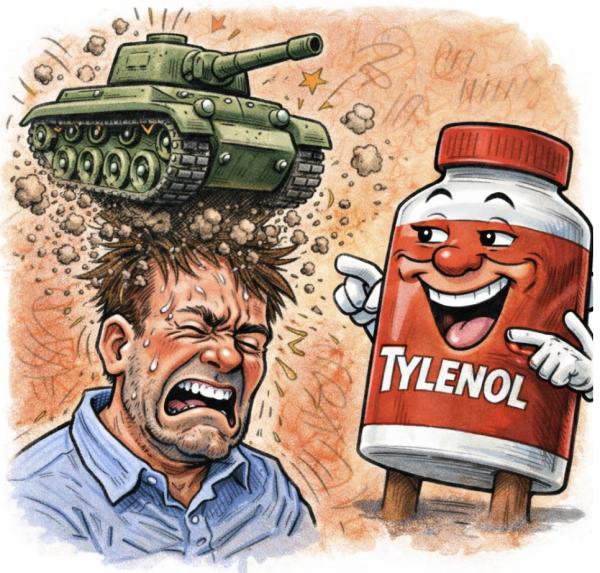
 You wake up on New Year’s Day, and all kinds of horrid things have been flying out of your mouth. Your head feels like it’s been in a stampede. What do you do? Tylenol? Maybe not.

Image: ACSH

Every New Year’s Day, those who have overindulged perform the same ritual. They stagger to the medicine cabinet and try to focus on the Tylenol. Next, they down a couple of tablets, and—assuming they stay down—pray for relief (or a quick death–either will do), because they're dealing with the dreaded headache from hell.

This ritual no doubt makes the folks over at Kenvue [1] happy. The company, formed in 2023 after spinning off from Johnson & Johnson, sells a wide range of over-the-counter products. The most popular? Tylenol (acetaminophen), and they must sell a whole bunch of it on New Year's Day.

But does it help?

(Un)happy New Year!

So, you woke up at 7 a.m. feeling like a Sherman tank had been dropped on your head. Tylenol seems like an obvious choice. But this ritual persists despite an inconvenient fact: Tylenol offers little or no meaningful relief for headaches of any kind—a claim that deserves evidence, not just attitude. 

Let’s look at the evidence.

We all know that many studies are awful. And it’s not always obvious which ones are awful. Journals don’t exactly advertise methodological failure in their titles.

You’ll probably not see something like this:

“This Study Sucks. A Retrospective Analysis.”

Fortunately, there are high-quality, long-standing reviews published by an independent international research collaboration. These are called Cochrane reviews, and they exist for exactly this reason: to separate the wheat from the chaff—or the "suck" from the "don’t suck." Review authors systematically sift through the literature and make clear which studies hold up under scrutiny and which ones don’t. Their analyses are published in the Cochrane Database of Systematic Reviews, a widely used source for evidence-based medicine.

And Cochrane Says…

Tylenol's relief of the pain of tension-type headaches is unimpressive. Here are the details

For complete pain relief in 2 hours:

  • About 24% of patients were pain-free when given 1,000 mg of acetaminophen.

(This isn't terribly impressive, but at least you have a 1 in 4 chance of getting some help from the drug, right?)

No. That's wrong. 

  • But about 19% of patients given a placebo were also pain-free.
  • So, the absolute benefit from the drug is about ~5% – ghastly.
  • Put another way, the number needed to treat (NNT) is 22. In other words, 22 people have to take acetaminophen for one additional person to be pain-free at two hours.

Does anyone really want to wait two hours for a 5% possibility of relief?

The results are pretty much the same when the endpoint is either pain-free or mild pain at 2 hours:

  • ~59% improved with acetaminophen
  • 49% improved with placebo (Absolute benefit: ~10%)
  • NNT ≈ 10 (10 people have to take the drug for one additional person to get relief from the drug)
     

Migraine Headaches: Lots of pain and little gain

If you're taking acetaminophen/Tylenol for a migraine, your new year is gonna be anything but happy. The numbers are similar to those from tension headaches. 

  • Endpoint: pain-free at 2 hours: ~19% with acetaminophen vs ~10% with placebo (Absolute benefit: ~9%)
  • NNT ≈ 11–12 
  • Endpoint: Pain reduced to mild or none at 2 hours: ~56% with acetaminophen vs ~36% with placebo
  • Absolute benefit: ~20%
  • NNT ≈ 5
  • At 1 hour, the benefit is barely distinguishable from a placebo.

Bottom Line

While this represents only a fraction of the published headache research, it focuses on the most rigorous evidence available. Carefully conducted systematic reviews tell us far more about real-world effectiveness than dozens of weaker, individual studies.

So, if you're hungover and feel like a mule kicked your head, acetaminophen probably isn't a great choice. The drug can outperform a placebo, but beating a placebo is a low bar. For many people, the real-world experience is: Take Tylenol, wait, and the headache will fade on its own. Or, it won't.

NOTE:

[1] Kenvue Inc., is a company that sells many common OTC products, including Tylenol. It was spun off from Johnson & Johnson in 2023. 

Dr. Josh Bloom, the Director of Chemical and Pharmaceutical Science, comes from the world of drug discovery, where he did research for more than 20 years. He holds a Ph.D. in chemistry.

https://www.acsh.org/news/2025/12/30/tylenol-your-new-years-hangover-consider-49890

Stossel Exposes the Five Biggest Lies of Socialistic Slavery

 by D. Parker

The year 2026 is shaping up to be an epic battle between the economic freedom of the free market and the societal slavery of socialism. 
 
The left can never admit to this horrible truth, so their only choice is to lie through their teeth, because no one would ever buy into their socialist national agenda if that dark reality were known. 
 
Getting ready for this epic battle means debunking these lies ahead of time, as in the accompanying John Stossel Video that eviscerates their top five. 
 
He diplomatically uses the term "myths," but we're now talking about a battle between good and evil. 
 
It is abundantly clear that socialism (collectivism, communism, fascism, Maoism, corporate statism, etc.) can never work without brute force, lies, and a mound of corpses, so we're way beyond niceties at this point. 
 
 
Socialistic slavery lie 1: “That wasn't real socialism!”
 
This is the one we're likely to hear the most next year, because the history of socialistic slavery is so devastating to the left.  They can't exactly deny reality, so they'll have to admit the existence of the Union of Soviet Socialist Republics, U.S.S.R., as well as Red China's socialism with Chinese characteristics. 
 
Lying leftists (pardon the redundancy) have to somehow explain the epic failure of the first experiments in socialism 200 years ago in 1825 in New Harmony, Indiana, and similar communities at Yellow Springs, Ohio; at Nashoba, near Memphis; at Haverstraw and Coxsackie, New York, and in the Kendal Community at Canton, Ohio, and many others. 
 
These 'villages of co-operation' were referred to in the first use of ‘socialist’ according to the Oxford English Dictionary in The Co-operative Magazine, London, November 1827.
 
Lying leftists can never admit that their ancient ideas don't work, so they have to play games with the 'no true Scotsman' fallacy, nitpick, and lie to exclude every socialist system. 
 
Their problem is that there are many variations of collectivism that have all failed to work, and the OED definition of the word socialism is unambiguous:
 
A political and economic theory of social organization which advocates that the means of production, distribution, and exchange should be owned or regulated by the community as a whole.
 
Note the phrase: "owned or regulated by the community as a whole" with regard to the means of production being regulated by the community as a whole.
 
Socialistic slavery lie 2:  Venezuela's failure has little to do with socialism.
 
This, of course, could be applied to many of the aforementioned, including communist Cuba. 
 
Lying leftists are forced to use these types of second-tier lies when some nations inconveniently identify themselves as socialist or communist slavery states. 
 
A fallback position for the left in denying the abject failure of socialism – if they can't play games with word definitions in the case of openly socialist national states, they distract with other reasons that socialism didn't work. 
 
The lies are that the drop in the price of oil and mismanagement caused all of Venezuela's economic woes.   
 
Note that other countries that depend on oil revenue didn't experience it because they rely on centralized control rather than the pricing signals of the free market.
  
Socialistic slavery lie 3:  Socialism is great, if it's democratic socialism.
 
Except that when the government controls whether or not you eat, it can control your vote, and 'democracy' goes out the window.   An economy based on force can never be 'democratic,' it only works for the first go around, then the government simply controls the vote, just like everything else.
 
It's the old saying: socialism, one man, one vote, once. 
 
Socialistic slavery lie 4:  Socialism works in Scandinavia.
 
One problem with this one: Scandinavian countries are not socialist.
 
The heading should speak for itself, because over the years, this little chestnut has been debunked repeatedly.
 
Leftists are forever playing a shell game of denying that socialist regimes were socialist while claiming non-socialist regimes are socialist.  In addition, they falsely ascribe anything the positive the government does as 'socialism.'  
 
Socialistic slavery lie 5:  Socialism is completely different from fascism.
 
We've counted more than 50 ways the left is like the National Socialists.  But mentioning this is the Lord Voldemort of political discourse, but it hasn't always been this way.
 
As noted in the video, it was at least understood during the 1920s and 1930s, that while these two collectivist ideologies weren't exactly the same, they had a lot in common. 
 
For example, in 1927, the American Federation of Labor Denounced both the reds and the fascists and stood in opposition to both, as standing for autocracy, likening fascism to communism.  
 
To the point that they used to say: Why is National Socialist Germany like a beefsteak?  Answer: Because it is brown outside and red inside.  And the common phrasing referred to the brown Bolshevism of the Third Reich, and the Red fascism of the U.S.S.R. 
 
The April 1939 issue of The Atlantic had a long dissertation on Brown Bolshevism, emphasizing the point.
 
After WWII, it strangely became controversial to make these comparisons. Academic papers on red fascism and brown Bolshevism from the 1970s studied many of the newspapers of the pre-WWII time period, noting many common traits between the two, engendering quite a controversy in doing so.
 
The left has always perpetrated this false dichotomy because they want to pretend the conflict is between socialism and 'dascism' instead of the true comparison of socialistic slavery and economic freedom – for obvious reasons.

Canard about illegals committing fewer crimes than other Americans gets blown apart from DHS data


It's sugar-coated garbage, and not just because we look around and confront the evidence of our own eyes, or consider the incentive an open border offers to criminals who can't get into the states otherwise.

Writing at the New York Post, John Lott has come up with a doozy of a report showing how data are skewed to conceal the fact that illegals commit at least three times the crime of ordinary Americans and those legally present, putting paid to the rubbish that crime from illegals is minimal, any illegal-alien crime in the news is just an aberration, and anyone thinking otherwise is just a MAGA racist xenophobe.

Lott points out that the baseline mistake for these claims is that official data lumps legal and illegal immigrants together. Separate them out, and vetted legal immigrants commit very few crimes -- but illegals commit way more than they are given 'credit' for by the open-borders lobby.

Citing DHS data for New York alone, Lott writes:

The DHS data gives us a handy metric to calculate relative rates of criminality.

Altogether, roughly 50,803 people are incarcerated in New York’s prison and jail systems: about 32,469 in the New York State Department of Corrections and Community Supervision, and another 18,334  in the state’s city and county jails.

The 7,113 illegal aliens currently incarcerated thus make up 14% of New York’s total inmate population — and this share is likely an underestimate, because the state doesn’t actively identify immigration status.

But assume the DHS data is correct, and illegals make up 14% of incarcerated individuals in New York.
 
New York is estimated to have between 676,000 and 825,000 illegal aliens out of a total state population of 19.99 million — meaning illegal immigrants make up only 3.4% to 4.15% of the state’s population. That means they are overrepresented in the state’s prisons and jails by at least 3.4 times. And even if the population estimate undercounts the number of illegal aliens in New York, and the true number present is two to three times higher, illegal aliens would still be massively overrepresented among New York’s convicted and accused criminals.

Lott points to some factors that likely mean the proportion of illegals committing crimes compared to the rest of the population is even higher than the mere threefold number:

One, once illegals are picked up by lawmen for committing crimes, they are often deported before facing charges or any jail time, which leaves them out of the statistics. Alternatively, illegals are deported before completing their terms.

This implies that the three-times-the-average numbers are likely even higher because these numbers don't show up in crime data.

Lott doesn't mention it, but other factors that likely skew the data away from illegals showing up in it are district attorneys who refuse to prosecute violent crime, cops who retire at their desks, prosecutors who reduce felonies to misdemeanors to prevent illegals' deportation, which happens a lot. There are also judges out there vacating convictions to help the illegals remain in the country. All of that skews crime data to suggest that the crimes never happened, which, to the victims, is quite an insult.

And it puts paid to rest the ridiculous claims from the NGOs, the bishops, the Democrat hacks, and the mainstream media that illegals commit very few crimes.

https://www.americanthinker.com/blog/2025/12/canard_about_illegals_committing_fewer_crimes_than_other_americans_gets_blown_apart_from_dhs_data.html

Eli Lilly, Novo waging price wars as obesity drug market heats up in China

 Eli Lilly (LLY) and Novo Nordisk (NVO) are slashing prices of their GLP-1 products in China as the rivalry in the booming obesity drug market there intensifies amid local competition, according to media reports.

Shanghai-based business news outlet Yicai reported on Monday that Novo (NVO) slashed list prices of the two highest dosages of Wegovy by as much as half in some Chinese provinces amid an upcoming patent cliff for the popular GLP-1 therapy.

CSPC Pharmaceutical Group (CSPCY) (CHJTF) and Hangzhou Jiuyuan Genetic Biopharmaceutical Co. are among the leading Chinese drugmakers looking to launch their own versions of Wegovy, as the patent for semaglutide, the active ingredient of the injectable, is set to expire in March.

Meanwhile, citing a WeChat account for a hospital in the eastern Chinese city of Nanjing, Reuters reported that from Jan. 1, Lilly (LLY) would also decrease the price of its GLP-1 medicine Mounjaro, which is used off-label for weight loss.

On a platform for Meituan, a Chinese food delivery group, a 10mg Mounjaro injector pen is listed at a projected cost of approximately ¥445 ($63), down from ¥2,180.

LLY and NVO’s pricing moves come as Hong Kong-listed Innovent Biologics (IVBIY) (IVBXF) makes market inroads with its obesity therapy Xinermei, which launched in July as the third once-weekly GLP-1 injectable available for weight management in China after Wegovy and Mounjaro.

https://www.msn.com/en-us/money/companies/eli-lilly-novo-waging-price-wars-as-obesity-drug-market-heats-up-in-china/ar-AA1ThMWX

Takeda, XOMA ink new royalty agreement; amend existing deal


XOMA Royalty (NASDAQ: XOMA) and Takeda amended their 2006 collaboration via a strategic royalty share transaction announced Dec 30, 2025. Takeda regains a majority of XOMA Royalty’s mezagitamab economics while XOMA Royalty will retain a low single-digit royalty on mezagitamab and up to $13.0 million in milestones (previously mid-single-digit royalty and $16.25 million in potential milestones).

In exchange, XOMA Royalty will receive payments (low to mid-single-digit royalties and milestones) tied to a basket of nine development-stage assets from Takeda’s externalized portfolio, including programs from Neurocrine, Mirum, Oak Hill Bio, Recursion, and others.

David Beckham-Backed Health Firm Ceases Bitcoin Treasury Plans


Prenetics, a health-sciences company that started buying Bitcoin earlier this year, has become the latest digital-asset treasury firm to halt that strategy amid depressed crypto prices.

The firm said on Tuesday that it stopped buying Bitcoin on Dec. 4, and will now focus more squarely on IM8, a nutritional supplement brand co-founded by English football icon David Beckham. Beckham is also a strategic investor in Prenetics, according to the company’s website.

https://www.bloomberg.com/news/articles/2025-12-30/david-beckham-backed-health-firm-ceases-bitcoin-treasury-plans