Search This Blog

Wednesday, June 10, 2026

Sanofi halts Phase 3 of riliprubart in treatment-refractory CIDP; interim review finds low efficacy likely


Sanofi halts Phase 3 MOBILIZE trial of riliprubart in treatment-refractory CIDP after interim review finds low efficacy likelihood

  • Interim analysis concluded riliprubart was unlikely to meet primary efficacy endpoints in the Phase 3 MOBILIZE trial.
  • Sanofi expects no material financial impact from the MOBILIZE discontinuation and reaffirms its 2026 financial guidance.

FDA accepts Takeda supplemental BLA for intravenous Entyvio in pediatric ulcerative colitis, Crohn’s


FDA accepts Takeda supplemental BLA for intravenous Entyvio in pediatric ulcerative colitis and Crohn’s disease

  • PDUFA target action date for the Entyvio pediatric sBLA is scheduled in the first quarter of 2027.

New uranium plant brings North Korea closer to mass-producing nukes


Reveal suggests DPRK is moving beyond building capacity, while signaling to Seoul it has a head start on enrichment


North Korea’s showcase of a new, fully operational uranium enrichment facility has underscored the credibility of its push to mass-produce nuclear warheads, while sending a clear message to the U.S. and South Korea about its head start on enrichment.

State media reported that leader Kim Jong Un inspected a “newly commissioned nuclear material production plant” featuring “more sophisticated technologies” on June 3, accompanied by senior officials from the Munitions Industry Department and the Nuclear Weapons Institute.

The site represents the third facility of its kind publicly revealed in the DPRK.


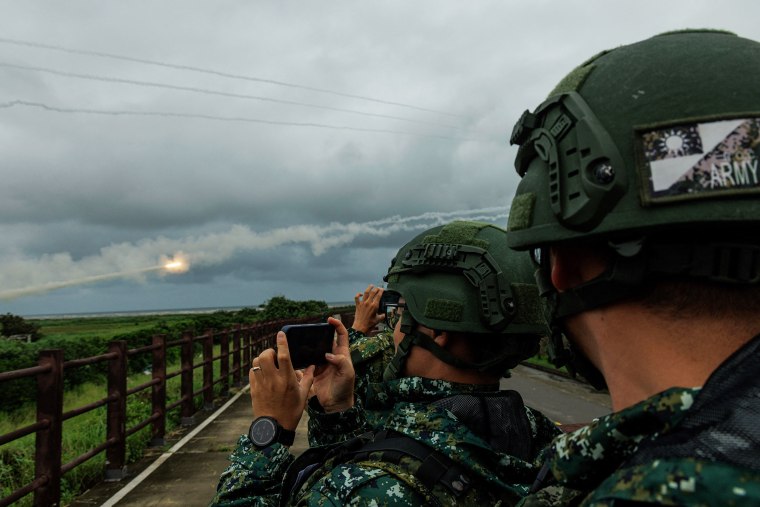
Taiwan test fires U.S. rocket system for the first time toward Chinese mainland


Taiwan’s military on Wednesday fired its new mobile HIMARS rocket system, which is widely used by Ukraine, simulating an attack on an invading Chinese force and demonstrating its ability to “shoot-and-scoot” by avoiding counter strikes

China, which views democratically governed Taiwan as its own territory, has never renounced the use of force to bring the island under its control, and its warplanes and warships operate almost daily around the island.


Taiwan test fired its Lockheed Martin-made High Mobility Artillery Rocket Systems, or HIMARS, for the first time last year off its east coast.

Wednesday marked the first time it has fired the precision weapon on the west coast, in central Taiwan‘s Taichung.

The military said the drill was to demonstrate the HIMARS’ mobility and ability to “shoot-and-scoot” — withdrawing after firing to avoid being locked onto by enemy radar — so “greatly improving battlefield survivability”.

“Our HIMARS demonstrated the solid combat capabilities of the unit and successfully completed this training,” company commander Ko Ming-pin said.

HIMARS is one of Ukraine’s main strike systems and has been used multiple times during the war with Russia.Taiwanese soldiers record footage and look on during an M142 High Mobility Artillery Rocket System (HIMARS) live-fire training exercise in Taichung on Wednesday.Cheng Yu-chen / AFP via Getty Images

The beaches and mud flats on Taiwan‘s west coast, directly facing China across the Taiwan Strait, are seen as the most likely location for an attempted landing by the Chinese military in the event of any invasion.

Taiwan’s military is modernising to enable it to fight an asymmetric war with more mobile weapons that can still pack a punch like the HIMARS, to turn the island into a “porcupine” that is hard to attack and can survive a Chinese assault.

With a range of about 190 miles, HIMARS could strike coastal targets in China’s southeastern province of Fujian on the other side of the Taiwan Strait.

The weapon would be used with Taiwan‘s domestically developed Thunderbolt-2000 launchers so Chinese forces could be targeted as they left port or attempted to land on Taiwan‘s coast.

Thunderbolts were fired on the first day of the drill on Tuesday.

Taiwan‘s government rejects China’s sovereignty claims, saying only the island’s people can decide their future.

Star ratings court win and analyst upgrade drive CLOV breakout surge


  • Federal court ruled late May that CMS must recalculate Clover's 2026 Medicare Advantage star ratings, potentially restoring 4-star status and ~$120M in quality bonuses.
  • Strong Q1 2026 results (May 6) showed GAAP net income of $27.3M, 62% revenue growth to $749M, and 51% YoY MA membership increase.
  • Canaccord Genuity raised price target to $4.20 from $3.20 on June 4 (Buy rating), citing materializing 2026 managed care thesis; sparked prior 9%+ gain.
  • Stock broke multi-year technical resistance, hitting new highs near $4.40 on June 9 from ~$3.92 prior close, equating to ~10-12% move.
  • Positive narrative around path to sustained profitability, Clover Assistant AI tech, and digital health tailwinds amplified retail and investor interest.
  • X chatter and forum buzz highlighted breakout amid sector strength, consistent with CLOV's history of retail-driven momentum.

Anti-Nvidia startup valued at $1.55B

 Cloud-computing startup TensorWave Inc., which exclusively uses Advanced Micro Devices (AMD) technology instead of Nvidia products, was valued at $1.55 billion after raising $350 million in a Series B funding round led by AMD and hedge fund Magnetar Capital, The Wall Street Journal reported on Wednesday.

TensorWave's Chief Executive Darrick Horton said the company was created to "restore competition to the market," adding, "I don't like buying things from monopolies. You don't have a lot of leverage." The company operates data centers using AMD chips and plans to use the fresh capital to expand its infrastructure footprint and purchase additional equipment.

The new investment nearly quadrupled TensorWave's valuation from roughly $400 million a year ago. The company was founded in 2023 and positions itself as an alternative to Nvidia, whose chips dominate the artificial intelligence infrastructure market.

https://breakingthenews.net/Article/Anti-Nvidia-startup-valued-at-dollar1.55B/66477633

Boeing expands MQ-28 combat capabilities

 The Boeing Company revealed new capabilities for its MQ-28 Ghost Bat combat drone at the ILA Berlin Air Show on Wednesday, including increased range, carrying capacity, and expanded weapons options.

"That additional capacity gives operators freedom to balance payload and endurance to configure for the mission at hand, whether that means carrying extra fuel for longer-range operations, increasing weapons carriage, or any combination of both," MQ-28 Global Program Director Glen Ferguson said. Boeing said the upgraded aircraft features a wing more than 25% larger and can carry two AMRAAM missiles or four Small Diameter Bombs internally.

Ferguson said the upgrades, developed with the Royal Australian Air Force, "will be progressively released to the fleet through a spiral upgrade program." Australia agreed in December to acquire six operational MQ-28A Ghost Bat drones under a A$1.4 billion contract with Boeing Defence Australia after the aircraft completed a live missile test against an aerial target.

https://breakingthenews.net/Article/Boeing-expands-MQ-28-combat-capabilities/66478167