Search This Blog

Tuesday, September 30, 2025

Tylenol, Autism and the Perils of Basic-Level Literacy


“Don’t take Tylenol,” President Donald Trump urged pregnant women in a packed White House press briefing Sept. 22, claiming a link between acetaminophen use and autism. Within hours, experts pushed back. One Reuters headline put it bluntly: “Trump links autism to Tylenol and vaccines, claims not backed by science.”

Who should we believe?

A friend of mine, a young mother, vented her frustration on Facebook. “In today’s day and age it’s not hard to spend a bit of time looking at the sources,” she wrote. That sounds plausible — until you actually try it. Evaluating competing scientific claims is hard work. It requires the ability to parse complex studies, distinguish correlation from causation, weigh evidence and spot bias.

And here’s the uncomfortable truth: As the latest round of 12th-grade NAEP results makes clear, this kind of independent evaluation is simply beyond the reading comprehension ability of most Americans.

To make sense of the Tylenol–autism debate — or any competing claims purporting to be scientifically sound, you need to do far more than skim headlines. You must:

  • Comprehend dense scientific language — including technical terms, qualifiers and statistical nuances.
  • Distinguish types of evidence — a correlational study versus a randomized controlled trial, or anecdotal accounts versus peer-reviewed findings.
  • Compare conflicting results — noting sample size, methodology and limitations.
  • Evaluate credibility and motives — is the claim coming from trial lawyers, pharmaceutical companies, advocacy groups or independent researchers?
  • Synthesize across sources to form a tentative, reasoned judgment.

These are advanced literacy skills. They align closely with reading levels that the National Assessment of Educational Progress labels as Proficient and Advanced. At those levels, readers can not only understand text, but critique it, integrate ideas across multiple sources and evaluate rhetorical effectiveness.

By contrast, readers at the Basic level can generally summarize explicit information in a single text. Those Below Basic struggle to do even that. But neither Basic or Below Basic readers have what it takes to effectively weigh competing claims — and that’s two-thirds of Americans. They can’t reconcile conflicts, judge evidence or detect bias. They may read the words, but they can’t test the arguments.

Some critics urge caution before declaring a reading emergency. Paul Thomas, for example, has argued flatly that “there is no reading crisis,” pointing to the way NAEP defines its benchmarks. Diane Ravitch often warns that “schools in crisis” narratives are exaggerated. In doing so, she has cited Tom Loveless, a former Brookings scholar who has been careful and consistent in reminding readers that scoring as Proficient on NAEP is not the same thing as reading at grade level. Loveless has done valuable service in clarifying that the NAEP benchmark represents mastery of challenging subject matter, not minimum competence.

That distinction is real, and it deserves to be respected. Basic does not mean illiterate. A student scoring at NAEP Basic can generally follow directions, read newspapers and function in daily life.

The Tylenol controversy neatly illustrates what’s at stake. It may not be accurate to say two-thirds of Americans can’t read. But it is accurate to say that two-thirds of Americans don’t read well enough to independently evaluate the kinds of competing claims undergirding the autism debate and myriad other contemporary issues and controversies: the reality and causes of climate change, the long-term risks and benefits of artificial intelligence, the trade-offs in energy policy between fossil fuels and renewables, the economic and public-safety arguments surrounding immigration and trade, or Is crime so out of control that we should call in the National Guard?

That’s a real cost. Reading at only a Basic level leaves you unable to parse complex evidence, weigh competing arguments or judge credibility. You live instead in a state of intellectual second-class citizenship — with no option other than to defer to authority or rely on third parties, forever vulnerable to those whose political or financial interests may or may not align with your own.

To be clear, even advanced readers rely heavily on intermediaries — journalists, trusted experts, institutions — to help navigate scientific and policy debates. That’s normal. None of us can be experts in everything.

But the difference is choice. A strong reader can lean on intermediaries but also push back, double-check or seek alternative explanations. Basic readers have no such option. Their skepticism leads to cynicism or blind faith. They must either trust or reject the messenger wholesale.

That condition is what we might think of as literacy dependence. It means millions of citizens live in an intellectual state where their capacity to evaluate evidence is outsourced entirely to others. They are, in effect, governed not just politically, but epistemically.

Literacy dependence does more than limit independence: It actively aids and abets cynicism and partisanship. When you lack the ability to evaluate evidence for yourself, you are almost axiomatically dependent on the views of others — political figures, interest groups, media outlets — whose motivations may not mirror your own.

This dependence has consequences:

  • Partisanship fills the gap. When people can’t evaluate claims, they default to tribal cues: which side said it, which identity group it affirms.
  • Misinformation thrives. Simplistic, emotive narratives spread more easily than nuanced explanations, and those unable to interrogate them are more vulnerable.
  • Legitimacy erodes. When people don’t understand the reasoning behind policies — whether vaccines, climate action or economic trade-offs — they may dismiss them as elite impositions.
  • Inequality deepens. Those with higher literacy become a narrow class of people capable of evaluating evidence. Everyone else lives in dependence.

So let’s be clear: Yes, NAEP Proficient is a high bar. It’s wrong to equate it with grade level. But that doesn’t mean there’s no crisis. Because in a society where evaluating arguments is the lifeblood of citizenship, Basic is not enough. Functional literacy is not civic literacy. The problem is not whether you can read. It’s whether you can reason.

Robert Pondiscio is a senior fellow at the American Enterprise Institute. He is the author of the book “How the Other Half Learns” (Avery, 2019).

https://www.the74million.org/article/tylenol-autism-and-the-perils-of-basic-level-literacy/

Build NYC Resource Selling $121 Million of Revenue Bonds for South Bronx Charter School

 Build NYC Resource Corp. is offering $121 million of revenue bonds with proceeds expected to finance the acquisition and construction of a charter school campus in the South Bronx.

The sale consists of $119 million tax-exempt Series 2025 A bonds, and $2 million of taxable Series 2025 B securities, according to documents posted on MuniOS on Monday. The Series A bonds will be issued in five separate tranches, which will mature starting on Oct. 15, 2040, and will reach final maturity in 2065. The taxable Series B bonds will mature on Oct. 15, 2037.

Proceeds will be loaned to EREA425 to finance acquiring, building and equipping of two condominium properties totaling 140,000 square feet in a building on Westchester Avenue in the Bronx. The bonds are limited revenue obligations of Build NYC Resource, and are secured by loan payments from the borrower, money held in certain funds, and pledged collateral, among other assets.

The site will be leased to Zeta Charter Schools, a Delaware non-profit corporation. Zeta operates a network of public charter schools across New York City, according to documents on MuniOS.

S&P Global Ratings has given the bonds a rating of BB+.

Build NYC Resource helps non-profit and other groups secure low-cost debt via tax-exempt bond financing. It works with education providers, cultural institutions, healthcare and hospital facilities, and other non-profit organizations.

Raymond James is lead manager on the sale.

https://www.morningstar.com/news/dow-jones/202509309838/build-nyc-resource-selling-121-million-of-revenue-bonds-for-south-bronx-charter-school

What does Trump's deal with Pfizer mean for drug prices?

 President Donald Trump, who has long argued that the U.S. pays more than it should for prescription medicines, on Tuesday said Pfizer had agreed to cut prices for drugs it sells to the Medicaid program for low-income Americans and to ensure the U.S. would not pay more for new medicines than other high-income nations. Trump said he expects other drugmakers to follow suit.

Here are details of the agreement:

THE "TRUMPRX" WEBSITE

Early next year the U.S. government plans to launch a website called TrumpRx that will help consumers search for a drug to see if they can buy it directly from its manufacturer. Nearly all of these existing direct-to-consumer sales platforms require patients to buy their medicines out-of-pocket, usually at a higher cost than they would pay if they had health insurance. That is very different from filling a prescription at a pharmacy that handles insurance claims, charging the patient only a flat co-pay or a percentage of the drug's cost. For people without health insurance, drugmakers often offer lower-cost or free drug programs.

MORE PRICE CUTS FOR MEDICAID

Pfizer pledged to reduce prices for a majority of its treatments covered by Medicaid, the joint federal and state health insurance program for low-income individuals and families. There were few details on timing and discount amounts.

Drugmakers are already required by statute to give Medicaid, which accounts for about 10% of U.S. drug spending, substantial discounts off the lowest available price for a medication.

The Trump administration did not say whether lower Medicaid prices would also impact the more substantial pharmaceutical sales passing through commercial insurers or other government plans, including Medicare.

MOST-FAVORED NATION PRICING

Pfizer also committed to launch new drugs at the same price in the United States as in other high-income countries.

Studies have shown that the U.S. pays more than three times as much for brand-name pharmaceuticals as other wealthy countries.

U.S. prices for newly launched pharmaceuticals more than doubled last year to $370,000 from $180,000 in 2021, as companies leveraged scientific advances to develop more therapies for rare diseases, which typically command high prices, a Reuters analysis found.

Some drugmakers had already pledged to bring launch prices more into alignment. Bristol Myers last week said it would launch schizophrenia drug Cobenfy in Britain next year at a price matching its U.S. list price. The drug, as is often the case in with new pharmaceuticals, was approved in the United States some 18 months before its anticipated UK launch.

Questions remained about whether any announced prices would be final prices or whether drugmakers could still offer confidential discounts to governments or other buyers.

The Trump administration said it would press other countries to pay more for medications, allowing drugmakers to fund additional research and development work. Other governments have bristled at the idea that they should pay more for branded drugs, although there has been talk of concessions.

A RETURN ON PFIZER'S INVESTMENT

Trump has said he will impose a 100% tariff on imports of branded or patented pharmaceutical products from October 1, unless a drugmaker is building a manufacturing plant in the U.S.

Pfizer pledged to onshore 100% of the value of all imports that it currently brings into the United States, and in return the company will receive a three-year grace period during which its products will not be subject to pharmaceutical-targeted tariffs.

https://finance.yahoo.com/news/explainer-does-trumps-deal-pfizer-234320271.html

FAA plans to furlough 11,000 employees in US government shutdown

 The U.S. Transportation Department said on Tuesday more than 11,000 employees at the Federal Aviation Administration will be furloughed if government funding lapses at midnight.

U.S. airlines have warned that a partial federal government shutdown could strain American aviation and slow flights, as air traffic controllers and security officers would be forced to work without pay and other functions would be halted.

The Transportation Department said the FAA would continue to hire air traffic controllers, and field training of controllers would continue. During prior government shutdowns, the FAA suspended hiring and most training of air traffic controllers.

More than 13,000 current controllers would be required to continue working, but would not be paid until the shutdown ended, the FAA said.

The FAA has about 45,000 employees. In total, the Transportation Department would furlough 12,200 employees out of 53,717, including the FAA.

The FAA also said certification activities would continue for operational safety functions of commercial airplanes and

engines, as well as commercial space launch oversight and licensing.

https://www.yahoo.com/news/articles/faa-furlough-11-000-employees-195457054.html

More Democrat policies that contributed to the cost-of-living crisis


I recently penned a blog about how government-subsidized student loans made colleges more unaffordable. Prices over the last sixty years have increased three times the rate of inflation, because the government kept printing and throwing money at colleges no matter how high they raised their prices.

Then, I wrote an article on health care, showing that the falsely named Affordable Care act has caused prices to soar at over ten times the inflation rate. As costs went up, the government just kept printing more money and raising subsidies.

Democrats routinely blocked any attempt to tackle this monstrosity, then they passed the hilariously named Inflation Reduction Act, which screwed seniors with astronomical increases in drug insurance premiums (which they falsely claim make prescriptions unaffordable).

This article will show how other laws and regulations pushed by Democrats intentionally increase prices. The people who are harmed the most, the poor and middle classes, are the people the Democrats claim to care the most about.

Electric cars. When subsidies didn’t persuade enough people to buy electric cars, Biden bureaucrats simply implemented new regulations, requiring unrealistically high mileage requirements. To comply, car companies had to invest billions—while losing billions of dollars each year. This forced up the price of gas cars, and subsequently insurance and repair costs.

We also got worthless carbon credits, which were just additional subsidies to electric car companies. They did nothing to reduce carbon.

And then the Biden administration shoveled out loans to electric car companies that were losing billions each year. There clearly was no underwriting on these loans. It was like throwing money down the drain. Here’s this, from the last few days of the Biden-Harris regime:

DOE Announces $6.57 Billion Loan to Rivian to Support the Construction of EV Manufacturing Facility in Georgia

Who cares that future generations will have to pay it back? Rivian lost around $5 billion in 2023 and 2024, and continued to lose billions in 2025:

Rivian reports Q2 net loss of $1.1 billion, keeps 2025 delivery guidance

Solar and wind. When subsidies didn’t compel a transition to inefficient solar and wind power, Biden and his bureaucrats again, simply implemented new regulations to destroy the reliable and affordable crude, natural gas, and coal companies. Raising energy prices affects everything, and crude oil is used in over 6,000 products. Obama and Biden just printed more money to support green pushers, despite the failures:

Obama-Era Mojave Desert Solar Plant Once Hailed As A Marvel Will Close As A Glowing Relic

A little more than a decade ago, the Ivanpah Solar Electric Generating System opened to great fanfare, with a $1.6 billion loan guarantee from the U.S. Department of Energy….

Prevailing wage laws. The Davis-Bacon Law was passed in 1931 to essentially block minority workers from taking white workers jobs. It dictates the price of labor on all federal contracts. It is not a free and competitive market when the government dictates prices. Democrats claim they want to get rid of everything racist, but they insist on keeping this clearly racist law that has held back minorities for almost 100 years, and which makes all government projects more expensive. From the Cato Institute:

The Davis-Bacon Act: Let’s Bring Jim Crow to an End

The Davis-Bacon Act, which requires that federal construction contractors pay their workers ‘prevailing wages,’ was passed by Congress in 1931 with the intent of favoring white workers who belonged to white-only unions over nonunionized black workers. The act continues to have discriminatory effects today by favoring disproportionately white, skilled and unionized construction workers over disproportionately black, unskilled and non-unionized construction workers.

Uncontrolled and illegal immigration. Letting millions of illegal aliens into the country every year clearly puts pressure on the price of everything. Supply and demand are simple concepts.

High-cost labor agreements. The high inflation during the Biden years gave the U.S. high priced multi-year labor agreements, which we will have to deal with for years. Government subsidies, taxes, and regulations always increase costs.

We never hear Jerome Powell talk about all the Democrat policies that contributed to the cost-of-living crisis. Instead, he keeps searching for inflation caused by tariffs, which haven’t caused much inflation at all. And the media and other Democrats pretend that the Federal Reserve is independent and non-political. Federal Reserve policies are the leading cause of inflationary costs. High interest rates cause the price of building and buying houses and other things to be much higher. The Federal Reserve also has been losing billions each year paying out more in interest than they are earning, which means they are also printing more money to cover their losses.

I don’t recall the Fed cutting their budget to pay for their losses.

As of early 2025, the Federal Reserve System has approximately 24,421 employees. In 2019 they had 22,879. So, as they have lost money, they have hired more people. Why should they be trusted to manage our economy?

Summary: Results never matter. Once a program starts, Democrats just keep printing more money trying to make more people dependent on the government instead of giving them greater opportunities to move up the economic ladder.

https://www.americanthinker.com/blog/2025/09/more_democrat_policies_that_contributed_to_the_cost_of_living_crisis.html

Trump’s Crypto Revolution: How Long Awaited Policies Might Rescue America from Its Debt Abyss


The National Debt Issue

America’s national debt is a ticking time bomb, exploding right under our noses. As of September 2025, the gross national debt has ballooned past $37 trillion, a staggering figure that’s not just numbers on a ledger but a crushing burden on every hardworking American. Interest payments alone are gobbling up 17% of federal spending, sucking the life out of our economy like a vampire at a blood bank.

But here’s the good news: President Donald J. Trump, in his triumphant return to the White House, is unleashing a crypto revolution that’s poised to slay this debt dragon. These bold policies aren’t some pie-in-the-sky gamble—they’re a smart, innovative strike at the heart of our fiscal woes, restoring American dominance in the digital age.

Let’s face it: the debt avalanche has been barreling down for decades, picking up speed like a runaway train. Back in 2000, the debt stood at a “mere” $5.7 trillion. By 2025, it’s skyrocketed over 550%, hitting that eye-watering $37 trillion mark.

The acceleration kicked into high gear after 9/11, with wars and tax cuts adding $5 trillion under Bush. Obama’s administration with its healthcare push doubled it to $20 trillion. Then came the COVID chaos: Trump added about $7 trillion in his first term, but that was amid unprecedented growth before the pandemic hit. Biden’s failed presidency piled on another $7 trillion with his bloated infrastructure and relief bills, fueling inflation that still haunts us. Per capita? That’s over $283,000 per household—a debt sentence for our kids and grandkids. It’s like watching a bad horror movie where the monster just keeps growing.

Government’s Actions on the Debt Monster

And what has the government done about it? Not much, if we’re honest. Since 2000, administrations have talked a big game but delivered peanuts. Bush’s tax cuts spurred growth but didn’t curb deficits. Obama claimed recovery, yet debt doubled on his watch with little surplus to show.

Trump’s first term was the closest to efficiency: pre-COVID, he delivered record-low unemployment and GDP boosts without the austerity that tanks economies. What about sleepy Joe Biden? His “Inflation Reduction Act” was a joke—$1.2 trillion later, prices soared, and debt kept climbing.

Up to now, U.S. leaders have been playing “presidential relay race” where each POTUS passes the debt baton. Not a single president since Clinton has run a surplus, and even then, it was smoke and mirrors. Traditional fixes like slashing spending or hiking taxes? They’d crash the economy faster than a Democrat’s green energy scam. Trump’s approach? Balance growth with innovation—no wonder he’s the one breaking the cycle.

Trump’s Crypto U-turn

Back in 2020, Trump was cautious on crypto, but by his 2024 campaign, he flipped the script, vowing to make America the “crypto capital of the planet.” As the 47th president, he wasted no time. In March 2025, he signed Executive Order 14233, establishing the Strategic Bitcoin Reserve—a “digital gold” stockpile using over 200,000 seized Bitcoins worth billions. By July, he inked the GENIUS Act into law, regulating stablecoins under the Bank Secrecy Act to combat money laundering while unleashing innovation.

He even appointed pro-crypto SEC Chair Paul Atkins, ending the Gensler-era witch hunts that stifled the industry. Within months, these moves propelled the U.S. crypto market cap toward $4 trillion, drawing in institutional giants like JPMorgan and boosting jobs in blockchain tech.

It’s not hype—it’s happening, and it’s putting America back on top against rivals like China.

Orange Whirlwind of Energy

At 79, Trump has zero in common with the fossilized politicians who cling to the past like it’s their last breath. These old-guard types reject anything new—tech, crypto, you name it—because it threatens their cozy swamp. Not Trump. He’s a whirlwind of energy, surrounding himself with sharp young minds like Vivek Ramaswamy as crypto advisor and entrepreneurs who think big. Remember Elon Musk hailing Trump’s policies as a “game-changer”? Or Mike Novogratz predicting Bitcoin at $200,000 by year’s end?

Trump is proving age is just a number in the digital era, rallying millennials and Gen Z with policies that scream opportunity. While the left whines about obvious “inequality,” Trump’s crew is building a future where America innovates and wins.

A Crypto Weapon Against Debt

Why is crypto the right way to tackle this monstrous debt? Because the old playbook is busted. The debt’s so massive—$37 trillion—that severe budget cuts would spark a recession, and tax hikes would kill jobs. Crypto flips the script: the Strategic Bitcoin Reserve diversifies our holdings like gold did in the old days, hedging against inflation and appreciating wildly. Analysts forecast massive gains, potentially offsetting trillions without touching entitlements.

It fosters innovation, creating high-paying jobs in DeFi and Web3, and attracts foreign capital fleeing unstable fiat systems. Low correlation to stocks means it’s a buffer in crises, and with bipartisan backing for laws like the GENIUS Act (passed 68-30 in the Senate, no less), it’s not partisan—it’s practical.

Think of it as an economic moonshot: post-WWII, we rebuilt with bold vision; now, crypto’s our digital Marshall Plan, slashing interest burdens by 2030.

Crypto-deniers. Why the Fuss?

Of course, the crypto-deniers in our domestic politics are out in force, and surprise—most hail from the Democrat party or left-leaning circles. Folks like Sen. Elizabeth Warren, who’s built a career bashing crypto as “risky” and pushing her own restrictive “principles,” lead the charge.

They blocked stablecoin overhauls, fretting about fraud and energy use, even as the industry booms safely under Trump’s regs. Is it blind hatred for Trump, or just outdated thinking? Either way, their opposition ignores crypto’s wins: financial inclusion for the unbanked, resilience against hacks better than fiat’s vulnerabilities. Sure, some concerns like environmental impact are valid, but resistance reeks of partisanship—post-election backlash from sore losers. Yet polls show 43% of Republicans and 39% of Democrats favor smart regulation, proving this isn't a red-blue divide; it’s progress vs. stagnation.

Skeptics risk getting left in the dust as the digital economy surges.

In the end, Trump’s swift crypto policies might transform debt dread into a golden opportunity. By harnessing blockchain’s power, we’re securing U.S. leadership, taming the fiscal beast, and igniting growth that benefits everyone—not just the elites. Americans are fed up with the Democrat party’s failed experiments; it’s time to embrace innovation. Invest, advocate, demand more—because in the face of fiscal Armageddon, crypto isn’t just good—it’s America’s ace in the hole. The revolution is here, and the Trump team made it!

https://www.americanthinker.com/articles/2025/09/trump_s_crypto_revolution_how_long_awaited_policies_might_rescue_america_from_its_debt_abyss.html

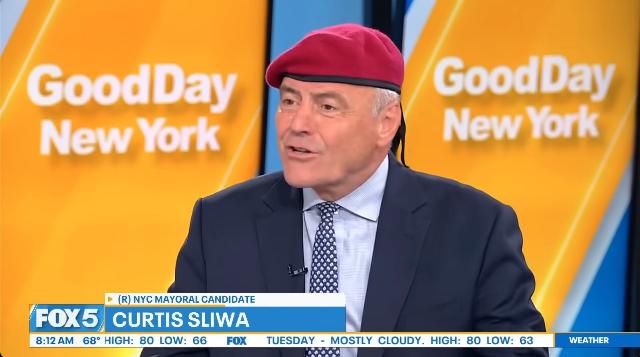
Wise Up, New Yorkers! An Unabashed Paean to Curtis Sliwa


NYC Mayor Eric Adams has announced that he has officially dropped out of the current mayoral race, leaving only former governor Andrew Cuomo (who served as NY state’s 56th governor from 2011 until he resigned in 2021 amid many accusations of sexual harassment) and Guardian Angels founder Curtis Sliwa to oppose Zohran Mamdani (whom I’ve written about several times, e.g. here and here).

Many pundits have expressed that, especially now with Adams out of the race, Cuomo is the only candidate to have a shot against Mamdani, based primarily on name recognition. That is of course excepting those many New Yorkers who are in thrall to Mamdani, the Ugandan-born member of Democrat Socialists of America who believes that the police are responsible for rising crime, that food stores are exploitative and should be owned and run by the city, and that the so-called “Palestinians” are a noble people who are oppressed by Israel, a country that he believes has no right to exist. Mamdani also refuses to condemn Hamas or the atrocities of Oct. 7, 2023.

YouTube screengrab.

Those who advocate voting for Cuomo acknowledge that New Yorkers who oppose Mamdani will have to hold their noses as they pull the levers for Cuomo. But although Cuomo’s own foul odor doesn’t compare with the stench emanating from Mamdani, there still just aren’t enough clothespins in the world for the nose-holding that voting for Cuomo requires. As much as I cannot fathom why New Yorkers would vote for Mamdani, I am deeply disappointed in all those who encourage voting for Cuomo.

The late conservative talk radio icon Bob Grant (whose real name was Robert Gigante and who was every bit as Italian-American as the Cuomos) used to play the theme from “The Godfather” any time he was speaking of Gov. Andrew Cuomo or his father, Gov. Mario Cuomo. He referred to Mario Cuomo as “Il sfaccim,” and let Mario’s son Andrew bear that same contemptuous sobriquet. For those who understand the meaning of that expression (which I will not translate here), it’s especially appropriate to hang that epithet on Mario Cuomo’s progeny.

Although he’s running as an Independent, Cuomo has been a lifelong card-carrying Democrat, a member of a Democrat family dynasty, and is therefore accountable for all the policies and harebrained schemes that today’s Democrat party endorses and supports. But Andrew Cuomo even fell out of favor with many of his fellow Democrats because of his disastrous handling of the COVID-19 pandemic, in which his policies were responsible for exponential increases in fatalities among elderly persons in nursing homes. To make matters worse, his administration attempted to cover up the nursing home deaths out of fear that the true statistics would be a political liability. For far too many New Yorkers, Cuomo is the man who killed Grandma and Grandpa, and then tried to deny it.

I know that politics makes for strange bedfellows, that it’s a tough and dirty business, and that deals made in smoke-filled back rooms are part and parcel of the whole political process. And yet I cannot in any way justify casting a vote for Andrew Cuomo, even if it’s to stop a monster like Mamdani. Voting for Cuomo represents totally flushing one’s principles down the terlet.

I’m no longer a resident of New York City, so I have no say in the matter, but for me there is only one clear and ethical choice for the role New Yorkers call “Hizzoner,” and that is Curtis Sliwa. If I could vote for NYC’s next mayor I would pull the lever for Curtis Sliwa in a hot second.

Born in the Canarsie section of Brooklyn in 1954, Sliwa has been a fixture on the NYC political scene for decades and has run for mayor before, most notably when he ran against Eric Adams in 2021 and was defeated.

Curtis Śliwa is a genuine hero. As a youth, he was cited for saving people from a burning building. He’s a high school dropout whose unmistakable Brooklyn accent contrasts with his prodigious vocabulary. A lifelong martial arts enthusiast, Sliwa can take care of himself, whether in a physical confrontation or a battle of wits.

Sliwa is best known for founding the Guardian Angels in 1979. But I have written before about how I remember the evolution of that organization. Curtis managed a McDonald’s in the Bronx and organized his employees to clean up litter in the neighborhood. While doing that, Curtis and his crew intervened in muggings. He encouraged his crew to learn karate, and in 1977 they coalesced into “The Magnificent 13,” a band of youthful (and diverse!) crimefighters who then took to riding “The Muggers’ Express” between Brooklyn and The Bronx to protect subway riders. That was what evolved into the Guardian Angels, which now has chapters around the world.

In addition to being a bona fide crimefighter, Curtis Sliwa has hosted several radio talk shows for decades. He’s always been a voice of plain-spoken, commonsense traditional respect for law and order, and is also an example of the “attitude” for which New Yorkers are known. He’s also been an advocate against animal abuse.

Curtis Śliwa is the real deal. He’s true to his principles and cannot be bought, despite being offered a king’s ransom to drop out of the race. He’s precisely what NYC needs; I just hope and pray that New Yorkers in sufficient numbers will wise up and not only reject Mamdani, but also reject the notion that Andrew Cuomo is the lesser of two evils. Choosing to vote for Andrew Cuomo over Zohran Mamdani is like choosing to shoot yourself in the head with a 9mm instead of a .45.

Author’s Note: Stu Tarlowe was born in NYC in 1948 and lived there until 1966 and again in 1978, but has not returned there since 2009. He has contributed to American Thinker since 2010, and most of his work for AT may be viewed here. He also posts on Stu’s Stack o’ Stuff, where subscriptions are currently free and where the content is not exclusively political.

https://www.americanthinker.com/articles/2025/09/wise_up_new_yorkers_an_unabashed_paean_to_curtis_sliwa.html