Search This Blog

Saturday, March 9, 2019

Anthem Won’t Mimic UnitedHealth’s Doctor Buying Binge

Health insurer Anthem has no plans to go on a medical care provider-buying spree like its chief rival UnitedHealth Group, the nation’s largest health insurer.
That was one of the key messages of Anthem CEO Gail Boudreaux and her management team Thursday in their annual investor day presentation in New York to discuss the health insurer’s strategy as it relates to medical care providers. Insurers are forming closer ties with doctors, hospitals and other medical care providers in hopes of reduce costs and improving health outcomes.
Though Anthem has purchased some doctor practices in Florida and — like UnitedHealth and Cigna — already owns its own pharmacy benefit manager (PBM) in IngenioRx, the nation’s second-largest health insurer is more interested in partnering with doctors and clinics than buying them. Anthem operates Blue Cross and Blue Shield plans in 14 states.
UnitedHealth, which owns the large Optum health services businesses, has spent billions of dollars buying doctor practices and urgent care centers and has a pending deal yet to close with DaVita Medical Group. Meanwhile, CVS Health, which owns more than 9,000 pharmacies and more than 1,100 retail health clinics, spent $70 billion buying Aetna, the nation’s third-largest health insurance company.
“The bottom line: we don’t have to own care provider practices, but we can enable our partnerships to define, create and deliver value,” Boudreaux said Thursday in her presentation, which was webcast.
Other executives said Anthem would be looking at acquisitions but those would be purchases largely designed to build on existing businesses.
“We are partnering with our providers,” said Dr. Prakash Patel, executive vice president and president of Anthem’s diversified business group. He said Anthem wants to provide doctors services to help them better manage their practices and the patients they are treating.
By partnering rather than buying doctor practices, Anthem executives said it doesn’t hurt the insurer’s ability to offer its employer and government clients value-based programs designed to make sure healthcare is delivered in the right place, at the right time and in the right amount.
POWERFUL WOMEN
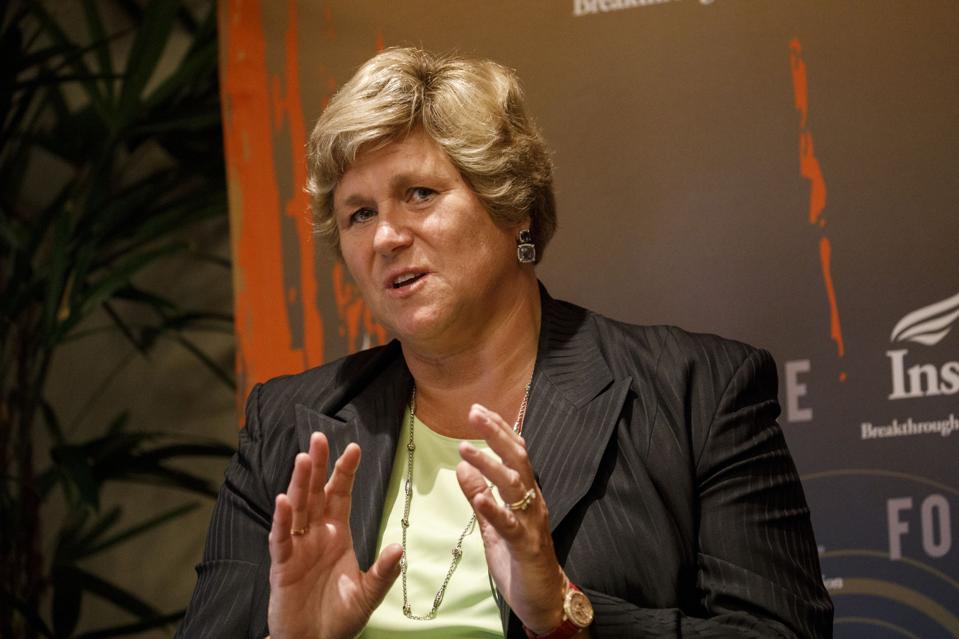
Gail Boudreaux, president and chief executive officer of Anthem Inc., speaks during the Fortune’s Most Powerful Women conference in Dana Point, California, U.S., on Monday, October 1, 2018. The conference brings together leading women in business,© 2017 BLOOMBERG FINANCE LP
“Anthem’s ‘Enhanced Personal Health Care,’ our largest value-based program, is helping strengthen our care provider relationships,” Boudreaux said. “Today, we have 6.2 million members, 166 accountable care organizations and 67,000 care providers. By 2023, we plan to have in excess of 11 million patients aligned with value-based care providers.”
Anthem executives said there are other ways to lower healthcare costs in the communities where they sell health insurance through medical care provider partnerships.
“We are sponsoring a new 50,000 sq. ft. medical complex in New Hampshire, to house primary care, internal medicine, lab, and specialists in a lower cost setting,” said Paul Marchetti, Anthem’s senior vice president of network and care delivery transformation. “As a sponsor, Anthem will have exclusivity on product alignment, with lower copays to encourage members to use the new complex.”

Nurse practitioner ranks growing exponentially

The number of nurse practitioners (NPs) in the U.S. has grown substantially over the 10 years, according to survey results recently released by the American Association of Nurse Practioners (AANP). According to the survey, there are an estimated 270,000 licensed and practicing NPs in the U.S., which is slightly higher than the AANP’s projected 248,000 NPs from March 2018. This number is twice the number of practicing NPs in 2007 (120,000).
Licensed nurse practitioners have been treating patients since the 1960s, when their role was initially intended to address pediatric well visits in rural areas in Colorado.
According to the survey, the 2018 State of the Nurse Practitioner Profession, almost 70% of respondents hold a certification in family care, 12% hold a certification in adult care, and six percent hold a certification in adult-gerontology care. Only four percent of respondents have a certification in pediatrics. While the authors of the study acknowledge that many NPs hold more than one certification, they do not identify how many NPs hold multiple certifications.
“NPs are the providers of choice for millions of patients,” said AANP President Joyce Knestrick, PhD, APRN, CFNP, FAANP, said in a news release. “Current provider shortages, especially in primary care, are a growing concern, yet the growth of the NP role is addressing that concern head-on. The faith patients have in NP-provided health care is evidenced by the estimated 1.06 billion patient visits made to NPs in 2018.”
According to the survey, NPs work in a variety of communities. One in six of the 4,300 respondents practice in urban areas and practice in hospital outpatient settings. More than 15% of the respondents said they work in communities with a population of less than 10,000. Roughly 5%of respondents work in communities with a population of less than 2,500. In those rural areas, NPs typically practice in rural health clinics.
The study also shows that NPs are committed to the communities they practice in – almost 60% said they will remain in their community for six years or more and 44% anticipate remaining in their current practice long-term.
Job satisfaction amongst NPs is high – nearly 77% of respondents were either satisfied or very satisfied with their employment at their practice site.
In terms of practice settings, the top five settings NPs work include: hospital outpatient, hospital inpatient, private group practice, private physician practice, and community health center.

Takeda announces results from Phase 3b head-to-head VARSITY study

Takeda Pharmaceutical announced results from the Phase 3b head-to-head VARSITY study which demonstrated that the gut-selective biologic vedolizumab was superior to the anti-tumor necrosis factor-alpha biologic adalimumab in achieving clinical remission in patients with moderately to severely active ulcerative colitis at week 52. Data showed that 31.3% of patients receiving vedolizumab intravenous achieved the primary endpoint of clinical remission compared to 22.5% of patients treated with adalimumab subcutaneous at week 52, with the difference being statistically significant. Furthermore, treatment with vedolizumab was associated with significantly higher rates of mucosal healing at week 52, with 39.7% of patients receiving vedolizumab achieving mucosal healing compared to 27.7% treated with adalimumab. A non-statistically significant difference in favor of adalimumab was seen in the percentage of patients using oral corticosteroids at baseline who discontinued corticosteroids and were in clinical remission at week 52. While the study was not powered to compare the safety of the two biologics, patients treated with vedolizumab had a lower rate of overall adverse events over 52 weeks than patients treated with adalimumab, with a lower rate of infections reported in patients treated with vedolizumab as compared to adalimumab. The rate of serious adverse events was also lower in vedolizumab-treated patients than adalimumab.
https://thefly.com/landingPageNews.php?id=2876837

Persistent, Prolonged Opioid Use Occurs After Plastic Surgery

Persistent and prolonged opioid use occur after plastic and reconstructive surgical procedures, according to a study published online March 7 in JAMA Facial Plastic Surgery.
Cristen Olds, M.D., from the Stanford Hospital and Clinics in California, and colleagues conducted a population-based cohort study involving 466,677 patients who underwent five classes of plastic and reconstructive procedures between Jan. 1, 2007, and Dec. 31, 2015. The prevalence of immediate and long-term postoperative opioid use was examined.
The researchers found that 54.6 percent of the patients filled prescriptions for postoperative analgesics; opioids accounted for 91.5 percent of the analgesic prescriptions filled. In 6.6 and 2.3 percent of patients, persistent (opioid prescriptions filled 90 to 180 days postoperatively) and prolonged (opioid prescriptions filled 90 to 180 days and again 181 to 365 days postoperatively) opioid use occurred. Compared with patients who did not fill opioid prescriptions, those who filled prescriptions in the perioperative period were significantly more likely to exhibit persistent and prolonged opioid use (odds ratios, 2.87 and 2.90, respectively), with the greatest odds for persistent use in patients undergoing breast and nasal procedures (odds ratios, 4.36 and 3.51). Perioperative opioid use, procedure type, and previous year mental health and substance abuse diagnosis were independent risk factors for persistent and prolonged opioid use.
“Given the significant risk of persistent opioid use after plastic and reconstructive procedures, it is imperative to develop best practices guidelines for postoperative opioid prescription practices in this population,” the authors write.

iMedicalApps: DST- Dementia Test Review

In a busy primary care practice, providers frequently encounter patients or their family members who request dementia screening. Although my current clinic has a neurologist and neuropsychologist available, a fully functional dementia clinic is likely not available to most community-based primary care providers. So how does a busy primary care provider screen for dementia?
There are many validated screening tools including the Mini-Cog, MoCA, MMSE, SLUMS, and AD8, among others. Here at iMedicalApps, we have reviewed a number of geriatrics apps including many from the American Geriatrics Society (AGS) — Geriatrics at Your FingertipsMultimorbidity/MCC GEMSiGeriatrics, and AGS GEMS — that contain some of these tools. Last year, I reviewed the app AlzDxRx which helps providers screen, diagnose, and manage patients with Alzheimer’s disease and contains several tools including the Mini-Cog. However, it did not contain the SLUMS or MoCA, as these are proprietary screening tools. Subsequently, we favorably reviewed a dedicated SLUMS app called eSLUMS.
Now another dementia screening called the Dementia Screening Tool (DST) is available for iOS and Android devices. The DST is an approved medical device and was developed in Germany by Dr. Sebastian Horn. The author’s website claims a sensitivity of 97% for the DST.
Likes
  • Brings the DST “medical device” to iOS and Android devices
  • Data input and clock drawing tests work well on a mobile device
  • Available for Android
Dislikes
  • No information on evidence for DST compared to other screening tools or references
  • Expensive
  • Explanation of results is incomplete

Seelos: licenses potential Parkinson`s candidate created at UCLA

Seelos Therapeutics Inc (NASDAQ:SEEL) stock shot up Thursday after the biotech said it has exclusively in-licensed the rights to a potential disease modifying Parkinsons disease therapy created by researchers at the University of California, Los Angeles(UCLA).
Parkinsons disease is a progressive nervous system disorder that affects movement, and symptoms include tremors and changes in speech and gait.
Seelos Therapeutics stock nearly doubled to $3.30 in morning trade.
The New York-based biotech has exclusively in-licensed the rights to a family of peptide inhibitors that target the aggregation of alpha-synuclein (-synuclein).
The function of -synuclein proteins in the healthy brain is unknown, but Parkinson`s researchers are interested in it because it is a major constituent of Lewy bodies, protein clumps that are the pathological hallmark of the neurological disorder.
The company has designed the new program as SLS-007, with an initial focus on Parkinson`s disease.
Pre-clinical data provides supportive evidence to slow progression, an early sign of disease-modifying potential in Parkinsons disease.
Seelos will evaluate the potential for in-vivo delivery of SLS-007 in a Parkinsons disease transgenic mice model.
“Accumulation and aggregation of -synuclein is a pathological hallmark of Parkinsons disease, Seelos Therapeutics CEO Raj Mehra said in a statement. Though its role is not completely understood, it appears pivotal in the pathogenesis of Parkinsons and other -synucleinopathies such as dementia with Lewy bodies and multiple system atrophy. Reducing the levels of pathological forms of -synuclein may alter the course of Parkinsons.”
Tim Whitaker, who is the head of R&D at Seelos, said that the current available treatments for Parkinsons including Dopamine promoter Levodopa and deep brain stimulation, long-term outcomes for patients remain poor.”
“With no disease-modifying treatments, and long-term use of established dopaminergic therapies resulting in both adverse events and side effects, significant need remains to develop not only a better means of restoring striatal dopamine but a safe and effective treatment that slows progression of the disease in patients with Parkinsons, said Whitaker.
Under the terms of the license, Seelos paid The UC Regents and UCLA$100,000upfront and will pay royalties on net sales.

Vaccine Prolongs Remission in Triple-Negative Breast Cancer

Treatment with a novel peptide vaccine appeared to delay disease recurrence in triple-negative breast cancer (TNBC) patients with low HER2 expression, a subgroup analysis of a phase II trial found.
At a median follow-up of 26.1 months, disease recurrence occurred in 7.5% of TNBC patients who received nelipepimut-S (NeuVax) compared with 26.7% in the control arm (HR 0.26, 95% CI 0.08-0.81, P=0.01), reported Guy T. Clifton, MD, of San Antonio Military Medical Center in Texas.
“We think the results are intriguing in light of what we now understand as far as triple-negative breast cancer being a more immunogenic subtype of breast cancer that’s more responsive to immunotherapy,” he said during his presentation here at the ASCO-SITC Clinical Immuno-Oncology Symposium.
In the NeuVax and control arms, respectively, rates of disease-free survival (DFS) among the 97 TNBC patients were:
  • 92.6% versus 70.2% at 24 months
  • 82.3% versus 70.2% at 36 months
But Clifton pointed out the trial was stopped at the first interim analysis for efficacy. In part because the investigators, in consultation with a data safety monitoring board, felt the overall findings would not change, but also because negative results of NSABP B-47found that trastuzumab (Herceptin) with chemotherapy was no better than chemotherapy alone for patients with HER2-low breast cancer.
The current study randomized 275 HER2-low expression breast cancer patients to trastuzumab and granulocyte-macrophage colony-stimulating factor (GM-CSF) with or without NeuVax, a vaccine designed to stimulate CD8 T cells.
In the intention-to-treat population, recurrences occurred in 8.8% of patients in the investigational arm versus 14.4% of those in the control arm at a median follow-up of 24.7 months (HR 0.62, 95% CI 0.31-1.25, P=0.18).
In the other subgroup of patients, those with hormone receptor-positive disease, there was also no DFS difference between groups, with the NeuVax arm numerically worse at 24 months but better at 36 months (HR 1.19, 95% CI 0.46-3.01, P=0.71).
Clifton concluded that the combination is safe, added no cardiac toxicity, and “may provide benefit for patients with HER2-low expressing triple-negative breast cancer,” but said this would need to be confirmed in a phase III trial, which is being pursued.
“Our approach has been to use this in the adjuvant setting, in patients who are clinically disease free,” he said. “It avoids immunosuppression associated with patients who are metastatic, but also avoids the tumor suppressive microenvironment associated with established tumors.”
“This is really an immuno-prevention trial, where you’re trying to do a secondary prevention,” said discussant Kunle Odunsi, MD, of Roswell Park Comprehensive Cancer Center in Buffalo, New York. “Therefore the type of T cells that you need to generate ideally should have memory attributes or even those stem cell attributes.”
He said that strengths of the study include the “very robust” preclinical rationale for the vaccine’s efficacy in this setting, use of a shared antigen allowing for ease of production and availability, and the broad patient group — patients had to be clinically disease free following standard therapies and positive for HLA-A2, A3, A24, or A26. During screening, only 17% were excluded for HLA status.
Odunsi noted that the effect observed in the TNBC group appears to be “clinically meaningful,” but also questioned whether the study was powered for such a subgroup analysis and whether GM-CSF is the most appropriate adjuvant.
From 2013 to 2018 the trial enrolled high-risk, invasive breast cancer patients with HER2 expression levels of 1-2 on immunohistochemical staining, across 26 U.S. centers. High-risk was defined as node-positive, regardless of hormone receptor status, or node-negative for TNBC patients.
Patients were well-matched for stage, said Clifton, and a little over half of patients in each arm received neoadjuvant chemotherapy.
Most patients (94.3%) had at least one treatment-related adverse event (AE), but no between-group differences were observed, and the majority were low-grade local injection site reactions, skin induration, pruritus, and fatigue. Importantly, cardiac toxicity was similar between the two groups, there were no grade 4 events, and no patients died due to AEs.
Clifton reported having no relationships with industry. Co-authors disclosed relationships with AstraZeneca, Medivation/Pfizer, Daiichi Sankyo, Genentech, Merck, Peregrine Pharmaceuticals, Sellas Life Sciences, and others.
Odunsi reported relationships with AstraZeneca, Merck, Geneos, Unleash Immuno Oncolytics, Immunovaccine, Tesaro Pharma, Truvax, and Tactiva Therapeutics.
LAST UPDATED