Search This Blog

Saturday, September 7, 2019

J&J gets Stelara okay in Europe for ulcerative colitis

Johnson & Johnson’s inflammatory disease drug Stelara has been approved in Europe for ulcerative colitis (UC), a new use for the multibillion dollar blockbuster.
The European Commission cleared Stelara (ustekinumab) for adults with moderately-to-severely active UC, a fourth indication for the drug that is also being reviewed by the US FDA. Stelara can be used to treat patients who have failed to respond to or can’t tolerate other biologic therapies for UC.
J&J’s pharma unit Janssen said Stelara is the first interleukin-12/23 inhibitor to be approved for UC, an inflammatory bowel disease which affects around 2.6 million people in Europe. It is estimated that current therapies doesn’t work in up to two-thirds of cases.
The approval in UC is based on the phase 3 UNIFI study, which showed that Stelara was effective in achieving clinical remission in around 16% of people who couldn’t tolerate or failed prior therapy, including TNF inhibitors or Takeda’s α4β7 integrin blocker Entyvio (vedolizumab), compared to 5% of the placebo group.
Stelara was first approved for psoriasis 10 years ago, and follow-up indications in psoriatic arthritis and Crohn’s disease have kept the drug growing at a healthy pace to reach more than $5 billion last year.
It has proved remarkably resilient, growing another 23% to reach $2.96 billion in the first half of this year despite approvals for new biologics drugs in its main therapeutic categories – including some that have outperformed it in head-to-head trials.
The list of drugs that have outperformed J&J’s drug in psoriasis is getting fairly long. It includes IL-17 inhibitors such as Novartis’ Cosentyx (secukinumab) as well as new IL-23 inhibitors like AbbVie’s recently-approved Skyrizi (risankizumab), although it seems these are making headway more against older TNF blockers than Stelara.
J&J also has its own selective IL-23 inhibitor – called Tremfya (guselkumab) – rolling out for psoriasis, with other indications including UC in late-stage testing.
The company has stolen a march on its biologic rivals with the approval of Stelara in UC, which the company thinks could be a sizeable market for the drug in its own right.
It will have to jostle for market share with other drugs, including Pfizer’s oral JAK inhibitor Xeljanz (tofacitinib), which was approved for moderate-to-severe UC last year but has some safety concerns at higher doses, as well as newer drugs like Eli Lilly’s experimental IL-23 inhibitor mirikizumab.
Analysts at GlobalData are less confident however, saying shortly after the UNIFI data was presented that Stelara “is expected to have a slow adoption” in UC, adding that “competition in the moderate to severe disease category in UC is expected to intensify over the coming years, making it difficult for Stelara to attain a strong foothold in the…market.”
GlobalData says inflammatory bowel disease sales for Stelara will reach $1.5 billion by 2026 in its top seven pharma markets, but $1.3 billion of that total will come from Crohn’s disease.

NextCure since its IPO

The initial public offering class of 2018 and 2019 has been very mixed. There have been some great winners, but there also have been some very well-known unicorns that have flopped. Sometimes it is the under-the-radar companies that offer the best upside stories, and sometimes unlucky timing or initial pricing can keep those great stories from ever being read about.
NextCure Inc. (NASDAQ: NXTC) appears to be one of those companies that has flown under the radar of the investing community since its initial public offering in 2019. The biotech outfit’s lead product candidate, NC318, is already in trials for the treatment of advanced or metastatic solid tumors. And its IPO timing in the first half of May was at a time when the “sell in May and go away” craze was in full swing.
Despite poor market sentiment in May, NextCure’s stock rose about 40% on its debut, with a $19.90 close (and $22.75 high) after pricing its 5 million shares at just $15 apiece. By the first week of June, the stock was back close to $15, and it wasn’t even moving until June 28 and July 1, when the volume spiked higher and the shares rose to $17.65 from $14.98.
Now, the shares are above $42. What is amazing, even on a day with a big analyst upgrade and with an 8% gain, is that NextCure has seen only four trading days in the past month in which the total volume was above 100,000 shares. That means this stock has tripled, and it hasn’t done it with any major investor interest.
This company was sitting on about $193 million in cash at the end of the second quarter, after its May 9 IPO raised about $86 million in gross proceeds. The company also has a collaboration agreement with Eli Lilly and Co. (NYSE: LLY). The company is among the many that want to use a patient’s own immune system to target cancers and other diseases. It is developing therapeutics after having identified several positive and negative immune regulators of myeloid cells and T cells to restore antitumor activity with its own FIND-IO technology.
NextCure’s latest news release indicated that it is on track to submit an investigational new drug application to the U.S. Food and Drug Administration (FDA) for its second product candidate (NC410) in the first quarter of 2020. The company noted recently that its NC410 is a novel immunomedicine that is seeking to block immune suppression mediated by an immune modulator called leukocyte‑associated immunoglobulin‑like receptor 1.
The driver on Thursday was that Piper Jaffray reiterated its Overweight rating and vaulted the target price to $54 from $26. Sure, the price target needed to be refreshed after it was surpassed and then some. Still, that’s a 100% boost to the target that was there earlier this summer.
According to the target hike at Piper Jaffray, the enthusiasm comes after continued enrollment in a dose-escalation study of NC318 in advanced solid tumors and the higher target is on increasing values ahead of a data release, which should come out during the fourth quarter.
Morgan Stanley had reiterated its Overweight rating in mid-August, but that target of $25 was raised to just $33.
One additional driver for investors may be the upcoming September 10 presentation at the Morgan Stanley 17th Annual Global Healthcare Conference in New York City.
NextCure was traded up almost 10% to $43.35 on Thursday, in a post-IPO range of $13.86 to $43.40. It’s just not common to see a stock rise this much, with a market cap that is nearing $1 billion and on such low trading volume.
The short interest has remained muted as it is a new stock, but as of mid-August the number of shares short had risen to over 236,000, when the shares were closer to $26.
Is NextCure the Next Big Cancer Biotech Every Investor Missed?

Pfenex Earns $11M Milestone under Agreement with Jazz Pharma

Pfenex Inc. (NYSE American: PFNX) today announced that it has earned an $11 million development milestone under its development and license agreement with Jazz Pharmaceuticals. The milestone is associated with process development activities for PF745, a recombinant crisantaspase with half-life extension technology.
“We are very pleased with our progress on PF745 and we believe the Jazz collaboration overall further validates the versatility of our proprietary protein expression platform and the quality of our development capabilities,” said Eef Schimmelpennink, Chief Executive Officer of Pfenex. “Similarly, we are appreciative of the progress recently reported by Jazz on PF743 (JZP-458) with the completion of the Phase 1 study and announcement of plans to initiate a Phase 2/3 study later in 2019.”
Under the terms of the development and license agreement, Pfenex is eligible to receive an aggregate total of up to $224.5 million in development and sales milestone fees, of which $177.5 million is still eligible to be received by Pfenex. Of this $177.5 million, $18.5 million are development milestones, $34 million are regulatory milestones, and $125 million are sales milestones. Pfenex may also be eligible to receive tiered royalties on worldwide sales of any products resulting from the collaboration.
https://www.globenewswire.com/news-release/2019/09/05/1911902/0/en/Pfenex-Earns-11-Million-Development-Milestone-under-its-Development-and-License-Agreement-with-Jazz-Pharmaceuticals.html

Friday, September 6, 2019

Aprea Therapeutics files for IPO

Clinical-stage biopharma Aprea Therapeutics has filed for an initial public offering.
The filing comes via J.P. Morgan, Morgan Stanley, and RBC Capital Markets, with a placeholder registration for $86.25M.
It's seeking a Nasdaq listing under the symbol OTCPK:APRE.
Operating expenses for the six months ended June 30 were $10.35M. The company expects IPO proceeds and cash on hand to complete each of its ongoing clinical trials.

Telemarketer charged in $1.2B Medicare fraud scheme pleads guilty in NJ

The owner of a telemarketing company implicated in the largest component of a $1.2 billion Medicare fraud involving the supply of medically unnecessary orthotic braces pleaded guilty to criminal charges on Friday, the U.S. Department of Justice said.
Lester Stockett, the owner of Video Doctor USA and Telemed Health Group and chief executive of AffordADoc, also agreed to pay $200 million of restitution, as part of his plea to conspiracy to defraud the United States through kickbacks and conspiracy to commit money laundering, the department said.
Stockett, 52, of Medellin, Colombia, entered his plea before U.S. District Judge Madeline Cox Arleo in Newark, New Jersey. His sentencing is scheduled for Dec. 16.
Valentin Rodriguez, a lawyer for Stockett, in an email said his client “took full and early responsibility for his grave mistakes in this industry, and regrets what his actions caused.”
The Justice Department said Stockett was involved in a $424 million conspiracy where he obtained kickbacks and bribes from patient recruiters, pharmacies and brace suppliers, and then paid kickbacks and bribes to induce doctors to order braces for elderly and disabled patients who did not need them.

Stockett was among 24 defendants, including owners of medical equipment companies, charged in six states in April, in what prosecutors called one of the largest healthcare fraud schemes ever prosecuted in the United States.
The scheme allegedly involved the use of offshore call centers and shell companies, with laundered money used to buy exotic cars, yachts and luxury real estate.

“The extent of Mr. Stockett’s fraud and money laundering, literally, knew no bounds,” FBI Special Agent in Charge Gregory Ehrie said in a statement. “From the U.S. to Latin America, the Philippines, and the Dominican Republic, the FBI followed the trail of ill-gotten gains back to Stockett and his conspirators. They stole precious federal funds earmarked to assist the elderly.”
Criminal charges remain pending against Stockett’s co-defendants, Creaghan Harry and Elliot Loewenstern, over their alleged involvement in the Video Doctor scheme. Their lawyers did not immediately respond to requests for comment.
The U.S. Department of Health and Human Services has warned about scammers who offer braces through television and radio ads or by phone, and said Medicare might later deny needed braces to beneficiaries who accept unwanted or unneeded braces now.

A swifter way towards 3-D-printed organs

Twenty people die every day waiting for an organ transplant in the United States, and while more than 30,000 transplants are now performed annually, there are over 113,000 patients currently on organ waitlists. Artificially grown human organs are seen by many as the “holy grail” for resolving this organ shortage, and advances in 3-D printing have led to a boom in using that technique to build living tissue constructs in the shape of human organs. However, all 3-D-printed human tissues to date lack the cellular density and organ-level functions required for them to be used in organ repair and replacement.
Now, a new technique called SWIFT (sacrificial writing into functional tissue) created by researchers from Harvard’s Wyss Institute for Biologically Inspired Engineering and John A. Paulson School of Engineering and Applied Sciences (SEAS), overcomes that major hurdle by 3-D printing vascular channels into living matrices composed of stem-cell-derived organ building blocks (OBBs), yielding viable, organ-specific tissues with high cell density and function. The research is reported in Science Advances.
“This is an entirely new paradigm for tissue fabrication,” said co-first author Mark Skylar-Scott, Ph.D., a Research Associate at the Wyss Institute. “Rather than trying to 3-D-print an entire organ’s worth of cells, SWIFT focuses on only printing the vessels necessary to support a living tissue construct that contains large quantities of OBBs, which may ultimately be used therapeutically to repair and replace human organs with lab-grown versions containing patients’ own cells.”
SWIFT involves a two-step process that begins with forming hundreds of thousands of stem-cell-derived aggregates into a dense, living matrix of OBBs that contains about 200 million cells per milliliter. Next, a vascular network through which oxygen and other nutrients can be delivered to the cells is embedded within the matrix by writing and removing a sacrificial ink. “Forming a dense matrix from these OBBs kills two birds with one stone: not only does it achieve a high cellular density akin to that of human organs, but the matrix’s viscosity also enables printing of a pervasive network of perfusable channels within it to mimic the blood vessels that support human organs,” said co-first author Sébastien Uzel, Ph.D., a Research Associate at the Wyss Institute and SEAS.
The cellular aggregates used in the SWIFT method are derived from adult induced pluripotent stem cells, which are mixed with a tailored extracellular matrix (ECM) solution to make a living matrix that is compacted via centrifugation. At  (0-4 C), the dense matrix has the consistency of mayonnaise—soft enough to manipulate without damaging the cells, but thick enough to hold its shape—making it the perfect medium for sacrificial 3-D printing. In this technique, a thin nozzle moves through this matrix depositing a strand of gelatin “ink” that pushes cells out of the way without damaging them.
A swifter way towards 3-D-printed organs
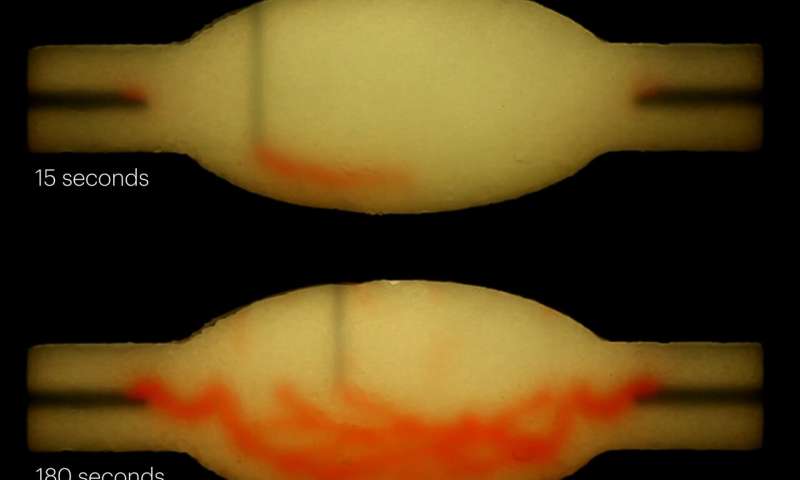
This image sequence shows a pervasive, branching network of vascular channels (red) being printed within a densely cellular tissue matrix via SWIFT. Credit: Wyss Institute at Harvard University
When the cold matrix is heated to 37 C, it stiffens to become more solid (like an omelet being cooked) while the gelatin ink melts and can be washed out, leaving behind a network of channels embedded within the tissue construct that can be perfused with oxygenated media to nourish the cells. The researchers were able to vary the diameter of the channels from 400 micrometers to 1 millimeter, and seamlessly connected them to form branching vascular networks within the tissues.
Organ-specific tissues that were printed with embedded vascular channels using SWIFT and perfused in this manner remained viable, while tissues grown without these channels experienced cell death in their cores within 12 hours. To see whether the tissues displayed organ-specific functions, the team printed, evacuated, and perfused a branching channel architecture into a matrix consisting of heart-derived cells and flowed media through the channels for over a week. During that time, the cardiac OBBs fused together to form a more solid cardiac  whose contractions became more synchronous and over 20 times stronger, mimicking key features of a human heart.
“Our SWIFT biomanufacturing method is highly effective at creating organ-specific tissues at scale from OBBs ranging from aggregates of primary cells to stem-cell-derived organoids,” said corresponding author Jennifer Lewis, Sc.D., who is a Core Faculty Member at the Wyss Institute as well as the Hansjörg Wyss Professor of Biologically Inspired Engineering at SEAS. “By integrating recent advances from stem-cell researchers with the bioprinting methods developed by my lab, we believe SWIFT will greatly advance the field of organ engineering around the world.”
Collaborations are underway with Wyss Institute faculty members Chris Chen, M.D., Ph.D. at Boston University and Sangeeta Bhatia, M.D., Ph.D., at MIT to implant these tissues into animal models and explore their host integration, as part of the 3-D Organ Engineering Initiative co-led by Lewis and Chris Chen.
“The ability to support living  with vascular channels is a huge step toward the goal of creating functional  outside of the body,” said Wyss Institute Founding Director Donald Ingber, M.D., Ph.D., who is also the Judah Folkman Professor of Vascular Biology at HMS, the Vascular Biology Program at Boston Children’s Hospital, and Professor of Bioengineering at SEAS. “We continue to be impressed by the achievements in Jennifer’s lab including this research, which ultimately has the potential to dramatically improve both organ engineering and the lifespans of patients whose own organs are failing,”

Explore further

More information: “Biomanufacturing of organ-specific tissues with high cellular density and embedded vascular channels” Science Advances (2019). advances.sciencemag.org/content/5/9eaaw2459

MS Drug Spending Skyrockets Due to Rising Prices

Study Authors: Alvaro San-Juan-Rodriguez, Chester B. Good, et al.; Daniel M. Hartung, Dennis Bourdette
Target Audience and Goal Statement: Neurologists, family physicians, primary care physicians
The goal of this study was to assess how trends in prices, market share, and spending on self-administered disease-modifying therapies (DMTs) for multiple sclerosis (MS) changed in Medicare Part D from 2006 through 2016.
Question Addressed:
How did prices, market share, and spending on self-administered DMTs for MS change in Medicare Part D from 2006 through 2016?
Study Synopsis and Perspective:
List prices of self-administered MS drugs more than quadrupled in 11 years, and Medicare spending for Medicare Part D beneficiaries soared more than 10-fold during the same period, an analysis of claims data showed.

Action Points

  • In an analysis of Medicare beneficiaries, annual treatment costs for self-administered disease-modifying therapies (DMTs) for multiple sclerosis (MS) more than quadrupled over a 10-year period.
  • Note that prices of self-administered DMTs for MS increased dramatically from 2006 to 2016, which resulted in a 7.2-fold increase in patients’ out-of-pocket costs.
Self-administered DMT prices rose from a mean of $18,660 to $75,847 a year from 2006 to 2016, reported Alvaro San-Juan-Rodriguez, PharmD, of the University of Pittsburgh, and co-authors in JAMA Neurology. Medicare spending on these drugs went from $7,794 to $79,411 per 1,000 Medicare beneficiaries during the same period.
Only four self-administered DMTs were approved for MS treatment prior to 2009, including glatiramer acetate (20 mg), interferon beta-1a (30 µg), interferon beta-1a (8.8/22/44 µg), and interferon beta-1b. Several new DMTs entered the market in the ensuing decade and there are now 19 FDA-approved DMTs for MS in 10 different mechanistic classes.
However, looking at Medicare Part D prescription claims from 2006 to 2016 (a period coinciding with the proliferation of more DMTs for MS), researchers found a steep increase in the list prices of MS drugs — the starting point before rebates, coupons, or insurance kicks in — and in the ultimate costs both to Medicare and the consumer.
“This study is the first to evaluate the impact of rising prices of multiple sclerosis drugs on Medicare Part D drug spending and patients’ out-of-pocket spending,” San-Juan-Rodriguez told MedPage Today. “Multiple sclerosis drugs have been well-known for presenting high price increases over the last years. Yet the impact of these high and rising drug prices on Medicare Part D spending and patients’ out-of-pocket spending was unclear,” he said.
“This study is an important contribution because it demonstrates to taxpayers and policymakers that rising prices of multiple sclerosis drugs have resulted in large increases in Medicare spending and patient out-of-pocket costs,” he added.
Many DMTs for MS reduce the frequency and severity of flare-ups, which can involve a variety of disabling neurological symptoms, such as vision loss, pain, fatigue, and muscle weakness.
Annual cost of treatment with each medication (based on Medicare Part D prescription claims gross costs and FDA-approved recommended dosing), market share of each medication (proportion of pharmaceutical spending accounted by every drug), and pharmaceutical spending per 1,000 Medicare beneficiaries for all drugs served as the main outcomes in this analysis of a 5% random sample of Medicare part D beneficiaries (a mean of 2.8 million Medicare beneficiaries per year). Researchers also quantified Medicare catastrophic coverage payments, low-income cost sharing subsidies, patients’ out-of-pocket costs, manufacturers’ coverage gap discounts, and other payments towards pharmaceutical spending.
Over the course of more than a decade, annual cost to the Medicare Part D program for DMTs rose from $396.6 million to $4.4 billion, which equals a more than 10-fold increase per Medicare beneficiary. Annual DMT cost escalation from $18,660 to $75,847, which translated into a mean yearly increase of 12.8%, was the main economic driver. Fingolimod and brand-name glatiramer (20 mg) were at the higher end of the range of annual costs of treatment, and interferon beta-1b and generic glatiramer (20 mg) were at the lower end.
For every 1,000 beneficiaries, pharmaceutical spending and out-of-pocket spending by the consumer during the same period increased 10.2-fold (from $7,794 to $79,411) and 7.2-fold (from $372 to $2,673), respectively.
Across the study period, brand name glatiramer maintained the largest market share per 1,000 beneficiaries, ranging from 32.2% to 48.4%. There was a substantial decrease in market share of platform therapies (interferon beta preparations and glatiramer acetate) from 2006 to 2016, in favor of newer therapies. Prices per 1,000 beneficiaries for fingolimod, teriflunomide, and dimethyl fumarate rose by 7.9%, 9.0%, and 19.2%, respectively.
Relative federal contributions towards pharmaceutical spending increased from $5,335 of $7,794 (68.5%) to $58,620 of $79,411 (73.8%).
“We’re not talking about patients without health insurance here,” said co-author Inmaculada Hernandez, PharmD, PhD, of the University of Pittsburgh, in a press release. “We’re talking about insured patients, under Medicare. Still, they are paying much more for multiple sclerosis drugs than they were 10 years ago.”
Bari Talente, executive vice-president of advocacy for the National MS Society, said in another press release: “Medications can change lives only if they are accessible — a seven-fold increase in out-of-pocket costs is not accessible.”
“People with MS, Medicare and our health care system cannot continue to face these types of increases, where prices more than quadruple over a 10-year period,” she said.
Analyses only included self-administered DMTs and not MS drugs that were administered in physician offices, which are reimbursed under Medicare Part B, the team acknowledged. This limits the generalizability of the data to the Medicare Part D population. Although only glatiramer (20 mg) faced within-molecule competition, economic theory holds that the prices of incumbent agents should decrease after the entry of competitors (even for within-molecule competition).
Source Reference: JAMA Neurology 2019; DOI: 10.1001/jamaneurol.2019.2711
Editorial: JAMA Neurology 2019; DOI: 10.1001/jamaneurol.2019.2445
Study Highlights: Explanation of Findings
Based on an analysis of 2006-2016 Medicare Part D claims data, annual costs of treatment of self-administered DMTs for MS more than quadrupled during the study period. Pharmaceutical spending on these MS drugs increased more than 10-fold and patients’ out-of-pocket costs increased more than seven-fold. While glatiramers occupied the lion’s share of the market, platform therapies experienced a market share drop over time in favor of newer therapies.
“One of the most significant findings was that the prices of these drugs have increased in parallel,” said San-Juan-Rodriguez. “Only a couple exceptions deviate from that general trend.”
Critics may argue that manufacturer rebates and other discounts mean that the MS drug list price does not translate into increased spending; however, the detailed cost breakdown from Medicare claims and study findings counter this argument.
Medicare spends more than three times as much for DMTs for MS than they pay to neurologists for all of the services that they provide, observed Daniel Hartung, PharmD, MPH, and Dennis Bourdette, MD, both of the Oregon Health & Science University in Portland, in an accompanying editorial. Simply put, this study documents the escalating costs that patients, Medicare Part D plans, and ultimately U.S. taxpayers are paying for “irrationally priced therapies,” they noted.
“The pharmaceutical and biotechnology industries claim that the high prices reflect the expense of research and development and need to incentivize continued innovation,” they wrote. But “these claims do not explain the continuous rise in the three drugs originally approved for MS, interferon beta-1b, interferon beta-1a, and glatiramer acetate,” they noted. “These drugs have long since recouped any cost of drug development, yet their prices have continued to rise.”
These three drugs had modest increases in price until 2002, when another interferon beta-1a was introduced at a price approximately 30% higher, initiating “the ever-increasing prices of DMTs for MS,” they pointed out.
San-Juan-Rodriguez and colleagues also noted that the proliferation of MS drug approvals “did not ameliorate and could have even contributed to high inflation rates observed for incumbent drugs.” This pattern serves as a counterexample to the argument that competition leads to lower prices.
Neurologists should “look carefully at their relationships with pharmaceutical and biotechnology companies and call them to task for unreasonable increases in prices,” Hartung and Bourdette wrote. “Remaining silent should not be an option.”
“The development of DMT for MS has been one of the great achievements of neurology in the past 25 years,” they continued. “Neurologists should not allow the unfettered increases in price for these drugs hurt the health care system or patients.”
Reviewed by Robert Jasmer, MD Associate Clinical Professor of Medicine, University of California, San Francisco