Search This Blog

Thursday, October 24, 2019

Surprise loss at GNC

GNC Holdings (NYSE:GNC) is on watch after posting an unexpected loss for Q3.
The company reports domestic same-store sales fell 2.8% during the quarter and total revenue was off 14%.
E-commerce was a high point GNC with increased conversion rates leading to 12% growth during the quarter.
GNC ended Q3 with $190M in liquidity.
Shares are inactive in the premarket session.
https://seekingalpha.com/news/3509076-surprise-loss-gnc-holdings

TG Therapeutics up 5% premarket on long-term ublituximab data

TG Therapeutics (NASDAQ:TGTX) announces final long-term data from the Phase 3 GENUINE study evaluating ublituximab, combined with AbbVie’s Imbruvica (ibrutinib), compared to ibrutinib alone in patients with relapsed/refractory high-risk chronic lymphocytic leukemia (CLL).
As previously announced, the trial met the primary endpoint of overall response rate up to two years.
The combination was well-tolerated with no new safety signals at a median of 4+ years of follow-up.
The company plans to share the results with the FDA and submit the data for presentation at a future medical conference.
Shares up 5% premarket on light volume.
https://seekingalpha.com/news/3509109-tg-therapeutics-5-percent-premarket-long-term-ublituximab-data

Premarket analyst action, Oct. 24

ACADIA Pharmaceuticals (NASDAQ:ACAD) initiated with Market Perform rating and $44 (5% upside) price target at Oppenheimer.
Nektar Therapeutics (NASDAQ:NKTR) initiated with Market Perform rating and $18 (7% upside) price target at Oppenheimer.
Neovasc (NASDAQ:NVCN) initiated with Buy rating and $9 (151% upside) price target at H.C. Wainwright. Shares up 7% premarket.
Nephros (NASDAQ:NEPH) initiated with Speculative Buy rating and $16 (66% upside) price target at Benchmark.
PDS Biotechnology (NASDAQ:PDSB) initiated with Buy rating and $10 (212% upside) at Chardan Capital Markets. Shares up 17% premarket.
Acorda Therapeutics (NASDAQ:ACOR) downgraded to Underweight at JPMorgan. Shares down 13% premarket.
Arrowhead Pharmaceuticals (NASDAQ:ARWR) downgraded to Neutral with a $39 (flat) price target at Baird. Shares down 2% premarket.
LaMaitre Vascular (NASDAQ:LMAT) downgraded to Outperform from Strong Buy at First Analysis. Shares down 2% premarket.
https://seekingalpha.com/news/3509090-chardan-likes-pds-bio-premarket-analyst-action

Wednesday, October 23, 2019

New antiviral drug effectively treats influenza

A new antiviral drug that induces mutations in the genetic material of influenza virus is highly effective in treating influenza infection in animals and human airway tissue and could be a groundbreaking advance in influenza therapy, according to a study by the Institute for Biomedical Sciences at Georgia State University.
The antiviral drug blocks RNA polymerase, the enzyme that plays a central role in replicating the genome of influenza virus, causing mutations in the viral genome. If enough mutations occur, the genome becomes nonfunctional and the virus cannot replicate. The findings were published online on Oct. 23 in Science Translational Medicine.
“The compound is highly efficacious against influenza,” said Dr. Richard Plemper, senior author of the study and a professor in the Institute for Biomedical Sciences. “It’s orally available, it’s broad spectrum against all influenza virus strains tested, and most important it establishes a high barrier against viral escape from inhibition.”
Influenza, caused by a contagious respiratory virus, is characterized by fever, cough, headache, muscle and joint pain, severe malaise, sore throat and sometimes gastrointestinal symptoms. Patients in higher risk groups, such as older adults and individuals with compromised immune systems, frequently require hospitalization. Each year, seasonal influenza results in 30,000 to 80,000 fatalities in the United States. The seasonal flu vaccine is only moderately effective, and licensed antivirals are compromised by rapidly emerging viral resistance to the drugs.
In the study, the new antiviral drug was tested in ferrets, the most informative animal model for human influenza disease, against various strains that include seasonal and pandemic viruses, such as the swine-origin influenza virus responsible for a 2009 pandemic. The researchers found that the antiviral drug efficiently inhibited replication of all of these strains. Virus burden dropped rapidly after treatment, and the duration of fever was significantly shorter in treated ferrets than in control animals that did not receive the drug.
“We think that the next generation of influenza antiviral drugs must not only be efficacious and safe, but also address the resistance problem,” said Dr. Mart Toots, first author of the study and a research assistant professor associated with Dr. Plemper’s lab in the Institute for Biomedical Sciences.
That is where the new drug comes in. Through a combination of conventional and ultra-deep sequencing, Toots has demonstrated in collaboration with Dr. Alex Greninger at the University of Washington that it is very challenging for the virus to find a viable way to avoid the compound.
“We have not identified specific resistance mutations yet and are confident to say that the genetic barrier against viral resistance is high,” Plemper said. “We believe that this compound has high clinical potential as a next-generation influenza drug that combines key antiviral features.”
###
This research on the compound, EIDD-2801, emerged from collaboration among Georgia State’s Institute for Biomedical Sciences and researchers at The Emory Institute of Drug Development (EIDD) and Drug Innovation Ventures at Emory (DRIVE) who originally discovered the compound. EIDD-2801 has entered formal preclinical development and clinical testing is expected to start in 2020.
Co-authors of the study include M. Toots, J.-J. Yoon, R.M. Cox, M. Hart, A.H. Barrena and R.K. Plemper at Georgia State University; Z.M. Sticher, P.G. Reddy, D.G. Mitchell, G.R. Bluemling, A.A. Kolykhalov, M.G. Natchus and G.R. Painter at Emory University; N. Makhsous, R.C. Shean and A.L. Greninger at the University of Washington; and R. Plesker at the Paul-Ehrlich-Institute, Germany.
The study was funded by public health service grants and contracts from the National Institutes of Health/National Institute of Allergy and Infectious Diseases (NIAID) and the Defense Threat Reduction Agency (DTRA) as well as a grant from the Georgia Research Alliance.
https://www.eurekalert.org/pub_releases/2019-10/gsu-rcn101619.php

Alzheimer’s patients in Biogen trial, on revival of drug, push for access again

When Jeff Borghoff saw the article Tuesday morning, the first thing he did was double-check the date it was published. He thought it might be years old, not a breaking story.
In Pennsylvania, Phil Gutis saw a Facebook post about the announcement. “What the hell?” he wondered.
Before March, both had been enrolled in a clinical trial for an experimental Alzheimer’s therapy from the drug maker Biogen. When the studies were halted because the drug, aducanumab, did not appear to be working, they had been devastated.
On Tuesday, however, the company announced that a new data analysis showed the treatment reduced some patients’ decline; it said it would ask the Food and Drug Administration to approve the drug. Alerts about the news ricocheted around clinics, Wall Street, and the broader community of Alzheimer’s patients, caregivers, and researchers.
But just as with the cancellation of the trials, the resurrection of aducanumab was particularly jolting for the roughly 3,200 participants and their families:
“I don’t even know what to think.”
“It’s dizzying. Truly dizzying.”
“What does it mean to us now?”
Biogen’s reversal also restored a cautious sense of optimism that an effective Alzheimer’s treatment could be within reach. Some patients wondered if perhaps the experimental treatment they had been taking had actually been slowing the progression of their disease.
“I did feel like it was working,” said Debby Rosenkrantz, 66, of Cambridge, Mass.
For many, there was also the urgent question of what comes next. Patients wanted to know if they could start receiving aducanumab again, and when, and how. Even if the FDA were to approve the drug, the process could take a year. And then there would be a process of determining whether insurance companies would cover the therapy.
As Susan Woskie, Rosenkrantz’s wife, said, “This is precious time for folks with cognitive decline.”
In an interview with STAT, Samantha Budd Haeberlein, Biogen’s lead Alzheimer’s scientist, said the company was working to open a new study for former trial participants. The study will be open label, meaning there will be no placebo arm and all patients will get the treatment. She said patients should reach out to their trial sites so that they can start receiving the drug once regulators and review boards have given the study a green light.
Haeberlein said she did not want to put a timeline on how long that process might take, but that “we will work to get that study up and available for patients as soon as possible.” U.S. sites are expected to open before other locations because talks with regulators were already underway.
Some patients were already on the case. Gutis, 58, had emailed his trial site Tuesday morning and received a quick reply: “Holy smokes, big news!”
Gutis, who was diagnosed more than three years ago, said he had been feeling good lately, a fact he attributed to his increased exercise regimen. Now, though, he wonders whether he may be benefiting from a lasting effect of the drug. “In some ways, you want to stay positive, but it’s so disappointing that they yanked the trial and caused so much anguish back in March, when clearly they didn’t have all the data,” said Gutis, who described feeling a mix of frustration and elation.
Other patients echoed that sentiment. They were grappling with the cognitive function they had lost in just the last seven months, and feared it could not be recovered. At the same time, the mixed messages from Biogen were so confounding that some patients said that, as hopeful as they were, they couldn’t help but wonder if the company was trying to jam a drug through the regulatory process for financial gain.
Since the trial ended, many of the patients had been told whether they were in the treatment arm or the placebo arm. Families of some patients in the treatment arm said that the therapy seemed to be slowing the progression of the disease and that their conditions deteriorated faster when the monthly infusions were stopped. They knew that the apparent benefits seen in their family members did not prove the drug was effective overall, but the revival of the drug caused many to believe again that it was at least possible.
Deb, 61, who lives in Maine and asked that her last name not be used because her colleagues didn’t know she had Alzheimer’s, said she has had more trouble thinking clearly since the trial ended. “There’s just this void,” she said. “It feels like it goes on forever. And it scares me.”
And Borghoff, 55, of Forked River, N.J., said he thought he had become more easily agitated and anxious since March.
“I’m sort of scratching my head and jumping for joy at the same time,” he said about the Biogen decision. “I hope there’s not a lot of time wasted for us to get back on it,” he added.
Dick Carroll, 75, said his cognitive scores actually improved while he was on the trial. But the onetime teacher knew that those results might just have been him getting better at taking those tests, not a benefit of the drug.
Still, his outlook on Tuesday was one of pure optimism. He was looking forward to figuring out how to get back on the drug, even if it meant fighting through the Houston traffic to get to the trial site. “Some hope is better than no hope,” he said.
In North Carolina, Debbie Salerno, who heard the news from her mother-in-law over the phone — and who confirmed it herself after hanging up because she found it so surprising — was eager to learn more because her husband, Tony Milazzo, 56, had been in the trial. She said she felt his disease progression had taken off since the trial was halted, and he no longer wanted to socialize or engage with others as much.
She said that she had told Milazzo about the return of aducanumab but that she didn’t know how he felt. “He’s sitting right next to me, but his reactions don’t always come out in his expression,” she said by phone.
She then started addressing Milazzo. She told him the drug he had been on in the trial might be coming back, and asked how that made him feel.
“I would like to be on the medication,” he said.
“Do you think it was helpful?” Salerno asked.
“I don’t remember that part of it.”
“Does the thought of the medication that would be helpful to you, does that give you a little bit of hope?”
“Yes.”
Alzheimer’s patients in Biogen trial, jolted by revival of drug, press for access once again


Are Plant-Based Burgers a Healthier Option?

Welcome to Impact Factor, your weekly dose of commentary on a new medical study. I’m Dr F. Perry Wilson.
This week, we’re taking a break from digesting the latest big clinical trial to take a bite out of a new product that has—overnight, it seems—popped up everywhere: the meatless burger.
But I don’t want to focus on the taste or texture or bloody appearance. I’d like to focus on the science and the implications for medicine.
We’ve had veggie burgers forever, which don’t taste like hamburgers. But there is something new under the sun, it seems. We now have the “Impossible Burger” by Impossible Foods.

Image from Impossible Foods
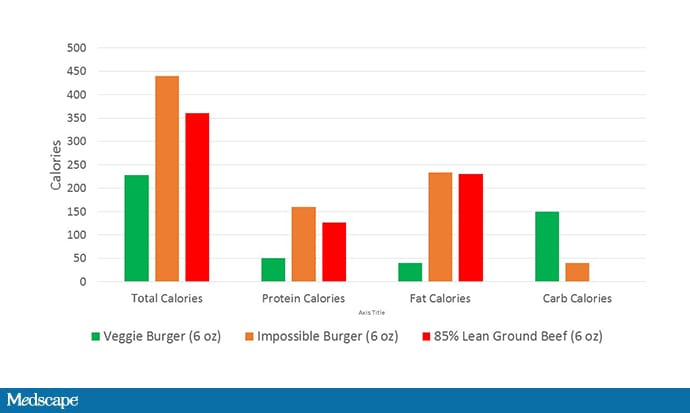
What sets these patties apart from the typical veggie burger fare are two things. First, on a macronutrient level, they are really quite similar to beef patties. Take a look at the breakdown of protein and fats in the Impossible Burger compared with your typical veggie burger and an 85% lean hamburger.

You can see that in terms of protein, fat, and total calories, an Impossible Burger looks a lot like a regular old hamburger.
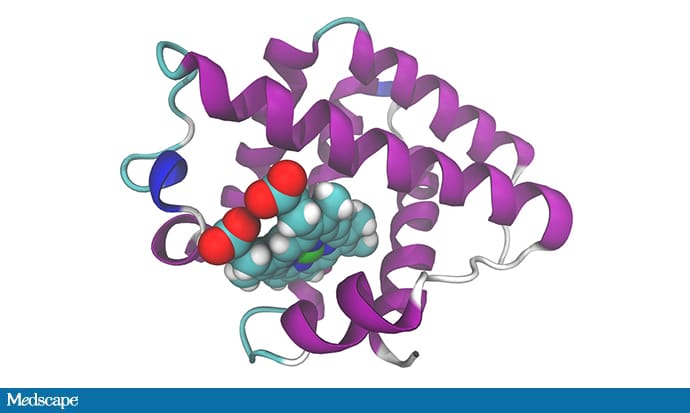
But the secret sauce in all of this may be this little molecule called leghemoglobin—so called because it is a hemoglobin-like molecule that comes from legumes.

You’ll recognize heme, that little iron-binding molecule at the center of hemoglobin and myoglobin. It’s what gives meat some of that bloody, iron-y, meaty flavor and appearance. Leghemoglobin was initially derived from soybean roots, where it is used to supply oxygen to those nitrogen-fixing bacteria in the root nodules to do their nitrogen-fixing business. Impossible Foods actually has transgenic yeast producing their leghemoglobin.
In [August] 2019, leghemoglobin was approved as a food color additive by the FDA. It’s red, after all, and that opened the Impossible Burger to the mass market, hence the hype.
Is it safe? Probably. A bioinformatic study suggests that leghemoglobin shouldn’t be allergenic, and rat-feeding studies didn’t show any worrying findings. And, of course, we’ve been ingesting bits of this stuff whenever we eat legumes. But to be fair, there are no long-term data.
So I’m assuming that they’re nontoxic, but most vociferously not assuming that they’re healthy. While technically this is a veggie burger, it is not trying to be healthy or low-fat; it’s simply trying to be meatless, and that it achieves.
As physicians, then, we should not recommend this to patients over meat for health reasons. There are much healthier plant-based foods to eat. But if a patient wants to limit meat consumption for ethical, environmental, or other reasons, with the power of some biochemistry, the challenge seems not quite so impossible.
F. Perry Wilson, MD, MSCE, is associate professor of medicine and director of Yale’s Program of Applied Translational Research. His science communication work can be found in the Huffington Post, on NPR, and here on Medscape. He tweets @methodsmanmd and hosts a repository of his communication work at  www.methodsman.com.
https://www.medscape.com/viewarticle/920105

Bloated on arrival? Biotech’s weightiest new issues

A big valuation at float is no guarantee of ongoing investor support, as a look at the sector’s biggest IPOs reveals.
This year has seen four drug developers come to market in the US with valuations of at least $2bn each, the biggest run of IPOs of this size the sector has witnessed. This is largely a function of the ballooning of private valuations over the past couple of years, meaning that these biotechs arrived at the feet of public investors at ever higher price tags.
Of course these investors do not need to accept sky-high valuations, and this month has witnessed several instances of pushback. ADC Therapeutics, for example, withdrew a flotation that would have given the Swiss firm a $2bn market cap, while Biontech was forced to take a 20% haircut to get away, equivalent to shaving almost $1bn from its valuation.
The German has company has enjoyed something of a rally this week, and now sits comfortably above its IPO price; volatility in the first few weeks of trading is not unusual, and it will be interesting to see where Biontech’s valuation ends up by the year end.
The performance of some of the sector’s other big IPOs, by market cap at float, shows that starting off with a huge valuation is certainly no guarantee of long-term success.The hit rate in drug development means that this is always the case, of course, but a “herd mentality” among investors is often cited as another reason for the huge pots of money that some companies are amassing.
Vir Biotechnology was the latest big beast to float; its IPO was finally priced at $20, the low end of the initially proposed range, and the stock has since sunk to $14. The presence at the helm of George Scangos, the former chief executive of Biogen, had a lot to do with this company’s ability to attract such large numbers, though its performance on the market suggests that there are big question marks over its valuation.
Genmab and Morphosys perhaps do not really fit here, as both had products on the market when they debuted on Nasdaq, and had prior European listings. But these companies at least had a basis for such valuations. It is hard to imagine groups like Rubius and Nantkwest, which floated without even having projects in the clinic, getting away with multi-billion dollar valuations in the current climate.
Like any cohort of high-risk biotech bets, this list contains blow-ups and success stories alike, with many still to play out. But it is notable that the combined market cap of all 12 companies has grown by around $12bn – and even if removing Juno, the most “successful” on this list based on a $9bn takeout by Celgene, the group’s value has risen by almost $5bn.
Still, if any trend can be seen here it is that those with very early assets have failed to keep their value. Progress at early-stage companies is much harder to track and assess, a fact that seems to become more apparent when these groups reach the market.
Biotech’s biggest flotations – by technology and stage at listing 
Company  IPO date Technology Pipeline at float 
Genmab Jul 2019 Antibody platform Darzalex and Arzerra on the market, 1 x ph2, 4 x ph1
Moderna Dec 2018 mRNA therapies 1 x ph2, 9 x ph1
Biontech Sep 2019 mRNA therapies 1 x ph2, 6 x ph1
Morphosys Apr 2018 Antibody platform Tremfya on the market, 2 x ph3, 14 x ph2
Nantkwest Jul 2015 Natural killer cells No clinical projects
Vir Oct 2019 siRNA, antibody and T cell platforms I x ph2, 1 x ph1
Allogene Oct 2018 Allogeneic CAR-T platform I x ph1
Juno Dec 2014 Autologous CAR-T plaform 2 x ph1
Bridgebio Jun 2019 Genetic diseases, technology agnostic 3 x ph3, 1 x ph2, 1 x ph1
Rubius Jul 2018 Red blood-cell based therapies No clinical projects
Galapagos May 2015 Targeted small molecules 3 x ph2, 1 x ph1
Axovant Jun 2015 Single Alzheimer’s asset 1 x ph2
Source: EvaluatePharma, SEC filings.
https://www.evaluate.com/vantage/articles/data-insights/ipo/bloated-arrival-biotechs-weightiest-new-issues