Search This Blog

Saturday, April 4, 2020

COVID-19 Infection and Renin Angiotensin System Blockers

The coronavirus disease 2019 (COVID-19) pandemic caused by severe acute respiratory syndrome coronavirus 2 (SARS-CoV-2) has already surpassed the combined mortality inflicted by the severe acute respiratory syndrome (SARS) epidemic of 2002 and 2003 and the Middle East respiratory syndrome (MERS) epidemic of 2013. The pandemic is spreading at an exponential rate, with millions of people across the globe at risk of contracting SARS-CoV-2. Initial reports suggest that hypertension, diabetes, and cardiovascular diseases were the most frequent comorbidities in affected patients, and case fatality rates tended to be high in these individuals. In the largest Chinese study to date,1 which included 44 672 confirmed cases, preexisting comorbidities that had high mortality rates included cardiovascular disease (10.5%), diabetes (7.3%), and hypertension (6.0%). Patients with such comorbidities are commonly treated with renin angiotensin system blockers, such as angiotensin-converting enzyme inhibitors (ACEIs) or angiotensin receptor blockers (ARBs). However, the use of ACEIs/ARBs in patients with COVID-19 or at risk of COVID-19 infection is currently a subject of intense debate. Below, we outline the mechanisms by which ACEIs/ARBs may be of benefit in those with COVID-19, what the current recommendations are for their use in infected patients, and suggested areas for further research.
SARS-CoV-2 uses the angiotensin-converting enzyme (ACE) 2 receptor for entry into target cells. ACE2 is predominantly expressed by epithelial cells of the lung, intestine, kidney, heart, and blood vessels. Both ACE and ACE2 belong to the ACE family of dipeptidyl carboxydipeptidases and exert distinct physiological functions. ACE cleaves angiotensin I to angiotensin II, which in turn binds and activates angiotensin II receptor type 1. This activation leads to vasoconstrictive, proinflammatory, and pro-oxidative effects. In contrast, ACE2 also degrades angiotensin II to angiotensin 1-7 and angiotensin I to angiotensin 1-9. When angiotensin 1-9 binds to the Mas receptor, it leads to anti-inflammatory, antioxidative, and vasodilatory effects. It is important to note that 2 forms of ACE2 exists: a structural transmembrane protein with extracellular domain that serves as a receptor for spike protein of SARS-CoV-2 and a soluble form that represents the circulating ACE2. Understanding the relationship between SARS-CoV-2 and membranous and soluble ACE2 may help us better understand the adaptive or maladaptive processes operative in COVID-19 infection.
Animal (mice) studies have shown that expression of ACE2 is substantially increased in patients treated with ACEIs/ARBs.2,3 Similar to these observations, higher urinary ACE2 levels were seen in patients with hypertension treated with the ARB olmesartan. In another study,4 circulating ACE2 levels were increased in patients with diabetes treated with ACEIs. Based on these observations, some experts have speculated that use of ACEIs/ARBs leading to increased expression of ACE2 could potentially facilitate infection with COVID-19.
A recent study by Liu et al5 showed that serum angiotensin II levels in patients with COVID-19 pneumonia was significantly higher compared with healthy individuals and were linearly associated with viral load and lung injury. Based on this, it can be postulated that SARS-CoV-2 binding to ACE2 may attenuate residual ACE2 activity, skewing the ACE/ACE2 balance to a state of heightened angiotensin II activity leading to pulmonary vasoconstriction and inflammatory and oxidative organ damage, which increases the risk for acute lung injury (ALI). Conceivably, renin angiotensin system modulation, either by ACEIs/ARBs or recombinant ACE2, leading to increased expression of ACE2 may help mitigate some of these deleterious effects of angiotensin II. It is also postulated that increased levels of soluble form of ACE2 may act as a competitive interceptor of SARS-CoV-2 and slow virus entry into the cells and protect from lung injury.6 Presently, to our knowledge, there are no clinical data on the utility of initiating ACEI/ARB therapy in treating patients with COVID-19. There is some evidence that ACEIs/ARBs may be beneficial in patients with ALI or acute respiratory distress syndrome (ARDS). In a meta-analysis of 37 studies,7 ACEIs and ARBs were associated with reduced risk of pneumonia and pneumonia-related mortality compared with control treatment. In a small double-blind, placebo-controlled randomized clinical trial of 61 patients,8 those randomized to receive enalaprilat (up to 10 mg intravenously over 24 hours following a regimen based on blood pressure) had numerically higher ventilator-free days (12.3 vs 8.7 days; P = .18) and days alive outside the intensive care unit (8.9 vs 4.9 days; P = .09) compared with those randomized to placebo. The trial did not complete its intended sample size owing to slow enrollment. In a retrospective cohort study from Korea with 132 patients with ARDS,9 patients taking ACEIs/ARBs showed better survival compared with controls, albeit several confounding factors could have influenced the results. In a subgroup of patients with severe COVID-19, hyperinflammation and cytokine storm syndrome led to acute respiratory failure from ARDS. What drives such intense hyperinflammation is not yet known; however, through upregulation of ACE2, ACEIs/ARBs can exert anti-inflammatory and antioxidative effects, which may be beneficial in preventing ALI and ARDS.10 Based on the pathophysiology of SARS-CoV-2 infection and pleiotropic effects of ACEIs/ARBs, these agents may have a potential role in the management of select patients with severe COVID-19.
Several professional societies have put forward their guidance regarding the use of ACEIs/ARBs in patients with COVID-19. In summary, all guidelines recommend continuing ACEIs/ARBs in patients with COVID-19 unless clinically indicated (Table). Furthermore, they do not suggest initiation of ACEIs/ARBs in those without another clinical indication (eg, hypertension, heart failure, diabetes), given the lack of strong evidence showing benefit of these medications in COVID-19. We agree with these recommendations, given the current state of evidence. However, the biological plausibility of salutary effects of ACEIs/ARBs in those with COVID-19 is intriguing. A multicenter, double-blind, placebo-controlled phase 2 randomized clinical trial of starting losartan in patients with COVID-19 in outpatient settings (ClinicalTrials.gov identifier: NCT04311177) and in in-patient settings (ClinicalTrials.gov identifier: NCT04312009) is currently being planned. Accordingly, further epidemiological studies and prospective trials are urgently needed to investigate if use of ACEIs/ARBs can reduce the incidence or mortality associated with COVID-19–associated ALI or ARDS, both in patients with and without additional clinical indications for ACEIs/ARBs.
Table.  Recommendations on the Use of Angiotensin-Converting Enzyme Inhibitors (ACEIs) and Angiotensin Receptor Blockers (ARBs) in Patients With Coronavirus Disease 2019 (COVID-19)
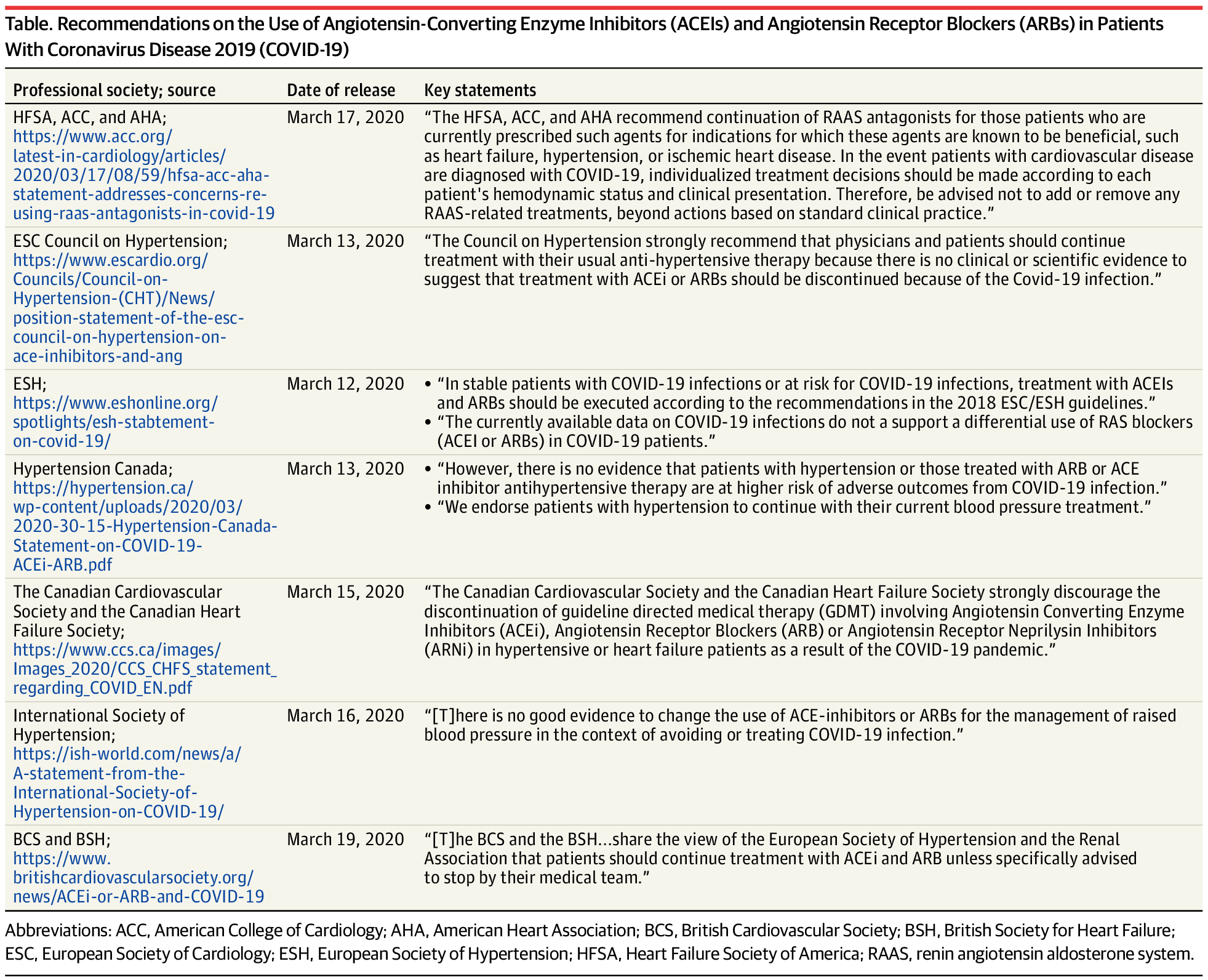
Recommendations on the Use of Angiotensin-Converting Enzyme Inhibitors (ACEIs) and Angiotensin Receptor Blockers (ARBs) in Patients With Coronavirus Disease 2019 (COVID-19)
Article Information
Corresponding Author: Franz H. Messerli, MD, Department of Cardiology, Bern University Hospital, University of Bern, Freiburgstrasse 18, 3010 Bern, Switzerland (messerli.f@gmail.com).
Published Online: April 3, 2020. doi:10.1001/jamacardio.2020.1282
Conflict of Interest Disclosures: Dr Maddox has received grants from the National Center for Advancing Translational Sciences, consulting fees from Creative Educational Concepts and Atheneum Partners, and honoraria and personal fees from the University of Utah, NewYork-Presbyterian, Westchester Medical Center, Sentara Heart Hospital, Henry Ford Health System, and University of California, San Diego; is the Executive Director of the Healthcare Innovation Lab at BJC HealthCare/Washington University School of Medicine in St Louis; advises Myia Labs through his institution, which receives equity compensation; and is the director of JF Maddox Foundation. Dr Messerli has received personal fees from Menarini, Medtronic, and Pfizer. No other disclosures were reported.
https://jamanetwork.com/journals/jamacardiology/fullarticle/2764299

How important is speech in transmitting coronavirus?

Normal speech by individuals who are asymptomatic but infected with coronavirus may produce enough aerosolized particles to transmit the infection, according to aerosol scientists at the University of California, Davis. Although it’s not yet known how important this is to the spread of COVID-19, it underscores the need for strict social distancing measures — and for virologists, epidemiologists and engineers who study aerosols and droplets to work together on this and other respiratory diseases.
Aerosols are particles small enough to travel through the air. Ordinary speech creates significant quantities of aerosols from respiratory particles, said William Ristenpart, professor of chemical engineering at UC Davis. Ristenpart is co-author on an editorial about the problem to be published in the journal Aerosol Science and Technology.
These respiratory particles are about one micron, or one micrometer, in diameter. That’s too small to see with the naked eye, but large enough to carry viruses such as influenza or SARS-CoV-2.
Some individuals superemitters
Last year, Ristenpart, graduate student Sima Asadi and colleagues published a paper showing that the louder one speaks, the more particles are emitted and that some individuals are “superemitters” who give off up to 10 times as many particles as others. The reasons for this are not yet clear. In a follow-up study published in January in PLOS One, they investigated which speech sounds are associated with the most particles.
Calculating just how easily a virus like SARS-CoV-2 spreads through droplets requires expertise from different fields. From virology, researchers need to know how many viruses are in lung fluids, how easily they form into droplets and how many viruses are needed to start an infection. Aerosol scientists can study how far droplets travel once expelled, how they are affected by air motion in a room and how fast they settle out due to gravity.
“The aerosol science community needs to step up and tackle the current challenge presented by COVID-19, and also help better prepare us for inevitable future pandemics,” Ristenpart and colleagues conclude.
###
Other authors on the editorial are Asadi; Professor Anthony Wexler, UC Davis Department of Mechanical and Aerospace Engineering; and Nicole Bouvier, Icahn School of Medicine at Mount Sinai.
https://www.eurekalert.org/pub_releases/2020-04/uoc–hii040220.php

Possible coronavirus drug identified by Australian scientists

  • Australian Scientists have shown that an anti-parasitic drug already available around the world can kill the virus within 48 hours.
  • Scientists from Monash University in Melbourne showed that a single dose of the drug, Ivermectin, could stop the SARS-CoV-2 virus growing in cell culture – effectively eradicating all genetic material of the virus within 48 hours.
  • The next steps are to determine the correct human dosage – ensuring the doses shown to effectively treat the virus in the test tube are safe levels for humans.
  • The use of Ivermectin to combat COVID-19 depends on pre-clinical testing and clinical trials, with funding urgently required to progress the work.
  • Ivermectin is an FDA-approved anti-parasitic drug that has also been shown to be effective in vitro against a broad range of viruses including HIV, Dengue, Influenza and Zika virus.
  • The findings of the study were published today in Antiviral Research.
A collaborative study led by Monash University’s Biomedicine Discovery Institute (BDI) in Melbourne, Australia, with the Peter Doherty Institute of Infection and Immunity (Doherty Institute), has shown that an anti-parasitic drug already available around the world kills the virus within 48 hours.
The Monash Biomedicine Discovery Institute’s Dr Kylie Wagstaff, who led the study, said the scientists showed that the drug, Ivermectin, stopped the SARS-CoV-2 virus growing in cell culture within 48 hours.
“We found that even a single dose could essentially remove all viral RNA by 48 hours and that even at 24 hours there was a really significant reduction in it,” Dr Wagstaff said.
Ivermectin is an FDA-approved anti-parasitic drug that has also been shown to be effective in vitro against a broad range of viruses including HIV, Dengue, Influenza and Zika virus.
Dr Wagstaff cautioned that the tests conducted in the study were in vitro and that trials needed to be carried out in people.
“Ivermectin is very widely used and seen as a safe drug. We need to figure out now whether the dosage you can use it at in humans will be effective – that’s the next step,” Dr Wagstaff said.
“In times when we’re having a global pandemic and there isn’t an approved treatment, if we had a compound that was already available around the world then that might help people sooner. Realistically it’s going to be a while before a vaccine is broadly available.
Although the mechanism by which Ivermectin works on the virus is not known, it is likely, based on its action in other viruses, that it works to stop the virus ‘dampening down’ the host cells’ ability to clear it, Dr Wagstaff said.
Royal Melbourne Hospital’s Dr Leon Caly, a Senior Medical Scientist at the Victorian Infectious Diseases Reference Laboratory (VIDRL) at the Doherty Institute where the experiments with live coronavirus were conducted, is the study’s first author.
“As the virologist who was part of the team who were first to isolate and share SARS-COV2 outside of China in January 2020, I am excited about the prospect of Ivermectin being used as a potential drug against COVID-19,” Dr Caly said.
Dr Wagstaff made a previous breakthrough finding on Ivermectin in 2012 when she identified the drug and its antiviral activity with Monash Biomedicine Discovery Institute’s Professor David Jans, also an author on this paper. Professor Jans and his team have been researching Ivermectin for more than 10 years with different viruses.
Dr Wagstaff and Professor Jans started investigating whether it worked on the SARS-CoV-2 virus as soon as the pandemic was known to have started.
The use of Ivermectin to combat COVID-19 would depend on the results of further pre-clinical testing and ultimately clinical trials, with funding urgently required to keep progressing the work, Dr Wagstaff said.
###
Read the full paper in Antiviral Research titled: The FDA-approved Drug Ivermectin inhibits the replication of SARS-CoV-2 in vitro: https://www.sciencedirect.com/science/article/pii/S0166354220302011
https://www.eurekalert.org/pub_releases/2020-04/mu-pcd040320.php

Characteristics of patients with fatal COVID-19

In a new study, researchers identified the most common characteristics of 85 COVID-19 patients who died in Wuhan, China in the early stages of the coronavirus pandemic. The study reports on commonalities of the largest group of coronavirus patient deaths to be studied to date. The paper was published online in the American Thoracic Society’s American Journal of Respiratory and Critical Care Medicine.
In “Clinical Features of 85 Fatal Cases of COVID-19 From Wuhan: A Retrospective Observational Study,” researchers from China and the United States report on an analysis of the electronic health records of patients with COVID-19 who died despite treatment at two hospitals in Wuhan: Hanan Hospital and Wuhan Union Hospital between Jan. 9 and Feb. 15, 2020. Wuhan, in China’s Hubei Province, was the epicenter of the COVID-19 outbreak.
“The greatest number of deaths in our cohort were in males over 50 with non-communicable chronic diseases,” stated the authors. “We hope that this study conveys the seriousness of COVID-19 and emphasizes the risk groups of males over 50 with chronic comorbid conditions including hypertension (high blood pressure), coronary heart disease and diabetes.”
The researchers examined the medical records of 85 patients who had died, and recorded information on their medical histories, exposures to coronavirus, additional chronic diseases they had (comorbidities), symptoms, laboratory findings, CT scan results and clinical management. Statistical analyses were then done.
The median age of these patients was 65.8, and 72.9 percent were men. Their most common symptoms were fever, shortness of breath (dyspnea) and fatigue.
Hypertension, diabetes and coronary heart disease were the most common comorbidities. A little over 80 0 percent of patients had very low counts of eosinophils (cells that are reduced in severe respiratory infections) on admission. Complications included respiratory failure, shock, acute respiratory distress syndrome (ARDS) and cardiac arrhythmia, among others. Most patients received antibiotics, antivirals and glucocorticoids (types of steroids). Some were given intravenous immunoglobulin or interferon alpha-2b.
The researchers noted: “The effectiveness of medications such as antivirals or immunosuppressive agents against COVID-19 is not completely known. Perhaps our most significant observation is that while respiratory symptoms may not develop until a week after presentation, once they do there can be a rapid decline, as indicated by the short duration between time of admission and death (6.35 days on average) in our study.”
Based on their findings, eosinophilopenia – abnormally low levels of eosinophils in the blood – may indicate a poor prognosis. The scientists also noted that the early onset of shortness of breath may be used as an observational symptom for COVID-19 symptoms. In addition, they noted that a combination of antimicrobial drugs (antivirals, antibiotics) did not significantly help these patients. The majority of patients studied died from multiple organ failure.
“Our study, which investigated patients from Wuhan, China who died in the early phases of this pandemic, identified certain characteristics. As the disease has spread to other regions, the observations from these areas may be the same, or different. Genetics may play a role in the response to the infection, and the course of the pandemic may change as the virus mutates as well. Since this is a new pandemic that is constantly shifting, we think the medical community needs to keep an open mind as more and more studies are conducted.”
###
The study authors are affiliated with a number of medical centers and departments of the Chinese PLA General Hospital; Wuhan Union Hospital; Renmin Hospital of Wuhan University; China’s National Clinical Research Center for Geriatric Diseases; Wuhan Hannan Hospital; Tongji Medical College, Huazhong University of Science & Technology; Joe DiMaggio Children’s Hospital, Hollywood, FL; and University of California, Davis.
https://www.eurekalert.org/pub_releases/2020-04/ats-nsi040320.php

Dealing with skin damage from face masks

DOCTORS and nurses on the COVID-19 frontline are spending many hours a day wearing face masks, and many members of the general public are doing the same. But although the devices offer invaluable protection, they can be the cause of significant skin damage through sweating and the rubbing of the masks against the nose.
Skincare experts at the University of Huddersfield are warning about the risks and are suggesting remedies.
Professor Karen Ousey is the University’s Director of the Institute of Skin Integrity and Infection Prevention and was part of a team that conducted detailed research into the pressure damage caused by a wide range of medical devices, including face masks. The findings and recommendations were published in February.
Now, the current emergency emphasises the problems that can arise with face masks, being worn for long periods by healthcare professionals.
“The wearers are sweating underneath the masks and this causes friction, leading to pressure damage on the nose and cheeks,” said Professor Ousey. “There can be tears to the skin as a result and these can lead to potential infection,” she added.
“The masks the healthcare professionals are wearing have to be fitted to the face – so if healthcare professionals add dressings to the skin under the mask after being fitted there is a chance the mask will no longer fit correctly,” continued Professor Ousey.
She suggests that people wearing masks keep their skin clean, well-hydrated and moisturised and that barrier creams should be applied at least half an hour before masks are put on.
“And we are suggesting that pressure from the mask is relieved every two hours. So you come away from the patient, relieve the pressure in a safe place and clean the skin again.”
Professor Ousey advises members of the general public – such as shop workers – who are wearing masks to keep their skin clean, dry and free of sweat.
“And if they do feel their masks rubbing, take them off as soon as they safely can.”
###
Professor Ousey was a member of the global team that last year met in London to pool research on device-related pressure ulcers. It produced a 52-page document – published by the Journal of Wound Care – that examines the issues in detail.
The team was headed by Amit Gefen, who is a Professor of Biomedical Engineering at Tel Aviv University and a Visiting Professor at Huddersfield’s Institute of Skin Integrity and Infection Prevention.
Professor Gefen is recording a video session dealing with device-related pressure ulcers that will soon be available to view via the Institute’s website.
Professor Ousey also urges members of the public to visit the National Wound Care Strategy webpage, which offers wide-ranging advice on wound care and pressure ulcers.
https://www.eurekalert.org/pub_releases/2020-04/uoh-sfs040320.php

Trial drug significantly blocks early Covid-19 in engineered human tissue

An international team led by University of British Columbia researcher Dr. Josef Penninger has found a trial drug that effectively blocks the cellular door SARS-CoV-2 uses to infect its hosts.
The findings, published today in Cell, hold promise as a treatment capable of stopping early infection of the novel coronavirus that, as of April 2, has affected more than 981,000 people and claimed the lives of 50,000 people worldwide.
The study provides new insights into key aspects of SARS-CoV-2, the virus that causes COVID-19, and its interactions on a cellular level, as well as how the virus can infect blood vessels and kidneys.
“We are hopeful our results have implications for the development of a novel drug for the treatment of this unprecedented pandemic,” says Penninger, professor in UBC’s faculty of medicine, director of the Life Sciences Institute and the Canada 150 Research Chair in Functional Genetics at UBC.
“This work stems from an amazing collaboration among academic researchers and companies, including Dr. Ryan Conder’s gastrointestinal group at STEMCELL Technologies in Vancouver, Nuria Montserrat in Spain, Drs. Haibo Zhang and Art Slutsky from Toronto and especially Ali Mirazimi’s infectious biology team in Sweden, who have been working tirelessly day and night for weeks to better understand the pathology of this disease and to provide breakthrough therapeutic options.”
ACE2 — a protein on the surface of the cell membrane — is now at centre-stage in this outbreak as the key receptor for the spike glycoprotein of SARS-CoV-2. In earlier work, Penninger and colleagues at the University of Toronto and the Institute of Molecular Biology in Vienna first identified ACE2, and found that in living organisms, ACE2 is the key receptor for SARS, the viral respiratory illness recognized as a global threat in 2003. His laboratory also went on to link the protein to both cardiovascular disease and lung failure.
While the COVID-19 outbreak continues to spread around the globe, the absence of a clinically proven antiviral therapy or a treatment specifically targeting the critical SARS-CoV-2 receptor ACE2 on a molecular level has meant an empty arsenal for health care providers struggling to treat severe cases of COVID-19.
“Our new study provides very much needed direct evidence that a drug — called APN01 (human recombinant soluble angiotensin-converting enzyme 2 – hrsACE2) — soon to be tested in clinical trials by the European biotech company Apeiron Biologics, is useful as an antiviral therapy for COVID-19,” says Dr. Art Slutsky, a scientist at the Keenan Research Centre for Biomedical Science of St. Michael’s Hospital and professor at the University of Toronto who is a collaborator on the study.
In cell cultures analyzed in the current study, hrsACE2 inhibited the coronavirus load by a factor of 1,000-5,000. In engineered replicas of human blood vessel and kidneys — organoids grown from human stem cells — the researchers demonstrated that the virus can directly infect and duplicate itself in these tissues. This provides important information on the development of the disease and the fact that severe cases of COVID-19 present with multi-organ failure and evidence of cardiovascular damage. Clinical grade hrsACE2 also reduced the SARS-CoV-2 infection in these engineered human tissues.
“Using organoids allows us to test in a very agile way treatments that are already being used for other diseases, or that are close to being validated. In these moments in which time is short, human organoids save the time that we would spend to test a new drug in the human setting,” says Núria Montserrat, ICREA professor at the Institute for Bioengineering of Catalonia in Spain.
“The virus causing COVID-19 is a close sibling to the first SARS virus,” adds Penninger. “Our previous work has helped to rapidly identify ACE2 as the entry gate for SARS-CoV-2, which explains a lot about the disease. Now we know that a soluble form of ACE2 that catches the virus away, could be indeed a very rational therapy that specifically targets the gate the virus must take to infect us. There is hope for this horrible pandemic.”
###
This research was supported in part by the Canadian federal government through emergency funding focused on accelerating the development, testing, and implementation of measures to deal with the COVID-19 outbreak.
https://www.eurekalert.org/pub_releases/2020-04/uobc-tdc040220.php

Friday, April 3, 2020

Johns Hopkins to test if virus survivors’ plasma can protect health care workers

Researchers at Johns Hopkins University now have federal approval to test if blood plasma from recovered COVID-19 patients can help protect the heroes on the front line of the battle against the coronavirus.
The hope is that transfusions of blood plasma would boost the immune systems of health care providers, first responders and others at high risk of exposure, the researchers said.
COVID-19 survivors carry antibodies generated to fight the disease and the plasma is the part of blood that contains those antibodies.
“The ability to carry out a prophylaxis trial will tell us whether plasma is effective in protecting our health care workers and first responders from COVID-19,” said Arturo Casadevall, a Johns Hopkins infectious disease expert, in a statement.
The plasma transfusions are a common treatment for patients suffering severe bleeding;  and scientists hope the same treatment can be used as both a preventative therapy and to help boost the immune systems of those already sick.
The US Food and Drug Administration issued Johns Hopkins approved for a clinical trial Friday.
Casadevall has amassed a team of physicians and scientists from around the country who are now establishing a network of hospitals and blood banks that can collect, isolate and process blood plasma from COVID-19 survivors, according to Johns Hopkins.
https://nypost.com/2020/04/03/blood-plasma-of-coronavirus-survivors-may-protect-health-care-workers/