Search This Blog

Saturday, April 4, 2020

Proposed Rule Could Mean Cuts in Federal Medicaid Funds to States

A proposal to change the way the federal government pays some states under the Medicaid program is causing headaches for healthcare groups and Medicaid directors, even though it hasn’t actually been enacted yet.
The Medicaid Fiscal Accountability Rule (MFAR), released last November by the Centers for Medicare & Medicaid Services (CMS), would reduce the amount of money that CMS gives to states as part of their Medicaid matching funds when the money is generated through various supplemental means.
“CMS is aware of numerous schemes states have used that are not consistent with federal statute,” the agency said in a press release. “Some examples include states that generate extra payments for private nursing facilities that enter into arrangements with local governments to bypass tax and donation rules, and the use of a loophole to tax managed care entities 25 times higher for Medicaid business than for similar commercial business. States can then use that tax revenue to generate additional payments, with no commensurate increase in state spending.”
“Many of the vulnerabilities in Medicaid financing arise from high-risk financing mechanisms that states have used, or sought to use, to finance the state portion of Medicaid payments,” the release continued. “These include intergovernmental fund transfers … provider taxes, and provider donations that provide additional payments to institutions with no clear link to improving care for patients. The proposed rule would provide clearer guidance on the law to states and other stakeholders, help close regulatory loopholes, and improve reporting to help CMS ensure that states fund their share of payments to providers through only permissible sources and with methodologies that comport with statutory requirements.”
Concerns About Payment Cuts
But critics of the proposed rule say that it would mean a cut in federal Medicaid funds that states have come to rely on.
“Through the proposed rule, CMS outlines a number of changes that reduce states’ ability to generate state share to finance their Medicaid program,” wrote Margaret Murray, CEO of the Association for Community Affiliated Plans (ACAP), which represents safety-net health plans, in a Jan. 31 letter to CMS. “ACAP is concerned that these changes will limit state flexibility to generate state share, which will have downstream effects on state Medicaid funding and ultimately reduce access to critical services for Medicaid beneficiaries.”
States could lose $37 billion to $49 billion annually under the rule, according to a report from Manatt Health and the American Hospital Association.
The agency gave two justifications for developing the rule, explained Edwin Park, JD, a research professor at Georgetown University’s Center for Children and Families, in a phone interview. First, “they document problems where states have violated existing federal requirements, and they say, ‘We don’t have enough data on what states and providers are doing,'” he said.
Two Justifications
In the rule’s preamble, CMS gives some examples of states violating current rules; however, “What’s not clear from that preamble is that they found these problematic arrangements under existing rules and … there are existing enforcement arrangements to prevent them. The rule changes really have nothing to do with those examples; they’re using the examples to make a very broad change to rules that have been in place for almost three decades.”
The other justification for the rule is a need for more transparency about these miscellaneous financing mechanisms like intergovernmental transfers and provider taxes; the rule would require more reporting from states. “There is general acceptance that there should be more known about these arrangements,” Park agreed. “But the reporting is only one small portion of the proposed rule, and the large majority of the rule is about prohibiting existing arrangements.”
As the COVID-19 pandemic advanced on the U.S., healthcare groups were encouraged that several of the stimulus bills passed by Congress addressed states’ healthcare funding needs. For example, the Families First Coronavirus Response Act, which President Trump signed into law on March 18, provides enhanced Medicaid matching funds to states to help them through the pandemic. But if there is less state money on the table because the federal government has disallowed some of these financing mechanisms, “you draw down less federal dollars, including the enhanced matching rate that Family First provides,” said Park.
“If you add on the COVID 19 crisis, as revenues fall and program costs rise, states are going to be cash-strapped,” he continued. That will mean Medicaid cuts, “and one of the obvious places states would go would be provider rates, as was done in previous economic downturns.”
Push for Delay or Rescission
During the debate over the most recent stimulus bill, Democratic legislators presented alternative legislation that included a provision that would delay the implementation of MFAR, but it didn’t get included in the final bill. The only possible good news on the MFAR front, according to Matt Salo, executive director of the National Association of Medicaid Directors, “is that CMS is telling us that all non-COVID-19 work is on the back burner. That’s good, but what does that really mean? Back burner until 6 weeks from now? Eighteen months from now? We of course don’t know.”
“There are assurances that when they do get back around to MFAR, two things will have happened — a lot of people commented, including us, and it sounds like they’re going to take those comments into consideration, which is good, and they also said everything they do post-COVID will be in light of the fact that they’re post-COVID,” so maybe the final MFAR rule won’t be as bad as people fear, Salo said in a phone interview. “But you can’t bank on any of that.”
In an ideal world, Congress would rescind MFAR entirely, the rule’s critics say, but that hasn’t happened yet. “We sent a letter to Congress recently calling for Congress to rescind the regulation, and sent a letter to the administration asking for the same thing,” Murray, of ACAP, said in a phone interview. “Ideally, they would rescind it, but if they can’t do that, could they at least delay it?”
With the comment period for the rule now closed, CMS is now in a period of finalizing the rule. The agency did not respond by press time to a request for comment on this story.
With the comment period for the rule now closed, CMS is now in a period of finalizing the rule. Asked to comment on this story, a spokesperson responded in an email that “in light of the 2019 Novel Coronavirus outbreak, CMS is looking closely at all its policies and across all its programs to see where we can strengthen the nation’s response.” Since MFAR is only a proposed rule, “no current regulations have been changed” yet, the spokesperson added.
https://www.medpagetoday.com/publichealthpolicy/medicaid/85798

COVID-19 lockdown will take its own toll on health

As governments race to stem the spread of coronavirus through an unprecedented closing of schools, businesses and travel, some specialists fear the long term public health impacts of a depressed economy and shuttered society.
It’s the most dramatic government intervention into our lives since World War II. To fight the coronavirus outbreak, governments across the globe have closed schools, travel and businesses big and small. Many observers have fretted about the economic costs of throwing millions of people out of work and millions of students out of school.
Now, three weeks after the United States and other countries took sweeping suppression steps that could last months or more, some public health specialists are exploring a different consequence of the mass shutdown: the thousands of deaths likely to arise unrelated to the disease itself.
The longer the suppression lasts, history shows, the worse such outcomes will be. A surge of unemployment in 1982 cut the life spans of Americans by a collective two to three million years, researchers found. During the last recession, from 2007-2009, the bleak job market helped spike suicide rates in the United States and Europe, claiming the lives of 10,000 more people than prior to the downturn. This time, such effects could be even deeper in the weeks, months and years ahead if, as many business and political leaders are warning, the economy crashes and unemployment skyrockets to historic levels.
Already, there are reports that isolation measures are triggering more domestic violence in some areas. Prolonged school closings are preventing special needs children from receiving treatment and could presage a rise in dropouts and delinquency. Public health centers will lose funding, causing a decline in their services and the health of their communities. A surge in unemployment to 20% – a forecast now common in Western economies – could cause an additional 20,000 suicides in Europe and the United States among those out of work or entering a near-empty job market.
None of this is to downplay the chilling death toll COVID-19 threatens, or to suggest governments shouldn’t aggressively respond to the crisis.
“Depressions are deadly for people, poor people especially.”
Dr. Jay Bhattacharya, Stanford University health policy researcher
A recent report by researchers from Imperial College London helped set the global lockdown in motion, contending that coronavirus could kill 2 million Americans and 500,000 people in Great Britain unless governments rapidly deployed severe social distancing measures. To truly work, the report said, the suppression effort would need to last, perhaps in an on-again, off-again fashion, for up to 18 months.
In the United States, the White House this week said the final toll could rise to 240,000 dead. States have responded to the dire warnings, and the escalating number of cases revealed each day, by extending stay-at-home shutdowns.
The medical battle against COVID-19 is developing so rapidly that no one knows how it will play out or what the final casualty count will be. But researchers say history shows that responses to a deep and long economic shock, coupled with social distancing, will trigger health impacts of their own, over the short, mid and long term.
Here is a look at some.
Domestic Violence
Trapped at home with their abusers, some domestic violence victims are already experiencing more frequent and extreme violence, said Katie Ray-Jones, the chief executive officer of the National Domestic Violence Hotline.
Domestic violence programs across the country have cited increases in calls for help, news accounts reported – from Cincinnati to Nashville, Portland, Salt Lake City and statewide in Virginia and Arizona. The YWCA of Northern New Jersey, in another example, told Reuters its domestic violence calls have risen up to 24%.
“There are special populations that are going to have impacts that go way beyond COVID-19,” said Ray-Jones, citing domestic violence victims as one.
Vulnerable Students
Students, parents and teachers all face challenges adjusting to remote learning, as schools nationwide have been closed and online learning has begun.
Some experts are concerned that students at home, especially those living in unstable environments or poverty, will miss more assignments. High school students who miss at least three days a month are seven times more likely to drop out before graduating and, as a result, live nine years less than their peers, according to a Robert Wood Johnson Foundation report.
Among the most vulnerable: the more than 6 million special education students across the United States. Without rigorous schooling and therapy, these students face a lifetime of challenges.
Special needs students “benefit the most from highly structured and customized special education,” said Sharon Vaughn, executive director of the The Meadows Center for Preventing Educational Risk at the University of Texas. “This means that they are the group that are most likely to be significantly impacted by not attending school both in the short and long term.”
In New Jersey, Matawan’s Megan Gutierrez has been overwhelmed with teaching and therapy duties for her two nonverbal autistic sons, eight and 10. She’s worried the boys, who normally work with a team of therapists and teachers, will regress. “For me, keeping those communications skills is huge, because if they don’t, that can lead to behavioral issues where they get frustrated because they can’t communicate,” Gutierrez said.
Soaring Suicides
In Europe and the United States, suicide rates rise about 1% for every one percentage point increase in unemployment, according to research published by lead author Aaron Reeves from Oxford University. During the last recession, when the unemployment in the United States peaked at 10%, the suicide rate jumped, resulting in 4,750 more deaths. If the unemployment rate increases to 20%, the toll could well rise.
“Sadly, I think there is a good chance we could see twice as many suicides over the next 24 months than we saw during the early part of the last recession,” Reeves told Reuters. That would be about 20,000 additional dead by suicide in the United States and Europe.
Less than three weeks after extreme suppression measures began in the United States, unemployment claims rose by nearly 10 million. Treasury Secretary Steven Mnuchin warned the rate could reach 20% and Federal Reserve economists predicted as high as 32%. Europe faces similarly dire forecasts.
Some researchers caution that suicide rates might not spike so high. The conventional wisdom is that more people will kill themselves amid skyrocketing unemployment, but communities could rally around a national effort to defeat COVID-19 and the rates may not rise, said Anne Case, who researches health economics at Princeton University. “Suicide is hard to predict even in the absence of a crisis of Biblical proportions,” Case said.
This week, the Air Force Academy in Colorado Springs, Colorado, relaxed its strict social isolation policies after the apparent suicides of two cadet seniors in late March, The Gazette, a Colorado Springs newspaper, reported. While juniors, sophomores and freshmen had been sent home, the college seniors were kept isolated in dorms, and some had complained of a prison-like setting. Now, the seniors will be able to leave campus for drive-thru food and congregate in small groups per state guidelines.
Public Health Crippled
Local health departments run programs that treat chronic diseases such as diabetes. They also help prevent childhood lead poisoning and stem the spread of the flu, tuberculosis and rabies. A severe loss of property and sales tax revenue following a wave of business failures will likely cripple these health departments, said Adriane Casalotti, chief of government affairs with the National Association of County and City Health Officials, a nonprofit focused on public health.
After the 2008 recession, local health departments in the U.S. lost 23,000 positions as more than half experienced budget cuts. While it’s become popular to warn against placing economic concerns over health, Casalotti said that, on the front lines of public health, the two are inexorably linked. “What are you going to do when you have no tax base to pull from?” she asked.
Carol Moehrle, director of a public health department that serves five counties in northern Idaho, said her office lost about 40 of its 90 employees amid the last recession. The department had to cut a family planning program that provided birth control to women below the poverty line and a program that tested for and treated sexually transmitted diseases. She worries a depression will cause more harm.
“I honestly don’t think we could be much leaner and still be viable, which is a scary thing to think about,” Moehrle said.
Job-loss Mortality
Rises in unemployment during large recessions can set in motion a domino effect of reduced income, additional stress and unhealthy lifestyles. Those setbacks in income and health often mean people die earlier, said Till von Wachter, a University of California Los Angeles professor who researches the impact of job loss. Von Wachter said his research of past surges in unemployment suggests displaced workers could lose, on average, a year and a half of lifespan. If the jobless rate rises to 20%, this could translate into 48 million years of lost human life.
Von Wachter cites measures he believes could mitigate the effects of unemployment. The Coronavirus Aid, Relief, and Economic Security Act approved by the White House last week includes emergency loans to businesses and a short-time compensation program that could encourage employers to keep employees on the payroll.
Young People Suffer
Young adults entering the job market during the coronavirus suppression may pay an especially high price over the long term.
First-time job hunters seeking work during periods of high unemployment live shorter and unhealthier lives, research shows. An extended freeze of the economy could shorten the lifespan of 6.4 million Americans entering the job market by an average of about two years, said Hannes Schwandt, a health economics researcher at Northwestern University, who conducted the study with von Wachter. This would be 12.8 million years of life lost.
Thousands of college graduates will enter a job market at a time global business is frozen. Jason Gustave, a senior at William Paterson University in New Jersey who will be the first in his family to graduate from college, had a job in physical therapy lined up. Now his licensure exam is postponed and the earliest he could start work is September.
“It all depends on where the economy goes,” he said. “Is there a position still available?”
In the weeks ahead, a clearer picture of the disease’s devastation will come into focus, and governments and health specialists will base their fatality estimates on a stronger factual grounding.
As they do, some public health experts say, the government should weigh the costs of the suppression measures taken and consider recalibrating, if necessary.
Dr. Jay Bhattacharya, who researches health policy at Stanford University, said he worries governments worldwide have not yet fully considered the long term health impacts of the impending economic calamity. The coronavirus can kill, he said, but a global depression will, as well. Bhattacharya is among those urging government leaders to carefully consider the complete shutdown of businesses and schools.
“Depressions are deadly for people, poor people especially,” he said.
https://www.reuters.com/investigates/special-report/health-coronavirus-usa-cost/
A call to honesty in pandemic modeling

Recently there has been a proliferation of modeling work which has been used to make the point that if we can stay inside, practice extreme social distancing, and generally lock-down nonessential parts of society for several months, then many deaths from COVID-19 can be prevented.
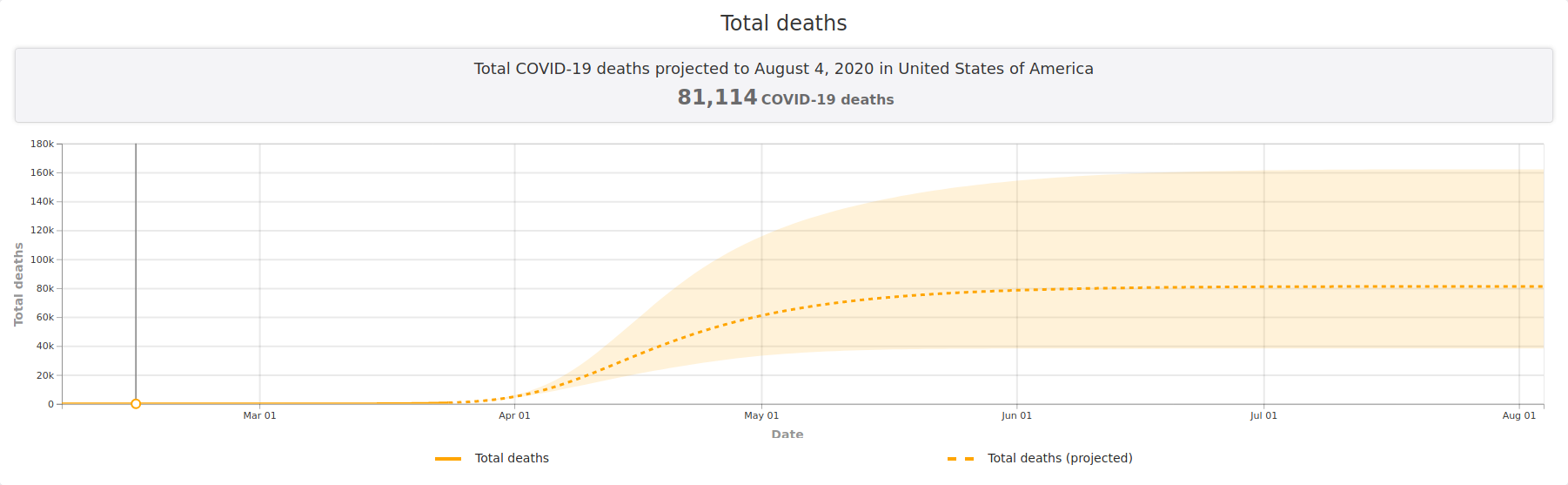
For example, a new study by Christopher J.L. Murray at the University of Washington models hospital and ICU utilization and deaths over a 4 month period of mitigations, and estimates that “Total deaths” can be kept under 100,000.
Murray’s study estimates hospital and ICU utilization in addition to deaths.
Like other recent studies considering short-term mitigations, he estimates fewer than 100,000 deaths.
A similar story is told by a recent model developed by a group of researchers and publicized by Nicholas Kristof of the New York Times. Their basic message? Social distancing for 2 months instead of 2 weeks could dramatically drop the number of COVID-19 infections:
The model publicized by Nicholas Kristof presents a dramatic benefit from 2 months of social distancing instead of 2 weeks.
The same narrative appears in recent study in the Lancet, whose authors modeled the effects of mitigations continuing in Wuhan through the beginning of March or the beginning of April. In their findings, the authors write that continuing mitigations until the beginning of April instead of the beginning of March “reduced the median number of infections by more than 92% (IQR 66–97) and 24% (13–90) in mid-2020 and end-2020, respectively.”.

Hiding infections in the future is not the same as avoiding them

A keen figure-reader will notice something peculiar in Kristof’s figure. At the tail end of his “Social distancing for 2 months” scenario, there is an intriguing rise in the number of infections (could it be exponential?), right before the figure ends. That’s because of an inevitable feature of realistic models of epidemics; once transmission rates return to normal, the epidemic will proceed largely as it would have without mitigations, unless a significant fraction of the population is immune (either because they have recovered from the infection or because an effective vaccine has been developed), or the infectious agent has been completely eliminated, without risk of reintroduction. In the case of the model presented in Kristof’s article, assumptions about seasonality of the virus combined with the longer mitigation period simply push the epidemic outside the window they consider.
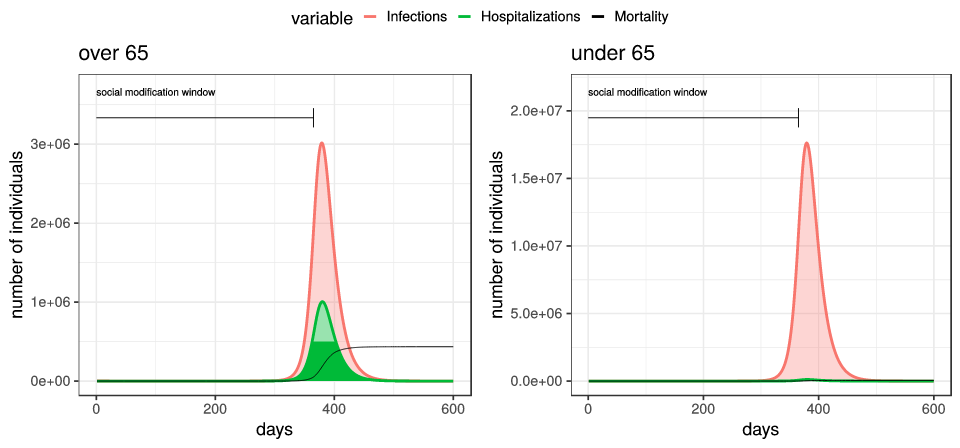
For example, in our work studying the possible effects of heterogeneous measures, we presented examples of epidemic trajectories for COVID-19 assuming no mitigations at all, or assuming extreme mitigations which are gradually lifted at 6 months, to resume normal levels at 1 year.
With no mitigations we see nearly 500,000 deaths relatively quickly.
With mitigations which let up between 6 months and a year we still see nearly 500,000 deaths, just later.
Unfortunately, extreme mitigation efforts which end (even gradually) reduce the number of deaths only by 1% or so; as the mitigation efforts let up, we still see a full-scale epidemic, since almost none of the population has developed immunity to the virus.
In the case of Kristof’s article, the epidemic model being employed is actually implemented in Javascript, and run — live — in a users web browser. This means that it is actually possible to hack their model to run past the end of October. In particular, we can look into the future, and see what happens in their model after October, assuming mitigations continue for 2 months. In particular, instead of the right-hand figure here:
Kristof’s original figure, with the effects of 2-months of mitigations shown on the right.
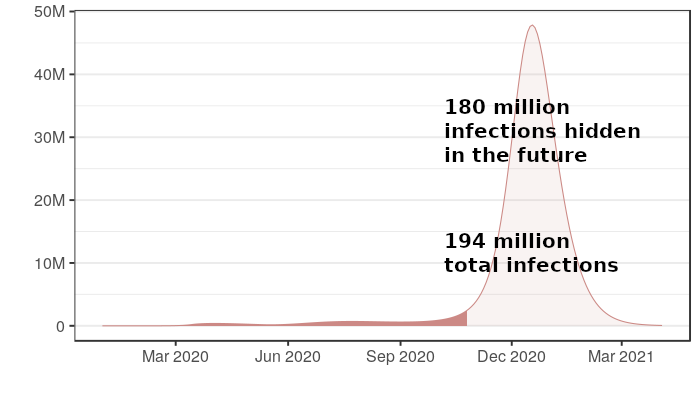
The truth for their Social distancing for 2 months scenario is this:
This is exactly the same model for “2 months of mitigations” from the Kristof column, but extended past October
Two months of mitigations have not improved the outcome of the epidemic in this model, it has just delayed its terrible effects. In fact, because of the role of weather in the model presented in the Kristof article, two months of mitigations actually results in 50% more infections and deaths than two weeks of mitigations, since it pushes the peak of the epidemic to the winter instead of the summer, whose warmer months this model assumes causes lower transmission rates.
The same thing plays out in other papers modeling a low number of infections or deaths from short-term suppression efforts. For example, Murray’s paper models 4 months of mitigations, but only models the epidemic over a 4 month period, ending in July. He concludes that less than 100,000 people will die in his model. But what happens in August? He obtains improvement in death rates in his model precisely because a small minority of the population becomes infected in his mitigation window. (In fact, because his approach is based on fitting a model to current data, it is unable to model a world in which transmission levels have returned to normal.) In fact, as soon as transmission levels increase, a large epidemic will follow, which he would detect if he did model the epidemic past 4 months. Similarly, in the Lancet study modeling mitigations in Wuhan, the only effect of delaying the end of mitigations is to delay the epidemic; infections are “reduced” in “mid-2020” and “end-2020”, but increased at later time-points.

For two months of containment to be better than two weeks of containment, the situation on the ground has to change

There is a simple truth behind the problems with these modeling conclusions. The duration of containment efforts does not matter, if transmission rates return to normal when they end, and mortality rates have not improved. This is simply because as long as a large majority of the population remains uninfected, lifting containment measures will lead to an epidemic almost as large as would happen without having mitigations in place at all.
This is not to say that there are not good reasons to use mitigations as a delay tactic. For example, we may hope to use the months we buy with containment measures to improve hospital capacity, in the hopes of achieving a reduction in the mortality rate. We might even wish to use these months just to consider our options as a society and formulate a strategy. But mitigations themselves are not saving lives in these scenarios; instead, it is what we do with the time that gives us an opportunity to improve the outcome of the epidemic.

What makes an honest model?

There can be value in modeling short-term effects of mitigations. For example, Murray’s study of ICU utilization over the next 4 months may have obvious relevance for planning in the short term — and his paper is clear that his model only models deaths over a 4 month period. But we take issue with models which study the effects of mitigations over a limited time-frame, when most of the impact of the epidemic would occur outside of that time-frame.
We should say that all the papers we quote here are clear about what they model, and none claimed explicitly to model the number of infections or deaths that would happen over the entire course of the epidemic. If one reads all of Kristof’s column, an honest disclaimer is eventually encountered:
But by this point, after figures with “total infections” labeled in bold have been tweeted to millions of followers, the model has already played its role in misleading the public. Moreover, the fixed time window they choose for their model — one of the only parameters of the model a user cannot tinker with in the app on Kristof’s column — means that users can’t discover this basic truth for themselves.
In particular, we suggest that no model whose purpose is to study the overall benefits of mitigations should end at a time-point before a steady-state is reached. This is not the same as saying that modelers must assume that the epidemic remains a threat until herd immunity is reached. Indeed, it is perfectly reasonable to model the effects of mitigation strategies if we assume that a vaccine will be available in 18 months, or that mortality 6 months from now could be reduced by new treatments, or that hospital capacity might be increased with the time bought by mitigations. But these are all assumptions that can and should be made explicit and quantitative in a model that attempts to estimate effects on overall mortality. Without making assumptions explicit, it is impossible to debate whether they are reasonable, or to estimate the sensitivity of the model’s conclusions.

Where we are now

Nations around the world are staring down a host of terrible options. Business-as-usual means overrun hospitals, and large numbers of preventable deaths. One or two years of suppression measures in wait for a vaccine means a global shutdown whose full ramifications will require input from experts across multiple domains to fully understand. The viability of middle roads, which might attempt to replace suppression efforts with contact tracing while allowing normal social and economic activity, is still debated by experts.
What should be absolutely clear is that hard decisions lie ahead, and that there are no easy answers. The team at Imperial, which recently released a new study currently serving as the basis for the U.K’s new efforts at containment, summarize it this way:
Regardless of which strategies various governments will eventually turn to in the fight against COVID-19, their success will hinge in large part on the cooperation of the public — maintaining effective suppression on a timescale of years, for example, would require extraordinary levels compliance from citizens. The public should not be misled by presenting false stories of hope to motivate behavior in the short-term. Public health depends on public trust. If we claim now that our models show that 2 months of mitigations will cut deaths by 90%, why will anyone believe us 2 months from now when the story has to change?

How the coronavirus job cuts played out by sector and demographics

The job losses suffered in March as the U.S. economy shut down in the face of the novel coronavirus pandemic were widespread but still were disproportionately felt in a handful of employment sectors and by women, the young and the less educated.
In all, 701,000 jobs were reported lost last month, the Labor Department said on Friday, but even that massive number – the largest since the financial crisis 11 years ago – did not capture the true depth of the losses because the monthly survey was conducted too early in March.
Still, it shows that even in the earliest stages of the business closures that have since spread across the country, the cuts were most heavily felt in industries such as hotels, restaurants and education as the travel industry shut down, bars and eateries closed their doors, and day care centers shuttered, all in the aim of limiting the spread of the disease.
And, perhaps ironically in the middle of a health crisis, the health care sector was among the most afflicted as providers of nearly any service apart from acute care for sufferers of COVID-19, the lung ailment caused by the novel coronavirus, suspended operations and stopped seeing patients.
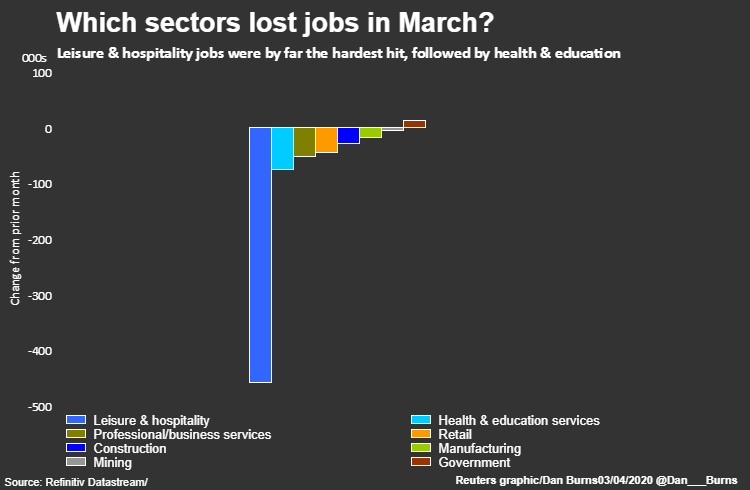
The following charts offer a picture of how March’s job losses – certain to be revised higher and followed by even larger cuts in April – played out across various industries and demographic groups.
https://fingfx.thomsonreuters.com/gfx/mkt/azgponbdvdx/Pasted%20image%201585942685326.png
The leisure and hospitality sector shed 459,000 jobs – 65% of all the positions lost in March. The loss, the largest monthly decline in the sector ever, effectively wiped out two years of employment gains in the industry.
The largest share of that came at restaurants and bars, which slashed 417,000 jobs.
Around 76,000 health and education jobs were eliminated led by 29,000 cuts at dentists and physicians offices and another 19,000 at day care centers.
The federal government sector stood out as a rare example of net job gains last month, thanks to the addition of 17,000 temporary workers for the 2020 census.
https://fingfx.thomsonreuters.com/gfx/mkt/xlbpglnkvqd/Pasted%20image%201585934947492.png
The unemployment rate shot up to 4.4% from a half-century low of 3.5%, the largest one-month increase in the jobless rate since 1975.
By race or ethnicity, the largest increases were seen among Asians and Latinos, with increases of 1.6 percentage points each, nearly twice the overall increase of 0.9 percentage point. Both whites and African Americans saw their rates rise at the same pace as the national rate, although the unemployment rate now for blacks – at 6.7% – is 65% higher than for whites at 4%.
The youngest workers were also the most likely to lose work in the early stages of the shutdown.
The unemployment rate for teenagers rose by 3.3 percentage points to 14.3% and for those between 20 and 24 years old by 2.3 points – the most since 1953 – to 8.7%.
By contrast, unemployment for those in the 25-to-34-year-old age bracket rose by just 0.4 percentage point to 4.1%. The jobless rate for workers aged 45 to 54 rose 0.7 percentage point to 3.2%, the lowest rate for any age group.
https://fingfx.thomsonreuters.com/gfx/mkt/qmyvmaoavra/Pasted%20image%201585939542068.png
Workers with lower levels of education also found themselves thrown out of work at a higher rate in March.
The rate for workers without a high school diploma jumped by 1.1 percentage points to 6.8%, the highest in nearly three years.
For people with a college degree, meanwhile, the jobless rate rose by 0.6 percentage point to 2.5%. Still, it was the largest monthly increase in the rate for that demographic since the Labor Department began tracking it in the early 1990s.

And finally, there was a notable gender gap in the unemployment rate increase last month. The jobless rate for men rose by 0.7 percentage point, while the rate for women rose 0.9 percentage point, perhaps explained by their greater representation in the hardest-hit employment sectors such as hospitality and health care.
The overall rate for both sexes over the age of 20 now stands at 4%.
https://www.reuters.com/article/us-health-coronavirus-usa-jobs/how-the-coronavirus-job-cuts-played-out-by-sector-and-demographics-idUSKBN21M0EL

LI doctor tries new hydroxychloroquine twist for elderly COVID-19 patients

A New York doctor hopes to help his elderly COVID-19 patients with a treatment plan inspired by the success tentatively being reported with hydroxychloroquine — and which he says shows promising results.
Dr. Mohammud Alam, an infectious disease specialist affiliated with Plainview Hospital, said 81 percent of infected covid patients he treated at three Long Island nursing homes recovered from the contagion.
“In this crisis, I realized I had to do something,” Alam said. ”I realized if this was my dad, what would I do? And I would do anything I could to help.”
Alam said he decided he could not apply the touted combination of the antimalarial hydroxychloroquine and antibiotic azithromycin because the side effects could be potentially fatal for his high-risk patients, many of whom had underlying heart issues.
“I knew I could not jeopardize these patients,” Alam said.
“We know from the FDA that azithromycin can cause fatal arrhythmia and abnormal heart failure that can lead to death,” Alam said.
His patients were under long-term acute care and had comorbidities such as hypertension, coronary artery disease, chronic obstructive pulmonary disease or congestive heart failure.
The FDA has warnings that azithromycin “can cause abnormal changes in the electrical activity of the heart that may lead to a potentially fatal irregular heart rhythm.”
So instead, Alam replaced azithromycin with another decades-old antibiotic that doesn’t pose any known risks to the heart.
“Doxycycline is an anti-inflammatory with properties similar to azithromycin but without the safety concerns and without cardiac toxicity,” he said.
“So I decided why not choose that?” added Alam, a board-certified internist, who shared the results of an observational report consisting of 47 patients he treated.
”With the [limited]resources we have at the nursing home, we took a deep breath and realized we need to do something,” Alam said.
Alam is not the only one to begin using doxycycline in the fight against COVID-19.
Henry Ford Health System has started using combinations of the three drugs because of apparently fewer side effects, published reports state.
Alam began treating his patients, 45 of whom had tested positive for the coronavirus after they developed a high fever, shortness of breath and cough.
He received permission from their families before starting them on the medications, which have not yet undergone randomized controlled trials.
“The majority had clinical improvement,” said Alam. “We had very good outcomes.”
Alam said that 38 of 47 patients treated returned to their baseline and their symptoms resolved. Seven of the patients were transferred to a hospital and two died.
There was no control group in the study so Alam acknowledged more studies are needed to evaluate his protocol’s effectiveness.
Alam noted that an 87-year-old woman with hypertension and coronary issues beat the virus. “Her daughter was so thankful that I didn’t need to transfer her to a hospital.”
“At the end of the day we feel like we sent fewer patients to the hospitals, we saved ICU beds and we saved some of the ventilators at the hospital,“ Alam said.
One health expert said using the decades-old doxycycline, which has been studied since the 1960s, is a plausible alternative to azithromycin.
“Since we’re talking about the elderly being the most vulnerable, or people with underlying conditions, there is a theoretical benefit of doxycycline over azithromycin because doxycycline is not associated with cardiovascular disease,” said Dr. Sten H. Vermund, the dean of the Yale School of Public Health.
Vermund also cautioned a clinical trial is necessary and also noted that two patients did pass away.
“I am optimistic about this combination, but a well-designed clinical study is urgently needed to identify the appropriate patient population, optimize dosing regimen and assess the side effect profile of this combination therapy,” added Dr. Ryan Saadi, a Yale-trained infectious disease epidemiologist who is currently developing a ventilator technology at Quantaira Health.
Vermund also added that other treatment alternatives that could be just as good and less toxic should also be considered.
https://nypost.com/2020/04/04/long-island-doctor-tries-new-hydroxychloroquine-for-covid-19-patients/

GM seeks tariff relief for ventilator parts

General Motors (NYSE:GM) has asked the Trump administration to drop import tariffs on Chinese parts it needs to make ventilators, WSJ reports, citing a letter to the U.S. Trade Representative.
The company believes the levies will make it more expensive to build the machines, according to the report.
The existing tariffs on ventilator parts “could potentially impede the ability of GM and other U.S. manufacturers to source parts for critical care ventilators quickly, reliably, and at as reasonable a cost as possible,” GM says in the letter.
The U.S. government began collecting extra tariffs on most of ventilator parts in September 2018; they are being tariffed at a 25% rate.
https://seekingalpha.com/news/3558404-gm-seeks-tariff-relief-for-ventilator-parts-wsj

Amazon advances pandemic response

Amazon (NASDAQ:AMZN) has been talking to the CEOs of Abbott Laboratories (NYSE:ABT) and Thermo Fisher Scientific (NYSE:TMO) as it investigates how to screen its warehouse staff for COIVD-19, according to internal notes seen by Reuters.
Abbott Laboratories and Thermo Fisher Scientific Inc have indicated an interest in working with Amazon, but the U.S. government is taking up all of their testing capacity at the present time.
Amazon is introducing face masks and temperature checks for workers at all its U.S. and European warehouses next week.
https://seekingalpha.com/news/3558428-amazon-advances-pandemic-response