Search This Blog

Sunday, July 19, 2020

Cholesterol-lowering drug could see covid treated like common cold – study

Could a simple drug that has been on the market for decades be used to treat COVID-19? A research team led by Hebrew University of Jerusalem (HU)’s Professor Yaakov Nahmias says that early research looks promising; their findings appear in this week’s Cell Press Sneak Peak.
Over the last three months, Nahmias and Dr. Benjamin tenOever at New York’s Icahn School of Medicine at Mount Sinai have focused on the ways in which the SARS-CoV-2 changes patients’ lungs in order to reproduce itself. Their major finding? This virus prevents the routine burning of carbohydrates. As a result, large amounts of fat accumulate inside lung cells, a condition the virus needs in order to reproduce. This new understanding of SARS CoV-2 may help explain why patients with high blood sugar and are often at a particularly high risk to develop COVID-19.
Viruses are parasites that lack the ability to replicate on their own, so they take control of our cells to help accomplish that task. “By understanding how the SARS-CoV-2 controls our metabolism, we can wrestle back control from the virus and deprive it from the very resources it needs to survive,” Nahmias explained.
With this information in hand, Nahmias and tenOever began to screen FDA-approved medications that interfere with the virus’ ability to reproduce. In lab studies, the cholesterol-lowering drug Fenofibrate (Tricor) showed extremely promising results. By allowing lung cells to burn more fat, fenofibrate breaks the virus’ grip on these , and prevents SARS CoV-2’s ability to reproduce. In fact, within only five days of treatment, the virus almost completely disappeared.
“With second-wave infections spiking in countries across the globe, these findings couldn’t come at a better time,” said Nahmias, and global cooperation may provide the cure. “The collaboration between the Nahmias and tenOever labs demonstrates the power of adopting a multi-disciplinary approach to study SARS-CoV-2 and that our findings could truly make a significant different in reducing the global burden of COVID-19,” tenOever added.
While there are many international efforts currently underway to develop a coronavirus vaccine, studies suggest that vaccines may only protect patients for a few months. Therefore, blocking the ‘ ability to function, rather than neutralizing its ability to strike in the first place, may be the key to turning the tables on COVID-19. “If our findings are borne out by , this course of treatment could potentially downgrade COVID-19’s severity into nothing worse than a common cold,” Nahmias concluded.

Explore further

More information: Ehrlich et al., The SARS-CoV-2 Transcriptional Metabolic Signature in Lung Epithelium. (2020). ssrn.com/abstract=3650499

Covid-19 Spread Fastest by Teens and Tweens – S. Korea Study

Older children are more likely to spread Covid-19 within a household than younger children and adults, according to a new study of 5,706 coronavirus patients in South Korea.The researchers traced and tested nearly 60,000 people who had contact with the infected people and found that, on average, 11.8% of household contacts tested positive for Covid-19, according to the early release of a study on the U.S. Centers for Disease Control and Prevention website.
For people who lived with patients between the ages of 10 and 19, 18.6% tested positive for the virus within about 10 days after the initial case was detected — the highest rate of transmission among the groups studied. Children younger than 10 spread the virus at the lowest rate, though researchers warned that could change when school reopens. The study comes on the heels of an intensifying debate about whether, when and how schools should resume classes. Working parents around the world have been struggling to balance their own remote work with the added complication of school closures. There is intense pressure on political leaders. In the U.S., the Trump administration has threatened to withhold federal funds for local school districts that fail to reopen.
At the same time, virus rates have been rising again, even in places that thought they’d extinguished their outbreaks, and many teachers are wary of returning to the classroom. State data suggests the infection rates among children could also be far higher than the 2% reported by the CDC. The South Korean study suggests that older children may be particularly contagious, although the researchers point out that household contacts could have contracted the virus elsewhere. Still, given the high rates of infection within families, the study called for more research to understand how to limit the spread of the virus at home.


Most COVID-19 cases in San Bernardino County, Cal. from private gatherings

A majority of COVID-19 cases in San Bernardino County are from private gatherings, according to county data released Friday.
Over the last 28 days, 71% of those infected with the virus attended a family gathering in the last 14 days. A total of 228 people out of 319 interviewed by contact tracers indicated that they attended a gathering, according to the county’s Department of Public Health.
In comparison, 3% of those infected said they had attended a religious service, while another 3% indicated they had attended a protest in the last 14 days.
“Gathering with family and friends from other households — chatting, laughing, and having a great time — is precisely how this virus spreads. That’s why the State’s stay-at-home order banning gatherings among people from different households is an order, not simply advice,” read a statement from the county.
Officials also noted that more than half of confirmed cases in the county, 52%, are among those between the ages of 20 and 39.
San Bernardino County still remains on the state’s COVID-19 watch list, which monitors for worsening coronavirus trends. As of Saturday, the county had 23,566 confirmed cases and 328 deaths.

MIT researchers create a reusable silicone mask to replace the N95

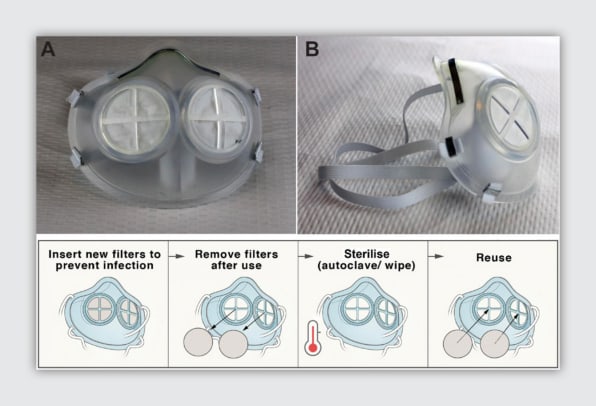
As new coronavirus cases spike in the U.S.—Florida alone now has 12 times more cases than the entire country of Australia—healthcare workers still face a shortage of N95 masks. Many hospitals are now reusing the masks, even though they’re intended to be thrown out after a single use. Various solutions for disinfecting masks or increasing the supply are in the works, but a new silicone mask now in development is designed to be used and sterilized repeatedly, and could be as effective as the gold standard of an N95 respirator.
“When the virus started popping up in the U.S., we talked about the need for PPE, and identified really early on that there was going to be a large deficit within the United States as well as the world,” says James Byrne, a radiation oncologist at Brigham and Women’s Hospital and research affiliate at MIT’s Koch Institute for Integrative Cancer Research who is part of a multidisciplinary team developing the new mask. “We really put our heads together to try to come up with something that was sustainable, and that’s how we really came up with this reusable, scalable, conformable, flexible mask.”
[Photo: Courtesy of the Researchers]
The team chose to use silicone rubber for the main part of the mask in part because of its durability—it’s the same material used in some baking equipment, and can easily withstand high temperatures. In a study of a prototype of the new mask, the researchers tested sterilizing it in an oven. They also tested a steam sterilization device and  by using bleach or rubbing alcohol. Nothing damaged the material. Because it can be sterilized in several different ways, it can be used anywhere. “We wanted to have a system that could be accessible and used by anyone globally,” says Giovanni Traverso, an MIT assistant professor of mechanical engineering and a gastroenterologist at Brigham and Women’s Hospital, another member of the team.
[Image: Courtesy of the Researchers]
It’s also possible to quickly make huge volumes of silicone masks. “Having something that was scalable, meaning that we could relatively quickly make many to support a large population was critical,” Traverso says. “Injection molding of silicone is something that is recognized in the industry.” The material, which is already used in some anesthesia masks, is also comfortable and flexes to fit different faces; in a small test of a prototype with healthcare workers, around a quarter said that they preferred wearing it rather than a standard N95 mask. Because the material is clear, it can also make it easier to communicate with patients.
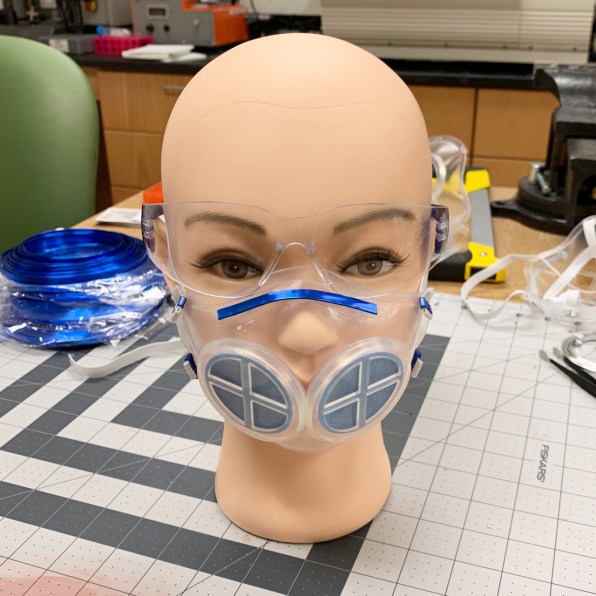
Two breathing holes in the mask use small N95 filters that can be popped in and thrown out after each use. By using far less material, it should be possible to meet demand more quickly. It also reduces waste. But the researchers are also exploring the use of a different filter material that could be sterilized and reused.
In tests with 20 healthcare workers, the team found that the mask could fit each individual correctly. They’re slightly tweaking the design based on feedback from the tests; one change involves slightly shifting the position of the filters so that it’s easier for patients to see the expression of the healthcare worker.
The researchers are now also setting up a company to bring the masks to market, as they run the prototypes through the final tests that will be necessary to get FDA approval. They’re also beginning talks with the FDA about emergency use authorization, both for healthcare workers and the general public. For hospitals, the switch to reusable masks could save money. The team is currently running both an environmental impact study and a cost-effectiveness study, and has estimated that its mask could cost just $15 and be used up to 100 times, making the cost per use likely less than a quarter, with the filter inserts less than a dollar. “There is a potential significant savings compared to the standard disposable system,” Traverso says.

Vermont only US state without Covid death in past 30 days

July 19, 2020

As of July 16, Vermont has officially gone 30 days without a death attributable to COVID-19, in stark contrast to much of the country, which has in recent weeks seen a surge in new daily cases and fatalities.
The state has remained steady at 56 deaths from COVID-19 since June 18, a trend Health Commissioner Mark Levine attributes to the vigilance of Vermonters as well as strict health protocols for those in long term care facilities, who account for 52% of the state’s fatalities. While Vermont’s neighbors — New York, Massachusetts and New Hampshire — see declines in infection rates and deaths, they continue to report new deaths almost daily.
“We like to think this is because Vermonters are actually doing what we advised them to do,” Levine said of the benchmark.
“On a given day in Vermont, we maybe have two people in the hospital with COVID,” Levine said. This, he noted, is a good sign for future trends in fatalities, because most deaths outside of long term care facilities occur in hospitals.
As Vermont survives its least deadly month yet, the rest of the country is still suffering through the worst of the pandemic.
“On a given day in Vermont, we maybe have two people in the hospital with COVID,” Levine said. This, he noted, is a good sign for future trends in fatalities, because most deaths outside of long term care facilities occur in hospitals.
As Vermont survives its least deadly month yet, the rest of the country is still suffering through the worst of the pandemic.
“I look at our surrounding states, and they’re doing so much better than they’ve ever done. But they still have deaths all the time,” Levine said. “There, death is a routine occurrence. Here, it isn’t at all.”
Compared to its northeastern neighbors, Vermont has a much smaller population. Still, its deaths per capita are substantially lower than those states, according to data from the New York Times. While the health department’s statistics are subject to change, overall, Vermont has seen just nine deaths per 100,000 people since the start of the pandemic, compared to 29 in New Hampshire, 122 in Massachusetts and 165 in New York.

Saturday, July 18, 2020

Young people are increasingly driving COVID-19’s spread

Younger Americans eager to get back to their social lives are increasingly responsible for the spread of the coronavirus, risking their own health and that of their family and friends under what health experts say is the misguided impression that the virus cannot cause them harm.
Health departments across the country are reporting that younger people are making up larger shares of the total number of those infected with the virus. The greater infection rates among young people are occurring both in states that are getting a handle on their outbreaks and those that are not.
“In these trends, we are seeing the impact of our collective decisions. We are jeopardizing the gains we made as a state,” Washington state Health Secretary John Wiesman said Friday, pointing to an increase in hospitalizations among people between the ages of 20 and 39. “[T]he actions each one of us takes now will determine what happens next.”
In early June, just 10 percent of those who tested positive in Rhode Island were in their 20s. By the end of the month, that share had doubled. The average age of a Rhode Islander who tests positive fell from 47.5 years old to 39.2 years old in a week.
Maryland Gov. Larry Hogan (R) said this week the percentage of those under 35 testing positive for the virus is now 84 percent higher than it is for those over 35.
In New Mexico, 44 percent of those who are testing positive for the virus are under 30 years old, according to state health data. In Illinois, there are more infections among people aged 20-29 than among any other age group. In California, those in their 20s make up the largest cohort of cases, followed closely by people in their 30s.
“There is a sense that a lot of young people, you’re young, think you’re invincible,” California Gov. Gavin Newsom (D) said at a June 24 press briefing. “That can be a selfish mindset.”
There are signs, too, that even children are vulnerable to the disease. More than 10 percent of confirmed cases in Arizona, Washington and Tennessee are among those under the age of 20, an analysis by Bloomberg found.
Public health experts think younger people may be under the impression that the coronavirus can do them no harm, after early signs showed that the virus was less likely to lead to severe outcomes among young adults. After months of disruptive lockdowns, they may be more interested in returning to some semblance of normalcy than in continuing to make the sacrifices necessary to bring the virus under control.
But while younger people are at less risk than those who are older, they are not immune. Data from the Centers for Disease Control and Prevention show that about 3,000 people in the United States under the age of 45 have died of COVID-19.
“One of the pieces of good news within this pandemic is that thankfully younger people are at lower risk of having severe disease, of being hospitalized and of dying from [COVID-19]. But the risk isn’t zero,” said Richard Besser, a former acting director of the Centers for Disease Control and Prevention who now heads the Robert Wood Johnson Foundation.
The risk extends beyond death, too. Preliminary studies have also hinted at the potential for long-term damage to the hearts, lungs and brains of those who survive the disease.
Public health officials are increasingly addressing their concerns to young people specifically.
“You have to have responsibility for yourself but also a societal responsibility that you’re getting infected is not just you in a vacuum. You’re propagating the pandemic,” Anthony Fauci, director of the National Institute of Allergy and Infectious Diseases, said Thursday, addressing young people in an interview with Facebook CEO Mark Zuckerberg.
What worries public health experts more than a surge of death among young people is that young people who are infected, who may not even know it, risk becoming vectors of transmission themselves. While they might not experience the worst symptoms of COVID-19, they might expose parents, grandparents, even friends or relatives who might have the underlying conditions that contribute to more severe disease.
“Young people don’t just stay with young people. Young people come home to older relatives who may be at higher risk, because of medical problems or simply due to their age,” Besser said.
In response to the growing number of younger people infected, some areas have closed bars and restaurants once again, in hopes of driving younger people out of densely crowded facilities where transmission may take place.
In his letter, Maryland’s Hogan warned local officials to crack down on establishments violating an executive order he issued requiring social distancing at eating establishments.
“At least 12 states have already moved to re-close bars and restaurants — we do not want to be forced to take the same action here in Maryland,” Hogan wrote as he urged counties to crack down on scofflaw businesses. “Our continued economic health and recovery depend on the active and aggressive local enforcement of these critical public health measures.”
Even with bars closed in many parts of the country, health officials are tracing clusters of cases back to house parties, where dozens of people can be infected by just one person who is sick. In recent weeks, health officials in Michigan, Minnesota, Pennsylvania and Oregon have identified house parties as the sources of large-scale transmission.
The house parties show that government restrictions meant to stamp out the virus only work if residents comply. Those who say abiding by the onerous rules — whether they are limits on crowd size or the use of masks in public — recall another group whose actions put public health at risk, smokers.
“Some of that reminds me of the discussion around second-hand smoke,” Besser said. “When smokers used to say, ‘Hey it’s my right to smoke,’ and we said, ‘Well you’re actually putting other people at risk.’ ”

Preventive trials on Eisai, Biogen Alzheimer’s med may prolong amyloid debate

  • A university and government-led consortium announced the start of two new clinical trials testing an Eisai and Biogen Alzheimer’s disease drug in people who have shown no signs of the neurodegenerative disorder. The Phase 3 studies will take more than four years to yield data.
  • The two trials will test the therapy, called BAN2401, in people with signs of brain accumulation of a protein called amyloid beta, which some experts believe is the cause of cognitive decline in Alzheimer’s. This hypothesis is intensely debated because so many experimental drugs that block amyloid accumulation haven’t worked, although Biogen and Eisai are making the case to regulators that one, called aducanumab, has.
  • Trials of amyloid-blocking drugs in pre-symptomatic patients have been no more promising than those in patients with signs of disease. Most recently, Eli Lilly’s drug solanezumab failed in the preventive DIAN-TU trial, which took eight years to yield results.
The new clinical program is called AHEAD 3-45, and consists of two separate trials of patients with signs of amyloid accumulation. The first, dubbed A3, will test BAN2401 in people with undetectable levels of amyloid in the brain but who are at risk of accumulation. The other, called A45, will enroll individuals with elevated amyloid and at risk of disease progression.
The trials, which will enroll 1,400 patients in total, will compare BAN2401 to placebo. In A3, the goal will be to detect a difference in amyloid levels, while A45 will use a clinical test to measure cognitive decline in participants who have no signs of disease at baseline.
BAN2401 is a synthetic antibody that binds with amyloid beta “protofibrils,” a form of the protein that is thought to be especially toxic to nerve cells. The drug is designed to prevent the accumulation of amyloid brain plaques that are considered to be characteristic of Alzheimer’s disease.
The Alzheimer’s Clinical Trial Consortium, funded by the National Institute on Aging, will run the trial along with Japanese drugmaker Eisai. The University of Southern California and Brigham and Women’s Hospital in Boston will coordinate study of the drug.
USC’s Alzheimer’s Therapeutic Research Institute already has a prevention trial underway called A4, testing Eli Lilly’s solanezumab in patients with elevated amyloid levels. Unlike many earlier prevention trials, USC’s work does not focus on patients with uncommon mutations that can lead to early or more severe disease.
Because Alzheimer’s disease typically results in slow cognitive decline, studies can take years to yield results even in symptomatic patients. In pre-symptomatic patients testing can take even longer: A4 began enrolling patients in 2014 and expects to have data in 2022.
In the case of the two new trials, the data are expected to be based on testing taken 216 weeks after a baseline evaluation.
Meanwhile, Eisai and Biogen last year initiated the first Phase 3 trial of BAN2401 in patients with early Alzheimer’s disease, despite mixed data that emerged from mid-stage trials.
Since then, BAN2401 has been largely eclipsed by the story around aducanumab, which was dramatically revived by the companies after an initial look at the drug’s studies had led to their early halt. Biogen recently completed its submission of the drug to the Food and Drug Administration, which now has two months to decide whether it will conduct an approval review.