Search This Blog

Sunday, March 21, 2021

Cancer immunotherapy may also treat certain autoimmune diseases

 A team of researchers has found disrupting the interaction between cancer cells and certain immune cells is more effective at killing cancer cells than current immunotherapy treatments.

The findings, which include studies in cell lines and animal models, appeared in JCI Insight and focus on a protein called CD6 as a target for a new approach to immunotherapy.

Over the past two decades, new approaches to  have been developed that block , which are receptors on the surface of certain immune cells, like natural killer T cells. Cancer exploits these immune cells and render them dormant.

This treatment, called checkpoint inhibitor immunotherapy, gives these immune cells a chance to fight back. Unfortunately, though, patients that become cancer-free are often left with autoimmune conditions that, in some patients, can eventually be fatal.

Only approximately one third of patients with cancer ultimately benefit from currently available immune checkpoint inhibitors.

"I'm interested in how cancer cells interact with certain immune cells to control the immune response to cancer, and how the immune system interacts with organs and tissues to cause ," says study senior author David Fox, M.D., a rheumatologist and cancer researcher at the University of Michigan Rogel Cancer Center. "How can researchers intervene to alter these interactions and simultaneously destroy cancers while preventing autoimmunity?"

Fox's lab and collaborators at the Cleveland Clinic Research Foundation have been studying the roles of CD6 and receptors it interacts with as it related to autoimmunity for many years. Previously, the research team was able to create man-made CD6 and CD318, a receptor that CD6 interacts with, to act like  in the immune system and fight off cancer cells.

This new study proved successful in combatting human breast cancer, lung cancer and prostate cancer in , indicating that the anti-CD6 antibody, known as UMCD6, could be useful in treating a wide range of cancer types.

They also grafted human breast cancer cells into immunocompromised mice, and followed up with transferring human immune cells into the mice. When given an injection of UMCD6, the tumors almost completely disappeared in just one week, compared to mice treated without UMCD6.

The findings have implications beyond this first description of a potential new approach to against cancer. The ability of UMCD6 to prevent and treat autoimmune diseases makes the potential implications for cancer immunotherapy especially intriguing, the researchers say.

It's been known that CD6 has to play a role in autoimmunity, since mice that don't have CD6 on their immune cells have major suppression of autoimmune diseases.

Prior research has shown that an antibody that binds to CD6 and pulls it from the cell surface to the inside of the cell can effectively treat autoimmune mouse models of three different human diseases: rheumatoid arthritis, an inflammatory  that causes the  to inflame the membrane that lines the joints, multiple sclerosis, a disease that affects the central nervous system, brain and spinal cord, and uveitis, an eye disease that can cause blindness.

Now, when treated with UMCD6, Fox saw the mice show striking reductions in disease activity, autoimmunity and organ damage in mice.

"When UMCD6 binds to CD6 on these specific immune cells, it creates a CD6 cluster that dives into the interior of the cell, allowing no CD6 to remain on the cell surface" says Fox. "This causes the killer T cells to seek out and destroy the cancer cells much more aggressively. At the same time, removing CD6 from the surface of CD4 cells, with the same UMCD6 antibody, controls and limits the activity of the CD4 cells, which are the  that instigate autoimmune diseases."

"Until now, we haven't been able to get  to kill  without triggering an immune response that can be harmful to patients," he adds. "What we've created here completely challenges prevailing concepts."

So how close are researchers to studying UMCD6 in humans?

There are ongoing studies of anti-CD6 antibodies in India, where an anti-CD6 antibody has been approved for the treatment of psoriasis. However, in the United States, substantial research remains to be done to translate the discovery from laboratory models to human clinical trials.

"If UMCD6 is proven to successfully treat cancer and prevent recurrences, this could overcome the major current limitations to checkpoint inhibition success in human  immunotherapy," says Fox. "I look forward to seeing what lies ahead in this field of research."


Explore further

Discovery offers potential for stripping tumors of T cell protection

More information: Jeffrey H. Ruth et al, CD6 is a target for cancer immunotherapy, JCI Insight (2021). DOI: 10.1172/jci.insight.145662
https://medicalxpress.com/news/2021-03-cancer-immunotherapy-autoimmune-diseases.html

Polymerized estrogen provides neuroprotection in preclinical testing

 A novel form of polymerized estrogen developed at Rensselaer Polytechnic Institute can provide neuroprotection when implanted at the site of a spinal cord injury—preventing further damage. This promising result, found in a preclinical model, was recently published in ACS Chemical Neuroscience, and it lays the groundwork for further advancement of this new biomaterial.

"What we saw that gives us hope is more neuroprotection, meaning we saw more spared neurons and more spared axons in the tissue," said Ryan Gilbert, a professor of biomedical engineering at Rensselaer, and co-author on this paper. "We believe that the estrogen released from our biomaterial design is providing a neuroprotective response."

After a spinal cord injury, the body's inflammatory response can cause further damage to nervous system cells—like a loss of neurons and axons—even beyond the site of initial injury. A solution that could prevent additional deterioration, or even promote regeneration over time, could be a paradigm shift in treatment. Estrogen is a natural hormone produced within the body. When polymerized, it shows promise as a source of neuroprotection following a spinal cord injury.

Gilbert, a member of the Center for Biotechnology and Interdisciplinary Studies at Rensselaer, collaborated with Edmund Palermo, an associate professor of materials science and engineering at Rensselaer, to design this polymer. The preclinical aspect was initiated by Manoj Gottipati, a Rensselaer research associate, currently working in the laboratory of Phillip Popovich, professor and chair of the Department of Neuroscience at The Ohio State University. At Ohio State, Gottipati worked with Zhen Guan from the Center for Brain and Spinal Cord Repair to test the polymerized estrogen film. The researchers observed enhanced neuroprotection in a preclinical mouse model that had the implanted polymerized estrogen when compared to models that did not receive this treatment.

The polymer itself is entirely made of estrogen, which is released slowly within the body over time as water reactions break down the bonds that hold the  together, making it a unique and promising therapeutic approach.

"Since the drug molecule is enchained in every repeating unit of the long chain, it contains a very high drug load compared to conventional delivery approaches," said Palermo, who is also co-author on this paper and a member of the Rensselaer Center for Materials, Devices, and Integrated Systems.

According to Palermo, the polymer studied in this research is one of a number of candidates the researchers will continue to investigate as they work to find the optimal release rate for enhanced neuroprotection. Finely tuning hydrophobicity, , and hydrolysis rates could all make a difference in critical aspects of its performance, such as how quickly the polymer releases  within the body.

"All of those factors will play a role in the complex cascade of biochemical and biophysical events that occur during the course of the body's reaction to spinal cord injury," Palermo said.

As the team continues to modify this biomaterial, what researchers develop could have implications beyond spinal cord injury therapeutics.

"I would say that this approach could be used for any sort of central nervous system injury, from spinal cord to brain injury," Gilbert said. "Anything where we could inject or place it near the  site and have that therapy be released for an extended duration."


Explore further

Polymerized estrogen shown to protect nervous system cells

More information: Manoj K. Gottipati et al, Acute Dose-Dependent Neuroprotective Effects of Poly(pro-17β-estradiol) in a Mouse Model of Spinal Contusion Injury, ACS Chemical Neuroscience (2021). DOI: 10.1021/acschemneuro.0c00798
https://medicalxpress.com/news/2021-03-polymerized-estrogen-neuroprotection-preclinical.html

How RNA editing affects the immune system

 Three University of Colorado Cancer Center researchers are part of a team that recently published a paper offering new insight into how the immune system relates to cancer. Quentin Vicens, Ph.D., Jeffrey Kieft, Ph.D., and Beat Vögeli, Ph.D., are authors on the paper, which looks at how an enzyme called ADAR1 operates in pathways associated with cancer.

"In a cell, ADAR1 edits native RNA—or self-RNA—so that the cell recognizes it as its own. It's a key protection against autoimmune disorders," Kieft says. "But if a virus infects, viral RNA isn't edited by ADAR1, so the cell can recognize that and react. The cell knows it has foreign RNA, and it activates immune responses to fight off that infection."

For their paper published last month in the journal Nature Communications, Kieft, Vögeli, Vicens, and the rest of the team—including Parker Nichols, a graduate student in the Structural Biology and Biochemistry program in the CU School of Medicine who works jointly in the Kieft and Vögeli labs—looked at where specifically the ADAR1 binds to RNA to perform the editing process. They already knew a domain of ADAR1 known as Z-alpha binds to a form of RNA called Z-RNA, but they found that Z-alpha ADAR1 can bind to other RNA forms as well.

"The team asked, 'How are all these locations in RNA being recognized by Z-alpha if they supposedly don't form Z-RNA?'" Kieft says. "One of the take-home messages is that other forms of RNA can bind to Z-alpha ADAR1 and can even partially form Z-RNA. That was a surprise because it shows that RNA can form this specific Z structure in places we didn't recognize before."

The team is now proposing a model for how Z-alpha ADAR1 is able to bind to different types of RNA. It's an important finding in  because of the role of ADAR1 in  regulation. A normally functioning  oftentimes can detect cancerous  as being dangerous and then eliminate them, but if there's too much ADAR1 editing happening, a cell could be tamping down the  in an effort to protect itself.

"In a lot of cancers, there is upregulation of ADAR1; it is doing more than it should," Kieft says. "The excess ADAR1 presumably is leading to more RNA editing than is normal. This is going to misregulate things,affecting specific regions of RNA or types of RNA. The excess editing is going to throw off the normal immune response, but it probably has a lot of other affects in the cell as well. Cancer is a disease where  has gone awry, so if an important regulatory pathway like editing by ADAR has gone haywire, that can contribute to the cancer."

Knowing all the targets of ADAR1 in a cell is also a step toward more effective therapies, Kieft says. If researchers understand the pathways, they may be able to find a way to disrupt the overactive editing process and boost the immune response. It's a finding applicable to many other diseases as well—Vögeli says since the paper was published, the researchers have heard from other scientists around the country interested in ADAR1.

"We have gotten a lot of feedback on the paper," he says. "There is a lot of interest in this field right now, and other people are interested in how they could use our structural information."

Vögeli and Vicens are now organizing a meeting focused on ADAR1 function and putting together special issues of the journals Molecules and International Journal of Molecular Sciences.

Vicens says the research project also illustrates the importance of collaborative work and being open to new directions. "I basically brought a new project and direction to the Kieft lab when I joined," Vicens says. "Both labs were open to supporting it intellectually and financially, and the resultant team effort enabled research that would not otherwise have been done."


Explore further

RNA editing protein ADAR1 protects telomeres and supports proliferation in cancer cells

More information: Parker J. Nichols et al, Recognition of non-CpG repeats in Alu and ribosomal RNAs by the Z-RNA binding domain of ADAR1 induces A-Z junctions, Nature Communications (2021). DOI: 10.1038/s41467-021-21039-0
https://medicalxpress.com/news/2021-03-rna-affects-immune.html

Delivering vaccines directly to lungs can up immune responses to infections, cancer

 Many viruses infect their hosts through mucosal surfaces such as the lining of the respiratory tract. MIT researchers have now developed a vaccination strategy that can create an army of T cells that are ready and waiting at those surfaces, offering a quicker response to viral invaders.

The researchers showed that they could induce a strong memory T cell response in the lungs of mice by giving them a  modified to bind to a protein naturally present in mucus. This can help ferry the vaccine across mucosal barriers, such as the lining of the lungs.

"In this paper, we specifically focused on T cell responses that would be useful against viruses or cancer, and our idea was to use this protein, albumin, as sort of a Trojan horse to get the vaccine across the mucosal barrier," says Darrell Irvine, the senior author of the study, who is the Underwood-Prescott Professor with appointments in the departments of Biological Engineering and Materials Science and Engineering; an associate director of MIT's Koch Institute for Integrative Cancer Research; and a member of the Ragon Institute of MGH, MIT, and Harvard.

In addition to protecting against pathogens that infect the lungs, these types of inhaled vaccines could also be used to treat cancer metastasizing to the lungs or even prevent cancer from developing in the first place, the researchers say.

Former MIT postdoc Kavya Rakhra is the lead author of the study, which appears today in Science Immunology. Other authors include technical associates Wuhbet Abraham and Na Li, postdoc Chensu Wang, former graduate student Kelly Moynihan Ph.D. '17, and former research technicians Nathan Donahue and Alexis Baldeon.

Local response

Most vaccines are given as an injection into the muscle tissue. However, most viral infections occur at mucosal surfaces such as the lungs and upper respiratory tract, reproductive tract, or gastrointestinal tract. Creating a strong line of defense at those sites could help the body fend off infection more effectively, Irvine says.

"In some cases, vaccines given in muscle can elicit immunity at mucosal surfaces, but there is a general principle that if you vaccinate through the mucosal surface, you tend to elicit a stronger protection at that site," Irvine says. "Unfortunately, we don't have great technologies yet for mounting immune responses that specifically protect those mucosal surfaces."

There is an approved nasal vaccine for the flu, and an oral vaccine for typhoid, but both of those vaccines consist of live, attenuated viruses, which are better able to cross mucosal barriers. Irvine's lab wanted to pursue an alternative: peptide vaccines, which have a better safety profile and are easier to manufacture, but are more difficult to get across mucosal barriers.

Delivering vaccines directly to the lungs can boost immune responses to respiratory infections or lung cancer: study
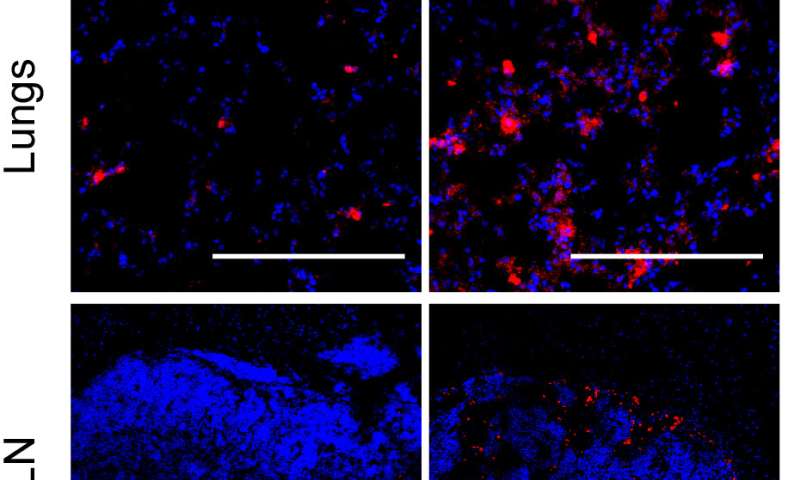
CpG (red) molecules from the novel albumin-binding vaccine (amphiphile, right column) were better retained in the lungs and draining lymph nodes of mice than the control vaccine (soluble, left column). Credit: Rakhra et al., Sci. Immunol. 6, eabd8003 (2021)

To try to make peptide vaccines easier to deliver to the lungs, the researchers turned to an approach they first explored in a 2014 study. In that paper, Irvine and his colleagues found that attaching peptide vaccines to albumin proteins, found in the bloodstream, helped the peptides to accumulate in the lymph nodes, where they could activate a strong T cell response.

Those vaccines were given by injection, like most traditional vaccines. In their new study, the researchers investigated whether albumin could also help peptide vaccines get across mucosal barriers such as those surrounding the lungs. One of albumin's functions is to help maintain osmotic pressure in the lungs, and it can easily pass through the epithelial tissue surrounding the lungs.

To test this idea, the researchers attached an albumin-binding lipid tail to a peptide vaccine against the vaccinia virus. The vaccine also included a commonly used adjuvant called CpG, which helps to provoke a stronger immune response.

The vaccine was delivered intratracheally, which simulates inhalation exposure. The researchers found that this type of delivery generated a 25-fold increase in memory T  in the mouse lungs, compared to injecting the albumin-modified vaccine into a muscle site far from the lungs. They also showed that when mice were exposed to the vaccinia virus months later, the intramuscular vaccine offered no protection, while all of the animals that received the vaccine intratracheally were protected.

Targeting tumors

The researchers also tested a mucosal vaccine against cancer. In that case, they used a peptide found on melanoma cells to immunize mice. When the vaccinated mice were exposed to metastatic melanoma cells, T cells in the lungs were able to eliminate them. The researchers also showed that the vaccine could help to shrink existing  tumors.

This kind of local response could make it possible to develop vaccines that would prevent tumors from forming in specific organs, by targeting antigens commonly found on tumor cells.

"In both the virus and the tumor experiments, we're leveraging this idea that, as other people have shown, these memory T cells set up shop in the lungs and are waiting right there at the barrier. As soon as a tumor cell shows up, or as soon as a virus infects the target cell, the T cells can immediately clear it," Irvine says.

This strategy could also be useful for creating mucosal vaccines against other viruses such as HIV, influenza, or SAR-CoV-2, Irvine says. His lab is now using the same approach to create a vaccine that provokes a strong antibody response in the lungs, using SARS-CoV-2 as a target.


Explore further

Intranasal influenza vaccine spurs strong immune response in Phase 1 study

More information: K. Rakhra el al., "Exploiting albumin as a mucosal vaccine chaperone for robust generation of lung-resident memory T cells," Science Immunology (2021). immunology.sciencemag.org/look … 6/sciimmunol.abd8003
https://medicalxpress.com/news/2021-03-vaccines-lungs-boost-immune-responses.html

Health declining in Gen X and Gen Y: national study

 Recent generations show a worrying decline in health compared to their parents and grandparents when they were the same age, a new national study reveals.

Researchers found that, compared to previous generations, members of Generation X and Generation Y showed poorer physical health, higher levels of unhealthy behaviors such as  and smoking, and more depression and anxiety.

The results suggest the likelihood of higher levels of diseases and more deaths in  than we have seen in the past, said Hui Zheng, lead author of the study and professor of sociology at The Ohio State University.

"The worsening health profiles we found in Gen X and Gen Y is alarming," Zheng said.

"If we don't find a way to slow this trend, we are potentially going to see an expansion of morbidity and mortality rates in the United States as these generations get older."

Zheng conducted the study with Paola Echave, a graduate student in sociology at Ohio State. The results were published online yesterday (March 18, 2021) in the American Journal of Epidemiology.

The researchers used data from the National Health and Nutrition Examination Survey 1988-2016 (62,833 respondents) and the National Health Interview Survey 1997-2018 (625,221 respondents), both conducted by the National Center for Health Statistics.

To measure physical health, the researchers used eight markers of a condition called , a constellation of risk factors for heart disease, stroke, kidney disease and diabetes. Some of the markers include waist circumference, blood pressure, cholesterol level and body mass index (BMI). They also used one marker of chronic inflammation, low urinary albumin, and one additional marker of renal function, creatinine clearance.

The researchers found that the measures of  have worsened from the baby boomer  through Gen X (born 1965-80) and Gen Y (born 1981-99). For whites, increases in metabolic syndrome were the main culprit, while increases in chronic inflammation were seen most in Black Americans, particularly men.

"The declining health trends in recent generations is a shocking finding," Zheng said. "It suggests we may have a challenging health prospect in the United State in coming years."

Zheng said it is beyond the scope of the study to comprehensively explain the reasons behind the health decline. But the researchers did check two factors. They found smoking couldn't explain the decline. Obesity could help explain the increase in metabolic syndrome, but not the increases seen in chronic inflammation.

It wasn't just the overall health markers that were concerning for some members of the younger generations, Zheng said.

Results showed that levels of anxiety and depression have increased for each generation of whites from the War Babies generation (born 1943-45) through Gen Y.

While levels of these two mental health indicators did increase for Blacks up through the early baby boomers, the rate has been generally flat since then.

Health behaviors also show worrying trends.

The probability of heavy drinking has continuously increased across generations for whites and Black males, especially after late-Gen X (born 1973-80).

For whites and Blacks, the probability of using street drugs peaked at late boomers (born 1956-64), decreased afterward, then rose again for late-Gen X. For Hispanics, it has continuously increased since early-baby boomers.

Surprisingly, results suggest the probability of having ever smoked has continuously increased across generations for all groups.

How can this be true with other research showing a decline in overall cigarette consumption since the 1970s?

"One possibility is that people in older generations are quitting smoking in larger numbers while younger generations are more likely to start smoking," Zheng said. "But we need further research to see if that is correct."

Zheng said these results may be just an early warning of what is to come.

"People in Gen X and Gen Y are still relatively young, so we may be underestimating their health problems," he said. "When they get older and chronic diseases become more prevalent, we'll have a better view of their  status."

Zheng noted that the United States has already seen recent decreases in life expectancy and increases in disability and morbidity.

"Our results suggest that without effective policy interventions, these disturbing trends won't be temporary, but a battle we'll have to continue to fight."

More information: Hui Zheng et al. Are Recent Cohorts Getting Worse? Trends in U.S. Adult Physiological Status, Mental Health, and Health Behaviors across a Century of Birth Cohorts, American Journal of Epidemiology (2021). DOI: 10.1093/aje/kwab076

https://medicalxpress.com/news/2021-03-health-declining-gen-national.html

Royal Caribbean Only Accepts Vaccinated Passengers On Next Caribbean Cruise

 Royal Caribbean International is taking a page from the airlines and implementing a COVID passport for all passengers and crew on their next sailing in the Caribbean in June. But here's the kicker: all passengers and staff must be vaccinated before entering the vessel. 

Unlike airlines that require passengers to get either vaccination or at least have a negative COVID-19 test, Royal Caribbean's June sail from Nassau, in the Bahamas, requires all adults to be vaccinated before entering the vessel. However, there's an exception, children under the age of 18 with a negative COVID-19 test are allowed to board.

The good news for Americans seeking the vaccine, President Joe Biden stated last week he wants vaccines available to all Americans by May 1. 

Michael Bayley, president and CEO of Royal Caribbean International, who was quoted by USA Today, said the cruise liner is excited to finally have a vessel sail in the Caribbean "gradually and safely."

"The vaccines are clearly a game-changer for all of us, and with the number of vaccinations and their impact growing rapidly, we believe starting with cruises for vaccinated adult guests and crew is the right choice," Bayley said. 

Royal Caribbean also announced its sister line, Celebrity Cruises, will begin sailing on June 5. The Celebrity Millennium will sail from St. Maarten on a week cruise with vaccinated crew and passengers, except passengers under 18 must have a negative test. 

"Returning to the Caribbean ... marks the measured beginning of the end of what has been a uniquely challenging time for everyone," said Lisa Lutoff-Perlo, CEO of Celebrity Cruises, a division of Royal Caribbean, who Reuters quoted. 

From airlines to cruise ships, a 'new normal,' or rather a dystopic future of COVID passports, something "conspiracy theorists" warned about is turning into a conspiracy fact. This overreaching system of control by corporations and governments is becoming a reality that will likely stay in places for years to come. 

It comes as no surprise as billionaire and top vaccine pusher Bill Gates, for the last eleven months, has been one of the most prominent figures discussing health passports.

Since the early days of the pandemic (read: here & here & here), we've discussed "COVID passports," "immunity passports," or at least mentioned those who don't get tested for the virus or vaccinated could face travel restrictions. 

We believe COVID passports of health passes could be required elsewhere, such as concerts, sports games, and even public transportation. 

Former Prime Minister and globalist Tony Blair recently said the "world is moving in this direction," adding that he couldn't see another way of this," while referring to immunity passports. 

Blair has previously said that vaccine passports are inevitable and that "It's going to be a new world altogether."

Will COVID passports revive the crippled cruise line industry? Well, it's hard to tell at this point - however, we can point to an explosive growth in RV sales by Americans who more than likely financed one of these recreational vehicles and are unlikely to spend money on a cruise anytime soon. 

https://www.zerohedge.com/covid-19/royal-caribbean-only-accepts-vaccinated-passengers-next-caribbean-cruise

Another Mega Short Squeeze On Deck

 At the end of the first week of March which saw an eruption in violent market turbulence in the aftermath of the sharp spike in bond yields and the catastrophic 7Y auction ...

... we pointed out an observation from Goldman's Prime Broker desk, which noted that halfway through the week, Goldman traders saw the "largest global short sales since May" with the GS Prime book was net sold yesterday (-0.9 SDs vs. the average daily net flow of the past year), driven by short sales outpacing long buys 1.7 to 1." In fact, the mid-week puke wasn't so much selling as short-selling, as "modest net selling (-0.5 SDs) was driven by short sales outpacing long buys 1.5 to 1."


This prompted us to predict that what was coming would be a "mega squeeze" in stocks.

Sure enough just a few days later, on March 10, when stocks did explode higher in the second week of March, Goldman's Prime Brokerage Service observed that Tuesday's eruption was the result of "risk unwind in Macro Products vs. large net buying in Single Names" led by TMT and Consumer Disc stocks, with the Goldman Prime book net bought for a fifth straight day in which "trading flows were risk-off with short covers outpacing long sales 4 to 1. And just to make sure there is no confusion, Goldman prime said that "yesterday’s de-grossing activity - short covers and long sales combined - was the largest since late January (-2.0 SDs)."

Furthermore, Bloomberg added that short covering in unprofitable tech firms helped the group halt seven straight days of selling and score the third-biggest net buying of the year. In fact, in the first two days of that week, Goldman basket of the most-shorted tech stocks soared 7%, more than double the return of the Russell 3000.

Commenting on the move, Andrew Brenner, the head of international fixed-income at NatAlliance Securities in New York told Bloomberg that “we see yesterday’s move as short covering without legs." Ok fine, but tell that to any Nasdaq shorts whose legs - and everything else - was steamrolled in the historic move higher.

We concluded our post by saying that "with the latest iteration of shorts now out of the picture, it's time for a new cohort of bears to take their place, and we wouldn't be surprised if we see renewed weakness in the Nasdaq as a flood of new shorts hammers the tech index only to then suffer another massive squeeze and so on, rinse, repeat."

Well, one again that is indeed what happened because while the Nasdaq did move sharply higher for a few days, it closed on Friday precisely at the March 10 short squeeze high as every squeeze higher has been met with a fresh burst of shorting.

We bring all this up because we now have the latest Goldman Prime data and - drumroll - we appear to be headed for another mega squeeze!

As Goldman's hedge fund client-facing desk wrote after the close on Friday, in a reversal of last week’s buying activity, "the GS Prime book saw the largest $ net selling since Dec ‘18 (-2.5 SDs), driven by short sales and long sales (3 to 1)." The bank then reveals that all regions and sectors saw increased shorting on the week with "Single Names/Macro Products were both net sold and made up 70%/30% of the $ net selling. With the exception of Asia which was net bought driven by long buying in Japan, all regions were net sold led by North America and Europe." Finally, broken down by industry, "10 of 11 global sectors were net sold led by Consumer Disc, Comm Svcs, Info Tech, and Materials, while Financials was the only net bought sector."

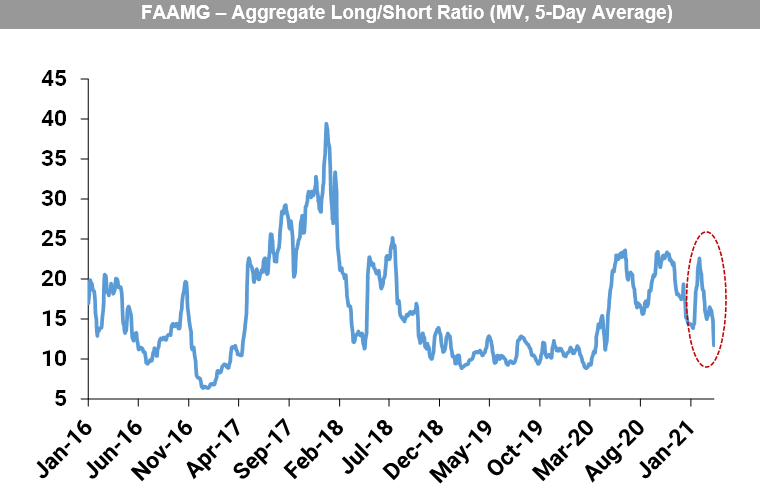
But what is most notable is that like two weeks ago, Goldman Prime reveals that "the largest net selling in US TMT Mega Caps since Mar ’20 driven by short sales" and the aggregate long/short ratio (MV) in FAAMG dropped -34% week/week on the GS Prime book to 10.41, which is the lowest level since Mar ’20 and in the 19th percentile vs. the past five years.

One final - and perhaps remarkable observation in light of the juggernaut that FAAMG had been for much of 2020 - the TMT Mega Caps (FAAMGs) collectively now make up 13.5% of the overall US net exposure in Single Names, down from 13.9% at the end of last week and 14.6% at the start of this year, according to GS Prime. The current level is in the 16th percentile vs. the past year and in the 55th percentile vs. the past five years. In short: traders are rapidly rotating away from the best performing sector of 2020.

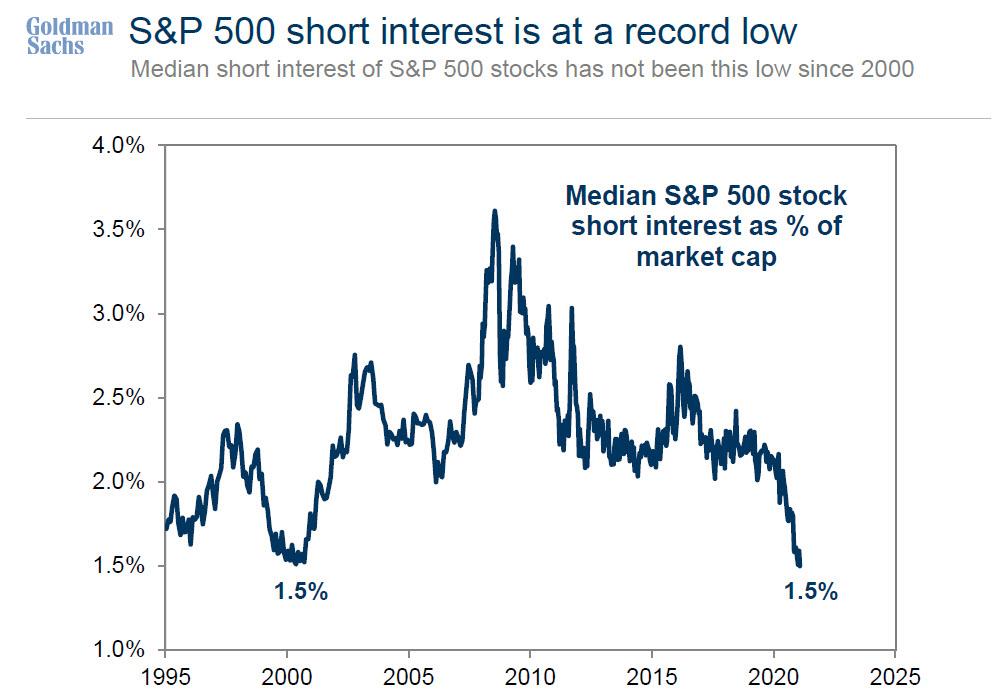
Adding insult to injury the latest Goldman Prime data also shows that hedge funds haven't generated any net alpha since the start of 2020 (!) for one simple reason: while the longs are modestly in the green, it is the collective shorts that keep steamrolling the "2 and 20" space, and every time hedge fund layer bearish, an initial spike in covering leads to a furious cascade of closing out of bearish positions perhaps as a result of the market's muscle memory where every attempt to go short has lead to pain and suffering for the bears leading to the lowest marketwide net short in history!

What does all this mean? Well, as a result of last week's aggressive attempt to pile on shorts - the most since Dec 2018 when stocks collapsed due to Powell's final rate hike which was seen as a huge policy mistake - we are once again facing the threat of a massive short squeeze, one exacerbated by the fact that hedge funds are now once again red for the year, as shown by the black line below...

... making them extremely jittery and likely to close out any potentially devastating shorts at the sign of even the smallest of bullish catalysts. Well, with not one, not two but three appearances by Fed Chair Powell eager to make up for his latest FOMC fiasco that sent yields to fresh 2021 highs, there will be ample triggers for another mega squeeze in the week ahead, and we are confident that in just a few days we will be once again discussing the latest "mega squeeze" leading to another historic market meltup with the full blessing of the Federal Reserve.

https://www.zerohedge.com/markets/another-mega-short-squeeze-deck