Search This Blog

Friday, November 19, 2021

Major Insurers Weigh in on 'Medical Necessity' of Biogen’s Aduhelm

 As reported during Biogen’s third-quarter report in October, its controversial Alzheimer’s drug Aduhelm (aducanumab) is struggling to get traction in the marketplace. Some of it is physicians’ reluctance to prescribe it because of questionable efficacy and potentially serious side effects. One patient may have died as a result of those side effects, although that is still being investigated. In addition, insurers are reluctant to pay for the drug, which has a price tag of $56,000 per patient per year. Medicare is still evaluating the drug to make its reimbursement recommendation, but a final decision isn’t expected until March or April 2022.

There are new reports that insurers are balking at paying for the drug. In a Bloomberg News survey of 25 large insurers, none described the drug as “medically necessary,” and said Aduhelm was still experimental — despite FDA approval — while some are still evaluating it.

Dr. Paul Schulz, a physician with the McGovern Medical School at UTHealth Houston and Memorial Hermann-Texas Medical Center, noted that for each person who is considered eligible for the drug, staffers can spend five hours working to get insurance approval, which is rarely granted.

“It’s very difficult to spend that much time getting something approved on a case-by-case basis,” Schulz said.

A representative for Health Care Services Corp., which has almost 17 million members in Blue Cross Blue Shield plans in five states, including Texas, said Aduhelm isn’t medically necessary for Alzheimer’s treatment “as a clinical benefit has not been established.”

Kaiser Permanente, a California-based health maintenance organization, pays for Aduhelm when a member’s doctor determines it is medically necessary.

Humana, another insurer, said it hasn’t made a final decision on who to cover and expressed concerns over conflicting data. It did say that Medicare’s decision will influence its final policy.

Cigna Corp. in June was quoted by Biogen as saying it was “working to ensure that the patients who will benefit most from this new treatment have a clear path to access it.”

But Cigna has since also called the drug “unproven” and won’t cover it. The company cited “emerging concerns regarding its safety and efficacy.”

Other patients who haven’t received approval from their payers have received the drug for free from Biogen, at least temporarily. However, there are concerns about delays, because the drug appears to be most effective when given early in the disease.

Dr. Jeffrey Gelblum of First Choice Neurology, a group of south Florida clinics that has about 80 patients receiving Aduhelm, said, “I don’t want to waste time. You’ve got a two-year window of intervention here, and if a patient comes in saying, ‘Look I’ve had this problem for a year,’ well, now I know I’m already a year into the problem.”

And deciding on eligibility not only includes standard Alzheimer’s cognitive tests, but a PET scan of the brain looking for amyloid plaques. The procedure runs about $5000 and isn’t covered by insurers. Another option is a spinal tap.

“There are many bottlenecks,” said Dr. Marwan Sabbagh, a physician at the Barrow Neurological Institute in Phoenix. “It’s not exclusive to our healthcare system.”

https://www.biospace.com/article/major-insurers-weigh-in-on-medical-necessity-of-biogen-s-aduhelm-/

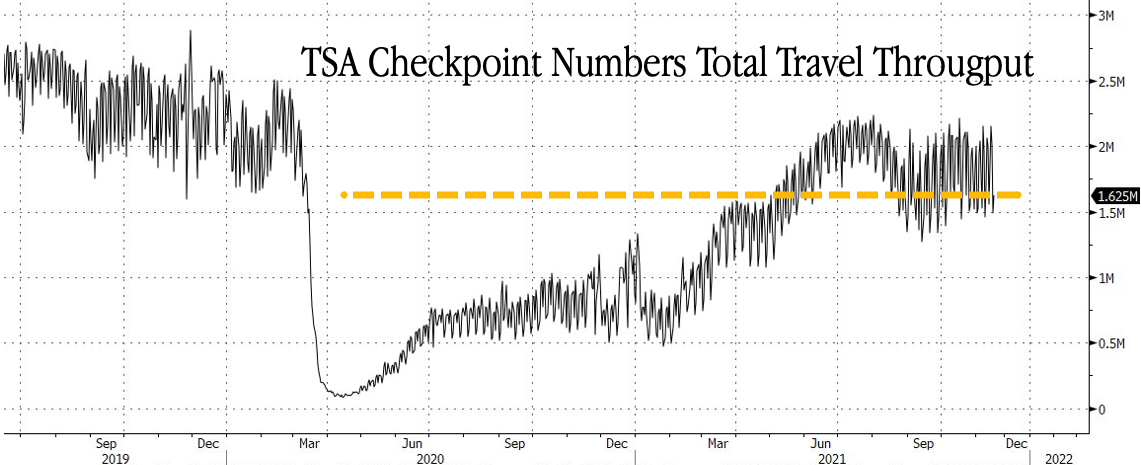
40% Of TSA Workers Still Unvaxx'd As Thanksgiving Deadline Looms

 Ahead of Thanksgiving week, one of the busiest travel periods of the year, as many as 40% of Transportation Security Administration (TSA) workers aren't vaccinated against COVID-19, according to Forbes

Beginning on Monday, all federal employees must be vaccinated. November 8 was the last date that airport security screeners could get a J&J dose and be considered "fully vaccinated" to meet Monday's deadline. 

Everett Kelley, president of the American Federation of Government Employees, representing 45,000 employees, told a panel on Capitol Hill yesterday that the union urged President Biden to push back the vaccination deadline for federal workers to January 4. He was unsure of how many TSA workers were fully vaccinated at the moment and noted several TSA officials requested religious and medical exemptions for the vaccine. 

A perfect storm could be developing. There appears to be a great deal of TSA workers who have yet to be vaccinated and may complicate their work status next week as AAA is projecting that 4.2 million Americans will fly over Thanksgiving weekend, about double the number from last year but still down 11% from pre-pandemic times. 

Meanwhile, TSA Administrator David Pekoske told ABC's "Good Morning America" on Wednesday that the "implementation of the mandate will have no effect staffing whatsoever on Thanksgiving." 

While there are so many unknowns next week as millions of Americans take to the skies to see family and friends for "Turkey Day" and football and day drinking, there is a rising probability that airport disruptions could be seen next week. 

China's BioKangtai begins first shipment of AstraZeneca's COVID-19 shot


AstraZeneca Plc's COVID-19 vaccine partner in China, Shenzhen Kangtai Biological Products (BioKangtai), has begun its first shipment of the shot, sending more than four million doses to Indonesia, BioKangtai said on Friday.

Including the first batch, BioKangtai plans to send over eight million doses of the China-made AstraZeneca shot, branded as KconecaVac, to Indonesia this month, Zhang Qian, general manager at BioKangtai's international affairs department, said in a video interview with local media.

BioKangtai has the right to manufacture the vaccine, and the right to sell it in mainland China, Indonesia and Pakistan.

The shot hasn't begun clinical trials in China, which AstraZeneca hoped to start last year before the application for local regulatory approval for the shot.

Shenzhen-based BioKangtai, which has its own COVID-19 vaccine approved by China, hasn't said why trials for the AstraZeneca shot have been delayed.

Western companies including AstraZeneca and BioNTech have partnered with Chinese firms to bring their shots to the country, but China has not allowed the use of any coronavirus vaccines developed and approved overseas.

BioKangtai said in February its facility dedicated to making the AstraZeneca shot was expected to reach an annual production capacity of 400 million doses. Its actual production rate remains unclear.

AstraZeneca has already shipped about 10 million doses of its COVID-19 vaccine to Indonesia as of October, according to Indonesia's health ministry. The southeast Asian country has also received the vaccine through the global vaccine sharing scheme COVAX.

https://www.marketscreener.com/quote/stock/SHENZHEN-KANGTAI-BIOLOGIC-37507054/news/China-s-BioKangtai-begins-first-shipment-of-AstraZeneca-s-COVID-19-shot-37077656/

Bayer shortlists private equity firms to bid for pest control unit


Bayer has shortlisted a number of private equity groups to make binding bids for its pest control unit Bayer Environmental Science (BES), Handelsblatt reported on Friday.

Cinven, CVC and Apax are among the bidders that Bayer, which earlier this year put the business up for sale, has picked for the next bidding round, the newspaper cited financial sources as saying.

Bayer, which declined to comment, is selling the unit to cut debt and to focus its crop science division on its core agriculture customers. Environmental Science offers pesticides and rodent control to non-farming customers like greenskeepers and warehouse managers.

https://www.marketscreener.com/quote/stock/BAYER-AG-436063/news/Bayer-shortlists-private-equity-firms-to-bid-for-pest-control-unit-Handelsblatt-37085025/

EQT, BioNTech investor consider bid for Novartis arm Sandoz -report


Investment group EQT and the Struengmann family, who are investors in BioNTech, are considering a joint offer for Sandoz, the generics arm of Swiss drugmaker Novartis, Handelsblatt reported on Friday.

A potential offer could value Sandoz at more than 20 billion Swiss francs ($21.6 billion), the German daily newspaper reported, citing unnamed sources.

After years of revamping the business, Novartis in October raised the prospect of divesting Sandoz, as price pressures mount in the off-patent drug sector.

It said it had begun a strategic review which would "explore all options, ranging from retaining the business to separation".

The Struengmann family and EQT, who have already made several joint investments, were looking to bring further investors on board in a consortium, Handelsblatt reported.

Several other private equity firms have taken an interest in Sandoz, the newspaper report added.

EQT and Novartis declined to comment. The Struengmann family office could not immediately be reached for comment.

Sandoz would be a return to their roots for biotech investors Thomas and Andreas Struengmann, who sold generic drugs business Hexal to Novartis in 2005. Hexal became part of Sandoz.

The Struengmann twins were early backers of BioNTech when it was founded in 2008 and remain major shareholders in the group that together with Pfizer Inc has developed one of the leading COVID-19 vaccinations in response to the pandemic.

They have also retained some generic drug activities, such as their ownership of Uruguay-based Mega Pharma SA.

For Novartis, a divestment would further simplify its structure after it spun off the Alcon eye care business in 2019 and this month agreed to sell a nearly one-third voting stake in Roche back to its cross-town rival.

https://www.marketscreener.com/quote/stock/NOVARTIS-AG-9364983/news/EQT-BioNTech-investor-consider-bid-for-Novartis-arm-Sandoz-report-37083824/

Dollar rises as COVID concerns spark flight to safety


The dollar rose on Friday as investors sought safe havens after Austria said it would be the first country in Western Europe to reimpose a full lockdown amid surging COVID-19 infections and Germany said it could follow suit, sending the euro lower.

The dollar index, which tracks the greenback against a basket of six major currencies, was up 0.489% at 96.029, close to the 16-month high of 96.266 hit on Wednesday. For the week, the dollar was up around 1%.

The euro, meanwhile, which has been on its back foot all week, hit a 16-month low amid the COVID surge in Europe and as expectations have grown that interest rates will be hiked faster elsewhere, particularly in the United States.

Federal Reserve Governor Christopher Waller said the U.S. central bank should speed up the pace of tapering its bond purchases to give more leeway to raise interest rates from their near-zero level sooner than it currently expects if high inflation and the strength of job gains persists.

At a separate event, Fed Vice Chair Richard Clarida said it "may very well be appropriate" to discuss speeding up the Fed's asset purchase wind-down when it next meets, on Dec. 14-15.

"The greenback right now is certainly benefiting from signs of a strengthening U.S. economy and from safe-haven flows due to renewed worries about the virus," said Joe Manimbo, senior market analyst at Western Union Business Solutions.

On top of a lockdown, Austria said it will require all its citizens to be vaccinated against COVID-19 from Feb. 1, while Germany's health minister cautioned lockdown restrictions could return there.

"One thing is certain, if the whole of Europe had to go under lockdown once more, and depending on how long that would last, we would need to rethink our growth scenarios," said Stephane Ekolo, global equity strategist at brokerage Tradition.

Commodity-linked currencies, such as the Australian, New Zealand and Canadian dollars, often seen as risky, all declined.

The euro has fallen more than 1% this week versus the dollar and was down 0.74% on the day at $1.12895, having earlier touched $1.1248, its weakest level since July 2020.

European Central Bank President Christine Lagarde doubled down on her cautious position on Friday, saying the ECB should not tighten policy as that could undermine recovery.

The Aussie was down 0.58% at $0.72335 and the Kiwi was 0.72% lower at $0.69945.

The Canadian dollar slid 0.42% to 1.2652.

The Japanese yen, also considered a safe-haven currency, strengthened following Austria's lockdown announcement, and was up 0.22% versus the dollar at 113.99 yen.

Sterling shed some of its recent gains and was down 0.39% at around $1.3448.

In cryptocurrencies, bitcoin was below $60,000 and set for its worst week in six months, last trading around $58,000.

https://www.marketscreener.com/news/latest/Dollar-rises-as-COVID-concerns-spark-flight-to-safety--37075891/

Stanley Capital's SPAC Healthcare AI Acquisition files for a $200 million IPO

 Healthcare AI Acquisition, a blank check company formed by Stanley Capital targeting the healthcare and pharma sectors, filed on Friday with the SEC to raise up to $200 million in an initial public offering.


The Cayman Islands-based company plans to raise $200 million by offering 20 million units at $10. Each unit consists of one share of common stock and one-half of a warrant, exercisable at $11.50. At the proposed deal size, Healthcare AI Acquisition would command a market value of $250 million.

The company is led by CEO and Chairman Simon Cottle and CFO and Director Patrick Hargutt, who are Founding Partners of Stanley Capital, an independent investment firm focused on healthcare, technology, and resource efficiency. The company plans to target businesses in the healthcare and pharmaceutical sectors with technological transformation potential.

Healthcare AI Acquisition was founded in 2021 and plans to list on the Nasdaq under the symbol HAIAU. The company filed confidentially on March 19, 2021. Citi and Jefferies are the joint bookrunners on the deal.