Vigil Neuroscience, a Phase 1-ready biotech developing antibody therapies for neurodegenerative diseases, filed on Friday with the SEC to raise up to $100 million in an initial public offering.
The company is utilizing a precision medicine approach to develop a pipeline of therapies, initially addressing genetically defined patient subpopulations, that it believes will activate and restore immune cell function within the brain. Its lead candidate, VGL101, is a fully human monoclonal antibody (mAb) that is initially being developed for adult-onset leukoencephalopathy with axonal spheroids and pigmented glia (ALSP). In November 2021, the FDA cleared Vigil's IND for VGL101 in ALSP, and the company plans to begin its first-in-human Phase 1 trial this December. It expects to complete the trial in the 2H22.
The Cambridge, MA-based company was founded in 2020 and plans to list on the Nasdaq under the symbol VIGL. Vigil Neuroscience filed confidentially on October 8, 2021. Morgan Stanley, Jefferies, Stifel, and Guggenheim Securities are the joint bookrunners on the deal. No pricing terms were disclosed.
Hong Kong has approved lowering the age limit for the COVID-19 vaccine from China's Sinovac Biotech to three years old, down from 18 years of age, as it pursues a broader campaign to incentivise its 7.5 million residents to get vaccinated.
"Adolescents aged 12 to 17 will be accorded priority to receive the CoronaVac vaccine, with a view to extending to children of a younger age group at a later stage," Hong Kong's Secretary for Food and Health (SFH) Sophia Chan said in a statement published on Saturday.
According to the statement, the SFH considered that the benefits of approving the extension of the age eligibility to cover those aged three to 17 "outweigh the risks".
A Hong Kong government advisory panel on COVID-19 vaccines had earlier recommended the SFH to approve the new age limit, the statement added.
The extension of the age eligibility comes as the vaccination campaign in the Asian financial hub which started in February has lagged many other developed economies, with about 67% of the population vaccinated with two shots from either Sinovac or Germany's BioNTech.
In a separate statement on Friday, the city's government said it purchased 1 million extra doses of BioNTech vaccine for the implementation of third dose COVID-19 vaccination.
Hong Kong has followed Beijing's lead in retaining strict travel restrictions to curb new COVID outbreaks, in contrast to a global trend of opening up and living with the coronavirus.
International business lobby groups have warned Hong Kong could lose talent and investment, as well as competitive ground to rival finance hubs such as Singapore, unless it relaxes its restrictions on travel.
Despite barely any recent local cases and an environment virtually free of COVID-19, Hong Kong has imposed mandatory hotel quarantine of up to 21 days for arrivals from most countries at the travellers' cost.
Theranos founder Elizabeth Holmes took the stand on Friday to defend herself against charges of defrauding investors and patients about the now-defunct blood-testing startup once valued at $9 billion.
Holmes, 37, is accused of making false claims about Theranos, including that its technology could run a range of diagnostic tests more quickly and accurately than conventional laboratory testing with a drop of blood from a finger prick.
Removing her blue mask to testify, Holmes said that her work at Theranos led her to believe in the company's technology.
Holmes told the jury about early efforts to raise capital, testifying that she had met with Silicon Valley venture capitalist Don Lucas, who ultimately invested in Theranos and became the chairman of its board.
"I knew him as someone who focused on building great companies for the long term," she said. "He had a lot of questions.
Lucas "began a very comprehensive diligence process," including asking for Theranos' financial information, Holmes added.
Once touted as the Steve Jobs of biotech, Holmes and Theranos' fortunes waned after the Wall Street Journal published a series of articles starting in 2015 that suggested its devices were flawed and inaccurate.
The willingness of Holmes to testify adds to the buzz surrounding the trial. Defendants are not required to testify in criminal cases, but sometimes do so in a bid to create reasonable doubt about their guilt by punching holes in the prosecution's case.
A major risk is that prosecutors can cross examine them, in an effort to expose possible inconsistencies or lies in their testimony.
Holmes has pleaded not guilty to nine counts of wire fraud and two counts of conspiracy.
Over the course of the two-month trial, jurors in San Jose, California, have heard testimony from more than two dozen prosecution witnesses, including patients and investors whom prosecutors say Holmes deceived.
At the close of their case on Friday, prosecutors moved to dismiss one count of fraud regarding a patient.
Defense attorney Lance Wade told jurors during opening statements in September that Holmes had been a young, hardworking entrepreneur who underestimated the obstacles Theranos faced.
He said the trial would show Holmes to be "a living, breathing human being who did her very best each and every day."
On Friday, Holmes described having been absorbed in lab research when she decided to leave Stanford University to start Theranos in 2003 at the age of 19.
She also said she had introduced early investors to representatives from pharmaceutical companies that Theranos was in talks with.
Private-equity firms Bain Capital and Hellman & Friedman LLC are close to a deal to acquire healthcare technology company Athenahealth Inc for about $17 billion including debt, the Wall Street Journal reported on Friday, citing people familiar with the matter.
The deal for Athenahealth, which provides cloud-based software to healthcare organizations, could be finalized in the coming days, according to the report.
In September, it was reported that private-equity firm Veritas Capital and hedge fund Elliott Investment were exploring options for Athenahealth including a sale or initial public offering which could be valued at up to $20 billion.
Elliott Investment and Veritas had partnered in 2018 for a $5.7 billion deal to take Athenahealth private, after which the company was merged with a healthcare unit that Veritas had acquired from General Electric.
Living a long, healthy life is everyone's wish, but it is not an easy one to achieve. Many aging studies are developing strategies to increase health spans, the period of life spent with good health, without chronic diseases and disabilities. Researchers at KAIST presented new insights for improving the health span by just regulating the activity of a protein.
A research group under Professor Seung-Jae V. Lee from the Department of Biological Sciences identified a single amino acid change in the tumor suppressor protein phosphatase and tensin homolog (PTEN) that dramatically extends healthy periods while maintaining longevity. This study highlights the importance of the well-conserved tumor suppressor protein PTEN in health span regulation, which can be targeted to develop therapies for promoting healthy longevity in humans. The research was published in Nature Communications on September 24, 2021.
Insulin and insulin-like growth factor-1 (IGF-1) signaling (IIS) is one of the evolutionarily conserved aging-modulatory pathways present in life forms ranging from tiny roundworms to humans. The proper reduction of IIS leads to longevity in animals but often causes defects in multiple health parameters including impaired motility, reproduction, and growth.
The research team found that a specific amino acid change in the PTEN protein improves health status while retaining the longevity conferred by reduced IIS. They used the roundworm C. elegans, an excellent model animal that has been widely used for aging research, mainly because of its very short normal lifespan of about two to three weeks. The PTEN protein is a phosphatase that removes phosphate from lipids as well as proteins. Interestingly, the newly identified amino acid change delicately recalibrated the IIS by partially maintaining protein phosphatase activity while reducing lipid phosphatase activity.
As a result, the amino acid change in the PTEN protein maintained the activity of the longevity-promoting transcription factor Forkhead Box O (FOXO) protein while restricting the detrimental upregulation of another transcription factor, NRF2, leading to long and healthy life in animals with reduced IIS.
Professor Lee said, "Our study raises the exciting possibility of simultaneously promoting longevity and health in humans by slightly tweaking the activity of one protein, PTEN." This work was supported by the MInistry of Science and ICT through the National Research Foundation of Korea.
Hae-Eun H. Park, Wooseon Hwang, Seokjin Ham, Eunah Kim, Ozlem Altintas, Sangsoon Park, Heehwa G. Son, Yujin Lee, Dongyeop Lee, Won Do Heo, Seung-Jae V. Lee. A PTEN variant uncouples longevity from impaired fitness in Caenorhabditis elegans with reduced insulin/IGF-1 signaling. Nature Communications, 2021; 12 (1) DOI: 10.1038/s41467-021-25920-w
Many things have changed in the United States in the past four years, from a new administration in Washington to the COVID-19 pandemic, which has disrupted work, financial security, family structures and even the ability to move around freely – to say nothing of its impact on public health.
Alongside these shifts, Americans have evolved in where they find meaning in their lives, according to a new Pew Research Center analysis of surveys conducted in September 2017 and February 2021. In both years, the Center asked a representative sample of U.S. adults to answer the following question in their own words: “What about your life do you currently find meaningful, fulfilling or satisfying? What keeps you going and why?”
Based on these surveys, here are six facts about where Americans find meaning in life and how those responses have shifted over the past four years. The analysis also examines how attitudes in the U.S. compare with those in 16 other advanced economies surveyed by the Center in 2021.
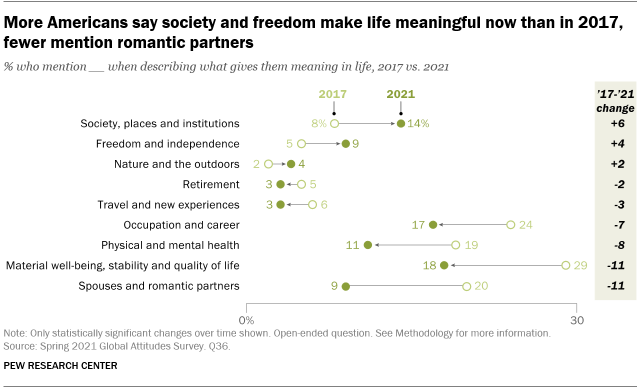
Americans have become more likely to mention society as a source of meaning in life, but much of this emphasis is negative. The share of Americans who mention society, places and institutions – which includes references to one’s local area, as well as to broader notions of the U.S., the government and social services – grew from 8% in 2017 to 14% in 2021. The increase was especially pronounced among those ages 65 and older (24% this year, up from 10%) and those without full-time jobs (17%, up from 8%).
As was the case in 2017, about half of adults who mention society (49%) bring up something negative, such as personal frustrations or difficulties. The nature of these complaints ranges widely, from economic concerns, distrust of government and partisan animosity to more general fears about the direction of the country. As one woman put it while reflecting on what she views as growing political extremism in America, “My hope is dimming because I see no light at the end of the tunnel.”
The U.S. stands out as one of only three publics surveyed in 2021 where mentions of society significantly coincide with greater negativity. The other two are Italy and Spain, but in neither of them is the relationship between society and negativity as strong as it is in the U.S.
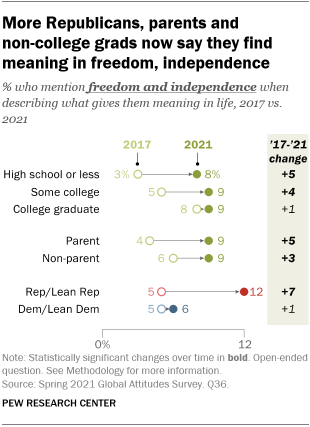
Americans – especially Republicans – have become more likely to mention freedom and independence as a source of meaning in life. Among Americans overall, 9% now mention issues such as freedom, independence and their ability to do what they want to do, including financial independence, having free time or a good work-life balance, or political freedoms like freedom of speech. This is up from 5% in 2017.
Much of this increase has occurred among Republicans and independents who lean toward the Republican Party. This year, 12% of Republicans mention freedom or independence, up from 5% in 2017. There has been no significant change among Democrats and Democratic-leaning independents during this period (6% this year vs. 5% in 2017).
While Republicans in the U.S. are much more likely than Democrats to mention freedom or independence as a source of meaning in life, similar ideological divides are not evident elsewhere in the world. Mentions of freedom are not associated with right-leaning ideological views in any of the other 16 publics surveyed in 2021; in fact, in two other publics (Italy and Spain), such mentions are more common among those on the ideological left.
Mentions of freedom in the U.S. have become more common among other demographic groups, too. For example, while just 4% of parents mentioned the topic in 2017, 9% do so in 2021, matching the share of non-parents who currently mention freedom or independence as a source of meaning in life. Similarly, Americans without a college degree have become more likely to refer to the subject, now mentioning it at roughly the same rate as those with a college degree (9%).
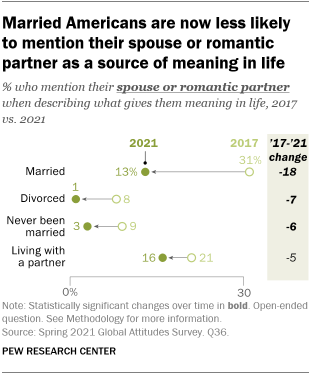
Compared with 2017, fewer Americans now mention spouses or romantic partners as a source of meaning in life. Around one-in-ten U.S. adults (9%) now mention their spouse or romantic partner or their romantic or dating life, down from 20% in 2017. This represents one of the largest decreases across all of the sources of meaning coded as part of this project. While both married and unmarried people are now less likely to mention partners or romance, the decline has been greatest among married adults. Just 13% of married adults mention their spouse in 2021, down from nearly a third (31%) in 2017.
Despite the decline, Americans are among the most likely to mention their spouse or partner among all 17 places surveyed. Outside of the U.S., mentions of romantic partners are most common in the Netherlands (8%) and Italy (7%). But no more than 5% of adults in most other places mention their spouse or partner.
Fewer Americans now mention finances, jobs or travel as a source of meaning in life than in 2017. The share of U.S. adults who bring up their material well-being – including references to feeling safe, secure, able to cover the basics, living comfortably or being well-off – has dropped from 29% to 18% over the past four years. This decline has been concentrated among two groups in particular: married adults and White Americans. In 2017, both groups were among the most likely to point to material well-being as a source of meaning.
The share of adults who mention their job, occupation or career as a source of meaning has declined from 24% to 17% since 2017, perhaps reflecting the fact that many Americans’ working lives have been upended during the coronavirus pandemic. While Americans with higher incomes and those with a college degree remain the most likely to bring up their jobs, both groups have become less likely to do so, with a decline from 37% to 27% among those in the upper-income tier and a decline from 39% to 26% among the college-educated.
The widespread travel restrictions in response to the pandemic may have also affected the share of Americans who derive meaning from travel, which declined from 6% in 2017 to 3% in 2021. But the topic of travel remains more common among college graduates and those with a total family income of $100,000 or more per year.
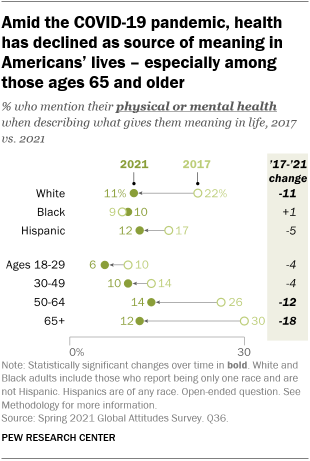
Older Americans have grown less likely to mention their physical or mental health as a source of meaning in life. The overall share of Americans who mention their physical or mental health or wellness fell from 19% in 2017 to 11% in 2021. And this shift has been especially pronounced among older Americans. This year, only 12% of those ages 65 and older mention their health as a source of meaning, down from 30% in 2017.
The emphasis on health has also fallen significantly among White Americans, who now mention the topic at a similar rate as Black and Hispanic Americans. In 2017, by contrast, White adults were more likely than Black and Hispanic adults to mention their health.
Most Americans are no more likely to mention difficulties or challenges than they were four years ago, although older adults are an exception. Between 2017 and 2021, the share of Americans who mention some sort of negative circumstance or difficulty when describing where they find meaning in life has remained stable – 17% of all adults. But older Americans have become more likely to mention difficulties or challenges when answering this question. Roughly a quarter of those 65 and older (27%) mention a difficulty or challenge in 2021 – more than any other age group and more than the 20% who did so in 2017. This pattern does not appear to be unique to the U.S.: In many of the other publics where the Center asked the same question in 2021, older people are also more likely to mention these kinds of difficulties.
Inhaled hydrogen (“active form of hydrogen” (APV; (H (H 2 O) m )) has powerful antioxidant and anti-apoptotic properties and has been used in a number of experimental and clinical studies in recent years.
Purpose . To study the safety and effectiveness of inhalation (APV; (H (H 2 O) m )) in the rehabilitation program of patients who have had an infection caused by the SARS-CoV-2 virus (Severe Acute Respiratory Syndrome CoronaVirus 2) during the recovery period.
Material and methods. A randomized controlled parallel prospective study included 60 patients who underwent COVID-19 (COronaVIrus Disease 2019), post-covid syndrome (ICD-10: U09.9) during the recovery period, who had clinical manifestations of chronic fatigue syndrome (CFS) who received standard therapy according to the protocol for the management of patients with chronic fatigue syndrome (ICD-10: G93.3): physiotherapy and ancillary drug therapy with drugs containing magnesium, B vitamins and L-carnitine. The study participants were divided into 2 groups: group 1 (main, n = 30) received daily inhalation of APV; (H (H 2 O) m) for 90 minutes for 10 days. (apparatus "SUISONIA" Japan), group 2 (control, n = 30) received standard therapy. Patients of both groups were comparable in gender and average age: in the main group - 53 (22; 70) years old, in the control group - 51 (25; 70) years. All patients on the 1st and 10th days. Observations determined biological markers of systemic inflammation, oxygen transport, lactate metabolism, intrapulmonary shunting, 6-minute exercise test, and vascular endothelial function.
Results. In the main group, a decrease in indicators was revealed: the stiffness index (SI) from 8.8 ± 1.8 to 6.8 ± 1.5 m / s (p <0.0001), the activity of alanine aminotransferase from 24.0 ± 12.7 up to 20.22 ± 10.61 U / L (p <0.001), venous blood lactate level from 2.5 ± 0.8 to 1.5 ± 1.0 mmol / L (p <0.001), capillary blood lactate level from 2.9 ± 0.8 to 2.0 ± 0.8 mmol / l (p <0.0001), the calculated index of the intrapulmonary blood shunt (Qs / Qt, according to the Berggren method, 1942) from 8.98 ± 5 , 7 to 5.34 ± 3.2 (p <0.01), the number of leukocytes from 6.64 ± 1.57 to 5.92 ± 1.32 10x9 U / L and an increase in the following parameters: reflection index (RI) with up to 46.67 ± 13.26 63,32 ± 13,44% (p <0.0001), the minimum blood oxygen saturation (SpO 2) during exercise from 92.25 ± 2.9 to 94.25 ± 1.56% (p <0.05), direct bilirubin from 2.99 ± 1.41 to 3.39 ± 1.34 μmol / L , (p <0.01), partial tension of venous blood oxygen (PcO 2 ) from 26.9 ± 5.0 to 34.8 ± 5.6 mm Hg. (p <0.0001), venous blood oxygen saturation (SvO 2 ) from 020.6 ± 51.8 to 018.1 ± 61.1% (p <0.05), partial capillary blood oxygen tension (PsO 2 ) from 48.7 ± 15.4 to 63.8 ± 21.2 mm Hg (p <0.01), capillary blood saturation (SsO 2 ) from 82.2 ± 4.2 to 86.2 ± 4.8% (p <0.01), the distance covered in 6 minutes with a 429 ± 45 0 to 569 ± 60 m.
Conclusion. Inhalation therapy with AFV; (H (H 2 O) m ) in the rehabilitation program of patients who underwent COVID-19, during the recovery period, turned out to be a safe and highly effective treatment method. Positive dynamics was noted in the form of a decrease in the manifestations of latent hypoxemia, an increase in exercise tolerance, and a decrease in endothelial dysfunction. From laboratory tests, there is a decrease in the number of leukocytes, normalization of lactate metabolism, and a decrease in the fraction of intrapulmonary blood shunting from right to left.