Search This Blog

Friday, April 8, 2022

Combining two molecules blocks 95% of live viral infection in lung cells

 COVID-19, in its multiple variants and its ability to thwart efforts to wipe it out, still has a lot of unknowns that make it impossible for scientists to declare victory over the disease, despite vaccines.

But now two Université de Montréal professors working at the Montreal Institute for Clinical Research (IRCM) have taken a big step towards understanding the coronavirus: they've identified and confirmed the power of two  to block the infection of lung cells by SARS-CoV-2, the virus that causes COVID-19.

The finding by the teams of medical professor Nabil G. Seidah, the IRCM's director of biochemical neuroendocrinology research, and microbiology professor Éric A. Cohen, the IRCM's director of human retrovirology research, was published Monday in the Journal of Virology.

How it works and why

Viral entry into lung  requires cleavage (↓) of the viral surface spike-glycoprotein of SARS-CoV-2 at two sites, S1/S2 (PRRAR↓) and S2' (KPSKR↓) to expose a fusiogenic sequence allowing host membrane fusion with the infectious virus.

Seidah's team was already the first to predict that the 4-residue insertion (PRRA) in the spike sequence would result in a typical proprotein convertase furin-like cleavage at the S1/S2 sequence of PRRAR↓.

The new study validates this concept and shows unequivocally that furin cleaves at both sites, enhancing viral infection, the scientists say. They also show that another enzyme, TMPRSS2, cleaves the membrane-bound receptor ACE2 and releases it into the medium, promoting cellular entry of SARS-CoV-2.

The result: combining of potent small molecule inhibitors of furin (BOS compounds) and TMPRSS2 (Camostat) blocks the live viral infection of lung cells by more than 95 percent.

Another weapon to fight COVID-19

SARS-CoV-2, the etiological agent of COVID-19, has caused more than 6 million deaths worldwide, and that number is still rising. Seidah and Cohen say their powerful new antiviral approach will help reduce the spread of SARS-CoV-2.

That's especially important, they add, as other coronaviruses are widely expected to develop in the near future. Having new treatments in the antiviral arsenal, they say, will help society better prepare for future pandemics.


Explore further

Infection researchers identify starting points for SARS-CoV-2 vaccine and therapy development

More information: Rachid Essalmani et al, Distinctive Roles of Furin and TMPRSS2 in SARS-CoV-2 Infectivity, Journal of Virology (2022). DOI: 10.1128/jvi.00128-22
https://medicalxpress.com/news/2022-04-combining-molecules-blocks-viral-infection.html

Up to 65% of Africans have had COVID, far more than thought

 The World Health Organization said that up to 65% of people in Africa have been infected with the coronavirus and estimates the number of actual cases may have been nearly 100 times more than those reported.

In a new analysis released Thursday, the U.N. health agency reviewed 151 studies of COVID-19 in Africa based on  taken from people on the continent between January 2020 and December 2021. WHO said that by last September, about 65% of people tested had some exposure to COVID-19, translating into about 800 million infections. In contrast, only about 8 million cases had been officially reported to WHO during that time period.

"This undercounting is occurring worldwide and it's no surprise that the numbers are particularly large in Africa where there are so many cases with no symptoms," WHO's Africa director Matshidiso Moeti said in a statement. WHO's analysis found that a large proportion of people with COVID-19—67%—showed no symptoms when infected with the disease, a higher percentage than other world regions.

Despite repeated warnings from WHO director-general Tedros Adhanom Ghebreysus that the coronavirus would devastate Africa, the continent has been among the least affected by the pandemic. In its new analysis, WHO said the milder COVID-19 cases seen in Africa were attributable in part to the continent's much smaller proportion of people with underlying  like , diabetes and .

Up to 65% of Africans have had COVID, far more than thought
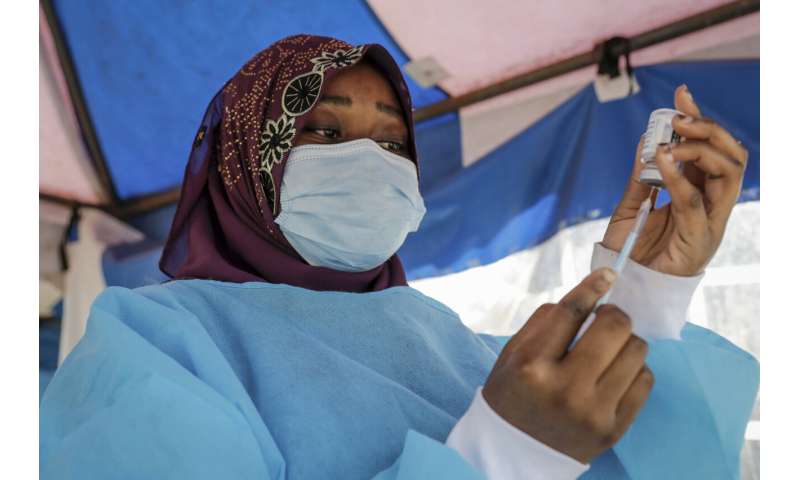
A nurse prepares to administer an AstraZeneca vaccination against COVID-19, at a district health center giving first, second, and booster doses to eligible people, in the low-income Kibera neighborhood of Nairobi, Kenya, Jan. 20, 2022. In a new analysis released Thursday, April 7, 2022, the U.N. health agency reviewed 151 studies of COVID-19 in Africa based on blood samples taken from people on the continent between January 2020 and December 2021. WHO said that by last September, about 65% of people tested had some exposure to COVID-19, translating into about 800 million infections. In contrast, by that time, only about 8 million cases had been officially reported to WHO. Credit: AP Photo/Brian Inganga, File

"Africa's youthful population is also a protective factor," the U.N. health agency said. Some studies have also suggested that previous infection with diseases including malaria, may offer people some protection against the coronavirus, although those hypotheses have yet to be confirmed.

Up to 65% of Africans have had COVID, far more than thought
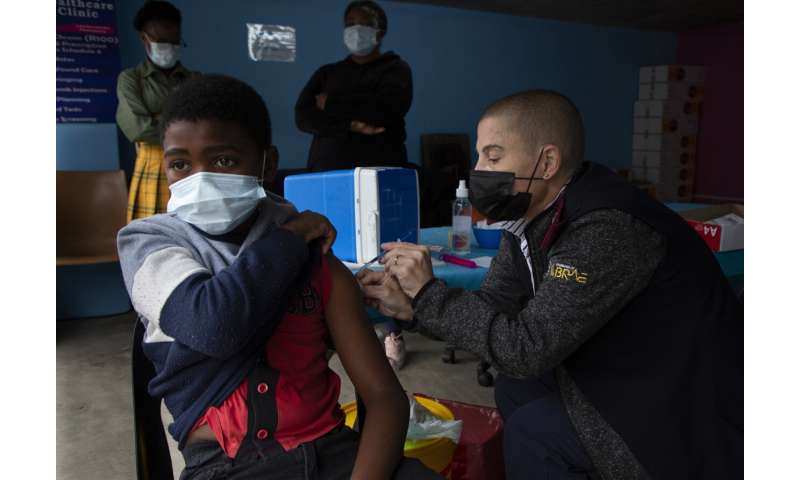
A boy receives a vaccination against COVID-19 at a site near Johannesburg, Dec. 8, 2021. In a new analysis released Thursday, April 7, 2022, the U.N. health agency reviewed 151 studies of COVID-19 in Africa based on blood samples taken from people on the continent between January 2020 and December 2021. WHO said that by last September, about 65% of people tested had some exposure to COVID-19, translating into about 800 million infections. In contrast, by that time, only about 8 million cases had been officially reported to WHO. Credit: AP Photo/Denis Farrell, File

To date, Africa has reported 11.5 million COVID-19 cases including more than 250,000 deaths. WHO said the virus has been trending downwards since January, although there have been some variations in some countries and some, including South Africa, have been hit particularly hard during successive waves of disease. Last week, WHO said the number of COVID deaths fell by about 30% on the continent.

Up to 65% of Africans have had COVID, far more than thought
Dr. Matshidiso Moeti, the first woman to lead the the World Health Organization's regional Africa office, sits in her office in Brazzaville, Congo, Tuesday Feb. 8, 2022. In a new analysis released Thursday, April 7, 2022, the U.N. health agency reviewed 151 studies of COVID-19 in Africa based on blood samples taken from people on the continent between January 2020 and December 2021. WHO said that by last September, about 65% of people tested had some exposure to COVID-19, translating into about 800 million infections. In contrast, by that time, only about 8 million cases had been officially reported to WHO. Credit: AP Photo/Moses Sawasawa, File

"Despite Africa's declining infections and high exposure to the virus, we cannot declare victory yet against COVID-19," said WHO Africa chief Moeti.

"The risks of more lethal variants emerging which overwhelm immunity gained from past infections cannot be brushed aside," she said, calling for increased vaccination rates across the continent. To date, only about 15% of people in Africa have been immunized against COVID-19.

https://medicalxpress.com/news/2022-04-africans-covid-thought.html

Newly developed COVID vaccine could protect against omicron and other variants

 The preclinical data for a vaccine developed at MedUni Vienna to protect against SARS-CoV-2 indicates that it is effective against all SARS-CoV-2 variants known to date, including omicron—even in those who have not yet built up any immunity as a result of vaccination (non-responders). The data from the study were recently published in the journal Allergy.

The antigen-based vaccine developed at MedUni Vienna, under the leadership of Rudolf Valenta from the Center for Pathophysiology, Infectiology and Immunology, targets the receptor binding domains (RBD) of the SARS-CoV-2 virus and induced a robust and uniform RBD-specific IgG antibody response in animal models and in human tests. This antibody response prevents the virus from docking onto and entering the body's cells, so that infection cannot occur.

Combination of coronavirus vaccine and hepatitis B vaccine

The SARS-CoV-2 subunit vaccine (PreS-RBD) developed at MedUni Vienna is based on a structurally folded fusion protein consisting of two receptor binding domains (RBD) of the SARS-CoV-2 virus and the PreS antigen from hepatitis B, which serve as immunological carriers for each other, thereby strengthening the . Currently available genetic SARS-CoV-2 vaccines induce mainly transient IgG1 antibody responses, whereas the PreS-RBD vaccine can additionally induce long-lived RBD-specific IgG4 antibodies.

PreS-RBD-specific IgG antibodies detected in blood and mucosal secretions reacted with SARS-CoV-2 variants, including the omicron variant. Antibodies induced by vaccination with PreS-RBD more potently inhibited the binding of RBD with its human receptor ACE2, and their virus-neutralizing titers were higher than those in a random sample of individuals fully immunized with two vaccinations of currently registered vaccines or than those of COVID-19 convalescents (i.e., individuals who had previously had COVID-19).

Immunity even for previous 'non-responders'

"The PreS-RBD vaccine has the potential to induce sterilizing immunity to old and new SARS-CoV-2 variants by preventing infection by stopping  and transmission through the inhibition of cellular virus entry," explains study leader Rudolf Valenta. Moreover, it is expected that the vaccine will even be effective in people who have not previously responded to vaccination ("RBD non-responders"), as they will receive additional T-cell support from the PreS portion of the vaccine. An earlier study by Valenta and colleagues had found that approximately 20% of those recovered from COVID-19 failed to form RBD-specific antibodies and were thus at constant risk of re-infection.

Results based on decades of experience from allergy research at MedUni Vienna

The development of this Austrian COVID vaccine was to a large extent inspired by decades of experience in allergy vaccine design. Previous work on allergy vaccines and  also conducted with PreS-based allergy vaccines have demonstrated the safety of PreS-based vaccines, even when used repeatedly.

"Our data give us grounds to hope that this readily producible protein-based vaccine antigen will be effective against all SARS-CoV-2 variants known to date, including omicron," says study leader Rudolf Valenta. "The  is designed to enable repeated injections to build up sustained sterilizing immunity, is suitable for use in all age and risk groups and appears to be superior to currently available vaccines when it comes to inducing neutralizing antibodies." If sufficient funding is forthcoming, the first clinical trials required for approval could be carried out this year.


Explore further

Efficacy of COVID-19 vaccines against omicron studied

More information: Pia Gattinger et al, Vaccine based on folded RBD‐PreS fusion protein with potential to induce sterilizing immunity to SARS‐CoV‐2 variants, Allergy (2022). DOI: 10.1111/all.15305
https://medicalxpress.com/news/2022-04-newly-covid-vaccine-omicron-variants.html

Calif. Sent Pandemic Food Stamps to Affluent Families

 News of the strange COVID payments started circulating quietly among neighbors and friends last year in several affluent beachside communities of North County San Diego.

Food stamp cards carrying as much as $1,700 were arriving in the mailboxes of all students, even those living in multi-million-dollar homes at two local public high schools serving neighborhoods with some of the highest household incomes in the state. The cards were addressed to the students themselves, and some families with more than one child attending the same school received double the amount or more, at least $3,400 worth of cards.

As more people discovered the government-issued largesse, local community online chatrooms were sprinkled with questions on whether the cards were illegal and should be sent back, along with complaints of teens buying sushi and other expensive fare from Whole Foods and other pricey organic markets or using the unexpected funds to throw cookouts and graduation parties. The debit cards can only be used for groceries at supermarkets or Amazon, not in sit-down restaurants or fast-food chains.

Many parents of students receiving the cards, who requested anonymity to speak to RealClearPolitics, weren’t sure what to make of the checks, mainly because their families had never received food assistance from the state and federal government before. And even if they had, the sudden cash windfalls without any warning spurred a myriad of questions: Were they sent by mistake? Would using them trigger tax implications or put their children in a database designating them as recipients of government assistance? The answers from California’s  Department of Social Services, which sent the checks, were “No,” “no,” and “no.”

There wasn’t an easy answer for the broader, more penetrating query: Why did their students receive them from the state when more needy families attending different high schools in the same school district did not? Many of these families didn’t even qualify for the $1,400 in federal stimulus checks sent during the first year of the pandemic to households with incomes of $150,000 or less a year and single adults earning $75,000 or less. The terse information accompanying the P-EBT cards didn’t provide much clarity.

The California Department of Social Services explained that the households were receiving Pandemic-Electronic Benefits Transfer, or P-EBT, cards as part of a federal program intended to compensate families who had children eligible to receive free or reduced-price school meals but not receiving them during COVID-related school closures in the 2020-2021 school year.

Some of the parents of California students who received the P-EBT cards don’t remember the schools providing free breakfast and lunch to all students before COVID. However, there were schools in the same district that offered drive-up free meals for any students who wanted them during pandemic school lockdowns. That led to even greater confusion over why the federal government was trying to compensate families who either utilized that free-meal service or chose not to.

An eligibility survey on a state website to answer the public’s questions isn’t all that helpful either. It includes questions about the child’s age, whether the majority of the students at the school attended in 2020-21 were enrolled in distance learning, and whether the child “was approved” to receive free or reduced-price school meals. If the answer was no to the last question, the survey responds that “at this time, it appears you may not be eligible for P-EBT 2.0 benefits.”

But many of the parents the online survey denied already had the cards with pre-loaded cash in their hands. They have since inundated the California Department of Social Services with their calls and questions. And even after receiving responses – that they were sent the funds in compliance with state and federal law – they remain bewildered by the payments.

In California, the broad eligibility rule for students receiving free meals is that a family of four must have an annual household income of $34,060 or less, and $48,470 or less for reduced-price school meals. In the communities in question – Fairbanks Ranch, Del Mar, Rancho Santa Fe, South Carlsbad, and Encinitas – the median household income ranges from $138,078 to $200,000, among the highest in the state, according to the most recent census data.

Is This Happening Nationwide?

The scenario most likely isn’t limited to some of Southern California’s wealthiest enclaves. A California DSS spokesperson tells RCP that 854 schools in the state fit into the same federal school lunch category as the two schools in North County San Diego where all students received the cards – Torrey Pines High School and La Costa Canyon High School. (Torrey Pines was ranked one of the best high schools in the nation by Newsweek magazine in 2015 and has 2,479 students, and La Costa Canyon High School, another top-rated secondary institution, has 1,600 students.)

Hundreds of other California schools whose entire student body received the cards because they occupy a similar “universal” federal school lunch category as Torrey Pines and La Costa Canyon, with all students able to receive free lunch and/or breakfast.

If all students at these schools received the cards regardless of income, as appears to be the case, it would amount to more than $1 billion in federal P-EBT going to California students who usually wouldn’t qualify for federal reimbursement for free breakfasts and lunches.

The same issue is likely occurring in other states with schools that participate in “universal” lunch programs offering free meals regardless of income. A local Atlanta news outlet reported earlier this month that certain schools across the state provided the same type of universal lunch programs as California, and noted that “thousands of students” were receiving the cards.

Other states are intentionally winding down the P-EBT payment program and are no longer sending out the cards to any students in their states. Alabama did not reapply for the latest round of benefits to cover this school year and intended for families who miss school because of COVID infection, citing the difficulty of tracking students who are out sick.

Since very early in the pandemic, Congress has tried to provide funds to compensate needy families for missed school breakfasts and lunches because of school lockdowns, initially as part of the Families First Coronavirus Response Act and later by the American Rescue Plan Act of 2021.

Child health advocates say the federal program helped keep millions of children fed during the pandemic. Democrats, led by Michigan Sen. Debbie Stabenow, tout the P-EBT program for providing essential benefits to more than 8 million families during the school closures in 2021, “lifting at least 2.7 to 3.9 million children out of hunger during that time.”

California alone has doled out $6 billion in 5 million P-EBT cards, with 4 million of the cards going to K-12 children in public and private schools, a California Department of Social Services spokeswoman told RealClearPolitics.

The USDA also is rightly credited with scrambling at the beginning of the pandemic to set up an elaborate nationwide network of schools providing bag lunches and other grab-and-go options for parents to pick up and take home for their kids. They even used buses to bring meals to pick-up spots in different neighborhoods.

Misuse of Taxpayer Dollars?

As COVID upended all Americans’ lives over the past two years, Congress passed nearly $6 trillion in emergency aid designed to fight the virus, assist families suffering from job losses, and help stabilize the economy. The funds were largely provided with no strings attached – meaning states and localities didn’t have to account for how the money was spent.

But with COVID cases plunging across the U.S. and masks and many other related mandates being lifted, Republicans recently rejected a White House request for $22.5 billion in additional COVID relief money. Republicans have agreed to provide $10 billion more amid a growing debate about the need for greater accountability for the funds. In his State of the Union address, President Biden announced the creation of a new Justice Department task force to ferret out pandemic fraud and has since named a chief prosecutor to lead the effort.

On March 2, Sen. Mitt Romney of Utah led his Republican colleagues in a letter to Biden, requesting an accounting of how the federal government has allocated trillions in taxpayer funds to combat the pandemic. The letter labeled the spending on COVID “the single biggest expenditure of public funds on one effort in the history of the nation.” Since passage of the American Rescue Plan last February, “questions are mounting about where exactly the additional money has gone,” the senators wrote.

It cited a Washington Post investigative piece  with the headline “‘Immense Fraud’ creates immense task for Washington as it tries to tighten scrutiny of $6 trillion in emergency spending.” In one example, according to the report, federal records show more than $81 billion set aside for school districts in response to the pandemic. Yet, there’s no information about what those communities did with the funds once they obtained the grants.

A separate Associated Press investigation in late March found that Broward County, Fla., spent $140 million building a high-end hotel, just one of scores of projects that state and local governments across the country are funding with the coronavirus relief money even though they have little or nothing to do with combating the pandemic.

In contrast, California’s P-EBT program is directly pandemic related, with a goal of keeping children in low-income households fed during school lockdowns and sky-high unemployment rates. Despite a bipartisan group of congressional leaders behind the effort, the distribution of the debit cards in California has been riddled with problems. The state auditor’s office found that the program’s administration failed to serve the intended recipients appropriately.

The P-EBT cards were delivered promptly only in the earlier months of the pandemic, while “families had to wait an average of more than 200 days to receive payments that replaced missed meals from school year 2020-21,” California’s state auditor, Elaine Howle, wrote in her report. Howle said unclear federal guidance, the timing of the national legislation, and technology constraints caused the delays.

The report also found that about 500,000 of the 3.4 million P-EBT cards had not been used as of September 2021, adding up to $182 million in untapped food benefits. Of those, 174,000 cards never made it to the families. The audit recommended that DSS notify schools about families’ under-utilized payments so they can follow up and let them know they’re available.

The auditor’s report says nothing about the opposite problem – that thousands, likely far more, were sent to students in affluent areas regardless of family income.

Tom Schatz, president of Citizens Against Government Waste, said the misdirected funds are sadly not all that surprising and very similar to what happened with the COVID stimulus payments.

“The $1,400 went to people based on their 2019 or 2020 tax returns but had nothing to do with whether they were currently employed making more money than the limits,” he said in an interview, arguing that the stimulus checks over-stimulated the economy, fueling inflation. “By the time the American Rescue Plan came around last year, [states] should have done a better job of only providing the money to people who really need help.”

It’s an example of a larger longtime problem Schatz described in which Congress gives states “greater flexibility” in doling out federal money, especially during national emergencies, so states don’t have to spend time and resources targeting the funds to those who really need it.

“A lot of this gets distributed regardless of income, even when there are income limits or it starts out having an income limit,” he said.

Congressional Intent

Sen. John Boozman, the ranking Republican on the Senate Agriculture Committee, which oversees the school lunch programs, said reports that state governments have sent federal pandemic food stamps to upper-income families raise serious red flags.

“USDA has not chosen to share this information with us, but if true, it raises a number of concerns,” Boozman told RCP in a statement. “Congress never intended for the Pandemic EBT program to be used in the manner described. It is supposed to be administered in a targeted and means-tested way to ensure it reaches those who need the assistance. Misuse of taxpayer funds in this manner is wrong and what fuels erosion of trust in these programs.”

A spokesperson for Sen. Stabenow, who chairs the Agriculture Committee, did not respond to multiple inquiries. Stabenow has pushed for billions of dollars in additional food assistance funds in COVID relief bills over the last two years, including the P-EBT program.

In a December press release, Stabenow touted her efforts to expand access to food benefits for children through a provision that would allow “all children under 6 to be deemed ‘enrolled’ in child care so that they will be eligible for [the] P-EBT benefit.”

Just last week, Stabenow, along with several of her Democratic colleagues and GOP moderate Sens. Susan Collins and Lisa Murkowski, introduced a bill that would allow the USDA to exercise even greater flexibility to continue serving meals to families through the next two summers, continuing the authority the agency had during the pandemic.

When reached by RCP, neither the USDA nor California’s DSS expressed concern about affluent families receiving $1,700 for each student who missed out on free lunches while on school lockdowns.

USDA: Federal Law Allows Payments to Affluent Households

In fact, a USDA spokesperson said that such payments are allowed under federal law. The students in question, the spokesperson said, received P-EBT benefits based on their enrollment at a school offering “universal free meals,” called “Provision 2” schools.

“P-EBT benefits are then paid to any child, provided they also missed out on free/reduced-price meal at school due to a COVID-related absence or virtual learning caused by COVID,” the spokesperson told RCP in an emailed response. “This is consistent with USDA statutory guidance that seeks to replace the social, learning, and health benefits of meals taken at school. P-EBT is only available when students experience school closures due to COVID-19.”

In California, eligible students received $123 a month for every month they were fully distanced from school and $68 a month if their school operated a hybrid learning environment with some in-school classes and some entirely virtual.

“[Additional] Benefits for summer P-EBT were authorized under the American Rescue Plan Act to further assist families disproportionately impacted by the pandemic,” California DSS spokesperson Theresa Mier told RCP.

Yet, the explanation is not that simple. To reduce school paperwork, Provision 2 schools only have to document income levels of their students once every four years and can apply for a four-year extension “when certain conditions are met,” a USDA website explains.

The schools can provide free lunch to all students and receive federal reimbursements for the meals based on their percentage of low-income students. It’s unclear whether the federal government provides the funding to provide the meals to all students and settles up with the schools when they submit the income level of their students. These figures likely shift from year to year as the student body changes.

Mier said there are 853 Provision 2 schools in California whose total student body received the cards.

There’s also another federal school designation similar to Provision 2, in which all students can partake of free meals regardless of income eligibility. These are “Community Eligible Schools,” which pay for the cost of providing the meals and are then reimbursed by the federal government based on the percentage of students participating in other “specific means-tested programs, such as Supplemental Nutrition Program (SNAP) and Temporary Assistance for Needy Families (TANF),” according to the USDA.

California’s government started mailing cards out in June 2021 for children under age 6 with that mailing completed in 2021. School-age children, kindergarten through 12th grade, started receiving their cards in August 2021 with the mailing completed in November, Mier said.

With record inflation continuing to push food costs higher, the extra cash will undoubtedly help families struggling to put food on the table. Unfortunately, because of a twisted set of federal and state rules, hundreds of millions, if not billions of dollars in the mix, also are helping subsidize the lifestyles of wealthier children – an unexpected boon for these families and grocery stores they frequent.

“I don’t think Whole Foods or Amazon need government subsidies, but here we are,” one local parent remarked.

For Schatz, it’s a prime example of an endemic problem with bloated government spending.

“It’s something that should be stopped or prevented from happening in the future for this program and others created during the pandemic, but it’s always difficult to turn things off once they’re turned on,” Schatz said. “It’s easily understood that people in these areas shouldn’t be getting $1,700 for each of their children, for 'free lunch' that they obviously can afford.”

https://www.realclearpolitics.com/articles/2022/04/07/calif_sent_pandemic_food_stamps_to_affluent_families_147437.html

Shanghai reports 22,609 new asymptomatic coronavirus cases, 1,015 symptomatic cases for April 8

 The major Chinese financial centre of Shanghai reported 22,609 new asymptomatic coronavirus cases and 1,015 new symptomatic cases on April 8, the local government said on Saturday.

The number of asymptomatic cases was up from 20,398 a day earlier. The number of symptomatic cases also rose from 824.

Shanghai is currently under a city-wide lockdown as authorities work to contain the city's biggest ever COVID-19 outbreak. 

https://finance.yahoo.com/news/shanghai-reports-22-609-asymptomatic-000219008.html

Nationwide spike in ‘mass overdose events’ driven by unintentional fentanyl use: DEA


  • According to the DEA, there have been at least seven confirmed mass overdose events in the U.S. in just two months. 

  • There have been 58 overdoses and 29 deaths. 

  • In these instances, people unknowingly ingested fentanyl believing it was some other drug. 

The Drug Enforcement Agency (DEA) is sounding the alarm over a troubling trend in which people are overdosing after unknowingly ingesting the highly potent synthetic opioid fentanyl.  

In a letter to federal, state and local law enforcement this week, the DEA said there’s been a nationwide spike in fentanyl-related mass-overdose events involving three or more overdoses occurring at the same time and location.  

According to the agency, there have been at least seven confirmed mass overdose events in the U.S. in just two months, resulting in 58 overdoses and 29 overdose deaths.  

Drug traffickers often mix illicit fentanyl — which can be 50 times more powerful than heroin and 100 times stronger than morphine — with other powder drugs such as cocaine and methamphetamine because it’s cheap to manufacture and a small amount can be incredibly powerful.  

Dealers also sell fake prescription pills containing fentanyl designed to look like legitimate prescription opioids such as OxyContin, Percocet or Vicodin.  

The DEA said this trend resulted in mass-overdose events as users are unknowingly taking large doses of the drug.  

Three of the seven mass-overdose events occurred in March alone. In one instance, 21 people overdosed at a homeless shelter in Austin, Texas after ingesting crack-cocaine and methamphetamine laced with fentanyl. Three of those people died.  

In Cortez, Colo., three people died in a hotel room after ingesting what they thought were oxycodone pills but were counterfeit prescription pills containing fentanyl.  

“Fentanyl is killing Americans at an unprecedented rate,” DEA Administrator Anne Milgram said in a statement.  

“Drug traffickers are driving addiction, and increasing their profits, by mixing fentanyl with other illicit drugs. Tragically, many overdose victims have no idea they are ingesting deadly fentanyl, until it’s too late.”  

Fentanyl has fueled an unprecedented spike in deadly drug overdoses nationwide. More than 105,000 Americans died from overdoses in the 12-month period ending in October with more than 66 percent of those fatalities involving fentanyl or other dangerous synthetic opioids, according to the Centers for Disease Control and Prevention (CDC).  

A recent study funded by the National Institute on Drug Abuse analyzed national data on law enforcement seizures of fentanyl between 2018 and 2021 and found steep increases in the number of counterfeit pill seizures.  

The analysis found the proportion of counterfeit pills to total seizures more than doubled over that time, with pills representing more than 29 percent of illicit fentanyl seizures by the end of 2021.  


Everybody Wants a Piece of Moderna. Next Up: University of Toronto

 Moderna is on a roll. On Thursday, the company announced it was partnering with the nonprofit scientific research organization IAVI. Earlier in the week, the University of Toronto reported it was partnering with the mRNA specialist.

U of T and Moderna have a partnership framework agreement that allows the two organizations to collaborate across a broad variety of areas, ranging from molecular genetics to biomedical engineering, biochemistry and more. This is the first research partnership Moderna has struck with a Canadian university.

“Today we are delighted to announce that Moderna is partnering with U of T, and is keen to do so because Moderna recognizes that there is nowhere else in the world where you can find expertise at scale like you can at U of T,” said Leah Cowen, U of T’s vice president, research and innovation and strategic initiatives. “It is not every day that an opportunity presents to combine a world-class life sciences research community and a disruptive biological innovator. We are proud to say that today is one such day.”

Moderna’s country general manager in Canada, Patricia Gauthier, indicated the company is looking forward to leveraging U of T’s interdisciplinary expertise to advance shared interests in medical research.

“At Moderna, we have several different modalities that we’re working towards,” Gauthier said. “We’ve proven our approach works with infectious diseases, so there’s a really big focus on that - but I think we can also go way beyond.”

The partnership with IAVI is to develop therapeutics and vaccines against global health threats, such as HIV/AIDS, TB, COVID-19 and antimicrobial-resistant enteric infections. The Moderna-IAVI partnership really started in January when a clinical trial launched at George Washington University (GWU) School of Medicine and Health Sciences to evaluate sequential dosing of priming and boosting HIV immunogens delivered by way of mRNA to determine if it can stimulate B-cell responses and hopefully them into broadly neutralizing antibodies. That trial is funded by the Bill & Melinda Gates Foundation.

Moderna is no stranger to strategic collaborations. It lists partnerships with AstraZeneca, Merck, Vertex, the Biomedical Advanced Research and Development Authority (BARDA), the Defense Advanced Research Projects Agency (DARPA), the Gates Foundation as mentioned earlier, the Karolinska Institute and Karolinska University Hospital and Institut Pasteur.

On April 4, Moderna launched the Moderna Charitable Foundation “to promote public health, access to quality healthcare and educational opportunities, particularly in underserved populations.”

The foundation was established by the company’s board of directors, which granted an initial upfront endowment of $50 million. The Foundation and the grant program will look at charitable programs with a particular focus on local and global communities impacted by the pandemic, supporting scientific education and innovation, public health and access to healthcare and pushing for inclusion and diversity.

Starting out, the Foundation announced about $5 million in initial grants to five local and global nonprofits. They included:

• Boston Medical Center’s Good Grief Program. This program focuses on therapeutic services for children who have experienced a loss.

• Heading Home. Based in Cambridge, Mass., this organization provides permanent, supportive housing for extremely low-income people.

 International Rescue Committee. Supports infection prevention and control programs in West and Central Africa, especially in conflict zones.

• Life Sciences Cares. Supports nonprofit partnerships and programs that fight poverty in the Greater Boston Area.

• Year Up. A workforce development program that “closes the opportunity divide between young adults and companies across the U.S.”

Stéphane Bancel, chief executive officer of Moderna, stated, “The Moderna Foundation is an extension of the positive societal impact we have made following the development of our COVID-19 vaccine and reflects our continued commitment to communities impacted by COVID-19. We are excited to extend our social impact and support the causes our employees care most about as we work relentlessly to improve human health with our mRNA technology.”

https://www.biospace.com/article/everybody-wants-a-piece-of-moderna-next-up-university-of-toronto/