In a major blow to the tobacco industry, the US government is looking to cut nicotine in all cigarettes sold to minimally or nonaddictive levels, the Wall Street Journal has reported citing officials familiar with the move.
However, the move, which is expected to be announced next week, won’t likely take effect for several years, as there are a number of hurdles that need to be passed, the newspaper reported.
The Food and Drug Administration first must need to outline the proposed rule and then invite public comments before publishing a final order.
Moreover, the Tobacco companies would most likely take legal recourse, further delaying the policy’s implementation.
The US government had been looking to push ahead with the policy as part of President Biden's Cancer Moonshot initiative which hopes to reduce deaths from cancer by at least 50 per cent over the next 25 years.
The move is being hailed as the biggest step taken by the government to curb smoking since 1998 when tobacco companies paid more than $200 billion to help states pay for healthcare.
Nicotine is an addictive chemical found in cigarettes and other tobacco products. While nicotine hooks people on cigarettes, nicotine itself doesn’t cause cancer, heart disease or lung disease, according to the FDA. It is other harmful compounds in cigarette smoke that are associated with more than 480,000 deaths in the US each year, according to the Centers for Disease Control and Prevention.
Lowering nicotine levels in cigarettes has been a hotly debated topic at the FDA since the 1990s.
There are various ways to reduce nicotine levels in cigarettes. Manufacturers can adjust the blend of tobacco leaves or use different types of paper or filters.
Nicotine can also be cut down from the leaf during the manufacturing process. One company uses genetic engineering to grow tobacco with 95 per cent less nicotine than a typical tobacco plant, the newspaper reports.
Potential once-daily male oral contraceptives have passed a first clinical hurdle, showing a degree oftestosteronesuppression that should be sufficient for acontraceptiveeffect without causing symptomatichypogonadism, according to phase 1 study results to be presented at ENDO 2022.
There are two pills in development and the studies so far suggest that both or a combination might be able to provide an acceptable balance of efficacy and tolerability, according to Tamar Jacobsohn, BS, a researcher in the Contraceptive Development Program, Eunice Kennedy Shriver National Institute of Child Health and Human Development, Bethesda, Maryland.
The two drugs evaluated in this study are dimethandrolone undecanoate (DMAU) and 11b-methyl-19-nortestosterone-17b-dodecylcarbonate (11b-MNTDC). Both are bifunctional prodrugs with androgenic and progestogenic effects. The prodrugs are designed to be cleaved after ingestion so that the active hormones are released over 24 hours, permitting once-daily dosing.
"As potent androgens, these steroids suppress gonadotropin secretion, leading to markedly decreased serum testosterone production," explained Jacobsohn in an interview.
However, she noted that there is still a long way to go on this research path. While the phase 1 studies have shown tolerability, the biology involved in suppressing sperm production suggests that men would need to take these pills daily for about 3 months at the very beginning of contraceptive treatment, until adequate sperm suppression is achieved to prevent pregnancy.
"We are working toward a phase 2 trial that will include a contraceptive efficacy endpoint, but there are lots of steps to get there, including more early phase studies," she noted.
"There is a huge unmet need in terms of male contraceptive methods," said Arthi Thirumalai, MBBS, an endocrinologist and assistant professor of medicine at the University of Washington School of Medicine in Seattle.
Dr Arthi Thirumalai
Senior author of a 2020 review article on male contraception, Thirumalai said in an interview that prodrugs and other hormonal methods to lower testosterone and suppress sperm production are attractive because of convenience, efficacy, and reversibility.
"We hope that oral formulations can be used to address this need," said Thirumalai, who has participated in several experimental and clinical studies of male contraception methods. She is, in fact, one of the many coauthors of the data presented by Jacobsohn.
Jacobsohn emphasized: "Development of an effective, reversible male contraceptive method will improve reproductive options for men and women, have a major impact on public health by decreasing unintended pregnancy, and allow men to have an increasingly active role in family planning."
Phase 1 Results With DMAU and MNTDC
The work that led to phase 1 studies suggested that each of the drugs — DMAU and MNTDC — might provide adequate hormone suppression to reduce sperm counts without inducing unacceptable symptoms of hypogonadism. To test this potential, dose-ranging phase 1 studies with an endpoint of testosterone suppression were conducted with each one.
In the two placebo-controlled phase 1a studies, which are be presented in a poster on Monday, healthy male subjects were randomly assigned to two pills of active therapy, four pills of active therapy, or placebo. In the two studies combined, 39 subjects received DMAU, 30 received 11b-MNTDC, and 28 received placebo.
Efficacy was evaluated by measuring testosterone levels. Tolerability was largely based on patient questionnaires.
At the end of 7 days, testosterone levels remained at reference levels (400 to 600 ng/dL) in those who received placebo. The levels fell to <100 ng/dL in all subjects assigned to an active agent regardless of which agent or dose.
From day 7 to 28, there was less median suppression of testosterone on 200 mg than 400 mg daily (92.7 ng/dL vs 49.6 ng/dL; P < .001), but both remained below the target of 100 ng/dL, Jacobsohn reported.
The difference in degree of testosterone suppression did not appear to influence tolerability.
Subjects on four vs two daily pills "did not report a significant difference in general satisfaction or their willingness to use the pills in the future or recommend them to other men," said Jacobson, presenting P values for these outcomes among subjects on active therapy relative to placebo that were not significant, ranging from 0.48 to 0.85.
Overall, there were no serious adverse events. Mild side effects associated with hypogonadism did occur, but "all resolved by the end of the study," she said.
Zero Sperm Production Is Not the Goal. Lowering It Sufficiently Is
Thirumalai said the need for a male contraceptive is strong. While condoms have a substantial failure rate, vasectomy is not reliably reversible even though the majority of men agree that the responsibility for preventing pregnancy should be shared, she said.
Thirumalai's earlier review article found that clinical trials of hormonal suppression to provide male contraception have been conducted for at least 30 years. The challenge has been finding an effective therapy that is well tolerated.
Drugs that combine both androgenic and progestogenic activity might be the answer. By manipulating hormones that lower testosterone, sperm production is reduced without eliminating a man's ability to ejaculate. Zero sperm production is not the goal, according to data in Thirumalai's review article.
Rather, studies suggest that when ejaculate contains less than 1 million sperm per mL (levels typically range from 15 to 200 million sperm/mL), the antipregnancy efficacy is similar to that achieved with female oral contraceptives.
However, clinical trials to demonstrate that this can be achieved safely have yet to be conducted.
Jacobsohn said that sperm half-life is about 3 months. This means that patients would need to be on hormonal therapy for a period of about this duration before reliable contraception is achieved.
In other words, the efficacy endpoint used in this current study [of 28 days duration] does not ensure effective contraception, but Jacobsohn suggested this is nevertheless an important step forward in clinical development.
Jacobsohn and Thirumalai report no relevant financial relationships.
Annual Meeting of the Endocrine Society #ENDO2022: Poster PMON261. To be presented June 13, 2022.
Beijing's most populous district Chaoyang announced three rounds of mass testing to quell a "ferocious" COVID-19 outbreak that emerged at a bar in a nightlife and shopping area last week, shortly after the city relaxed curbs imposed during an outbreak in April.
City health officials said that so far there have been 166 confirmed cases linked to the outbreak that began at the Heaven Supermarket bar in the Sanlitun area on Thursday, 145 of them bar patrons.
Mass testing would take place between Monday and Wednesday in Chaoyang district, where the bar is located, officials told a press briefing.
The overall numbers of cases and deaths from the pandemic remain extremely low in China compared with many countries around the world.
But even as much of the world has relaxed curbs, Chinese authorities maintain their zero-COVID policy, trying to stamp out outbreaks early with measures including heavy restrictions on movement and mass testing.
Xu Hejian, Beijing city government spokesman, told Sunday's briefing that the current outbreak in the capital is "ferocious."
"At present, the risk of a further spread still exists. The most urgent task at the moment is to trace the source of the cluster and also manage and control the risks," he said, adding Beijing must prevent the emergence of "epidemic amplifiers."
Two buildings housing hundreds of residents in one Chaoyang compound were put under strict lockdown on Sunday after a single positive case, a residential committee worker told Reuters.
Large metal barricades were installed around the compound. Staff in hazmat suits carrying disinfectant entered the building and extra security and police were brought in at the exits.
Several businesses nearby including the "Paradise Massage & Spa" were also put under temporary lockdown with police tape and security personnel brought in to block the exits.
A handful of customers and staff at the parlour would be locked in for at least two days whilst checks were carried out, a government worker told Reuters.
Some Beijing residents reported that on Sunday they received multiple texts telling them to report to their neighborhood organizations if they had visited Sanlitun's bars recently.
It is only a week since state media reported that Beijing would further relax COVID curbs by allowing indoor dining.
More testing in Shanghai
In Shanghai, subject to two months of lockdown up until the start of June, authorities announced on Saturday a round of testing for most of its 25 million residents.
Shanghai officials told reporters said they found one symptomatic and four asymptomatic cases as of Sunday afternoon, after finding 10 new local symptomatic cases and 19 local asymptomatic cases a day earlier.
Dine-in services will be allowed to resume in a number of restaurants and eateries in three suburban districts, Shanghai officials said.
China reported 275 new coronavirus cases for June 11, of which 134 were symptomatic and 141 were asymptomatic, the National Health Commission said on Sunday.
There were no new deaths, leaving the total tally in the pandemic at 5,226. As of Saturday, mainland China had confirmed 224,781 cases with symptoms.
Lawmakers are considering using part of the state’s $100-billion budget surplus to buy water rights back from farmers, putting money in their pockets while keeping water in rivers for endangered fish.
Water pumping into an irrigation canal in California.
Photography by Richard Thornton, Shutterstock.
In an ongoing struggle over water supply in California, a state that is grappling with another incoming summer of crippling drought, officials have proposed buying back water rights held by local farmers.
In California, all water is technically the property of the state government. But thanks to a set of regulations, some farmers have “senior water rights” that allow them to take as much water as they need to keep their crops growing in abundance. The new proposal, introduced as part of budget negotiations between Governor Gavin Newsom’s administration and lawmakers, would use $1.5 million in taxpayer dollars to buy some of those rights back from farmers to keep the water in waterways.
According to the US Drought Monitor, 98 percent of California is in a state of severe or worse level of drought, resulting in low river levels and bad news for endangered salmon and other fish species in the region.
Proponents of the idea say that it could help mitigate decades-long arguments that arise every year between environmental groups and farmers. In theory, buying the water rights would allow officials to keep more water in the rivers, which would benefit endangered fish species and the overall health of the ecosystems that rely on the rivers, while still aiding farmers by padding their pockets.
The money would come from the state’s record-high $100-billion budget surplus. But the $1.5-billion plan wouldn’t go as far as it may seem. John McManus, executive director of Golden State Salmon, told CBS Sacramento that the amount of water wouldn’t be enough to negatively impact the agricultural industry, but it could help fish species in dire need of more water.
“This is no threat to irrigated agriculture in California. It’s not going anywhere. The $1.5 billion may sound like a lot of money, but it’s not a lot in the grand scheme of things,” he said. “We’re talking about the possibility of providing a small amount of additional water to keep species currently on life support from going extinct and, hopefully, to rebuild the population.”
With the budget, the government could purchase only 200,000 acre-feet—defined as enough water to cover one acre with one foot of water—of the 35 million acre-feet farmers use annually, according toCapital Press. Each acre-foot of water would cost them an average of $7,500; that is, if farmers are willing to sell—an aspect of the proposal that has sparked controversy.
On one hand, notes Tom Birmingham, general manager of Westlands Water District, it’s not all that uncommon for farmers to sell their water rights back to the district.
he Mark Cuban Cost Plus Drug Co. has added 87 generic drugs to its product list, the company said in a June 2 Facebookpost.
Sildenafil and tadalafil, the generic forms of the popular erectile dysfunction drugs Viagra and Cialis, are among the most recently added medications.
The pharmacy has regularly added low-cost versions of common generic drugs to its product list this year, rapidly growing from offering about 250 medications in late April to more than 700 as of early June.
"We are continuously working to add new drugs as quickly as possible," the pharmacy said in a May 20 tweet.
As the company has continued to grow and get better prices from its suppliers, it also has launched "Price Drop Fridays," in which it shares new lower prices for various medicines each week.
A U.S. military official predicted a pause in the administration of the Moderna and Pfizer COVID-19 vaccines could happen if more cases of post-vaccination heart inflammation were detected, according to newly obtained emails.
Harry Chang, a U.S. Army lieutenant colonel, made the prediction on April 27, 2021—the same day the director of the U.S. Centers for Disease Control and Prevention (CDC) said the agency was not seeing a safety signal when it came to heart inflammation experienced after getting a COVID-19 vaccine.
Chang noted the pause in the administration of the Johnson & Johnson vaccine over blood clots and said an increased number of heart inflammation issues could trigger a similar action.
“A pause of the Pfizer/Moderna administration (much like the J&J blood clot pause) will have an adverse impact on US/CA vaccination rates; assessed as unlikely due to causes of myocarditis can come from multiple sources (eg. COVID, other conditions, other vaccines/prescriptions, etc),” Chang wrote in an email.
Myocarditis is a type of heart inflammation.
“However, increased reported #s & media attention is likely to trigger a safety review pause by ACIP/FDA,” he added, referring to the Advisory Committee on Immunization Practices, which advises the CDC on vaccines, and the U.S. Food and Drug Administration (FDA), which decides whether to clear immunizations.
Chang was talking to Tricia Blocher, an official at the California Department of Public Health, and other California and military officials. He was reacting to a story about the U.S. Department of Defense detecting a higher-than-expected number of cases of heart inflammation in troops following COVID-19 vaccination.”
The email was one of 19 pages of messages obtained by The Epoch Times through a Freedom of Information Act request.
Members of ACIP’s COVID-19 Vaccine Safety Technical Work Group (VaST) were sent the Pentagon story, as were some CDC officials, the emails show.
Among them was Dr. Tom Shimabukuro, a leader of the Vaccine Safety Team, part of the CDC’s COVID-19 Vaccine Task Force.
Shimabukuro almost immediately asked colleagues for data from the Vaccine Safety Datalink, a tracking system co-run by the CDC and nine health care organizations to monitor vaccine safety. Eric Weintraub, the project leader for the datalink, found that 24 cases of myocarditis had been automatically detected in the tracking system.
The email chain ended there, with no indication that the officials probed further to see if there was a possible link between the vaccines and heart inflammation.
Weintraub did not respond to a request for comment, nor did Chang, who assessed that the discovery of heart issues was “likely to add to further concerns by general public over vaccine safety and make the ‘vaccine wall’ more challenging to overcome.”
The emails “reveal there was an early red flag with post-mRNA COVID vaccine-related myocarditis reports in the U.S. and Israel” but that officials were concerned that acknowledging the risk “would have a negative effect on public perception of COVID vaccine safety and uptake,” Barbara Loe Fisher, co-founder and president of the National Vaccine Information Center, told The Epoch Times in an email.
“The historic reluctance of public health officials to acknowledge that vaccines carry serious risks, which are greater for some people, is one of the biggest impediments to improving the safety of the mass vaccination system,” she added.
Both the Moderna and Pfizer shots are built on messenger RNA, or mRNA, technology.
On the same day as the emails, Dr. Rochelle Walensky, the CDC’s director, told reporters during a virtual briefing that after learning of the Pentagon’s discovery, the CDC examined its data and did not see an elevated rate.
“We have not seen a signal, and we’ve actually looked intentionally for the signal in the over 200 million doses we’ve given,” she said.
It’s not clear what data Walensky was relying upon. She did not respond to an inquiry.
Shimabukuro, asked if he had advised Walensky on whether a pause should be imposed, referred comment to the CDC. A spokeswoman for the agency told The Epoch Times in an email, “Vaccination policy is the purview of CDC’s Advisory Committee on Immunization Practices (ACIP) and it would be best to contact the CDC ACIP staff with questions concerning pausing vaccination.”
The CDC sets vaccination policy, but often consults with the ACIP before doing so.
The ACIP did not return emailed questions.
“To think that Walensky said she had reviewed the data and wasn’t convinced of the causal nature of this—really, really perplexing,” Dr. Anish Koka, a cardiologist based in Philadelphia, told The Epoch Times in a Twitter message.
Myocarditis and a similar condition, pericarditis, are serious issues that often force people to stop exercising and undertaking other physical activities for a period of time. In some cases, the conditions maylead to death. Most cases detected following vaccination require hospitalization. Some people are suffering long-term effects.
“I understand that the public health authorities are using a very different risk/benefit calculus because the disease in question is infectious, but there were certainly other options to consider rather than take a one note approach of 2 vaccines for every young healthy male 20 some days apart,” Koka said.
Both the Moderna and Pfizer vaccines are administered in 2-dose primary series. Boosters are now recommended because the vaccines aren’t as effective as previously claimed.
Neither the CDC nor ACIP released reports on post-vaccination heart inflammation for weeks after the Pentagon detection went public.
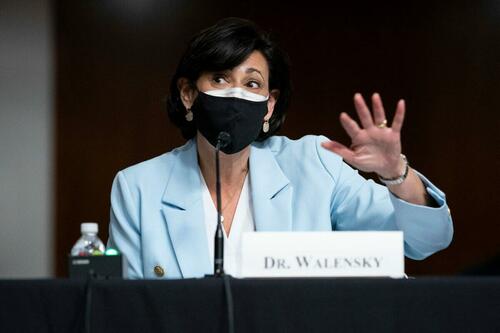
Dr. Rochelle Walensky, director of the Centers for Disease Control and Prevention, answers questions during a Senate committee hearing in Washington on Jan. 11, 2022. (Greg Nash/Pool/AFP via Getty Images)
The first report from ACIP, a summary of presentations given behind closed doors, said that myocarditis rates after vaccination did not differ from expected rates, which are established using baselines based on the regular occurrence of the condition in the general population.
A few weeks later, however, the panel acknowledged that there were higher than expected rates of post-vaccination heart inflammation, detailing the numbers in a report dated May 24, 2021.
Shimabukuro presented data on the higher-than-expected rates duringpublic meetings the following month. He revealed that myocarditis and pericarditis were being reported at much higher rates than expected in males aged 12 to 29, but claimed it was too soon to indicate a link between the issues and the vaccines. He and others soon said data points “suggest an association with immunization,” and VaST said the data suggested a “likely association.”
Around the same time, the FDA added warnings about heart inflammation to fact sheets that are distributed to vaccine recipients, caregivers of recipients, and medical professionals who administer the shots, and military doctors reported more cases than expected among troops who received one of the vaccines.
Approximately 341 cases of myocarditis or pericarditis following vaccination had been reported to the Vaccine Adverse Event Reporting System (VAERS), a passive system managed by the CDC and the FDA, by the end of April 2021.
As of June 8, over 5,000 cases have been reported.
Some reports have been deleted, potentially skewing the numbers. Additionally, studies indicate reports to VAERS are an undercount.
Based on the reports that have been made, rates of myocarditis are higher than expected in males as young as 5 and as old as 49 after the second dose, according to data Shimabukuro shared at an FDA meeting on June 7. The highest rate is among 16- and 17-year-old males, with 76 reports per one million second doses and 24 cases per one million third doses.
“The current evidence supports a causal association between mRNA COVID-19 vaccination and myocarditis and pericarditis,” Shimabukuro said.
The CDC in February advised some people to wait longer between the first and second shots to try to minimize the risk of heart inflammation.
But some experts say the rates mean that healthy, young people should not get any of the doses, since COVID-19 primarily presents severe problems to the elderly and those with underlying conditions such as kidney disease.
“Based on currently available data, the risks of administering COVID-19 vaccination among healthy children may outweigh the benefits,” Dr. Joseph Ladapo, Florida’s surgeon general, said earlier this year.
Multiple countries have paused the Moderna vaccine for youth, due to the heart inflammation.
Other experts say at least one dose is recommended, while still others, and the CDC, continue to recommend vaccination for virtually all Americans 5 and older.
The pause on Johnson & Johnson’s vaccine over blood clots was eventually lifted, but the FDA in May restricted its use. There was never a pause on the Moderna or Pfizer vaccines in the United States.
A June study by researchers from the University of Sydney highlighted concerning trends of increased screen time, alcohol use, and poor sleep for teenagers due to the COVID-19 pandemic. The increase has implications for teens’ long-term health, said researchers.
“We know these lifestyle risk behaviors are common among young people, but we also know they are key predictors of chronic diseases later in life, such as cancer, cardiovascular disease and mental disorders,” said lead author Dr. Lauren Gardner, Research Fellow at the University’s Matilda Centre for Research Excellence in Mental Health and Substance Use.
The authors of the study expressed special concern at an observed increase in alcohol consumption, recreational screen time, and insufficient sleep, particularly in girls.
The study examined survey responses from almost 1,000 Australian teens across the states of New South Wales, Queensland, and Western Australia, with the cohort age averaging 12.6 years old.
Researchers compared responses over the 2-year period from pre-pandemic 2019 to 2021, during the pandemic. The authors compared trends in six key lifestyle behaviors that put teens at risk of chronic disease in later life. These include physical inactivity, poor diet, recreation screen time, inadequate sleep, alcohol use, and smoking.
Overall, the team found an 8 percent increase in teenagers engaging in recreational screen time for more than two hours a day. Ninety-four percent of surveyed teens reported excessive levels of recreational screen time during the pandemic, compared to 86 percent pre-pandemic.
A 2021 study conducted in the United States reported similar findings, with average screen use found to be 7.7 hours per day; almost double respondents’ pre-pandemic estimate of 3.8 hours.
“As screen time increased, so did adolescents’ worry and stress, while their coping abilities declined,” lead author Dr. Jason Nagata said.
“Though social media and video chat can foster social connection and support, we found that most of the adolescents’ screen use during the pandemic didn’t serve this purpose,” said Nagata.
In addition to the screen time increase, a greater number of teens reported alcohol consumption: an increase from 2 percent to 10 percent of survey respondents. While researchers expected an increase in alcohol consumption as the cohort aged; they were surprised to find that it was greater for females than males.
Sleep duration was reported to have increased from 2019 to 2021. However, insufficient sleep—sleep duration below 8 to 11 hours—was still more prevalent for females compared to males, with around an extra third of female respondents reporting insufficient sleep.
Other risk factors such as smoking, poor diet, and physical inactivity also reported increases. Researchers say the increases, although associated with the pandemic, were not significant.
Prof. Maree Teesson, director of the Matilda Centre, said the new study reinforces other international research highlighting the varied impact of the COVID-19 pandemic across countries and within regions.
“Supporting young people to improve or maintain positive health behaviors is important,” she said. “The full extent of the impact of the pandemic on children and young people is being recognized internationally.”