Search This Blog

Sunday, June 12, 2022

Intranasal Biohaven Zavegepant Shows Promise in Acute Migraine

 Zavegepant, an investigational nasal spray formulation of a small-molecule calcitonin gene-related peptide (CGRP) receptor antagonist, met its co-primary endpoints in a phase III randomized placebo-controlled trial of acute migraine.

On both primary endpoints -- 2-hour pain freedom (23.6% vs 14.9%, P<0.0001) and 2-hour freedom from most bothersome symptom (39.6% vs 31.1%, P=0.0012) -- zavegepant was superior to placebo, reported Jelena Pavlovic, MD, PhD, of Albert Einstein College of Medicine and Montefiore Headache Center in New York City, in a presentation at the American Headache Society annual meeting.

"We saw superiority over placebo after a single dose as early as 15 minutes and sustained through 48 hours," Pavlovic said. "Pain relief at 15 minutes, return to normal function at 30 minutes, and sustained pain relief through 48 hours are highlighted as secondary predefined points of interest."

Zavegepant is a high-affinity, selective, structurally unique small-molecule CGRP receptor antagonist, Pavlovic noted. "It is the only molecule currently in the class that is delivered by nasal spray that is in late-stage development for the acute treatment of migraine," she said.

A phase I study had shown that zavegepant 10 mg was rapidly absorbed with a Tmax of about 30 minutes, Pavlovic pointed out. "The phase II/III dose-ranging study demonstrated that 10 mg of zavegepant was the optimal dose for migraine," she added.

The phase III trial studied adults with a history of two to eight moderate or severe monthly migraine attacks who had less than 15 monthly headache days. Preventive migraine drugs were permitted in the trial (excluding other CGRP antagonists), as long as the dose had been stable for 3 months or longer.

A total of 1,269 people (mean age 40.8, 82.9% female) were included in the study: 623 people randomized to zavegepant and 646 to placebo. At baseline, the mean number of moderate-to-severe attacks was 4.7 and untreated attacks lasted an average of 30.8 hours. Historically, the most bothersome symptoms among participants were photophobia (60.4%), nausea (24.7%), and phonophobia (15.0%). A total of 13.4% of participants used preventive migraine medication.

Participants self-administered one dose of zavegepant 10 mg nasal spray or placebo to treat one migraine attack of moderate or severe pain intensity and reported data into an eDiary starting at 15 minutes after dosing.

At 15 minutes post-dose, 15.9% of the zavegepant group reported pain relief, compared with 8.0% of placebo. At 30 minutes post-dose, those numbers increased to 30.5% for the zavegepant group and 20.3% for placebo (P<.0001 for all).

Other findings included return to normal function at 30 minutes (10.5% vs 6.1%, P=0.0059) and 2 hours (35.8% vs 25.6%, P=0.0001), and sustained pain relief 2 to 48 hours post-dose (36.1% vs 29.6%, P=0.013) for zavegepant and placebo, respectively.

The most common adverse events (AEs) in the zavegepant group were dysgeusia (20.5%), nasal discomfort (3.7%), and nausea (3.2%). Most AEs were mild or moderate; none were serious. One participant in the zavegepant group and two in the placebo group had transaminase elevations more than three times upper limit of normal.

Zavegepant is under FDA review with a decision date expected in the first quarter of 2023, drug developer Biohaven Pharmaceuticals announced in May. It is the only CGRP receptor antagonist in clinical development with both intranasal and oral formulations, the company said.

Disclosures

The study was supported by Biohaven Pharmaceuticals.

Pavlovic disclosed being a consultant for Allergan and serving on the Biohaven advisory board.

Vertex, CRISPR build case for gene-editing drug

 A gene-editing drug developed by CRISPR Therapeutics and Vertex Pharma has continued to show impressive results in clinical trial, with an update at the EHA congress showing long-term effects on the symptoms of both beta thalassaemia and sickle cell disease.

New data from the CLIMB-111, CLIMB-121, and CLIMB-131 presented in a late breaker at the EHA yesterday came from 75 patients with thalassaemia and SCD who had been treated with CTX001 (exagamglogene autotemcel or exa-cel) for between around 2 and 37 months previously.

CTX001 is an ‘ex vivo’ application of gene-editing, in which the technology is used to modify a patient’s own cells outside the body to make foetal haemoglobin (HbF), which can serve as a substitute to regular haemoglobin in both diseases.

Reverting to HbF in thalassaemia and SCD patients produces normal, healthy red blood cells, rather than the misshapen cells produced by faulty haemoglobin in the two disorders.

Out of 44 patients with transfusion-dependant thalassaemia (TDT), 42 were transfusion-free over the follow-up period, while the remaining two required 75% and 89% fewer volume of transfused blood.

Meanwhile, Vertex and CRISPR presented new data on 31 patients with SCD who had been suffering a median of four vaso-occlusive crises (VOCs) – painful attacks that are associated with the disease – prior to treatment with CTX001.

Of these, all 31 were free of VOCs during follow-up – a phenomenal result given that VOCs are regarded as the most debilitating and distressing symptom of SCD – and Vertex and CRISPR now say they are planning to file for regulatory approval of CTX001 before the end of the year in the US and Europe.

The new data comes just after bluebird bio’s gene therapy for TDT – betibeglogene autotemcel (beti-cel) – was recommended for approval by an FDA advisory committee on Friday, setting it up to possibly reach the US market later this year.

The data put Vertex and CRISPR on course to bring the first therapy based on the CRISP/Cas9 gene-editing technology to market.

CTX001 treatment has its limitations, however, not least that patient have to undergo myeloablative chemotherapy with a busulfan-based regimen followed by transplant with the CRISPR-modified cells back into the bone marrow.

Most side effects were consistent with that process, which is similar to the current approach taken to treat both diseases using a bone marrow transplant, which requires a matched donor.

Two TDT patients had serious adverse events related to exa-cel, said Vertex and CRISPR, but there were no serious side effects linked to the therapy in the SCD group. There have also ben no cases of cancer – a concern with bluebird’s gene therapy approach.

“Both of these blood diseases can reduce life expectancy and have a daily emotional and physical impact on those affected,” said Professor Josu de la Fuente, a gene therapy and haematology specialist at Imperial College London in the UK.

“Despite modern treatments, most patients have a significant burden so there is an urgent need for new therapies to combat the challenges of these diseases and these data continue to build confidence that exa-cel could fill that need.”

Analysts at EvaluateVantage have previously suggested that CTX001 could become a $1.3 billion product if it gets approved for both indications.

https://pharmaphorum.com/news/eha-vertex-crispr-build-case-for-gene-editing-drug/

White House to train health care workers in Latin America

 President Joe Biden, Vice President Kamala Harris and HHS Secretary Xavier Becerra travel to Los Angeles today to participate in the Summit of the Americas, where they are expected to outline a plan to increase public health communication and surveillance in the Americas. 

The plan is part of an administration bid to step up global partnerships in order to stem further COVID-19 outbreaks and prevent future pandemics before they start, and will help other countries in the Americas prevent and prepare for public health emergencies. The administration anticipates the plan will be fully implemented by 2030.

The primary goal is to train an additional 500,000 health care workers across Latin America within the next decade in conjunction with the newly-formed Americas Health Corps. This would cost roughly $100 million, a senior administration official said. The training would be conducted by leveraging existing Centers for Disease Control and Prevention, Peace Corps and Pan American Health Organization training platforms.

The U.S. also plans to work more closely with the Pan American Health Organization and the Caribbean Public Health Agency to address equity issues in the Americas regarding COVID-19 vaccines and therapeutics, according to the Biden administration. 

More than 40 percent of total COVID-19 deaths globally have occurred in Latin America and the Caribbean, despite the region having only 8 percent of the world’s population, according to the White House.

The administration wants to expand the number of CDC regional offices throughout the Americas and expand USAID’s global health security program and staffing to seven countries in South America and the Caribbean. It also aims to diversify public health supply chains. 

“The Administration remains committed to advancing pandemic response and global health security and has prioritized additional activities in the Americas for this year and into the future,” the White House said in a fact sheet on the announcement.

https://rollcall.com/2022/06/08/white-house-to-train-health-care-workers-in-latin-america/

Pharma groups decry Covid-19 vaccine IP waiver ahead of Geneva conference

 If the World Trade Organization gets its way, an IP waiver deal for Covid-19 vaccines may be reached as soon as next week. But the critics keep piling up.


A handful of pharma advocacy and lobbying groups — including the International Federation of Pharmaceutical Manufacturers and Associations and the Washington Council on International Trade — decried an IP waiver deal on Thursday, arguing that it’s unnecessary and threatens to quash innovation.


“An IP waiver does not address inequitable access to Covid-19 vaccines and will put global health security at risk. It will undermine innovation and industry’s ability to partner, invest at risk, and respond quickly to future pandemics,” the IFPMA said in a statement.


TRIPS Council chair, ambassador Lansana Gberie of Sierra Leone, said yesterday that delegations around the waiver “have entered into real negotiation mode in the last 24 hours,” and that the WTO is aiming to get a version ready for adoption next week by ministers arriving in Geneva for the 12th Ministerial Conference.


WTO approaches a deal early next week for a Covid-19 vaccine IP waiver

Both India and South Africa called for an IP waiver back in 2020. Just 32% of people in South Africa are fully vaccinated, according to the New York Times, compared to 67% in the US. Under the TRIPS agreement, developing countries would be able to reproduce Covid vaccines by using the formula and technology created by original manufacturers.


However, the WCIT argues that such a deal “detracts from more effective solutions and poses a threat to IP rights which are critical in alleviating the scourge of inequality and global poverty.” The group argued that the real problems are in clearance at points of entry, infrastructure gaps, and supply chain gaps such as a lack of refrigeration equipment in local distribution centers.


“Led by the United States, the developed world has closed the supply gap through vaccine donations — and indeed, there is now a global surplus of doses,” WCIT said.


In May, Switzerland announced they were destroying 600,000 expired doses of Moderna’s shot. England and Denmark have also tossed more than 6.6 million doses.


“By May 2021, less than six months after the first vaccine authorization, monthly production output was close to a billion vaccine doses; enough to vaccinate the world if countries were willing and able to share,” the IFPMA said in a statement.


PhRMA also chimed in on Thursday, adding that world leaders “should focus on the real challenges of getting Covid-19 vaccines and treatments to people around the world, such as last-mile distribution, supply chain issues and vaccine hesitancy.”


Meanwhile, others argue that the proposed deal is too little too late.


“It does not do much that you can’t already do,” KEI founder and IP waiver and compulsory license advocate Jamie Love told Endpoints News back in March, upon seeing a leaked draft of the watered-down deal. Nonprofit advocacy org Public Citizen also said in a statement that the proposal would help no one “but the floundering WTO and should be rejected.”

https://endpts.com/pharma-groups-decry-covid-19-vaccine-ip-waiver-ahead-of-geneva-conference/

Covis asks FDA to omit study potentially linking Makena and cancer

 It’s been almost 10 months since the FDA granted Covis Pharma a hearing to review its controversial preterm birth drug Makena, which won an accelerated approval but failed its confirmatory trial, and still the company and FDA are wrangling over the details of that hearing.


In a letter dated Thursday, Covis lawyers from Sidley are now objecting to the hearing, including a publication that suggests a potential link between Makena and cancer in the offspring.


The study in question, published in the American Journal of Obstetrics and Gynecology, reviewed the cancer risk of thousands of babies born in the Bay Area to mothers given 17-α hydroxyprogesterone caproate, with the researchers concluding that caution of use in early pregnancy is warranted, given the possible link with cancer in the offspring.


But Sidley submitted comments from an outside expert witness and stats consultant, Anita Das, who noted that Makena is indicated for the prevention of recurrent preterm birth and only for administration starting at 16 weeks of gestation, whereas the study showed “a significant increased risk of any cancer” only when 17-α hydroxyprogesterone caproate, known then as Delalutin, was administered in the first trimester or up to about 12 weeks.


Sidley lawyer and former FDA chief counsel Rebecca Wood also wrote to FDA that the study is “neither sufficiently reliable to be considered nor relevant to the safety and efficacy of Makena,” and “it would be error, both legally and as a matter of sound public health policy, for FDA to include it in the hearing record or otherwise to consider it in connection with the proposed withdrawal of accelerated approval for Makena.”


She also explained how the American College of Obstetricians and Gynecologists has concluded that this article “does not change the risk-benefit profile of Makena,” saying that due to limitations in the design, the study’s findings are not conclusive and should not influence practice.


But other doctors aren’t so sure that such evidence should be dismissed by FDA ahead of the hearing. And the FDA has yet to announce its decision on what it will do.


Adam Urato, an an obstetrician-gynecologist in Framingham, MA, told Endpoints News the request from Sidley is “outrageous,” adding:


Sidley/Covis wants FDA to ignore the Murphy study showing a link between synthetic progesterone during pregnancy and cancer in the offspring. This is a major issue. We don’t know the long-term effects of injecting women with Makena. It absolutely could potentially cause cancer in the exposed offspring. That’s certainly a possibility. This is a very important issue to be discussed and here we have Covis arguing that FDA must not even consider it or include it in the hearing record. This is a scientific paper that was peer reviewed and published in a leading OB/GYN journal (the official journal of the Society of Maternal Fetal Medicine.) FDA must say no to this.


Regardless of the inclusion of this study, the FDA and Covis Pharma will duel it out during a two-and-a-half-day virtual hearing set for next September or October, according to a letter from Celia Witten, FDA’s director of the Office of Cellular, Tissue and Gene Therapy, who’s presiding over the hearing.


FDA plots multi-day hearing to review 'dangling' accelerated approval that drugmaker refuses to pull

The hearing will allow for both Covis and FDA’s Center for Drug Evaluation and Research to each make two-hour presentations, and both CDER and Covis will be given a full hour to ask questions after the opposing side makes its presentation. An additional four hours will be set aside for public comments.


“I must afford CDER and Covis an opportunity to ask questions after presentations by the public and reserve time for the advisory committee members and me to do so, as well,” Witten wrote to attorneys from both CDER and Covis. The third day (a half day) will allow for closing statements from both sides.

https://endpts.com/ahead-of-accelerated-approval-withdrawal-hearing-covis-asks-fda-to-omit-study-potentially-linking-makena-and-cancer/

How Fast Does The Job Market Need To Crash To End The Fed's Hiking Panic? Goldman Answers

 With inflation coming in red hot, hotter than most had anticipated, and unlikely to revert back to normal any time soon especially as exploding energy, food and rent prices will remain in the stratosphere for a long time (absent a depression), the last hope bulls have is that the jobs market will crater (a process which real-time indicators suggest is already in pla, yet which the BLS stubbornly refuses to acknowledge, likely for obvious political reasons with a critical mid-term election looming).

And if not crater, then certainly the US labor market needs to slow down well beyond recent trendline in order to short-circuit the vicious wage-price spiral and allow inflation to reset. Indeed, as Goldman's chief economist Jan Hatzius said on Friday, a combination of higher labor force participation and lower labor demand will likely be necessary to restore balance to the labor market and bring inflation back toward the FOMC’s 2% inflation target.

To be sure, indicators of labor demand have already softened in recent months, with job openings declining 4% in April and the monthly pace of payroll growth slowing to roughly 400k from 600k in the winter, but as even the most optimistic economists will admit, demand needs to cool meaningfully further (in fact, as even Bloomberg now admits, "Powell Facing Choice Between Elevated US Inflation and Recession.")

So doing some quick math, Goldman calculates that payroll growth will need to slow to roughly 150k on average in the second half of the year in order to begin to rebalance the labor market and calm wage and price pressures, and the faster the better. The problem is that as Goldman also concedes, according to historical data and statistical analysis "such a slowdown may be hard to achieve: slowdowns of this magnitude have only happened a few of times outside of recessions in modern US history, and while the recent trend of payrolls growth—the best predictor of upcoming payrolls growth—has slowed, the pace is still elevated."

Here are some more details on why the hurdle for job growth to slow by the required amount appears high on a historical basis..

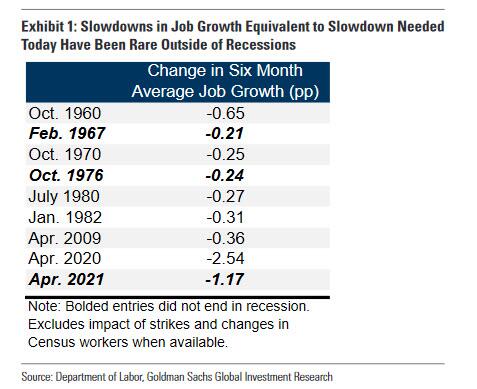
The chart below shows the nine instances since 1960 that payrolls growth has slowed by more than 0.20% — roughly the amount Goldman thinks is required to restore balance to the labor market today, expressed as the change in the six-month average monthly percent change (in Goldman's framework, monthly payroll growth needs to decline from 0.34% over the last six months to 0.11% over the next six months).

Although slowdowns of 0.20% or more have been quite uncommon outside of recessions, today’s economic backdrop - at least until a recession is officially declared in a few months - is somewhat comparable to the three historical instances where job growth slowed and a recession was avoided: ahead of the slowdowns in 1976 and 2021, job growth was running well above trend as the economy was recovering from a recession, and ahead of the slowdown in 1967, the Federal Reserve tightened monetary policy to combat inflationary pressures.

As an aside, Goldman economists points out that the recent pace of payroll growth is one of the best predictors of upcoming payrolls growth and even more useful than knowing the future rate of output growth (the predictive power of job momentum likely reflects lags in the hiring and firing process, the cost of large personnel changes, and the pro-cyclicality of capacity utilization.)

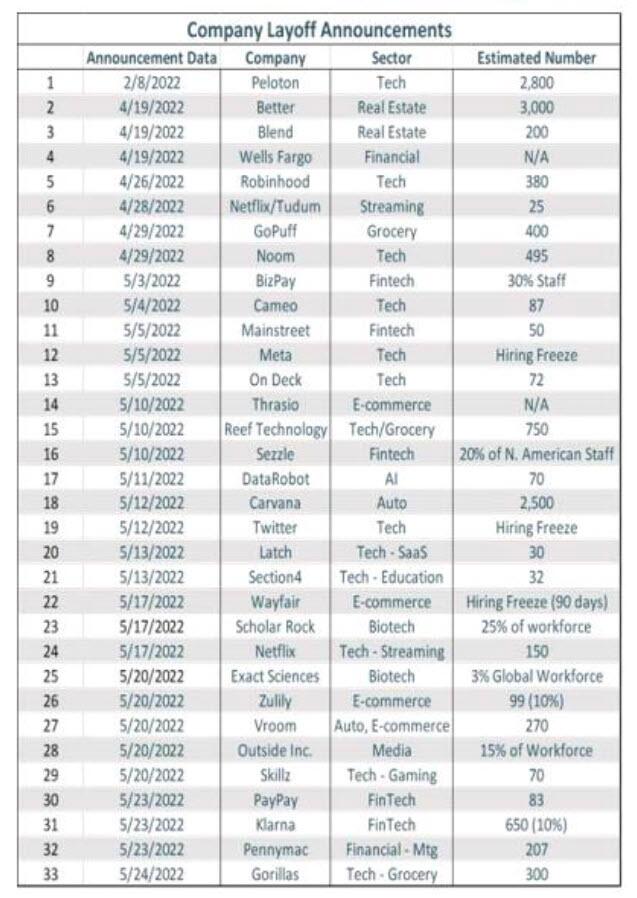
With payrolls growing just over 400k per month over the last three months (if slowing), putting a high weight on momentum would suggest a high hurdle for job growth to slow enough in coming quarters to restore balance to the labor market. However, it is also the case that employment growth has recently slowed to roughly 225k per month over the last three months in the noisier household survey, suggesting that the underlying trend could be overstated by just looking at nonfarm payrolls. Furthermore, while not captured yet by the US labor bureau, leading labor market indicators such as mass layoff announcement has surged in recent weeks, with dozens of announcements in the otherwise rock-solid tech sector. Expect similar weakness across the rest of the rest of the labor market.

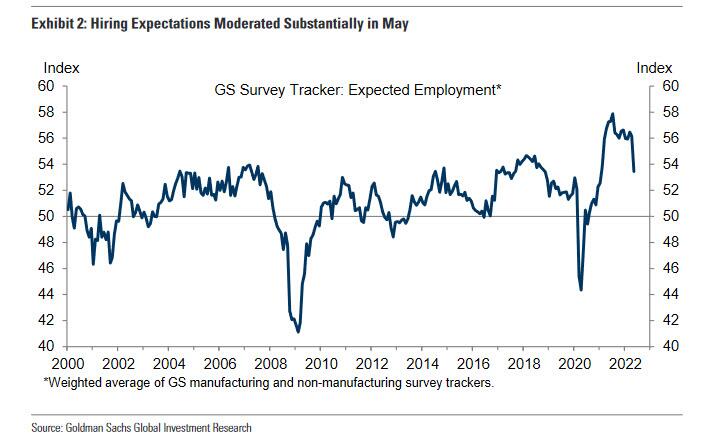
Goldman itself admits as much: "recent anecdotes of hiring freezes and more selective hiring indicate that companies expect payroll growth to slow, and the most recent business activity surveys corroborate these signals."

In the next chart, the bank constructs an aggregate index of employment growth expectations by replicating its own survey tracker methodology on the employment expectations components of eight regional Fed manufacturing and services surveys. It found that in May, this series recorded its third largest monthly decline since 2000—behind only October 2008 and March 2020—yet even so it remains at a historically elevated level... but not for long.

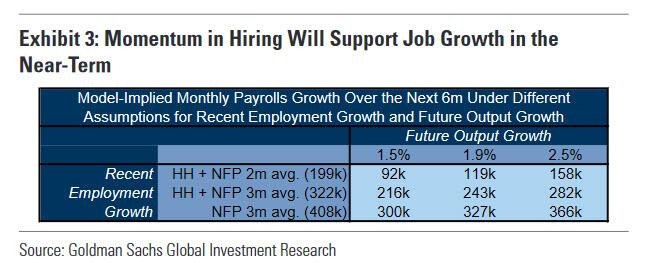
Which brings us to punchline #1: to get a sense of how much employment growth could slow - or rather should slow - over the coming months, Goldman estimates a model of future payroll growth based on lagged payroll growth, changes in output growth, and lagged changes in survey-based employment growth expectations. It then uses the model coefficients to project future payrolls growth based on different assumptions about the recent employment growth trend and future output growth.

Goldman derives two conclusions from the scenarios above:

  • First, different plausible assumptions for the recent employment growth trend imply a wide range of outcomes for future payrolls growth: coupling the bank's baseline (and recently cut) H2 2002 GDP growth forecast with the different employment growth trends suggests that monthly payrolls growth could range from roughly 125k up to 325k (middle column).
  • Second, the balance of risks to near-term employment growth appears skewed to the upside relative to Goldman's own forecasts of 215k per month over the next three months and 160k over the next six months (suggesting that Goldman is once again overly optimistic on the economy and will soon be slashing its jobs, and GDP, forecasts again).

One final point: while Goldman does not say it, but is generously implied in its analysis, the bigger the recession, the faster US job growth turns negative and the quicker wage growth implodes, the better for the bulls even if it sends the odds of more summer violence (if not before the midterms, then certainly next year after the GOP has won control of Congress) through the roof.

https://www.zerohedge.com/markets/how-fast-does-job-market-need-crash-end-feds-hiking-panic-goldman-answers

A Framework for Trading and Trading Psychology


If you were to listen into the conversation of a basketball coach with a player, you would hear quite a bit about how to play the game.  The coach might talk about getting back on defense or working harder to get position on rebounds or taking the high percentage shot, but the conversation would be about playing better.  Whatever needed to be addressed in terms of psychology would be embedded within the coaching regarding the playing.  

For example, if the player is not taking the high percentage shot at the top of the key (a failing for which I vividly recall being taken to task), the coach will address the psychology by making it abundantly clear that he believes in you and that you will never be blamed for missing a high percentage shot.  The coach might also include a ridiculous number of top of the key jumpers in the next round of shooting practice.  Such coaching *very* much addresses psychology, but in the context of actual playing.

Oddly, trading psychology is rarely approached in such a fashion.  I find it refreshing (and unfortunately rare) to hear a trading coach talk about actual trading.  It is as if the game inside the trader's head is completely separate from the game of trading and somehow, magically, the two are supposed to converge.  I can't think of any other performance field where psychology is so completely decontextualized.

In coming weeks, I will be returning to regular trading and, yes, I will be reviewing my performance and coaching myself.  You can be sure that I will not be exhorting myself to perform positive affirmations; nor will I be telling myself--in generic fashion--to follow my process and trade with discipline.  I will review each trade like a basketball coach reviews game film with a team.  In so doing, the psychology will be addressed within the context of what was done well and what needs improvement.  That is what deliberate practice is all about.

My framework for trading is to break the market down into three components:

*  Trend
*  Longer-term Cycles
*  Shorter-term Cycles

Trades are placed based upon the assumption that the trend and cyclical components that characterize the most recent market action will continue into the immediate future.  That assumption of what is called stationarity is based upon an assessment of the stability of market participation from one time period to the next.  It is for that reason that I trade at certain times (which, historically, tend to be stationary/uniform) and avoid trading at other times.

The time series of market action is based on events, not time.  When we look at bars on a chart that are denominated by volume, trades, ticks, etc., we create more stationary time series and are able to find more uniform cyclical behavior within markets.

At the end of the day, I am looking to buy troughs of cycles in rising markets and sell peaks of cycles in falling markets.  I have no particular macro stories to tell myself or chart patterns to divine.

I look forward to illustrating my trading--and my trading psychology.  The most important thing is not the trading framework I utilize, but the integration of the psychology with the actual trading.  We develop psychologically by doing things differently.  There is no meaningful psychological development apart from doing.