Search This Blog

Sunday, February 26, 2023

Zelenskiy fires a top Ukrainian military commander, no reason given

 Ukrainian President Volodymyr Zelenskiy on Sunday fired a senior military commander helping lead the fight against Russian troops in the country's embattled east but gave no reason for the move.

In a one-line decree, Zelenskiy announced the dismissal of Eduard Moskalyov as commander of the joint forces of Ukraine, which are engaged in battles in the Donbas region.

Zelenskiy mentioned Moskalyov in a daily address on Friday when listing the military commanders he had spoken to. Moskalyov had been in the post since March 2022, shortly after Russia invaded Ukraine.

Neither the joint forces' Facebook nor Twitter accounts made any mention of the dismissal.

Russian forces are making concerted efforts to capture the two eastern regions that make up the Donbas, and Zelenskiy has in recent weeks variously described the military situation in the east as difficult and painful.

Pro-Moscow units are focusing their efforts on the city of Bakhmut, mounting repeated assaults despite suffering what Ukrainian and Western officials say are heavy casualties.

In a Facebook post, the Ukrainian armed forces' general staff said Russian troops had carried out several unsuccessful attacks in the Bakhmut area on Sunday.

https://sports.yahoo.com/zelenskiy-fires-top-ukrainian-military-213505395.html

Italy approves clampdown on migrant rescue ships, fines charity

 Italy's parliament on Thursday passed into law a government decree establishing a code of conduct for migrant charity ships, despite criticism from the United Nations and humanitarian groups that it will imperil lives.

The new set of rules is part of Prime Minister Giorgia Meloni's efforts to crack down on the rescue vessels, which her government says encourage people to make the perilous trip across the Mediterranean from northern Africa.

Charities deny this, saying migrants set to sea regardless of whether rescue boats are in the vicinity.

Under the new law, ships have to request access to a port and sail to it "without delay" after a rescue, rather than remain at sea looking for other migrant boats in distress, and disclose detailed information about their rescue activities.

Previously, vessels operated by charities, or non-governmental organisations (NGOs), often spent several days in the central Mediterranean and regularly completed multiple rescues before heading north towards Italy.

Captains breaching the new rules risk fines of up to 50,000 euros ($53,355), and repeated violations can result in their vessels being impounded, the law stipulates.

Hours after the parliamentary vote, the Doctors Without Borders (MSF) charity said its Geo Barents vessel had been blocked for 20 days and the organisation fined 10,000 euros.

The sanctions were imposed after MSF was accused of withholding some information about a rescue it completed last week, when the Geo Barents took 48 migrants to the Adriatic port of Ancona, a spokesperson for the charity said.

"We are assessing what legal actions we can take to challenge what happened. It is not acceptable to be punished for having saved lives," MSF said in a tweet.

'EXPLOITATION, FORCED LABOUR'

Nicola Molteni, a deputy interior minister and member of the hard-right League party, told the upper Senate before its final vote on Thursday that "if immigration is not controlled, it creates exploitation, forced labour, illegal labour."

Humanitarian groups said banning multiple rescues would cause ever more deaths while the United Nations urged Italy to withdraw the decree.

"This is simply the wrong way to address this humanitarian crisis," said Volker Türk, the U.N. High Commissioner for Human Rights. The Roman Catholic Church in Italy last month said the new measures violated international law and should be scrapped.

NGOs also complain the government is forcing them to take migrants to distant northern Italian ports, far from where they carry out the rescues.

The new obligations have significantly increased costs for the NGOs and only a few boats have taken to sea in recent months. But their reduced sailings have done nothing to slow the arrival of migrants.

Government data shows 12,667 people have reached Italy so far this year, more than double the same period of 2022. The missing migrants project says at least 157 people have been reported as missing, presumed dead, this year.

An internal interior ministry document seen by Reuters said out of 105,000 migrants who arrived in Italy in 2022, only around 10% were brought ashore by NGO boats.

https://www.yahoo.com/entertainment/italy-gives-final-approval-decree-130630252.html

Bayer embraces activist Ubben with place on its sustainability council


Activist investor Jeff Ubben is joining an independent, external group of experts that advises Bayer’s management on sustainability, as the German industrial group tries to embrace its high-profile shareholder. But the gesture may fail to satisfy 

Ubben, who wants the group to use sustainability to drive returns, as the position is informal and far less powerful than on one of the boards, say people familiar with the situation. Under Germany’s two-tier board system, the sustainability council has neither formal decision making power nor oversight rights. 

The two relevant bodies are the executive board and the supervisory board, which has a separate ESG committee to oversee Bayer’s execution of sustainability strategy. Ubben, founder of hedge fund ValueAct Capital which he left in 2020 to start Inclusive Capital, says Bayer could become a “sustainability hero” by creating products to address food security and climate change problems. Bayer’s shares have fallen nearly 60 per cent since 2015. It has been hit hard by litigation involving Roundup — a weedkiller it acquired when it bought Monsanto — claiming that the herbicide caused cancers.

 The company suffered a vote of no confidence in management in 2019, unprecedented in German postwar corporate history. Ubben, who took a €500mn stake to shake up the German crops and drugs conglomerate, has in previous campaigns sought and won seats on company boards. He said he did not want to just show up and demand a board seat, but that he did not think having a seat on the sustainability council and the board would be “mutually exclusive”. 

 Ubben will also advocate resolving the remaining litigation involving Roundup and continue to raise questions about whether the company should be split into agriculture and pharmaceutical groups. He lobbied for an external chief executive to take over Bayer, and the company recently appointed Bill Anderson, who had previously led Roche’s pharmaceutical business.

 Ubben said he had a “big opportunity” with Anderson, who he will meet soon.

 “He’s got this company that has three or four discounts attached to it. It’s got a conglomerate discount. It’s got an ESG discount. It had a governance discount, a litigation discount. All of those are opportunities for value creation,” he told the Financial Times. 

 Ubben describes Inclusive Capital as an impact fund, which means investing with the aim of driving up the long-term stock price by using environmental and social goals to gain value. 

“We are basically impact first.” Bayer is Inclusive Capital’s largest investment to date. 

Ubben said it had been perceived as causing sustainability problems by investors concerned about genetically modified crops, rather than a solution to food security by creating new products to increase yields. The sustainability council was established in 20

20 and according to Bayer has “access to relevant documents and experts within the company”. Ubben, who will receive an undisclosed amount of pay from Bayer for his work on the council, told the Financial Times that he hoped to work closely with new management. Matthias Berninger, Bayer’s head of science and sustainability and a former politician with the German Green party, said the council has worked to improve the group’s ESG policies and wants to pioneer green technologies.

Rick Scott: Biden ‘compromised’ by China

 GOP Florida Sen. Rick Scott on Sunday accused President Biden of repeatedly “pacifying” China and suggested the commander in chief may be “compromised” somehow by the Communist country. 

Scott told John Catsimatidis on his WABC 770 AM radio show that no American company should be doing business in China or Russia, saying the US must “focus on what’s good for America, what’s good for Americans, what’s good for our children, our grandchildren.

“​All that Biden does is pacify China. I mean, I don’t know why he does it​. I don’t know if he’s compromised. I don’t know what it is​. But ​this is a guy that won’t stand up to dictators around the world​,” Scott said.

The president has had to deflect questions for months about his role in first son Hunter Biden’s business dealings in Ukraine and China, which were first reported by The Post in October and November 2020. 

GOP Sen. Rick Scott said in an interview on Sunday that President Biden might be "compromised" by China.
GOP Sen. Rick Scott said in an interview Sunday that President Biden might be “compromised” by China.
AP

Scott reiterated comments he made on Twitter last week in response to a poll that showed Americans are now more concerned with China’s influence around the world than Russia’s, and that 58% disapprove of how Biden is handling relations with Beijing. 

“Communist China has chosen to be our enemy. The CCP wants to destroy our way of life, and​ ​@JoeBiden shows nothing but weak appeasement​,” Scott posted on Twitter, linking to The Associated Press survey.

“The American people deserve a leader in Washington who stands up to evil regimes and puts America first​,” he added.​

President Biden has been repeatedly pressed on his family's business relationships in China.
President Biden has been repeatedly pressed on his family’s business relationships in China.
AP

The poll was conducted just before Biden made a surprise visit to Ukraine but after the US military shot down a Chinese spy balloon Feb. 4 off the coast of South Carolina.​

Biden faced pointed criticism for the delay in shooting down the balloon, thus allowing it to sail across a large part of the United States, including over sensitive military installations. 

Secretary of State Antony Blinken also said last Sunday that he believed China was considering providing lethal weapons to Russia in its year-long war against Ukraine, further straining relations between Washington and Beijing.​

The Biden family had been involved in two relationships with companies linked to the Chinese government.

And business records show that Hunter Biden still retains a 10% stake in Chinese state-backed BHR partners, which claims it manages about $2.1 billion in assets. 

The embattled first son co-founded BHR Partners in 2013, right around the time he accompanied his father, then the vice president in the Obama administration, on Air Force Two for an official trip to Beijing.

Hunter Biden’s lawyer said in 2021 that the president’s son’s stake in BHR had been divested. 

Rep. James Comer (R-Ky.), the chair of the House Oversight Committee, has set the panel’s sights on the Biden family’s interests in China. 

The president bristled earlier this month when confronted by reporters about whether he is compromised by his family’s connections to China, saying, “Give me a break.”

Asked by a reporter from The Post, whether his son still owns a company with “Chinese government entities,” Biden waved his hand.​

“​You can come to my office and ask a question when you have more polite people with you​,” he responded.

https://nypost.com/2023/02/26/sen-rick-scott-suggests-biden-is-compromised-by-china/

White student sues historically black college Howard University for $2M over racial discrimination

 A white student at Howard University’s law school is suing the institution for racial discrimination, alleging the school created a “hostile education environment.”

Michael Newman, the plaintiff, attended Howard University School of Law starting in the fall semester of 2020 and remained there for just two years until he was expelled in September 2022. He is seeking $2 million in monetary damages for “pain, suffering, emotional anguish and damage to his reputation.”

Frank Tramble, Vice President and Chief Communications Officer for Howard University, said that while he could not comment “substantively” due to pending litigation, the university “is prepared to vigorously defend itself in this lawsuit as the claims provide a one-sided and self-serving narrative of the events leading to the end of the student’s enrollment at the University.” 

Newman suffered “depression, anxiety and suicidal thoughts” as a result of “public ostracism, vilification and humiliation,” the lawsuit claims. At one point, Global Head of Diversity Recruiting Reggie McGahee allegedly told Newman he had become the most hated student McGahee had seen during his tenure at the university, according to the suit.

When Newman raised concerns over his treatment to school administrators, the law school’s dean allegedly denied that Caucasian students at Howard Law, and Newman in particular, faced racial discrimination to any degree. 

Following discussions of Newman’s purported racial insensitivity, students learned of a tweet from Newman’s private Twitter account that included a picture of a slave baring his badly scarred back with the caption, “But we don’t know what he did before the picture was taken,” according to the lawsuit.

Newman claimed the tweet was mocking commentators who “attempt to explain away videos of police brutality by claiming the victim must have committed wrongdoing before the video started.” He alleged that students responded with references to his race, gender, sexual preference, age and personal appearance. 

Michael Newman is seeking $2 million in monetary damages from Howard University for "pain, suffering, emotional anguish and damage to his reputation."
Michael Newman is seeking $2 million in monetary damages from Howard University for “pain, suffering, emotional anguish and damage to his reputation.”
Photo by Drew Angerer/Getty Images

The trouble started when the university shifted to remote learning at the start of the pandemic, meaning students communicated through purely online forums and through GroupMe chats, Newman claimed in court papers.

After a symposium featuring an African-American speaker in the run-up to the 2020 election, Newman said he posted on a professor’s forum page asking if further dialogue could be had on “whether: (1) black voters didn’t question turning to government for solutions, and (2) reliably voting for the same party every election disincentivized both parties from responding to the needs of the black communities.”

Some students responded negatively to Newman’s post and reached out to school administrators, prompting Newman’s removal from one of his group chats for the class, according to the allegations.

Newman also described feeling “utterly disenfranchised” at the school and compared himself to a black student at a primarily white university. The student response was again largely negative, with some calling his comment “offensive,” he claimed.

Newman repeatedly apologized for offending anyone, stressing he was seeking to “learn, not just law, but to learn the thoughts and experiences of people of color,” the lawsuit stated.

But Newman allegedly faced more overt hostility, with many students starting to refer to him as “mayo king” (a perceived reference to his race) and “white panther,” and students claimed that “controversies” that they blamed on Newman had caused “severe stress” and “distracted them from their studies. 

Newman tried to remedy the situation by sending out a four-part letter explaining his views, but the effort was labeled a “manifesto,” with one student accusing him of “manipulating [classmates’] emotions … as a social experiment,” the lawsuit said. The letters allegedly resulted in Newman’s removal from a second class-wide group chat.

School of Law Dean Danielle Holley later secretly recorded a Zoom meeting she called with Newman and McGahee, during which she suggested Newman transfer to another school, accusing him of racially harassing classmates, according to the allegations.

During a digital town hall attended by 300 participants to discuss controversies surrounding Newman, Holley allegedly characterized Newman’s letters as “disturbing in every sense of the word,” according to the suit. She allegedly blocked him from using several functions to try and speak up in his defense, even disabling the chat function and turning off his camera. 

Holley and Newman wound up filing simultaneous complaints, with Holley accusing Newman of “continual harassment of member [sic] of the Howard Law community, and disturbance of the learning environment at the School of Law.” At the same time, Newman claimed Holley had perpetuated “threats,” “discrimination” and a “hostile academic environment.” 

In a panel reviewing Holley’s complaint, the school determined that Newman was “responsible” and ruled that he should be expelled. To his knowledge, Newman’s complaint was never adjudicated, the suit claimed.

Newman appealed the ruling, but a second review panel allegedly reached the same conclusion despite the revelation that Holley had supplied the first panel with evidence that Newman never saw, which he argued amounted to “secret evidence.”

The attorneys representing Newman filed the suit in federal court. 

Newman’s lawyers will try to prove the school broke its contract with Newman, a student who attended on a scholarship, after a series of incidents and accusations led to multiple review panels and hearings that resulted in his expulsion, according to the lawsuit.

https://nypost.com/2023/02/26/white-student-sues-historically-black-college-howard-university-for-2m-over-racial-discrimination/

No, Red State Economies Don't Depend On A "Gravy Train" From Blue States

 by Ryan McMaken via The Mises Institute,

When Congresswoman Marjorie Taylor Greene called (again) for "national divorce" this week, a common retort among her detractors on Twitter was to claim that so-called red states are heavily dependent on so-called blue states to pay for pretty much everything.

Reporter Molly Knight claimed, for example, that "Red states get their money for roads and cops and schools from blue states. You cut off that gravy train and you e [sic] got a third world country."

Others claimed that red states would be "entirely broke" without blue states. America's social democrats have apparently fully gone over to pushing the narrative that the "red states" are poor and backward while the "blue states" are productive and economically sophisticated.

The implication here is that red states would never survive any sort of separation from the blue states because the red states would then miss out on the presumably large amounts of free money.

Unfortunately for these critics, the data doesn't really back them up. While it is certainly true that a handful of red states receive much more in federal spending than their residents pay in federal taxes, this is not at all the situation across most red states. This is especially not the case in states with states with larger metropolitan areas such as Florida and Texas. 

The real story is more complicated, and to see the details, we can look at state-by-state comparisons in terms of "return on taxes paid." This is a measure of how much each state receives in federal spending for every dollar extracted in federal taxes. States with a "return" above one dollar are getting back more than their residents paid in federal taxes. Residents in a state with a "return" below a dollar pay more than they receive. 

To do this analysis, we start with the tax collections from each state, as reported by the Internal Revenue service. Then, we look at federal spending in each state. There are some smaller categories of spending that are difficult to track, but we can capture the overwhelming majority of federal spending in each state by looking at several key categories:

Once we add it all up we can see the "return on taxes paid" in graph form below:
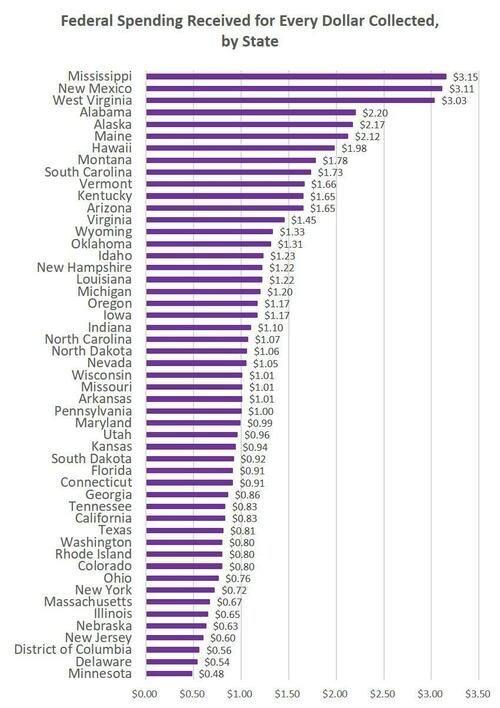
By this analysis, the federal spending in Minnesota only amounted to 48 cents for every tax dollar extracted from the state. On the other hand, Mississippi received more than three dollars for every tax dollar paid by residents. Contrary to the idea that most red states are like Mississippi, however, we find that most states—both red and blue—are much closer to the middle on this. The states that are within a few cents of receiving a dollar for a dollar—i.e., "breaking even"—include the Dakotas, North Carolina, Nevada, Wisconsin, Missouri, Utah, Maryland, Kansas, and Florida. Meanwhile, California and Texas are approximately equal with each other, receiving about 80 cents in federal spending for every dollar paid by residents in taxes. 

My findings here are similar to the study that was repeatedly sent to Rep. Greene by many of her scoffing critics. Specifically, Green was instructed to read this Moneygeek article which purportedly "proves" that the red states depend heavily on blue-state largesse to survive.  Yet, with both our analysis here, and with the Moneygeek article, we will find that the characterization of red states as an economic drain on the country requires quite a bit of hyperbole.2

After "National Divorce": A Red State vs. Blue State Breakdown

Just how badly would red states fare if they were to break off from the blue states? Well, only a minority of these states would be "in the red" and get back significantly more than they pay in. 15 out of 27 red states are either net-tax-paying states or within a few cents of "breaking even."  In other words, with the exception of states like Mississippi and West Virginia and Alabama, most of these states could realistically expect to be self-funding in case of a national break-up. Moreover, viewed as a single bloc, the red states' overall "return" on taxes paid is only $1.02. Were these states to become an independent region of their own, it would hardly be impossible to manage with current tax resources. In fact, if a "Red States of America" wanted to ensure available revenues exceeded current tax liabilities, the bloc could simply exclude the less productive states.  If Mississippi and West Virginia don't bring much to the table, there's no immutable law of nature requiring the "Red States of America" to include them.
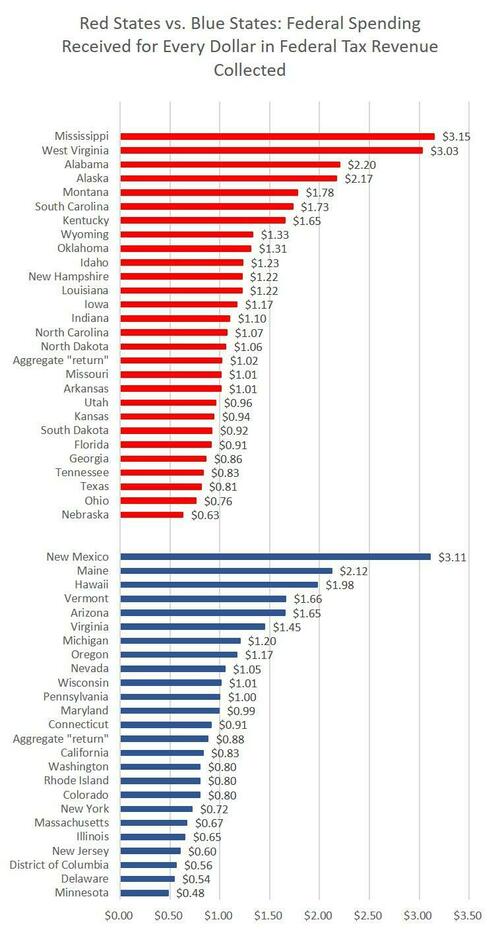
Some of the current net tax receiver states could also easily change their fortunes by simply splitting off the less productive areas such as southwest Alabama, western Mississippi, and eastern Kentucky. The blue states would surely be happy enough to have those areas as dependencies

How Much GDP Do the Red States Produce? 

One other tactic used to portray the red states as a bunch of impoverished welfare queens is to claim that the overwhelming majority of the US's GDP is produced in the blue states. Again, this is a sizable exaggeration. Breaking out the blue and red states as we did above, we find that the blue states naturally produce more GDP because they have more people. Specifically, the blue states contain about 54 percent of the US population and they produce about 59 percent of GDP. In contrast, the red states contain about 46 percent of the US population and produce 40 percent of GDP. In this scenario, a red state bloc would still have a GDP over $8 trillion and would have the world's third largest economy behind China and the "Blue States of America." It would have an economy larger than Germany, Japan, and India. 

Looking at GDP per capita, we find the red state bloc would remain on a par with western Europe and Canada. If divided up, the blue states today would come in around $69,000 per capita. The red states would come in at about $55,000. Taken as two groups, this would place the blue states on a par with Denmark (at approximately $68,000), and the red states a little above Finland (at approximately $54,000). 

Why Some States Are Net Taxpayers, and Some Aren't

Why do we have these large disparities among states? Federal tax revenues are driven heavily by the number of high-earning and full-time workers in each state. States with large numbers of retirees and elderly will thus produce less tax revenue while receiving more in federal spending. States with large low-income populations (relative to overall size) will receive a proportionally higher amount of federal spending. Thus, it's not surprising that Mississippi, with its large low-income population in the Delta region, is a net recipient of federal spending. Similarly, the population in West Virginia is relatively low-income and elderly. Neither of these states have notably large metropolitan areas to balance out these lower-income households. On the other hand, Florida, Texas, Utah, and Ohio have the productive metropolitan areas necessary to balance out populations of pensioners and the unemployed.

It should also be noted that when I say "metropolitan area" I don't mean "urban core." Activists on the Left often like to promote the idea that the most entrepreneurial, productive, and dynamic sectors of society are necessarily concentrated in urban cores. But the data does not show this. Rather "suburbanization" of both employment and labor is a longstanding trend, meaning that many sectors of the economy in recent decades have been decentralized out of the urban core, and each state's most productive centers are often found in the suburban counties—where political leanings are not at all necessarily "blue." Moreover, many of a state's most productive workers—engineers, medical personnel, entrepreneurs, financial workers, for example—choose to live in suburbs. Thus, the most productive states are often states with large sprawling suburban areas, and not necessarily "big cities" in the twentieth-century sense.  

The Red States Would Survive

Rep. Greene's Twitter critics are clearly very enthusiastic about portraying Americans in red states as impoverished unsophisticated welfare queens unable to get by without wealth transfers from the blue states. It's a convenient narrative, although an inaccurate one. It is likely in most scenarios, however, that secession would come with short-term economic dislocations and disruptions.  Yet, short-term economic troubles have never been an insurmountable obstacle to secession and revolution. The American revolutionaries, after all, voluntarily cut themselves off from trade and took on huge debts to achieve political independence. Short term economic realities also do not dictate long-term prospects. If a Red States of America embraced global trade and a reduced regulatory burden, it could expect to see its economy accelerate in the medium and longer term. Moreover, cultural issues often trump economic ones, and residents may be willing to sacrifice some amount of wealth (measurable in dollars) for the perceived advantages of political self-determination. Were red-state Americans given the option to secede in exchange for per capita GDP levels similar to those of Germany, I suspect that many would take that bargain. 

https://www.zerohedge.com/political/no-red-state-economies-dont-depend-gravy-train-blue-states

COVID "Likely Arose" From Lab Leak, US Energy Department Admits In Classified Report

 The argument that Covid-19 leaked from the virology lab in Wuhan, China (the only Level 4 lab in Asia) is growing louder after years of Big Tech and governments censoring the Covid debate.

Last summer, the WHO, an avid protector of the Chinese government, made a sharp change in attitude by admitting the possibility of a lab leak. A Senate Committee on Health Education, Labor, and Pensions noted last fall, "substantial evidence suggests that the COVID-19 pandemic was the result of a research-related incident associated with a laboratory in Wuhan." The FBI and other intelligence agencies have also investigated the Wuhan Lab.

The latest US agency to embrace the lab leak idea is the Energy Department, the Wall Street Journal reported Sunday, citing a classified intelligence report provided to the White House and top members of Congress. 

Sources told WSJ, "the Energy Department has concluded that the Covid pandemic most likely arose from a laboratory leak." 

The Energy Department had an undecided stance on the virus' origins. The conclusion is due to new intelligence, but the department hedged itself by indicating "low confidence" in its latest opinion, according to people who have read the classified report. 

The agency joins the FBI in expressing the opinion the virus' origins are due to a Chinese lab leak. WSJ noted four other agencies and a national intelligence panel still believe the virus was likely the result of natural transmission, and two are undecided. 

The Energy Department's report is important because the agency supervises the US national laboratories, some of which are Level 4 labs. 

US officials wouldn't shed more color on why the Energy Department changed its views on the origins of Covid. They said the agency and FBI have come to the same conclusions for different reasons. 

After the pandemic struck, the mainstream media and Big Tech social media platforms labeled anyone as a "conspiracy theorist" for even mentioning the lab leak origin. 

Recall Zero Hedge was banned from Twitter in February 2020 after we "published an article linking a Chinese scientist to the outbreak of the fast-spreading coronavirus."

It was later revealed that left-wing faux-news site BuzzFeed had complained to Twitter about Zero Hedge supposedly releasing "the personal information of a scientist from Wuhan," but all we had done was print information that was publicly available and ask questions about whether a lab leak may have been plausible than the seafood market. Three years later, our questioning appears to have been correct so far. 

A recent Twitter Files drop has shown the incestuous relationship between Big Tech and the government rigging the debate around Covid origins. 

... and even reporters have asked Anthony Fauci questions about the origins. 

The complex narrative that governments, non-governmental organizations, Big Tech, and mainstream media built around Covid with shaky assumptions and misdirections is falling apart -- hence the latest pivot by the Energy Department. 

https://www.zerohedge.com/markets/covid-likely-arose-lab-leak-us-energy-department-admits-classified-report