Search This Blog

Wednesday, August 16, 2023

Target slashes profit outlook on student loan repayment fears and economic malaise

 The economy is proving to be a moving bullseye for Target (TGT).

In its second quarter earnings report, the discounter slashed its full-year profit outlook on Tuesday, warning that general economic malaise, rising interest rates, and uncertainty from the restart of student loan repayments in a few weeks may continue to take their collective toll.

"The resumption of student loan repayments is one of many factors that we're watching really closely," Target CFO Michael Fiddelke told Yahoo Finance on a media call.

Target CEO Brian Cornell added that the back-to-school season has started on a "solid" note but warned that much of the key shopping period lay ahead of the retailer.

Shares rose 7.5% in pre-market trading as Wall Street speculated the guidance cut wasn't as bad as feared.

Yet another cautious outlook from Target arrives as the big-box retailer continues to battle a more price-competitive Walmart (WMT) and the fallout from consumer uproar over Pride Month merchandise.

"Certainly, during the month of June we did see some behavior from guests that caused our teams to feel unsafe at work," Cornell said on the Pride Month fallout. "And we certainly saw some angry guests that were intimidating our team members and damaging merchandise and defacing some of the signage. Once we took those actions and addressed the situation, we certainly saw things normalize and we certainly think we took the right steps during that moment in time."

The earnings rundown

  • Net sales: -4.9% year over year to $24.8 billion vs. estimates for $24.96 billion

  • Gross profit margin: 27% vs. 21.5% a year ago and estimates for 25.63%

  • Inventory growth: -17% year over year vs. estimates for -35.75%

  • Diluted EPS: +357.6% year over year to $1.80 vs. estimates for $1.40

What else caught our attention

  • Comparable sales dropped 5.4% from a year ago (last year they rose 2.6%):

    • Digital comparable sales: -10.5%

    • Store comparable sales: -4.3%

  • Inventory fell 17% from the prior year, led by a 25% reduction in the stock of discretionary categories like apparel and home goods.

  • The company didn't repurchase any of its stock in the quarter despite having $9.7 billion left on a prior buyback authorization.

  • Both the number of transactions and average check size declined in the quarter.

  • Third quarter earnings per share are seen in a range of $1.20 to $1.60 vs. estimates for $1.84.

  • Full-year earnings per share are seen in a range of $7.00 to $8.00 (previous: $7.75 to $8.75).

Pre-earnings vibe on Target

  • "Target is facing a self-imposed Mojo hiccup, with our web traffic tracker turning meaningfully negative after the May incident. Investors are expecting a F2Q miss and guide-down for the second half. What is not yet known is how conservative the outlook will be, and if the Street will take a reasonable look for any potential EPS recovery in 2024. With sentiment widely negative and a miss/lower expected we believe it is too late to short Target stock. That said, with a material guide down likely we also believe it is too soon to jump into the name." -Greg Melich, Evercore ISI

  • "Today, we believe Target sits at the center of a number of consumer headwinds. With 51% of its sales derived from discretionary categories (apparel, hardlines, and home), 49% derived from more consumable categories (which are facing disinflation), accelerating share of wallet reversion occurring, and student loans potentially coming due, we see the risk of downward earnings revisions rising. The company was already losing market share and we fear that these headwinds might not abate as we look to the back-to-school and holiday seasons in second half." -Chris Horvers, JPMorgan

Fitch May Reassess China's A+ Credit Rating If Debts Balloon As Economy Falters

 Confidence across China's financial markets is declining by the week as the People's Bank of China injected the largest amount of short-term cash since February, one day after it cut interest rates. We penned a note overnight titled With China's Economy On "Verge Of Collapse," PBOC Central Banker Calls For Helicopter Moneyoutlining the deteriorating conditions in the world's second-largest economy. Now Fitch Ratings has warned it may reconsider China's A+ sovereign credit rating should its non-government debt liabilities balloon. 

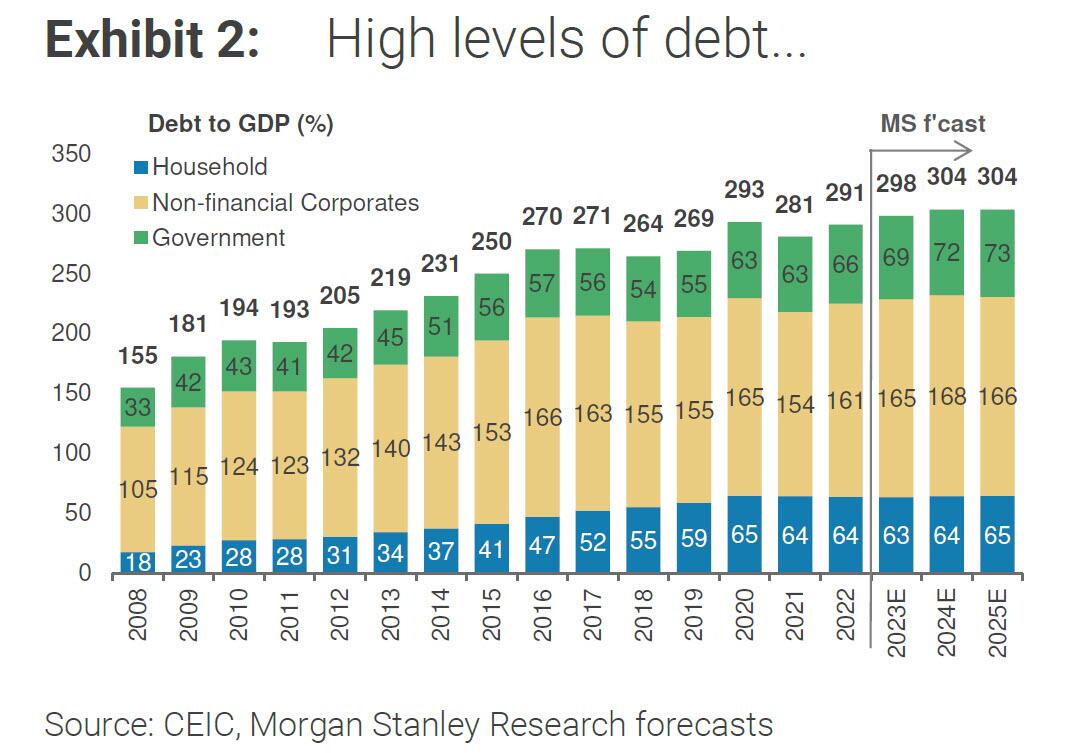
"We might think again, because the debt-to-GDP ratio is a little bit on the high side for a single 'A' credit," if China decides to expand its balance sheet to support the economy, James McCormack, global head of sovereigns, told Bloomberg TV, on Wednesday. He doesn't expect an imminent downgrade but noted that an increase in corporate and banking sector debt could become "real liabilities for the government." 

McCormack continued, "So if it really does extend its balance sheet to support the economy — and I wouldn't say we're expecting that, certainly recent evidence doesn't suggest that that will be the case — then we might think again because the debt to GDP ratio is a little bit on the high side for a single 'A' credit."

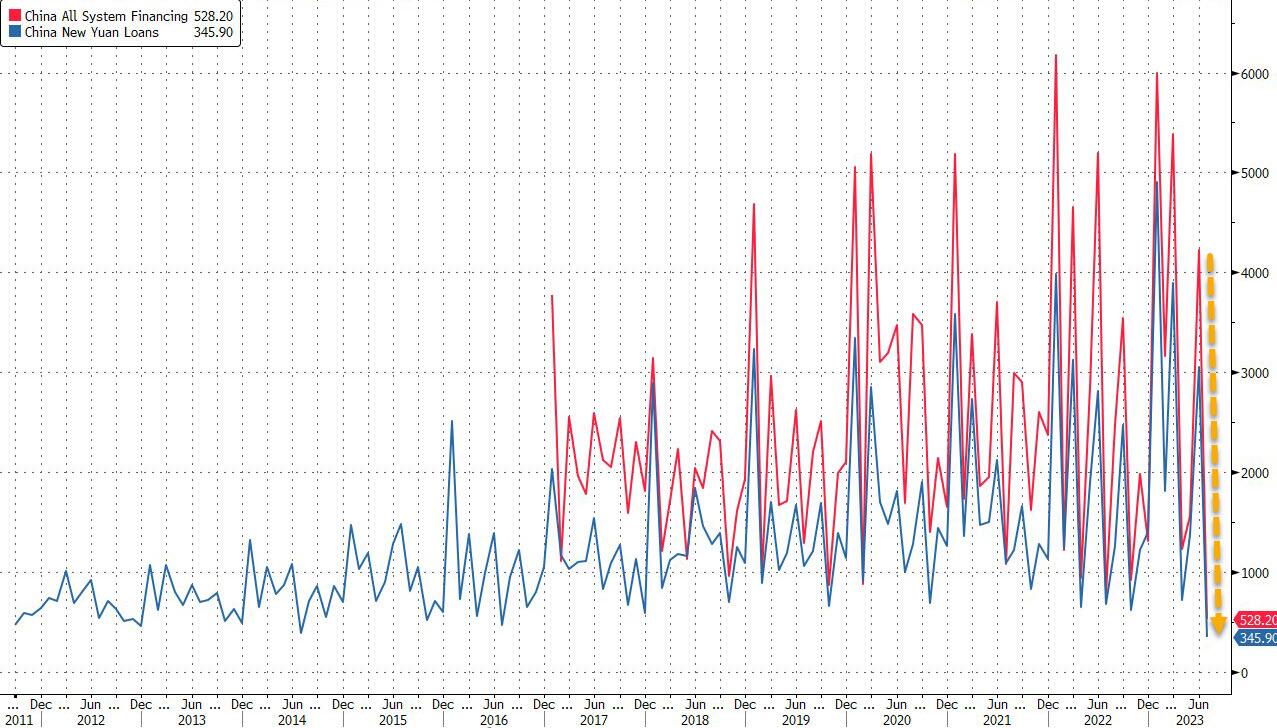
On Sunday, China's new loans tumbled in July to the lowest since 2009.

On Tuesday, the People's Bank of China cut interest rates on one-year loans -- the medium-term lending facility -- by around 15 bps to 2.5%, the most significant cut in three years. The move to stimulate the economy comes as the recovery appears to falter. 

Rabobank's Michael Every cites the Economic Observer, a subsidiary of Xinhua News Agency, which published a newsletter titled "Finance Bureau Chiefs in the Past Half Year," and which concluded that local government finances and the national economy are reportedly "on the verge of collapse, and the thunder will explode at any time." The dominos appear to be falling:

  • Country Garden just defaulted;

  • Zhongzhi Enterprise Group missed payments on high-yield investment products;

  • recent bank loan data were terrible;

  • and today saw industrial production 3.7% y-o-y (4.3% expected),

  • retail sales 2.5% y-o-y (vs. 4.0%),

  • fixed asset investment 3.4% y-o-y year-to-date (vs. 3.7%),

  • property sales -8.5% y-o-y year-to-date (vs. -8.1%),

  • and unemployment 5.3% vs. 5.2% (not to mention that youth unemployment which just hit all time highs, will no longer be reported for obvious reasons).

Evidently, the move to stimulate the economy suggests policymakers are in a panic. It'll be more challenging than ever to stimulate the economy because of the country's massive debt load. Becky Liu, head of China macro strategy at Standard Chartered Bank, noted, "Aside from helicopter money, nothing seems to be very effective so more aggressive actions will be needed to avert this downward momentum."

And Fitch is taking notice as to why it appears McCormack was floating a trial balloon on Bloomberg today about the risks of a China downgrade if non-government debt liabilities worsen. 

McCormack's comments about China come weeks after ratings agency downgraded the US and warned major US banks are at risk of downgrades

https://www.zerohedge.com/markets/fitch-may-reassess-chinas-credit-rating-if-debts-balloon-economy-falters

VinFast Stock Plunges After EV Maker's Blockbuster Nasdaq Debut

 Shares of electric-vehicle maker VinFast Auto are down more than 30%, a day after their first trading session on the Nasdaq.

VinFast shares more than tripled in their market debut Tuesday. That gave the company a market value of roughly $86 billion, putting it comfortably ahead of industry stalwarts General Motors and Ford, Refinitiv data shows.

Biophytis: Next Regulatory Steps in Europe, US for Severe Covid Project

 Biophytis SA (Nasdaq CM:BPTS, Euronext Growth Paris:ALBPS), ("Biophytis"), a clinical-stage biotechnology company specialized in the development of therapeutics that are aimed at slowing the degenerative processes associated with aging and improving functional outcomes for patients suffering from age-related diseases, announced today that it has received feedback from the European Medicines Agency (EMA) and the Food and Drug Administration (FDA) enabling it to plan the next regulatory steps for its COVA project dedicated to the development of Sarconeos (BIO101) for severe forms of Covid-19.

After filing requests for pre-submission meetings with both agencies in recent weeks, the company will now request a scientific advice meeting in Europe and a Type B meeting in the United States. The purpose of these meetings will be to gather recommendations from the EMA and the FDA to fine-tune COVA's development plan prior to marketing approval.

These discussions will enable Biophytis to present the available data (preclinical, clinical, product and industrialization) and specify the additional information to be provided in the context of marketing authorization applications, in particularly the design of a confirmatory phase 3 clinical study.

Biophytis will also present the agencies with the possibility of extending the scope of its indication to viral respiratory pathologies other than Covid-19, notably influenza, based on its non-specific mechanism of action. This extension would significantly increase the number of patients eligible for treatment and optimize the commercial potential of Sarconeos (BIO101).

https://finance.yahoo.com/news/biophytis-announces-next-regulatory-steps-051500486.html

Tuesday, August 15, 2023

Doctors Sound The Alarm Over Latest Obesity Drug Risk

  by Jack Phillips via The Epoch Times (emphasis ours),

Doctors are warning popular drugs taken for weight loss, such as Ozempic and Wegovy, may include the risk of life-threatening complications under anesthesia.

Patients who take drugs like Wegovy or Ozempic for weight loss may face life-threatening complications if they need surgery or other procedures that require empty stomachs for anesthesia.

This summer’s guidance to halt the medication for up to a week may not go far enough, officials said. Some anesthesiologists in the United States and Canada say they’ve seen growing numbers of patients on the weight-loss drugs who inhaled food and liquid into their lungs while sedated because their stomachs were still full—even after following standard instructions to stop eating for six to eight hours in advance.

The drugs can slow digestion so much that it puts patients at increased risk for the problem, called pulmonary aspiration, which can cause dangerous lung damage, infections, and even death, said Dr. Ion Hobai, an anesthesiologist at Massachusetts General Hospital in Boston.

This is such a serious sort of potential complication that everybody who takes this drug should know about it,” Mr. Hobai, who was among the first to flag the issue, told The Associated Press this week.

Mr. Hobai suggested that individuals taking the drugs first tell their doctors before sedation and discuss the risk profile. “If you’re taking this drug and you need an operation, you will need to have some extra precautions,” he said.

It’s not clear how many patients taking the anti-obesity drugs may be affected by the issue. But because the consequences can be so dire, Mr. Hobai and a group of colleagues decided to speak out. Writing in the Canadian Journal of Anesthesia in mid-July, they called for the drug to be stopped for even longer—about three weeks before sedation.

That accounts for how long semaglutide, the active medication in Ozempic and Wegovy, remains in the body, said Dr. Philip Jones, a Mayo Clinic anesthesiologist who is also deputy editor-in-chief of the journal. “When 90 percent of it is gone, which is after three weeks, hopefully everything should go back to normal,” Mr. Jones said.

Several weeks ago, the American Society of Anesthesiologists (ASA) said that people who take GLP-1 agonists like Wegovy or Ozempic every day should stop taking the drugs on the day of their surgery.

That guidance was disseminated after “many reports from medical literature and anesthesia leaders about people who fasted but still vomited either going to sleep or waking up from anesthesia,” said Dr. Ronald L. Harter, the incoming president of the ASA and a professor of anesthesiology at The Ohio State University Wexner Medical Center.

“This was very concerning and something we needed to address and communicate to the public like we are doing right now,” Mr. Harter told ABC.

Anesthesiologists have long discouraged patients from drinking or eating before surgery to ensure the stomach is empty to reduce the chance of vomiting during the procedure.

“This is really a fairly unique situation where you have a relatively new class of drugs that are very, very quickly being taken up by and are being used by a fairly significant portion of the population,” Mr. Harter said. “One of the potential side effects of these medications is to delay gastric emptying, which has a unique risk or potential for aspiration for patients undergoing anesthesia. It was a combination of all those factors that really prompted us to give guidance, really to our anesthesiologist and to our patients who are on these medications.”

The group stated that if the patient is having symptoms such as vomiting, bloating, abdominal pain, or nausea, doctors should consider delaying the surgical procedure.

Several weeks ago, the European Medicines Agency (EMA) said it was investigating a connection between Ozempic and Wegovy and suicidal thoughts. About 150 reports of possible cases of self-injury among people taking semaglutide GLP-1 agonists were flagged.

Sales of semaglutide products—particularly Ozempic—have soared in the past few years after the drug was shown to spur fast and significant weight loss. The drugs manufactured by Novo Nordisk include the brands Ozempic and Rybelsus, which are approved to treat diabetes, and Wegovy, which is approved by the FDA to treat obesity.

Earlier this year, Novo Nordisk promised to boost its supply of Wegovy. However, in the company’s first-quarter earnings report, the firm said that it would “temporarily” reduce U.S. supply.

Demand for the medications has outstripped supply. As of May, Ozempic and Wegovy remain on the FDA’s list of drug shortages. When drugs are in short supply, compounding pharmacies are permitted to produce versions of those medications.

The U.S. Food and Drug Administration (FDA) in 2014 approved semaglutide for weight loss among overweight or obese individuals with high blood pressure, Type 2 diabetes, and high cholesterol.

The Epoch Times has contacted Novo Nordisk for comment on Wednesday.

https://www.zerohedge.com/medical/doctors-sound-alarm-over-latest-drug-risk

VinFast: Vietnam EV maker valued at more than Ford or GM

Vietnamese electric vehicle (EV) maker VinFast's stock market valuation has soared above Ford and General Motors (GM) on its first day of trading.

Shares in the firm, which has yet to make a profit, surged by 255% in their debut on New York's Nasdaq.

That gave VinFast a stock market valuation of $85bn (£67bn), much higher than Ford's $48bn and GM's $46bn.

It comes as motor industry giants and newer manufacturers fight for a slice of the booming EV market.


The listing has added around $39bn to the net worth of Vinfast's chairman Pham Nhat Vuong.

He founded the company in 2017 and was already Vietnam's richest man.

Instead of a conventional share sale, VinFast went public using a shell company, or special purpose acquisition company (Spac).

Spacs are a often used by start-ups to speed up the often slow and expensive process of taking a private company public. In simple terms, it means merging a company that is not on a stock exchange with one that is.

Several EV makers - including Lordstown Motors and Faraday Future - have gone public using Spacs in the last three years.

However, both firms have lost more than 90% of their stock market value since their mergers.

VinFast also faces tough competition as major players fight for market domination.

Market leaders - including Elon Musk's Tesla and BYD, which is backed by veteran investor Warren Buffett - have been cutting prices to boost sales.

In the first half of the year VinFast delivered 11,300 EVs, according to a company presentation. By comparison, Tesla delivered more than 889,000 vehicles in the same period.

In the first three months of the year, the firm's revenue fell 49% from the previous year, and it posted a net loss of $598m. Last year, the company lost more than $2bn.


https://www.bbc.com/news/business-66517549

Chinese drugmakers develop copycat versions of ‘miracle’ weight-loss drug


Chinese pharmaceutical companies are developing domestic versions of “miracle” weight-loss drugs as they take on western drugmakers selling anti-obesity medication in one of the world’s biggest markets. 

 Chinese drug companies hope to compete with the Danish pharma group Novo Nordisk’s pioneering drugs in China, which has the world’s largest overweight and diabetic population. If successful, they could also potentially offer a cheaper alternative in the west. 

 The new generation of weight-loss drugs form part of a category called glucagon-like peptide-1 agonists or GLP-1s. Novo Nordisk’s semaglutide or Ozempic dominates the market, but dozens using the same mechanism are undergoing clinical trials in China, analysts said.

 “There will be an explosion in supply at the latest by 2026,” said Beijing-based UBS pharmaceutical analyst Chen Chen. Novo Nordisk’s Wegovy, a version of Ozempic marketed for weight loss, is in short supply globally after it was found to produce a 15 per cent average reduction in patients’ body weight

. The market for diabetes and new weight-loss drugs is forecast by analysts to reach $130bn-$140bn in sales worldwide. Chinese health officials have said tackling diabetes and obesity is a top policy priority as the country’s ageing population takes a toll on the hospital and social care systems. 

Some 89mn people are living with diabetes in China, just over 8 per cent of the population, a figure that The Lancet forecasts will reach 108mn by the end of the decade, or 10 per cent of the population.

 Chinese health officials have prioritised tackling diabetes and obesity in the country’s ageing population © Oriental Image/Reuters While many multinationals are trying to diversify sales away from China, western pharmaceutical groups including Moderna and AstraZeneca are digging in, striking investment deals and joint ventures with local companies to capitalise on the huge potential presented by the ageing population. 

Novo Nordisk currently dominates the $500mn Chinese market for GLP-1 drugs, according to analytics group Clarivate. So far Chinese regulators have approved Novo Nordisk’s drug only for diabetes, but users can get it from doctors for weight loss or purchase it on the black market. The same compounds are used to treat diabetes and obesity.

 Last month Beijing gave the first approval for GLP-1 weight loss drugs, made by Chinese companies Huadong Medicine and Shanghai Benemae Pharmaceutical. Analysts predict Novo Nordisk will soon gain approval in China for its weight-loss drug Wegovy, which only requires an injection once a week, compared with the daily dose for Huadong’s and three doses for Benemae’s medicine.

 Helen Chen, greater China managing partner at LEK Consulting in Shanghai, said as many as 70 drugs were being trialled but domestic rivals would not “make much of a dent” until they were included on a government procurement list. Even if domestic rivals capture a larger share of market demand, analysts are still projecting revenue to grow for Novo Nordisk.

 Clarivate forecasts GLP-1 sales in China will grow eight-fold to reach $4.2bn in 2031, with Novo Nordisk still the market leader. In the west, Novo Nordisk faces competition from US pharma group Eli Lilly’s tirzepatide, also known as Mounjaro, which is expected to receive approval for weight loss soon. In a phase-three trial, participants lost an average of 22.5 per cent of their body weight.

 The pair will also compete in China when Eli Lilly introduces tirzepatide for weight loss. It has also sold the rights for its weight-loss drug mazdutide, currently in phase-three trial, to the Suzhou-based biotech group Innovent. Analysts at Goldman Sachs estimate Innovent will account for 19 per cent of GLP-1 sales in China by 2033, given its strong clinical results and marketing spend.

 Meanwhile, a Chinese rival keen to take a slice of this growing market is challenging Novo Nordisk’s semaglutide patent, which is due to expire in 2026. Last year, China’s National Intellectual Property Administration judged in favour of Huadong, which argued Novo Nordisk’s patent was invalid. 

The Danish group is appealing against the decision in a higher-level court. Cheaper Chinese drugs might also prove attractive to stretched healthcare systems in the west, analysts said. Recommended The Big Read Weight-loss drugs: will health systems and insurers pay for ‘skinny jabs’?

 Emily Field, an analyst at Barclays, said obesity drugs were a “price-sensitive” market. “My reading of the tea leaves on this is that over time it will evolve into portfolios of options of orals and injectables,” she said.

 Less effective and cheaper drugs could still be attractive, she said. “Some patients absolutely do need to lose 50 per cent. For some, 15 per cent is a healthy range.” 

 London-based UBS pharma analyst Michael Leuchten said 5-10 per cent weight loss was not a high bar for these companies to meet. But he added that to be approved in the US, Chinese companies would have to show data collected in trials outside of China, a lengthy process.

 “Then if there is a very cheap option that is pretty good, some pragmatic countries might open the door to local players,” he said. “Government players will love you for it as prices come down.”

https://www.ft.com/content/9559b587-4de3-4b68-a311-7bfc77870855