The Marine Corps acting commandant, Eric Smith, on Monday issued a two-day stand-down to take place at some point this week for all aviation units both inside and outside of the United States, a Marine Corps spokesman told ABC News.
The move was made in the wake of a "mishap" with an F-35 fighter jet in South Carolina on Sunday.
That craft has not yet been located, though the military continues to search.
A Marine Corps spokesperson said in a statement on Sunday that the F-35's pilot "safely ejected from the aircraft. We are currently still gathering more information and assessing the situation. The mishap will be under investigation."
No units are allowed to fly until they have a two-day discussion about safety measures and procedures, the commandant said in a service-wide email on Monday. While the Marine Corps commandant said he has full confidence in the aviation units, he said he felt this was the "right and prudent" thing to do given both this incident and another recent incident in Australia.
One promising approach to treating type 1 diabetes is implanting pancreatic islet cells that can produce insulin when needed, which can free patients from giving themselves frequent insulin injections. However, one major obstacle to this approach is that once the cells are implanted, they eventually run out of oxygen and stop producing insulin.
To overcome that hurdle, MIT engineers have designed a new implantable device that not only carries hundreds of thousands of insulin-producing islet cells, but also has its own on-board oxygen factory, which generates oxygen by splitting water vapor found in the body.
The researchers showed that when implanted into diabetic mice, this device could keep the mice's blood glucose levels stable for at least a month. The researchers now hope to create a larger version of the device, about the size of a stick of chewing gum, that could eventually be tested in people with type 1 diabetes.
"You can think of this as a living medical device that is made from human cells that secrete insulin, along with an electronic life support-system. We're excited by the progress so far, and we really are optimistic that this technology could end up helping patients," says Daniel Anderson, a professor in MIT's Department of Chemical Engineering, a member of MIT's Koch Institute for Integrative Cancer Research and Institute for Medical Engineering and Science (IMES), and the senior author of the study.
While the researchers' main focus is on diabetes treatment, they say that this kind of device could also be adapted to treat other diseases that require repeated delivery of therapeutic proteins.
MIT Research Scientist Siddharth Krishnan is the lead author of the paper, which appears in the Proceedings of the National Academy of Sciences. The research team also includes several other researchers from MIT, including Robert Langer, the David H. Koch Institute Professor at MIT and a member of the Koch Institute, as well as researchers from Boston Children's Hospital.
Replacing injections
Most patients with type 1 diabetes have to monitor their blood glucose levels carefully and inject themselves with insulin at least once a day. However, this process doesn't replicate the body's natural ability to control blood glucose levels.
"The vast majority of diabetics that are insulin-dependent are injecting themselves with insulin, and doing their very best, but they do not have healthy blood sugar levels," Anderson says. "If you look at their blood sugar levels, even for people that are very dedicated to being careful, they just can't match what a living pancreas can do."
A better alternative would be to transplant cells that produce insulin whenever they detect surges in the patient's blood glucose levels. Some diabetes patients have received transplanted islet cells from human cadavers, which can achieve long-term control of diabetes; however, these patients have to take immunosuppressive drugs to prevent their body from rejecting the implanted cells.
More recently, researchers have shown similar success with islet cells derived from stem cells, but patients who receive those cells also need to take immunosuppressive drugs.
Another possibility, which could prevent the need for immunosuppressive drugs, is to encapsulate the transplanted cells within a flexible device that protects the cells from the immune system. However, finding a reliable oxygen supply for these encapsulated cells has proven challenging.
Some experimental devices, including one that has been tested in clinical trials, feature an oxygen chamber that can supply the cells, but this chamber needs to be reloaded periodically. Other researchers have developed implants that include chemical reagents that can generate oxygen, but these also run out eventually.
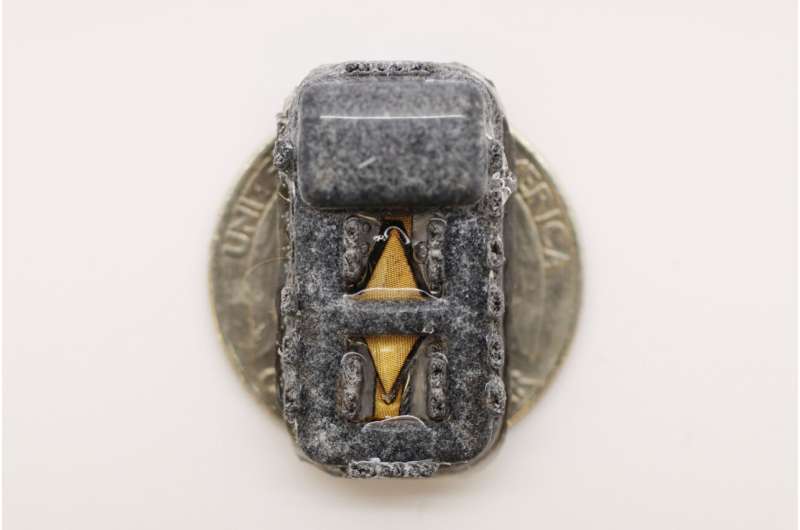
Optical image of cathode side of fully assembled O2-Macrodevice showing, with a United States quarter-dollar coin for scale. Credit: Claudia Liu and Dr. Siddharth Krishnan, MIT/Boston Children’s Hospital
The MIT team took a different approach that could potentially generate oxygen indefinitely, by splitting water. This is done using a proton-exchange membrane—a technology originally deployed to generate hydrogen in fuel cells—located within the device. This membrane can split water vapor (found abundantly in the body) into hydrogen, which diffuses harmlessly away, and oxygen, which goes into a storage chamber that feeds the islet cells through a thin, oxygen-permeable membrane.
A significant advantage of this approach is that it does not require any wires or batteries. Splitting this water vapor requires a small voltage (about 2 volts), which is generated using a phenomenon known as resonant inductive coupling. A tuned magnetic coil located outside the body transmits power to a small, flexible antenna within the device, allowing for wireless power transfer. It does require an external coil, which the researchers anticipate could be worn as a patch on the patient's skin.
Drugs on demand
After building their device, which is about the size of a U.S. quarter, the researchers tested it in diabetic mice. One group of mice received the device with the oxygen-generating, water-splitting membrane, while the other received a device that contained islet cells without any supplemental oxygen. The devices were implanted just under the skin, in mice with fully functional immune systems.
The researchers found that mice implanted with the oxygen-generating device were able to maintain normal blood glucose levels, comparable to healthy animals. However, mice that received the non-oxygenated device became hyperglycemic (with elevated blood sugar) within about two weeks.
Typically when any kind of medical device is implanted in the body, attack by the immune system leads to a buildup of scar tissue called fibrosis, which can reduce the devices' effectiveness. This kind of scar tissue did form around the implants used in this study, but the device's success in controlling blood glucose levels suggests that insulin was still able to diffuse out of the device, and glucose into it.
This approach could also be used to deliver cells that produce other types of therapeutic proteins that need to be given over long periods of time. In this study, the researchers showed that the device could also keep alive cells that produce erythropoietin, a protein that stimulates red blood cell production.
"We're optimistic that it will be possible to make living medical devices that can reside in the body and produce drugs as needed," Anderson says. "There are a variety of diseases where patients need to take proteins exogenously, sometimes very frequently. If we can replace the need for infusions every other week with a single implant that can act for a long time, I think that could really help a lot of patients."
The researchers now plan to adapt the device for testing in larger animals and eventually humans. For human use, they hope to develop an implant that would be about the size of a stick of chewing gum. They also plan to test whether the device can remain in the body for longer periods of time.
"The materials we've used are inherently stable and long-lived, so I think that kind of long-term operation is within the realm of possibility, and that's what we're working on," Krishnan says.
"We are very excited about these findings, which we believe could provide a whole new way of someday treating diabetes and possibly other diseases," Langer adds.
More information: Krishnan, Siddharth R. et al, A wireless, battery-free device enables oxygen generation and immune protection of therapeutic xenotransplants in vivo, Proceedings of the National Academy of Sciences (2023). DOI: 10.1073/pnas.2311707120. doi.org/10.1073/pnas.2311707120
Anebulo Pharmaceuticals is an emerging specialty biopharmaceutical company with a primary focus on developing therapy for acute cannabinoid intoxication (ACI), presenting a unique opportunity as approximately 2.1 million ACI cases are reported in U.S. emergency departments annually.
The company has produced compelling clinical proof-of-concept data, employing a visual analog scale (VAS) methodology to measure the substantial reduction in ACI symptoms, particularly the alteration in the sensation of being "high." This data serves as a risk mitigation factor for the forthcoming clinical advancement of ANEB-001.
The analysts Boobalan Pachaiyappan and Raghuram Selvaraju note that the ACI indication appears to share some characteristics with the opioid overdose crisis, which resulted in many non-fatal overdoses each year and resulted in nearly 110K deaths in the U.S. alone during 2022.
The analysts note that Anebulo's strategy centers around utilizing ANEB-001, a small molecule antagonist targeting the CB1 cannabinoid receptor.
H.C. Wainwright says that positive pivotal data for ANEB-001 could make Anebulo an attractive acquisition target.
The analyst says that ANEB-001 could be priced at $2.5K per administration and may ultimately achieve total sales approaching $500 million in the U.S. alone. Assuming a conservative potential launch in 2028, ANEB-001 could reach the U.S. market in 2027, depending upon the speed at which the clinical development progresses. Peak sales could be achieved in the late 2030s.
HC Wainwrighthas upgraded Oncternal Therapeutics Inc ONCTto Buy from Neutral with a price target of $2.
At the European Hematology Association meeting earlier this year, Oncternal unveiled initial findings from preclinical investigations that assessed T cells and natural killer (NK) cells expressing the company's ROR1 CAR, featuring the antigen-binding segment of zilovertamab.
NK92 cells engineered with the anti-ROR1 CAR exhibited degranulation when exposed to ROR1+ cancer cells in vitro.
Furthermore, anti-ROR1 CAR T cells displayed statistically significant anti-tumor activity against the rapidly proliferating mantle cell lymphoma (MCL) line known as JeKo-1 in vivo.
Although cancer cell growth rebounded in mice treated with the lowest dose, both the intermediate and high doses of anti-ROR1 CAR-T cells effectively maintained the cancer cell burden at a low level. These results are particularly noteworthy when considering the efficacy outcomes observed with zilovertamab vedotin and the preclinical data for ONCT-808.
During the 2023 annual American Society of Clinical Oncology meeting, Merck & Co Inc MRK presented initial results from the Phase 2 waveLINE-004 trial of zilovertamab vedotin (MK-2140)—a ROR1-targeted ADC that Merck acquired for approximately $2.8B in 2020 through its purchase of VelosBio—in r/r DLBCL patients who progressed after or were ineligible for autologous stem cell therapy.
Zilovertamab vedotin achieved a 30% ORR (10% CR) in 20 efficacy-evaluable patients; this is relatively in line with the 29% ORR that zilovertamab vedotin demonstrated in r/r DLBCL patients (n=17) in the Phase 1 waveLINE-001 trial.
The analysts Raghuram Selvaraju and Robert Burns write that the waveLINE-004 results set the benchmark that ONCT-808 must meaningfully surpass.
With the potential for more than two dozen label expansions on the horizon, Bristol Myers Squibb bets its pipeline can help it withstand the pressure from the Inflation Reduction Act and a trio of weighty patent losses.
As a measure of the company’s R&D prowess, BMS has scored nine FDA approvals over the last three years and more than 45 regulatory nods globally over that same stretch, Chris Boerner, BMS’ chief operating officer and incoming CEO, said during the company’s R&D Day Thursday.
Now, BMS aims to clinch more than 25 label expansions for its approved drugs over the coming years, the company said in an accompanying press release.
“The starting point is strong,” Boerner said.
“At the same time,” he caveated, “we recognize that we have entered a period of headwinds.”
The executive singled out last year’s Inflation Reduction Act (IRA), under which BMS’ blockbuster blood thinner Eliquis will be up for Medicare price negotiations in 2026. He also brought attention to losses of exclusivity, related not just to blood cancer drug Revlimid—which fell victim to generics last spring—but also Eliquis, and, toward the end of the decade, Opdivo.
That said, Boerner sees a clear opportunity to “navigate” those headwinds and “drive sustained, reliable growth over time.”
BMS is presenting its pipeline roadmap after a rough stretch since Revlimid's loss of exclusivity. For one, the company in July projected 2023 sales will fall compared with last year. Investors have been anxious too, with the company's share price falling around 18% so far in 2023.
To rebound, BMS will count on a diversified pipeline. The company now has 12 registrational programs that will be visible over the next 18 months, Boerner said, versus just six at the beginning of 2023. Plus, the company boasts an “exciting” set of early assets that will form its next wave of medicines, he added.
But it’s not all about early-stage assets, given Bristol’s potential to nab some 25 label expansions in the coming years.
In immunology, for instance, Sotyktu makes up one of four drugs in a portfolio of new launches that could reach individal peak sales of more than $4 billion, BMS figures. That drug, approved in September 2022 for plaque psoriasis, is nearing a phase 3 readout in psoriatic arthritis and recently kicked off a late-stage trial in systemic lupus erythematosus.
At the same time, BMS revealed Thursday that it’s no longer pursuing the development of Sotyktu in inflammatory bowel disease (IBD).
Elsewhere, BMS is leveraging improved manufacturing of its CD19-directed CAR-T medicines to take its cell therapy prospects into immunology, Samit Hirawat, M.D., chief medical officer of drug development, said in an interview.
In this field, BMS is first targeting systemic lupus erythematosus, but it’s also looking to pursue other indications such as myositis. Plus, the company soon plans to submit an investigational new drug application to study the CAR-T approach in patients with multiple sclerosis, the CMO added.
BMS is also banking on Zeposia—its multiple sclerosis and ulcerative colitis drug—to land an approval in Crohn’s disease. The drug is currently in phase 3 trials for that indication.
In oncology, meanwhile, BMS is angling for label expansions on Opdualag and Opdivo, plus the potential for a subcutaneous formulation of the latter cancer drug. Data on that below-the-skin formulation of Opdivo should be arriving “imminently,” Hirawat said, specifying that those results could read out in the “next couple of months.”
The company still has room to grow in hematology, too, thanks to Reblozyl, which recently added a new indication and still has “more to follow,” Hirawat said.
All told, BMS thinks it has a “very rich, very deep, very differentiated pipeline” that portends a “bright future,” not just from a pipeline perspective, but a business perspective, too, Hirawat said.
BMS is keeping its eyes peeled for external prospects, too. When it comes to internal versus external innovation, BMS relies on a “healthy balance of both,” Robert Plenge, M.D., Ph.D., chief research officer and head of research at BMS, said during the interview.
BMS’ excitement around its pipeline comes as the company’s star player Revlimid falls to generics faster than expected. Back in July, BMS sliced its 2023 sales projection for Revlimid by a whopping $1 billion and cut its overall revenue forecast, too.
“We do not take an adjustment of this magnitude lightly,” said departing CEO Giovanni Caforio, who will step down in November to be replaced by Boerner.
But BMS has urged investors to stay calm, pointing to four growth “pillars” it expects to lean on through the second half of the decade.
Through 2025, the company expects its immuno-oncology stalwarts Opdivo and Yervoy—plus blood thinner Eliquis—to together chip in another $8 billion to $10 billion in annual growth.
Another $10 billion to $13 billion in annual sales is expected from BMS' recent and expected near-term launches, Caforio said last year. Those include CAR-T therapy Breyanzi, anemia drug Reblozyl and psoriasis launch Sotyktu.
By 2029, the company has said its portfolio of new launches could deliver $25 billion or more.
With backing from an FDA advisory committee and results from a positive phase 3 trial, respectively, Alnylam and BridgeBio are each on track to enter the blockbuster transthyretin amyloidosis cardiomyopathy (ATTR-CM) market. But doctors say they’ll mostly stick with Pfizer’s first-to-market franchise, according to two analyst groups.
Pfizer’s tafamidis, sold as Vyndaqel and Vyndamax, will largely be able to maintain a 60%-plus share of treated patients in the next few years as the overall ATTR-CM market grows, Leerink Partners analysts said in a Monday note based on a survey of 57 doctors who treat the condition.
Separately, after talking to a cardiology opinion leader, analysts at Evercore ISI concluded that tafamidis “seems quite entrenched” and “might be difficult to displace,” according to a Friday note.
Tafamidis will likely remain the ATTR-CM leader even as Alnylam’s Onpattro and BridgeBio’s acoramidis hit the scene, according to the analysts.
For Onpattro, external advisers to the FDA last week voted 9-3 in support of the RNA silencer’s use in ATTR-CM. But because Onapttro only showed a “small” benefit in a phase 3 trial, several advisory committee members frowned upon the idea of using the Alnylam drug as an alternative to tafamidis in newly diagnosed patients.
Similarly, 68% of doctors polled by Leerink said they would use Onpattro—if approved—only after a patient fails on tafamidis. In their responses, several doctors said tafamidis, as an oral med, is more convenient than Onpattro, which is an infusion. Some said tafamidis is well established and that there’s no need to use another drug.
In addition, the expert interviewed by Evercore ISI said he would also reserve Onpattro for patients who’ve failed on tafamidis.
Pfizer’s tafamidis stabilizes TTR to prevent progression of ATTR. Theoretically, it could work alongside the RNA-interfering Onpattro because of the drugs’ different mechanisms of action. Opinions on this combination approach are divided, with 54% of doctors surveyed by Leerink saying they are unsure about its validity. Evercore’s expert said doctors likely won’t use the two drugs together unless data prove the benefit.
Meanwhile, market penetration might be easier for another TTR stabilizer in BridgeBio’s acoramidis. In a phase 3 trial, acoramidis reduced the risk of cardiovascular-related death by 30% and CV-related hospitalization by 50% compared with placebo in ATTR-CM. Alnylam’s Onpattro doesn’t have statistically powered CV outcomes data.
More than 80% of physicians surveyed by Leerink see acoramidis as an attractive option for ATTR-CM. About half of the doctors are willing to use acoramidis as a first-line therapy, but most still expect a minimal shift from tafamidis.
Evercore’s expert argued the two stabilizers are too similar to support switching and that acoramidis’s twice-daily dosing is a disadvantage compared with tafamidis’s once-daily frequency. But because reimbursement hurdles and out-of-pocket costs are a problem for patients on tafamidis, BridgeBio could convince doctors to switch with “a significant cost advantage,” he said.
Based on the survey, Leerink’s analysts picture a different outlook for tafamidis than the Wall Street average. Rather than a fast revenue increase in the next few years followed by a decline beginning around 2025, the Leerink team expects tafamidis to continue to grow from $2.4 billion in 2022 and peak at nearly $4 billion around 2029.
As for acoramidis, the Leerink team believes the drug could reach $1.8 billion in sales in 2030. Current consensus has Onpattro’s 2030 sales at $654 million, according to Leerink.
Alnylam is gunning for another ATTR-CM nod for its second-generation silencer, Amvuttra, with a phase 3 readout expected soon. The Leerink team expects Amvuttra will hold the largest share within the silencer class, pegging its potential at $3.4 billion by 2030 versus a consensus estimate of $5 billion.
Amid Sanofi’s multi-year effort to simplify its product portfolio, the drugmaker is offloading 11 central nervous system (CNS) meds to lifecycle management company Pharmanovia.
Sanofi is selling drugs that range the psycholeptic, anxiolytic, anti-epileptic and anti-psychotic treatment fields. The drugs involved in the deal are Frisium, Sentil, Urbanyl, Urbanil, Urbanol, Urbadan, Noiafren, Castilium, Gardenal, Tercian and Stemetil.
As for Pharmanovia, the company "revitalizes, extends and expands” the lifecycle of established medicine brands, it said in a statement.
The terms of the deal were not disclosed.
For years, Sanofi CEO Paul Hudson has been on a mission to center the company around first-in-class or best-in-class growth drivers.
It seems that many of Sanofi’s CNS meds have no place in the focused company, as the company inked a separate divestment of 15 CNS products to Neuraxpharm last year. That deal also included two pain and vascular treatments.
The company hasn't only sold of its CNS medicines. In July, Germany's Stada became the new owner of a clutch of former Sanofi consumer health products. That deal followed a similar 2021 sale of Sanofi consumer products.
Separately, Sanofi last summer returned exclusive worldwide rights to cancer med Libtayo to partner Regeneron for $900 million.
Meanwhile, Sanofi and Regeneron's superstar immunology drug Dupixent is on a roll. The companies recently presented phase 3 trial data proving the drug’s worth in chronic obstructive pulmonary disease (COPD), an indication the two will file for next year.
In the first half of the year, Dupixent pulled in nearly 4.9 billion euros, a 37% increase from the same period in 2022.
Now, Sanofi reached what Hudson calls a “new steady state," during which it will focus on new launches, including hemophilia A treatment Altuviiio and infant RSV antibody Beyfortus.