Search This Blog

Wednesday, November 8, 2023

France reported to be probing Sanofi over Dupixent launch

 France’s financial prosecutor has reportedly launched an investigation into Sanofi’s “financial communication” surrounding the launch of its biggest-selling drug Dupixent.

According to French investigative news outlet La Lettre, a preliminary investigation has been opened by the Parquet National Financier (PNF), focusing on information issued by Sanofi in 2017, when it first brought Dupixent (dupilumab) to market as a treatment for atopic dermatitis.

The report, which cites an unnamed “judicial official”, alludes to allegations of “dissemination of false or misleading information and price manipulation.”

Sanofi said in a statement it was “not aware of any preliminary investigation […] into its 2017 accounts or otherwise,” and insisted that, as a publicly listed company, “the financial information that Sanofi publishes is accurate, precise, and truthful, and is also duly audited by two auditing firms.”

The company also said it “reserved the right to take legal action against any false or defamatory allegations.” Shares in Sanofi fell as much as 1.3% after the news emerged yesterday, but closed down 0.6%.

A preliminary investigation by the PNF does not necessarily lead to a formal probe, so, it is quite possible that no further action will be taken.

Sanofi launched Dupixent in 2017 with a peak annual sales prediction of around $3 billion or more that was lower than some analyst predictions, including Evaluate, which was forecasting $5 billion-plus for the product.

Since then, the Regeneron-partnered product has seen its annual sales swell beyond all expectations – pumped up by a steady stream of new indications, including severe asthma, chronic rhinosinusitis with nasal polyps, eosinophilic oesophagitis, and prurigo nodularis – to reach $8.9 billion last year, up nearly 44% on 2021.

In its third-quarter results, Sanofi said it expects the strong growth to continue this year, with annualised sales nearing $11.75 billion and, while the performance of the product has been a massive boost to Sanofi, it has led some shareholders to voice concerns it could become over-reliant on the product.

Under chief executive Paul Hudson, who took the helm in 2019, Sanofi has been undertaking a major restructuring, spinning off its active pharmaceutical ingredients business last year and announcing last month it may follow the same path with its consumer health unit, becoming a pure-play prescription pharma business.

Hudson is looking to a new wave of product launches to reduce its reliance on Dupixent, including respiratory syncytial virus (RSV) prevention therapy Beyfortus (nirsevimab), once-weekly haemophilia A therapy Altuviio (efanesoctocog alfa), and Tzield (teplizumab) for type 1 diabetes, as well as late-stage developmental drugs like frexalimab for multiple sclerosis, RSV and pneumococcal vaccines, and amlitelimab for atopic dermatitis.

https://pharmaphorum.com/news/france-reported-be-probing-sanofi-over-dupixent-launch

FTC challenges dozens of ‘improper’ US drug patents

 The financial regulator in the US has sent letters to 10 companies that it claims have improperly listed patents in the FDA’s ‘Orange Book’ in order to block generic rivals.

The Federal Trade Commission (FTC) is contesting the validity of more than 100 patents held by manufacturers of brand-name asthma inhalers, epinephrine autoinjectors, and other drug products, and has told the FDA that it disputes their “accuracy or relevance.”

The agency warned in September that it may consider legal action against companies who list new patents in the Orange Book – or Approved Drug Products with Therapeutic Equivalence Evaluations, as it is otherwise known – in order to trigger processes that delay the entry of generics into the market.

The FDA is automatically barred from approving a generic drug for 30 months if a brand-name drug company sues a generic competitor for infringing on an Orange Book-listed patent, regardless of the outcome of the lawsuit.

In the firing line are AbbVie, AstraZeneca, Boehringer Ingelheim, Impax Laboratories, Kaleo, Viatris unit Mylan Specialty, and subsidiaries of GSK and Teva, which have all received notice letters in connection with the crackdown.

For example, AZ is being challenged over patents for its asthma inhaler Symbicort (budesonide/formoterol), which made $2.5 billion in sales last year, with other letters highlighting Boehringer’s $1.6 billion chronic obstructive pulmonary disease (COPD) therapy Spiriva (tiotropium bromide) and Mylan’s EpiPen (epinephrine) products, which had $378 million in 2022 revenues and have come under scrutiny for big price rises in recent years. The full list of letters is available here.

“Wrongfully listed patents can significantly drive up the prices Americans must pay for medicines and drug products, while undermining fair and honest competition,” said the FTC's chair, Lina Khan.

“We will continue to use all our tools to protect Americans from illegal business tactics that are hiking the cost of drugs and drug products.”

The FTC noted that it is up to the FDA to send a statement of dispute to the owner of the patent, who will then have 30 days to withdraw or amend these listings or certify under penalty of perjury that the listings are valid.

FDA Commissioner Robert Califf added his voice to the dispute, reminding all holders of drug approvals that “they are obligated to ensure that patent listings comply with statutory and regulatory requirements and to substantively respond to statements of dispute provided under the FDA’s patent listing dispute process.”

The move is further evidence of increasing scrutiny of the activities of the pharma industry by the FTC, which has also been taking a tougher stance on mergers and acquisitions in the sector and launching investigations into the role of pharmacy benefit managers in the medicines supply chain.

https://pharmaphorum.com/news/ftc-challenges-dozens-improper-us-drug-patents

Pressure grows on US Treasury to salvage trucking giant Yellow

 Congressional pressure is growing on the U.S. Treasury to help salvage trucking giant Yellow from bankruptcy, from Republicans and Democrats alike, letters viewed by Reuters show.

Republican Senator Josh Hawley is the latest lawmaker to ask Treasury, in a letter on Thursday, to extend the terms of a controversial $700 billion pandemic loan granted by the Trump administration to Yellow.

It follows separate letters sent by Republican Senator Roger Marshall and Democrats Sherrod Brown and Bob Casey last month. Earlier this week, Democratic senators Elizabeth Warren and Ed Markey sent letters.

THE TAKE

Republicans and Democrats pushing Treasury could benefit Jack Cooper, one the largest U.S. privately owned auto transport companies, making its long-shot bid to rescue Yellow from bankruptcy liquidation more likely.

Key to Jack Cooper's bid is convincing Treasury to extend the loan currently due at the end of September 2024 to the same time in 2026, allowing Jack Cooper to offer more favorable terms for Yellow.

NOTABLE QUOTE

"A modification of the repayment terms will allow Yellow to obtain a buyer who will keep its assets together as a going concern - that is, keep it in business as a player in the trucking sector," Hawley wrote, noting reports of such a buyer.

Making Yellow’s "loan repayment terms more flexible, is a commonsense step to keep Yellow’s trucks on the road, and keep its workforce gainfully employed," he wrote.

CONTEXT

Yellow, formerly known as YRC, is one of the largest so-called less-than-truck load carriers in the U.S. Its customers include Walmart and Home Depot.

The Biden administration is looking at ways the company could be allowed to continue to operate, urged on by the International Brotherhood of Teamsters union that lost thousands of jobs.

Yellow's assets include 12,000 trucks and 35,000 trailers, along with hundreds of terminals, according to its bankruptcy court filing. It fired 22,000 union drivers, and plans to sell the trucks and real estate separately.


Endgame: Interest On US Debt Skyrockets Above $1 Trillion For The First Time Ever

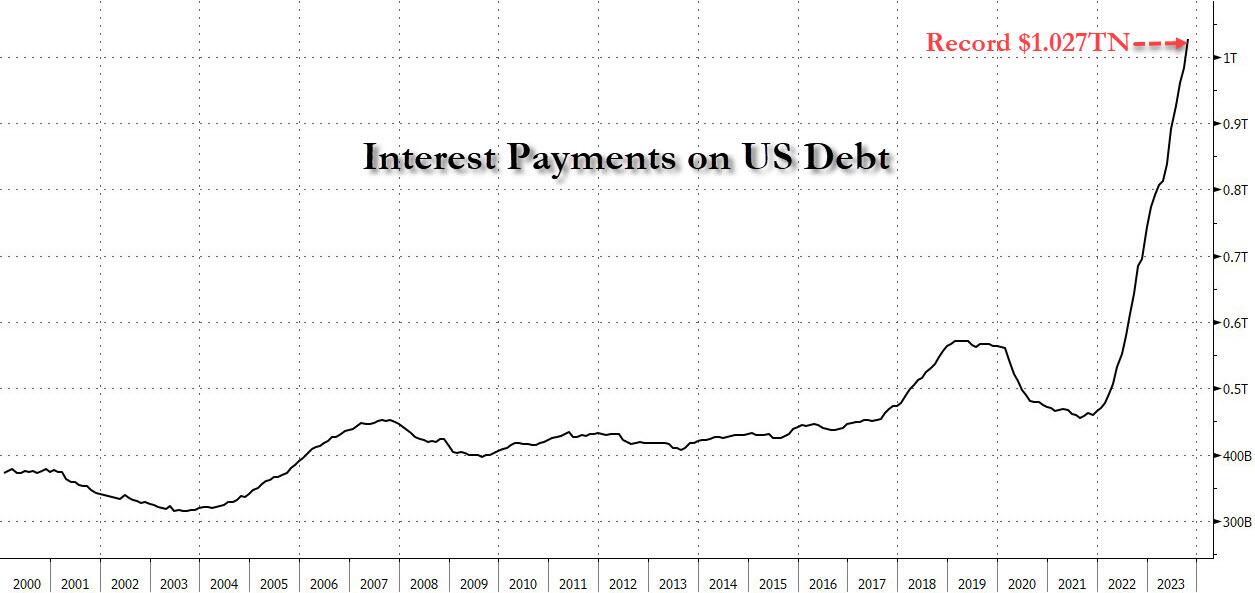
 Back in July, when we last looked at the unprecedented horror show that is the US budget deficit - and concluded correctly, long before the Q2 Quarterly Refunding Announcement,  that debt issuance was about to explode and yields would soar - we warned that the debt Rubicon was about to be crossed and "US Debt Interest Payments Are About To Hit $1 Trillion."

Fast forward to today when the endgame has apparently arrived: according to the Treasury's own calculations, total interest is now over $1 trillion (or $1.027 trillion to be precise).

We calculated this by multiplying the average interest rate on marketable US Treasury debt (which according to the Treasury is 3.096% as of Oct 31) by the $26.003 trillion in marketable US debt (as of Oct 31) which nets off to $805 billion, and adding to this non-marketable debt interest (which as of Oct 31 was 2.884% multiplied by the amount of non-marketable debt which is $7.696 trillion) and which in turn is an additional $222 billion in interest. Add across and you get $1.027 trillion.

Naturally, this calculation of estimated real-time interest costs - which is entirely based on Treasury data - is different than what the Treasury actually paid. Interest costs in the fiscal year that ended Sept. 30 ultimately totaled $879.3 billion, up from $717.6 billion the previous year and about 14% of total outlays, however that number is merely lagging what the pro forma print currently is, and will inevitably catch up to it, and then lag on the other side even as pro forma interest payment start dropping (once interest rates plunge after the next QE/YCC is launched).

Fans of exponential functions, we got you covered: the unprecedented surge in both interest rates and interest expense in the past two years means that total US interest has doubled since April 2022 and that's with the inherent lag in interest catch up - as a reminder, the vast majority of 5, 7, 10 and 30 year debt is still locked in at much lower interest rates, and as such, rates will continue to rise as all of the existing debt rolls into much higher rates over the coming years.

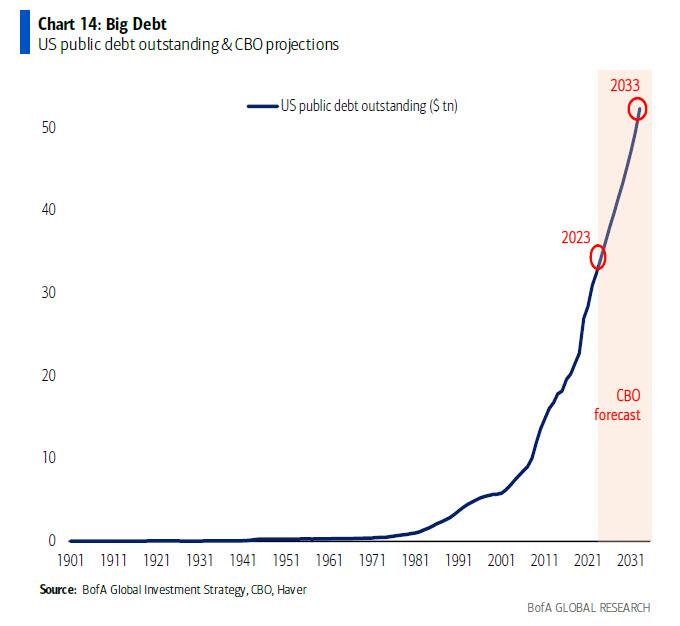
Looking ahead, the staggering surge in both yields and total long-term Treasuries in recent months confirms the government will continue to face an escalating interest bill. As a reminder, we were the first to point out that it took just one month after US federal debt first rose above $33 trillion for the first time, to spike by another $600 billion...

... bringing the total to $33.6 trillion, more than the combined GDPs of China, Japan, Germany, and India.

And just to show you how terrifying it is about to get, BofA's Michael Hartnett notes that "the CBO projects that US government debt will rise by $20 trillion next 10 years, or $5.2 billion every day or $218 million every hour!"

Some more context: total world debt (government, corporate & household) hit a record $227tn in Q1’23, double from $110tn in 2007 & $0.5tn in 1952.

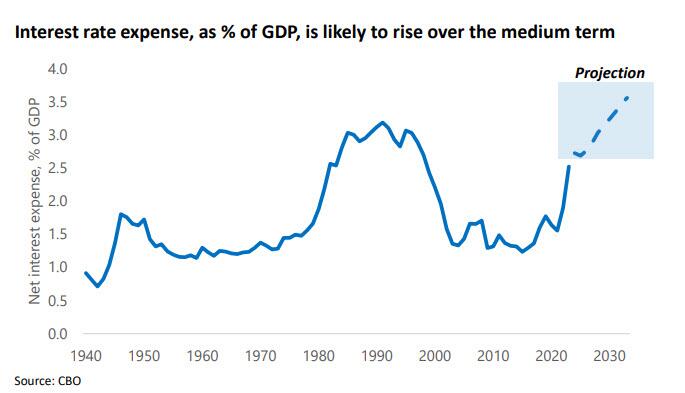
And then there was this warning from the TBAC which very tongue-in-cheek said that "Interest rate expense, as % of GDP, is likely to rise over the medium term", and also over every other term.

As Bloomberg's Mark Cudmore concludes, the worsening metrics may "reignite debate about the US fiscal path amid heavy borrowing from Washington. That dynamic has already helped drive up bond yields, threatened the return of the so-called bond vigilantes and led Fitch Ratings to downgrade US government debt in August."

An even more damning conclusion comes from Hartnett, Fiscal excess in the 2020s is adding to already high levels of government debt; until policy makers address the trajectory of government debt, investors are likely to worry that asset-bearish solutions to indebtedness such as inflation, default, currency debasement, are set to be pursued; but as likely central banks may simply bail out governments in coming years via QE & the introduction of YCC (policies that would be v US dollar negative).

Finally, as we explained yesterday (see "How Treasury Averted A Bond Market "Earthquake" In The Last Second: What Everyone Missed In The TBAC's Remarkable Refunding Presentation"), the US treasury market was this close to collapse as recently as last week, and if it hadn't been for some clever language and sleight-of-forward-guidance by the Treasury, in the latest TBAC statement, the endgame for US debt would now be in play. For now, however, it has been merely delayed.

https://www.zerohedge.com/markets/endgame-interest-us-debt-skyrockets-above-1-trillion-first-time-ever


UK parents lose bid to take critically ill baby home

 A judge has ruled a critically ill baby's life support treatment will not be allowed to be ended at home.

Indi Gregory has mitochondrial disease and medics treating her at Nottingham's Queen's Medical Centre (QMC) have said they can do no more for her.

Her parents had requested that Indi be allowed to return to their home in Ilkeston, Derbyshire.

However the High Court ruled her treatment should end in a hospice or hospital.


The family will appeal said the Christian Legal Centre, which is supporting them.

On Wednesday, Mr Justice Peel ruled Indi's treatment would stop no earlier than 14:00 GMT on Thursday.

In a written judgement he said it would be "all but impossible" to remove the eight-month-old's life support and carry out palliative care at her family's home.

Medics told the judge Indi was currently "clearly distressed, agitated and in pain".

They said that extubation - the removal of her life support - could happen anywhere in theory, but her after-care would need to be "managed by trained professionals with resources on hand to deal with complications, and minimise distress".

Due to the potential complications, which are now more severe due to the length of time she has received care, her needs after extubation will now be more serious, they said.


Mitochondrial disease prevents cells in the body producing energy and the NHS says the condition is incurable.

In October, Mr Justice Peel gave medics permission to withdraw life support, saying the medical evidence was "unanimous and clear".

Since then Indi's parents have failed to persuade Court of Appeal judges in London and judges at the European Court of Human Rights (ECHR) in Strasbourg, France, to overturn the decision.

The judge was told on Tuesday the parents' preference was for treatment to be withdrawn at home.

However, he decided it was in her best interests for it to take place at a hospice, or the QMC, where the appropriate members of staff and equipment were located.

"I consider it essential that [Indi] should continue to have clinical treatment of the highest quality, carried out in a safe and sustainable setting," he said.

"That will not be available at home."


Bambino Gesu Children's Hospital in Rome agreed to provide treatment but a judge denied an application to move Indi to Rome for further care on Thursday.

The family's appeal against the High Court ruling was rejected on Saturday.

A protest against the ruling was held outside the QMC on Sunday.

The Italian government intervened and granted her Italian citizenship on Monday.

Italian prime minister Giorgia Meloni vowed to do what she could to "defend" Indi's life.

Indi's father, Dean Gregory, said he was disappointed the offer of help from Italy had been dismissed by the hospital and court system.

He told the BBC: "I'm just focussed on saving my daughter's life and doing what's in Indi's best interests.

"She deserves a chance. She has a country offering to pay for everything - we just have to take her over there so it is not costing the hospital or the government anything.

"Everybody seems like 'why won't they let her go?' they have nothing to lose."

He added he felt confident if Indi was allowed to travel to Italy, she could be saved.

Dr Keith Girling, medical director at Nottingham University Hospitals (NUH) NHS Trust, said: "This is an incredibly challenging time for Indi and her family, and our thoughts are with them today.

"Following today's High Court decision, our priority will remain to provide Indi specialised care appropriate to her condition and in line with the direction of the court, supporting her family in every way possible."


https://www.bbc.com/news/uk-england-derbyshire-67353844

Acutus Medical is laying off more than half of its workers

 Acutus Medical (Nasdaq:AFIB) announced today that it will lay off 65% of its workforce as part of a major restructuring.

The Carlsbad, California–based company’s most recent annual report lists 225 workers at the end of 2022, which means the layoff could involve roughly 146 workers.

Restructuring will involve winding down Acutus Medical’s EP mapping and ablation business, including the AcQMap mapping system, the AcQMap 3D mapping catheter, the AcQBlate force-sensing ablation catheter, the AcGuide Max 2.0 steerable sheath, and associated accessories. (The company said  it will support AcQMap procedures with a small group of therapy managers through Nov. 30.)

Acutus Medical’s main remaining focus will be the manufacturing of left-heart access products for Medtronic. It sold its left-heart access portfolio to Medtronic for $50 million last year, and has brought in tens of millions of dollars worth of milestone payments from the deal since then. Under the deal, it’s due 100% of total net end-user sales in year one, 75% of total net end-user sales in year two, and 50% in years three and four.

“In light of the current financing environment and the capital investments required to achieve leadership in the electrophysiology (EP) market, we have concluded that the optimal use of the Company’s resources is to reallocate capital from our mapping and ablation business to the manufacturing of left-heart access products for Medtronic, which we believe will maximize the potential for future earnouts and cash flow,” Acutus Medical board chair Scott Huennekens said in a news release.

The company’s CEO David Roman added: “The realignment of resources and corporate restructuring unfortunately impacts our team. It is undoubtedly difficult to part with our valued and highly talented colleagues who have made substantial contributions to our company.”

Acutus Medical officials expect to complete the restructuring in the first quarter of 2024. Following the restructuring, the company will be a contract manufacturing business. Company officials say the business has the potential to generate positive cash flow over the next several years.

The layoffs are but the latest example of medtech companies trimming their workforces as they seek to adjust to the post-pandemic economic environment and state of healthcare. MassDevice has reported on more than 18,000 layoffs in the industry since mid-2022.

https://www.massdevice.com/acutus-medical-is-laying-off-more-than-half-of-its-workers/

China's Foreign Direct Investment Turns Negative For The First Time On Record

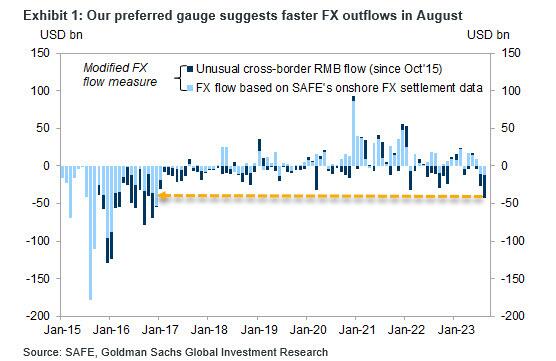
 We got an early look that something is very broken in China's capital flows back mid-September, when we first reported that contrary to the official PBOC forex data, a more in depth analysis of China's fund flows reveals the biggest FX outflow since 2016 amid what we called was a "sudden surge in capital flight", one which also kicked in just before bitcoin's powerful thrust higher from $26K to $35K.
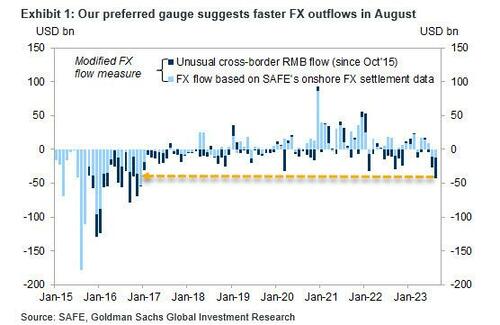
In retrospect, the reading wasn't a fluke, and three months after we reported that "China's Inward Foreign Direct Investment Falls To The Lowest Level On Record" the latest balance of payments data revealed that China recorded its first-ever quarterly decline in foreign direct investment (FDI), underscoring the capital outflow pressure we first flagged two months ago (and which was much more acute than the modest FX outflow signaled by the PBOC), and Beijing's challenge in wooing overseas companies and capital in the wake of a "de-risking" move by Western governments.

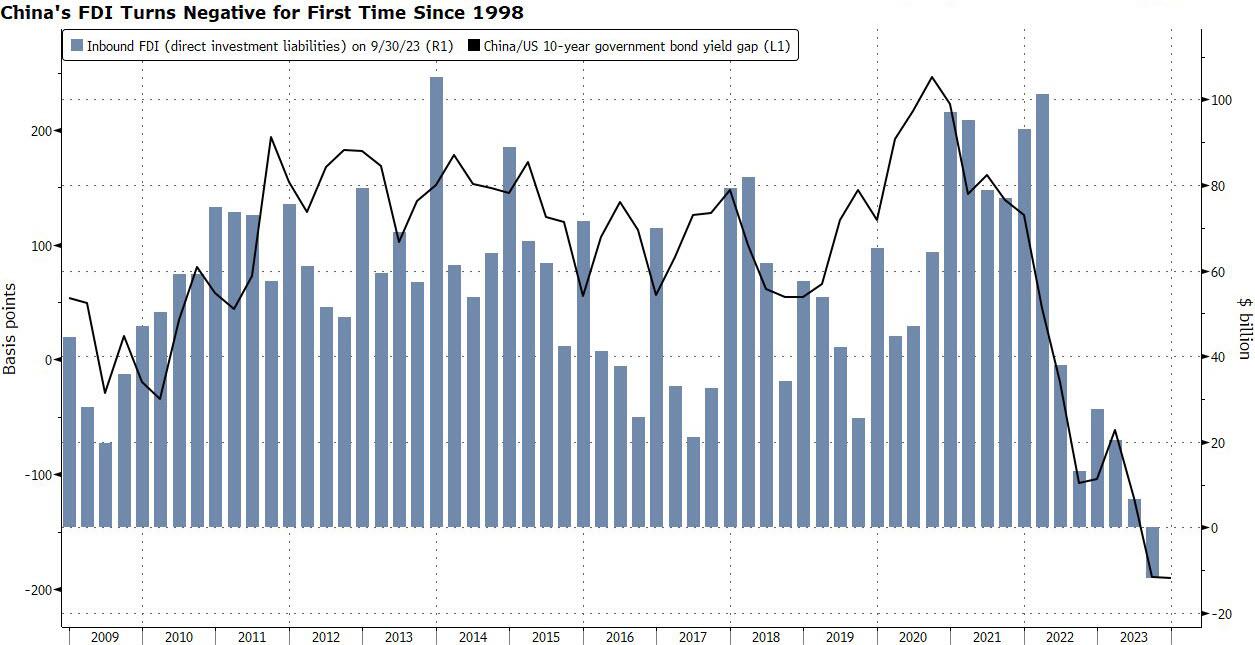
As shown in the chart below, direct investment liabilities in the country’s balance of payments - a broad measure of FDI that includes foreign companies' retained earnings in China - have been slowing over the last two years after hitting a near-peak value of more than $101 billion in the first quarter of 2022; since then the gauge weakened nearly every quarter and was a deficit of $11.8 billion during the July-September period, marking the first contraction since records started in 1998, which could be linked to the impact of "de-risking" by Western countries from China, as well as China's interest rate disadvantage (the chart below shows a striking correlation between inbound FDI and China's tumbling bond yields).
“It’s concerning to see net outflows where China’s doing its best at the moment to try and open — certainly the manufacturing sector — to new inflows,” said Robert Carnell, regional head of research for Asia-Pacific at ING Groep NV. “Maybe this is the beginning of a sign that people are just increasingly looking at alternatives to China for investment.”

"Some of the weakness in China's inward FDI may be due to multinational companies repatriating earnings," Goldman analyst Hui Shan wrote (full note available to pro subscribers) adding that "with interest rates in China 'lower for longer' while interest rates outside of China 'higher for longer', capital outflow pressures are likely to persist."

According to Julian Evans-Pritchard, head of China economics at Capital Economics, the unusually-large interest rate gap "has led firms to remit their retained earnings out of the country".

Although he sees little evidence that foreign companies are, on aggregate, reducing their presence in China, "we do think that, over the medium-term at least, increasing geopolitical tensions will hamper China's ability to attract FDI and instead favor emerging markets that are more friendly to the West."

Driven by the FDI outflows, China's basic balance - which encompasses current account and direct investment balances and are more stable than volatile portfolio investments - recorded a deficit of $3.2 billion, the second quarterly shortfall on record.

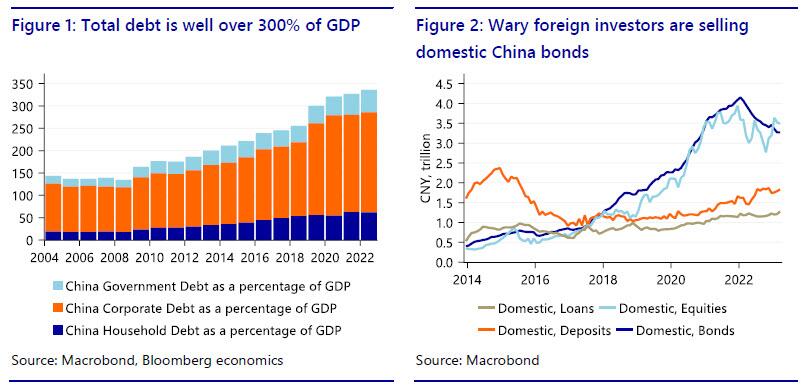
"Given these unfolding dynamics, which are poised to exert pressure on the RMB, we anticipate a sustained strategic response from China's authorities," Tommy Xie, head of Greater China Research at OCBC wrote, and while he is hardly alone in expecting a powerful response from Beijing to stop the bleeding before China is fully "Japanified" so far the ruling Communist Party has failed to materially stimulate its economy, the result of a staggering 300% in consolidated debt to GDP, which has largely tied Beijing's hand for the past 4 years.
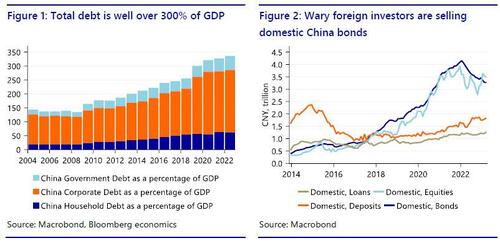
Xie expects China's central bank to continue counter-cyclical interventions - including a strong bias in daily yuan fixings and managing yuan liquidity in the offshore market- to support the currency in the face of these headwinds.

Separately, onshore yuan trading against the dollar also hit record-low volume in October, highlighting authorities' stepped-up efforts to curb yuan selling. The latest data showed that onshore volume of yuan trading against the dollar slumped to a record low of 1.85 trillion yuan ($254.05 billion) in October, a 73% drop from the August level.

The PBOC has been urging major banks to limit trading and dissuade clients to exchange the yuan for the dollar, sources have told Reuters. This happened after our September report that FX outflows from China had hit $75 billion, the highest since the country's 2015 devaluation.

In an attempt to reverse the bleeding, the Chinese government has embarked on a big push in recent months to lure foreign investment back to the country. Bloomberg reported that on Wednesday, the Ministry of Commerce asked local governments to clear discriminatory policies facing foreign companies in a bid to stabilize investment confidence. It's doubtful the move will have any impact on capital flows which are not driven by "discriminatory" policies and have everything to do with China's dismal economy.

It cited the need to ensure subsidies for new energy vehicles are not limited to domestic brands as one example. In some industries, foreign firms wait longer and are subject to more rigorous reviewing process when applying for licenses.

In August, the internet regulator met with executives from dozens of international firms to ease concerns about new data rules. The government has also pledged to offer overseas companies better tax treatment and make it easier for them to obtain visas.

But Beijing’s pledges have rung hollow for some firms, with foreign business groups decrying “promise fatigue” amid skepticism about whether meaningful policy support is forthcoming. They also have incentive to repatriate earnings overseas because of the wide gap in interest rates between China and the US, which may be pushing them to seek higher returns elsewhere.

The FDI outflows are adding pressure on the onshore yuan, which has hit the weakest level since 2007 earlier this year. China’s benchmark 10-year government bond yield is trading at 191 basis points below that of comparable US Treasuries, versus an average premium of about 100 basis points over the past decade.

The lack of investment among global firms in China will have far reaching effects on the world’s second-largest economy, especially as it tries counter US curbs on access to advanced technology.

Aside from geopolitical risks, companies had also been pulling back on investment in China last year as the country rolled out pandemic restrictions. While those curbs have been removed, firms are still contending with other challenges from rising manufacturing costs in China and regulatory hurdles as Beijing scrutinizes activity at foreign corporations due to national security concerns.

“Some of the most damaging things have been the abrupt regulatory changes that have taken place,” said Carnell, pointing to this year’s anti-espionage campaign, which resulted in some firms having their offices raided by local authorities. “Once you damage the sort of perception of the business environment, it’s quite difficult to restore trust. I think it will take some time.”

While foreign companies make up less than 3% of the total number of corporations in China, they contribute to 40% of its trade, more than 16% of tax revenue and almost 10% of urban employment, state media has reported. They’ve also been key to China’s technological development, with foreign investment in the country’s high-tech industry growing at double-digit rates on average since 2012, according to the official Xinhua News Agency.

“A decline in trade and investment links with advanced economies will be a particularly significant headwind for a catching up economy such as China, weighing on productivity growth and technological progress,” Kuijs said. And since youth unemployment - the single, most direct precursor to the one thing Beijing fears most of all, social unrest - is already at an all time high and will continue to rise (even if China will no longer report on what it is), the likelihood that Beijing will pursue some bazooka stimulus, both fiscal and monetary, only grows with every month that Beijing does not pursue such a critical, if temporary, measure to prevent catastrophe.

https://www.zerohedge.com/markets/chinas-foreign-direct-investment-turns-negative-first-time-record