Search This Blog

Thursday, March 6, 2025

Judge declines to immediately spare USAID contractors from firings

 A federal judge on Thursday declined to immediately spare U.S. Agency for International Development (USAID) contractors from mass firings, letting move forward a core part of the Trump administration’s effort to dismantle the agency.

U.S. District Judge Carl Nichols said USAID’s personal services contractors failed to prove they face irreparable harm and a likelihood of success on the merits, denying their motion for a temporary restraining order that would have returned fired contractors to employment and allowed them to resume work.

The judge said any harm the contractors face is “directly traceable” to changes the government has made to their contracts, suggesting relief should be sought through a different avenue.

The Personal Services Contractor Association, an advocacy group for U.S. personal services contractors, sued the Trump administration last month to insulate the contractors from efforts to tear down the agency.

In court filings, lawyers for the contractors said notices of contract termination had been distributed to “possibly hundreds” of the roughly 1,110 contractors who work for USAID, some 46 percent of whom work overseas. 

“The destruction of USAID is now imminent,” said Carolyn Shapiro, a lawyer for the challengers, during a hearing on the matter Wednesday. 

The contractors urged the judge to come to a “different conclusion” than he had in a separate case involving unions representing USAID employees, who sued over the shutdown of the agency’s operations.  

In that case, Nichols initially granted a temporary restraining order staving off a purge of USAID employees but ultimately dissolved the order after finding the unions’ initial assertions of harm were “overstated,” declining to grant further relief.

Shapiro sought to steer the judge away from the individual harms USAID contractors might face and instead argued that they faced irreparable harm from the government’s “structurally unconstitutional decision-making.”

She said refusing to grant the temporary relief sought risks a “Humpty Dumpty”-like scenario in which USAID, once dismantled, could not be put back together again. 

The judge said Thursday that harm amounts to “generalized grievances,” not reaching the high bar needed to win the temporary relief sought.  

Justice Department lawyer Michael Clendenen contended that the contractors’ situation is “almost identical” to that of the unions that failed to win injunctive relief while litigation continues.  

Nichols questioned a key difference between the two cases — that the USAID employees who were represented by unions were being placed on paid leave, while the contractors stood to be terminated altogether.  

But Clendenen suggested the 15-day notice prior to any terminations should provide a buffer to any immediate harm, and any economic harm could be rectified through different channels to seek monetary damages. 

The Trump administration has broadly looked to dismantle USAID, including by firing employees and freezing its payments to contractors. 

In a separate challenge to the apparent dismantling, U.S. District Judge Amir Ali ordered the Trump administration to immediately release nearly $2 billion in foreign aid payments owed under existing contracts.  

The Supreme Court in a 5-4 emergency ruling Wednesday refused to halt that order, handing a loss to the administration.  

Later Thursday, Ali will hear arguments over whether further injunctive relief is warranted in that case.  

https://thehill.com/regulation/court-battles/5180024-judge-usaid-contractors-firing/

Navarro: ‘Canada has been taken over … by Mexican cartels’

 Peter Navarro, a senior trade adviser to President Trump, said Wednesday that Canada has been “taken over” by Mexican cartels as tensions between the countries are on the rise over Trump-imposed tariffs seeking to crack down on fentanyl entering the U.S.

“What I want to say to every world leader who gets up in arms when all we’re asking for is fairness and to have them stop killing our people is, ‘Please, listen to us.’” Canada could do a lot more,” Navarro said, discussing drug flow into the U.S. on Fox News’s “Special Report” with anchor Bret Baier.

“Canada has been taken over, Bret, by Mexican cartels,” he continued as highlighted by Mediaite.

Navarro’s comments come amid tensions between Canada and the U.S. over tariffs. On Tuesday, Trump imposed 25 percent tariffs on the country’s northern neighbor and Mexico alongside an extra 10 percent tariff on Chinese goods. The president pointed to frustration over the stream of fentanyl into the U.S., but experts have previously noted that a relatively small amount enters the country via its northern border.

Ontario Premier Doug Ford, who has been very vocal in his opposition to Trump’s tariffs, said Tuesday he was hopeful the tariff fight between his country and the U.S. will end within days.

“I hope it stops within the next few days. … And I’m not just saying that,” Ford told NewsNation’s Blake Burman on “The Hill.”

“It will be an absolute disaster for both countries, and people will be unemployed, plants will shut down, assembly lines will shut down and inflation’s going to happen within days,” he continued later. “So this is unfortunate. One person’s responsible, and that’s President Trump.”

In his “Special Report” appearance, Navarro said he had been viewing a “press conference today and a reporter said something along the lines … only caught like four pounds of fentanyl at the Canadian border.”

“Let me do a little fentanyl math for you,” Navarro added. “Four pounds kills a million people.”

https://thehill.com/homenews/administration/5180208-navarro-canada-has-been-taken-over-by-mexican-cartels/

US Treasury's Bessent says FSOC will drive regulatory change, outlines tariff policies

  U.S. Treasury Secretary Scott Bessent on Thursday said he plans to use the Financial Stability Oversight Council to drive change in financial regulations that are unduly burdensome to banks and characterized by a “broken supervisory culture,” coordinating via Treasury rather than consolidating agencies. 

One focus for banking supervisors should be to analyze supplementary leverage restrictions, he said, adding that more broadly President Donald Trump has begun an “aggressive campaign to rebalance the international economic system.”

“For too long, the designers of multilateral trade deals have lost sight of this. International economic relations that do not work for the American people must be reexamined,” Bessent said at the Economic Club of New York. “This is what tariffs are designed to address – leveling the playing field such that the international trading system begins to reward ingenuity, security, rule of law, and stability – not wage suppression, currency manipulation, intellectual property theft, non-tariff barriers, and draconian regulations.”

https://bluewaterhealthyliving.com/news/business-and-economy/us-treasurys-bessent-says-fsoc-will-drive-regulatory-change-outlines-tariff-policies/

2 telehealth firms turn to branded Zepbound as restrictions loom on copies

 Telehealth firms Teladoc and LifeMD said on Thursday they had signed an agreement to offer Eli Lilly's weight-loss drug Zepbound to self-paying patients, ahead of restrictions on selling copies known as compounded drugs.

Both companies said they had signed deals with Gifthealth, the pharmacy partner of Lilly's direct-to-consumer website, LillyDirect, through which the drugmaker sells vials of Zepbound at discounts for cash-pay customers.

The move offers the telehealth companies an avenue to keep selling the highly popular weight-loss drugs even as the compounded drugs industry faces increasing restrictions on making copies of the treatments.

Teladoc said it does not offer compounded versions of the drugs, but patients are prescribed the branded medications.

The agreement portends more deals of this nature by telehealth companies given that bulk compounding is likely to be significantly curtailed, Citi analyst Daniel Grosslight said.

While Lilly's Zepbound and rival Novo Nordisk's Wegovy were in shortage, compounding pharmacies sold cheaper copies of the treatments in the past year.

The branded drugs have since been removed from the U.S. Food and Drug Administration's shortage list.

A federal judge on Wednesday denied an injunction that would allow compounding pharmacies to keep making copies of Zepbound in the U.S.

The FDA also said last month there was no longer a shortage of Novo's weight-loss and diabetes drugs, Wegovy and Ozempic, a declaration that will curtail the widespread sale of cheaper copies.

The agreement with Gifthealth will allow eligible members without insurance coverage to gain access to single-use vials that can be delivered directly to their homes, Teladoc said.

Integration with LillyDirect's self-pay pharmacy channel would allow seamless access to branded Zepbound vials at the newly reduced self-pay price, LifeMD said.

Telehealth company Ro in December began offering single-dose vials of Zepbound and was directly integrated with LillyDirect's self-pay pharmacy.

https://www.newsbreak.com/reuters-555486/3843274555694-telehealth-firms-teladoc-lifemd-tie-up-with-eli-lilly-s-pharmacy-partner-to-offer-zepbound

Novo Enters the Ring in Legal Fight Against GLP-1 Compounders as Lilly Notches Victory


Novo Nordisk is intervening in the lawsuit filed by a drug compounders trade group against the FDA over the agency’s decision to declare the Wegovy shortage over. Eli Lilly did the same in a parallel case over Zepbound’s removal from the FDA shortage list and this week a judge denied the compounders’ injunction.

The legal battle continues between the FDA and compounding pharmacies over the latter party’s ability to produce blockbuster weight loss drugs such as semaglutide—marketed by Novo Nordisk as Wegovy—and tirzepatide—marketed by Eli Lilly has Zepbound. Following the removal of these drugs from the FDA shortage list, the compounders trade group Outsourcing Facilities Association (OFA) filed lawsuits in an attempt to continue making the lucrative drugs.

Now, Novo has followed Lilly in inserting itself in the nuanced legal situation just as a U.S. federal judge denies an injunction that would have given the OFA permission to continue making copies of Zepbound, Reuters reported.

Judge Mark T. Pittman of the US District Court for the Northern District of Texas ruled on Wednesday that Novo Nordisk can intervene in the case brought against the FDA by OFA in response to the removal of Wegovy from the agency’s shortage list, multiple outlets reported. This decision comes two months after a court granted Lilly similar permission for a separate lawsuit the OFA filed following Zepbound’s removal from the FDA’s shortage list and the same day that it sided with Lilly in denying an OFA injunction.

In the OFA’s most recent lawsuit, the trade organization calls the FDA’s decision “reckless and arbitrary decision,” contending that it will deprive patients of vital treatments for type 2 diabetes, obesity, cardiovascular disease and other serious medical conditions.

Pittman originally denied Novo’s request to get involved in the case, ruling it premature, but reversed its decision Wednesday after the Danish pharma filed a renewed motion. With Wegovy and Ozempic far and away its top selling products—over $8 billion in 2024 sales for the former and $16.9 billion for the latter—Novo has substantial interest in ensuring the FDA comes out ahead in this lawsuit, effectively prohibiting compounders from making knock-off copies.

When the agency declares a drug in shortage, Congress determined a doctor, pharmacist or licensed outsourcing facility is allowed to compound the drug appropriate to patient needs. With semaglutide no longer in that status, compounding pharmacies are no longer legally approved to make their own versions of the drug. According to the lawsuit, since the FDA placed semaglutide on the shortage list in 2022, patient demand has been satisfied thanks to pharmacies and outsourcing facilities.

The latest lawsuit closely mirrors the one filed by the OFA in October 2024 when the FDA ended the shortage of Eli Lilly’s GLP-1 + GIP combo, tirzepatide. The agency confirmed in December that tirzepatide was no longer in shortage status and gave compounders 90 days to cease production of their copycats. Lilly was eventually approved to intervene in that fight, which is before the same federal court.

The OFA has since filed a motion for a preliminary injunction, arguing the FDA was making a decision applicable to the entire compounding industry, which would constitute as a rule. It is not clear at this time whether this is the injunction that was denied on Wednesday. Rulemaking for the agency comes with strict requirements including engaging the public with a notice-and-coment period, per the Administrative Procedure Act.

Prior to the overturning of Chevron deference last year, questions have swirled about the FDA’s protocols for managing the drug shortage list. With pressures from parties like the OFA, the agency could face challenges in regulating the drug supply chain through this mechanism. The GLP-1 weight loss space is a particularly thorny area, with a thriving shadow market of not just compounders but research peptide makers all cashing in on the insatiable demand that originally sent Wegovy and Zepbound to the FDA’s shortage list.

https://www.biospace.com/business/novo-enters-the-ring-in-legal-fight-against-glp-1-compounders

Trade Deficit increased to $131.4 Billion in January

 The Census Bureau and the Bureau of Economic Analysis reported:

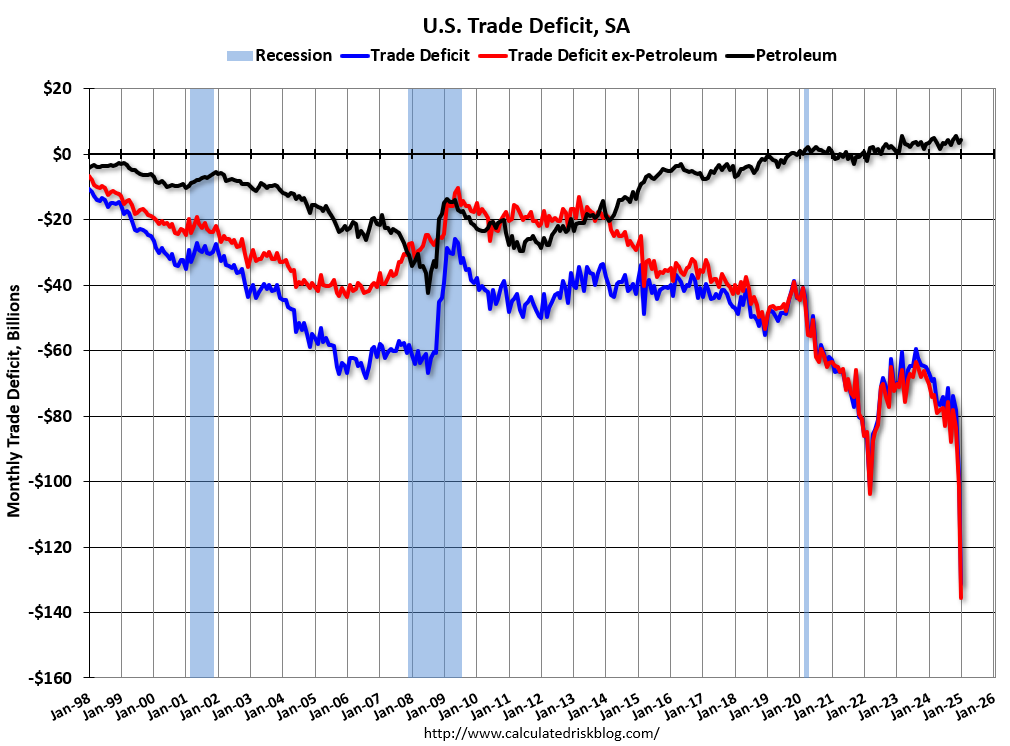
The U.S. Census Bureau and the U.S. Bureau of Economic Analysis announced today that the goods and services deficit was $131.4 billion in January, up $33.3 billion from $98.1 billion in December, revised.

January exports were $269.8 billion, $3.3 billion more than December exports. January imports were $401.2 billion, $36.6 billion more than December imports.
emphasis added
U.S. Trade Exports ImportsClick on graph for larger image.

Both exports and imports increased in January.

Exports were up 4.1% year-over-year; imports were up 23.1% year-over-year.

Both imports and exports have generally increased recently.  

The second graph shows the U.S. trade deficit, with and without petroleum.

U.S. Trade DeficitThe blue line is the total deficit, and the black line is the petroleum deficit, and the red line is the trade deficit ex-petroleum products.

Note that net, exports of petroleum products are positive and have been increasing.

The trade deficit with China increased to $31.7 billion from $23.7 billion a year ago.  

The surge in imports in January happened as some importers were avoiding the coming tariffs.

Politico: Trump Team Holding Secret Talks With Ukrainian Opposition As US Sours On Zelensky

 You know that President Zelensky is in trouble when even Democrats in the US are calling for new elections in Ukraine, at a moment that some Trump officials have issued comments strongly hinting they prefer to see new leadership in Kiev.

For example Maine Democratic Rep. Jared Golden has this week urged Zelensky to "call and win a new election" to "strengthen his hand" in negotiating a peace agreement to end the war. Golden said in the earlier Tuesday statement that Zelensky must "show the world he has the mandate" from the Ukrainian people.

Trump previously hammered Zelensky for being a "dictator without elections" - however, Ukraine's parliament recently voted to uphold his 'legitimacy' - backing the martial law situation which constitutionally allows elections to be canceled and delayed indefinitely. 

A new bombshell report has been issued Thursday saying that Trump's team is actually engaging members of the Ukrainian opposition in secret - toward efforts in support of potential political transition in Kiev.

Yulia Tymoshenko. NurPhoto via Getty Images

Politico writes, "Four senior members of Donald Trump’s entourage have held secret discussions with some of Kyiv’s top political opponents to Volodymyr Zelenskyy, just as Washington aligns with Moscow in seeking to lever the Ukrainian president out of his job."

"The senior Trump allies held talks with Ukrainian opposition leader Yulia Tymoshenko, a remorselessly ambitious former prime minister, and senior members of the party of Petro Poroshenko, Zelenskyy’s immediate predecessor as president, according to three Ukrainian parliamentarians and a U.S. Republican foreign policy expert," the report continues.

Tymoshenko has confirmed that her team is talking "with all our allies who can help in securing a just peace as soon as possible."

This is massive and will without doubt see relations spiral further, at least until Zelensky comes to the US administration with hat in hand. The White House wants a formal apology. But it seems the opportunity to willingly sign Trump's controversial mineral deal has come and gone.

As for the content of these secret Trump admin and Ukrainian opposition meetings, Politico reveals:

The discussions centered on whether Ukraine could hold quick presidential elections. These are being delayed in line with the country’s constitution because Ukraine remains under martial law. Critics of holding elections say they could be chaotic and play into Russia’s hands, with so many potential voters serving on the front lines or living abroad as refugees.

"The Trump aides are confident that Zelenskyy would lose any vote due to war fatigue and public frustration over rampant corruption," the report continues. "Indeed, his poll ratings have been in decline for years, although they have picked up in the wake of last week’s Oval Office brawl, when the Ukrainian leader was shown the door after being berated by President Donald Trump and Vice President JD Vance. The most recent poll shows Zelenskyy still comfortably ahead in the race for the presidency."

Zelensky's declining popularity is something that the mainstream media has kept silent on for at least the last year or so. There also remains significant domestic opposition to conscription policies which have seen recruiters taking harsh measures, in some cases forcibly rounding up young men on the streets to eventually send them to the front lines.

As for another potential rival for power, who might seriously challenge Zelensky, Political highlights the following:

His nearest rival, trailing him by more than 20 percentage points, is Valery Zaluzhny, a former army commander who is now Ukraine’s ambassador to Britain. Only 10 percent backed Poroshenko, who is known as the Chocolate King due to his confectionary empire. Tymoshenko garnered just 5.7 percent support.

In Washington, perhaps highest official to have come closest to actually calling for a change in leadership in Kiev is US National Security Advisor Mike Waltz, who told CNN last Sunday: "it’s unclear whether President Zelensky, particularly after what we saw on Friday, is ready to transition Ukraine to an end to this war, and to negotiate and have to compromise." Waltz then said that "we need a leader that can deal with us, eventually deal with the Russians, and end this war" - in remarks that hinted strongly at political transition soon.

https://www.zerohedge.com/geopolitical/trump-team-holding-secret-talks-ukrainian-opposition-us-sours-zelensky