Search This Blog

Thursday, March 6, 2025

The Art Of Winning

 What a difference! Just months ago, the nation was rudderless under the so-called ‘leadership’ of a president more concerned with hiding his own decline. American success and prosperity? Dead last on the priority list. Instead, it was: Let’s drain the treasury for a “whatever it takes” war. Let’s empty the Strategic Petroleum Reserve to win a midterm. Let’s hire 87,000 IRS agents to harass hardworking Americans.

November 5 changed everything.

America elected a man who survived two assassination attempts, 93 indictments, and a political establishment that wanted him locked away for 641 years. The shockwaves of that victory are being felt from Tokyo to London, from Buenos Aires to Beijing. When Americans travel, they’re hit with the same questions: What’s Trump going to do about Taiwan? Can he actually end the Russia-Ukraine war? And wait—does he really want to take over Canada?

His presence in the Oval Office has already curbed the invasion at the southern border. No new laws, no congressional deals—just a President who actually wants to stop illegal immigration. As he said Tuesday before Congress:

The media and our friends in the Democrat Party kept saying we needed new legislation; we must have legislation to secure the border. But it turned out that all we really needed was a new president.

But if you listened to the media, you’d think the sky was falling.

The usual voices wasted no time warning that Trump’s economic agenda would cripple investment, spook businesses, and send America into recession. The Guardian fretted about a looming “Trumpcession.” Joseph Stiglitz insisted that Trump’s trade policies made the U.S. a “scary place to invest.” Business Insider lamented that businesses were too rattled to commit capital.

And yet, the flood of investment tells a different story. In just six weeks, America has secured over $3 trillion in fresh commitments. From semiconductors to AI, from energy to manufacturing, the world’s biggest players aren’t fleeing—they’re betting big on America’s future.

Let’s look at what’s happening on the ground:

Apple’s $500 billion investment is a resounding vote of confidence in America’s economic future under Trump. Just days after meeting with President Trump, CEO Tim Cook unveiled Apple’s ambitious plans, which include a new AI server factory in Texas, a manufacturing academy in Detroit, and expansions across multiple states—from Arizona and Nevada to California and North Carolina. The investment will create tens of thousands of high-tech jobs, particularly in AI, silicon engineering, and machine learning, reinforcing America’s leadership in cutting-edge technology. Apple isn’t just staying in the U.S.—it’s doubling down.

Honda is shifting gears—literally and figuratively—in response to Trump’s economic policies. The automaker announced it will move production of its popular Civic hybrid from Mexico to Indiana, a direct result of Trump’s tariffs on Mexican and Canadian imports. In addition, Honda is investing in a new manufacturing plant in the U.S., one of the largest in the world, further cementing America’s resurgence as a global auto manufacturing powerhouse.

Eli Lilly is making a massive bet on American pharmaceutical manufacturing, announcing a $27 billion investment to build four new facilities in the U.S. The company says these plants will create over 3,000 permanent jobs and require 10,000 construction workers to bring them to life. Faced with Trump’s push to bring pharmaceutical manufacturing home—backed by potential tariffs on foreign drug imports—Eli Lilly is choosing to invest on American soil.

TSMC, the world’s dominant semiconductor manufacturer, is nearly tripling its U.S. investment with a $100 billion expansion, solidifying America’s place in the global chip supply chain. The plan includes three new chip plants, two advanced packaging facilities, and a research and development center––all aimed at producing the world’s most powerful AI and semiconductor chips. This commitment follows Trump’s push to reduce reliance on China and ensure cutting-edge technology is made in America.
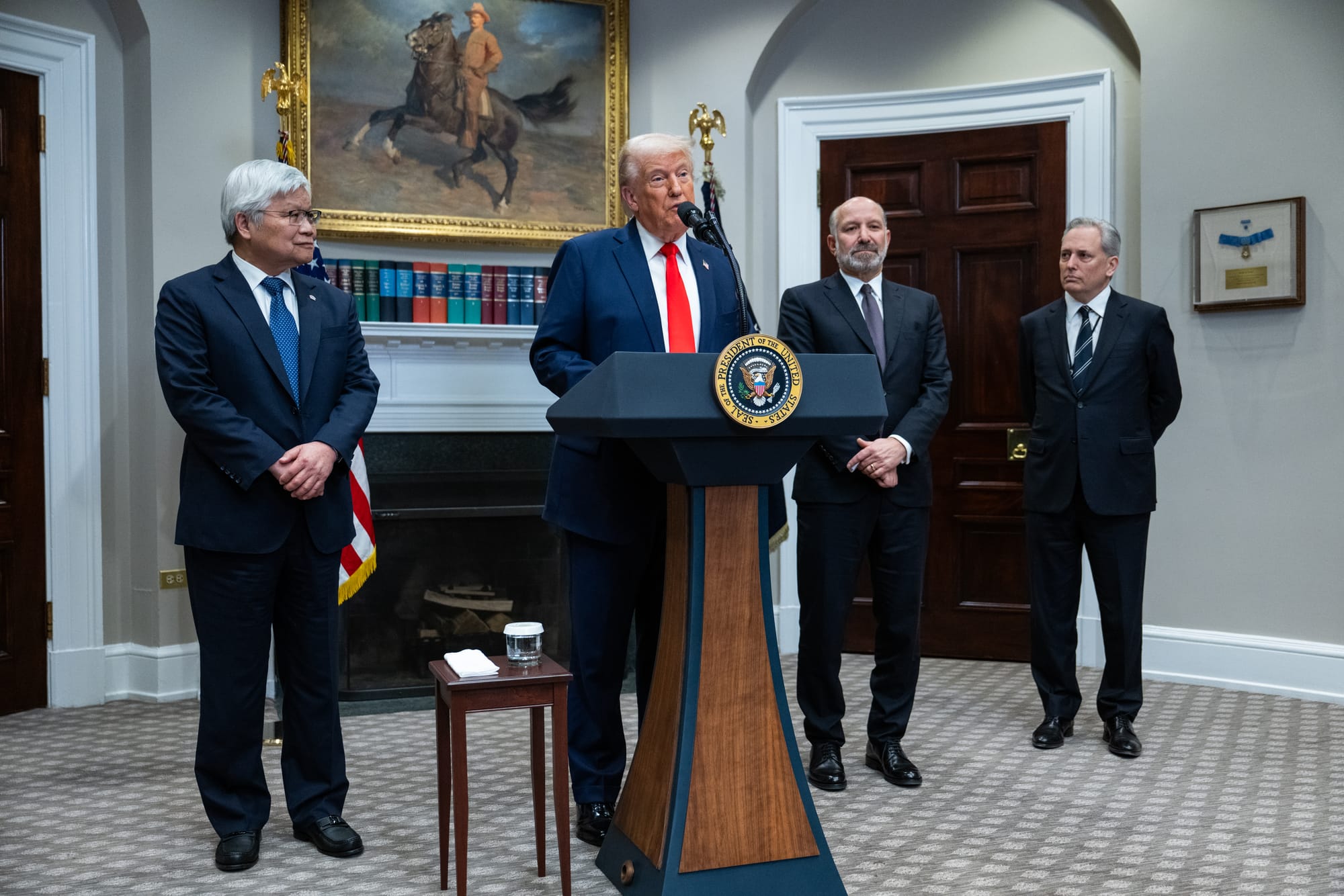
President Donald Trump (C) holds a press conference with TSMC CEO C.C. Wei (L) to announce that Taiwan Semiconductor Manufacturing Company (TSMC) plans to invest $100 billion in new manufacturing facilities in the United States in the Roosevelt Room of the White House on March 3, 2025 in Washington, DC. President Trump was also joined by United States Secretary of Commerce Howard Lutnick and White House AI and Crypto Czar David Sacks (R). (Photo by Annabelle Gordon for The Washington Post via Getty Images)

Trump said on Tuesday: "This is a time for big dreams and bold action." Beyond manufacturing, Trump is securing America’s dominance in the AI revolution. His Stargate Project—a $500 billion joint venture with OpenAI, Oracle, SoftBank, and MGX—is the largest AI infrastructure investment in history. While critics feared Trump’s policies would drive away innovation, the world’s top AI players are choosing to build in America.

In addition to corporations, nations are finding Trump’s America attractive for big investments:

Japan – Japan has pledged $1 trillion in new investments in the U.S., signaling a deepening economic alliance. Prime Minister Shigeru Ishiba also committed to importing U.S. liquefied natural gas (LNG) at historic levels and expanding Japanese industrial and auto manufacturing in America, strengthening trade ties between the two nations.

Saudi Arabia – Crown Prince Mohammed bin Salman has committed $600 billion in investments across U.S. energy, infrastructure, and technology sectors over the next four years. This massive infusion underscores Saudi Arabia’s strategic pivot toward deeper economic cooperation with America.

India – Prime Minister Narendra Modi and Trump have agreed to expand U.S.-India trade to $500 billion, further solidifying a crucial economic partnership. India is also ramping up investments in U.S. technology and defense industries, aligning with Trump’s broader strategy to counterbalance China’s global influence.

For all the dire warnings about Trump’s economic policies, the evidence is now overwhelming. The biggest corporations and wealthiest nations aren’t fleeing America—they’re racing to invest. From AI to autos, pharmaceuticals to semiconductors, Trump’s America is once again the prime destination for global capital.

On Tuesday, President Trump emphasized his vision of limitless potential and triumph ahead, declaring: "My fellow Americans, get ready for an incredible future because the golden age of America has only just begun."

He asserted, "We have accomplished more in 43 days than most administrations accomplish in four years or eight years — and we are just getting started."

Winning isn’t just a slogan—it’s America’s new reality. To put it simply, America is back.


https://tippinsights.com/the-art-of-winning/

David Sacks: Zelensky's Grift Ends When War Ends, Why Would He End It When He's Profiting So Much?

 White House crypto czar David Sacks called Ukrainian President Volodymyr Zelensky "an actor playing Winston Churchill" in an interview with FOX News host Jesse Watters on Monday.


JESSE WATTERS, FOX NEWS: So there's nothing wrong with having other countries apologize to us. Trump's crypto czar and co-host of the All In podcast, David Sacks, is here now. How you doing, David?

DAVID SACKS: Good, good, good to see you, Jesse.

WATTERS: Or should I call you czar?

SACKS: David's fine.

WATTERS: All right. What is going on in Zelensky's head?

SACKS: Well, you know, it's always hard to know exactly. I mean, Zelensky had one job. All he had to do was show up, be respectful, sign the minerals deal, shake hands for the cameras.

And instead, he turned out to be, he acted not like Churchill, but an actor playing Winston Churchill. He acted like a spoiled Hollywood actor. He acted entitled, he acted ungrateful, he acted peevish, petulant, combative.

And now he, of course, he's gonna have to come crawling back and offer an apology. But I think that when someone shows you who they are, believe them.

WATTERS: So there's no way you can deal with a guy like Zelensky. He's got to leave before anything gets signed.

SACKS: Well, I'm not saying we shouldn't deal with him, but I think that Zelensky has powerful motivations not to make peace. I don't think he really wants to make peace. He says that the war needs to keep going on.

He basically says the war needs to go on forever. And I think there's good reasons for that in his mind. Number one, if the war is over, he loses power, right?

He canceled elections there. He's in the sixth year of a five-year term. And if he stands for elections, he's very unpopular there, despite what the fake polls from USAID say.

And he'll be vulnerable to political retaliation from his political opponents. He needs this war to justify his rules. So I think that's number one is, if he gives up power, his own safety is at risk.

Number two is the gravy train here. I mean, we've been sending hundreds of billions of dollars over to Ukraine. And these Ukrainian elites there, these oligarchs have been feasting on that money.

And Zelensky is at the top of that pyramid. And that whole grift ends if the war ends. And I just think that that gives him a powerful incentive to want to keep this whole thing going.

Why would he end it when he and his cronies are profiting so much from this war?

WATTERS: Do we have evidence that these oligarchs or Zelensky are like stashing yachts in the There's definitely been Ukrainian officials who've been caught leaving the country with suitcases full of cash.

SACKS: And even before this war, Jesse, this was considered the most corrupt country in Europe. There's been plenty of evidence of American weapons reaching the black market as well. There's tons of stories about this.

There's been a lot of articles about it. So I don't think there's any doubt there's been massive amounts of corruption. The only question is how much.

WATTERS: Yeah, we got to send Doge over to Ukraine and get to the bottom of that.

SACKS: We need to audit. Absolutely. Yeah.

WATTERS: Last question real quick. When you have the Democrats in the ear of Zelensky before he blows this meeting up, do you think that they're trying to sabotage this piece?

SACKS: For sure. I mean, the Democrats have become the party of forever war. Remember, this was Joe Biden's war.

He easily could have ended this war in the first month if he had agreed to the Istanbul Accords, which said that all Ukraine had to do was stay neutral to basically agree not to become part of NATO. And Biden said that was unacceptable. And that's why the war continued.

And then Biden said that we've got to support Ukraine in this war for as long as it takes, as much as it takes. And that's what the Democrats are doing. They want this war to go on forever.

They want to keep spending hundreds and hundreds of billions of dollars. They want to keep funding organizations like USAID. They just want this to keep going and going.

But that's not in the American interest. What benefit are we getting out of all this money that we're sending to Ukraine? What benefit are the Ukrainians getting?

Hundreds of thousands of Ukrainians are dying. They're not winning this war. They're losing this war.

What is so wrong with letting President Trump try to negotiate a peace deal? All right.

https://www.realclearpolitics.com/video/2025/03/03/david_sacks_zelenskys_grift_ends_when_the_war_ends_why_would_he_end_it_when_hes_profiting_so_much_from_the_war.html

After Disavowing NewsGuard, Microsoft Still Promotes The Censorship Group

 Microsoft is still promoting the online censorship group NewsGuard — even after the corporation told Texas Sen. Ted Cruz it would “disavow” its affiliation with the group.

Microsoft had “disavow[ed] its affiliation with NewsGuard” following inquiries by Cruz, according to a Feb. 6 statement from the senator’s office. But according to Microsoft’s website, the company is still promoting the censorship software. 

NewsGuard is an online tool that helps censor and suppress unapproved speech deemed “disinformation.” As The Federalist previously reported, the State Department’s now-defunct Global Engagement Center backed both NewsGuard and the similar group Global Disinformation Index. The groups sought to defund conservative outlets including The Federalist, redirecting advertiser money toward favored publications. So The Federalist, The Daily Wire, and the State of Texas sued the State Department for First Amendment violations through these groups. 

Despite its claims to Cruz, Microsoft has continued promoting NewsGuard’s censorship services. Microsoft’s “Educator Center” recommended NewsGuard as recently as Feb. 12

In an article on “COVID and mental health,” Microsoft recommends using Search Coach — a filtered search engine for students —  in conjunction with NewsGuard. “Before selecting any results, observe any NewsGuard ratings that come up from your search.”

“Notice that some of the top links don’t have 100/100 scores. Select the NewsGuard rating. What did they lose points for? How might this impact whether the site is credible?” the webpage reads. “Why are the different components of a NewsGuard rating important?”

NewsGuard gives poor credibility ratings to conservative sites — labeling The Federalist with a meager 12.5 percent score in the past. Under “Teacher resources,” Microsoft’s webpage points to another article called “Learn to use NewsGuard in Search Coach.” The page was no longer available online as of March 4.

After The Federalist reached out to Microsoft for comment, the corporation removed a similar page under its description of Search Coach. “NewsGuard is a tool that shows trust ratings for over 7,500 news and information websites. It is embedded in Search Coach to provide ratings right on the students’ results page. Created by journalists, NewsGuard is a tool for assessing website credibility and transparency,” the webpage stated. It said students using Search Coach can “[s]elect the NewsGuard rating to open up a checklist that shows how NewsGuard decided on that website’s rating.”

The Federalist did not hear back from Microsoft in time for publication.

Filtering Speech for Students

Cruz wrote to Microsoft CEO Satya Nadella in December, expressing concern about the company’s funding and promotion of NewsGuard’s “media literacy tool” in schools. NewsGuard boasts that “media literacy resources” like its browser extension “guide learners of all ages through the overwhelming landscape of online news and information.” 

“Given growing concerns about NewsGuard’s ideological bias and its efforts to manipulate young minds, I ask for transparency regarding Microsoft’s involvement in and financing of this Orwellian censorship project,” Cruz wrote. “NewsGuard, which touts itself as an ‘apolitical’ ‘news rating’ organization, has been under increasing scrutiny for its bias against conservative viewpoints.”

Cruz called out NewsGuard for targeting The Federalist, The Daily Wire, and Newsmax — labeling them “‘unreliable’ based on a subjective, opaque, and inconsistent rating system, while flagging their accurate reporting as misinformation.” He said the “media literacy” program is “actively marketed to schools” and “has faced criticism for pushing a left-wing ideological agenda while censoring conservative perspectives and news outlets.”

Cruz presented Microsoft with a list of questions, asking Microsoft to list agreements between itself and NewsGuard, detail “funding” for NewsGuard “media literacy,” and indicate whether Microsoft is aware of NewsGuard’s bias.

In response, Cruz’s office said in the Feb. 6 release, Microsoft agreed to “disavow” its affiliation with NewsGuard. “Microsoft claimed their support of NewsGuard was limited to a one-time donation in 2018 and asked NewsGuard to remove the claim on its website that ‘NewsGuard’s Media Literacy Programs are made possible thanks to generous support from Microsoft.’” 

But it seems Microsoft has continued promoting the NewsGuard censorship machine. And its relationship with NewsGuard is deeper than it apparently indicated to Cruz’s office.

Collusion With Online Censors

Microsoft’s working relationship with NewsGuard goes back years. Microsoft announced it would be “Defending against disinformation in partnership with NewsGuard” in 2018. “Disinformation,” of course, is the term used by members of the censorship-industrial complex to refer to inconvenient or unapproved speech. Microsoft touted NewsGuard’s “‘Nutrition Label’ and corresponding Red/Green Reliability Rating” for media.

“Disinformation can distort democracy,” wrote Tom Burt, then-corporate VP of Customer Security and Trust. “Defending against disinformation efforts, therefore, is a critical challenge we are addressing in our Defending Democracy Program.”

Burt said that Microsoft did “not have any oversight or editorial control over the NewsGuard ratings,” but it “applaud[ed] the approach NewsGuard is taking” and was “proud to sponsor NewsGuard’s new browser extension.” NewsGuard is currently available as a free “Featured” add-on to Microsoft Edge. The company said its Defending Democracy Program would work with “leading organizations around the world to combat disinformation efforts.”

Microsoft launched its “Defending Democracy Program” earlier in 2018 to focus on four main goals, one of which was to “[d]efend against disinformation campaigns.” It would partner with “leading academic institutions and think tanks” to target speech deemed “state-sponsored computational propaganda and junk news.” The company planned on “piloting new cross-industry protections” in the 2018 midterm elections and the 2020 presidential election.

Microsoft President Brad Smith said in September 2019 that the company was “so enthusiastic” about NewsGuard’s work. He made the remarks in an interview with Reuters. 

“Let people know with, you know, a green or a yellow or a red icon whether they are getting something when they see their search results from a reliable news source like Reuters, for example, or, you know, what is in effect the subsidiary of a foreign government,” Smith said at the time. “We need to reach a large number of people — let’s make that our goal. And let’s acknowledge right now, ‘Hey, we’re just getting started.’”

NewsGuard promotes its free extension for speech arbitration on Microsoft Edge. “NewsGuard requires a monthly subscription for access on most internet browsers — but it’s free for all users of the Edge browser.” It displays “[w]arnings on from [sic] hoaxes, conspiracy theories, advertising posing as news, and other unreliable sites.” According to the group’s website, “[t]he extension is available for free on Microsoft’s Edge browser through a license agreement with Microsoft.”

NewsGuard’s advisory board — which it previously claimed “play[s] no role in the determinations of ratings or the Nutrition Label write ups of websites unless otherwise noted and have no role in the governance or management of the organization” — includes officials from the administrations of former Presidents Bill Clinton, George W. Bush, and Barack Obama. This includes former CIA Director Michael Hayden, who signed a letter attempting to discredit the Hunter Biden laptop story.

Notably, the board also includes Richard Stengel, Obama’s former State Department undersecretary of state for public diplomacy and public affairs from 2014 to 2016. Stengel oversaw the Global Engagement Center — the same government agency that supported the online censorship groups Global Disinformation Index and NewsGuard. 

https://thefederalist.com/2025/03/04/after-disavowing-newsguard-microsoft-still-promotes-the-censorship-group/

Hims & Hers down as judge denies motion over end to Lilly’s Zepbound shortage

 Hims & Hers (NYSE:HIMS) fell ~8% in the premarket Thursday after a federal judge denied a motion filed by a compounding trade group over the FDA’s decision to declare that Eli Lilly’s (NYSE:LLY) weight loss drug Zepbound is no longer in shortage.

Hims & Hers (NYSE:HIMS) markets compounded versions of rival Novo Nordisk’s (NVO) weight loss therapy semaglutide at a sharp discount to the branded version. Shares of the telehealth firm sold off in October after the FDA officially announced an end to the Zepbound shortage.

The declaration led to lawsuits from the compounding trade groups, the Outsourcing Facilities Association, which filed a motion seeking a preliminary injunction from U.S. District Judge Mark Pittman over the FDA’s decision.

"We are stunned by the judge's decision, but without the opportunity to review the sealed order, we cannot comment on why he made this decision," Reuters reported, quoting Lee Rosebush, Chairman of the lead plaintiff, the Outsourcing Facilities Association.

Commenting on the court's decision to reject their motion, Morgan Stanley argued that it would be “an incremental positive” for LLY, and there would be an end to the compounding of Lilly’s weight loss therapy tirzepatide after Mar. 19 at 503B outsourcing facilities.

Compounders “may or may not appeal this decision,” Markets Insider reported, quoting Morgan Stanley. The firm has an overweight recommendation and a $1,146 per share target on LLY.

https://www.msn.com/en-us/money/companies/hims-hers-down-as-judge-denies-motion-over-end-to-lilly-s-zepbound-shortage/ar-AA1AnFra

Chicago Denies School District Push for Debt to Pay Pension Bill


Chicago refuses to take on more debt to balance the budget of its cash-strapped school system, denying a pitch district leadership floated Wednesday.

The city will not borrow on behalf of Chicago Public Schools, Cassio Mendoza, a spokesperson for Mayor Brandon Johnson, said on Thursday in response to a proposed budget amendment from the district. School officials suggested another entity issue debt to help cover a portion of the roughly $300 million of additional expenses related to pending teacher and principal contracts as well as an outstanding pension bill that it owes the city.

https://www.bloomberg.com/news/articles/2025-03-06/chicago-denies-school-district-push-for-debt-to-pay-pension-bill

"More Fake News!": White House Denies WSJ Report On Executive Order To Shut Down Education Dept

 (Update: 1250ET): The White House has denied a Wall Street Journal report which states that President Trump "is expected to issue an executive order as soon as Thursday aimed at abolishing the Education Department," calling the report "More Fake News!" - and adding that "President Trump is NOT signing an Executive Order on the Department of Education today."

That said, Leavitt's comment is also sleight of hand - as the report's lede was that a draft of the order had been created - and that it was to be signed on Thursday. Leavitt only refuted the part about Trump signing it, while we know Trump has discussed eliminating the department.

In fact, leaks about the admin preparing a draft EO to eliminate the Department of Education is old news.

by Jennifer Kabbany via The College Fix,

President Donald Trump has drafted an executive order calling for the U.S. Department of Education to be shut down, The Wall Street Journal reported late Wednesday, citing unnamed “people briefed on the matter.”

A draft of the order “directs Education Secretary Linda McMahon to ‘take all necessary steps to facilitate the closure of the Education Department’ based on ‘the maximum extent appropriate and permitted by law,'” the Journal reported.

McMahon, during her confirmation hearing last month, had stopped short of saying she would shut the department down, arguing that takes an act of Congress.

However, McMahon told staff in an email Monday — the same day she was confirmed by the Senate — that “Trump and the American voters had ‘tasked us with accomplishing the elimination of the bureaucratic bloat here at the Education Department—a momentous final mission—quickly and responsibly,'” the Journal reported, adding:

Fully unwinding the department would require a filibuster-proof, 60-vote majority in the Senate, legal experts have said. The major programs it administers—including money for students with disabilities and student loans—are codified in law and have significant political constituencies. The draft order doesn’t mention Congress. …

With around 4,500 employees as of last year, the department is the smallest cabinet-level agency. Polls show most Americans are skeptical of eliminating the department, and Democrats have rallied in opposition to the idea.

The federal agency began in 1979 under President Jimmy Carter and currently has an annual budget of about $80 billion.

The department is in charge of, among other things, financial aid and student loans for college students, career and vocational education funding, Title IX regulations and oversight, and the Office for Civil Rights. It also maintains massive data records on all schools in the nation.

The department’s federal student loan portfolio amounts to approximately $1.6 trillion in student loan debt, and it is also responsible for the Free Application for Federal Student Aid, or FAFSA, program.

Conservatives in Washington D.C. have argued that the federal student loan programs could be moved to the Treasury Department.

McMahon, at her confirmation hearing, said the Office for Civil Rights could be moved to the Justice Department and disabilities support to the Department of Health and Human Services.

As The College Fix previously reported, the Trump team has already taken major steps in the last six weeks to purge the agency of diversity, equity and inclusion programs and employees.

https://www.zerohedge.com/political/trump-drafts-executive-order-close-down-education-department-report

Trudeau not willing to lift Canada’s retaliatory tariffs if Trump leaves some tariffs on Canada

 Canadian Prime Minister Justin Trudeau is unwilling to lift Canada’s retaliatory tariffs on the United States if President Donald Trump leaves any U.S. tariffs on Canada, a senior government official told The Associated Press on Wednesday.

The official confirmed Trudeau’s stance on the condition of anonymity because the person was not authorized to speak publicly on the matter. The official said Trump and Trudeau spoke by phone around midday.

Other Canadian officials publicly echoed Trudeau’s position.

“We’re not interested in meeting in the middle and having some reduced tariff. Canada wants the tariffs removed,” Canadian Finance Minister Dominic LeBlanc told the Canadian Broadcasting Corporation.

Ontario Premier Doug Ford, the leader of Canada’s most populous province, agreed.

“Zero tariffs or nothing. This attack was not started by our country. This was started by President Trump. He decided to declare an economic war against our country and our province, and we’re going to hold strong,” Ford said.

Trump launched a new trade war Tuesday by imposing tariffs against Washington’s three biggest trading partners, drawing immediate retaliation from Mexico, Canada and China and sending financial markets into a tailspin. Trump put 25% taxes, or tariffs, on Mexican and Canadian imports, though he limited the levy to 10% on Canadian energy.

A day after the new tariffs took effect, Trump said he would grant a one-month exemption for U.S. automakers. The announcement came after Trump spoke Wednesday with leaders of Ford, General Motors and Stellantis, the parent company of Chrysler and Jeep. His press secretary said Trump told the chief executives to move auto production to the U.S. to avoid tariffs.

“A number of industries have reached out to us to ask us for exemptions to the tariffs,” Vice President JD Vance said.

U.S. Commerce Secretary Howard Lutnick said exceptions might be considered — a statement that reflected a softening of the American position after the import taxes hurt the stock market and worried consumers.

Ford took note of the anxiety, saying the American people “woke up two days ago when the market was crashing.” Americans “are voicing their opinion. The CEOs, the market tanked. That’s what really caught his (Trump’s) attention.”

Some Canadian provinces banned the sale of American booze, including Manitoba, whose leader, Wab Kinew, mocked Trump by signing a “beautiful” order that officially removes all U.S. liquor from stores in his province.

Canadian Foreign Minister Mélanie Joly said they are not interested in going “through this psychodrama every 30 days so.”

“There’s too much unpredictability and chaos coming of the White House right now,” Joly said. “He wants to weaken us and once he has weakened us possibly try to annex Canada. He has said this in the past.”

In an interview Wednesday with Bloomberg Television, Lutnick said: “There are going to be tariffs. Let’s be clear.” But he also said the president was considering offering relief to some sections of the market until April 2.

On April 2, Trump plans to announce what he calls “reciprocal” tariffs to match the tariffs, taxes and subsidies from other countries. That could dramatically increase the tariff rates charged globally while maintaining the risk of broader tariffs.

If the tariffs are not removed, Ford told the AP, the American and Canadian auto industries will last approximately 10 days before they start shutting down assembly lines in the U.S. and Ontario.

“People are going to lose their jobs,” Ford said.

Lutnick said he would talk Wednesday with Trump about the possible options regarding Canada and Mexico, saying that both countries are working to address the U.S. president’s concerns about drug trafficking.

Nelson Wiseman, professor emeritus at the University of Toronto, noted that Trudeau called the tariffs “very dumb” at a news conference Tuesday and said Trudeau’s tough talk resonated well with Canadians.

“Canada had a choice: to go along with Lutnick’s proposal or to reject it. The government opted for the latter, but that may be a negotiating ploy. It is playing well with Canadians. They are very angry with Trump,” Wiseman said.

Peter Navarro, a senior trade adviser to Trump who said he watched Trudeau’s news conference, told CNN on Wednesday that it would be useful if the prime minister “toned stuff down.”

But Daniel Béland, a political science professor at McGill University in Montreal, said Trudeau’s comments were likely intended to project strength.

“Trump thrives on intimidation, and any sign of weakness on the part of Canada might help pave the way for more economic bullying. So that’s probably why the prime minister is showing resolve, at least in public,” Béland said.

Minnesota Gov. Tim Walz said he spoke with the premiers of Manitoba and Ontario, calling it an “unnecessary and costly trade war.”

“While the President may not value the partnerships that contribute billions of dollars to our economy, Minnesota does,” Walz posted on social media.

https://thehill.com/homenews/ap/ap-international/ap-trudeau-not-willing-to-lift-canadas-retaliatory-tariffs-if-trump-leaves-some-tariffs-on-canada-2/