Search This Blog

Thursday, March 6, 2025

Biden admin locked up just 8 out of 100+ migrants with ISIS ties who crossed into US, Gabbard says

 The Biden administration locked up or deported just 8 out of more than 100 migrants with suspected ties to ISIS who crossed illegally into the US, Director of National Intelligence Tulsi Gabbard revealed Wednesday during a visit to the border.

The Trump administration is now working to hunt down the terror suspects and pick up the pieces left behind by the last administration, Gabbard said during a press conference with Vice President JD Vance and Secretary of Defense Pete Hegseth at Eagle Pass, Texas.

The Biden administration locked up or deported just 8 out of more than 100 migrants with suspected ties to ISIS.REUTERS

The migrants — from ISIS recruiting hotbed countries in Central Asia — were known to have ties to an “ISIS affiliated network,” the former Democratic congresswoman said.

The Biden administration was previously informed that more than 4,000 migrants utilized the ISIS-tied smugglers to cross into the US and that “hundreds” of them were identified by the feds as “either known terrorists or associated with known terrorists,” said Gabbard.

00:00
04:47

Gabbard said that when she took over, she found that just of those eight migrants are either still locked up or have been deported.

The Biden administration was previously informed that more than 4,000 migrants utilized the ISIS-tied smugglers to cross into the US.US DOJ
Gabbard said that when she took over, she found that just of those eight migrants are either still locked up or have been deported.Toby Canham for NY Post

“That information was provided to the Biden Administration. You may remember in some of the news a little over one hundred of those people were arrested in 2024. Of those who were arrested, only eight were either deported or remained in custody,” she said.

“Only eight, the rest of them were released back into our country. Where are they? What are they doing? What may they be plotting? This is just the beginning,” she added.

Gabbard joined Vance, along with Defense Secretary Pete Hegseth, for a tour of the southern border in Eagle Pass Wednesday, where they spoke with federal and local leaders and visited a detention center.

Gabbard joined Vance, along with Defense Secretary Pete Hegseth, for a tour of the southern border in Eagle Pass Wednesday.SecDef/X
The Trump administration is now working to hunt down the terror suspects and pick up the pieces left behind by the last administration.Getty Images

While speaking to reporters, Vance touted President Trump’s success in securing the border, where illegal crossings have dropped to their lowest levels in recorded history.

In the area where Eagle Pass is located, daily illegal migrant crossings have dropped from 1,500 to 30, according to Vance.

“It turns out we didn’t need new laws, we didn’t need fancy legislation, we just needed a new president of the United States,” said Vance.

Hegseth echoed Vance’s statement, but said they’re not done and won’t be finished with the job until they have full “operational control” of the area.

https://nypost.com/2025/03/05/us-news/biden-admin-locked-up-just-8-out-of-100-migrants-with-isis-ties-who-crossed-into-us-tulsi-gabbard-says/

Vertex Pharma drops as UnitedHealth offers Tier 3 coverage for new pain medicine

 Vertex Pharmaceuticals (NASDAQ:VRTX) ended a four-day winning streak on Thursday after UnitedHealth (NYSE:UNH) placed its new pain medication Journavx in a less favorable Tier 3 coverage in two commercial formularies.

According to a formulary update from UnitedHealth’s (NYSE:UNH) Pharmacy Benefits Manager Optum Rx on Thursday, the non-opioid pain drug will be placed under Tier 3 in the company’s Premium and Select Formularies.

Optum Rx said an expert committee is further evaluating the twice-daily medication for its value and safety.

However, its decision will mean that Vertex’s (NASDAQ:VRTX) will face intense competition from Tier 1 and Tier 2 drugs, usually preferred brand-name drugs and generics, in its efforts to increase uptake for Journavx, a more expensive pain therapy option compared to opioids.

After its January FDA approval for moderate to severe acute pain in adults, the company priced Journavx at $15.50 per 50mg tablet.

https://www.msn.com/en-us/money/savingandinvesting/vertex-pharma-drops-as-unitedhealth-offers-tier-3-coverage-for-new-pain-medicine/ar-AA1AoH4h

Americans Borrowed $74 Billion Last Year to Cover Healthcare Costs

 More than 31 million Americans (12%) report needing to borrow about $74 billion last year to pay for healthcare despite most having some form of health insurance, according to a new survey from West Health and Gallup. Nearly one-third (28%) report being “very concerned” that a major health event could throw them into debt.

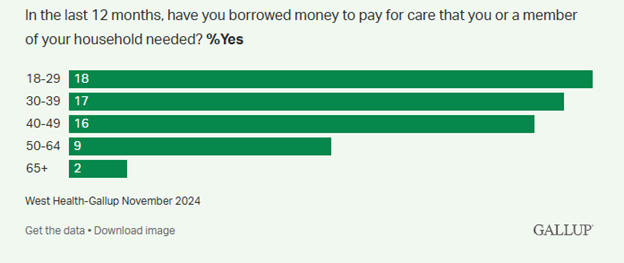
The survey found almost 20% of Americans aged 49 and under needed to borrow money to cover medical costs compared with just 9% of those 50 to 64. Women between the ages of 50 and 64 were twice as likely as men in the same age group to say they had to borrow (12% vs. 6%). Two percent of Medicare-eligible adults (those over the age of 65) reported having to borrow.

West Health Gallup Healthcare Costs 12 months 02282025

“Too many Americans are racking up medical debt whether they have health insurance or not,” said Tim Lash, President, West Health Policy Center, part of West Health, a family of nonprofit organizations focused on healthcare and aging. “A high-priced healthcare system that requires Americans to take out loans or make painful tradeoffs just to stay healthy is in desperate need of policy reform or things will get even worse.”

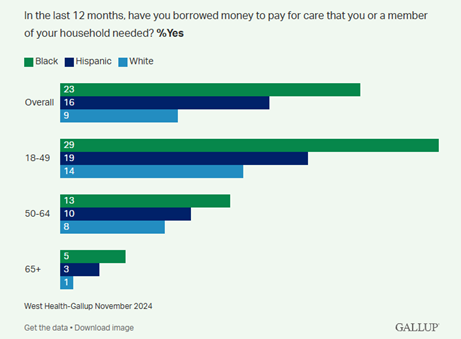
Black (23%) and Hispanic adults (16%) were significantly more likely to report having borrowed money than White (9%) adults. The biggest disparities were found among adults under the age of 50. Black adults aged 18-49 (29%) were the biggest borrowers followed by Hispanic adults (19%) and White adults (14%) in the same age range. Americans with children under the age of 18 were twice as likely to report borrowing compared to households with no children (19% vs. 8%).

West Health Gallup Healthcare Costs ethn 12 months 02282025

Breakdown of Borrowing

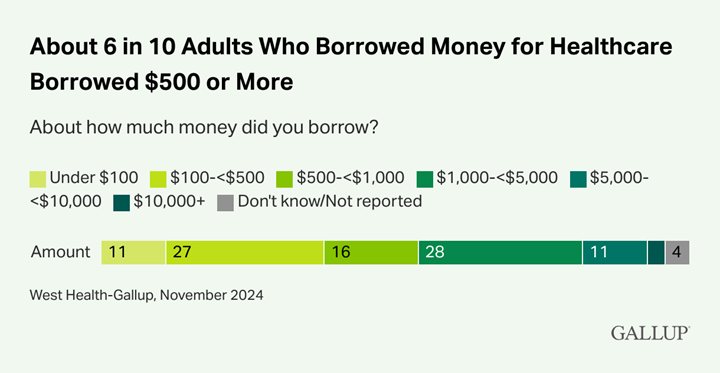
Americans collectively borrowed about $74 billion to pay for healthcare last year, with more than half (58%) borrowing $500 or more and 41% borrowing $1,000 or more. Fourteen percent borrowed $5,000 or more.

West Health Gallup Healthcare Costs dollars borrowed 02282025

Concerns Over Medical Debt Across Age, Race and Income

Most Americans (58%) report being at least somewhat concerned that a major health event could land them in debt, including 28% who say they are “very concerned.” Concerns span income levels, with more than six in 10 households with annual incomes under $120,000 worried. Fewer higher earners were concerned, but 40% of households making over $180,000 report they too have concerns.

Even with Medicare eligibility, more than half (52%) of people aged 65 or older say they are at least somewhat concerned they could go into medical debt if they suffered a major health event. Concerns also run high among Black adults (62%), Hispanic adults (63%) and women (62%). Only 14% of respondents say they are not concerned at all.

“It is clear that high healthcare costs continue to burden the American people, and financial insecurity around care is not limited to any one demographic,” said Dan Witters, director of wellbeing research at Gallup. “These findings underscore the need for solutions that make healthcare more affordable for all Americans.”

Methodology

The West Health-Gallup Survey was conducted via web Nov. 11-18, 2024, with a nationally representative sample of 3,583 U.S. adults aged 18 and older. The margin of sampling error is ±2.1 percentage points at the 95% confidence level.

https://westhealth.org/news/americans-borrowed-74-billion-last-year-to-cover-healthcare-costs/

Biden-Era Medicaid Cost Surge

 Over the past 12 years, two major policy changes have led to massive Medicaid program growth. Keep in mind, the growth of Medicaid has not improved Americans’ health, as a recent Paragon research paper documented, and has worsened access to care for traditional Medicaid enrollees.

The first change is that the Affordable Care Act (ACA) significantly expanded Medicaid by granting eligibility to able-bodied, working-age adults and favoring them over traditional Medicaid enrollees (children, pregnant women, seniors, and the disabled) through significantly higher federal reimbursement rates for state spending on them. Paragon has produced a comprehensive reform that would end the ACA’s federal discrimination against traditional Medicaid enrollees and move nearly half of Medicaid expansion enrollees into the exchanges with a large premium tax credit. This is a long overdue policy reform that Congress should consider.

The second change stems from a set of Biden administration policies, along with increased state Medicaid money laundering schemes, that have significantly increased the federal Medicaid baseline as shown in the first figure below. Between the Congressional Budget Office’s 2021 and 2024 baselines, projected federal Medicaid spending increased by 8.6 percent, a sizeable $685 billion, from 2023 to 2034.

CBOs Medicaid Baseline Rose Significantly Between 2021 and 2024 Reports
 

Several Biden policies explain a portion of this increase. The Families First Coronavirus Response Act provided states with additional federal Medicaid money so long as they maintained Medicaid enrollment during the COVID public health emergency (PHE). The Biden administration also extended the PHE into the spring of 2023, which kept ineligible people on the Medicaid program much longer.  Finally, the Biden administration took regulatory actions to keep ineligible people on the program longer and to validate state financing gimmicks that fleece federal taxpayers and raise Medicaid rates well above Medicare rates for many providers in many states.  As a preview, in March, Paragon will be releasing a research paper on the growth of Medicaid money laundering and what policymakers should do about it.

The House budget resolution contains instructions for the Energy and Commerce Committee to find $880 billion in savings relative to baseline. Congress could achieve these savings through common sense, necessary Medicaid reforms. The figure below illustrates how an expected level of savings in Medicaid (assuming Medicaid reforms make up about 80 percent of the savings) compares to the 2021 and 2024 CBO baselines.

Reconciliation Would Only Reduce Medicaid Spending by 3.3% from 2027-2034 Using 2021 CBO Baseline
 

Crucially, the magnitude of savings relative to the 2021 baseline—before the surge of Biden-era spending—is two-thirds smaller than the 2024 baseline. In fact, spending would only be 3.1 percent lower under this level of savings relative to the 2021 baseline. In essence, Biden’s policies led to a surge of wasteful federal Medicaid expenditures and the House budget resolution would largely reverse the fiscal impact of his policies.

One more important note—this just shows the federal side of Medicaid spending. States will be able to replace all savings that result from federal reforms. As discussed in my most recent newsletters, one of the main problems that federal policymakers should address is the substantial shift in Medicaid costs from the states to Washington over the past 15 years.


Brian Blase, Ph.D., is the President of Paragon Health Institute. Brian was Special Assistant to the President for Economic Policy at the White House’s National Economic Council (NEC) from 2017-2019, where he coordinated the development and execution of numerous health policies and advised the President, NEC director, and senior officials. After leaving the White House, Brian founded Blase Policy Strategies and serves as its CEO.


As a Policy Analyst for the Idaho Freedom Foundation, Niklas Kleinworth is a strong advocate for public policy solutions that place America first, are fiscally efficient, limit government, and expand the free market


https://paragoninstitute.org/paragon-pic/biden-era-medicaid-cost-surge/

Medical Schools’ Botched Pass-Fail Experiment

 Medical schools and institutions are now among the zealous champions of progressive ideology. Within days of George Floyd’s death in May 2020, the Association of American Medical Colleges demanded that the nation’s medical schools “employ anti-racist and unconscious bias training.” The following year, the American Medical Association called on physicians to “dismantle white supremacy, racism, and other forms of exclusion and structured oppression.” But efforts to enhance diversity among the medical student body—too often by compromising standards of excellence—have long been in place at America’s medical schools, from affirmative action policies to pass-fail grading of courses and clinical rotations.

In a recent Journal of the American Medical Association commentary, however, four Stanford University-affiliated scholars pushed back on these changes—a ripple that suggests a potential academic shift. In their essay, Drs. James Agolia, David Spain, and Jeff Choi, and medical student Allen Green, denounce the “diminishing objectivity” of the residency-admissions process. “We believe that some objective standards are necessary,” they write, “for programs to identify candidates who best fit their program in a fair, consistent, transparent, and efficient fashion.”

Specifically, the authors lament that the United States Medical Licensing Exam made its initial test pass-fail. The USMLE, which all would-be doctors take, is administered in three parts. Step 1 is taken after the second year in medical school to test pre-clinical medical knowledge; Step 2 is taken after the fourth or final year to assess clinical knowledge; and Step 3 is taken after the first year of residency to evaluate clinical decision-making.

The change was several years in the making. The exam’s co-sponsors, the National Board of Medical Examiners and the Federation of State Medical Boards, first recommended making Step 1 pass-fail in 2019. Other groups, including the AMA and AAMC, collaborated in developing the proposal, which was eventually adopted in 2022.

The Stanford scholars argue that changing Step 1 to pass-fail was a mistake for four reasons. First, since most competitive residency programs use Step 1 scores to select their residents, pass-fail grading gives these programs less information about applicants’ abilities. Second, it removes an opportunity for underprivileged students to stand out. “[A] high Step 1 score was once a venue through which students from less prestigious medical schools could distinguish themselves with more competitive programs,” they note. Third, in a misguided effort to lower the stakes of Step 1, the exam’s sponsors put even more pressure on students when taking Step 2 in their fourth year. Finally, the scholars observe that pass-fail grading led students to undertake extra activities during medical school—mostly unpaid research—to stand out. Students and faculty point to the often poor quality of this research, and believe that students’ time would be better spent developing clinical skills.

These are compelling reasons to oppose turning Step 1 into a pass-fail test. But they do not address an important motivation for the change: DEI. One the “[g]uiding principles for change” listed in the USMLE’s 2019 summary report was to “[m]inimize racial demographic differences that exist in USMLE performance.” In practice, this meant lowering standards.

That 2019 report also listed “diversity in medicine” as a “guiding principle.” The important subtext here, not spelled out in the report, is the idea that minority patients fare better when treated by a doctor of the same race. Yet, a recent review found that the purported benefits of a same-race doctor were unevenly-to-negatively supported by data. More certain is the value of the full USMLE: a 2024 study in Academic Medicine found that “better provider USMLE performance was associated with lower in-hospital mortality.”

The early results of making Step 1 pass-fail are in, and they are worrisome. Scores fell to a ten-year low in 2023. “The USMLE Step 1 examination was once a high-stakes standardized examination for which students studied extensively,” the Stanford authors observed. “When it became pass-fail in January 2022, the incentive to study for high scores vanished.”

While it’s true that test scores don’t give the full picture, medical school is too far along in the educational pipeline to discount academic merit in the name of social justice. It is time for the United States Medical Licensing Exam to abandon its misguided pass-fail experiment.