Search This Blog

Monday, September 1, 2025

Noem accuses CBS of ‘shamefully’ editing interview on Abrego Garcia to ‘whitewash’ MS-13 tie

 Homeland Security Secretary Kristi Noem went on a tirade against CBS News on Sunday over allegations the network edited her interview about alleged MS-13 gang member Kilmar Abrego Garcia, an illegal migrant that theTrump administration deported to El Salvador earlier this year.

Noem was on CBS’ “Face the Nation” discussing Abrego Garcia Sunday morning, she said on X, but noticed by afternoon that the footage had been clipped to remove part of her answer.

“This individual was a known human smuggler, a MS-13 gang member, an individual who was a wife beater, and someone who was so perverted that he solicited nude photos from minors, and even his fellow human traffickers told him to knock it off, he was so sick in what he was doing and how he was treating small children,” the DHS chief said in the full, unaired clip.

Noem claimed a portion of her interview was cut from CBS.AP
Comparison of Kristi Noem’s uncut and CBS-aired interview segments.X/@Sec_Noem

“So he needs to never be in the United States of America and our administration is making sure we’re doing all that we can to bring him to justice,” she added.

“Secretary Noem’s “Face The Nation” interview was edited for time and met all CBS News standards,” a CBS rep told The Post. “The entire interview is publicly available on YouTube, and the full transcript was posted early Sunday morning at CBSNews.com

Noem wrote on X, “This morning, I joined CBS to report the facts about Kilmar Abrego Garcia. Instead, CBS shamefully edited the interview to whitewash the truth about this MS-13 gang member and the threat he poses to American public safety.”

A US federal immigration judge ruled in 2019 that Abrego Garcia couldn’t be deported to El Salvador due to threats from local gangs — but the Trump administration flew him along with hundreds of other alleged gang members out of the country to a megaprison in the Central American nation earlier this year.

Kilmar Abrego Garcia speaks during a rally and prayer vigil for him before he enters a U.S. Immigration and Customs Enforcement (ICE) field office on August 25, 2025 in Baltimore, Maryland.Getty Images

The Trump administration claimed he was a member of the violent MS-13 gang — a US-designated foreign terrorist organization — based on a determination during that 2019 court proceeding.

Abrego Garcia and his defense attorneys have denied the allegation.

Democrats visited with and advocated for Abrego Garcia, saying he was “wrongfully” removed to El Salvador and kept there for weeks first at the notorious prison CECOT and then at a lower-security facility.

The purported Salvadoran gangbanger was eventually brought back to the US in June and charged with human smuggling, but released briefly before that trial only to be apprehended again by ICE on Aug. 25

He now faces the possibility of being deported to Uganda after having declined to plead guilty to the smuggling charges as part of an agreement that would send him to Costa Rica instead.

Abrego Garcia’s lawyers are still working on getting him asylum in the US. His first attempt in 2019 was denied, but if this one is approved, it could put him on a pathway to a green card and American citizenship.

https://nypost.com/2025/09/01/us-news/kristi-noem-accuses-cbs-of-editing-her-interview-on-kilmar-abrego-garcia-to-whitewash-ms-13-gang-affiliation/

Why 'Eating The Rich' Undermines Everyone's Prosperity

 by David Hebert via TheDailyEconomy.org,

recent report from The Heritage Foundation argues that “the wealthy” are not “idle idols” but are instead owners and investors of wealth-creating ventures.

Through their ownership of productive assets, they are the driving force behind overall wealth creation in the country and, in some cases, the world.  The report reveals a crucial truth that is often lost in today’s political rhetoric: the overwhelming majority of American wealth among the most wealthy (88.2 percent) consists of assets linked directly to businesses and economic production. Despite the commonly accepted belief that millionaires hold their money in real estate or “yachts, sports cars, private planes, gold bars, and jewelry,” most of that wealth is investment, not consumption goods.
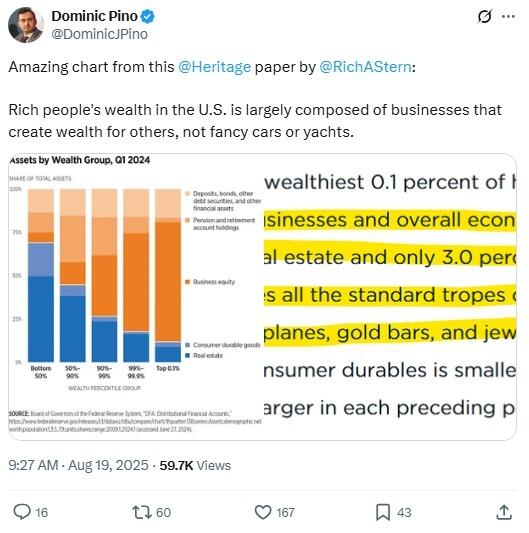
Building on this important truth, we emphasize two additional insights that may inform our current policy debates, particularly as the Trump administration seeks to expand government ownership stakes in private companies.

First, we must acknowledge that capitalism, for all its flaws in practice, is fundamentally a system that rewards serving others, not exploiting them.

Look at Henry Ford: he benefited tremendously from figuring out how to mass produce cars such that the common man was able to afford a vehicle. But I submit to you that, while he became fabulously wealthy from his innovations, the real winners of this exchange were people like you and me. Everyday Americans received better access to transportation, fundamentally transforming our lives. People like Ford already had access to this then-privilege, so while he may command more wealth as a result of his efforts, the efforts themselves improved our lives much more than his.

The people who create medical treatments and vaccines against disease also often become wealthy. But when people all around the world are freed from contracting diseases, enjoying a fundamentally better and happier life, the wealth gained by their inventors seems small. 

Or think of tech moguls like Bill Gates, Steve Jobs, and Tim Cook. By bringing computing power to the masses, they fundamentally transformed the way we all live our everyday lives.

Consider this ad for computers from 1990:

In today’s dollars, these items would cost $6,590, $2,533, and $5,829, respectively. Also in 1990, the average nominal pay for the whole United States was $23,602, meaning that the average person would have to work 220 hours, 84 hours, and 194 hours respectively, to buy these items. Today, with an average wage of $36.44 ($72,880 annually), the hours worked to afford these items (at their 2025 prices) would be 181, 70, and 160.

But we wouldn’t be buying computer equipment from 1990, anyway. Computer prices have actually fallen dramatically. At the time of this writing, a comparable baseline iMac costs $1,299 (35 hours of work).  The latest LaserJet printer from HP costs $169 (4.6 hours).  IBM sold its computer hardware division to Lenovo in 2005, and a Lenovo desktop computer now costs $859 (23.5 hours). Even if we ignore the massive improvements in quality and the explosion of computing power contained in those devices, computing power has never been more affordable. Millions of careers were transformed by the efforts of Bill Gates, Steve Jobs, Tim Cook, and everyone else from engineer to assembly line at Microsoft and Apple. And while the CEOs and employees of these companies have surely become wealthier, the real winners of the innovations are everyday people like you and me.

In a free society characterized by capitalism, wealth is generated by serving others.

Those who can best serve others — and consume less than they generate — find themselves amassing what we define as “wealth.”

The second lesson we can glean from the Heritage study is what the ultra-wealthy actually do with the wealth they amass. Nearly 90 percent of their fortunes are tied up in productive economic activity, not luxury consumption. Only three percent of the top one percent’s wealth is in consumer durables — things like cars, furniture, and jewelry. For the bottom quintile, that ratio is likely to be 15-20 percent.  

Far from being “idle rich,” the wealthy invest their fortunes, providing the capital necessary to fund increased economic activity. For the rest of us, that means more jobs, more production, and better access to the goods and services that enable us to live healthily and wealthily, however we choose to define these terms.

That investment cycle also helps explain why “eating the rich” is a recipe for disaster. Sticking the rich with exorbitant federal taxes can only mean that wealth is removed from productive economic uses to pay for public sector malfeasance. Policymakers are not taking gold coins out of a swimming pool à la Scrooge McDuck, they’re taking investments out of the private sector. The loss of capital impacts not the rich, primarily, but the prosperity that the rest of us have come to enjoy and depend upon.

The reality is that the wealth of the wealthiest people in America largely represents the market’s assessment of their ability to continue serving their customers in the future. As new information comes to light, this assessment can and does change. Tesla, for example, started off white-hot, with stock prices skyrocketing. But lately, after the abysmal launch of the Cybertruck and delays in its production and delivery, combined with some of Musk’s stupendously bad investments, the market has revised its assessment of Tesla downward.  As a result, Musk has lost more than $80 billion in wealth thus far in 2025 alone.

This brings us to a troubling development: President Trump, Congressional Republicans, and members of the so-called New Right have recently floated the idea that we should tax the rich more. Even more alarmingly, these same people hold that the federal government should take equity stakes in private companies. This is a fundamental departure from the principles that allowed for the creation of the wealth policymakers now wish to strip away, and a complete rejection of lower-tax, small-government Republicanism.

President Trump is “taking a 10 percent stake in Intel,” making the federal government the single largest stakeholder of the company. Earlier this year, the sale of US Steel to Nippon was approved, contingent on the US government receiving a “golden share.” While Trump is in office, this golden share is held by the President (i.e. Donald Trump), and after he leaves office, it will revert to being held by the Treasury and Commerce Departments. Importantly, while he is in office, the President will have veto power over some production and wage decisions. Not wishing to be left behind, the Pentagon is taking a 15 percent stake in MP Materials, a producer of rare-earth magnets, among other things.

All of this shifts the nation away from the capitalism that created an economy (and indeed, society) the likes of which has never been seen in human history and toward the type of capitalism found in, say, China. Trying to “out-China” China is a fool’s errand.
The reality is that economies, societies, and the nation itself are best served when individual people are given the freedom and tools to succeed, not when government bureaucrats pick winners and losers.

In a free-market, capitalist system like the one the US for the most part enjoys, the best way to serve oneself is by serving others.

https://www.zerohedge.com/personal-finance/why-eating-rich-undermines-everyones-prosperity

Low-Dose Oral Anticoagulant Slashes Recurrence After Provoked VTE

 Extended low-dose apixaban (Eliquis) after venous thromboembolism (VTE) provoked by events like trauma or surgery in patients with obesity or other enduring risk factors dramatically reduced recurrences without much risk of major bleeding, the HI-PRO trial showed.

Twice daily 2.5-mg doses of the direct oral anticoagulant (DOAC) for 12 months slashed the rate of symptomatic recurrent VTE over that period by a relative 87%, on par with the effect of extended-duration secondary prevention in unprovoked VTE, reported Gregory Piazza, MD, of Brigham and Women's Hospital in Boston, at the European Society of Cardiologyopens in a new tab or window meeting.

The rate dropped to just 1.3% compared with 10.0% among patients given placebo (P<0.001), according to the findings simultaneously published in the New England Journal of Medicineopens in a new tab or window.

Major bleeding occurred in one patient out of 300 in the apixaban group and none in the placebo group. Clinically relevant nonmajor bleeding rates were 4.8% and 1.7%, respectively (HR 2.68, 95% CI 0.96-7.43, P=0.06).

"The most striking finding of this trial is the unexpectedly high risk of recurrence in the placebo group at 1 year, which more closely resembled findings for unprovoked VTE than for truly provoked events," wrote Neil A. Zakai, MD, of the University of Vermont in Burlington, in an accompanying editorialopens in a new tab or window.

"For decades, the guidance was simple: treat a provoked VTE -- one caused by a transient factor such as surgery, trauma, or immobility -- for 3 to 6 months, stop, and move on. Safer anticoagulants and emerging evidence now challenge this long-held approach," he noted, with experts arguing for distinctions such as major versus minor and transient as compared with persistent.

The new findings "invite us to reconsider whether the 'provoked' label is a license to discontinue anticoagulation or the beginning of a more nuanced conversation with our patients," Zakai wrote.

He pointed out that the findings probably reflected the definition of "provoked," relying on clinician judgment rather than standardized definitions for provoking factors unlike in previous epidemiologic studies. The most common provoking factors for the index VTE were surgery (33.5%), immobility (31.3%), trauma (19.2%), and acute medical illness (18.3%). But minor triggers were not uncommon, such as long-haul travel (16.7%). Only 9.3% of the patients had been hospitalized in the 3 months preceding the index VTE event.

The trial was done at a single-center, with more than half of the patients enrolled by a single clinician. While this raises the possibility of a definition of provoked VTE reflecting local practice patterns, it reflects everyday clinical practice, Zakai wrote.

The researchers agreed that the dichotomy of provoked versus unprovoked is "insufficient to determine the duration of anticoagulation." Enduring risk factors -- obesity for about half of the study population, chronic inflammatory or autoimmune disorder for about half, atherosclerotic cardiovascular disease for about 30%, and chronic lung disease for around 20% -- appeared to select a group that approximated recurrence risk of high-risk patients (>8%), they argued.

Post hoc subgroup analysis found consistent impact on the primary endpoint in patients with both major and minor transient provoking factors.

The 600 adults in the trial had VTE after a transient provoking factor and had at least one enduring risk factor. After completing at least 3 months of anticoagulation, they were randomly assigned to double-blind treatment with oral apixaban (2.5 mg twice daily) or placebo for 12 months. VTE with active cancer was excluded, as was anyone with active or recent bleeding events.

The participants' mean age was 59.5; 57.0% were female; and 19.2% had non-white race.

A secondary composite outcome of cardiovascular death, nonfatal myocardial infarction, stroke or transient ischemic attack, systemic embolism, major adverse limb event, or coronary or peripheral ischemia leading to revascularization occurred at a similarly low rate with apixaban and with placebo (0.7% and 1.0%, HR 0.67, 95% CI 0.11-3.98).

The only major bleeding event in the apixaban group was a 3-mm parafalcine subdural hematoma after a fall from a horse that didn't lead to hospitalization or drug discontinuation after neurosurgical consultation.

Among the additional safety findings, one patient in the apixaban group and three in the placebo group died, but no deaths were attributed to cardiovascular or hemorrhagic causes.

"Extended anticoagulation can offer substantial benefit to selected patients with provoked VTE but only if we are able to identify them accurately," Zakai wrote. "Future prevention strategies should blend scientific evidence, clinician judgment, and patient values. The goal is not simply to decide whether to extend therapy but to know for whom the benefits outweigh the risks -- and how patients and treating clinicians weigh those benefits and risks. The 'provoked' label should not end the conversation regarding the duration of anticoagulation; it should be the opening to an individualized patient-centered conversation."

Disclosures

HI-PRO was supported by a research grant from the Bristol-Myers Squibb (BMS)-Pfizer Alliance.

Piazza disclosed relationships with Alexion Pharmaceuticals, Amgen, Bayer, Boston Scientific, BMS, Esperion Therapeutics, Janssen Global Services, NAMSA, Penumbra, Pfizer, Regeneron Pharmaceuticals, and Thrombolex.

Zakai disclosed no relationships with industry.

Texas Bill Would Let Residents Sue Out-of-State Abortion Pill Providers

 A measure that would allow nearly any private citizen to sue out-of-state prescribers and others who send abortion pills into Texas has won first-round approval in the state House.

It would be the first law of its kind in the country and part of the ongoing effort by abortion opponents to fight the broad use of the pillsopens in a new tab or window, which are used in the majority of abortions in the U.S. -- including in states where abortion is illegal.

The bill passed in the House on Thursday and could receive a final vote in the Republican-dominated state Senate next week. If that happens, it would be up to Republican Gov. Greg Abbott, to decide whether to sign it into law.

Here are things to know about the Texas legislation and other legal challenges to abortion pills.

The Texas Measure Is a New Approach to Crack Down on Pills

Even before the U.S. Supreme Court in 2022 overturned Roe v. Wade and allowed state abortion bans, pills -- most often a combination of mifepristoneopens in a new tab or window and misoprostol -- were the most common way to obtain abortion access.

Now, with Texas and 11 other states enforcing bans on abortion at all stages of pregnancy, and four more that bar most of them after the first 6 weeks or so of gestation, the pills have become an even more essential way abortion is provided in the U.S.

"We believe that women need to be protected from the harms of chemical abortion drugs," said Amy O'Donnell, a spokesperson for Texas Alliance for Life, which supports the bill. "They harm women and their intent is to harm unborn babies."

Under the bill, providers could be ordered to pay $100,000. But only the pregnant woman, the man who impregnated her, or other close relatives could collect the entire amount. Anyone else who sues could receive only $10,000, with the remaining $90,000 going to charity.

The measure echoes a 2021 Texas lawopens in a new tab or window that uses the prospect of lawsuits from private citizens to enforce a ban on abortion once fetal activity can be detected -- at about 6 weeks' gestation. The state also has a ban on abortions at all stages of pregnancy.

The pill bill also contains provisions intended to keep those with a history of family violence from collecting and barring disclosure of women's personal or medical information in court documents.

Anna Rupani, executive director of Fund Texas Choice, a group that helps women access abortion, including by traveling to other states for it, said the law is problematic.

"It establishes a bounty hunting system to enforce Texas' laws beyond the state laws," she said.

Law Could Open the Door to Further Battles Between States

While most Republican-controlled states have restricted or banned abortions in the last 3 years, most Democratic-controlled states have taken steps to protect access.

And at least eight states have laws that seek to protect prescribers who send abortion pills to women in states where abortion is banned.

There are already legal battles that could challenge those, both involving the same New York doctor.

Louisiana has brought criminal charges against Maggie Carpenteropens in a new tab or window, MD, accusing her of prescribing the pills to a pregnant minor. And a Texas judge has ordered her to pay a $100,000 penalty plus legal fees for violating that state's ban on prescribing abortion medication by telemedicine. New York officials are refusing to extradite her to Louisianaopens in a new tab or window or to enter the Texas civil judgement.

If the Texas law is adopted, it's certain to trigger a new round of legal battles over whether laws from one state can be enforced in another.

"Its very different from what's come before it," said Greer Donley, a University of Pittsburgh law professor who studies the legal landscape of abortion.

Two Key States Seek to Get Into Anti-Mifepristone Legal Battle

Texas and Florida -- the second and third most populous states in the country -- asked a court last week to let them join a lawsuit filed last year by the Republican attorneys general of Idaho, Kansas, and Missouri to make mifepristone harder to accessopens in a new tab or window.

Those states contend -- as many abortion opponents do -- that mifepristone is too risky to be prescribed via telehealth and that the FDA should roll back approvals and tighten access.

The U.S. Supreme Courtopens in a new tab or window last year unanimously rejected a case making similar arguments, saying the anti-abortion doctors behind it lacked the legal standing to take up the case.

This week, more than 260 reproductive health researchers from across the nation submitted a letter to the FDA affirming the safety record of the abortion medication mifepristone. In the letter, the researchers urged the FDA not to impose new restrictions on the drug and to make decisions based on "gold-standard science."

The FDA is also facing a lawsuit from a Hawaii doctoropens in a new tab or window and healthcare associations arguing that it restricts mifepristone too much.

https://www.medpagetoday.com/obgyn/abortion/117229

'Parkinson's Largely Is a Preventable Disease' — New book

On policy, pesticides, and what people can do to curb Parkinson's risk

Parkinson's disease is not a natural consequence of aging; it is an unnatural one, maintain neurologists Ray Dorsey, MD, of Atria Health in New York City, and Michael Okun, MD, of the University of Florida in Gainesville.

"It is not just found in older men. It affects everyone. It is not predominantly due to genetics. Rather, chemicals in our food, water, and air have created this largely man-made disease," Dorsey and Okun write in their new book, "The Parkinson's Planopens in a new tab or window."

"These chemicals are all around us, and none are necessary."

"The Parkinson's Plan" opens with the story of two women -- Jana Reed, MD, and Sara Whittingham, MD -- one an emergency medicine physician, the other an anesthesiologist. Both were diagnosed with Parkinson's disease in their mid-40s.

MedPage Today spoke with Dorsey about the changing face of Parkinson's disease and what "The Parkinson's Plan" aims to accomplish. An edited version of that discussion follows.

How does Parkinson's disease seem different now?

Dorsey: When Dr. Parkinson described the condition in 1817, he described six individuals with the disease: at least five were men, and all were over the age of 50.

The image of Parkinson's disease that's been taught -- and likely still is taught -- is that it is a disease that affects older men, and it's principally due to aging and perhaps genetics.

Jana Reed and Sara Whittingham are the new faces of Parkinson's disease. They're both women. They both served in the U.S. military. They both were in Afghanistan. They both were diagnosed with Parkinson's disease in their 40s, within a month of each other.

In both cases, as we tell through the book, the likely principal cause of their Parkinson's disease is not within them, but outside of them, in their environment.

It's a chemical that very few neurologists are taught about, trichloroethylene [TCE]. This chemical and perchloroethylene [PCE], commonly used in dry cleaning, might be the most important causes of Parkinson's.

Researchers have shown increased Parkinson's risk in the Camp Lejeune studyopens in a new tab or window where TCE and PCE contaminated the Marine base in North Carolina. Marines who served there when they were young, in their 20s, had a 70% increased risk of developing Parkinson's 34 years later compared to Marines who served at Camp Pendleton.

TCE is everywhere. It's used to degrease metal and decaffeinate coffee. Ten million Americans worked with it. As for Sara Whittingham -- she may have not directly worked with it, but she was an aircraft maintenance officer, and her job was to oversee the cleaning and degreasing of jet engines. One of the big cleaning agents is trichloroethylene. She was likely inhaling it in the area where she was working.

What prompted this book?

Dorsey: Parkinson's largely is a preventable disease. The rise in Parkinson's disease is happening on our watch. We wrote a plan to prevent and treat the disease so future generations can be spared.

As a neurologist, I can't think of a better gift to give than a world where your disease is no longer there, or is extraordinarily rare. We've seen that with polio. We've seen that with other diseases. I think we can do that for Parkinson's.

We set goals for Parkinson's for the next 10 years: we said by 2035, we should reach goals of zero, 10, and 100. We should see zero percent growth in the incidence of Parkinson's, a 10-fold increase in research funding and the percentage spent on prevention, and 100% access to levodopa.

If you look at Parkinson's research dollars, only two pennies of every dollar are spent on trying to prevent the disease. There are houses that sell for more money than we, as a society, spend on trying to prevent Parkinson's disease.

We have not answered the bell. That's a failure of science and a failure of funding agencies.

As neurologists, our calling card is that we figure out why people get diseases. We need to figure out why people have Parkinson's disease so we can take action to prevent it and treat it most effectively.

What does "The Parkinson's Plan" recommend?

Dorsey: We give you the Parkinson's prevention pyramid: What can we do as a society? What can we do in our communities? What can we do as individuals?

The first thing is to measure the disease. What gets measured gets managed.

Parkinson's is one of the fastest-growing brain diseases in the world. If we want to prevent it, we need to first see how many people are getting it and track that over time to see if we're making progress or not. We need to find the areas of the country with high rates, with large numbers of new cases, so we can take targeted actions.

Second, we need to ban some of the most toxic chemicals. The EPA banned TCE and PCE last year. It looks like that ban is going to be put in place. In 2021, they banned chlorpyrifos, a pesticide that used to be found on over half of apples in the United States, but the manufacturer sued and the fate of that is uncertain.

We also need to ban paraquat. Over 50 countries, including China, have banned it, but the United States has not.

What else can we do?

Dorsey: We give 25 suggestions about what individuals can do to perhaps slow the rate of the disease: Wash your produce, preferably your organic produce. Avoid dry cleaners that use perchloroethylene. Use an air purifier if you live in a heavily polluted area. Add a water purifier to your home.

We also give suggestions for communities. Why are we allowing pesticides to be sprayed on kids' playgrounds and schools? Many pesticides are nerve toxins. We should find that socially unacceptable and we should take actions to address that. And golf coursesopens in a new tab or window -- why can't we ask golf courses to use less toxic pesticides?

We need more research to prevent and slow Parkinson's. There are studies that suggest that among people with Parkinson's disease, those exposed to high levels of air pollution are at greater risk for being hospitalized. There are studies that show exercise as a potential way to slow the rate of progression of the disease.

Some studies have robust evidence, some have very limited evidence -- but we're not even studying many of the most important questions out there.

https://www.medpagetoday.com/neurology/parkinsonsdisease/117235