Search This Blog

Friday, February 6, 2026

New York vs. West Virginia: A sanctuary case study

 by Guy Benson, Washington Examiner

Enforcing federal immigration law is the remit of the federal government alone, per Supreme Court precedent — the court famously ruled against Arizona’s efforts to step up enforcement at the state level during the Obama administration — but said enforcement is a more efficient and safer process for everyone involved when state and local authorities cooperate with the feds. This is basic common sense.

Even in blue Minnesota, the epicenter of the anti-Immigration and Customs Enforcement firestorm in recent weeks, where two American citizens have been shot and killed in the unrest, a new poll from KSTP and Survey USA, which contains a number of negative findings for the Trump administration, shows that voters there understand the basic utility and wisdom of cooperation. In response to the question, “Should state/local authorities help with immigration enforcement?” a double-digit majority of Minnesotans, 50%-36%, responded in the affirmative.

Despite a deluge of demonization and anti-enforcement propaganda lately, a fresh Cygnal national survey also illustrates strong public support for anti-illegal immigration policies. According to the polling memo:

73% say entering the United States without legal permission is breaking the law Americans support deporting those here illegally by a nearly 2:1 margin, 61%-34% 54% want ICE to enforce federal immigration laws and remove illegal immigrants 58% oppose defunding ICE, including majorities of independents and swing voters

The difference between federal and lower agencies working together, versus resistance, is stark. In a Jan. 31 court ruling that declined to halt ICE operations in Minneapolis, a Biden-appointed judge noted that “based on the record before the Court, a factfinder could reasonably credit that Plaintiffs’ sanctuary policies require a greater presence of federal agents to achieve the federal government’s immigration enforcement objectives than in a jurisdiction that actively assists ICE.” It’s glaringly obvious. It’s common sense. Let’s consider how the two approaches work in practice. On one hand, in non-sanctuary West Virginia, collaboration worked exceptionally well in a newly reported operation. According to the Department of Homeland Security, “from Jan. 5 to Jan. 19, ICE Philadelphia conducted a statewide surge with 14 of its 287(g) partners in West Virginia, arresting over 650 illegal aliens, including several with serious criminal histories and prior removals.”

Among those taken into custody was an illegal immigrant from India operating a commercial vehicle who was “cited for numerous commercial vehicle infractions for operating an unsafe commercial vehicle” and who had “been previously ordered removed.” What would the objections be to deporting this person, who has already received full due process? Another was a Chinese national who’d already been convicted on multiple counts of endangering the welfare of children in Ohio. Convicted, not accused. What would the argument be against detaining and removing him? “ICE also arrested a convicted child sex abuser, a criminal convicted of drug possession charges, and many others during the operation,” the press release reads. These are operations that occurred with cooperation from local law enforcement “partners in West Virginia.” The rule of law is stronger, and public safety is enhanced, because of this work.

On the other hand, we have New York, where Gov. Kathy Hochul (D-NY) just introduced new legislation “to curb local and federal law enforcement agreements,” as the Washington Examiner has reported. In sanctuary New York City, yet another illegal immigrant criminal was just cut loose by a judge. The New York Post describes it this way: "An alleged crack-smoking, sexual-predator migrant wanted by ICE was allowed to flee through a back door of a Manhattan courthouse — infuriating federal agents.” This alleged perpetrator has been released multiple times, including after a horrible incident in 2011, in which the suspect is said to have “followed a 21-year-old woman home in Midtown, choked her and tried to remove her clothes. … He was stopped by a bystander who heard the woman’s cries and came to her aid, holding Mora down until cops arrived.” A police source told the New York Post that “Judge Sheridan Jack-Browne had a copy of the federal criminal arrest warrant for Mora but released him.”

Rafael Mangual of the Manhattan Institute and the Council on Criminal Justice asked, “Has any NYC official tried to explain why releasing someone like this rather than turning them over to immigration authorities is a good idea?” Indeed, what is the affirmative defense for this policy? How is protecting this sort of person from deportation in the interest of any American? Come to think of it, why was this person with no right to be in the country at all still here even after an alleged violent attack on a woman 15 years ago?

The politicians who support this madness should have to spell it out and explain themselves. Part of the problem is that they’re so rarely asked such questions. Many activists with press badges are so busy running interference for illegal immigrants that they seem to have little remaining time or appetite to cover virtually any of the many ICE success stories, or even “speak truth to power” with tough challenges when the powerful are sanctuary politicians with whom they agree.

https://www.msn.com/en-us/news/us/new-york-vs-west-virginia-a-sanctuary-case-study/ar-AA1VNJOg

Easy-to-get blood test can help detect cancer before symptoms appear

 When it comes to cancer, waiting for symptoms may soon be old news.

Telehealth company Hims & Hers began offering a blood test this week that screens for a wide range of cancers before warning signs appear, including those without routine screenings.

“When cancer is identified earlier, people often have more options and a better chance for positive outcomes,” Dr. Pat Carroll, the company’s chief medical officer, told The Post. “It’s an important step toward supporting longer, healthier lives.”

A hand holding a smartphone showing a "no cancer signal detected" result from a blood test.
The blood test is not intended to replace recommended cancer screenings.Courtesy of Hims & Hers

The test, called Galleri, requires just one blood draw. From that single sample, it scans for tiny DNA fragments shed by more than 50 different types of cancer.

“If a cancer signal is detected, the test can predict the tissue or organ system where that signal is most likely originating from,” Carroll explained.

“That guidance is important because it helps inform next steps with a healthcare provider, rather than simply flagging something abnormal without direction.”

Hims & Hers is the latest telehealth company to offer Galleri, which has been available through other providers since 2021.

Starting this week, subscribers to the company’s $350 lab testing service can add the prescription-only test for an extra $700 — about 25% off Galleri’s list price.

“This is a tool for customers seeking proactive care,” Carroll said.

“Because more than 1 in 3 people will develop cancer in their lifetime, people from all backgrounds can benefit from additional tools that can help monitor their health before symptoms arise,” he continued.

Like many “laboratory-developed tests,” Galleri hasn’t yet been cleared by the FDA as safe and effective. However, its manufacturer, Grail, submitted it for formal review last week.

That submission includes results from a major clinical trial published in 2025. In the study, which followed nearly 36,000 adults over age 50, the test detected 40.4% of cancer cases.

More than half of those cancers were caught early — in Stage 1 or 2 — and about three-quarters were cancers that don’t have standard screening tests, including those affecting the pancreas, liver, head and neck.

That’s important because many cancers grow quietly, without symptoms or routine ways to spot them early on. In fact, 57% of cancers don’t have recommended screenings, yet they account for 70% of cancer deaths in the US.

“That gap can contribute to delayed diagnoses and care journeys that are often more complex than they need to be,” Carroll said.

Still, the test isn’t foolproof.

Out of 216 patients flagged by Galleri as having cancer signals in the trial, nearly 62% were diagnosed with cancer within a year — but 38% turned out to be false alarms.

Those false positives are one reason cancer screening guidelines are somewhat conservative. Research shows unnecessary screenings can lead to overdiagnosisexcessive treatment, high costs — and a lot of stress and anxiety for patients.

Carroll stressed Galleri isn’t meant to diagnose cancer, only to screen for warning signs.

Illustration of a multi-cancer test app showing results, interpretations, and next steps.
If cancer signals are detected, Hims & Hers will connect customers with a healthcare provider to go over their results.Courtesy of Hims & Hers

“A cancer signal detected result doesn’t mean a customer has cancer, but it does indicate the need for further evaluation,” he said.

If a signal pops up, Carroll said a provider will reach out quickly — typically within 15 hours — to walk the customer through the results.

“Following that conversation, we can support customers in downloading the results and sharing them with their preferred in-person healthcare provider, who may suggest further testing and imaging,” Carroll said.

“If a customer doesn’t have a healthcare provider, they’ll be able to contact a Galleri patient advocate.”

Hims & Hers’ own release on Galleri notes that “false positive and false negative results can occur.”

That uncertainty has some experts concerned that a clean result could offer false peace of mind — leading people to brush off symptoms or skip routine screenings altogether.

“A lot of people, they might not be so savvy about interpreting the test,” Eric Topol, director of the Scripps Research Translational Institute, who reviewed the trial data on his Substack, told The Washington Post.

“They get the result ‘negative, no cancer detected.’ Why would they chase that down further?”

Carroll emphasized that Galleri — which is meant to be taken annually — is not a replacement for standard screenings like mammograms or colonoscopies.

“We encourage customers to think of this as a tool to use in addition to their regular screenings,” he said.

“It represents a meaningful advancement in how we can look for cancer signals earlier and more comprehensively than traditional screening alone.”

https://nypost.com/2026/02/06/health/hims-amp-hers-debuts-blood-test-for-50-types-of-cancer/

Trump drops 25% duty on India for buying Russian oil

 United States President Donald Trump signed an executive order eliminating a 25% tariff on Indian goods that he previously imposed on New Delhi for importing Russian oil.

In addition, Washington and New Delhi issued a joint statement, announcing that India would eliminate tariffs on all US industrial goods, as well as a "wide range" of agricultural products. The US would apply a levy of 18% on Indian goods, including textiles, among others, whereas the duties on "certain aircraft and aircraft parts" manufactured in India would be removed. Moreover, India pledged it would buy $500 billion of US energy products, military hardware, precious metals, and technology over the next 5 years.

On Tuesday, Trump said he had a phone call with Indian Prime Minister Narendra Modi, who agreed to halt imports of Russian oil. Modi subsequently hailed the trade agreement reached with the US.

https://breakingthenews.net/Article/Trump-drops-25-duty-on-India-for-buying-Russian-oil/65626020

Warsh to leave Coupang if confirmed as Fed chair

 E-commerce company Coupang Inc. said on Friday that United States President Donald Trump's pick for the next chair of the US Federal Reserve, Kevin Warsh, who serves as a member of Coupang's Board of Directors, will leave the company if he is confirmed by the US Senate.

"On February 3, 2026, Mr. Warsh informed the Company that if he is confirmed as Chairman of the Board of Governors of the United States Federal Reserve System by the United States Senate, he would resign as a director of the Company. Mr. Warsh's decision was not due to any disagreement with the Company on any matter relating to the Company's operations, policies or practices," the company said in a filing to the US Securities and Exchange Commission (SEC).

https://breakingthenews.net/Article/Warsh-to-leave-Coupang-if-confirmed-as-Fed-chair/65625880

Trump places 25% tariff on countries trading with Iran

 United States President Donald Trump signed an executive order imposing a 25% duty on imports from "any country" that "directly or indirectly" purchases, imports, or acquires goods and services from Iran.

Furthermore, Trump stated that the executive order may be modified in case foreign nations decide to retaliate against the new tariff. The measure comes amid Washington's increased pressure against Iran and shortly after negotiations about the Middle Eastern country's nuclear program in Oman.

The new levy could affect nations such as China, a major importer of Iranian oil.

https://breakingthenews.net/Article/Trump-places-25-tariff-on-countries-trading-with-Iran/65625963

Soaring Trucker Rejection Rates Suggest "Epic Year" For Drivers

 Trucking advocacy group American Truckers United set the narrative late last year that the Trump administration's crackdown on fraudulent, non-domiciled commercial driver's licenses that flooded US highways during the Biden-Harris regime era - linked to deadly crashes nationwide and the collapse in spot rates for mom-and-pop American truckers - was finally set to end and begin transitioning into industry tailwinds in 2026.

The note was penned on Dec. 27 and titled "Trump's Highway Enforcement Lays Groundwork For U.S. Trucking Revival." ATU pointed out that the Trump administration's purging of illegal alien truck drivers was set to create fairer wages, safer roads, and protect the jobs of honest, hard-working citizen truckers.

ATU noted a reversal in trucking spot rates in late 2025. Fast forward to today, rejection rates published on X by FreightWaves founder and CEO Craig Fuller show what is shaping up to be a stellar year for American truckers.

Fuller posted Truckload Rejection Index (TRI) data from SONAR showing rejection rates of 14%.

TRI tracks the percentage of contracted truckload shipments that carriers reject instead of hauling at the agreed contract rate, and only suggests that truck capacity is tightening after the Trump administration began purging illegals from the trucking industry.

Fuller emphasized, "26 could be an epic year for truckers."

Fuller also cites rising manufacturing trends (see ZH MFG note) in the US, which only suggest a boom year for truckers.

Great news for truckers. Tailwinds certainly have arrived.

https://www.zerohedge.com/markets/soaring-trucker-rejection-rates-suggest-epic-year-drivers

How Platforms Influence Your Perception

 by Barry Ritholtz


I spend a lot of time in “How Not to Invest” discussing how our own biases often work against us. This is especially true when it comes to the information we consume relative to our investments and portfolio.

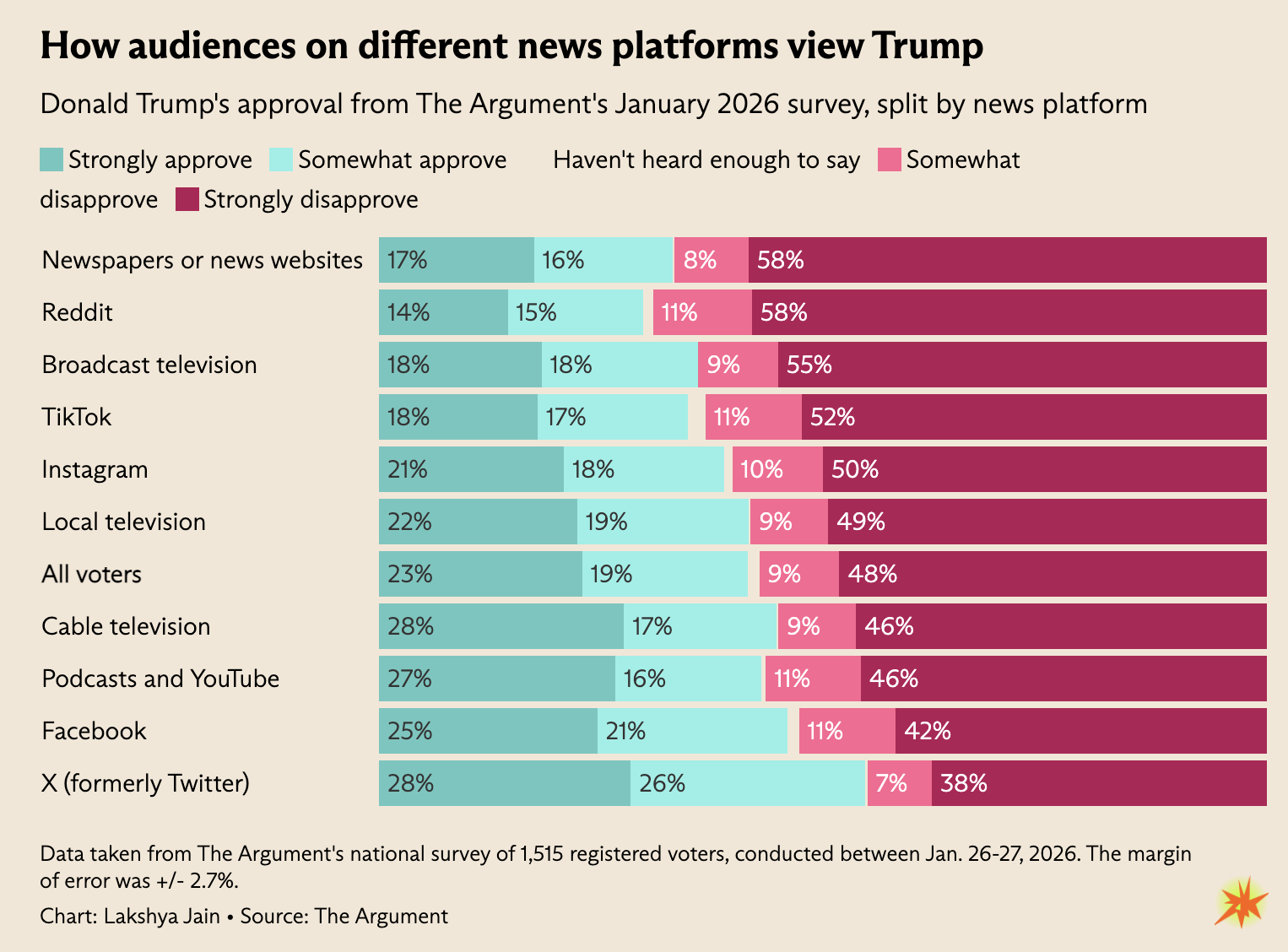
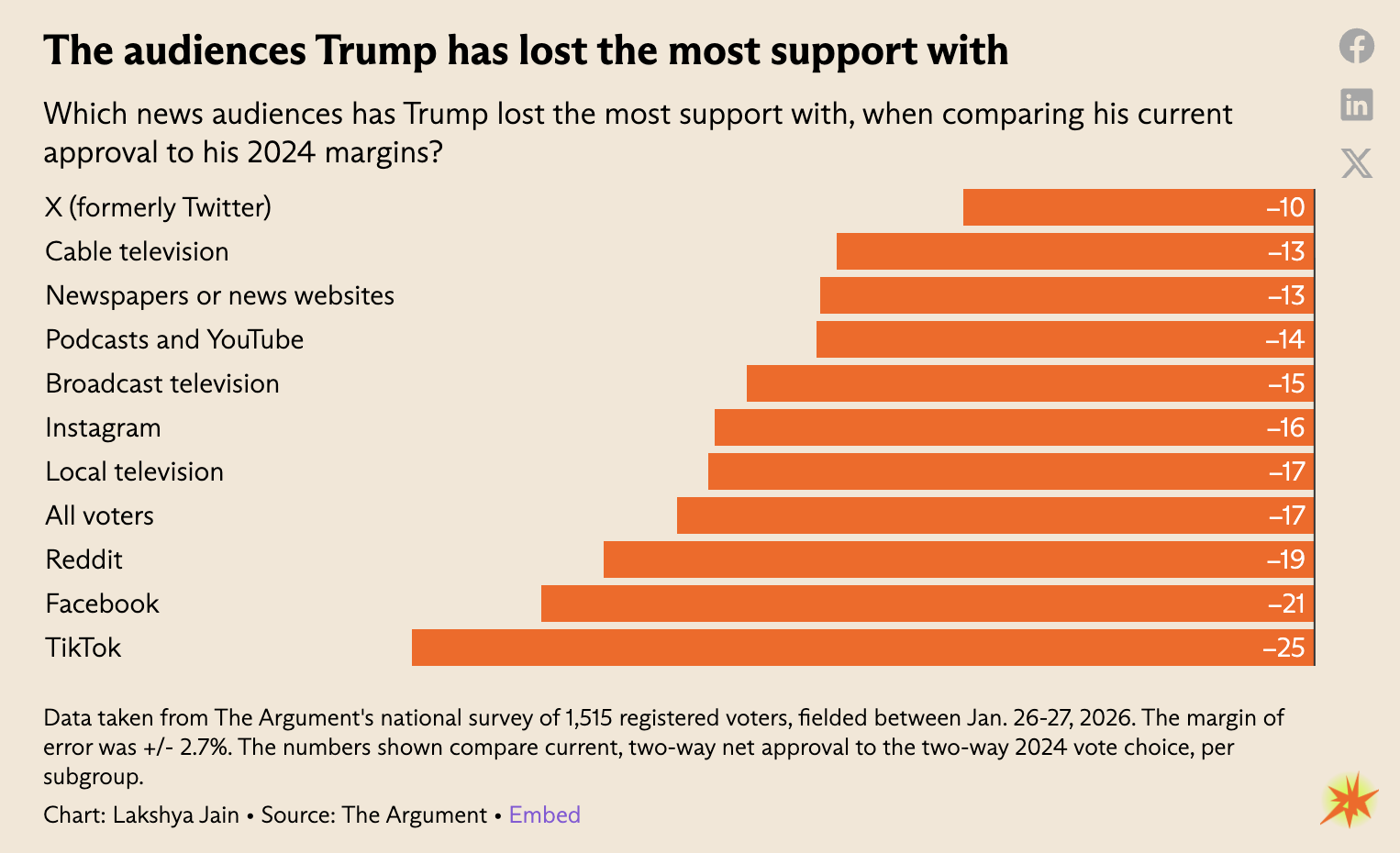
While we tend to focus on the confirmation biases in various media outlets or cable channels we seek out, we may not stop to consider how the algorithms that drive the social media platforms we consume are affecting our perception of current news events (See chart above).

The Argument takes this to the next level by using survey data on where people get much (most?) of their news and how this affects their perception of specific events. They don’t evaluate platforms by their bullish or bearish stance, but rather how major news stories show up in people’s partisan preferences by platform:

“Whether you’re getting your information from TikTok, Instagram, Reddit, Twitter, cable news, or elsewhere, platforms are shaping your information diet in ways you may not even notice. Content is inseparable from the vehicle within which it arrives.”

There is some selection bias in that people typically gravitate to the platform that reflects their own views; that certainly is likely ever since Twitter was purchased by Musk. Regardless of that selection issue, the results were quite surprising.

Consider the political leanings associated with each platform in the chart:

There is definitely an “algorithmic bias” built into all of these platforms.

I cannot say that I was surprised at Reddit, which tends to be more like the old internet — where college-educated, youth, and higher income skew to the left. I am a little surprised at TikTok, but I to assume it’s mostly a younger age demographic that drives all of that. I am completely unsurprised at Twitter…

https://ritholtz.com/2026/02/how-platforms-influence-your-perception/