Search This Blog

Friday, April 3, 2026

Blasts reported in Tehran as search continues for US pilot in Iran

 Summary

  • Several explosions were heard in Tehran on Friday night, eyewitnesses told Iran International.

  • Israel has suspended airstrikes in areas “relevant” to the search for a downed US pilot, the Associated Press reported, citing an Israeli official.

  • One ‌of ​the ⁠two ‌Americans from an F-15 ​fighter jet ‌downed in Iran ‌has been rescued, Reuters reported citing a US official.

  • Iran said it downed a US fighter jet and reported aerial search activity in the area.

  • US President Donald Trump said on Friday the United States could reopen the Strait of Hormuz and “take the oil,” calling it a potential “gusher for the world.”

  • A French-linked container ship exited the Strait of Hormuz, the first such transit by a Western European vessel since the war disrupted shipping, Bloomberg reported on Friday.

  • A UN Security Council vote on a Bahrain-backed resolution on the Strait of Hormuz was removed from the schedule with no explanation.

  • Iran warned on Friday it would expand strikes to US and Israeli fuel, energy, economic and power infrastructure if Washington escalates attacks on its infrastructure.

  • Iran’s internet blackout entered its 35th day on Friday with connectivity at about 1% of normal levels, leaving the public largely cut off, NetBlocks said.

Bahrain says 4 injured after drone interception

 Bahrain's Ministry of Interior said four citizens were injured and several homes in Sitra were damaged after Iranian drones were intercepted.

Officials reported that shrapnel from the interception caused minor injuries and struck residential areas on Friday.

The ministry attributed the incident to "Iranian aggression" and confirmed emergency teams were carrying out procedures.

https://breakingthenews.net/Article/Bahrain-says-4-injured-after-drone-interception/66011898

Thiessen’s five steps

 by Scott Johnson

Marc Thiessen is a senior fellow at the American Enterprise Institute, former chief speechwriter for President Bush (43), and a current supporter of our efforts to throttle the Iranian regime. He writes a twice-weekly column for the Washington Post. In his most recent column, he advances a plan to end the war without an agreement in five steps:

1. Complete all remaining military tasks. Trump said the war will “continue until our objectives are fully achieved.” So which tasks remain? Seize or destroy Iran’s fissile material so the regime cannot easily restart its nuclear program (or give what Trump calls its “nuclear dust” to terrorists for a dirty bomb). Take out all the remaining targets on the military’s list. Implement the innovative plan that sources tell me Centcom Commander Adm. Brad Cooper has prepared to open the Strait of Hormuz by force, and then hand the mission over to a multinational armada made up of countries who receive oil from the strait, which must take responsibility for keeping it open. Or, alternatively, the United States can charge a substantial “escort fee” for each ship passing through the strait, which would be waived for countries participating in the mission. And then, finally, either take control of Kharg Island, by seizing or blockading this linchpin of Iran’s energy export sector, or destroy it to cripple Iran’s ability to fund terrorist proxies and a military rebuild.

If the U.S. completes these tasks, it will have a stranglehold over Iran, and the regime will never again be able to hold the world’s economy hostage. U.S. military commanders believe that these objectives can be achieved in the next two to three weeks, but the determination of when the mission is complete should be conditions-based. Success matters more than speed.

2. Eliminate the Iranian leaders who were spared for the purpose of negotiations. Trump reportedly asked Israel not to strike certain Iranian leaders so he would have negotiating partners. If those leaders refuse his terms of surrender, their existence has no remaining purpose. Trump should issue one last ultimatum, then unleash Israel to take them out in a final barrage of leadership strikes.

3. Unilaterally declare victory. No ceasefire. No peace agreement. When Cooper informs the president that he has achieved all the military tasks set out for him, Trump should announce that he is suspending military operations.

4. Impose peace terms. Trump should announce to the remnants of the regime that all the demands he put forward are now in effect and will be imposed by force if necessary. If Iran violates any of his terms — by trying to rebuild its nuclear or ballistic missile programs, for instance, or providing support for its terrorist proxies — the U.S. and Israel reserve the right to strike at will. Iran tests America’s resolve at its peril.

5. Bar Iran from firing on protesters and set conditions for eventual regime collapse. Trump should inform the regime that the U.S. will tolerate no more massacres and executions. If the Iranian people take to the streets and the regime fires upon them, the units and leaders responsible will face elimination. Each time they kill innocent Iranians, the U.S. and Israel reserve the right to respond by killing Iran’s political and military leaders.

Thiessen emphasizes the salience of the fifth point in support of regime change: “This final element is essential to the long-term success of Trump’s Iran campaign.”

https://www.powerlineblog.com/archives/2026/04/thiessens-five-steps.php

The Arc of Lifespan – Limits to longevity

 Life expectancy has long symbolized human progress, but what happens when that progress slows down or even reverses? Despite decades of medical and social advances, recent data show a troubling plateau in our lifespans. To understand why, we must look beyond simple trends and explore the complex factors influencing the course of our lifespan.

Definition of life expectancy

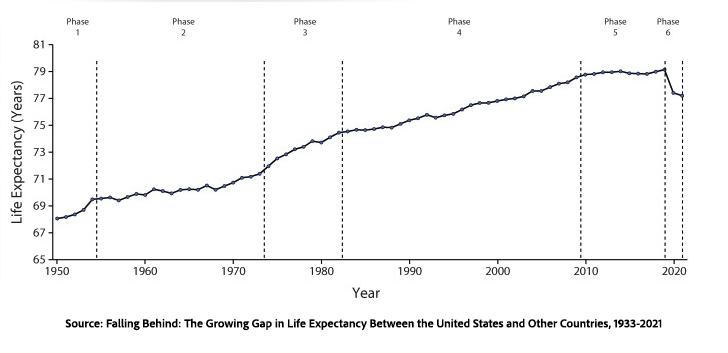
Healthcare science often uses life expectancy as a measure of outcome. It is defined as the average number of years a person who has reached a certain age can expect to live. This is an aggregated figure that considers all factors affecting our lifespan—our genetics and biology, controllable lifestyle choices such as diet, exercise, smoking, and drinking, access to healthcare, and socioeconomic factors like income, housing, and neighborhood safety. 


A graph showing the growth of the us</p>
<p>AI-generated content may be incorrect.

 Despite increased longevity since the 1950s and the Boomers, the growth rate has plateaued and, with the pandemic considered, has actually decreased. A new study in PNAS aims to examine some of the key trends behind the stagnation in lifespan improvements. They offer a visual explanation using Lexis diagrams.

To understand what the study reveals, it helps to first see how that diagram works.

How Lexis Diagrams Work

A Lexis diagram combines three dimensions of information into one image. On these charts, the x-axis represents calendar time, and the y-axis shows age. Color indicates whether mortality is improving or worsening, with darker or more intense shades showing stronger changes. This makes the diagram helpful for identifying patterns that might be missed in a typical line graph.

Read horizontally, the diagram illustrates how mortality rates change over time for people of the same age—such as comparing four-year-olds in the 1940s with four-year-olds today. Read vertically, it emphasizes the impact of events that affect multiple age groups simultaneously, like pandemics, recessions, or major medical advances. Read diagonally, it follows birth cohorts over time, showing whether one generation is faring better or worse than the previous ones.

With that framework in place, the study’s findings become easier to interpret.

The Study

Researchers examined death certificate data for individuals born from the 1890s to the 1980s, creating Lexis diagrams for all-cause mortality and the three main causes of death: cardiovascular disease, cancer, and external causes—causes originating outside the body, such as accidents, violence, etc.—which is categorized as the “other” group. 

  • The slowdown cannot be explained by just one cause. The study found that the stagnation results from a mix of generational (“cohort”) effects and broader societal (“period”) effects impacting multiple causes of death at the same time.
  • For Baby Boomers, especially those born in the 1950s, the study suggests a transition point: at many adult ages, mortality rates were higher than in earlier generations. A major part of that shift was the slower improvement in deaths from cardiovascular disease. These patterns may also overlap with what economists have called “deaths of despair,” a term used to describe rising mortality linked to suicide, alcohol, and drugs in some middle-aged Americans, though that broader interpretation goes beyond this study alone.
  • Gen Xers—people born in the 1970s—are experiencing rising mortality rates in early and middle adulthood, with earlier increases seen in cardiovascular deaths. Although deaths from smoking-related cancers have declined, colon cancers associated with obesity have increased. Of course, this generation has also been heavily impacted by waves of drug overdoses, which have raised mortality from external causes.
  • A widespread rise in mortality started around 2010, impacting almost all generations alive then, indicating that broad societal or health-system factors are involved rather than just generational differences.

Those patterns describe what happened; the harder question is why those gains began to fade.

Why Have the Gains Stalled?

So why has life expectancy stalled? The short answer is a combination of various biological, behavioral, and social factors – there is no smoking gun to focus on. 

Biologically, despite the dreams of tech bros, we may be approaching our biological limits. Medical advances produce survivors who are frail, and their deaths slow perceived progress. The notable stagnation in cardiovascular disease indicates both the reason for and the futility of continually lowering cholesterol levels that require treatment.

There are period-specific factors; epidemics of smoking, AIDS/HIV, opioids, and COVID all have effects that echo over time. We also cannot ignore our lifestyle choices, such as the impact of smoking on earlier cohorts and drugs on later ones, along with the rising tide of obesity and underlying metabolic disease. And there are those problematic socioeconomic factors that influence our ability to access care and avoid risk.

What emerges is not just a single failure but a layered story. Generations bear the imprint of their exposures—smoking, drugs, diet—while societies add on economic inequality, public health crises, and shifting medical advancements. Medicine continues to extend life, but it also alters who survives and with what burdens. The result is a population whose health trajectory reflects decades of accumulated choices and circumstances. Life expectancy stalls not because progress stopped, but because the forces shaping health have become more complex, interacting, and harder to influence in a single direction.


Source: Insights into US life expectancy stagnation from birth cohort mortality dynamics PNAS DOI: 10.1073/pnas.2519356123

Dr. Charles Dinerstein, M.D., MBA, FACS is Director of Medicine at the American Council on Science and Health. He has over 25 years of experience as a vascular surgeon.

https://www.acsh.org/news/2026/04/03/arc-lifespan-limits-longevity-50037

Iran said to refuse US 48-hour ceasefire proposal

 The Iranian authorities rejected a proposal from the United States for a 48-hour ceasefire, Iran's semi-official Fars News Agency reported on Friday, citing an informed source. The US officials reportedly sent the proposal through a "friendly" country.

"US diplomatic efforts to achieve a ceasefire have intensified, especially after Iran targeted a US military depot on Kuwait's Bubiyan Island," the source reportedly said. The report also claimed that Tehran's response to the proposal was not sent in writing, but shown through "continued heavy attacks."

The Iranian officials were also said to have refused to meet with the American delegation in Islamabad in the coming days, claiming that the US demands for reaching a ceasefire were "unacceptable."

https://breakingthenews.net/Article/Iran-said-to-refuse-US-48-hour-ceasefire-proposal/66011667

NYT: Second US plane said to have crashed in Persian Gulf

 A second US plane was said to have crashed in the Persian Gulf region earlier today, the New York Times reported on Friday, citing two US officials who wanted to remain anonymous. The news followed the reports of Iran downing another US plane, later identified as an F-15E strike fighter.

The second jet, the A-10 Warthog subsonic attack aircraft, crashed near the waters of the Persian Gulf, and its lone pilot was rescued, the sources stated. Furthermore, the incident occurred at roughly the same time as the shooting of the F-15E plane inside Iranian airspace, although it remained unclear whether the A-10 was hit by enemy fire.

Meanwhile, one of the pilots aboard the F-15E was rescued, while search operations are still ongoing to locate and extract the second crew member.

https://breakingthenews.net/Article/Second-US-plane-said-to-have-crashed-in-Persian-Gulf/66011657

How the Supreme Court’s trans therapy case guts the ‘expert’ class

 Scientific freedom won big at the US Supreme Court this week.

On Tuesday the court refused to uphold Colorado’s ban on “conversion therapy,” ruling 8-1 that the state law unconstitutionally restricts licensed talk therapist Kaley Chiles’ freedom of speech under the First Amendment. 

Similar bans in 22 other states, including New York and California, will probably fall under this ruling.

The mainstream press billed the legal struggle in Chiles v. Salazar as a cultural battle between Christian right-wingers and transgender advocates.

But in truth, a bigger, more powerful issue was at stake: Can government silence medical dissent?

Eight justices voted against the Colorado law, including liberal Justices Sonia Sotomayor and Elena Kagan.

Colorado’s lawyers defended the ban by pointing to a consensus among “every major professional healthcare association in the country” that conversion therapy — which aims help patients suffering gender dysphoria to feel comfortable with their birth sex — is ineffective and likely harmful.

But today’s medical consensus is often tomorrow’s outdated science. 

Knowledge evolves, unless the law silences the free exchange of ideas.

Justice Neil Gorsuch nailed that point in his majority opinion.

Medical consensus, he wrote, “is not static: it evolves and always has. A prevailing standard of care may be what most practitioners believe today” — but perhaps not tomorrow.

That’s called progress.

The court has not always been this wise. 

During the oral argument in October, Justice Samuel Alito pointed to one of the court’s most disgraceful past rulings, Buck v. Bell. 

In that tragic 1927 case, the court upheld a Virginia that authorized state mental institutions to sterilize residents considered “feeble-minded.”

Pointing to broad consensus among medical professional organizations — including the American Medical Association — that involuntary sterilization would improve humanity, Justice Oliver Wendell Holmes wrote that “three generations of imbeciles are enough.”  

That allowed Virginia to sterilize a teenager who had been raped by a member of her foster family and who, along with her infant daughter, had been labeled “feeble-minded.”

So much for the wisdom and morality of medical consensus.

But there’s no need to look back as far as Buck v. Bell to see the danger of relying on medical consensus.

During the COVID-19 pandemic, the Biden administration leaned on social-media companies to erase or reduce the visibility of doctors like Jay Bhattacharya and Scott Atlas who challenged lockdowns, mandatory vaccinations, school closings and masking. 

Professional organizations and scientific journals all joined in groupthink — the real meaning of “consensus.”

Ultimately they were proven wrong.

Politicians like former law professor Elizabeth Warren, who should know better about the meaning of the First Amendment, went after Amazon for selling books that challenged COVID regulations.

That’s what makes the Chiles v. Salazar ruling so important: It tells the government to keep its hands off freedom of speech in the medical arena.

This wasn’t a victory for the right, but a victory for everyone.

Kagan made that point in her concurring opinion, calling the Colorado law “a textbook” example of a First Amendment violation.

She explained that if Colorado passed a law banning gender-affirming talk therapy — in effect, the  mirror image of the law Chiles challenged — it would raise the same First Amendment problems. 

In short, the justices affirmed, government may not silence differing viewpoints on what constitutes proper or appropriate medical care.

Banning certain medical procedures is a somewhat different matter, one where the First Amendment does not apply.

Last year the court upheld Tennessee’s right to ban hormone therapy or puberty inhibitors for minors, reasoning that states have always had the power to regulate medical practice. 

But it’s not always clear where medical expression ends and medical practice begins.

Justice Ketanji Brown Jackson, the only dissenter in Chiles v. Salazar, erred by opposing the right of medical professionals to break from the current consensus.

“Before now,” she wrote, “licensed professionals had to adhere to standards when treating patients. They could neither do nor say whatever they want.” 

Jackson excoriated the majority for turning “its back on that tradition.”

Her words echoed those of Dr. Anthony Fauci, who infamously insisted that attacks on him, “quite frankly, are attacks on science.”

Americans suffered and even died during COVID because of the wrongheaded idea that consensus thinking should never be questioned — and that it’s acceptable to censor those who dare to do so.

The ruling in Chiles v. Salazar is a bold, nonpartisan step to protect freedom of speech and invigorate the marketplace of medical ideas. 

Betsy McCaughey is a former lieutenant governor of New York.

https://nypost.com/2026/04/03/opinion/supreme-courts-trans-therapy-case-guts-the-expert-class/