Search This Blog

Wednesday, August 12, 2026

WTI Dips After Massive Crude Inventory Build, Big SPR Drain, Surge In Imports

 Oil prices are marginally lower this morning as OPEC again cut its forecast for global oil-demand growth for this year, but stalled talks to reopen the critical Strait of Hormuz waterway and risks in the Red Sea prolong disruptions to global supplies.

Physical disruptions are spreading beyond Hormuz. Refinery attacks and fires have hit Russia and Libya, while the Houthis claimed another attack on Saudi Aramco’s Jazan complex. The Red Sea has become a key alternative export route for the Kingdom, and Houthi attacks are putting that release valve under pressure.

Overnight saw API report a huge crude inventory build and 

API

  • Crude +9.1mm

  • Cushing +1.6mm

  • Gasoline -1.5mm

  • Distillates -600k

DOE

  • Crude +17.4mm (-1.4mm exp) - biggest build since Jan 2023

  • Cushing +1.61mm

  • Gasoline -968k

  • Distillates -10k

After API's reported large build, the official data showed an almost unprecedented 17.4mm barrel build in crude stocks (the biggest since Jan 2023), Cushing saw another build while products saw draws for the second week in a row...

The massive oil stock build was driven by imports which rose to the highest level since November 2024. The US imported over a million barrels a day of oil last week, in part driven by a rise in Venezuelan imports and a return of Saudi Arabian oil. This is a sharp reversal from only a few months prior when oil was flowing abroad in massive quantities.

Net Imports at their highest since June 2025 (thanks in addition to a big slump in US crude exports to the lowest since Nov 2025) ...

Stocks at the critical Cushing Hub are limping off 'tank bottoms'...

As we detailed here, the Strategic Petroleum Reserve saw drawdowns re-accelerate last week (with 6.1mm barrels leaving the caves of salt), back below $300 million barrels to its lowest level since January 1983. Nevertheless, total commercial crude stocks rose 11.3mm barrels last week - the largest since February...

A total of 117 million barrels of crude has been taken out of the SPR since late March under a program to release 172 million barrels as part of a relief plan coordinated by the IEA aimed at lowering energy costs.

US Crude production also limped higher near record highs as the rig count continues to rise...

The oil stock build comes even as refiner runs rose and are sitting at the highest seasonal level since 2019. Fuel makers have signaled they intend to run harder-than-usual through the third quarter, a time when plants typically go down for maintenance.

WTI dipped back below $83 after the official data, holding gains from Friday's close around $77...

Interestingly, Bloomberg points out that US gasoline demand continued to remain resilient in the face of elevated gasoline prices. US retail gasoline prices are averaging over $4 per gallon, almost $1 per gallon (29%) higher than last year’s level at this time, according to data from the American Automobile Association. However, this week’s gasoline demand is only 36,000 barrels per day -- 0.4% lower compared to last year. 

Finally, as we noted yesterday, quoting Bloomberg macro strategist, Michael Ball, market structure reflects that stress better than outright prices. Brent and WTI curves remain backwardated and refining cracks are elevated, signaling near-term scarcity. Options are less aggressively bullish, with 25-delta call skews in both benchmarks dropping to their least bullish levels since July 10.

That points to a market vulnerable to spot disruptions while increasingly pricing a path toward de-escalation.


https://www.zerohedge.com/energy/wti-dips-after-massive-crude-inventory-build-big-spr-drain-cushing-tank-bottoms

NYC 13% Pension Aggregate Return for Fiscal Year 2026

 Funds now valued at a combined $326.3 billion

Returns significantly outpace actuarial target of 7.0% and reduce City pension obligations by an estimated $6.3 billion over five fiscal years

New York City Comptroller Mark Levine and the trustees of the five New York City retirement systems (Systems) today announced an aggregate 13% investment return net of fees across the five Systems for the fiscal year ending June 30, 2026. The Systems are now valued at $326.3 billion, reflecting strong performance amid a complex investment landscape marked by evolving trade policy, persistent inflation, geopolitical uncertainty, and continued investment in artificial intelligence.

The past fiscal year’s performance surpasses the 7.0% actuarial target and reduces the City’s required pension obligations by approximately $6.3 billion over five fiscal years beginning in FY28.

“Retirees work for decades to earn the financial security that a pension provides and protecting that security requires a disciplined and prudent investment approach. Global markets faced significant headwinds over the past year, and our results demonstrate the importance of maintaining a long-term focus and a diversified strategy designed to deliver sustainable, risk-adjusted returns for decades to come,” said New York City Comptroller Mark Levine.

The five systems – the New York City Teachers’ Retirement System, Employees’ Retirement System, Police Pension Fund, Fire Pension Fund, and Board of Education Retirement System – posted an annualized average three-year return of 11.1%, five-year return of 6.2%, seven-year return of 8.6% and 10-year return of 8.9%.

NYC Combined Systems Annualized Returns, Net of Management Fees


The funds maintain a disciplined, diversified, and long-term investment strategy to ensure appropriate risk-adjusted returns. They have 43% invested in Public Equities, 25% in Public Fixed Income (i.e. Government and Corporate Bonds), and about 22% in Private Markets Alternatives (including Private Equity, Real Estate, Alternative Credit, Infrastructure, and Hedge Funds) and cash.

The Systems’ public market investments, which represent more than 74% of the Systems’ assets, generated strong gains for the Systems across both equities and fixed income as the principal contributor to investment performance. The solid performance of public markets was driven in large part by emerging markets equity investments led by the information technology sector. Fixed income market investments also experienced positive gains, supported by higher starting yields, strong investor demand and historically tight credit spreads.

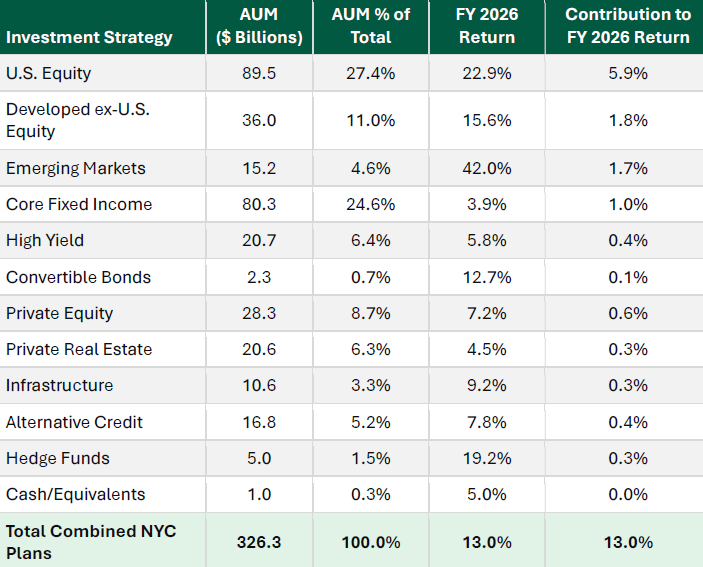
The Systems’ private markets investment returns supported their long-term investment strategy, providing diversification, downside protection and long-term value creation. Hedge Funds delivered a record program return of 19.2%, while Infrastructure and Alternative Credit also generated strong returns of 9.2% and 7.8%, respectively. Real Estate also saw stronger returns this year due to the strategic shift toward multifamily and industrial properties, and a reduction in office exposure.

“This past year’s performance reflects our commitment to deliver for hundreds of thousands of members and beneficiaries counting on us to safeguard the retirement assets that they have worked tirelessly to earn. I am grateful for the leadership of Comptroller Levine, and the commitment of staff within the Bureau of Asset Management, and our fruitful partnership with our asset managers, trustees and investment consultants that made this possible,” said Chief Investment Officer Monte Tarbox.

Assets Under Management, Return Net of Fees, and Contribution to Return


Review today’s report on the audited investment returns for the fiscal year ending June 30, 2026, at https://comptroller.nyc.gov/reports/new-york-city-pension-funds-returns-for-fiscal-year-2026 for market reflections and a detailed review on overall performance and individual asset classes.

About the New York City Retirement Systems

The New York City retirement systems comprise the City’s five public pension funds (the New York City Teachers’ Retirement System, Employees’ Retirement System, Police Pension Fund, Fire Pension Fund, and Board of Education Retirement System), and are collectively the third largest public pension system in the nation, valued at approximately $326.3 billion in assets under management as of June 30, 2026.

https://comptroller.nyc.gov/newsroom/nyc-comptroller-levine-and-pension-trustees-announce-robust-13-pension-aggregate-return-for-fiscal-year-2026/

'AP: Amid Flesh-Eating Bacteria Deaths, Health Officials Urge Caution for Beachgoers'

 Health officials in Louisiana are urging beachgoers to take precautions during a summertime surge in infections from a flesh-eating bacteria found in coastal waters.

Louisiana has confirmed nine cases of Vibrio vulnificus infections this year, the state's health department said last week in a news release. All were hospitalized, and five died. During the same period over the previous decade, Louisiana reported an average of seven cases and one death.

"Seek medical care immediately if a wound exposed to brackish or salt water becomes red, swollen, painful, warm or discolored," officials said in the release. "Tell the healthcare provider about the water exposure."

The Gulf Is an Ideal Environment

Vibrio bacteria thrive in seawater and in the brackish mix of fresh and saltwater found in estuaries and lagoons. Most infections are reported from May to October, and most happen in states along the Gulf Coast. Doctors say the Gulf is an ideal environment with the right amounts of salt and heat to let this organism proliferate.

The mostly deadly type is Vibrio vulnificus, according to the CDC. As many as one in five of those infections are fatal, a much higher rate than other types of Vibrio bacteria.

Florida, which tends to have more infections than other states, has reported 14 Vibrio vulnificus cases and two deaths so far this year, compared with 33 cases and five deaths for all of last year. Records show more cases in years when Florida is hit by tropical storms and hurricanes.

Bacteria Enters Through Breaks in the Skin

Some people become infected by eating raw or undercooked shellfish -- particularly oysters. But a large percentage fall ill when the person is in ocean or brackish water and the bacteria enter the body through small breaks in the skin.

Doctors say severe cases are seen more often in elderly patients, people with weakened immune systems, and those with liver disease, diabetes, and certain chronic illnesses.

Scientists say climate change is helping the germs proliferate and spread northward. A 2023 study found that the northernmost case has been shifting by about 30 miles each year, and that cases overall have been rising.

Beachgoers Can Protect Themselves

Vibrio vulnificus can enter the body through unhealed cuts and scrapes, recent piercings and tattoos, and recent surgical incisions. People should immediately wash cuts and scrapes thoroughly with soap and clean running water after coming in contact with coastal waters or raw seafood, the CDC said. They should see a doctor if they start to develop symptoms such as fever, chills, and hot red areas on the skin that start to turn dark and blister.

Oysters are a particular risk, and there is no way to tell if an oyster is contaminated just by looking at it. People should wash hands with soap and water after handling raw shellfish and wear protective gloves if they have a weakened immune system and are at a higher risk of infection.

Health officials also offer cooking instructions for clams, mussels, and other shellfish. They recommend throwing away any with open shells before boiling or steaming.

https://www.medpagetoday.com/publichealthpolicy/publichealth/122543

Most Older Diabetics Don't Get Recommended Medication Tweaks


  • Guidelines recommend individualizing HbA1c goals to health status in older adults with type 2 diabetes.
  • A review of electronic health records found that most older adults with type 2 diabetes outside target HbA1c goals didn't receive medication adjustments in the right direction.
  • Only 17% of below-goal patients had their regimen deintensified, while 33% of above-goal patients had their treatment intensified.

Most older adults with type 2 diabetes whose HbA1c level was outside the American Diabetes Association (ADA)-recommended target did not have their medications adjusted, a review of electronic health records indicated.

Among nearly 90,000 patients ages 65 and older, only 16.9% of those with an HbA1c below guideline goals had their regimen deintensified. Meanwhile, only 32.8% of patients whose HbA1c was above goal had their treatment intensified, reported researchers led by Phuc Le, PhD, MPH, of the Cleveland Clinic, in JAMA Internal Medicine.

"There are opportunities to improve treatment alignment at both ends of the glycemic spectrum," with the goal of achieving the right treatment intensity for each individual patient, Le told MedPage Today.

"Some patients in poor health with HbA1c substantially below goal who may be most vulnerable to the harms of overly intensive glycemic control continued to have treatment intensified," she said. "At the same time, some patients in good health with HbA1c above goal who could benefit from intensive control did not receive treatment intensification."

ADA guidelines recommend individualizing HbA1c goals based on health status. Patients with significant cognitive or functional limitations, frailty, or severe comorbidities should follow less stringent targets to avoid hypoglycemia. In contrast, healthier patients with longer life expectancies may follow a more intensive regimen with goals similar to younger adults.

"Clinicians should consider the patient's overall health, comorbidities, functional status, life expectancy, and treatment preferences when setting a glycemic goal, and then periodically reassess whether the medication regimen remains appropriate for that goal," Le advised.

For the analysis, researchers evaluated electronic health record data from 2019 through 2023. HbA1c was defined as "at goal" if it was between 0 and 1.5 percentage points below the ADA's specified targets, stratified by health status as follows:

  • Poor health (one or more terminal conditions): Below 9%
  • Intermediate health (three or more chronic conditions): Below 8%
  • Good health (neither condition): Below 7.5%

Outside of the at-goal range, HbA1c levels were categorized as either below or above goal. Intensification and deintensification were defined as an increase or decrease in the number of diabetes drug classes or non-insulin drug dosages within 3 months after versus 3 months before the index HbA1c ​measurement.

Across the study period, 7.9% of patients had good health, 61.6% had intermediate health, and 30.6% had poor health status. Overall, 13.8% of patients had above-goal, 37.8% had at-goal, and 48.4% had below-goal HbA1c​ levels. Average age of the cohort was roughly 71.6 years, and half of the patients were men.

In 2023, those with above-goal HbA1c ​were more likely to experience medication intensification (32.8% vs 16.1%, P<0.001) or deintensification (20.3% vs 16.3%, P<0.001) compared with at-goal patients. Intensification patterns were similar across health statuses, including among healthy older adults.

"This represents a missed opportunity to improve glycemic control in otherwise healthy older adults, placing them at risk for long-term complications, such as retinopathy, nephropathy, and cardiovascular disease," the authors wrote.

Conversely, those with below-goal HbA1c ​had a similar rate of deintensification compared with at-goal patients (16.9% vs 16.3%, P=0.338) and a lower rate of intensification (7.7% vs 16.1%, P<0.001) compared with at-goal patients.

However, intensification for below-goal levels occurred most frequently in patients with poor health. The researchers called this finding concerning, "because intensive glycemic control in frail or medically complex older adults is associated with increased risks of hypoglycemia and other adverse outcomes."

Deintensification should not be viewed as providing less care, Le stressed.

"In some older adults, safely reducing medication burden can be an important part of good diabetes care," she noted. "The goal is to balance the long-term benefits of glycemic control against treatment burden and potential adverse effects, particularly hypoglycemia, in patients with substantial comorbidity or limited life expectancy."

The study could not determine why individual clinicians intensified, deintensified, or maintained treatment, Le acknowledged.

"Therefore, these results should not be interpreted to mean that every HbA1c value outside the guideline range requires a medication change," she said. "Rather, they highlight opportunities for clinicians to make individualized glycemic goals a more explicit part of clinical decision-making."

Next steps should focus on improving adherence to guideline recommendations and leveraging safer medication options, the authors concluded.

Disclosures

Le reported no disclosures. Co-authors reported relationships with the NIH, the Patient-Centered Outcomes Research Institute, Bayer, and Blue Cross Blue Shield Association.

'GLP-1 Telehealth Platforms Rated by U.S. News'

 For the first time ever, U.S. News & World Report has released ratings of telehealth platforms offering GLP-1 weight-loss drugs.

The inaugural ratings evaluated 20 online platforms that offer FDA-approved, brand-name GLP-1 medications, such as semaglutide (Wegovy), tirzepatide (Zepbound), and orforglipron (Foundayo).

Overall, 11 of the platforms received top ratings, including Amazon One Medical, Noom, Ro, and WeightWatchers.

Companies that only offer compounded GLP-1 medications -- which are not FDA-approved and may carry greater risks -- were not included in the ratings. However, some telehealth platforms included in the ratings may provide compounded medications, U.S. News noted.

The company pointed to growing demand for GLP-1 medications as the reason for rolling out the new resource, adding that patients have to navigate complicated fee structures, varying levels of physician oversight, and complex insurance processes when trying to find a good telehealth provider.

"As millions of Americans look online to access these treatments, they're facing a crowded, confusing landscape filled with hidden costs and varying levels of clinical care and oversight," Gretel Schueller, managing editor of health at U.S. News, said in a statement. "Our debut ratings were designed to cut through that noise so they can find a trustworthy telehealth provider of GLP-1s."

Schueller noted that a U.S. News survey from earlier this year revealed that 52% of health experts said GLP-1 expansion would be the "single biggest public health trend of 2026."

She added that telehealth platforms should "serve as a tool to support" patient care, rather than being a replacement for in-person care, urging patients to "look for platforms offering real-time interaction with a licensed healthcare provider, and to always keep their primary care physician in the loop to align GLP-1 treatment with their long-term health goals."

Schueller also said in the statement that each telehealth platform caters to specific needs. For instance, Amazon One Medical has dedicated insurance support, Found has thorough medical oversight, Noom has comprehensive lifestyle and nutrition coaching, and Ro has the best customer satisfaction.

She noted 85% of respondents to user feedback surveys rated their experience with their telehealth platform as "very good" or "excellent," and nearly two-thirds lost more than 10% of their body weight. When people "choose a telehealth platform grounded in high clinical standards," Schueller said, using telehealth to get GLP-1s can be "an effective and safe way to lose weight."

To determine the ratings, U.S. News evaluated platforms on a 5-point scale across 6 categories -- including clinical support, health screening processes, transparency, insurance support, supplemental support, and customer satisfaction -- as well as feedback from more than 1,200 active GLP-1 telehealth users.

The 11 top performing GLP-1 telehealth platforms were as follows:

  • Amazon One Medical
  • Found
  • Fridays
  • Ivim Health
  • LifeMD
  • Mochi Health
  • Noom
  • PlushCare
  • Remedy Meds
  • Ro
  • WeightWatchers

'Daiichi, AstraZeneca drug Enhertu wins further approval in China'

 Daiichi Sankyo Co Ltd on Wednesday said Enhertu, which it is developing alongside AstraZeneca PLC, received another approval in China.

Tokyo-based Daiichi said the drug was backed by China's National Medical Products Administration for the first-line treatment of adult patients with unresectable or metastatic HER2 positive breast cancer.

The approval, which is based on phase 3 trial data results, is for Enhertu plus pertuzumab.

Daiichi said the combination reduced the risk of disease progression or death by 44% compared to taxane, trastuzumab and pertuzumab in patients with HER2 positive metastatic breast cancer who had not received prior chemotherapy or HER2 targeted therapy or had received neoadjuvant or adjuvant HER2 targeted therapy more than six months before the diagnosis of advanced or metastatic disease.

Daiichi shares had closed flat at JPY2,805.00 each on Wednesday in Tokyo, while Cambridge-based AstraZeneca traded 1.5% lower at 11,672.00 pence each on Wednesday afternoon in London.

https://global.morningstar.com/en-gb/news/alliance-news/1786541330570824900/daiichi-astrazeneca-drug-enhertu-wins-further-approval-in-china

Raising Our S&P 500 Earnings & Price Targets Outlook Due To FEMO (Fabulous Earnings Momentum)


I. Quarterly Earnings Per Share

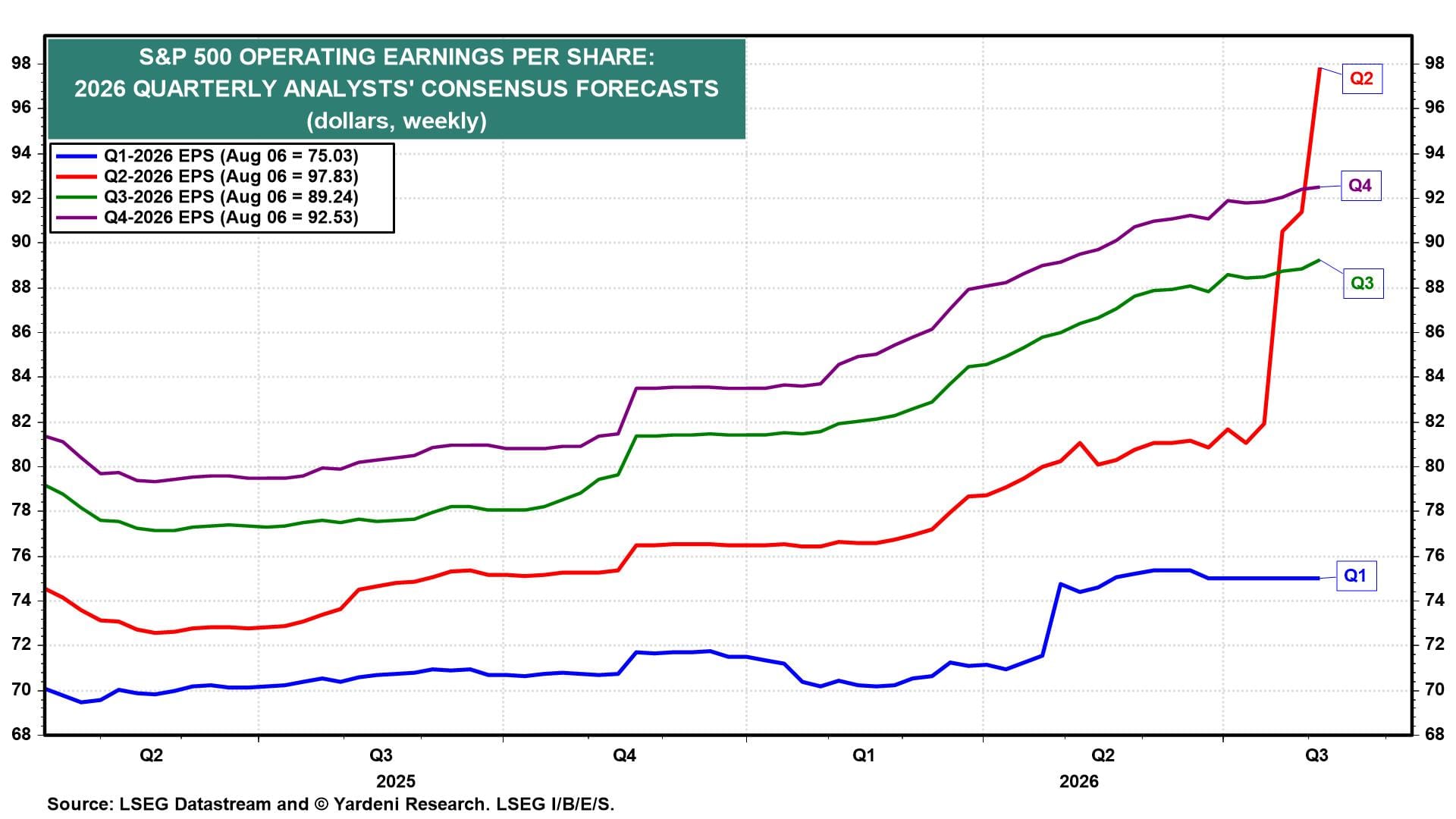
What a fabulous Q2-2026 earnings season it has been! So far, 90% of S&P 500 companies have reported. They broadly crushed industry analysts' forecasts for earnings and profit margins, both of which saw a boost from mark-to-market (MTM) gains from Alphabet and Amazon for a second straight quarter. These MTM gains (along with Meta’s little-mentioned gain from a tax reversal) boosted earnings by $5.88 to $75.03 during Q1 and by $14.00 to $97.83 in Q2 (chart).

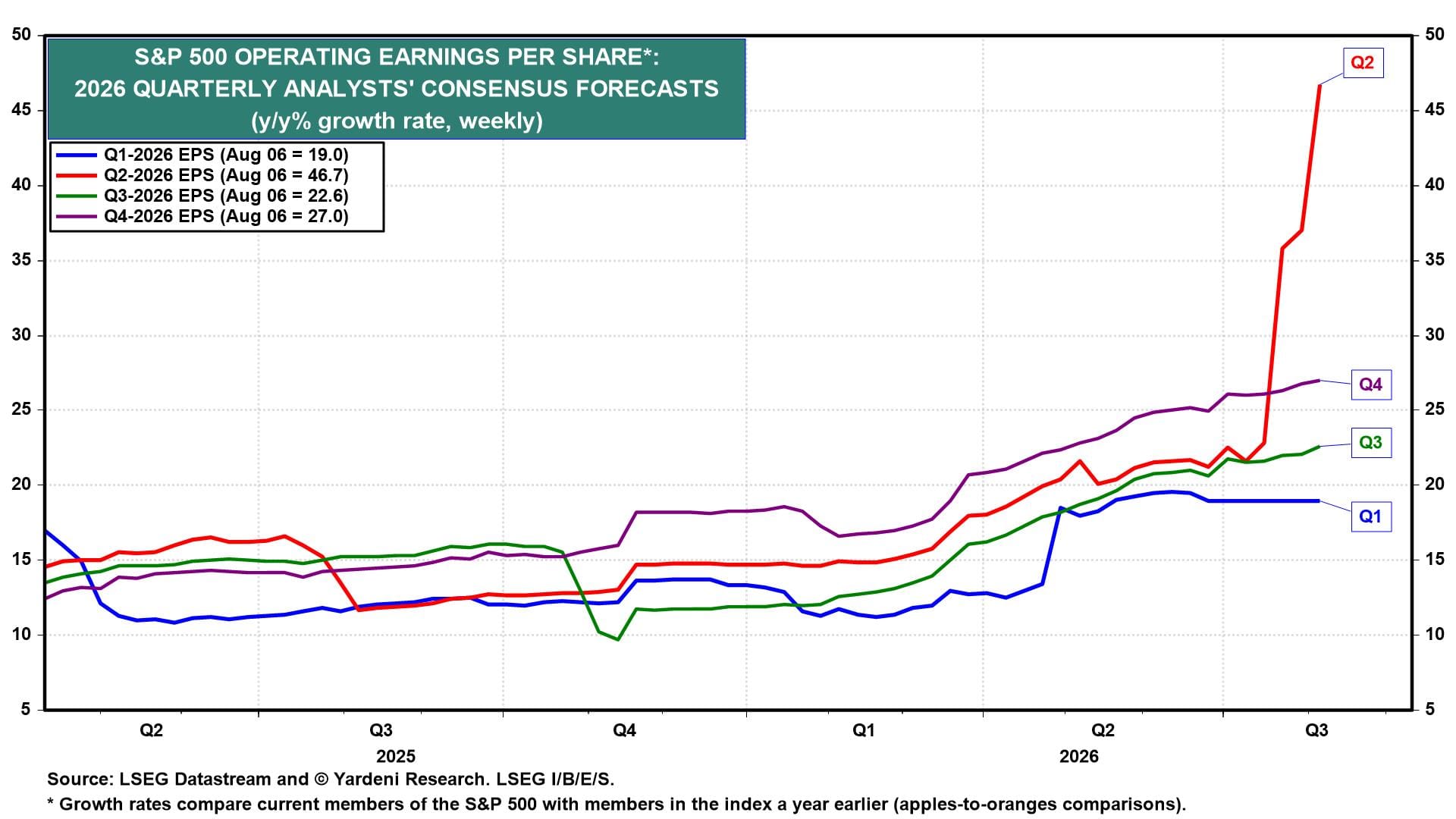
As a result, S&P 500 EPS rose 19.0% y/y in Q1 and 46.7% y/y in Q2. Without the MTM gains, earnings rose 9.5% and 25.7% during those two quarters (chart)

https://www.yardeniquicktakes.com/raising-our-s-p-500-earnings-price-targets-outlook-due-to-femo-fabulous-earnings-momentum/