Search This Blog

Wednesday, August 12, 2026

Sutro 'encouraging early Phase 1 data for STRO-004' after miss


Sutro Biopharma posts Q2 2026 loss with non-GAAP EPS -$2.33, revenue $9.8M, misses EPS and revenue estimates

  • Non-GAAP EPS of -$2.33 declined 66% YoY, while revenue of $9.8M fell 85% YoY.
  • Company also unveiled encouraging early Phase 1 data for STRO-004 alongside reporting Q2 2026 results.

'Iran Quds Force chief asked Iraq to delay state arms monopoly - Al Arabiya'


Iran's Quds Force commander Esmail Qaani asked the Iraqi government during a recent secret visit to postpone efforts to enforce a state monopoly on weapons, Al Arabiya English reported on Wednesday, citing sources.

Qaani told Iraqi leaders that moving to bring weapons solely under state control at this time would be viewed as "a stab in the back" to Iran, according to the report.

He also said enforcing a state monopoly on arms in Iraq could pave the way for efforts to control Iran-aligned factions in other countries, the sources told Al Arabiya.

The Quds Force is the foreign operations arm of Iran's Revolutionary Guards and has long maintained close ties with armed groups in Iraq and elsewhere in the region.

https://www.iranintl.com/en/202608128625

'UK, Italy considered for Hezbollah disarmament mission - Reuters'


Israel and Lebanon have agreed on Britain, Italy, Switzerland and Indonesia as potential contributors to a mechanism that could deploy foreign troops to verify the disarmament of Iran-backed Hezbollah, Reuters reported Wednesday, citing people familiar with the matter.

The shortlist emerged from US-mediated talks in Rome last week, according to the report. A Lebanese official told Reuters that Washington would decide which countries from the agreed list would ultimately take part.

https://www.iranintl.com/en/202608120447

First Morgan Stanley, Now BofA To "Mobilize And Deploy" $250 B Into US Infrastructure Supercycle

 Bank of America unveiled a massive 18-month initiative to mobilize and deploy $250 billion across critical US infrastructure, targeting the computing, energy, and industrial systems needed to support artificial intelligence and accelerate the transition toward physical AI.

The announcement comes just days after Morgan Stanley launched its US Innovation Infrastructure Initiative, which aims to facilitate $1.5 trillion in capital raising and financing over the next decade. The back-to-back commitments signal that Wall Street is positioning for a multiyear capital-spending supercycle spanning data centers, power generation, grid modernization, semiconductors, advanced manufacturing and robotics.

"Without hard infrastructure, it's difficult to preserve our competitiveness and leadership for the next generation," Karen Fang, global head of infrastructure and sustainable finance and co-head of global capital solutions, said in an interview with Bloomberg. "Old infrastructure has to be modernized."

BofA's financing will span three broad categories:

  • Digital infrastructure, including data centers, computing equipment, chips, telecommunications and semiconductors
  • Energy and power, including conventional and renewable generation, storage and distribution systems
  • Core infrastructure, including transportation, electricity transmission, grid modernization, water systems, critical minerals and mining

Surging demand for computing power, energy, manufacturing capacity and more resilient supply chains is driving a new investment cycle across the US. BofA said the initiative could support tens of thousands of jobs in construction, manufacturing, technology and long-term operations.

Morgan Stanley mapped out the AI infrastructure supply chain:

Nancy Lazar, Piper Sandler's chief global economist and head of the firm's economics research team, recently outlined how data center construction, reshoring, infrastructure upgrading and the reenergizing of America's industrial base are creating an all-American blue-collar comeback as goods-producing jobs begin to reverse their multidecade downturn and shift higher.

Lazar noted:

Bullish on Goods-Producing Jobs vs. Hotel & Restaurant Jobs.

When China joined the WTO in 2001, U.S. goods-producing jobs began a decade of decline, while leisure & hospitality and education & health jobs continued to rise...

...so today, goods-producing jobs are less than half those of low-paying service jobs; their share was over 50% in the mid-1980s.

That employment mix shift gave us the bifurcated consumer, as lower-paying jobs gained share. Goods-producing jobs pay more than overall service-producing jobs, and lots more than leisure & hospitality or education & health care jobs.

Good news: That mix is now shifting the other way, as the long-running (not just tech) capex cycle raises productivity and margins, encouraging companies to add headcount.

Look at relative earnings growth by sector below.

Let's come back to our "Powering Up America" and nuclear-power investment themes (began Decemeber 2020) over the last several years. They were right on the money, and both remain intact ahead of the multiyear capital-spending supercycle that BofA and Morgan Stanley are about to unleash.

Related:

The infrastructure required to power the AI economy, strengthen energy security, and support the AI revolution will be central to writing the next chapter ofAmerica'ss growth story into the 2030s.

https://www.zerohedge.com/ai/first-morgan-stanley-now-bofa-mobilize-and-deploy-250-billion-americas-supercycle

WTI Dips After Massive Crude Inventory Build, Big SPR Drain, Surge In Imports

 Oil prices are marginally lower this morning as OPEC again cut its forecast for global oil-demand growth for this year, but stalled talks to reopen the critical Strait of Hormuz waterway and risks in the Red Sea prolong disruptions to global supplies.

Physical disruptions are spreading beyond Hormuz. Refinery attacks and fires have hit Russia and Libya, while the Houthis claimed another attack on Saudi Aramco’s Jazan complex. The Red Sea has become a key alternative export route for the Kingdom, and Houthi attacks are putting that release valve under pressure.

Overnight saw API report a huge crude inventory build and 

API

  • Crude +9.1mm

  • Cushing +1.6mm

  • Gasoline -1.5mm

  • Distillates -600k

DOE

  • Crude +17.4mm (-1.4mm exp) - biggest build since Jan 2023

  • Cushing +1.61mm

  • Gasoline -968k

  • Distillates -10k

After API's reported large build, the official data showed an almost unprecedented 17.4mm barrel build in crude stocks (the biggest since Jan 2023), Cushing saw another build while products saw draws for the second week in a row...

The massive oil stock build was driven by imports which rose to the highest level since November 2024. The US imported over a million barrels a day of oil last week, in part driven by a rise in Venezuelan imports and a return of Saudi Arabian oil. This is a sharp reversal from only a few months prior when oil was flowing abroad in massive quantities.

Net Imports at their highest since June 2025 (thanks in addition to a big slump in US crude exports to the lowest since Nov 2025) ...

Stocks at the critical Cushing Hub are limping off 'tank bottoms'...

As we detailed here, the Strategic Petroleum Reserve saw drawdowns re-accelerate last week (with 6.1mm barrels leaving the caves of salt), back below $300 million barrels to its lowest level since January 1983. Nevertheless, total commercial crude stocks rose 11.3mm barrels last week - the largest since February...

A total of 117 million barrels of crude has been taken out of the SPR since late March under a program to release 172 million barrels as part of a relief plan coordinated by the IEA aimed at lowering energy costs.

US Crude production also limped higher near record highs as the rig count continues to rise...

The oil stock build comes even as refiner runs rose and are sitting at the highest seasonal level since 2019. Fuel makers have signaled they intend to run harder-than-usual through the third quarter, a time when plants typically go down for maintenance.

WTI dipped back below $83 after the official data, holding gains from Friday's close around $77...

Interestingly, Bloomberg points out that US gasoline demand continued to remain resilient in the face of elevated gasoline prices. US retail gasoline prices are averaging over $4 per gallon, almost $1 per gallon (29%) higher than last year’s level at this time, according to data from the American Automobile Association. However, this week’s gasoline demand is only 36,000 barrels per day -- 0.4% lower compared to last year. 

Finally, as we noted yesterday, quoting Bloomberg macro strategist, Michael Ball, market structure reflects that stress better than outright prices. Brent and WTI curves remain backwardated and refining cracks are elevated, signaling near-term scarcity. Options are less aggressively bullish, with 25-delta call skews in both benchmarks dropping to their least bullish levels since July 10.

That points to a market vulnerable to spot disruptions while increasingly pricing a path toward de-escalation.

https://www.zerohedge.com/energy/wti-dips-after-massive-crude-inventory-build-big-spr-drain-cushing-tank-bottoms

NYC 13% Pension Aggregate Return for Fiscal Year 2026

 Funds now valued at a combined $326.3 billion

Returns significantly outpace actuarial target of 7.0% and reduce City pension obligations by an estimated $6.3 billion over five fiscal years

New York City Comptroller Mark Levine and the trustees of the five New York City retirement systems (Systems) today announced an aggregate 13% investment return net of fees across the five Systems for the fiscal year ending June 30, 2026. The Systems are now valued at $326.3 billion, reflecting strong performance amid a complex investment landscape marked by evolving trade policy, persistent inflation, geopolitical uncertainty, and continued investment in artificial intelligence.

The past fiscal year’s performance surpasses the 7.0% actuarial target and reduces the City’s required pension obligations by approximately $6.3 billion over five fiscal years beginning in FY28.

“Retirees work for decades to earn the financial security that a pension provides and protecting that security requires a disciplined and prudent investment approach. Global markets faced significant headwinds over the past year, and our results demonstrate the importance of maintaining a long-term focus and a diversified strategy designed to deliver sustainable, risk-adjusted returns for decades to come,” said New York City Comptroller Mark Levine.

The five systems – the New York City Teachers’ Retirement System, Employees’ Retirement System, Police Pension Fund, Fire Pension Fund, and Board of Education Retirement System – posted an annualized average three-year return of 11.1%, five-year return of 6.2%, seven-year return of 8.6% and 10-year return of 8.9%.

NYC Combined Systems Annualized Returns, Net of Management Fees


The funds maintain a disciplined, diversified, and long-term investment strategy to ensure appropriate risk-adjusted returns. They have 43% invested in Public Equities, 25% in Public Fixed Income (i.e. Government and Corporate Bonds), and about 22% in Private Markets Alternatives (including Private Equity, Real Estate, Alternative Credit, Infrastructure, and Hedge Funds) and cash.

The Systems’ public market investments, which represent more than 74% of the Systems’ assets, generated strong gains for the Systems across both equities and fixed income as the principal contributor to investment performance. The solid performance of public markets was driven in large part by emerging markets equity investments led by the information technology sector. Fixed income market investments also experienced positive gains, supported by higher starting yields, strong investor demand and historically tight credit spreads.

The Systems’ private markets investment returns supported their long-term investment strategy, providing diversification, downside protection and long-term value creation. Hedge Funds delivered a record program return of 19.2%, while Infrastructure and Alternative Credit also generated strong returns of 9.2% and 7.8%, respectively. Real Estate also saw stronger returns this year due to the strategic shift toward multifamily and industrial properties, and a reduction in office exposure.

“This past year’s performance reflects our commitment to deliver for hundreds of thousands of members and beneficiaries counting on us to safeguard the retirement assets that they have worked tirelessly to earn. I am grateful for the leadership of Comptroller Levine, and the commitment of staff within the Bureau of Asset Management, and our fruitful partnership with our asset managers, trustees and investment consultants that made this possible,” said Chief Investment Officer Monte Tarbox.

Assets Under Management, Return Net of Fees, and Contribution to Return
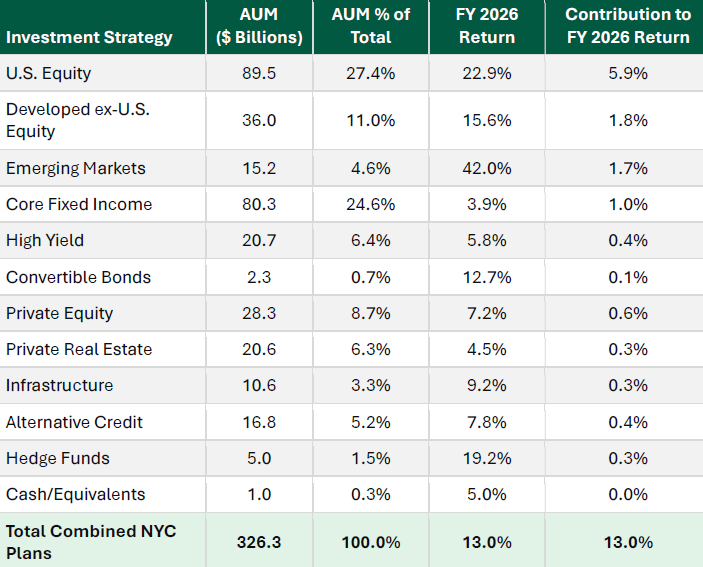

Review today’s report on the audited investment returns for the fiscal year ending June 30, 2026, at https://comptroller.nyc.gov/reports/new-york-city-pension-funds-returns-for-fiscal-year-2026 for market reflections and a detailed review on overall performance and individual asset classes.

About the New York City Retirement Systems

The New York City retirement systems comprise the City’s five public pension funds (the New York City Teachers’ Retirement System, Employees’ Retirement System, Police Pension Fund, Fire Pension Fund, and Board of Education Retirement System), and are collectively the third largest public pension system in the nation, valued at approximately $326.3 billion in assets under management as of June 30, 2026.

https://comptroller.nyc.gov/newsroom/nyc-comptroller-levine-and-pension-trustees-announce-robust-13-pension-aggregate-return-for-fiscal-year-2026/

'AP: Amid Flesh-Eating Bacteria Deaths, Health Officials Urge Caution for Beachgoers'

 Health officials in Louisiana are urging beachgoers to take precautions during a summertime surge in infections from a flesh-eating bacteria found in coastal waters.

Louisiana has confirmed nine cases of Vibrio vulnificus infections this year, the state's health department said last week in a news release. All were hospitalized, and five died. During the same period over the previous decade, Louisiana reported an average of seven cases and one death.

"Seek medical care immediately if a wound exposed to brackish or salt water becomes red, swollen, painful, warm or discolored," officials said in the release. "Tell the healthcare provider about the water exposure."

The Gulf Is an Ideal Environment

Vibrio bacteria thrive in seawater and in the brackish mix of fresh and saltwater found in estuaries and lagoons. Most infections are reported from May to October, and most happen in states along the Gulf Coast. Doctors say the Gulf is an ideal environment with the right amounts of salt and heat to let this organism proliferate.

The mostly deadly type is Vibrio vulnificus, according to the CDC. As many as one in five of those infections are fatal, a much higher rate than other types of Vibrio bacteria.

Florida, which tends to have more infections than other states, has reported 14 Vibrio vulnificus cases and two deaths so far this year, compared with 33 cases and five deaths for all of last year. Records show more cases in years when Florida is hit by tropical storms and hurricanes.

Bacteria Enters Through Breaks in the Skin

Some people become infected by eating raw or undercooked shellfish -- particularly oysters. But a large percentage fall ill when the person is in ocean or brackish water and the bacteria enter the body through small breaks in the skin.

Doctors say severe cases are seen more often in elderly patients, people with weakened immune systems, and those with liver disease, diabetes, and certain chronic illnesses.

Scientists say climate change is helping the germs proliferate and spread northward. A 2023 study found that the northernmost case has been shifting by about 30 miles each year, and that cases overall have been rising.

Beachgoers Can Protect Themselves

Vibrio vulnificus can enter the body through unhealed cuts and scrapes, recent piercings and tattoos, and recent surgical incisions. People should immediately wash cuts and scrapes thoroughly with soap and clean running water after coming in contact with coastal waters or raw seafood, the CDC said. They should see a doctor if they start to develop symptoms such as fever, chills, and hot red areas on the skin that start to turn dark and blister.

Oysters are a particular risk, and there is no way to tell if an oyster is contaminated just by looking at it. People should wash hands with soap and water after handling raw shellfish and wear protective gloves if they have a weakened immune system and are at a higher risk of infection.

Health officials also offer cooking instructions for clams, mussels, and other shellfish. They recommend throwing away any with open shells before boiling or steaming.

https://www.medpagetoday.com/publichealthpolicy/publichealth/122543