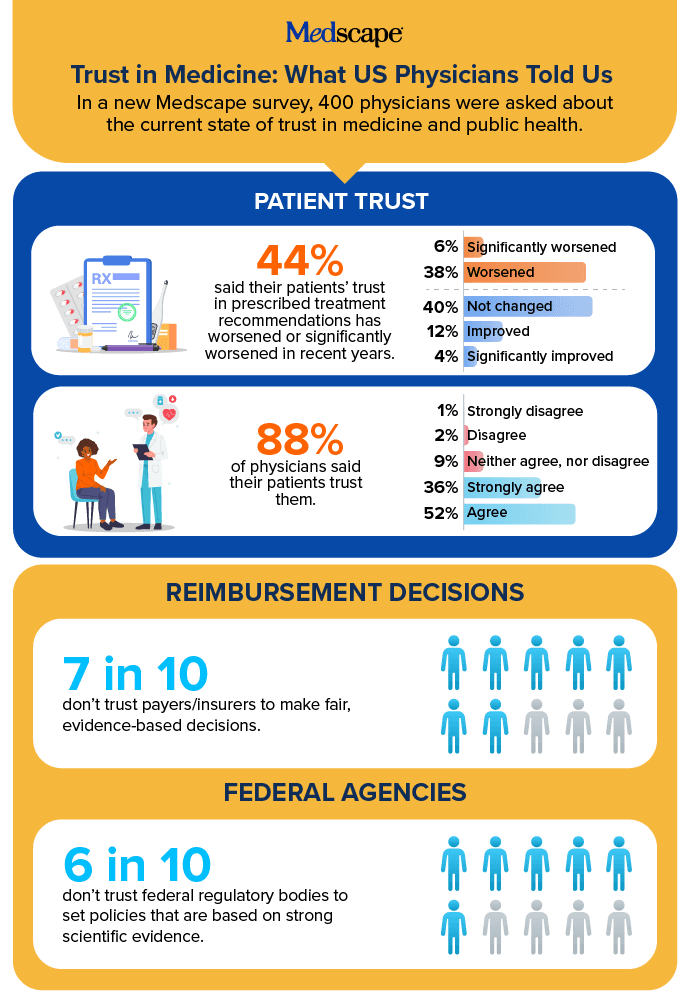
Nearly half of the physicians believe that patients have less trust in their treatment recommendations today than they did several years ago, a possible reflection of growing public distrust in science, a new Medscape survey found.
And as controversy surrounds policy changes at US health agencies under the Trump administration, fewer than 1 in 5 (18%) physicians surveyed said they trust federal regulators to craft policy grounded in solid science, the Medscape survey found.
The survey of 400 US physicians was conducted by Medscape among its readers. The responses, collected from February 11 to March 6, took a measure of physicians’ opinions about the current state of the profession and issues involving trust in medicine.
Trust has “deteriorated with time as the world itself has become more self-focused, self-serving, and more self-promoting as all of us have lost the true and fundamental visions and values in the practice of medicine,” commented a 65-year-old ob/gyn who participated in the survey.
Patients’ Trust Fading in Treatment Advice
Overall, 44% of those surveyed said patient trust in their treatment recommendations had worsened or significantly worsened over the past several years.
In contrast, a large majority of physicians (88%) said their patients still trust them, personally. Several said spending time with them, which is increasingly difficult to do amid to corporatization of healthcare, makes the difference.
“My patients trust me, but I am having to spend more time debriefing them regarding disinformation from our own government, something I never dreamed would ever happen,” said a 60-year-old neurologist.
A pediatrician wrote that she makes a point to be “more intentional, cautious, and thorough” in her work to head off trust issues “so patients, families, and colleagues can feel confident in my care and judgment.”

Patients who trust certain doctors may tend to stay with them, said Jing Li, PhD, an associate professor of health economics at the University of Washington in Seattle who did not participate in the survey. Also, some physicians may be overconfident and “don’t want to admit that some patients don’t trust them,” she said.
Disbelief in Federal Approach
Just 18% of physicians surveyed said they trust federal regulatory bodies to set policies that are based on strong scientific evidence, whereas 60% said they don’t trust regulators and another 22% took no stance on the topic.
“It’s hard to get patients to trust you about vaccines or other recommendations when the federal agencies have different goals,” commented one pediatrician, 59, who participated in the survey. “It makes it hard for patients to have good information, especially when it’s combined with all the social media information that people are being bombarded with.”
Doubting Reimbursement Decisions, Employers’ Motives
In another survey finding that is unlikely to surprise physicians, 7 in 10 respondents said they either disagreed or strongly disagreed with the statement: “I trust payers/insurers to make reimbursement decisions that are fair and evidence-based.”
The data mirror the rising tide of physicians moving away from direct reimbursement roles in the healthcare landscape. Many told the American Medical Association recently that the reason for selling their private practices was the need to negotiate better pay rates with insurers.
But moving to the employee side of the equation usually doesn’t solve that challenge, the Medscape survey results showed.
- About half (49%) of the physicians said they “agreed” or “strongly agreed” that their employers prioritize patient safety over profits.
- Of the other respondents, 29% said they “disagreed” or “strongly disagreed” that their employers put financial returns over profits, whereas 22% were neutral on the topic.
A 55-year-old ob/gyn said she decided to step away from what she described as the “insurance hamster wheel” and transitioned her practice to direct pay. “I want to treat my patients and spend time with them and give them the care I want to give,” she commented.
Impact on Career Plans
Like the ob/gyn, 4 in 10 of physicians surveyed said trust-related issues have influenced their career plans, including considering leaving clinical practice, reducing their hours or switching employers.
“I’ll retire a few years earlier than planned to get away from these issues,” said a 62-year-old allergy and immunology specialist.
A 42-year-old family medicine physician in Oklahoma City said she created a direct primary care clinic “to get back to unhurried time with patients and care that’s built around people, not paperwork.”
Li, who studies physician behavior, said the survey results are troubling. But she noted that physicians remain among the most respected professionals, providing them the authority to not only heal patients but also actively support needed reforms to the system. “They shouldn’t ignore that,” she said, “and shouldn’t be overly pessimistic.”
Li had no relevant disclosures.

No comments:
Post a Comment
Note: Only a member of this blog may post a comment.