Search This Blog

Monday, July 8, 2019

Takeda New Data Back Benefit for Hemophilia A Personalized Prophylaxis

– Updated results from the Phase IIIb/IV PROPEL Study show that pharmacokinetic (PK)-driven dosing may be used to achieve FVIII target trough levels of 8–12%; and that selecting a patient-appropriate target FVIII level plus adjusting a dosing regimen to that patient’s PK characteristics, can improve the overall PK profile and may enhance outcomes, with no adverse event profile change – thus reinforcing the importance of PK-guided dosing and the potential benefit of personalized prophylaxis with ADYNOVATE1
– Data presented alongside 47 other ISTH 2019 presentations showcasing the latest developments from Takeda’s hematology gene therapy pipeline and leading Factor portfolio
– Takeda’s robust presence at ISTH underscores its commitment to progressing scientific advancements for the bleeding disorders community
Takeda Pharmaceutical Company Limited (TSE:4502/NYSE:TAK) (“Takeda”), R&D-driven, global biopharmaceutical company with a leadership position in rare diseases, has today announced updated results from its phase IIIb/IV clinical trial for ADYNOVATE® [Antihemophilic Factor (Recombinant), PEGylated] at the 27th Annual International Society on Thrombosis and Haemostasis Congress (ISTH), in Melbourne, Australia. The PROPEL study is a PROspective, randomized, multi-center study comparing the safety and efficacy of ADYNOVATE following PK-guided prophylaxis targeting two different Factor Eight (FVIII) trough activity Levels in subjects with severe hemophilia A.
The latest results of the landmark PROPEL study show that ADYNOVATE prophylaxis in severe hemophilia A patients may enhance a patient’s PK profile – by targeting FVIII trough levels of 8–12% (elevated prophylaxis arm, ELE) as compared with 1–3% (reference prophylaxis arm, REF). This represents a clinically meaningful trend towards more patients experiencing zero bleeds [62% ELE versus 42% REF, respectively; p=0.0545].Patients randomized to the 8-12% target group also saw a:
  • Reduced mean total annualized bleed rate (ABR); (1.6 ELE versus 3.6 REF, respectively).
  • Reduced mean spontaneous joint ABR (0.5 ELE versus 2.0 REF)
The data supports the view that patients may benefit from PK-driven dosing that targets FVIII trough levels of 8–12%. The safety findings from this latest update were also comparable and consistent with previous ADYNOVATE trials.1,2 Ongoing analyses will further characterize the relationship between PK-tailored dosing of ADYNOVATE FVIII levels and bleeding events.
Adapting the dosing regimen for an individual patient, guided by that patient’s individual PK characteristics, has great potential – for managing patients with hemophilia A, particularly those desiring greater bleed protection.

Redhill Biopharma (RDHL) PT Raised to $23 at Ascendiant Capital


Appeals court denies states’ request in Texas v. Azar to delay hearing July 9

The Fifth Circuit Court of Appeals has denied a request from 18 states to delay a key hearing on the states’ lawsuit to invalidate the Affordable Care Act.
The court ruled on Tuesday that the hearing scheduled for July 9 in New Orleans will continue. The appellate court is hearing an appeal to an earlier ruling that the ACA is unconstitutional.
A collection of 18 states and the Trump administration filed the lawsuit charging that the ACA is unconstitutional because the individual mandate penalty was zeroed out in tax reform.
The Trump administration supports the lawsuit, while 17 attorneys general and the District of Columbia are opposing it.

The Fifth Circuit did not give a reason on why it will not delay the hearing. However, it will give both parties an extension until July 23 to file supplemental briefs in the case.
The ACA remains in effect while the lawsuit makes its way through the federal courts.

Sunday, July 7, 2019

AB Science publishes on positive phase 2/3 clinical trial with masitinib in ALS

AB Science SA (NYSE Euronext – FR0010557264 – AB), announces today that full, peer-reviewed results from its phase 2/3 (AB10015) study of masitinib in amyotrophic lateral sclerosis (ALS) have been published in the journal Amyotrophic Lateral Sclerosis and Frontotemporal Degeneration (ALSFD).
Entitled, ‘Masitinib as an add-on therapy to riluzole in patients with amyotrophic lateral sclerosis: a randomized clinical trial1, this article and its accompanying online supplemental material are freely accessible online from the journal website: https://doi.org/10.1080/21678421.2019.1632346.
Study AB10015 reached its primary endpoint and showed that masitinib at 4.5 mg/kg/day in combination with riluzole was able to significantly (p-value < 0.05) slow ALSFRS-R decline by 27% as compared with the active riluzole control at week 48.

Evotec, VC Consortium Form ‘Breakpoint Therapeutics GmbH’

  • PORTFOLIO OF DRUG DISCOVERY PROJECTS TARGETING DNA DAMAGE RESPONSES (“DDR”), A HIGHLY PROMISING APPROACH TO TREAT CANCER PATIENTS
  • BREAKPOINT THERAPEUTICS WILL ADVANCE MULTIPLE COMPLEMENTARY AND SYNERGISTIC DRUG DISCOVERY PROGRAMMES INITIATED AT EVOTEC
  • STRONG CONSORTIUM OF RENOWNED FUNDING PARTNERS CONSISTING OF MEDICXI, TAIHO VENTURES, LLC AND EVOTEC PROVIDING EARLY STAGE FINANCING OF EUR 30 M
Evotec SE (Frankfurt Stock Exchange: EVT, MDAX/TecDAX, ISIN: DE0005664809) today announced the formation of Breakpoint Therapeutics GmbH, a spin-off company focusing on the development of Evotec’s DNA damage response (“DDR”) portfolio, comprising discovery-stage assets and drug targets that promise broad therapeutic application in a variety of cancers. Breakpoint Therapeutics’ mission is to develop first and best-in-class oncology drugs that interfere with DNA repair and replication stress pathways to facilitate the cure of therapy-resistant cancers.
Breakpoint Therapeutics will initially focus on advancing multiple drug discovery programmes initiated at Evotec that address high unmet medical needs of different patient groups. The goal of the spin-off company is to accelerate early projects through discovery and pre-clinical development and expect to deliver the first IND-ready drug in 2022.
The early stage funding amounting to EUR 30 m will be covered by a renowned international investor consortium led by Medicxi, a life sciences-focused investment firm, Taiho Ventures, LLC (“Taiho”), the venture capital arm of Taiho Pharmaceutical, and Evotec. Evotec will hold below 50% of the company and consolidate at equity accordingly.
The company will conduct its research activities using Evotec’s fully established, validated and industrialised platforms. This highly virtual set up of Breakpoint Therapeutics achieves maximal flexibility in accessing required resource to drive projects forward at highest scientific standards and best capital efficiency.

16 dog food brands may cause heart disease in pets, FDA warns

  • The U.S. Food and Drug Administration is still trying to determine why dogs eating certain types of pet food are seemingly more at risk of canine heart disease than others.
  • Since alerting the public to the increasing caseload of dilated cardiomyopathy, or DCM, in dogs nearly a year ago, the FDA is for the first time identifying 16 pet food brands most frequently connected to the disease.
  • Still, the agency said it has “not yet determined the nature of this potential link,” and urged dog owners to consult with a veterinarian for advice on their pet’s diet.

The U.S. Food and Drug Administration has identified more than a dozen brands of pet food it says are most frequently connected to a spike in reported cases of heart disease in dogs.
The FDA is continuing to investigate more than 500 reports of dilated cardiomyopathy, or DCM, in dogs eating certain types of pet food. A form of canine heart disease, DCM can cause congestive heart failure in dogs.
“We know it can be devastating to suddenly learn that your previously healthy pet has a potentially life-threatening disease like DCM,” Steven Solomon, director of the FDA’s Center for Veterinary Medicine, said Thursday in a statement. Because the FDA has “not yet determined the nature of this potential link, we continue to encourage consumers to work closely with their veterinarians.”
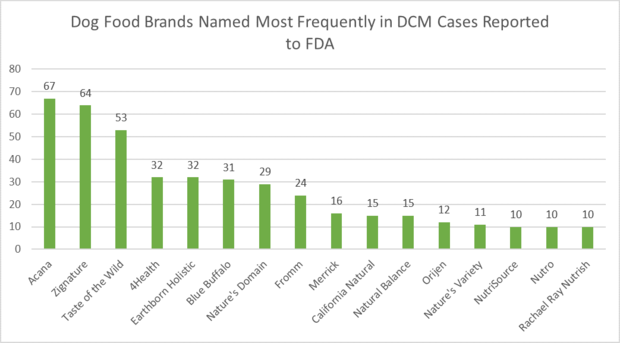
dog-food-brands-named-most-frequently-in-dcm-cases-reported-to-fda.png
U.S. FOOD AND DRUG ADMINISTRATION
The FDA initially alerted the public to the cases plaguing dogs last July but did not specify food brands. The agency instead pointed to pet food labeled as “grain-free” and containing peas, lentils and other legume seeds and/or potatoes as their primary ingredients.
 
The probe now has the agency identifying 16 brands of dog food with the most frequently reported cases of DCM. Acana was named in 67 DCM reports, Zignature in 64 and Taste of the Wild in 53.

Pet food industry barks back

Zignature, for one, disputed any connection. “In parallel with the FDA investigation, our own third-party internal studies found no link between our high-quality pet food products and any of the other physical characteristics that correlate to DCM,” Zignature said in a post on its site.
Champion Petfoods, which owns Arcana and Orijen, is working on its own and with others in the industry to try to determine the cause of DCM, but objected to the FDA’s listing of brands.
“We think it is misleading for the FDA to post the names of brands, while at the same time fully stating that they have no scientific evidence linking diet to DCM. We feel this will only serve to further confuse pet lovers,” the company stated.
The company’s research shows “Champion pet foods are safe,” it said.
The Pet Food Institute, a trade group that represents 98% of pet food and treat makers, said it has consulted with nutritionists, product safety experts and veterinarians for more than a year in trying to determine if there’s a link between diet and DCM. “This is a complex issue with many factors requiring scientific evaluation,” Dana Brooks, the group’s president and CEO, said in a statement.
Noting that the FDA’s probe focused on ingredients in grain-free pet food, the agency “has not identified any established link between certain ingredients and incidents of DCM,” the industry group stated on its web site, which also noted “millions of dogs eat and are thriving on grain-free dog food.”
The causes of DCM “may be the result of many factors, including a recipe formulation and processing, and your individual pet,” according to the institute, which advised those with questions about their pet’s food to contact the manufacturer and to consult with their family vet.
Between January 2014 and April 30, 2019, the FDA received 524 reports of DCM, including 119 dog deaths and five cat fatalities. Of those reports, 222 of them came between Dec. 1, 2018, and the end of April, the agency said.
Here is the list of 16 pet food brands and the number of reported DCM cases that the FDA suspects are related to each brand:
  • Acana: 67
  • Zignature: 64
  • Taste of the Wild: 53
  • 4Health: 32
  • Earthborn Holistic: 32
  • Blue Buffalo: 31
  • Nature’s Domain: 29
  • Fromm: 24
  • Merrick: 16
  • California Natural: 15
  • Natural Balance: 15
  • Orijen: 12
  • Nature’s Variety: 11
  • NutriSource: 10
  • Nutro: 10
  • Rachael Ray Nutrish: 10

Pig-ear dog treats linked to salmonella outbreak in 13 states

Pig ears sold as dog treats in 33 states are being recalled due to an outbreak of salmonella. Pet Supplies Plus is recalling bulk pig ears sold in open bins at its more than 400 stores across the country, the retail chain said in a notice posted by the U.S. Food and Drug Administration.
The FDA and the U.S. Centers for Disease Control and Prevention are investigating contaminated pig ears, with evidence indicating that contact with the dog treats is the likely source of a salmonella outbreak that has sickened 45 people, including 12 hospitalizations, in 13 states.
None of the 45 cases are confirmed to be a result of purchasing pig ears from Pet Supplies Plus, the retailer stated.
 
“Testing by the Michigan Department of Agriculture and Rural Development revealed that aging bulk pig ear product in one of our stores tested positive for salmonella,” according to the retailer. “We have pulled bulk pig ear product from the shelves of all of our stores and have stopped shipping bulk pig ears from our distribution center.”
Salmonella can affect animals eating contaminated products as well as the humans who handled the sickened animals as well as the infected product. The salmonella infection causes symptoms including nausea, vomiting, bloody diarrhea, abdominal cramping and fever in people, and in rare cases, more serious ailments. Pets with salmonella infections could be lethargic and have diarrhea, fever and vomiting.
Bulk pig ears were distributed to Pet Supplies Plus stores in Alabama, Arizona, California, Colorado, Connecticut, Delaware, Florida, Georgia, Iowa, Illinois, Indiana, Kansas, Kentucky, Massachusetts, Maryland, Michigan, Minnesota, Missouri, North Carolina, Nebraska, New Hampshire, New Jersey, New York, Ohio, Oklahoma, Pennsylvania, Rhode Island, South Carolina, Tennessee, Texas, Virginia, Wisconsin and West Virginia.
Consumers who purchased bulk pig ears should throw them away, and those with further questions can call (734) 793-6564 Monday through Friday from 9 a.m. to  4 p.m. E.T., Pet Supplies said.
The recall is among recent health concerns regarding what pets eat, with the FDA recently identifying 16 brands of dog food more frequently connected to a spike in canine heart disease.