Search This Blog

Saturday, March 27, 2021

Novartis closes U.S. gene therapy site as Zolgensma sales fell from Q3 to Q4

 Novartis is laying off 400 people and closing a U.S. gene therapy location that it bought only two years ago to make its $2.1 million per patient treatment Zolgensma as sales momentum for the most expensive one-time treatment stalled last year.

Novartis is closing the Longmont, Colo., plant after buying it from AstraZeneca in 2019, , U.S. media including the Denver Business Journal reported. Sales of Zolgensma, a one-time treatment for spinal muscular atrophy, were $254 million in the fourth quarter from about $291 million in the third quarter, company data show.

Novartis now plans to make gene therapy at two other commercial production locations in Illinois and North Carolina.

“We now know that we can fulfill our long-term demand, including for patients who may benefit from our next wave of gene therapies, with two commercial sites coupled with the technical development capabilities at our San Diego site, as well as our extensive network of external partners,” Novartis said in a statement to media.

Zolgensma’s sales have been hurt, in part, by stalled efforts to expand its use in older patients after safety concerns prompted Novartis to pause a trial in order to collect more data for the U.S. Food and Drug Administration.

Novartis, which bought Zolgensma in 2018 with its $8.7 billion purchase of AveXis, has faced delays and trial failures on other drugs as well. These snags have muted revenue expectations, including for its cholesterol drug Leqvio that is awaiting regulatory sign-off on a European production facility and failure of an inflammation drug to boost lung cancer survival.

https://www.reuters.com/article/us-novartis-zolgensma-plant-closure/novartis-closes-u-s-gene-therapy-site-as-zolgensma-sales-fell-from-q3-to-q4-idUSKBN2BJ06M

FDA OKs Bristol Myers, bluebird 1st Anti-BCMA CAR T Cell Therapy for Multiple Myeloma

 Abecma is a first-in-class BCMA-directed personalized immune cell therapy delivered as a one-time infusion for triple-class exposed patients with multiple myeloma1

In the pivotal KarMMa trial, the majority (72%) of patients achieved rapid, deep and durable responses1

Safety profile of Abecma is well-established and predictable including cytokine release syndrome and neurologic toxicities that are mostly low-grade with early onset and resolution

https://www.businesswire.com/news/home/20210326005507/en/U.S.-Food-and-Drug-Administration-Approves-Bristol-Myers-Squibb%E2%80%99s-and-bluebird-bio%E2%80%99s-Abecma-idecabtagene-vicleucel-the-First-Anti-BCMA-CAR-T-Cell-Therapy-for-Relapsed-or-Refractory-Multiple-Myeloma


Friday, March 26, 2021

DOJ Extends Review of UnitedHealth, Change Healthcare Deal

 U.S. antitrust regulators are taking a closer look at UnitedHealth Group Inc.’s proposed $8 billion deal to acquire data and payments company Change Healthcare Inc.

Officials from the Department of Justice asked both companies for more information about the transaction, according to a filing from Change Healthcare Friday. The so-called second request gives regulators more time to review the takeover beyond a standard 30-day period.

If the deal closes, it would wrap a major supplier of health information-technology services into one of the largest U.S. health services and insurance providers. The Biden administration has recently signaled that it plans to take a more careful look at corporate mergers, including in the health-care industry.

Change Healthcare’s shares dropped 1.2% in latet rading Friday after the filing. Spokespersons for Change Healthcare and UnitedHealth declined to comment on the DOJ review.

Hospitals and other companies use Change Healthcare’s services to submit claims and collect payment from insurers. Change Healthcare also offers systems for assessing whether appropriate care was provided to patients.

UnitedHealth’s OptumInsight business, into which Change Healthcare would be folded if the deal goes through, offers some similar services. UnitedHealth, which reported revenue of $257 billion last year, also owns the nation’s largest health insurer and a growing care-delivery arm with more than 50,000 physicians.

Hospital Opposition

The American Hospital Association in a letter this month urged U.S. regulators to scrutinize the deal, saying it threatens to reduce competition and “will likely result in higher prices for providers and in lower quality clinical outcomes for patients.”

The hospital group said the companies are the largest suppliers of certain “must-have” services, including clearinghouses that rout claims to insurers for payment.

In response to the letter, a spokesman for Optum said in a statement that the companies have “distinct and complementary capabilities” and the combination would improve care by simplifying administrative, clinical and payment processes.

The companies have said they expect the transaction to close in the second half of 2021. Concerns about antitrust hurdles were evident during the merger discussions, according to a securities filing from Change Healthcare.

On Nov. 15, as deal talks were underway, the companies’ legal advisers discussed how far UnitedHealth would be willing to go to gain regulatory approval of the transaction, and drafted an “antitrust efforts proposal,” according to the filing.

The following week, Change Healthcare’s board determined it wouldn’t continue to explore the deal “unless UnitedHealth Group further strengthened its commitment to obtaining antitrust approval,” according to the filing. The deal proposal was later updated “in a manner that the Board viewed as more favorable to Change.”

The agreement says the companies may sell assets if required for approval, though divestitures accounting for more than $650 million in annual revenue would be a “burdensome condition” UnitedHealth wouldn’t be bound by, according to the filing.

https://www.bloomberg.com/news/articles/2021-03-26/doj-seeks-further-review-of-unitedhealth-change-healthcare-deal

Longitudinal immune profiling of SARS-CoV-2 reinfection in solid organ transplant recipient


Jonathan KleinAnderson F. BritoPaul TrubinPeiwen LuPatrick WongTara AlpertMario A. Pena-HernandezWinston HaynesKathy KamathFeimei LiuChantal B.F. VogelsJoseph R. FauverCarolina LucasJieun OhTianyang MaoJulio SilvaAnne L. WyllieCatherine MuenkerArnau Casanovas-MassanaAdam J. MooreMary E. PetroneChaney C. KalinichIMPACT Research TeamCharles Dela CruzShelli FarhadianAaron RingJohn ShonAlbert I. KoNathan D. GrubaughBenjamin IsraelowAkiko IwasakiMarwan M. Azar

No Surge In COVID Two Weeks After Mask Mandate Lifted In Texas

 Authored by Meiling Lee via The Epoch Times,

After two weeks of lifting its mask mandate and allowing businesses to open at full capacity, Texas is not seeing a surge of new COVID-19 cases.

Gov. Greg Abbott, a Republican, issued an executive order (pdf) that went into effect on March 10 to loosen COVID-19 restrictions. Although the government’s statewide mask mandate was lifted, individual businesses were still able to “limit capacity” or impose mask mandates at their own choosing.

But in Austin and Travis County, residents 10 years or older still have to wear a mask outside their home after a district judge refused to grant Attorney General Ken Paxton a restraining order that would have ended a mask mandate enforced by Travis County and Austin city officials. The trial is set to take place on March 26.

Texas had been witnessing a downward trend in COVID-19 cases and hospitalizations prior to Abbott’s announcement ending the restrictions.

COVID-19 is the disease caused by the CCP (Chinese Communist Party) virus.

The Texas Department of State Health Services (DSHS) posted on Twitter yesterday that Texas saw a seven-day average decrease in the daily number of new cases, hospitalizations, and deaths.

At the time the executive order was issued, March 2, new COVID-19 cases in the state stood at 7,240 cases, with a seven-day average of 7,259 cases. That number dropped to 5,350 cases by March 10 when the executive order came into effect and the economy fully opened.

Two weeks later on March 24, the number of daily new cases stands at 3,827, with a seven-day average of 3,401 cases.

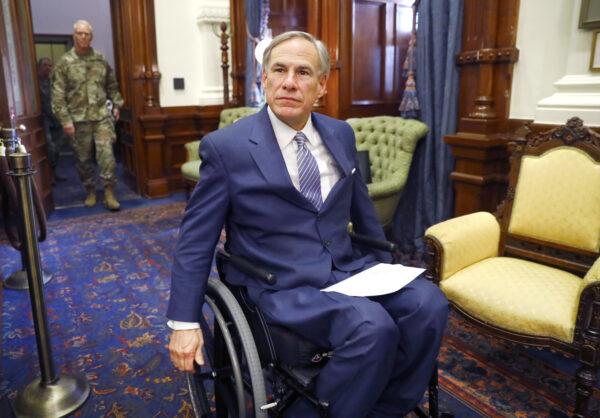
Texas Governor Greg Abbott arrives for his COVID-19 press conference at the Texas State Capitol in Austin on March 29, 2020. (Tom Fox-Pool/Getty Images)

Abbott included in his order a provision for county judges across the state’s 22 hospital regions to “use COVID-19 mitigation strategies” if hospitalizations rise over 15 percent of “hospital bed capacity” for seven straight days.

“County Judges may not impose jail time for not following COVID-19 orders nor may any penalties be imposed for failing to wear a face mask. If restrictions are imposed at a county level, those restrictions may not include reducing capacity to less than 50% for any type of entity,” he added.

Abbott’s mask mandate rollback had attracted criticism from high-profile figures, including California Gov. Gavin Newsom and Dr. Anthony Fauci, a top adviser to President Joe Biden.

“We understand people’s need to get back to normal, and we’re going in that direction. But when you start doing things like completely putting aside all public health measures as if you’re turning a light switch off, that’s quite risky,” Fauci said during an appearance on CNN earlier this month.

“We don’t want to see another surge, and that’s inviting one when you do that.”

Mississippi also announced it was lifting COVID-19 related restrictions on March 2.

“Starting tomorrow, we are lifting all of our county mask mandates and businesses will be able to operate at full capacity without any state-imposed rules,” Republican Gov. Tate Reeves said on Twitter. “Our hospitalizations and case numbers have plummeted, and the vaccine is being rapidly distributed. It is the time!”

In Mississippi, new COVID-19 cases have also been steadily declining but not as much as in Texas.

There were 301 cases with a seven-day average of 582 on March 2. Two weeks later, Mississippi had 387 new cases and a seven-day average of 289 cases.

The state’s death toll is significantly lower than Texas, with four deaths on March 24 and a seven-day average of 6 deaths.

Texas saw 163 deaths on the same day, with a seven-day average of 123. This is down from March 10 which saw 202 deaths and a seven-day average of 190 deaths. Texas has around ten times the population of Mississippi.

At the time of publishing, more than six million Texan residents and 720,607 Mississippians have received at least one dose of the COVID-19 vaccine.

https://www.zerohedge.com/covid-19/no-surge-covid-two-weeks-after-mask-mandate-lifted-texas

Tennessee doctors starting Johnson & Johnson vaccine trial for teens

 Researchers are working on a new trial to see if the COVID-19 vaccine is effective for kids.

They are looking for 50 kids to join the trial. Participants must be between 12 years old and 17 years old, officials said. Researchers chose to start researching the vaccine's effectiveness on younger ages because students may soon return to school, and they said it's important they're comfortable returning to class.


"It's very important to have a vaccine available to this age group, so they can be comfortable going to school and getting the socialization, and all the other parts of going to school that they are missing because of the remote learning," said Dr. Bill Smith with the UT Medical Center.

Researchers said they chose to focus on the Johnson & Johnson vaccine because it only requires one dose.

Anyone who wants to participate in the trial can call (865) 305-DRUG to take part in it.


https://www.wbir.com/article/news/health/coronavirus/ut-medical-center-starting-johnson-johnson-vaccine-trial-for-teens/51-f36d6513-c46f-4ffb-8293-63d75624c33f