Search This Blog

Sunday, May 9, 2021

Some Countries Shift Guidance on AstraZeneca Vaccine

 Several countries have shifted their guidance in recent days on who should receive the AstraZeneca PLC vaccine, as public-health officials continue to weigh the risk of the vaccine against the prevalence of Covid-19 cases.

The AstraZeneca shot hasn't been cleared for use in the U.S., unlike Covid-19 vaccines from Pfizer Inc., Moderna Inc. and Johnson & Johnson. But in some wealthy countries where the supply of those vaccines has been more constrained, AstraZeneca doses have been offered to people as young as 30, showing the wide variation even among wealthy countries in vaccination campaigns.

On Friday, the U.K.'s vaccines advisory body said the vaccine produced by AstraZeneca, which has raised concerns among health experts due its possible link to rare blood clots, should preferably not be given to people under 40. Previous guidance suggested the vaccine should preferably not be given to people under 30.

In Canada last week, members of a national expert panel referred to the vaccines made by Pfizer-BioNTech and Moderna as the preferred option after elected officials had earlier encouraged citizens to get the first vaccine available, which for some age groups was AstraZeneca's shot.

Meanwhile, German officials on Thursday took the opposite tack, saying they would make the vaccine available to all adults after earlier limiting it to those 60 years and older, as it sought to speed up a vaccination campaign that had gotten off to a slow start.

AstraZeneca has struggled to pull together the data required for an emergency-use authorization for its Covid-19 vaccine in the U.S., and on Friday people familiar with the matter said it could skip that step in favor of pursuing a more time-intensive application for a full-fledged license to sell the shot. U.S. government and public-health officials have said they have ample supplies of other vaccines that are already authorized for use.

Health officials point out that with the pandemic abating in certain countries, the calculations around the benefits of receiving a vaccine change.

British officials said Friday that while the risks of suffering the rare blood clots from the AstraZeneca vaccine are minuscule, they now outweigh the risks of someone under 40 suffering a fatal Covid-19 case. The calculation of the overall safety of the vaccine itself hasn't altered, the U.K. medicines regulator said.

They said unvaccinated individuals under 40 should receive alternative vaccines, "where available and only if this does not cause substantial delays in being vaccinated."

Raywat Deonandan, an epidemiologist at the University of Ottawa, said it is reasonable for experts' advice to change as new evidence emerges, and officials should be open with the public about what they know and recommend.

But he said officials can struggle to communicate both the risks and benefits of the AstraZeneca vaccine, adding to confusion and potentially chipping away at public trust.

He said confusing messaging has been displayed in Canada: Last month authorities in many parts of the country began allowing people in their 40s and early 50s to book appointments for AstraZeneca's vaccine. Prime Minister Justin Trudeau, who has repeatedly said the best vaccine is the first one that is available, was among those who signed up.

Yet on the day Mr. Trudeau received his shot, the expert panel, called the National Advisory Committee on Immunization, said it preferentially recommended the messenger RNA vaccines produced by Pfizer-BioNTech and Moderna. It said AstraZeneca's vaccine should be offered to those 30 years and older who don't want to wait, and for whom the benefits outweigh the risks.

The panel last week said individuals needed to be aware of their options so they could make an informed choice about whether to be vaccinated with the first available vaccine, or to wait for a messenger RNA option.

"The only message that really got through [in past weeks] was, 'accept the first vaccine that's offered to you,' " said Prof. Deonandan. "Now you hear it's OK to wait for the better dose? That's a slap in the face."

Canada's chief public health officer, Theresa Tam, said she didn't see the advice from the government and the panel as different.

"Everyone is trying to provide the best information in order for everyone to make a decision," Dr. Tam said.

Michelle Baysan, who tweeted about getting her vaccine last month, said she was bothered by the change in tone.

"Now I have anxiety that I've injected something into myself that 'isn't the best option,' " said the 43-year-old from Richmond, British Columbia. Still, she added that she was glad to have received a vaccine dose.

The Canadian advisory panel has said the risk of vaccine-induced immune thrombotic thrombocytopenia, or blood clotting, was about one in 100,000. As of May 6, Canada had reported 11 cases of blood clots and three blood clot-related deaths. It had administered more than 2 million AstraZeneca shots as of May 1.

In the U.K. as of April 28, there were 242 reported cases of blood clots in people receiving the AstraZeneca vaccine. They resulted in 49 deaths. So far 22.6 million first doses of the AstraZeneca vaccine have been administered in Britain.

Britons aren't usually given a choice of which vaccine they receive, unless they are in a younger age group, with doses allocated on the basis of what is available and can be easily stored and administered. Opinion polling and data on take-up of vaccines suggest concerns around blood clots haven't significantly dented Britons' willingness to get vaccinated.

Other countries have seen more hesitancy. In Australia, where the AstraZeneca vaccine is recommended for those 50 years and older, a poll by Essential Research found 37% of all adults said they would be willing to get either the AstraZeneca or Pfizer vaccine, while 27% said they would only be willing to have the Pfizer shot. Just 3% of those surveyed said they would take AstraZeneca's vaccine but not Pfizer's, and 14% said they wouldn't want to take either vaccine.

In Europe, just over a third of Germans and 23% of French people said they considered the AstraZeneca vaccine to be safe, according to a recent survey from YouGov.

Meanwhile, health officials in the U.S. have said a 10-day halt in administering Johnson & Johnson's Covid-19 vaccine, which has also been associated with rare blood clots, have made some Americans more hesitant to get vaccinated.

Canadians' confidence in the AstraZeneca vaccine rose sharply during the second half of April, a poll from the Angus Reid Institute suggested, corresponding with the period when many members of Canada's Generation X, or those born between 1965 and 1980, signed up for appointments. Doses of that vaccine were previously set aside for people over 55 in most provinces, but uptake had slowed, experts said, prompting a gradual expansion to younger age groups.

Gen Xers were posting selfies of their inoculations and encouraging others to get the shots. A survey conducted between April 20 to 22 found that 52% of Canadians who were willing to be vaccinated were comfortable getting AstraZeneca's vaccine, up from 41% earlier in the month.

Heather Badenoch, a 45-year-old Ottawa resident who spent three days trying to snag an AstraZeneca appointment at overbooked pharmacies, said she was glad to have some protection, especially because her husband and mother-in-law would both be considered high risk if they contracted Covid-19.

"Zero regrets and pleased to have the antibodies," Ms. Badenoch said last week.

https://www.marketscreener.com/quote/stock/ASTRAZENECA-PLC-4000930/news/Some-Countries-Shift-Guidance-on-AstraZeneca-Vaccine-33204819/

Policy Makers Can't Agree on Causes of Shortage of Workers

 Policy makers on Sunday debated the root cause of a growing shortage of workers that threatens to restrain the pace of economic growth while the U.S. emerges from the Covid-19 pandemic.

Many Republicans say enhanced and extended unemployment benefits are discouraging Americans from seeking work, especially in low-wage jobs where the aid often pays more than they earned at previous jobs. The Biden administration and Democrats say other factors, including lack of access to child care and shortages of computer chips, are holding back more robust job growth.

U.S. employers added a seasonally adjusted 266,000 jobs in April, the Labor Department said Friday. The figure was a sharp slowdown from March and well below the one million jobs economists expected to be created. A separate report showed there were 7.4 million unfilled jobs in the U.S.

Neel Kashkari, president of the Federal Reserve Bank of Minneapolis, said labor supply is a factor holding back better overall growth, at least temporarily.

"There is some truth to the unemployment benefits, maybe, being a disincentive," he said in a CBS interview that aired Sunday. "I see that in the data and I see that in anecdotes as we talk to people."

Under relief bills passed by Congress, those receiving jobless benefits get an additional $300 a week on top of regular state benefits, which average $318 a week, according to the Labor Department. That means the average unemployment recipient earns better than the equivalent of working full time at $15 an hour. Those enhanced benefits are available until September, for a maximum of nearly 18 months -- about three times longer than most states typically allow.

Mr. Kashkari said that child-care shortages, schools with limited capacity and fear of the virus, even among those who are vaccinated, also weigh on people seeking jobs. Mr. Kashkari, who previously worked in the George W. Bush administration, said he recently flew in a plane, but is still hesitant to dine inside a restaurant even after being vaccinated against Covid-19.

Congress and the Federal Reserve have acted aggressively to position the economy for a fast recovery, Mr. Kashkari said, which helped inform optimistic economic projections. But the recovery also depends on "how we are all feeling and the confidence that ultimately we need to have to fully restore the economy," he said.

Mr. Kashkari said he expects stronger job growth in the second half of the year, when virus fears subside, schools fully open and extended unemployment benefits are scheduled to expire.

Commerce Secretary Gina Raimondo said the Biden administration is monitoring the effect unemployment benefits are having on Americans' willingness to work, but added, "There's nothing in the data which would suggest that that's the reason people are out of work."

The U.S. still has about 8 million fewer jobs than before the pandemic took hold last year, and the number of job seekers rose in April from March, the Labor Department said. Friday's data also showed that wages and average hours worked a week rose last month, which could suggest companies are needing to pay more to find employees and asking current staff to do more.

"The number one reason now that people aren't going back to work is...fear," Ms. Raimondo said in a CBS interview that aired Sunday, adding that child care and a shortage of suppliers, particularly semiconductors, are also limitations. Auto makers shed 27,000 jobs in April when several factories were idled due to chip shortages.

Increasing domestic chip production and expanding access to child care are goals of President Biden's recent spending proposals, Ms. Raimondo said. However, those initiatives would likely take years to be implemented and depend on bills getting passed by Congress.

The commerce secretary also said that the labor market varies across the country, and added it is appropriate for governors to adjust policies. Republican governors in South Carolina, Montana and Arkansas have ended the $300 enhanced payments paid for by the federal government.

While Utah hasn't taken that step, Republican Gov. Spencer Cox said benefits need to be restrained to return workers to the job. Utah's unemployment rate was 2.9% in March, tied for the lowest in the U.S., according to the Labor Department.

"The biggest problem we have right now in the state of Utah are finding workers for the jobs that are available," he said in a CNN interview that aired Sunday. He said he had heard from workers that the benefits were a disincentive. "It is a terrible jobs report...But that's what happens when we pay people not to work."

https://www.marketscreener.com/news/latest/Policy-Makers-Can-t-Agree-on-Causes-of-Shortage-of-Workers--33204842/

India's Hero MotoCorp extends shutdown at its plants due to pandemic


India's largest motorbike maker, Hero MotoCorp Ltd , extended a shutdown at its manufacturing facilities across India till May 16, a day after Maruti Suzuki India Ltd announced a similar move, citing the COVID-19 pandemic.

Hero's decision was made to ensure safety of its workforce and to break the virus chain, the company said in a statement on Sunday. Hero MotoCorp had suspended its manufacturing operations in April.

India's largest carmaker, Maruti, on Saturday extended a planned maintenance shutdown until May 16.

It was not immediately clear if Maruti's shutdown was to ensure safety of its workers or due to lower demand.

The coronavirus pandemic pushed India's passenger vehicle sales to their lowest in six years, annual data from an auto industry body showed last month, with the sector bracing for further fallout from a recent surge in cases. India on Sunday reported more than 4,000 fatalities over the past 24 hours, taking the overall death toll to 242,362. Cases rose by 403,738, increasing the total since the start of the pandemic to 22.3 million.

https://www.marketscreener.com/quote/stock/HERO-MOTOCORP-LIMITED-6491918/news/Hero-MotoCorp-nbsp-India-s-Hero-MotoCorp-extends-shutdown-at-its-plants-due-to-pandemic-33204712/

Biden declares state of emergency over fuel cyber-attack

 The US government declared a state of emergency on Sunday after the largest fuel pipeline in the US was hit by a ransomware cyber-attack.

The Colonial Pipeline carries 2.5 million barrels a day - 45% of the East Coast's supply of diesel, gasoline and jet fuel.

It was completely knocked offline by a cyber-criminal gang on Friday and is still working to restore service.

The emergency status enables fuel to be transported by road.

Experts say fuel prices are likely to rise 2-3% on Monday, but the impact will be far worse if it goes on for much longer.

Multiple sources have confirmed that the ransomware attack was caused by a cyber-criminal gang called Dark Side, who infiltrated Colonial's network on Thursday and took almost 100GB of data hostage.

After seizing the data, the hackers locked the data on some computers and servers, demanding a ransom on Friday. If it is not paid, they are threatening to leak it onto the internet.


Colonial said it is working with law enforcement, cyber-security experts and the Department of Energy to restore service.


On Sunday evening it said that although its four mainlines remain offline, some smaller lateral lines between terminals and delivery points are now operational.

The Colonial PipelineIMAGE COPYRIGHTCOLONIAL PIPELINE
image captionThe Colonial Pipeline carries 2.5 million barrels a day

"Quickly after learning of the attack, Colonial proactively took certain systems offline to contain the threat. These actions temporarily halted all pipeline operations and affected some of our IT systems, which we are actively in the process of restoring," the firm said.

"We are in the process of restoring service to other laterals and will bring our full system back online only when we believe it is safe to do so, and in full compliance with the approval of all federal regulations."

Independent oil market analyst Gaurav Sharma told the BBC there is a lot of fuel now stranded at refineries in Texas.

The emergency amendment of the Jones Act enables oil products to be shipped in tankers up to New York, but this would not be anywhere near enough to match the pipeline's capacity, he warned.

"Unless they sort it out by Tuesday, they're in big trouble," said Mr Sharma. "The first areas to be impacted would be Atlanta and Tennessee, then the domino effect goes up to New York."

He said oil futures traders were now "scrambling" to meet demand, at a time when US inventories are declining, and demand - especially for vehicular fuels - is on the rise as consumers return to the roads and the US economy attempts to shake off the effects of the pandemic.

Ransomware as a service

A Dark Side ransomware notice
image captionA Dark Side ransomware notice that appears on victims' computer screens

While Dark Side is not the largest such gang in this space, the incident highlights the increasing risk ransomware is posing to critical national industrial infrastructure, not just businesses.

It also marks the rise of an insidious criminal IT eco-system worth tens of millions of pounds, that is unlike anything the cyber-security industry has ever seen before.

In addition to a notice on their computer screens, victims of a Dark Side attack receive an information pack informing them that their computers and servers are encrypted.

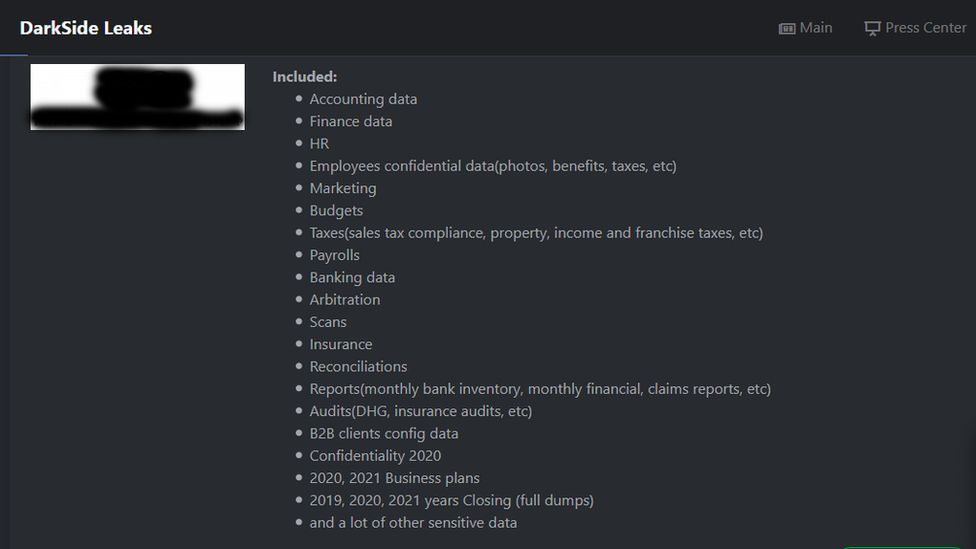
The gang lists all the types of data it has stolen, and sends victims the URL of a "personal leak page" where the data is already loaded, waiting to be automatically published, should the company or organisation not pay before the deadline is up.

Dark Side also tells victims it will provide proof of the data it has obtained, and is prepared to delete all of it from the victim's network.

According to Digital Shadows, a London-based cyber-security firm that tracks global cyber-criminal groups to help enterprises limit their exposure online, Dark Side operates like a business.

A redacted screenshot of Dark Side's website on the dark web details its success in attacking a large US manufacturer
image captionA redacted screenshot of Dark Side's website on the dark web details its success in attacking a large US manufacturer

The gang develops the software used to encrypt and steal data, then trains up "affiliates", who receive a toolkit containing the software, a template ransomware demand email, and training on how to carry out attacks.

The affiliate cyber-criminals then pay Dark Side a percentage of their earnings from any successful ransomware attacks.

It also works with "access brokers" - nefarious hackers who work to harvest the login details for as many working user accounts on various services as they can find.

Rather than break into these accounts and alert users or the service providers, these brokers sit on the usernames and passwords and sell them off to the highest bidders - cyber-criminal gangs who want to use them to carry out much larger crimes.

Digital Shadows says the Colonial Pipeline cyber-attack has come about due to the coronavirus pandemic - the rise of engineers remotely accessing control systems for the pipeline from home.

James Chappell, co-founder and chief innovation officer at Digital Shadows, believes Dark Side bought account login details relating to remote desktop software like TeamViewer and Microsoft Remote Desktop.

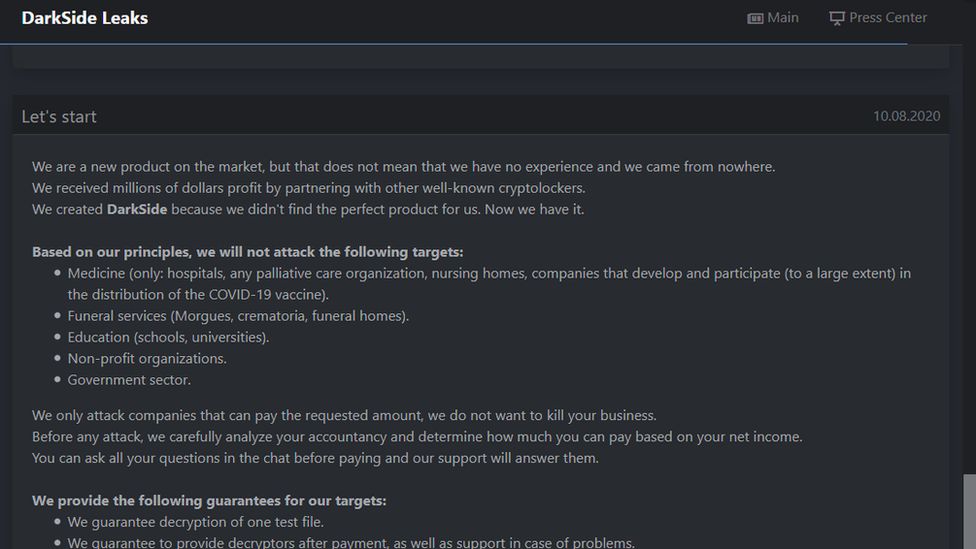
Dark Side even has a website on the dark web where it brags about its work in detail, listing all the companies it has hacked and what was stolen, and an "ethics" page where it says which organisations it will not attack.

DarkSide's website on the dark web
image captionDarkSide's website on the dark web details its achievements and sets out "ethics" of sorts

And when it released a new software in March that could encrypt data faster than before, the gang issued a press release and invited journalists to interview it.

"We're seeing a lot of victims now, this is seriously a big problem now," said Mr Chappell.

"Every day there's new victims. The amount of small businesses that are falling victim to this - it's becoming a big problem for the economy globally."

Mr Chappell added that Digital Shadows' research showed the cyber-criminal gang is likely based in a Russian-speaking country, as it seems to avoid attacking companies in the Commonwealth of Independent States - an organisation of the countries of Russia, Ukraine, Belarus, Georgia, Armenia, Moldova, Azerbaijan, Kazakhstan, Kyrgyzstan, Tajikistan, Turkmenistan and Uzbekistan.


https://www.bbc.com/news/business-57050690

Blocking viruses' exit strategy

 The Marburg virus, a relative of the Ebola virus, causes a serious, often-fatal hemorrhagic fever. Transmitted by the African fruit bat and by direct human-to-human contact, Marburg virus disease currently has no approved vaccine or antivirals to prevent or treat it.

A team of researchers is working to change that. In a new paper in the journal Antimicrobial Agents and Chemotherapy, investigators from Penn's School of Veterinary Medicine, working together with scientists from the Fox Chase Chemical Diversity Center and the Texas Biomedical Research Institute, report encouraging results from tests of an experimental antiviral targeting Marburg virus. The compound blocks the virus from departing infected cells, thus putting the brakes on the spread of infection. Their findings are the first to show that this novel class of inhibitors can be effective against the infection in an animal model.

In addition, due to possible similarities in virus-host interactions between Marburg and SARS-CoV-2, the team has conducted experiments on the culprit behind the coronavirus pandemic. While preliminary and thus-far-unpublished, their initial tests show signs of promise.

"It really is exciting," says Ronald Harty, a co-corresponding author of the research and a professor at Penn Vet. "These viruses are quite different but may be interacting with the same host proteins to control efficient egress and spread, so our inhibitors may be able to block them both."

While many antivirals target the virus itself, the drug candidates that Harty and colleagues have been developing for years are known as "host-oriented." They prevent virus-host interactions by blocking the proteins in host cells that viruses hijack during late stages of infection.

Not only does this approach help avoid the likelihood that a virus would evolve to resist such a therapy, but it also increases the chance that a drug could be used against multiple viruses, as many rely on the same host cell machinery to reproduce and spread.

The Marburg and Ebola viruses use the VP40 protein to interact with a host protein called Nedd4 to complete the process of "budding" off a host cell. This stage of infection, which is key to viral spread, is the one the research team has targeted.

In previous studies, they had tested a variety of small molecule inhibitors of this process using laboratory tests that relied on non-infectious and more-benign viral models. Those assays helped them land on a leading candidate, FC-10696, for further study.

In the current work, they zeroed in on this candidate with rigorous evaluations. First, they tested the inhibitor to ensure it would be safe and retained long enough in the body to have an effect. Next, because the live Marburg virus is too dangerous to study safely in anything but a Biosafety Level 4 (BSL-4) laboratory, they used an assay to look at what are known as virus-like particles, or VLPs, which can bud off of a host cell like the live virus but are not infectious.

Using the Biosafety Level 2 laboratory at Penn, "it's a very quick way we can test these inhibitors," Harty says.

After seeing a dose-dependent response to FC-10696 on VLP budding in cells in a cell-culture dish, the researchers tested the compound using the real Marburg virus. These studies were done in a BSL-4 lab at Texas Biomedical Research Institute and found the compound inhibited the budding and spread of live Marburg virus in two human cell types, including in macrophages, an immune cell type commonly infected by the virus.

Finally, they evaluated the compound in mice that had been exposed to Marburg virus. Those mice treated with FC-10696 took longer to display disease symptoms and had a reduced viral load.

"These are the first promising in vivo data for our compounds," Harty says. "Whereas the control group all became sick very quickly and died, with the treated animals there was one survivor and others showed delayed onset of clinical symptoms. It's showing that our inhibitors are having an effect."

A portion of the VP40 protein in Marburg and Ebola viruses that enables budding is known as a PPxY motif. SARS-CoV-2 also happens to have this motif on its Spike (S) protein, which it uses to infect human cells. In a follow-up experiment that is not yet published, the researchers found evidence that FC-10696 was able to inhibit budding of the SARS-CoV-2 coronavirus in human lung epithelial cells.

"The SARS-CoV-2 studies are ongoing, and they're very exciting," Harty says.

Ronald N. Harty is a professor of pathobiology and microbiology in the University of Pennsylvania School of Veterinary Medicine.

Harty's coauthors were Ziying Han, Jingjing Liang, Ariel Shepley-McTaggart, and Bruce D. Freedman of Penn Vet; Hong Ye, Jay E. Wrobel, and Allen B. Reitz of the Fox Chase Chemical Diversity Center; Michael S. Saporito of Intervi, LLC; and Alison Whigham, Katrina Kavelish, and Olena Shtanko of the Texas Biomedical Research Institute. Han was first author and Harty and Shtanko were co-corresponding authors. Harty and Freedman are co-founders of Intervi, LLC.

The study was supported in part by the National Institutes of Health (grants AI138052, AI138630, AI129890, and AI070077) and an Innovator Award from The Wellcome Trust.

Story Source:

Materials provided by University of PennsylvaniaNote: Content may be edited for style and length.


Journal Reference:

  1. Ziying Han, Hong Ye, Jingjing Liang, Ariel Shepley-McTaggart, Jay E. Wrobel, Allen B. Reitz, Alison Whigham, Katrina N. Kavelish, Michael S. Saporito, Bruce D. Freedman, Olena Shtanko, Ronald N. Harty. Compound FC-10696 Inhibits Egress of Marburg VirusAntimicrobial Agents and Chemotherapy, 2021; DOI: 10.1128/AAC.00086-21

Nanoparticle breakthrough in fight against cancer

 A team of researchers at the Center for Bioactive Delivery at the University of Massachusetts Amherst's Institute for Applied Life Sciences has engineered a nanoparticle that has the potential to revolutionize disease treatment, including for cancer. This new research, which appears today in Angewandte Chemie, combines two different approaches to more precisely and effectively deliver treatment to the specific cells affected by cancer.

Two of the most promising new treatments involve delivery of cancer-fighting drugs via biologics or antibody-drug conjugates (ADCs). Each has its own advantages and limitations. Biologics, such as protein-based drugs, can directly substitute for a malfunctioning protein in cells. As a result, they have less serious side effects than those associated with traditional chemotherapy. But, because of their large size, they are unable to get into specific cells. ADCs, on the other hand, are able to target specific malignant cells with microdoses of therapeutic drugs, but the antibodies can only carry a limited drug cargo. Since the drugs are more toxic than biologics, increasing the dose of ADCs increases the risk of harmful side effects.

"What our team has done," explains Khushboo Singh, a graduate student in the chemistry department and one of the study's lead authors, "is to combine the advantages of biologics and ADCs and address their weaknesses. It is a new platform for cancer therapy."

The team's approach depends on a nanoparticle the team engineered called a "protein-antibody conjugate," or PAC. "Imagine that the antibodies in PACs are the address on an envelope," adds Sankaran "Thai" Thayumanavan, distinguished professor in chemistry and interim head of biomedical engineering at UMass, "and that the cancer-fighting protein is the contents of that envelope. The PAC allows us to deliver the envelope with its protected treatment to the correct address. So, safer drugs are delivered to the right cell -- the result would be a treatment with fewer side effects"

At the heart of the PAC is a "polymer brush," a nanoparticle that the team engineered. This brush does two things. First, it is studded with antibodies that are capable of locating individual cancerous cells. Next, the brush has to both hold a sizable cargo of biologics but also keep that dose intact. The team found that their nanoparticle could carry four times the therapeutic dose of a typical ADC, and, through a variety of techniques, could be increased many times over.

While the UMass team's research represents a major milestone in cancer research, their findings are also widely applicable, and "open many new opportunities in biomedicine, extending far beyond cancer to all sorts of genetic diseases, or really any abnormality that occurs inside a human cell," says Bin Liu, one of the papers lead authors and a graduate student in the UMass chemistry department at the time of the research.

"Among the implications," says Thayumanavan, "perhaps the most exciting part is that this opens the door to develop cures for certain cancers that have been long considered undruggable or incurable" The team's research is currently being tested in models beyond a petri-dish.


Story Source:

Materials provided by University of Massachusetts AmherstNote: Content may be edited for style and length.


Journal Reference:

  1. Bin Liu, Khushboo Singh, Shuai Gong, Mine Canakci, Barbara A. Osborne, S. Thayumanavan. Protein–Antibody Conjugates (PACs): A Plug‐and‐Play Strategy for Covalent Conjugation and Targeted Intracellular Delivery of Pristine ProteinsAngewandte Chemie International Edition, 2021; DOI: 10.1002/anie.202103106

Breaching the blood-brain barrier to deliver meds

 RNA-based drugs have the potential to change the standard of care for many diseases, making personalized medicine a reality. This rapidly expanding class of therapeutics are cost-effective, fairly easy to manufacture, and able to go where no drug has gone before, reaching previously undruggable pathways.

Mostly.

So far, these promising drugs haven't been very useful in getting through to the well-protected brain to treat tumors or other maladies.

Now a multi-institutional team of researchers, led by Costas Arvanitis at the Georgia Institute of Technology and Emory University, has figured out a way: using ultrasound and RNA-loaded nanoparticles to get through the protective blood-brain barrier and deliver potent medicine to brain tumors.

"We're able to make this drug more available to the brain and we're seeing a substantial increase in tumor cell death, which is huge," said Arvanitis, assistant professor in the Wallace H, Coulter Department of Biomedical Engineering (BME) and Georgia Tech's George W. Woodruff School of Mechanical Engineering (ME).

Arvanitis, whose collaborators include researchers and clinicians from Emory's School of Medicine and the University of Cincinnati College of Medicine, is the corresponding author of a new paper published in the journal Science Advances that describes the team's development of a next-generation, tunable delivery system for RNA-based therapy in brain tumors.

"Our results were very positive, but if you think I'm excited, you haven't talked to oncologists -- they're 10 times as excited," Arvanitis said.

The roots of this project go back to when he and the paper's lead author, ME grad student Yutong Guo, arrived at Georgia Tech in August 2016.

"From the start, I was very interested in the application of ultrasonics in treating brain disease," said Arvanitis, who linked up with Emory physician Tobey MacDonald, director of the Pediatric Neuro-Oncology Program at the Aflac Cancer and Blood Disorders Center, and one of the paper's co-authors. "Our main question was, can we use ultrasound to deliver drugs to tumors? Because that is a major challenge."

RNA drugs have two major weaknesses: limited circulation time and limited uptake by cells. To overcome these challenges, the drugs are packaged in robust nanocarriers, typically 100 nm in size, to improve their bioavailability. Still, these nanocarriers have typically been too large to penetrate the blood-brain barrier, the tightly-connected and selective endothelial cells surrounding blood vessels in the brain, until now a locked door to RNA drugs.

But now, Arvanitis and his colleagues have discovered a safe way to get the drug safely across.

Using mouse models, the team deployed a modified version of ultrasound, the diagnostic imaging technique that uses sound waves to create images of internal body structures, such as tendons, blood vessels, organs and, in the case of pregnant women, babies in utero. The researchers combined this technology with microbubbles -- tiny gas pockets in the bloodstream, designed as vascular contrast agents for imaging -- which vibrate in response to ultrasound waves, changing the permeability of blood vessels.

"Focusing multiple beams of ultrasound energy onto a cancerous spot caused the microbubbles' vibrations to actually stretch, pull, or shear the tight junctions of endothelial tissue that make up the blood-brain barrier, creating an opening for drugs to get through," Guo said.

It's a technique that biomedical ultrasound researchers have been refining for more than a decade, and recent clinical trials have demonstrated its safety. But there hasn't been much evidence for selective and effective delivery of nanoparticles and their payloads directly into brain tumor cells. But even when blood borne drugs succeed in penetrating the blood-brain barrier, if they are not taken up by the cancer cell, the job isn't complete.

Arvanitis and his team packaged siRNA, a drug that can block the expression of genes that drive tumor growth, in lipid-polymer hybrid nanoparticles, and combined that with the focused ultrasound technique in pediatric and adult preclinical brain cancer models. Using single-cell image analysis, they demonstrated a more than 10-fold improvement in delivery of the drug, reducing harmful protein production and increasing tumor cell death in preclinical models of medulloblastoma, the most common malignant brain tumor in children.

"This is completely tunable," Arvanitis said. "We can fine tune the ultrasound pressure to attain a desired level of vibration and by extension drug delivery. It's non-invasive, because we are applying sound from outside the brain, and it's very localized, because we can focus the ultrasound to a very small region of the brain."

Current standard treatments for brain tumors come with potentially awful side effects, Arvanitis said, "however, this technology can provide treatment with minimal side effects, which is very exciting. Now we are moving forward to try and identify what components are missing to translate this technology to the clinic."


Story Source:

Materials provided by Georgia Institute of TechnologyNote: Content may be edited for style and length.


Journal Reference:

  1. Yutong Guo, Hohyun Lee, Zhou Fang, Anastasia Velalopoulou, Jinhwan Kim, Midhun Ben Thomas, Jingbo Liu, Ryan G. Abramowitz, YongTae Kim, Ahmet F. Coskun, Daniel Pomeranz Krummel, Soma Sengupta, Tobey J. MacDonald, Costas Arvanitis. Single-cell analysis reveals effective siRNA delivery in brain tumors with microbubble-enhanced ultrasound and cationic nanoparticlesScience Advances, 2021; 7 (18): eabf7390 DOI: 10.1126/sciadv.abf7390