Search This Blog

Tuesday, January 11, 2022

'Why You Should Report a Positive At-Home COVID-19 Test Result—and How to Do It'

 The winter of 2021-2022 promises to be an eventful chapter in the COVID-19 pandemic, which is seeing record numbers of cases flaring across the country due to the highly contagious omicron variant.

But those case numbers are typically a reflection of health care-administered testing, which doesn’t include the increasingly common at-home tests people are using to determine whether they’re infected. And that, health officials say, is proving to be a gap in data.

According to Patrick Ashley, the senior deputy director of health emergency preparedness and response administration at DC Health, people who test positive for the coronavirus using one of the antigen-based tests available at retail stores should report their results to their local health agency or their physician.

“Whether it’s a PCR test that’s done through a laboratory or an antigen test that’s done at home, the disease is still the disease, so understanding what’s going on in the community helps us to understand do we need to dial things up or dial things down?” Ashley told NBC.

An increased number of cases can influence public health policy in a given region. If those positives go unreported, a community may not have an accurate picture of community spread.

Many health departments around the country have web portals for reporting at-home test results; contacting your doctor means their office will likely report the case to officials. Reporting may also allow for patients to have documentation of test results to show to employers or schools.

Muddying the waters somewhat is that the at-home tests are typically antigen-based, which provide rapid results but are not as sensitive as PCR-based testing available in a clinical setting. An at-home test may provide a false negative result when not enough of the virus is present—often during its early stages or when a person is still asymptomatic. Because PCR tests look for genetic material in the virus and need less of it, they’re seen as more reliable. (Pixel, a mail-away PCR test by LabCorp, can be taken at home, though demand for the test kits is high.)

If you test positive on an antigen or PCR at-home test, it’s best to visit your local health department’s website to see if they offer guidance on reporting it. If not, reaching out to your doctor should result in the information getting in the right hands. If you test negative but experience symptoms or happen to be in a high-spread area, it’s probably not necessary to report it, but you should isolate for whatever amount of time is recommended by your doctor to avoid infecting others.

https://www.mentalfloss.com/article/654058/you-should-report-positive-home-covid-19-test

Disabled Americans Feel Abandoned by CDC

 On Friday, CDC Director Dr. Rochelle Walensky appeared on Good Morning America, and made a statement that pissed off large swaths of the country: “The overwhelming number of [Covid] deaths — over 75 percent — occurred in people who had at least four comorbidities, so really these are people who were unwell to begin with,” Walensky said. “It’s really encouraging news in the context of Omicron.” Immediately, people with disabilities and comorbidities were furious. By Monday, the CDC knew they had a problem. 

According to an email shared exclusively with Rolling Stone, the CDC has tasked Karen Remley, Director for the National Center on Birth Defects and Developmental Disabilities (NCBDDD) at the CDC, with repairing the damage. The email, which was sent to organizations in the disability community, asks for an opportunity to meet and discuss how the organization might help the communities that feel dismissed by them. “I am aware of the concerns that have been circulating around comments made related to Omicron death statistics and comorbidities,” Remley writes. “I would like to connect on a telephone call to discuss this in more detail and to learn more about how CDC, NCBDDD, and I can be of support to you and the audiences we collectively care deeply about.” 

Some have dismissed the controversy as overblown, a willful misinterpretation of what she meant — she was referring to a study of vaccinated people and the small number of deaths among them, which was edited out of the version aired by GMA. (“She is deeply concerned and cares about the health and well-being of people with disabilities and those with medical conditions who have been impacted by COVID-19,” a representative told Rolling Stone.) But for disabled and chronically ill people, they finally heard the quiet part out loud. Since the beginning of the pandemic, they’ve been told they’re at the highest risk of dying from Covid. And increasingly, they’re hearing that it’s not worth the effort to protect them.

Maria Town, President and CEO of the American Association of People with Disabilities, remains disheartened by Wallensky’s comments. “[It] highlights the fact that the Director and the CDC view people with disabilities as acceptable losses during the COVID-19 pandemic,” Town tells Rolling Stone. “Her comments, even with the additional context, reveal the systemic and institutional biases against disabled people that determine our lives are inherently worth less.”

When the CDC released its latest Covid isolation guidelines late last month, it marked another disturbing turning point for disabled Americas. The agency shortened the timeline and added a bullet point stating people who were recently infected should, “Avoid people who are immunocompromised or at high risk for severe disease, and nursing homes and other high-risk settings, until at least after 10 days.” 

Matthew Cortland, a senior fellow at Data for Progress focusing on disability policy and an attorney, wonders how this would work in the real world. “How on Earth is anyone supposed to know that I am immunocompromised?” Cortland, whose disability isn’t visible, tells Rolling Stone. “Is the CDC going to send me some sort of wearable sandwich board warning people I’m immunocompromised or does CDC expect to make my own?”

Their question belies a fundamental misunderstanding of what it means to be disabled: That it can be seen with the naked eye, or that disabled people can make themselves scarce for the convenience of others. “Are we supposed to just stay in our homes indefinitely so that other people who [are covid positive] and who were told by the CDC they can go back into the world while still infectious” can just get on with their lives?” Cortland asks.

The truth is, advocates say, that dialogue between the disability community and the CDC regarding Covid safety should’ve happened long ago—with the CDC Director herself—before the omicron variant reached the states. According to a 2019 report from the Center for American Progress, disabled adults experience poverty at nearly twice the rate of nondisabled adults: yet disabled people who rely on government assistance to survive have yet to be provided with a single free N-95 mask or a single home testing kit (an idea that was openly mocked by White House Press Secretary Jen Psaki.) Millions of Americans without the money, resources and ability to access tools to mitigate the risk of contracting Covid have been abandoned by the CDC, and with the push to get back to work, there are no signs of that changing.

“My anger at the administration as a high-risk person is founded on a lifetime of institutions and people who do not see my inherent worth whether I can produce or not,” Alice Wong, a disabled activist with a neuromuscular disability who uses a ventilator, tells Rolling Stone. “Who does the CDC serve? Not marginalized communities who predicted the disastrous ways this pandemic would unfold without decisive leadership.”

https://www.rollingstone.com/politics/politics-news/covid-cdc-disability-comorbidity-anger-1282759/

Athletes who had COVID will be considered ‘fully vaccinated,’ NCAA says in new guidelines

 The NCAA on Thursday released its new COVID-19 guidance for winter sports, and the guidance contains some important news.

As ESPN reports, the NCAA’s COVID-19 Medical Advisory Group updated its definition of “fully vaccinated” to account for various new vaccinations, boosters, and immunity factors.

“Fully vaccinated individuals now include those within two months of receiving the Johnson & Johnson vaccine, five months of receiving the Pfizer vaccine series or six months of receiving the Moderna vaccine series;” reports ESPN staff writer Jeff Borzello, “and individuals who are beyond the aforementioned timeline and have received the booster vaccine.”

But perhaps the biggest development came in the following line.

“Individuals within 90 days of a documented COVID-19 infection fall within the equivalent of ‘fully vaccinated.’”

In many parts of the world, including the United States, vaccine passports are required for travel.

Vaccine passports are morally dubious for several reasons, but they seem particularly unjust for people who’ve already had COVID-19, since they’ve already been exposed to the virus and have acquired natural immunity. Some evidence, such as a medical study out of Israel published in October, suggests that people with natural immunity actually have more protection from COVID-19 than vaccinated individuals.

Dr. Anthony Fauci, the Director of the National Institutes of Health and the Chief Medical Advisor to the President, was recently asked on CNN about the Israeli study—specifically if people naturally infected with COVID-19 had a lower risk of contracting the virus than those who received the vaccine. He declined to give a clear answer.

“I don’t have a really firm answer for you on that,” Fauci said. “That’s something that we’re going to have to discuss regarding the durability of the response.”

Harvard Medical School professor Martin Kulldorff disagrees.

“Based on the solid evidence from the Israeli study, the Covid recovered have stronger and longer-lasting immunity against Covid disease than the vaccinated,” Kulldorff wrote. “Hence, there is no reason to prevent them from activities that are permitted to the vaccinated.”

Getting vaccinated after getting COVID-19 might provide additional protection.

“Recent research,” the Mayo Clinic says, “suggests that people who got COVID-19 in 2020 and then received mRNA vaccines produce very high levels of antibodies that are likely effective against current and, possibly, future variants. Some scientists call this hybrid immunity.”

Kulldorff is right, however, that it is unnecessary and indeed discriminatory to treat people with natural immunity differently than those who’ve been vaccinated. (Vaccine passports themselves are morally dubious, as noted above, since they deprive individuals of fundamental freedoms.)

Moreover, Kulldorff says the NCAA’s decision to consider those who’ve had COVID “fully vaccinated” for just three months—a smaller window than those who’ve received the Pfizer and Moderna vaccines—is strange since evidence indicates that natural immunity offers stronger protections against COVID than the vaccines.

“It is good that the NCAA recognizes natural immunity for those who have recovered from Covid, but, since natural immunity is stronger and longer lasting than vaccine induced immunity, there are no public health reasons to only acknowledge it for three months after infection,” Kulldorff, an epidemiologist and biostatistician who has studied infectious disease outbreaks for years, told me in an email.

Still, while Dr. Fauci may not have made up his mind on natural immunity yet, it’s clear that other organizations are reaching their own conclusions as the federal government’s clumsy attempts to contain COVID-19 continue to fail.

“The omicron variant has presented another surge of cases across the country,” NCAA chief medical officer Brian Hainline said. “Given how the pandemic continues to evolve, it’s important that staff on member campuses continue to work with their local and state health officials on protocols most suitable for their locations.”

It’s unclear precisely what Hainline meant with these comments, but his use of the terms “local and state-health officials” may reflect President Biden’s recent admission that “there’s no federal solution” to the pandemic.

This would certainly be a step in the right direction. But the real epiphany will be when they realize the heavy hand of the state has only made the pandemic worse.

https://www.themainewire.com/2022/01/athletes-who-had-covid-will-be-considered-fully-vaccinated-ncaa-says-in-new-guidelines/

As Tennessee ends daily COVID reporting, cases skyrocket and may peak higher

 Alarming but not unexpected, that’s how doctors are describing the latest COVID-19 surge in Tennessee, led by the omicron variant.

“The situation in Tennessee is alarming but not unexpected — we’re seeing trends here comparable to what we’re seeing really all over the country,” said Dr. Loren Lipworth, an Epidemiologist with Vanderbilt University Medical Center.

The Tennessee Department of Health decided to end its daily COVID case reporting. But according to data from the CDC, over the weekend Tennessee surpassed its peak in cases with over 19,500 and it’s likely to do so again.

“The omicron case numbers are really skyrocketing and that seems to be moving kind of to the South and Midwest a little more,” Lipworth said.

Data shows about 1 in 350 Tennesseans testing positive for COVID, but the true number is likely higher.

“There’s a lot of COVID out there and you know we have to remember that the numbers of cases that we’re seeing reported are probably an underestimate of the true COVID cases circulating in the community, a lot of people are testing at home using rapid test and those are not always reported to the state,” Lipworth said.

Just 51% of the state is fully vaccinated with concerns that Tennessee hospitals could become overwhelmed.

“We are going to see a higher number of hospitalizations in our communities just by the sheer fact that we’re seeing so many cases and 30, 40, 50 percent may not be vaccinated and those are the people that are really high risk for severe disease with omicron.”

Doctors also say they’re keeping a close eye on pediatric COVID infections resulting in hospitalizations, currently, there are 64 kids in hospitals.

Over 2,100 adults are also hospitalized.

https://www.wkrn.com/community/health/coronavirus/as-tennessee-ends-daily-covid-reporting-cases-are-skyrocketing-and-could-peak-higher/

T-cells from common colds could help scientists make "Holy Grail": Variant-proof COVID vaccine

 T-cells generated as part of the body's natural immune response to the common cold may help protect against serious illness from COVID-19, according to a study carried out in the U.K.  Researchers at Imperial College London told CBS News the findings could help scientists create vaccines that remain more effective against new variants of the coronavirus.

The study, which was peer reviewed and published in the journal "Nature Communications," began in September 2020 and looked at 52 household contacts of people who had tested positive for COVID-19. It found that 26 people who were exposed to the coronavirus but did not get sick had significantly higher cross-reactive T-cells, generated by previous common colds, than those who did become ill with COVID.

"The conclusion should not be that if you've had a common cold you don't need to worry about contracting COVID-19," Professor Aljit Lalvani, one of the authors of the study, told CBS News.

This is so for a number of reasons, including that not all colds are caused by coronaviruses, and T-cells' ability to fight off symptomatic infections wanes over time.

"What the study tells us is that there is a mechanism, a natural mechanism of natural protective immunity, that is triggered by previous common cold coronavirus infections. … So the point is not to rely on that, but to exploit and to harness that naturally occurring protective immunity to develop better vaccines."

Lalvani said the majority of the current COVID-19 vaccines specifically target the virus' spike protein, which it uses to affix itself to healthy human cells. The vaccines cause the body to produce antibodies and T-cells that respond to that protein. This has offered good protection against the coronavirus so far, but as has been seen with Omicron, multiple mutations to the spike protein can render the vaccines less effective.

Lalvani says the research at Imperial College found that T-cells generated after a common cold caused by other coronaviruses (which are common) attack a type of proteins that remain similar across the known COVID-19 variants. These internal proteins are responsible for virus replication, rather than attaching to external cells. That vital role in the virus' evolution gives it far less potential to mutate, he explained.

"The fact that (the T-cells) can attack the internal proteins of each of these related viruses [COVID-19 variants] means that they give what's called a broad cross-protection," Lalvani told CBS News. "That's in sharp contrast to the surface spike protein, which is the target of antibodies induced by vaccines. And clearly, SARS-CoV-2 is under huge, intense pressure in the global population because most people now have these antibodies, whether induced by vaccination or infection, so the virus is trying naturally to evade that immunity through mutation, and that's why Omicron has such a high number of mutations in the spike protein. But the internal proteins are relatively unchanged."

Lalvani said the study should affect how scientists approach the development of future COVID vaccines.

"This is now a definitive green light to move forward and develop a T-cell inducing vaccine to internal core proteins, which should protect against current and future variants," he said. "We're very fortunate to have found what immunologists refer to as the 'Holy Grail,' so we're keen for people to understand this and to see that, at last, there is a path towards dealing with future variants."

https://www.cbsnews.com/news/covid-vaccine-common-cold-t-cells-natural-immunity-variant-proof-vaccine/

Half of Europe to be infected with Omicron within weeks - WHO

 The World Health Organization has warned that half of Europe will have caught the Omicron Covid variant within the next six to eight weeks.

Dr Hans Kluge said a "west-to-east tidal wave" of Omicron was sweeping across the region, on top of a surge in the Delta variant.

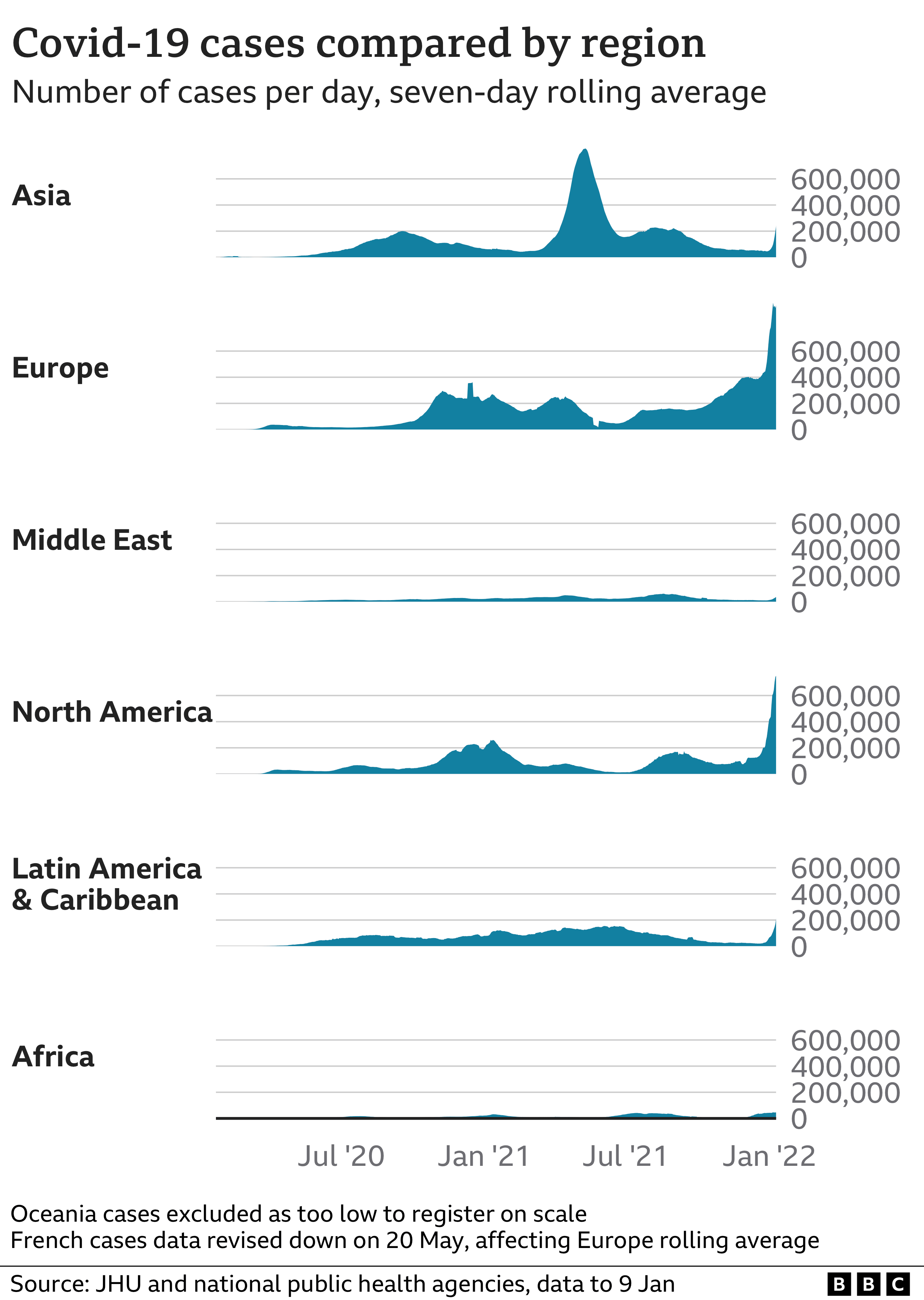
The projection was based on the seven million new cases reported across Europe in the first week of 2022.

The number of infections has more than doubled in a two-week period.

"Today the Omicron variant represents a new west-to-east tidal wave, sweeping across the region on top of the Delta surge that all countries were managing until late 2021," Dr Kluge told a news conference.

He quoted the Seattle-based Institute for Health Metrics and Evaluation as forecasting that "more than 50 percent of the population in the region will be infected with Omicron in the next six to eight weeks".

He said European and Central Asian countries remained under "intense pressure" as the virus spread from western countries into the Balkans.

"How each country now responds must be informed by its epidemiological situation, available resources, vaccination uptake status and socio-economic context", he added.

Recent studies suggest that Omicron is less likely to make people seriously ill than previous Covid variants. But Omicron is still highly contagious and can infect people even if they are fully vaccinated.

The record number of people catching it has left health systems under severe strain.

On Monday, the UK reported a further 142,224 confirmed cases of the virus and 77 deaths. A number of hospitals have declared "critical" incidents due to staff absences and rising pressures caused by Covid.

Elsewhere, hospital numbers are also rising. France's Health Minister Olivier Veran warned last week that January would be tough for hospitals.

He added that Omicron patients were taking up "conventional" beds in hospitals while Delta was putting a strain on ICU departments.

In eastern Europe, Poland reported that 100,000 people had died from the virus in the country since the start of the pandemic. Poland now has the sixth-highest mortality rate in the world from Covid-19, and almost 40% of its population remains unvaccinated.

In Russia, top consumer health official Anna Popova told a meeting of the government's coronavirus task force that without action to control the spread of the virus, the daily number of new Covid cases there could reach 100,000.

The daily infection rate had recently been declining from a peak of 41,335 cases recorded in early November, Reuters news agency reports.

Ms Popova said 305 known cases of the Omicron variant had been detected so far, in 13 of the country's regions. Russia has registered at least 311,281 deaths and 10.5 million cases to date.

On Monday, the pharmaceutical firm Pfizer said it would be able to launch a version of its vaccine that offers special protection against Omicron, to be rolled out in March. Health experts say it is not yet clear whether this is needed.

Chart showing cases compared by region

'Omicron can make you contagious before you test positive, allowing for rapid spread'

 Ahead of Christmas, health experts suggested undergoing a rapid coronavirus test just before any gatherings.

But some health experts are now warning that you can test negative even if you’re infected and contagious while still being visibly healthy.

In general, tests are able to reveal an Omicron infection, but enough virus needs to have reproduced and appear at sufficiently high levels in the nose or saliva to be detectable, according to Dr. Michael Mina, an epidemiologist and former professor at the Harvard T.H. Chan School of Public Health, whose interview on the podcast “In the Bubble,” hosted by former White House COVID-19 advisor Andy Slavitt, published this week.

“Omicron does appear to be more infectious, so it might be taking off and actually spreading the first day or two before there’s enough virus in your nose to turn the [rapid] antigen test positive — or the PCR test positive, for that matter,” Mina said on the podcast. “You might already be infectious, and that’s potentially because the virus now is just so able to potentially aerosolize and get out of people at lower amounts.”

The U.S. Food and Drug Administration has long warned that rapid antigen tests “may not detect an early” coronavirus infection. But those warnings hadn’t received much attention in the months preceding the Omicron surge.

People can be contagious regardless of whether they are showing symptoms, and many coronavirus-infected people will show no symptoms at all.

Coronavirus-infected people can still test negative even after starting to show signs of symptoms of COVID-19, with subsequent tests over the next couple of days eventually turning positive.

That’s what happened recently with the 28-year-old son of Dr. Robert Wachter, the chair of UC San Francisco’s Department of Medicine.

He wrote recently that his son, who had received three shots of the Moderna vaccine, became symptomatic two days after watching a movie at home with a friend. The vaccinated friend subsequently tested positive, three days after the movie night.

The son’s first rapid test, taken two days after the movie night, was negative, even though he was showing symptoms such as a sore throat, dry cough, muscle aches and chills, but no loss of taste or smell.

After he found out his friend tested positive, the son took another rapid test, which was positive. For this test, a swab was used in his throat before being placed in his nose.

It’s “a bit gross,” Wachter said, but it was done amid early data suggesting that Omicron starts appearing at higher levels in the throat before it starts appearing at detectable levels in the nose. (Health authorities in Britain have produced a video on how to do this.)

Wachter’s son is feeling better, with a mild sore throat and no fever five days after his symptoms began, Wachter said Monday.

For people who do show signs of illness, symptoms seem to start much earlier after exposure than with earlier variants, Mina wrote.

“This means that there is a chance the virus isn’t yet growing in the nose when you first test,” he said.

Some people have voiced alarm that rapid nasal swab tests may not pick up the coronavirus as early as rapid saliva swab tests. Mina said the nasal swabs still do a good job of detecting the virus for most of the days a person is contagious and remain helpful in stopping transmission.

“Just like a seatbelt, these are all risk-mitigation strategies — they’re not risk-erasing strategies. And so, just like a seatbelt and an airbag, neither of them are perfect,” Mina said on the podcast.

Among people who get the Omicron variant and eventually show symptoms, signs of illness might appear as little as one to two days after exposure, with contagiousness beginning roughly two days after exposure, Mina said.

And the symptoms of someone who has been vaccinated, or has prior exposure to the virus, may start earlier than an unvaccinated person or one who hasn’t been infected. That’s because their immune systems have been taught to recognize the virus, Mina said.

Initial symptoms could be congestion, runny nose and fever, which are consistent with the immune system quickly recognizing the virus and attacking it.

By contrast, the immune system of a person who is unvaccinated or wasn’t previously exposed to the coronavirus wouldn’t be able to recognize it. In the pre-Omicron phase of the pandemic, it generally took five to seven days before symptoms arose.

The earlier onset of symptoms following exposure to the coronavirus is a good development, Mina said. Before there was so much exposure to the coronavirus, many infected people who eventually developed symptoms were contagious for two to three days before they started feeling ill.

There is a potential blind spot of a day in which both PCR and antigen tests are unable to detect the contagious status of a coronavirus-positive person.

“Probably the first day that you’re infectious with Omicron, you’re probably going to get a negative on [a rapid] antigen test,” Mina said. As for a PCR test, there’s a 50% chance the test result will be positive on the first day you’re infectious, Mina said, but even then, the results wouldn’t be available for a couple of days because of lab-processing time.

“On average, everyone should assume there might be as much as a day before any test would tell you that you’re positive,” Mina said.

On the first day you’re contagious, you’ll likely not be “super infectious.” On the second day of contagiousness, however, “you might actually become pretty infectious,” Mina said. A rapid test will probably still be negative; a PCR test may be positive, but that result might not be available for a couple of days.

It might take until the third day of contagiousness before a rapid test is positive, Mina said.

Rapid tests are still helpful for determining whether a person is contagious for most of the days someone is capable of transmitting the virus. On the third or fourth day of infectiousness, when the level of virus produced by the body is astronomical, rapid tests do a good job of detecting high levels of coronavirus, Mina said.

For tests that show you’re no longer contagious, a PCR test is not useful, experts say. They can show positive test results for weeks following an infection, long after a person has stopped being contagious.

Rapid test starts showing negative results about the time contagiousness ends, Mina said. “If you don’t have [contagious levels of] virus, the antigen test tend to turn negative, and if you do, the antigen test tend to stay positive,” Mina said.

https://www.latimes.com/california/story/2022-01-11/omicron-can-make-you-infectious-before-you-test-positive