Search This Blog

Thursday, May 4, 2023

48% in US Worried About Their Money's Safety In Banks, More Than During Peak Of 2008 Crisis

 By Megan Brenan of Gallup


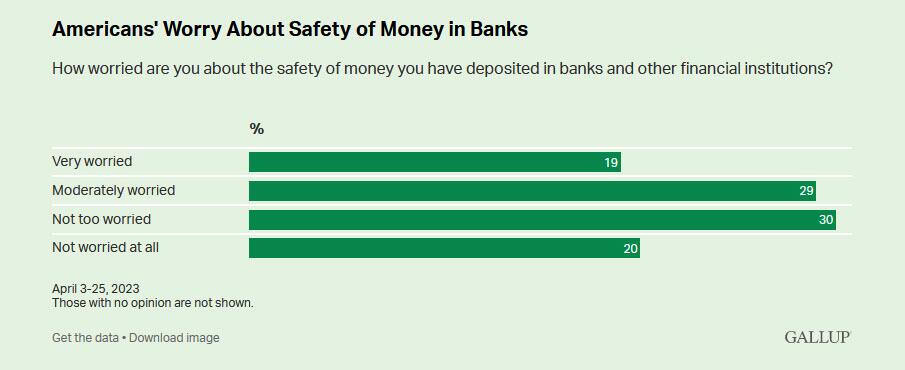
Amid turbulence in the U.S. banking system, nearly half of Americans are anxious about the safety of the money they have in accounts at banks or other financial institutions. A total of 48% of U.S. adults say they are concerned about their money, including 19% who are “very” and 29% who are “moderately” worried. At the same time, 30% are “not too worried” and 20% are “not worried at all.”

These findings are from a Gallup poll conducted April 3-25, the month after Silicon Valley Bank and Signature Bank collapsed. News about the failure of a third bank -- First Republic -- came after the poll was completed. Most bank failures in the U.S. over the past two decades have been linked to the 2008 financial crisis, which was the last time Gallup gauged Americans’ level of worry about their money held in banks or other financial institutions.

The latest readings are similar to those in 2008. In September of that year, shortly after the collapse of Lehman Brothers, which remains the largest bankruptcy filing in U.S. history, 45% of U.S. adults said they were very or moderately worried about the safety of their money. Several months later, in December, after Congress’ Troubled Assets Relief Program (TARP) bailed out other banks in danger of failing, Americans were slightly less concerned about the safety of their personal financial accounts, as 41% said they were very or moderately worried. 

Worry About Banks Higher Among Republicans and Independents

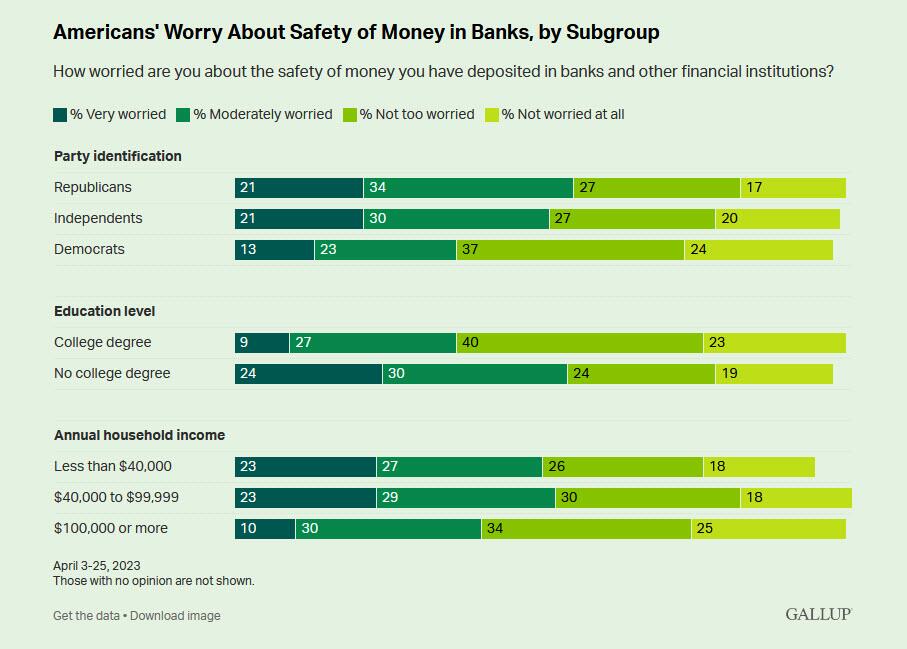
Republicans, independents, middle- and lower-income adults, and those without a college degree are more worried than their counterparts about the safety of their money.

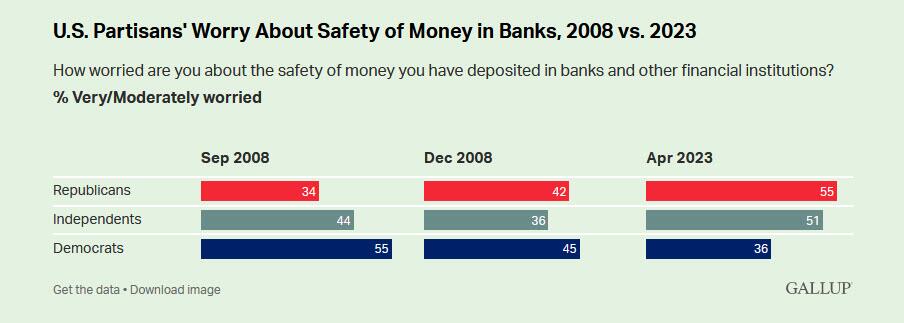
Whereas majorities of Republicans (55%) and independents (51%) say they are at least moderately worried, a 36% minority of Democrats are. Similarly, 54% of U.S. adults with no college degree are very or moderately worried, while 36% of college graduates are. About half of Americans with an annual household income under $100,000 express worry about their money, while 40% of those with higher incomes do.

Partisans’ levels of worry about the safety of their money in the banking system also diverged in September 2008, but in the opposite way. Republican President George W. Bush was in the White House when the financial crisis unfolded, and the views by party were nearly the reverse of those today. At that time, 55% of Democrats were very or moderately worried versus 34% of Republicans.

Another indication that partisanship is a significant driver of opinion on this question is that after the government bailout in 2008 and Barack Obama’s election win against John McCain, Democrats’ and independents’ levels of worry dropped, while Republicans’ rose eight percentage points.

While there weren’t differences by education level in September 2008, worry among lower- and middle-income adults was higher than that among higher-income adults.

Bottom Line

After several recent high-profile bank failures in the U.S., about half of Americans are concerned about the safety of the money they have in banks or other financial institutions. This is on par with the level of worry measured during the financial crisis in 2008 when financial institutions previously believed to be “too big to fail” collapsed. And while Gallup has not measured this during calmer times for the banking industry, the December 2008 reading showed slightly diminished concern after the crisis had been addressed, suggesting high worry about the security of deposits may not be the norm for Americans.

When banks fail, it is also unclear whether Americans’ heightened concern about their own deposits reflects a lack of awareness of the protections for small accounts provided by federal deposit insurance or their fear of a snowball effect that could bring down federal insurance as well. The Federal Deposit Insurance Corporation (FDIC), a U.S. federal government agency, insures $250,000 per depositor, per insured bank, for each account ownership category. Yet, lower-income adults, those without a college degree and Republicans are more worried than their counterparts. Worry among these groups may be higher because they do not know about FDIC insurance, or it may be linked to their displeasure with the current presidential administration and the U.S. economic situation.

https://www.zerohedge.com/markets/48-americans-are-worried-about-their-moneys-safety-us-banks-more-during-peak-2008-crisis

J&J’s consumer health spinoff Kenvue opens at $25.53, a 16% jump, in IPO

 Johnson & Johnson

’s consumer health spinoff Kenvue jumped 16% in its market debut on the New York Stock Exchange Thursday, marking the biggest U.S. IPO in more than a year. 

The new company opened at $25.53 per share after originally pricing its IPO at $22 Wednesday night, toward the high end of its target range.

Kenvue sold 172.8 million shares in an upsized deal that raised about $3.8 billion and valued the company at roughly $41 billion. 

At its opening price, Kenvue had an implied valuation of nearly $48 billion. 

The company, which trades under the ticker “KVUE,” holds a wealth of widely known consumer brands such as Band-Aid, Tylenol, Listerine, Neutrogena, Aveeno and J&J’s namesake baby powder. 

“Millions of consumers around the world this morning wake up with a Kenvue product in their home,” CEO Thibaut Mongon, told CNBC’s “Squawk on the Street” Thursday morning ahead of the stock’s debut.

Mongon previously served as J&J’s executive vice president and worldwide chair of consumer health. He will sit on Kenvue’s board.

Kenvue’s IPO marks the largest restructuring move in J&J’s 135-year history. 

J&J first announced the spinoff in November 2021 as an effort to streamline operations and refocus on its faster-growing medical devices and pharmaceutical divisions. 

But J&J will generally be able to control the direction of Kenvue’s business and matters that shareholders vote on for the time being: The health giant will own 1.7 billion shares of Kenvue’s common stock after the IPO completes, representing a 90.9% stake. J&J will reduce the rest of its stake in Kenvue later this year. 

Mongon told CNBC that J&J has been “very clear” about its intent to separate from Kenvue in 2023.

Kenvue expects to pay a quarterly cash dividend of approximately 20 cents per share starting with the third quarter, which will end Oct. 1. 

Mongon called it an “attractive dividend policy that will be a way for us to produce more value back to shareholders.”

Meanwhile, the consumer-focused Kenvue is already profitable. Kenvue posted $14.95 billion in sales for 2022 and a net income of $1.46 billion on a pro forma basis, according to a preliminary prospectus filed with the Securities and Exchange Commission last week.

“We do this from a position of strength. Kenvue is a healthy business,” Mongon told CNBC.

For the first quarter, which ended April 2, Kenvue estimates it raked in sales of $3.85 billion and net income of around $330 million. Those results are preliminary.

Kenvue expects annual sales growth through 2025 to be about 3% to 4% globally, according to the filing.  

The IPO still leaves J&J liable for thousands of allegations that its talc baby powder and other talc products caused cancer. Those products fall under the company’s consumer health business, now Kenvue, but the spinoff will assume only talc-related liabilities that arise outside the U.S. and Canada, according to its IPO filing from January.

When asked about the liabilities, Mongon said Kenvue is “laser-focused on what we do best: serving our customers and also our portfolio with the brands that we mentioned.” 

The debut raises hopes that the muted U.S. market for initial public offerings could be recovering after it collapsed last year. 

Kenvue’s IPO raised more than every other offering so far this year, according to a report from Renaissance Capital, with just 40 IPOs in 2023 raising a combined $2.4 billion

The spinoff is also the largest IPO since EV maker Rivian went public in November 2021.

https://www.cnbc.com/2023/05/04/jj-kenvue-ipo-kvue-starts-trading-on-nyse.html

Marijuana may be behind 30% of schizophrenia cases in young men: NIH-funded study

Marijuana may be driving a surge in schizophrenia cases among young men, a major Government-funded study suggests.

Researchers backed by the National Institute on Drug Abuse estimated 30 percent of schizophrenia cases in men aged 21 to 30 are linked to cannabis addiction.

Overall across all age groups, the analysis of 6 million people found 15 percent of diagnoses in men and four percent in women could be attributed to the drug.

Dr Nora Volkow, NIDA director and co-author of the study, said the results called for 'urgent action' and demanded people think twice before smoking marijuana.

Schizophrenia cases have been rising in recent decades, linked to growing and aging populations. But the researchers warn it could become more common as marijuana becomes increasingly legal. 

Dr Volkow said: 'The entanglement of substance use disorders and mental illnesses is a major public health issue, requiring urgent action and support for people who need it.

'As access to potent cannabis products continues to expand, it is crucial that we also expand prevention, screening, and treatment for people who may experience mental illnesses associated with cannabis use. 

She added: 'The findings from this study are one step in that direction and can help inform decisions that health care providers may make in caring for patients, as well as decisions that individuals may make about their own cannabis use.'

Several studies have found links between cannabis and schizophrenia in the past, though the exact cause is not clear. 

Marijuana can cause psychosis, impairing the way you think, make decisions, handle emotions, and interact with reality.

It can also interfere with brain development in young people. 

But it may be that people who are schizophrenic simply use cannabis to ease their symptoms.

About 2.8million adults in the United States have the condition, estimates suggest.

Patients suffer symptoms including losing touch with reality, hallucinations, paranoia and an inability to answer questions. As a result, sufferers face problems in their personal and professional lives.

There is no cure for the condition, with doctors instead focusing on managing symptoms via anti-psychotic medications and therapy.

In the latest study, researchers in Denmark analyzed the medical records of six million people over five decades, from 1972 to 2021.  

All participants were aged between 16 to 49 years at least once over the period surveyed. 

They were all also from Denmark, where recreational cannabis use is illegal but it can still be accessed via the black market.

Participants' medical files were checked for cannabis use disorder, which was defined as being unable to stop using the drug even if it was causing damage to their health and social lives. 

All cases were also checked for a schizophrenia diagnosis.

There were 45,327 cases of schizophrenia in the study.

A total of 60,563 participants were also diagnosed cannabis use disorder, of which three quarters were in men.

After factoring in other risk factors including alcohol use and parental history of schizophrenia, cannabis use disorder was linked to about 30 percent of diagnoses of schizophrenia in young men in the year 2021.

Researchers suggested that more schizophrenia cases were linked to cannabis use in men because this group was more likely to smoke the drug and smoke it more regularly than women.

Previous research has suggested that men are more likely to use the drug than women and to use it more regularly, which may be linked to peer pressure.

Nonetheless, the advent of other ways to use the drug — such as gummies — is now driving a rise in marijuana use among women. 

The NIDA — which funded the study — has been outspoken in its warnings over cannabis use in the United States, warning that far too little is known about its health effects for the drug to be widely available for recreational use.

It has been spurred into action after as many as 22 states have rolled forward and legalized the recreational use of marijuana.

A growing body of studies warns, however, that the drug can damage brain development in adolescents and may raise the risk of mental disorders such as depression and anxiety.

Dr Carsten Hjorthøj, a mental health expert at the University of Copenhagen who was involved in the research, said: 'Increases in the legalization of cannabis over the past few decades have made it one of the most frequently used psychoactive substances in the world, while also decreasing the public’s perception of its harm. 

'This study adds to our growing understanding that cannabis use is not harmless and that risks are not fixed at one point in time.'

He warned back in 2021 that cannabis was 'not harmless'.

'There is, unfortunately, evidence to suggest that cannabis is increasingly seen as a somewhat harmless substance,' he told CNN.

'This is unfortunate, since we see links with schizophrenia, poorer cognitive function, substance use disorders, etc.' 

The study was published in the journal Psychological Medicine

https://www.dailymail.co.uk/health/article-12046605/Marijuana-30-PERCENT-schizophrenia-cases-young-men.html

Bausch Health misses

 Bausch Health's taken a hit, trading lower than expected. The Q1 adjusted EPS and sales results were worse than anticipated, and the company’s revenue for the quarter saw a decline of 5.4% YoY, bringing it to $1.92 billion. Looking ahead, Bausch Health is predicting revenue for 2022 to be in the range of $8.25 billion to $8.40 billion, which falls short of the $8.56 billion consensus. The company is also projecting a full-year adjusted EBITDA of up to $3.375 billion (non-GAAP). 

https://beststocks.com/bausch-healths-q1-results-fall-short-causing/

Fulcrum cut to Neutral from Buy by Goldman

 Target to $3 from $9

https://finviz.com/quote.ashx?t=FULC&p=d

Regional Bank Crisis Spreads To Bigs As US Bancorp Tumbles, Stocks Dump Amid Widespread Liquidations

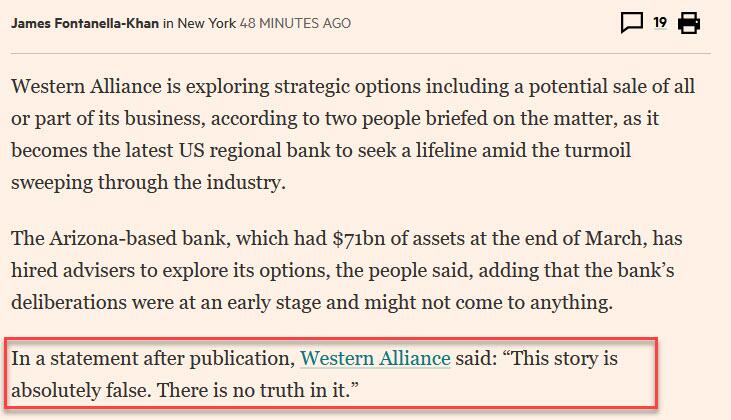
 Update (10:50am):  Moments after the FT report which sent WAL shared plunging to $11 (after closing at $30 yesterday), the company rushed out a press release to announce that the FT article is "absolutely false"

Western Alliance Bancorporation (“Western Alliance” or the “Bank”) (NYSE: WAL), the holding company for Western Alliance Bank, today issued the following statement in response to an article published by the Financial Times.

The Financial Times’ report today that Western Alliance is considering a potential sale of all or part of its business is categorically false in all respects. There is not a single element of the article that is true. Western Alliance is not exploring a sale, nor has it hired an advisor to explore strategic options.

It is shameful and irresponsible that the Financial Times has allowed itself to be used as an instrument of short sellers and as a conduit for spreading false narratives about a financially sound and profitable bank.

We are considering all of our legal options in response to today’s article.

For its part, the FT also did an on brand "update" to its article:
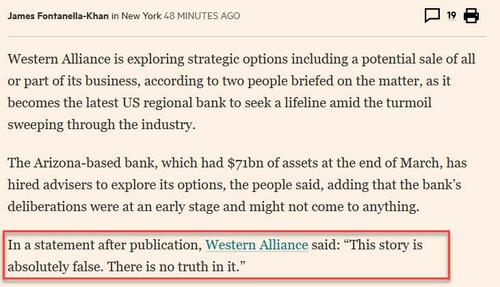
While the stock managed to bounce modestly, rising to $18 before getting halted again, we doubt this will help much as the bank run is now in full swing. After all, how is the thinking supposed to go: "Oh, so the story was false, let me quickly undo that deposit withdrawal i just made"

* * *

Update (10:30am): it's just getting worse and worse:

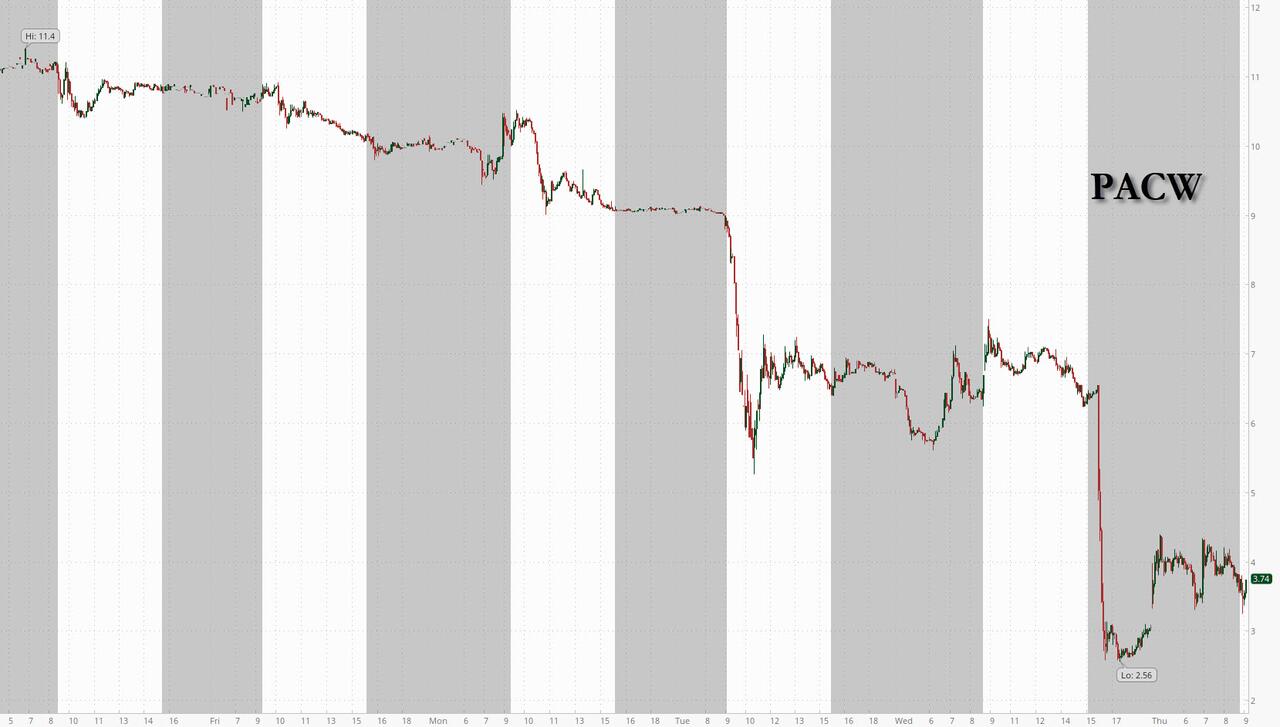
  • *PACWEST SHARES HALTED AFTER EXTENDING ROUT TO 52%
  • *KBW BANK INDEX DOWN AS MUCH AS 5.5% TO LOWEST SINCE SEPT. 2020
  • *S&P 500 FALLS 1% TO LOWEST INTRADAY SINCE MARCH 30

And now Western Alliance has joined the collapse...

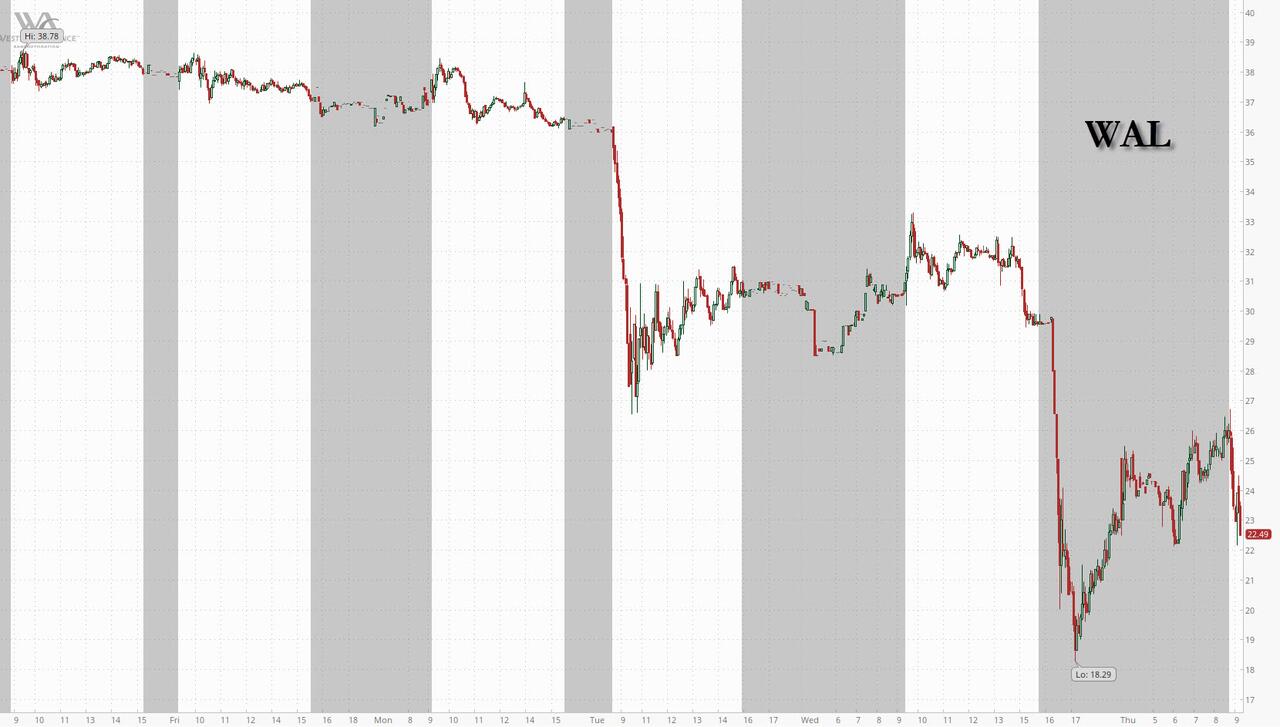
  • *WESTERN ALLIANCE RESUMES, EXTENDS SLUMP TO 45%, HALTED AGAIN

After an FT report said that it too, like PacWest, is exploring strategic options including a potential sale of all or part of its business. Citing two sources, the FT notes that the bank has hired advisers to explore its options and adds that deliberations are at an early stage, although at this rate, there won't be much to deliberate in a few short hours when the bank is out of all deposits.

* * *

Earlier

Two days ago, on May 2, in the aftermath of the FRC take-under by JPM which Jamie Dimon praised (of course) as a deal proving that the "system works as it should", and predicted that the bank crisis is now almost over, a forecast which the Fed chair reiterated yesterday (just before all hell broke loose), we warned that the "banking crisis is baaaack" for the simple reason that by bailing out FRC, up to $75 billion in Fed reserves would be drained from the system pushing small banks back to their reserve constraint and forcing another market puke and/or Fed bailout.

And as events less than 24 hours later proved conclusively, we were again right.

Early this morning, after its stock crashed as much as 60% and falling to a record low in the afterhours session following a Bloomberg report that it was seeking to sell itself or raise capital and sparking concerns that it was the next insolvent bank, California's  PacWest Bancorp (it's always a California bank for some odd reason), confirmed that it was indeed in talks with several potential investors, and said core deposits have increased since March in a desperate attempt to calm markets after the stock rout made it the new focal point of concern over the health of US regional lenders.

“The bank has not experienced out-of-the-ordinary deposit flows following the sale of First Republic Bank and other news,” PacWest said in a statement after the stock’s post-market plunge. “Our cash and available liquidity remains solid and exceeded our uninsured deposits.”

Sadly for PACW, in a world where a bank bringing attention to its balance sheet only invites bear raids and massive shorting, the bank failed to rebound and this morning it plunged as much as 48%, after being halted twice, and was last trading down 42%.
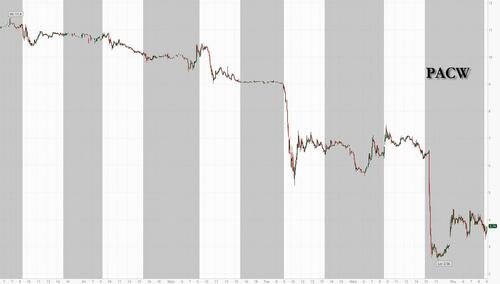
And now that small, "western" banks are once again under the microscope, the regional bank turmoil is - just as we predicted - "baaaack", and is hitting banks both small such as Western Alliance, which is down 24%...
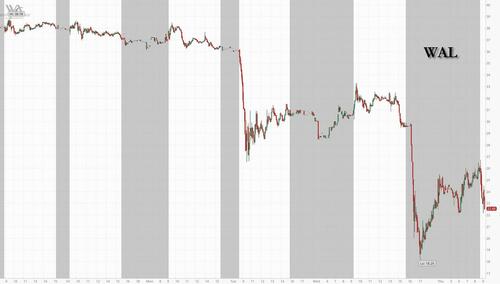
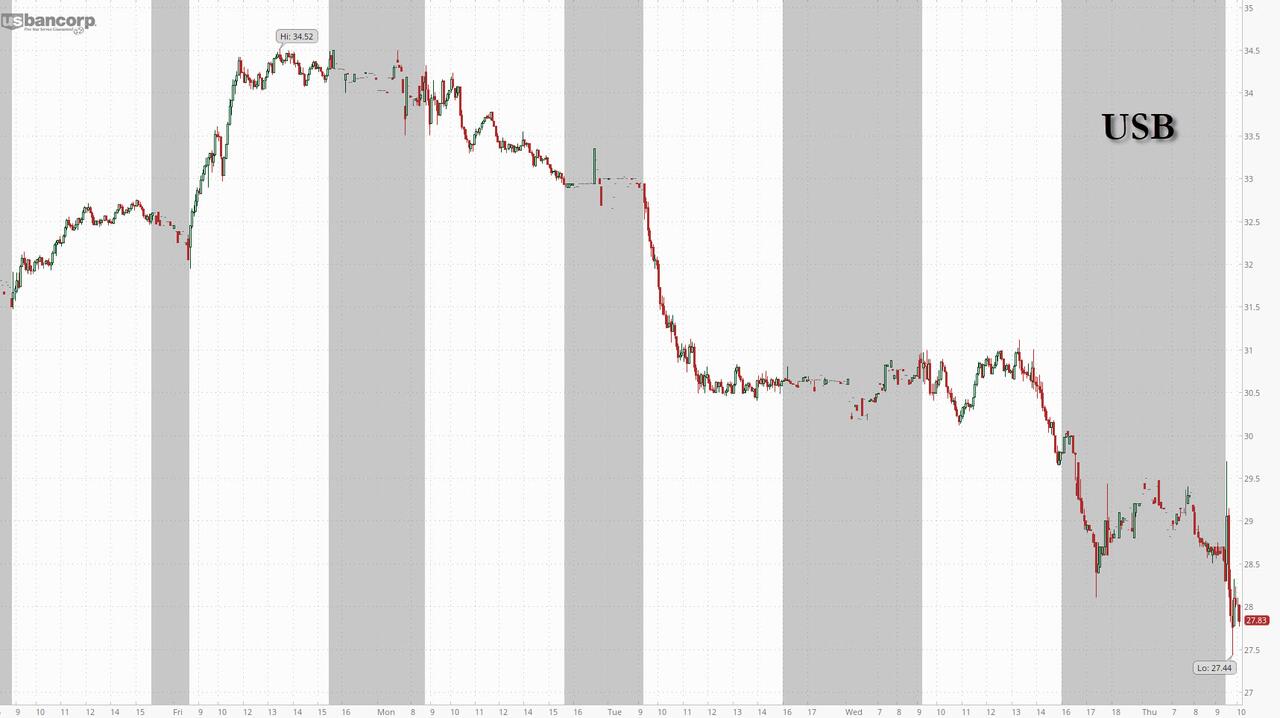
... as well as much buyer banks, such as US Bancorp, which this morning is down as much as 8% dropping ...
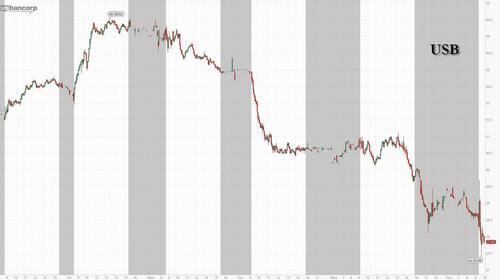
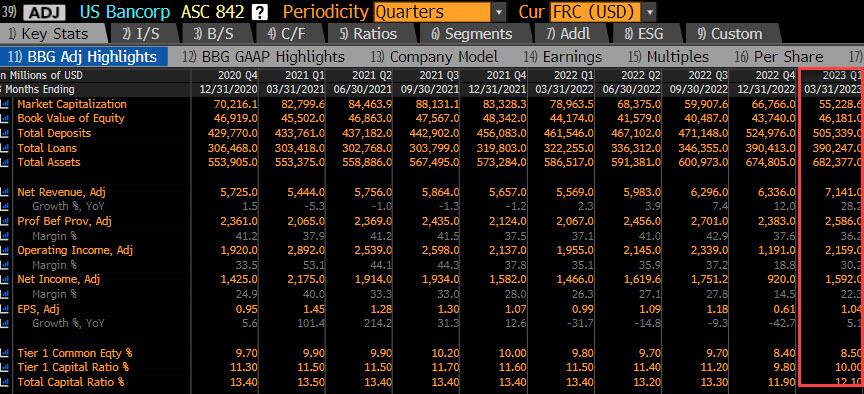
... and which actually is no longer just a small bank with over $682 billion in assets, over $500 billion in deposits and almost $400 billion in loans...
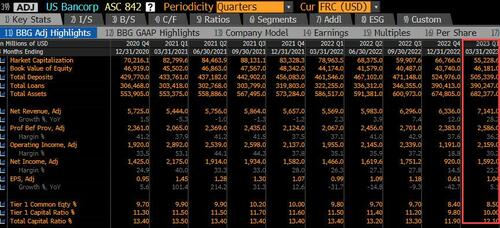
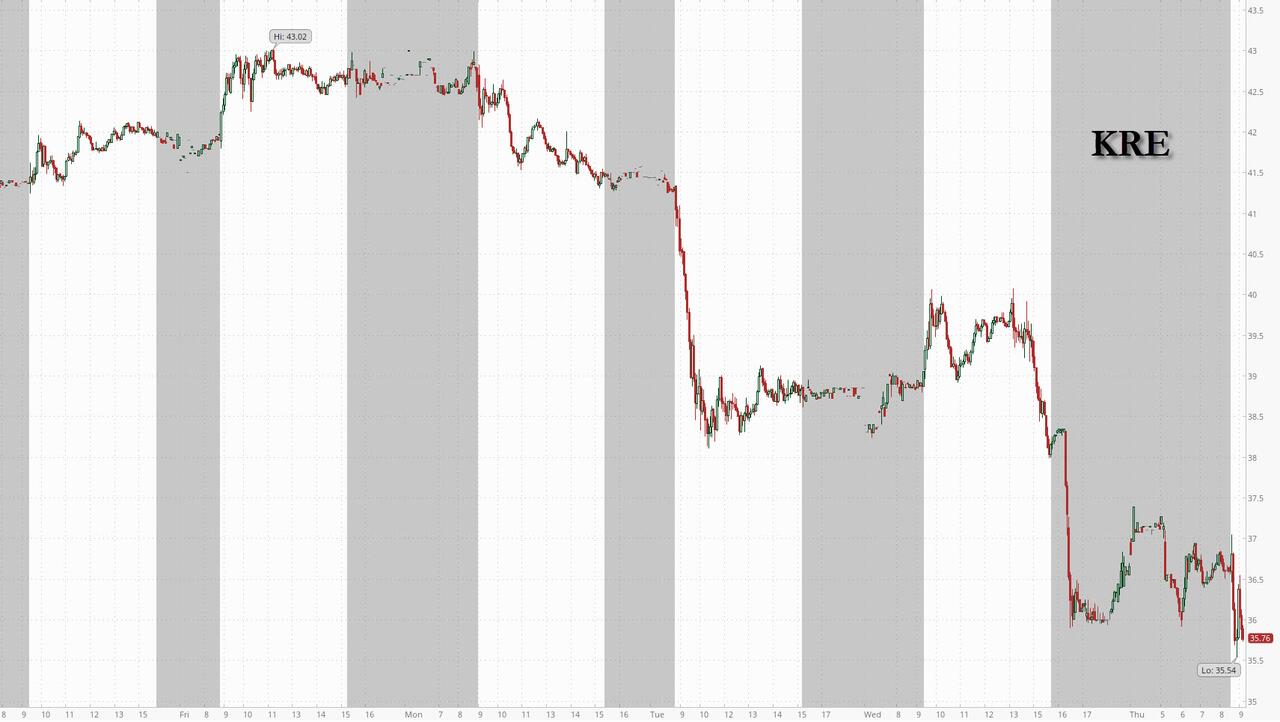
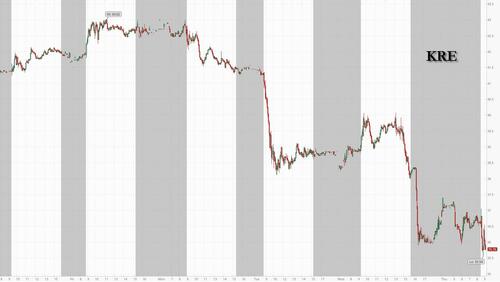
... thus threatening to bring what was until now purely a regional bank crisis to the echelon of larger banks. But for now this remains almost exclusively a small/regional bank crisis - as we warned it would be back on March 8 largely due to their commercial real estate exposure - and the KRE index is plunging another 6% this morning, dragging it to the lowest level since October 2020.
Earlier we reported that First Horizon tumbled as much as 40% after saying it and Toronto-Dominion Bank mutually agreed to terminate their merger agreement amid uncertainty around regulatory approvals.

Meanwhile, with the Fed still clearly ignoring what is shaping up as an epic bank crisis - or perhaps stoking it as some cynics have pointed out, suggesting it is Powell's hope that a cascade of failing banks will make the Fed's job of sparking a recession, credit crisis and deflationary bust easier...

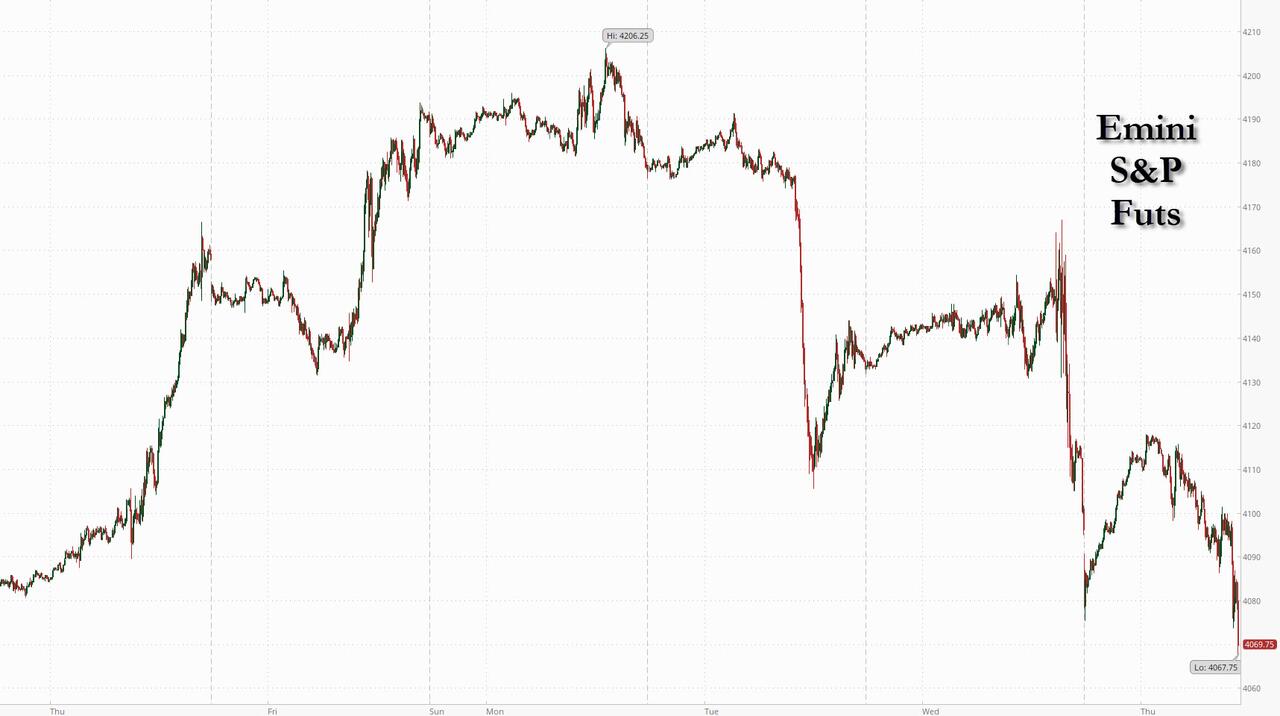
... traders everywhere are selling anything that isn't nailed down, and following last night's bizarre flash crash in oil, they have brought the liquidation to the S&P which is down 0.9% this morning in another broad-based selloff...
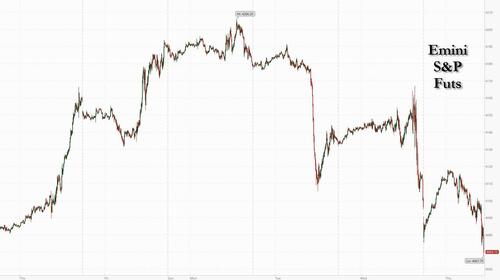
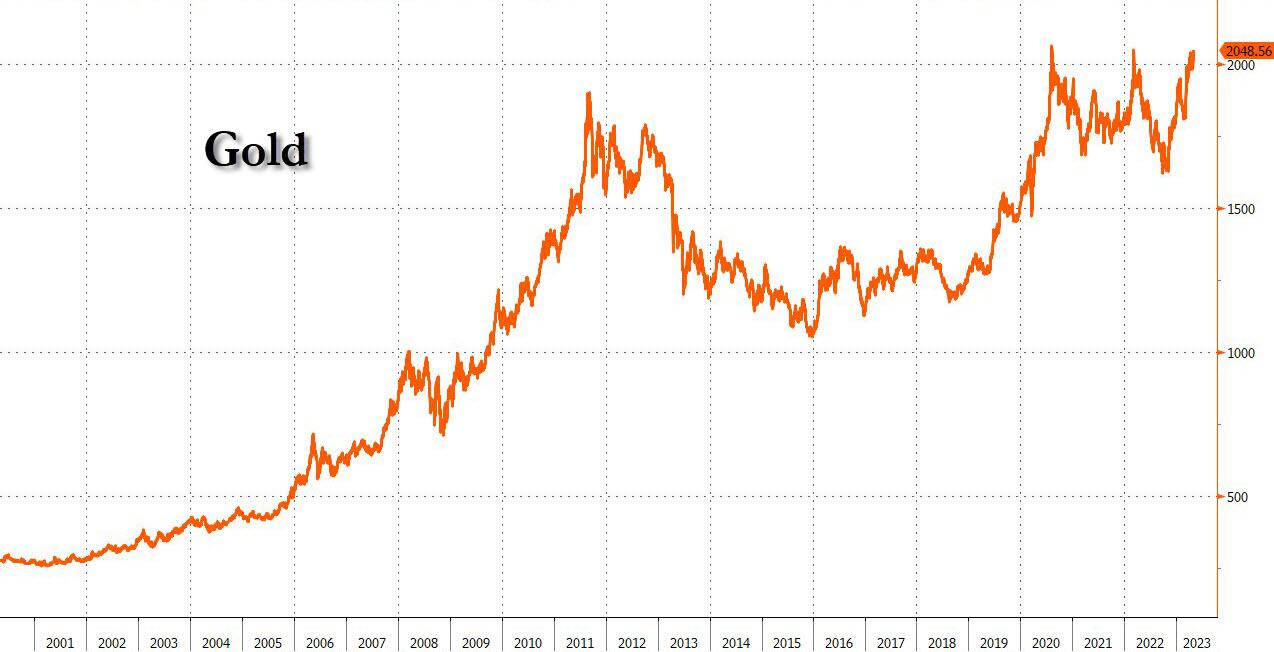
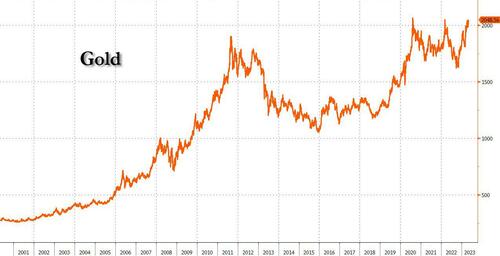
... as the VIX spikes above 20, and 10Y yields tumble while gold continues to trade just shy of its all time high.
Meanwhile, what we warned earlier this week may not have registered at the Fed just yet, but its former staffers are finally admitting that it is indeed the case: “The acute phase of bank turmoil may not be over, and policymakers need urgently to recognize that,” said Krishna Guha at Evercore, and former manager at the NY Fed.

“The problem is that their financial stability policy options are limited.”

In response to the relentless bank selling, there has been nothing but silence from the clueless Biden admin, but some reports suggest that a blanket deposit insurance is being considered, which however as we said - and Elon Musk agrees - will do nothing to contain the bank run...

... as well as rumors of a short selling ban, which also will only make matters worse.

It also appears that soon regulators will start going after twitter accounts that spread rumors of failing banks, incite panic and start bank runs, and not just today but going all the way back to the first bank failure of the cycle: Silvergate.

“We believe the banks are having their GameStop-like moment, where social media is amplifying non-traditional approaches to assessing solvency,” TD Cowen analyst Jaret Seiberg wrote in a note. “This creates a self-fulfilling prophecy that pressures stock prices, which then leads to more questions.”

The slide comes as prominent investors including hedge fund billionaire Bill Ackman warn that stresses on the banking system are far from over. It also puts in focus concerns that policymakers need to do more to shore up smaller lenders that have suffered as the Federal Reserve raised interest rates.

Incidentally, since the deposit flight is now largely a function of rate differentials as the FDIC has made it clear any amount of deposits are insured - i.e., the rate offered by most banks is far, far below that which money market funds offer today, and depositors can easily move all their money from place A to place B in under a minute with 3 clicks on their iPhone...

... the only thing that can stop this crash is the Fed cutting rates... which needless to say, would be reputational suicide for the what little credibility the Fed has left as it would be the fastest reversal following a rate hike in history...

... and will immediately send all non-USD alternatives soaring to record highs, as the dedollarization conversation turns much more serious.

https://www.zerohedge.com/markets/regional-bank-crisis-spreads-big-banks-usb-tumbles-stocks-dump-amid-widespread-liquidations
RFK Jr. Says Climate Change Being Exploited To Push 'Totalitarian Controls'

 by Jack Phillips via The Epoch Times (emphasis ours),

Democratic presidential candidate Robert F. Kennedy, Jr. said that climate-related issues are being “exploited” by wealthy individuals in a bid to enact “totalitarian controls” over society.

“Climate issues and pollution issues are being exploited by … mega billionaires” like Microsoft co-founder Bill Gates, Kennedy told radio host Kim Iversen over the past weekend. “The same way that COVID was exploited to use it as an excuse to clamp down top-down totalitarian controls on society and then to give us engineering solutions.”

“And if you look closely, as it turns out, the guys who are promoting those engineering solutions are the people who own … the patents for those solutions,” Kennedy said during Iversen’s show. “It’s a way they’ve given climate chaos a bad name because people now see that it’s just another crisis that’s being used to strip mine the wealth of the poor and to enrich billionaires.”

I, for 40 years, have had the same policy on climate and engineering,” said Kennedy, the scion of former Attorney General and New York Sen. Robert F. Kennedy. “You can go check my speeches from the 1980s, and I’ve said the most important solution for environmental issues [is] not top-down controls, it’s free market capitalism.”

Kennedy—a longtime environmental activist and lawyer—wrote in a 2014 blog post for corporations and other groups that “sponsor climate lies” should face punishment. But he wrote that he “support[s] the First Amendment which makes room for any citizen to, even knowingly, spew far more vile lies without legal consequence” before adding at the time: “I do, however, believe that corporations which deliberately, purposefully, maliciously, and systematically sponsor climate lies should be given the death penalty,” Kennedy wrote for EcoWatch.

Kennedy’s comments about climate change years ago were highlighted by Fox News and other right-leaning publications after he declared his candidacy for president last month. Although he’s better known for his comments about childhood vaccines, Kennedy worked as an environmental lawyer for New York City and also for the Natural Resources Defense Council (NRDC).

Also in the Iversen interview, Kennedy suggested that other than Gates, the World Economic Forum is also exploiting climate-related policies to produce a totalitarian society. The Davos, Switzerland-based group hosts annual meetings each year that include world leaders and top business executives, while in January, speakers at the forum said that governments and businesses should pursue a “net-zero” policy around carbon emissions and that people don’t need cars.

“What we have in this country now is not free market capitalism—it’s corporate crony capitalism. It’s … a cushy kind of socialism for the rich and a brutal, barbaric, merciless capitalism for the poor,” Kennedy also stated in the interview.

https://www.zerohedge.com/political/rfk-jr-says-climate-change-being-exploited-push-totalitarian-controls