Galapagos NV (Euronext & NASDAQ: GLPG) today announced its first quarter 2023 financial results, a year-to-date business update and its outlook for the remainder of 2023.
“The first months of the year mark an eventful period for our company across all areas of our business. Within our pipeline, we presented encouraging initial Phase 1/2 results with GLPG5201, our CD19 CAR-T candidate in chronic lymphocytic leukemia. Our later-stage immunology programs made further progress with the initiation of the Phase 3 study with filgotinib in patients with AxSpA and the opening of clinical sites to enroll patients in a Phase 2 study with our TYK2 inhibitor product candidate, GLPG3667, in DM.
Looking ahead, we aim to bring in additional assets in our strategic therapeutic areas and to further expand our proprietary oncology pipeline and CAR-T point-of-care network. We expect multiple catalysts over the next few months, including the topline results from two Phase 1/2 studies with our CD19 CAR-T candidates GLPG5101 and GLPG5201 manufactured at point-of-care. We are confident that through our R&D and business development strategy in our areas of growth in immunology and oncology, we can deliver long-term value and transform the lives of patients across the globe,” said Dr. Paul Stoffels1, CEO and Chairman of Galapagos.
Insulet Corporation (NASDAQ: PODD) (Insulet or the Company), the global leader intubeless insulin pumptechnology with its Omnipod®brand of products, today announced financial results for the three months ended March 31, 2023.
First Quarter Financial Highlights:
First quarter 2023 revenue of $358.1 million, up 21.2%, or 23.3% in constant currency1, compared to $295.4 million in the prior year
Total Omnipod revenue of $357.6 million, an increase of 32.7%, or 34.9% in constant currency
U.S. Omnipod revenue of $259.0 million, an increase of 48.8%
International Omnipod revenue of $98.6 million, an increase of 3.4%, or an increase of 9.6% in constant currency
Drug Delivery revenue of $0.5 million, a decrease of 98.1%
Gross margin of 67.2%, down 380 basis points. Adjusted gross margin1 of 64.9% excludes income of $8.0 million associated with the voluntary medical device correction (MDC) notices issued in 2022
Operating income of $27.7 million, or 7.7% of revenue, compared to $37.9 million, or 12.8% of revenue, in the prior year. Adjusted operating income1 of $19.7 million, or 5.5%, excludes income of $8.0 million noted above
Net income of $23.8 million, or $0.34 per diluted share, compared to $27.8 million, or $0.40 per diluted share, in the prior year. Adjusted net income1 of $15.8 million, or $0.23 per diluted share, excludes income of $8.0 million noted above
Adjusted EBITDA1 of $48.8 million, or 13.6% of revenue, compared to $63.0 million, or 21.3% of revenue, in the prior year
Recent Strategic Highlights:
Achieved record U.S. and Total Omnipod new customer starts for any first quarter
Received U.S. FDA clearance of Omnipod GOTM, a first-of-its-kind basal-only insulin Pod
On track to commercially launch Omnipod 5 in the United Kingdom mid-year and in Germany in the fall
Advanced sustainability across the Company, as detailed in Insulet's 2022 Sustainability Report2
Some of the people most strongly associated with promoting lockdown measures during the COVID-19 pandemic have recently sought to recast their positions. Examples include Anthony Fauci, former leader of the federal COVID-19 response, teachers’ union head Randi Weingarten, and Canadian Prime Minister Justin Trudeau.
Fauci seemed eager to shirk responsibility for the lockdowns when talking to The New York Times last week.
“Show me a school that I shut down and show me a factory that I shut down. Never. I never did,” he said.
It was the Centers for Disease Control and Prevention (CDC) that produced the lockdown recommendations, he emphasized.
“I gave a public-health recommendation that echoed the CDC’s recommendation, and people made a decision based on that,” he said, noting that he “happened to be perceived as the personification of the recommendations.”
That perception wasn’t mere happenstance though. Fauci hardly missed an opportunity for a media spotlight, accepting accolades for supposedly leading the country through the crisis.
Fauci boasted in October of 2020 that, early in the pandemic, it was he who recommended that President Donald Trump “shut the country down.”
“This was way before” the major outbreak in the New York City area at the onset of the pandemic, he said.
Moreover, Fauci now argues he was appreciative of those who had their reasons for not following the advice of federal public health agencies.
“I never criticized the people who had to make the decisions one way or the other,” he said.
That doesn’t appear to be accurate.
Fauci was repeatedly cited by the media as criticizing states that diverged from federal guidance.
On one occasion he called it “risky” and on another warned of “needless suffering and death” if states lifted COVID-19 restrictions earlier than federal guidelines suggested.
The former pandemic adviser now acknowledges that COVID-19 vaccines were presented to the public in a less-than-ideal way.
“We probably should have communicated better that the clinical trials were only powered to look at the effect on clinically recognizable disease, symptomatic disease,” he told the New York Times.
Nonetheless, various officials made comments to the effect that the vaccines stopped transmission of the virus—which was incorrect—while people who pointed out the limitations of the vaccine clinical trials were dismissed as “anti-vax” and censored by social media.
“Records can be shown to demonstrate Fauci’s undeniable leadership on decisions that led to substantial pain for otherwise healthy and productive Americans,” commented Michael Chamberlain, director of Protect the Public’s Trust, a group that pushes for government transparency and impartiality.
School Reopening
Weingarten, head of the American Federation of Teachers (AFT), recently told Congress that the union advocated for school reopening from early on in the pandemic.
“We spent every day from February [2020] on trying to get schools open,” she said.
That appears to be only partially true.
The union did issue a paper in April of 2020 that proposed reopening schools that were largely shut down the month before amid the rising spread of the SARS-CoV-2 virus that causes COVID-19 (pdf).
In practice, however, Weingarten always appeared to demand more to be done before schools could be opened “safely.”
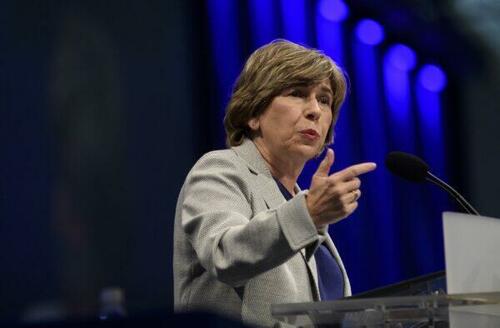
American Federation of Teachers President Randi Weingarten speaks in Pittsburgh, Pa., on July 13, 2018. (Jeff Swensen/Getty Images)
Some of the core demands included universal masking of teachers and students, improving ventilation at school buildings, and maintaining 6-foot physical distancing at all times. But those requirements, according to the union, required major investment or sacrifices of classroom time. Classes needed to be much smaller, for example, to ensure the distancing.
“If you do 6 feet of physical distancing, you’re essentially saying in a school you’re going to have about 50 percent or 60 percent of people in there at any one time, not a 100 percent,” Weingarten told NBC News in February of 2021.
And the demands went on.
United Federation of Teachers’ (UFT’s) reopening report from February of 2021 called for 20 percent of all students and staff to be tested each week. If one student tested positive, the whole classroom should be sent home for 14 days; if two students in different classrooms tested positive, the whole school should shut down in-person learning for 14 days, the document recommended (pdf).
New York City schools tried to implement similar if less stringent rules, only to prompt protests from parents.
“Day 2 of school. A positive case was found in daughter’s classroom. 25 kids now have remote school for 10 days,” Jill Goldstein, who has a child in one of the city schools, wrote on Twitter.
“This is unacceptable.”
There also appeared to be a tendency to delay school reopening until teachers had ample opportunity to get vaccinated.
On one hand, the AFT said vaccinations weren’t necessary for school reopening, but on the other, it argued that teachers needed to be prioritized for vaccination and that vaccination progress should be “aligned” with the reopening.
“Teachers and school-related personnel need the layer of protection vaccines provide. It is the bare minimum of what they need to get back into the classroom,” Weingarten said in a February 24, 2021, tweet.
In some of the districts with large local unions and robust reopening demands, it was only after the vaccines became widely available that local authorities were able to reach reopening deals, according to a report by the Defense of Freedom Institute (pdf).
Some of the AFT’s largest local affiliates went even further.
United Teachers of Los Angeles (UTLA), one of the AFT’s largest and most powerful affiliates, argued that reopening would require “broader community preparedness and increased funding.” That was supposed to include not only prolific testing, masking, and social distancing, but also expanded sick leave, a wealth tax, a millionaire tax, “Medicare for all,” and a moratorium on charter schools, according to a document issued by the union in July of 2020 (pdf). The document is no longer accessible on the UTLA website.
Facing public resistance, the UTLA in the end agreed to a reopening plan without such extraneous demands.
Resources, Red Zones, and Politics
Weingarten seemed rather inflexible in her demands.
When the CDC lifted mask recommendations for COVID-19-vaccinated people in May of 2021, Weingarten criticized Texas for no longer requiring masks in schools, pointing out that children weren’t eligible for the vaccine yet. Two months later, the CDC recommended masks again regardless of vaccination, citing the spread of the virus’ Delta variant and data showing vaccinated people were spreading it just as much as the unvaccinated.
Experts have warned that masking children, especially the youngest ones, could stunt their development. Some people have also criticized what they perceived as arbitrary masking rules. If classes were held at restaurants, for example, students would have been presumably allowed to take their masks off while sitting, based on rules once in place in many jurisdictions.
Three years after the FDA forced Novo Nordisk to pause a trial of its potential Hemlibra rival over reports of blood clots, the U.S. regulator has placed further barriers in front of the drug—even as it secures approval in other territories.
In a first-quarter earnings call this morning, Martin Holst Lange, M.D., Ph.D., Novo Nordisk’s executive vice president of development, revealed that on April 24 the Big Pharma received a complete response letter from the FDA regarding the therapy, an anti-tissue factor pathway inhibitor antibody called concizumab.
“In the letter, the FDA requested additional information related to the monitoring and dosing of patients to ensure that concizumab is administered as intended,” Lange explained. “Further information on the manufacturing process was also requested.”
“We will work now closely with the FDA to provide the requested data,” he added.
The latest holdup will bring back memories of 2020, when Novo Nordisk was forced to halt trials of concizumab over reports of blood clots in three patients. The studies resumed five months later, and, in a 2022 interview, executives insisted to Fierce Biotech that those issues were now in the rearview mirror.
“We worked with the FDA and the European agencies to evaluate the data from these three cases,” Novo Nordisk's chief medical officer for rare disease, Stephanie Seremetis, M.D., said at the time. “We described a mitigation strategy that has clearly been effective and since we restarted the trials we had no additional thrombotic events.”
The Big Pharma confirmed to Fierce this morning that no new safety issues have been identified related to the drug, while the therapy's “safety/efficacy profile is consistent with what we have observed in clinical trials to date.” Novo will “work closely with the FDA as plans for resubmission continue,” the spokesperson added.
The available data were presumably enough to convince Canadian regulators, who gave the green light to concizumab, marketed as Alhemo, last month for patients with hemophilia B who have FIX inhibitors and require routine prophylaxis to prevent or reduce the frequency of bleeding episodes.
Administered as a daily dose via what the company describes as a “patient-friendly pen,” concizumab’s big selling point over Roche’s hemophilia mainstay Hemlibra is that it can be taken by patients with hemophilia B, for which there are currently limited treatment options. The therapy already proved its worth last year, when the explorer7 study showed an 86% reduction in treated spontaneous and traumatic bleeds.
With a significant approval already in the bag, clinical data that exceeded the company’s expectations and confidence that its blood clot mitigation strategy is up to scratch, Novo Nordisk will be hoping that it can quickly overcome the FDA’s final regulatory approval and achieve its long sought-after U.S. approval.
Qiagen after the close of the market on Wednesday reported first-quarter net sales of $485 million, a decline of 23% from $628 million in Q1 2022.
For the quarter ended March 31, the Netherlands-based firm said consumables and related revenues was $431 million, down 23% year-over-year from $561 million, and instruments revenue was $55 million, a drop of 19% year-over-year compared to $67 million.
Of the total revenues, Q1 molecular diagnostics product revenue was $250 million, down 30% year-over-year compared to $357 million, and life sciences product revenue was $235 million, a drop of 14% year-over-year from $272 million.
Non-COVID-product group revenue was $434 million, an increase of 8% year-over-year from $400 million, while COVID-19 product group revenue was $52 million, down 77% year-over-year from $229 million.
Non-COVID product group sales rose due to underlying double-digit growth at constant exchange rates in consumables and related revenues, which more than offset a modest sales decline at constant exchange rates in instruments. Both the molecular diagnostics and life science customer classes delivered double-digit sales gains at constant exchange rates excluding COVID product groups over the prior-year period.
Net income for the recently completed quarter was $85 million, or $.51 per share, compared to $155 million, or $.67 per share, in the prior-year quarter. Q1 adjusted earnings per share (EPS) was $.51.
“We exceeded our outlook for net sales growth and adjusted EPS driven by strong sales in the non-COVID-based business,” Qiagen CEO Thierry Bernard said on a conference call to discuss the financial results. “Net sales at [constant exchange rates] for the first quarter were $502 million and exceeded our outlook for at least $490 million. On the other hand, due to Q1 2022 being an exceptionally strong quarter for COVID testing, we had sizable headwinds as expected in COVID product sales in the first quarter of 2023.”
At the end of the quarter, Qiagen had cash and cash equivalents of $359.2 million and short-term investments of $928.2 million.
For full-year 2023, the firm reaffirmed its outlook for net sales of at least $2.05 billion at constant exchange rates and adjusted EPS of at least $2.10 per share also at constant exchange rates. The outlook is based on expectations for double-digit sales growth at constant exchange rates on a full-year basis from the non-COVID product groups, but for a significant decline in COVID-19 sales compared to 2022.
For Q2 2023, net sales are expected to be at least $490 million at constant exchange rates, while adjusted EPS is expected to be at least $.50 per share, also at constant exchange rates.