Search This Blog

Monday, June 16, 2025

Cricket For MAGA: Trump Mobile Launches 'America First' Phone, Service

 Democrats are coming off their weekend color revolution via 'No Kings,' quarterbacked by far-left NGOs that were seemingly successful in orchestrating a mass mobilization effort against President Trump, effectively emptying retirement homes across America and sending deranged leftist elderly boomers onto city streets as foot soldiers. Now, Democrats will be triggered on Monday. But instead of rioting around ICE facilities, they'll rage on BlueSky, infuriated that the Trump Organization just launched a mobile service and smartphone

The Trump Organization's new smartphone is expected to be priced at around $499. The service will be offered through a $47.45-per-month plan that includes unlimited talk, text, and data, as well as roadside assistance and a "Telehealth and Pharmacy Benefit," according to its website.

"Alongside the team from Trump Mobile, Donald Trump Jr. and Eric Trump unveil T1 Mobile, a transformational, new cellular service designed to deliver top-tier connectivity, unbeatable value and all-American service for our nation's hardest-working people," the Trump Organization wrote in a press release. 

Think of it as 'Cricket' for MAGA... 

Here's what the $47.45-per-month plan gets you:

  • Unlimited talk, text, and data

  • Complete device protection

  • 24/7 roadside assistance through Drive America

  • Telehealth services, including virtual medical care, mental health support, and easy ordering and delivery for prescription medications

  • Free International calling to more than 100 countries, including many with American military bases to help honor the families who are bravely serving in our military abroad

  • No contracts, no credit check

Donald Trump Jr. commented on the new service that launches later this year: 

"Trump Mobile is going to change the game, we're building on the movement to put America first, and we will deliver the highest levels of quality and service. Our company is based right here in the United States because we know it's what our customers want and deserve." 

The Trump Organization stated that the "T1 Phone" will be a "sleek, gold smartphone engineered for performance and proudly designed and built in the United States for customers who expect the best from their mobile carrier." 

Earlier, Eric Trump told Fox News that Trump Mobile's call center will be based in America's Heartland, specifically in St. Louis, Missouri, rather than overseas. 

Axios noted, "The T1 brand on its phone is owned by the Trump Organization, effectively putting the Trump family in a manner of competition with the likes of Apple and Samsung, both of which the president has threatened to tariff heavily." 

Last month, President Trump warned Apple CEO Tim Cook that iPhones could face a 25% tariff if the company doesn't move manufacturing to the U.S. Cook has spent the last several years shifting production out of China, with a growing share of iPhone assembly now taking place in India. 

"I have long ago informed Tim Cook of Apple that I expect their iPhone's that will be sold in the United States of America will be manufactured and built in the United States, not India, or anyplace else. If that is not the case, a Tariff of at least 25% must be paid by Apple to the U.S.," the president said on Truth Social last month. 

Democrats are expected to erupt in outrage today, accusing President Trump and his family of using the presidency to enrich themselves and their billionaire allies. Much of the backlash is likely to be on Bluesky.

The Trump Organization's mobile phone venture is making a strategic move—possibly a tariff playpositioning itself ahead of Apple and other tech giants by using domestic phone production to sidestep potential import duties. However, no specifics have been provided about actual U.S.-based manufacturing.

https://www.zerohedge.com/technology/cricket-maga-trump-mobile-launches-america-first-phone-service

Google to terminate Scale AI partnership

 Alphabet’s Google plans to end its relationship with Scale AI, an AI data-annotation startup, after Meta acquired a 49% stake in the company, valuing it at $29bn, reported Reuters.

As Scale AI’s largest client, in 2025 Google had allocated $200m for human-annotated data critical for technologies like Gemini, its ChatGPT competitor.

The company has now initiated discussions with Scale AI’s competitors to reassign this workload, sources familiar with the development told the publication.

Scale AI, previously valued at $14bn, generated $870m in revenue in 2024, with Google accounting for $150m of its services in that year.

Other major clients, including Microsoft and Elon Musk’s xAI, are also considering exiting, while OpenAI, which reduced its reliance on Scale months ago, will continue working with the startup as one of many data vendors, its CFO stated.

Google, Microsoft, and OpenAI declined to comment, while xAI did not respond to the request.

Scale AI’s core service involves human annotators, such as historians and scientists with advanced degrees, labelling complex datasets to refine AI models. These annotations, costing up to $100 each, are vital for generative AI developers.

Scale also serves self-driving car companies and the US government, which are expected to remain clients.

Meta’s stake has raised concerns among AI developers, who fear sharing proprietary data with Scale could expose their strategies to a rival, said Reuters.

Scale’s CEO, Alexandr Wang, and select employees will transition to Meta, where Wang will lead AI efforts.

The Meta deal will benefit Scale AI’s investors, including Accel and Index Ventures, and its employees.

https://finance.yahoo.com/news/google-terminate-scale-ai-partnership-105946983.html

Amid regional conflict, the Strait of Hormuz remains critical oil chokepoint, mainly for Saudis

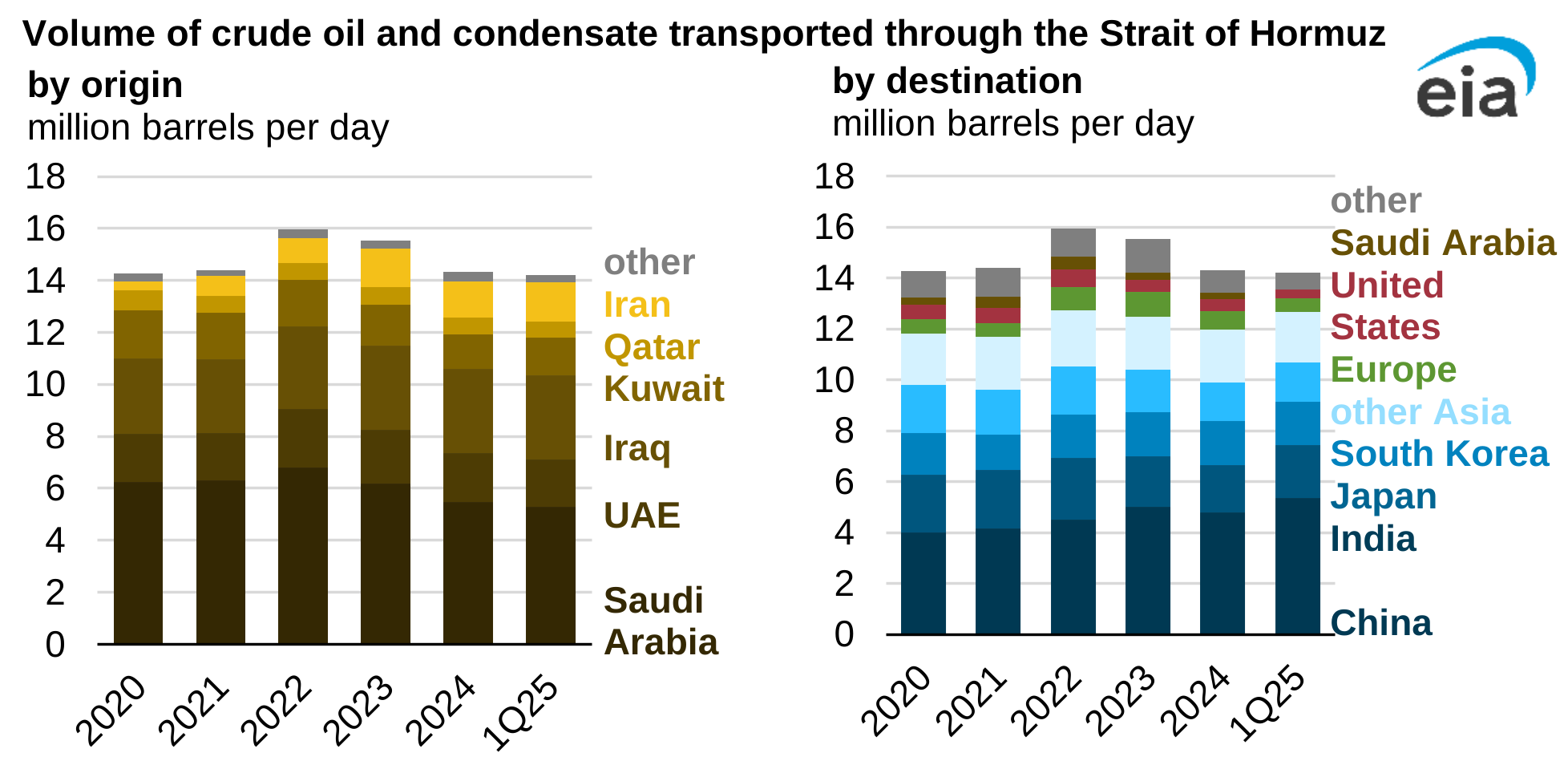
 Based on tanker tracking data published by Vortexa, Saudi Arabia moves more crude oil and condensate through the Strait of Hormuz than any other country. In 2024, exports of crude and condensate from Saudi Arabia accounted for 38% of total Hormuz crude flows (5.5 million b/d).

Alternative routes
Saudi Arabia and the UAE have some infrastructure in place that can bypass the Strait of Hormuz, which may somewhat mitigate any transit disruptions through the strait. The pipelines do not typically operate at full capacity, and we estimate that about 2.6 million b/d of capacity from the Saudi and UAE pipelines could be available to bypass the Strait of Hormuz in the event of a supply disruption.

Saudi Aramco operates the 5 million-b/d East-West crude oil pipeline, which runs from the Abqaiq oil processing center near the Persian Gulf to the Yanbu port on the Red Sea. Aramco temporarily expanded the pipeline’s capacity to 7.0 million b/d in 2019 when it converted some natural gas liquids pipelines to accept crude oil. In 2024, Saudi Arabia pumped more crude oil through the East-West pipeline to avoid the shipping disruptions around the Bab al-Mandeb.

The UAE also operates a pipeline that bypasses the Strait of Hormuz. This 1.8 million-b/d pipeline links onshore oil fields to the Fujairah export terminal in the Gulf of Oman. In 2024, crude oil and condensate volumes originating in the UAE and traversing Hormuz were 0.4 million b/d less than in 2022 because refinery upgrades allowed more heavy crude oil to be refined locally. These upgrades also allowed the UAE to increase exports of its lighter crude oil grades, and use of the pipeline to the Fujairah export terminal increased. Increased use of the pipeline for day-to-day operations has limited the excess capacity available to reroute additional volumes around the Strait of Hormuz.

Iran inaugurated the Goreh-Jask pipeline and the Jask export terminal on the Gulf of Oman (avoiding the Strait of Hormuz) with a single export cargo in July 2021. The pipeline’s effective capacity remains around 300,000 b/d. However, during the summer of 2024 Iran exported less than 70,000 b/d from ports (Bandar-e-Jask and Kooh Mobarak) using the Goreh-Jask pipeline and stopped loading cargoes after September 2024.

Destination markets
We estimate that 84% of the crude oil and condensate and 83% of the liquefied natural gas that moved through the Strait of Hormuz went to Asian markets in 2024. China, India, Japan, and South Korea were the top destinations for crude oil moving through the Strait of Hormuz to Asia, accounting for a combined 69% of all Hormuz crude oil and condensate flows in 2024. These markets would likely be most affected by supply disruptions at Hormuz.

volume of crude oil and condensate transported through the Strait of Hormuz
Data source: U.S. Energy Information Administration analysis based on Vortexa tanker tracking
Note: 1Q25=first quarter of 2025

In 2024, the United States imported about 0.5 million b/d of crude oil and condensate from Persian Gulf countries through the Strait of Hormuz, accounting for about 7% of total U.S. crude oil and condensate imports and 2% of U.S. petroleum liquids consumption. In 2024, U.S. crude oil imports from countries in the Persian Gulf were at the lowest level in nearly 40 years as domestic production and imports from Canada have increased.

https://www.eia.gov/todayinenergy/detail.php

Teva, Fosun Partner on Novel Anti-PD1-IL2 Therapy (TEV-56278) in Immuno-Oncology


  • Teva-engineered TEV-56278 is an anti-PD1-IL2 ATTENUKINE™ therapy in Phase 1 for the treatment of various forms of cancer, including melanoma

  • Fosun Pharma-Teva collaboration agreement established with goal of accelerating clinical data generation for TEV-56278

  • Partnership leverages strategic relationships to enable research and development of innovative treatments to advance Teva's Pivot to Growth strategy

Stocks Rise on Reports Iran Wants to Restart Talks


Relative calm returned to global markets, with stocks climbing and oil sinking alongside gold as fears subsided that Israel’s war against Iran would escalate into a wider conflict. Equities extended gains on news reports Iran is signaling it wants to restart talks over nuclear programs.

Equities bounced after Friday’s slide, with the S&P 500 up over 1%. West Texas Intermediate crude slid 4%, erasing an earlier rally. Treasuries moved away from session lows as the drop in oil eased inflation angst just days ahead of the Federal Reserve decision. Before that, the market will face a demand test during a $13 billion sale of 20-year bonds. The dollar fell.

Phathom: FDA Confirms 10 Years of Regulatory Exclusivity for VOQUEZNA

Phathom Pharmaceuticals (NASDAQ: PHAT) announced that the FDA has corrected the Orange Book listing for VOQUEZNA® (vonoprazan) tablets, confirming its 10-year New Chemical Entity (NCE) exclusivity period through May 3, 2032. VOQUEZNA, a first-in-class potassium-competitive acid blocker (PCAB), is approved for treating heartburn associated with Non-Erosive GERD and Erosive GERD in adults. The product is also available as VOQUEZNA TRIPLE PAK and DUAL PAK for H. pylori infection treatment. This correction reinforces the long-term commercial potential for this novel GI treatment, ensuring market protection for the full statutory period.

FDA clears Ocugen’s phase 2/3 trial for Stargardt disease therapy

 Ocugen, Inc. (NASDAQ: OCGN), a $330 million market cap biotechnology company whose stock has surged over 33% in the past six months, announced Monday that the U.S. Food and Drug Administration has cleared an Investigational New Drug amendment to begin a Phase 2/3 pivotal confirmatory trial of OCU410ST, a modifier gene therapy for Stargardt disease. According to InvestingPro data, the company maintains a healthy liquidity position with a current ratio of 2.6, though it faces significant R&D expenses.

The therapy has previously received Rare Pediatric Disease Designation and Orphan Drug Designation from the FDA for treating ABCA4-associated retinopathies, including Stargardt disease.

The planned Phase 2/3 trial will enroll 51 participants with Stargardt disease. Of these, 34 will receive a one-time subretinal injection of OCU410ST in the eye with poorer visual acuity, while 17 will serve as untreated controls. The primary endpoint will measure reduction in atrophic lesion size, with secondary endpoints including improvements in visual acuity.

According to the company’s press release, Phase 1 trial data showed a favorable safety profile with no serious adverse events related to the treatment. The data also indicated 48% slower lesion growth at 12 months in treated eyes compared to untreated eyes, and a statistically significant improvement in visual function.

https://www.investing.com/news/company-news/fda-clears-ocugens-phase-23-trial-for-stargardt-disease-therapy-93CH-4096942