Search This Blog

Thursday, August 21, 2025

Putin's demand to Ukraine: give up Donbas, no NATO and no Western troops, sources say

 Vladimir Putin is demanding that Ukraine give up all of the eastern Donbas region, renounce ambitions to join NATO, remain neutral and keep Western troops out of the country, three sources familiar with top-level Kremlin thinking told Reuters.

The Russian president met Donald Trump in Alaska on Friday for the first Russia-U.S. summit in more than four years and spent almost all of their three-hour closed meeting discussing what a compromise on Ukraine might look like, according to the sources who requested anonymity to discuss sensitive matters.

Speaking afterwards beside Trump, Putin said the meeting would hopefully open up the road to peace in Ukraine - but neither leader gave specifics about what they discussed.

In the most detailed Russian-based reporting to date on Putin's offer at the summit, Reuters was able to outline the contours of what the Kremlin would like to see in a possible peace deal to end a war that has killed and injured hundreds of thousands of people.

In essence, the Russian sources said, Putin has compromised on territorial demands he laid out in June 2024, which required Kyiv to cede the entirety of the four provinces Moscow claims as part of Russia: Donetsk and Luhansk in eastern Ukraine - which make up the Donbas - plus Kherson and Zaporizhzhia in the south.

Kyiv rejected those terms as tantamount to surrender.

In his new proposal, the Russian president has stuck to his demand that Ukraine completely withdraw from the parts of the Donbas it still controls, according to the three sources. In return, though, Moscow would halt the current front lines in Zaporizhzhia and Kherson, they added.

Russia controls about 88% of the Donbas and 73% of Zaporizhzhia and Kherson, according to U.S. estimates and open-source data.

Moscow is also willing to hand over the small parts of the Kharkiv, Sumy, and Dnipropetrovsk regions of Ukraine it controls as part of a possible deal, the sources said.

Putin is sticking, too, to his previous demands that Ukraine give up its NATO ambitions and for a legally binding pledge from the U.S.-led military alliance that it will not expand further eastwards, as well as for limits on the Ukrainian army and an agreement that no Western troops will be deployed on the ground in Ukraine as part of a peacekeeping force, the sources said.

Yet the two sides remain far apart, more than three years after Putin ordered thousands of Russian troops into Ukraine in a full-scale invasion that followed the annexation of the Crimean peninsula in 2014 and prolonged fighting in the country's east between Russian-backed separatists and Ukrainian troops.

Ukraine's foreign ministry had no immediate comment on the proposals.

President Volodymyr Zelenskiy has repeatedly dismissed the idea of withdrawing from internationally recognised Ukrainian land as part of a deal, and has said the industrial Donbas region serves as a fortress holding back Russian advances deeper into Ukraine.

"If we're talking about simply withdrawing from the east, we cannot do that," he told reporters in comments released by Kyiv on Thursday. "It is a matter of our country's survival, involving the strongest defensive lines."

Joining NATO, meanwhile, is a strategic objective enshrined in the country's constitution and one which Kyiv sees as its most reliable security guarantee. Zelenskiy said it was not up to Russia to decide on the alliance's membership.

The White House and NATO didn't immediately respond to requests for comment on the Russian proposals.

Political scientist Samuel Charap, chair in Russia and Eurasia Policy at RAND, a U.S.-based global policy think-tank, said any requirement for Ukraine to withdraw from the Donbas remained a non-starter for Kyiv, both politically and strategically.

"Openness to 'peace' on terms categorically unacceptable to the other side could be more of a performance for Trump than a sign of a true willingness to compromise," he added. "The only way to test that proposition is to begin a serious process at the working level to hash out those details."

TRUMP: PUTIN WANTS TO SEE IT ENDED

Russian forces currently control a fifth of Ukraine, an area about the size of the American state of Ohio, according to U.S. estimates and open-source maps.

The three sources close to the Kremlin said the summit in the Alaskan city of Anchorage had ushered in the best chance for peace since the war began because there had been specific discussions about Russia's terms and Putin had shown a willingness to give ground.

"Putin is ready for peace - for compromise. That is the message that was conveyed to Trump," one of the people said.

The sources cautioned that it was unclear to Moscow whether Ukraine would be prepared to cede the remains of the Donbas, and that if it did not then the war would continue. Also unclear was whether or not the United States would give any recognition to Russian-held Ukrainian territory, they added.

A fourth source said that though economic issues were secondary for Putin, he understood the economic vulnerability of Russia and the scale of the effort needed to go far further into Ukraine.

Trump has said he wants to end the "bloodbath" of the war and be remembered as a "peacemaker president". He said on Monday he had begun arranging a meeting between the Russian and Ukrainian leaders, to be followed by a trilateral summit with the U.S. president.

"I believe Vladimir Putin wants to see it ended," Trump said beside Zelenskiy in the Oval office. "I feel confident we are going to get it solved."

Russian Foreign Minister Sergei Lavrov said on Thursday that Putin was prepared to meet Zelenskiy but that all issues had to be worked through first and there was a question about Zelenskiy's authority to sign a peace deal.

Putin has repeatedly raised doubts about Zelenskiy's legitimacy as his term in office was due to expire in May 2024 but the war means no new presidential election has yet been held. Kyiv says Zelenskiy remains the legitimate president.

The leaders of Britain, France and Germany have said they are sceptical that Putin wants to end the war.

SECURITY GUARANTEES FOR UKRAINE

Trump's special envoy Steve Witkoff was instrumental in paving the way for the summit, and the latest drive for peace, according to two of the Russian sources.

Witkoff met Putin in the Kremlin on August 6 with Kremlin aide Yuri Ushakov. At the meeting, Putin conveyed clearly to Witkoff that he was ready to compromise and set out the contours of what he could accept for peace, according to two Russian sources.

If Russia and Ukraine could reach an agreement, then there are various options for a formal deal - including a possible three-way Russia-Ukraine-U.S. deal that is recognised by the U.N. Security Council, one of the sources said.

Another option is to go back to the failed 2022 Istanbul agreements, where Russia and Ukraine discussed Ukraine's permanent neutrality in return for security guarantees from the five permanent members of the U.N. Security Council: Britain, China, France, Russia and the United States, the sources added.

"There are two choices: war or peace, and if there is no peace, then there is more war," one of the people said.

https://uk.news.yahoo.com/exclusive-putins-demand-ukraine-donbas-150626626.html

Nvidia CEO in Taipei to visit TSMC, says in talks with US over new China chip

Nvidia CEO Jensen Huang arrived in Taipei on Friday to visit chip foundry partner TSMC, as the biggest U.S. company navigates rising friction between Washington and Beijing over access to its industry-leading AI chips.

"My main purpose coming here is to visit TSMC," he told reporters, adding that he would only stay a few hours and leave after dinner with TSMC leaders, according to a live feed broadcast by local media at Taipei's Songshan airport, where he landed in a private jet.

TSMC did not immediately respond to a request for comment.

U.S. President Donald Trump earlier this month opened the door to the possibility of more advanced Nvidia chips beyond the H20 being sold in China.

Reuters earlier this week reported that Nvidia was working on a new chip tentatively named the B30A based on its latest Blackwell architecture that will be more powerful than the H20 model.

Asked about the B30A, Huang said Nvidia was in talks with the U.S. over offering China a successor to its H20 chip, but that it was not their decision to make.

"It’s up to, of course, the U.S. government, and we are in dialogue with them, but it is too soon to know." he said.

Complicating Nvidia's effort to retain market share in China has been allegations by Chinese state media that the U.S. company's chips could pose security risks.

Authorities last week summoned Chinese tech firms about purchasing the H20, raising concerns about potential information security risks.

Huang said that shipping the H20 to China was not a national security concern and that the ability to ship the H20 chips to China was "very much appreciated".

Trade publication The Information reported on Thursday that Nvidia instructed Arizona-based Amkor Technology to stop production of its H20 chips this week and also notified South Korea's Samsung Electronics, citing two people with direct knowledge of the communications.

Amkor handles advanced packaging for the chip, while Samsung Electronics supplies high-bandwidth memory chips for the model.

Neither company immediately responded to a Reuters request for comment.

"We constantly manage our supply chain to address market conditions," Nvidia spokesperson said in a statement, adding, "As both governments recognise, the H20 is not a military product or for government infrastructure."

"China won't rely on American chips for government operations, just like the U.S. government would not rely on chips from China. However, allowing U.S. chips for beneficial commercial business use is good for everyone," it said.

https://finance.yahoo.com/news/nvidia-ceo-taipei-visit-tsmc-025303358.html

Erik Menendez denied parole after 35 years in prison for parents' murder

 Erik Menendez, who along with his brother Lyle has served 35 years of a life prison term for the 1989 shotgun murders of their parents in their Beverly Hills, California, home, was denied parole on Thursday, the California Board of Parole Hearings said.

https://www.yahoo.com/news/articles/erik-menendez-denied-parole-35-015526954.html

Trump weighs using $2 billion in CHIPS Act funding for critical minerals, sources say

 The Trump administration is considering a plan to reallocate at least $2 billion from the CHIPS Act to fund critical minerals projects and boost Commerce Secretary Howard Lutnick's influence over the strategic sector, two sources familiar with the matter told Reuters.

The proposed move would take from funds already allocated by Congress for semiconductor research and chip factory construction, avoiding a fresh spending request as it seeks to reduce U.S. dependence on China for critical minerals used widely in the electronics and defense industries.

Boosting Lutnick's role over critical minerals financing would also help centralize the administration's approach to the sector, a push sought by White House officials after the rollout of the Pentagon investment in rare earths company MP Materials last month sparked questions about the U.S. government's minerals strategy, one source said.

The White House did not respond to requests for comment. Pentagon officials were not immediately available to comment. MP Materials declined to comment.

The Commerce Department oversees the $52.7 billion CHIPS Act, formally known as the CHIPS and Science Act. The act, signed into law by then-President Joe Biden in 2022, has provided funding so far for research while also seeking to lure chip production away from Asia and boost American domestic semiconductor production.

But since taking office in January, Trump has moved to change the CHIPS Act - legislation he has called "a horrible, horrible thing" that amounts to a giveaway to companies - largely by renegotiating grants to chipmakers.

Repurposing some funds for mining-related projects would align in part with the spirit of the CHIPS Act as the semiconductor industry requires abundant supplies of germanium, gallium and other critical minerals over which China has tightened its market control, said the sources, who are not permitted to speak publicly about the deliberations.

"The administration is creatively trying to find ways to fund the critical minerals sector," said the first source. The plans are under discussion and could change, the sources added.

Mining companies themselves could benefit, but also processing and recycling firms. Most of the minerals considered critical by the U.S. government are not processed inside the country.

Kent Masters, CEO of North Carolina-based Albemarle, the world's largest producer of lithium for rechargeable batteries, told Reuters last month that the company's stalled plans to build a U.S. lithium refinery are "difficult now without some type of government support or partnership."

It was not immediately clear if the Trump administration aimed to use the funds for grants or equity stakes in mining companies, but Lutnick aims to "get the $2 billion out the door" as soon as possible, the first source said, adding that the administration aims to find other funds to reallocate in the near future.

A former U.S. official said the Biden administration considered using CHIPS Act grants for rare earths but decided it was uneconomical, required many environmental exemptions and was best left for the Department of Energy to handle.

The administration is also looking to use CHIPS Act-related funding to take equity stakes in Intel and other chip makers in exchange for cash grants, Reuters reported on Tuesday.

Trump moved quickly to expand U.S. critical minerals production since taking office in January by signing executive orders to boost deep-sea mining and domestic projects.

On Tuesday he met with the CEOs of Rio Tinto and BHP at the White House despite the ongoing negotiations with European leaders over Russia's invasion of Ukraine, a move aimed at underscoring his support for U.S. mining.

The CHIPS Act deliberations come after the Energy Department last week proposed $1 billion in spending for some critical minerals projects, with funds tied to the 2021 Bipartisan Infrastructure Law.

The White House aims to give Lutnick a greater role over funding decisions for critical minerals by giving him oversight of the decision making process within the administration, the sources said.

The Pentagon's multibillion-dollar investment in MP Materials and its move to extend a price support mechanism - a deal negotiated by Deputy Defense Secretary Steve Feinberg - was seen by White House Chief of Staff Susie Wiles as uncoordinated as it sparked confusion over whether Washington would guarantee a price floor for all miners and forced the administration to clarify that it does not intend for MP to have a rare earths monopoly, the two sources said.

Much of the funding for MP's deal - including Washington's equity stake, loans and purchase agreements - still needs to be allocated by Congress.

Two weeks after the Pentagon announced its MP investment, administration officials rushed to meet at the White House with rare earths firms and their customers to underscore broad support for the entire sector, Reuters reported.

Lutnick will now help coordinate the administration's funding decisions, taking the lead from the Pentagon and other agencies, the sources said.

Lutnick ran brokerage firm Cantor Fitzgerald before he joined Trump's cabinet. Cantor is a large shareholder in Critical Metals Corp, which Reuters reported in June is under consideration for a loan from the U.S. Export-Import Bank.

https://finance.yahoo.com/news/exclusive-trump-weighs-using-2-190927826.html

Pop Mart, Health-Care Stocks Lead Hang Seng Index Contenders


Hang Seng Indexes Co. is likely adding Labubu doll-maker Pop Mart International Group Ltd. and several health-care firms to its Hong Kong stock benchmark, analysts say.

Pop Mart has been a frequent contender for inclusion in the Hang Seng Index, with its market capitalization more than tripling this year amid strong demand for its toys and figurines. Health-care stocks have also gained momentum, driven by breakthroughs and overseas partnerships that have lifted sector performance. The results of the quarterly review are expected to be released after the market closes on Friday.

https://www.bloomberg.com/news/articles/2025-08-21/pop-mart-health-care-stocks-lead-hang-seng-index-contenders

Peter Thiel-backed Ethereum treasury ETHZilla officially rebrands, now holds 94,675 ETH


ETHZilla aims to become a benchmark for on-chain treasury management among public companies, with support from partnerships across the Ethereum ecosystem. ETHZilla has rebranded from 180 Life Sciences and will trade under the tickers ETHZ and ETHZW on Nasdaq from August 18, 2025.

  • The company now holds 94,675 ETH, valued at over $405 million.
  • 180 Life Sciences, an Ethereum treasury firm backed by Peter Thiel’s investor group, said Monday it has officially rebranded as ETHZilla. The company is now listed on the Nasdaq Capital Market under the symbols “ETHZ” and “ETHZW.”

Discussing the company’s rebranding, Executive Chairman McAndrew Rudisill said the move was part of ETHZilla’s plan to position itself as a top Ethereum treasury play.

“We are embracing our identity as ETHZilla and our commitment to developing a market-leading strategy that seeks to bring the value of Ethereum to investors in the public markets,” said Rudisill in a statement.

ETHZilla currently holds 94,675 ETH worth more than $405 million at current market prices. That makes it the fifth-largest public company holding Ethereum. It trails BitMine Immersion, SharpLink Gaming, Coinbase, and Bit Digital.

ETHZilla’s rebrand follows recent private placement and convertible note offerings that generated roughly $565 million in gross proceeds. The PIPE drew participation from over 60 institutional and crypto-focused investors, including Harbour Island, Electric Capital, Polychain Capital, GSR, Borderless Capital, and Omicron Technologies, among others.

“We are launching this new brand and our new treasury strategy with significant interest from the market and valuable partnerships with prominent Ethereum ecosystem founders and leaders,” Rudisill stated.

ETHZilla has appointed Electric Capital as its external asset manager to implement an on-chain yield program intended to surpass conventional ETH staking returns. The firm continues to operate its iGaming business and is pursuing opportunities to monetize its biotech IP portfolio.

https://cryptobriefing.com/ethzilla-rebrand-ethz-eth-holdings/

The Fed Brews Up a Nasty Potion

 by Adam Sharp

Stocks are priced at valuations near the 2000 dot-com extremes.

Hot tech IPOs like Circle are doubling and tripling on day 1.

Home prices have soared to unaffordable levels.

Meme coins and meme stocks are back in vogue.

Sports-betting is red hot, with the latest trend being 10-leg parlays with a (tiny) chance to pay off 100x+.

Trading on margin (leverage) has reached new records.

Speculation is the new national pastime.

So why is President Trump pushing the Fed to cut rates? At first glance, it seems a bit reckless.

But the truth is, when it comes to monetary policy, there are no good options left.

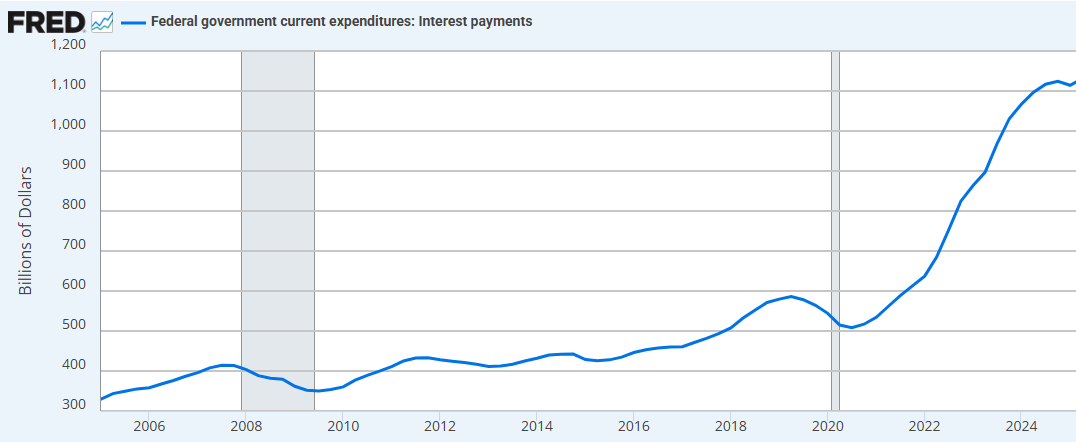
If we keep rates at current levels, the U.S. government’s interest expenses will continue to soar. That’s the cost to service federal debt. As you can see by the chart below, annual interest payments have exploded to over $1 trillion in recent years as debt soared and rates rose.

image 1

We now famously spend more on paying the interest on our debt than we do on military and defense spending.

It is utterly unsustainable.

And it’s a big reason why rates need to eventually be brought down. But there are other reasons, as well…

The Dollar and the Wealth Effect

“Well, you know, I’m a person that likes a strong dollar, but a weak dollar makes you a hell of a lot more money”.
–Donald Trump, July 2025

When the Fed raises U.S. interest rates, the dollar rises against other fiat currencies. When they cut, the dollar weakens and falls.

Right now, Donald Trump and Scott Bessent want a weaker dollar. They’re trying to rebuild and strengthen American industry, and that’s going to be very difficult with a strong dollar.

A weaker dollar would make American products more competitive in the global market. Trump has repeatedly pointed to Japan and China, and how they constantly weaken their own currencies to boost exports.

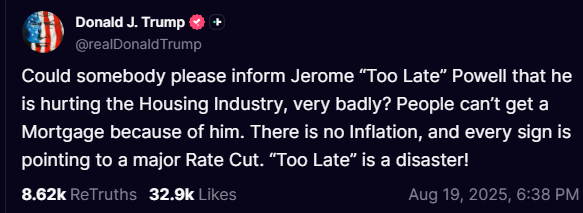
Trump also wants lower interest rates to lower mortgage payments, which have more than doubled in recent years, compounding the housing affordability crisis.

image 2

Lower interest rates could also help prop up the stock market bubble. If that bubble pops, it would absolutely crush consumer spending and the economy. Trump does not want that to happen.

However, we should note that the relationship between interest rates and stock market performance is far from clear. Our friend Jim Rickards says that lower rates are often associated with falling markets.

Nevertheless, the prevailing “wisdom” is that lower rates = higher stock prices, and that seems to be what President Trump believes.

So despite the market being bubbly and overheated, there is indeed a strong case for cutting rates. And that is exactly what is likely to happen over the next year.

The End Game: Yield Curve Control

Once interest rates approach zero again, we should fully expect more QE (money printing).

And eventually, the Fed will be forced to institute “yield curve control”. Let’s break down this intimidating-sounding concept. It’s really not difficult to grasp once we show how it worked in the 1940s.

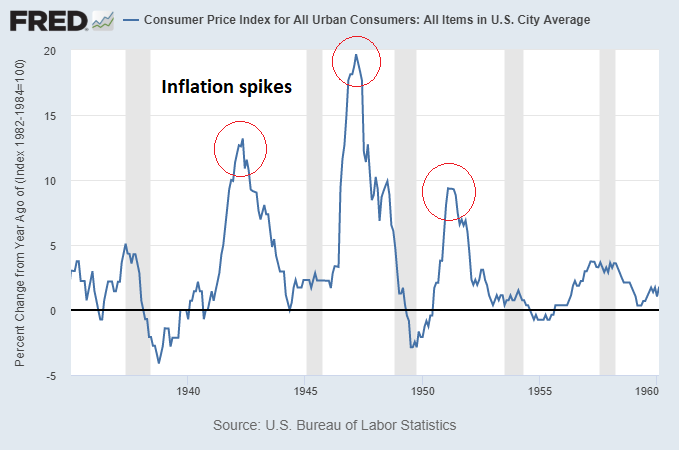
Yield curve control (YCC) was instituted between 1942 to 1951 because the U.S. had to issue massive amounts of bonds and notes to pay for WW2. Normally this supply dump would have caused interest rates to soar higher.

But 15% interest rates on the 10-year bond would have been disastrous to federal finances. So the Fed and Treasury capped long-term bonds at 2.5%. Short-term notes were capped at 0.375%.

Even as inflation reached nearly 20% annualized, government bond yields were suppressed at near-zero levels.

1940s Inflation During Yield Curve Control

image 3

Source: Lyn Alden

Anyone who had savings, bonds, or CDs had their purchasing power crushed.

During the YCC period from 1942-1951, inflation soared around 75% in total. Owning bonds and holding cash was an absolute disaster.

Compounding the problem, owning gold was illegal for U.S. citizens. Besides, the price of gold was “capped” by the gold standard at $35/oz.

Hard Assets Win Again

During the 1940s yield curve control period, investors who thrived did so by owning hard assets. Oil companies, base metal miners, manufacturers, railroads, smelters. Even food companies did pretty well.

Financial stocks like banks, meanwhile, performed poorly. As did utilities and other “yield-sensitive” sectors.

It’s important to remember that history doesn’t repeat, but it does rhyme. Within the next 5 years, I fully expect yield curve control to come into play. Possibly quite a bit sooner. There are no good options left on the table. YCC will once again become the path of least resistance.

But this go-round, gold and silver miners should be the stars of the show. During the 1940s they were essentially capped by their monetary ties. There is no such harness today. Sky’s the limit.

But it’s also good to hedge our bets with other hard assets. We’re bullish on base metal miners like Valeoil and gas, and even commodity-heavy emerging markets like Brazil. We’ll continue to explore this trend and find other ways to protect ourselves from what’s coming.

Fortunately there’s still plenty of time to prepare. The market is just beginning to wake up to the possibility of rate cuts and QE. And we may not get the first rate cut for a few months still.

And yield curve control? Almost nobody’s talking about that yet. But they will be. Just give it time.

Hard Assets Win Again

During the 1940s yield curve control period, investors who thrived did so by owning hard assets. Oil companies, base metal miners, manufacturers, railroads, smelters. Even food companies did pretty well.

Financial stocks like banks, meanwhile, performed poorly. As did utilities and other “yield-sensitive” sectors.

It’s important to remember that history doesn’t repeat, but it does rhyme. Within the next 5 years, I fully expect yield curve control to come into play. Possibly quite a bit sooner. There are no good options left on the table. YCC will once again become the path of least resistance.

But this go-round, gold and silver miners should be the stars of the show. During the 1940s they were essentially capped by their monetary ties. There is no such harness today. Sky’s the limit.

But it’s also good to hedge our bets with other hard assets. We’re bullish on base metal miners like Valeoil and gas, and even commodity-heavy emerging markets like Brazil. We’ll continue to explore this trend and find other ways to protect ourselves from what’s coming.

Fortunately there’s still plenty of time to prepare. The market is just beginning to wake up to the possibility of rate cuts and QE. And we may not get the first rate cut for a few months still.

And yield curve control? Almost nobody’s talking about that yet. But they will be. Just give it time.

https://dailyreckoning.com/the-fed-brews-up-a-nasty-potion/