Vanguard Group, the world’s second-largest asset manager, has decided to allow ETFs and mutual funds that primarily hold cryptocurrencies to be traded on its platform, reversing a longstanding position.
Starting on Tuesday, Vanguard will allow ETFs and mutual funds that primarily hold select cryptocurrencies, including Bitcoin, Ether, XRP, and Solana, to be eligible for trading on its platform. It’s a compromise that belies the firm’s long-standing view that digital assets are too volatile and speculative for serious portfolios and comes despite a more than $1 trillion drawdown in crypto market value since early October.
The AI boom is proving to be a windfall for construction workers building the massive data centers that power it all.According to The Wall Street Journal, workers moving into data-center construction are seeing pay jumps of 25% to 30% compared to their previous jobs — and in some cases, much more.
Among them is DeMond Chambliss, who traded his small drywall business in Columbus, Ohio, for a supervisor role overseeing 200 workers at a data center site. He now makes over $100,000 annually. “I pinch myself going to work every day,” the 51-year-old tells the Journal. In Oregon, electrical safety specialist Marc Benner pulls in $225,000 a year, while electrician Andrew Mason makes over $200,000 managing workers at six Northern Virginia data centers.
The Journal reports this isn’t just about higher base pay. Companies are sweetening the pot with perks like heated break tents, free lunches, daily incentive bonuses, and even remote project management positions. One construction site offers workers $100 in daily incentive pay, which can add up.
The surge comes as tech giants like Amazon, Google, and Microsoft race to build hundreds of new data centers, colliding with an industry-wide shortage of roughly 439,000 skilled workers, according to the Associated Builders and Contractors trade group.
In the years after the COVID-19 pandemic, U.S. immigration policy changes fueled a sharp rise in both legal and illegal immigration.Lawful admissionsjumped, as did encounters at theU.S.-Mexico borderbetween migrants and U.S. authorities.
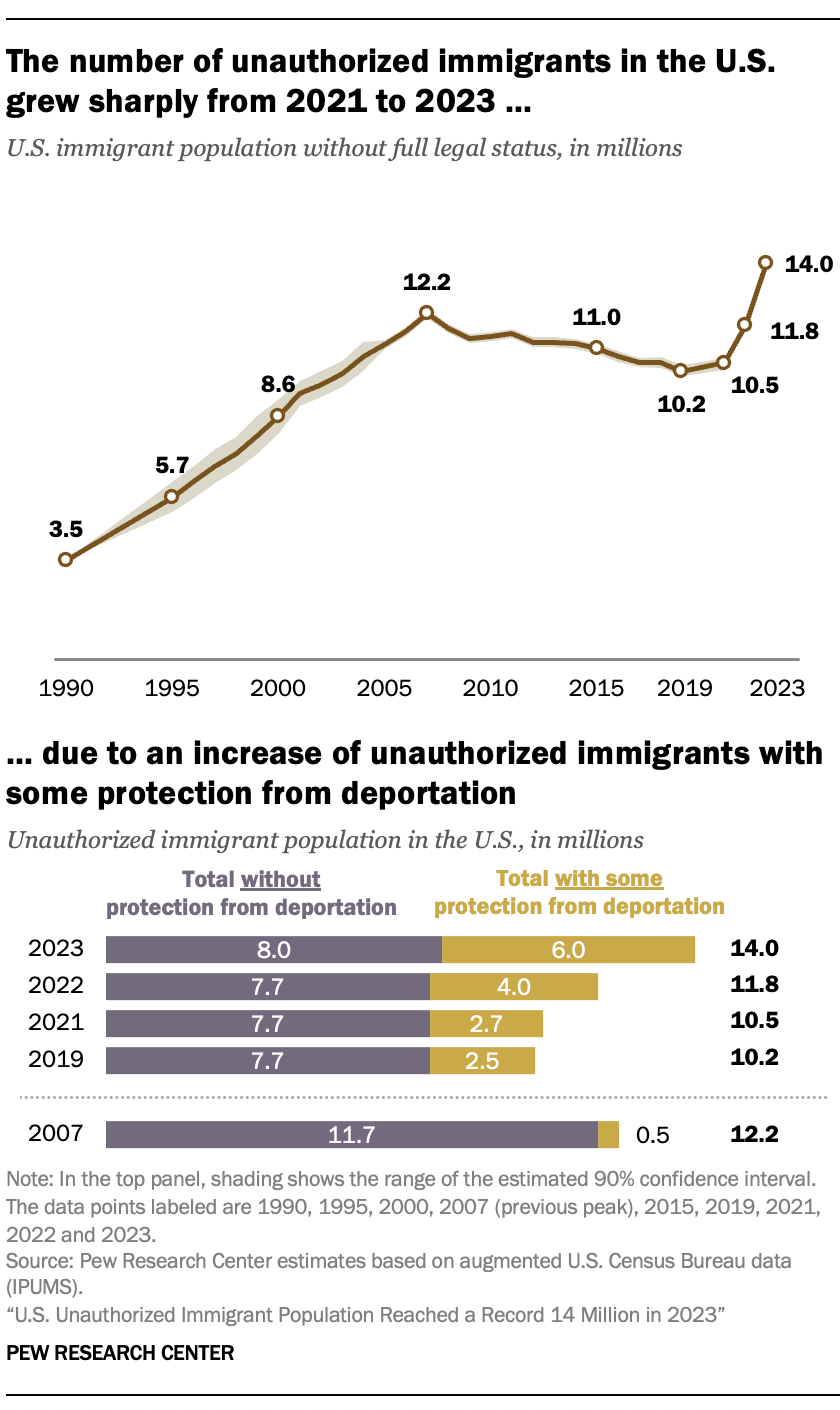
The number of unauthorized immigrants in the United States reached an all-time high of 14 million in 2023 after two consecutive years of record growth, according to a new Pew Research Center estimate. The increase of 3.5 million in two years is the biggest on record. Data from 2023 is the most recent available for developing a comprehensive and detailed estimate.
The label “unauthorized immigrants” captures a complex array of statuses, including immigrants who entered the U.S. legally. While the label is not perfect, it groups together immigrants living in the country with impermanent, precarious statuses. The term has been used for decades by researchers who develop estimates of the population and is generally used in this report.
The increase from 2021 to 2023 was driven primarily by growth in the number of unauthorized immigrants who were living in the U.S. with some protections from deportation, such as immigrants paroled into the country and asylum seekers. About 6 million immigrants without full legal status had some protection from deportation in 2023, up from 2.7 million in 2021. In 2007, when the total unauthorized immigrant population was at its previous high (12.2 million), about 500,000 had some protection from deportation.
Unauthorized immigrants with some protection from deportation accounted for more than 40% of those without full legal status in 2023. These protections can be, and in some cases have been, removed by the federal government, sometimes with little notification.
To understand which groups are considered unauthorized immigrants in this analysis, read “Who are unauthorized immigrants?” later in this report.
In 2023, unauthorized immigrants accounted for 27% of all U.S. immigrants, up from 22% in 2021. The group’s share of the U.S. population increased from 3.1% to 4.1% during this time.
Changes to the unauthorized immigrant population, 2024-25
Through early 2024, the overall unauthorized immigrant population continued to grow at a record pace, according to a Center review of preliminary and incomplete data sources. After mid-2024, policy decisions spanning the Biden and Trump administrations again changed this population. Growth slowed considerably in the last half of 2024 after the Biden administration stopped accepting asylum applications at the border and paused parole programs.
In 2025, the unauthorized immigrant population has probably started to decline, due in part to increased deportations and reduced protections under the Trump administration.
As of mid-2025, the unauthorized immigrant population likely remains above 2023 levels. Still, we won’t know the full impact of these policy shifts until more complete data becomes available.
This report explores the dynamics shaping the population of immigrants living in the U.S. without full lawful status. It provides a complete estimate and profile for the unauthorized immigrant population in 2023 based on the best data currently available. The report also provides a look at how the population has since changed, sketching out trends based on incomplete data from 2024 and the first half of 2025 – though complete estimates are not yet possible due to these limitations.
The new estimates for 2023 (and revised estimates for 2022) are based on Pew Research Center analysis of Census Bureau data from the American Community Survey (ACS), the most recent data available for a fully detailed estimate of unauthorized immigration. The survey data for these two years has been supplemented to take into account recent Census Bureau revisions of their data on the magnitude of immigration to the U.S.
Which groups of U.S. unauthorized immigrants had deportation protection in 2023?
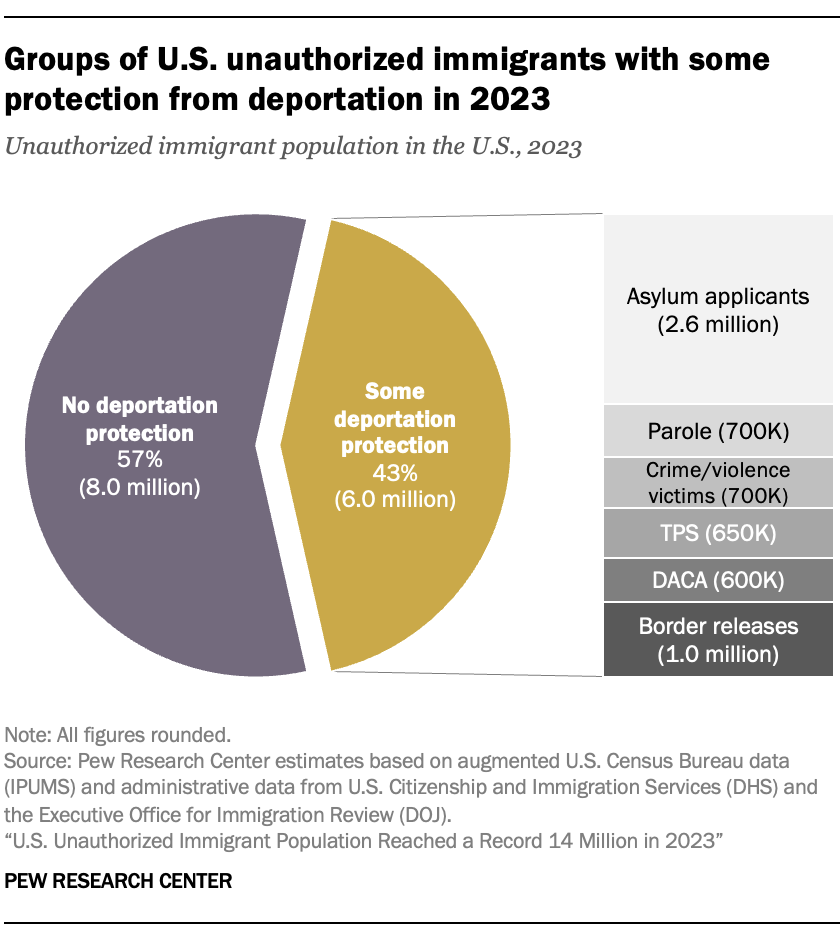
Several groups of unauthorized immigrants had some protections from deportation in July 2023:
Asylum applicants (2.6 million)
Those who entered the U.S. legally after receiving parole (700,000)
Victims of crimes or violence (700,000)
Those with Temporary Protected Status (TPS), which is available to migrants in the U.S. from countries facing war, natural disasters or other crises (650,000)
Another 1.0 million migrants encountered by U.S. Border Patrol were released into the U.S., typically with orders to appear in immigration court. These immigrants have some protections from deportation while their cases are resolved, but their protections are more limited.
Individuals in these groups are counted as part of the “unauthorized” immigrant population because their deportation protections are temporary and can quickly change. For example, the Trump administration in 2025 has:
Removed deportation protections and rescinded work permits for about 500,000 parolees from Cuba, Haiti, Nicaragua and Venezuela.
Largely stopped releasing immigrants into the U.S. who are encountered at the border.
The vast majority of unauthorized immigrants – more than 12 million in 2023 – either entered the U.S. illegally or overstayed a visa. Another 2 million entered the U.S. legally and were paroled or released into the country. Protection from deportation provided by programs such as DACA, TPS or asylum are only available to immigrants already in the U.S.
What is the composition of the U.S. immigrant population?
As of 2023, unauthorized immigrants represented 4.1% of the total U.S. population and 27% of the foreign-born population.
Meanwhile, the lawful immigrant population grew steadily from 24.1 million in 2000 to 37.8 million in 2023. The growth was driven by a rapid increase in the number of naturalized citizens, from 10.7 million to 23.8 million. The number of lawful permanent residents largely held steady at 11.9 million. As a result, in 2023, almost half (46%) of all immigrants in the country were naturalized U.S. citizens.
U.S. immigrant population trends
The overall U.S. immigrant population reached an all-time high of more than 53 million in January 2025, accounting for a record 15.8% of the U.S. population. However, growth slowed substantially starting in early 2024, and the number declined by more than 1 million between January and June 2025, according to data from the Current Population Survey.1 This would be the first sustained drop in the U.S. immigrant population since the 1960s.
What countries do unauthorized immigrants come from?
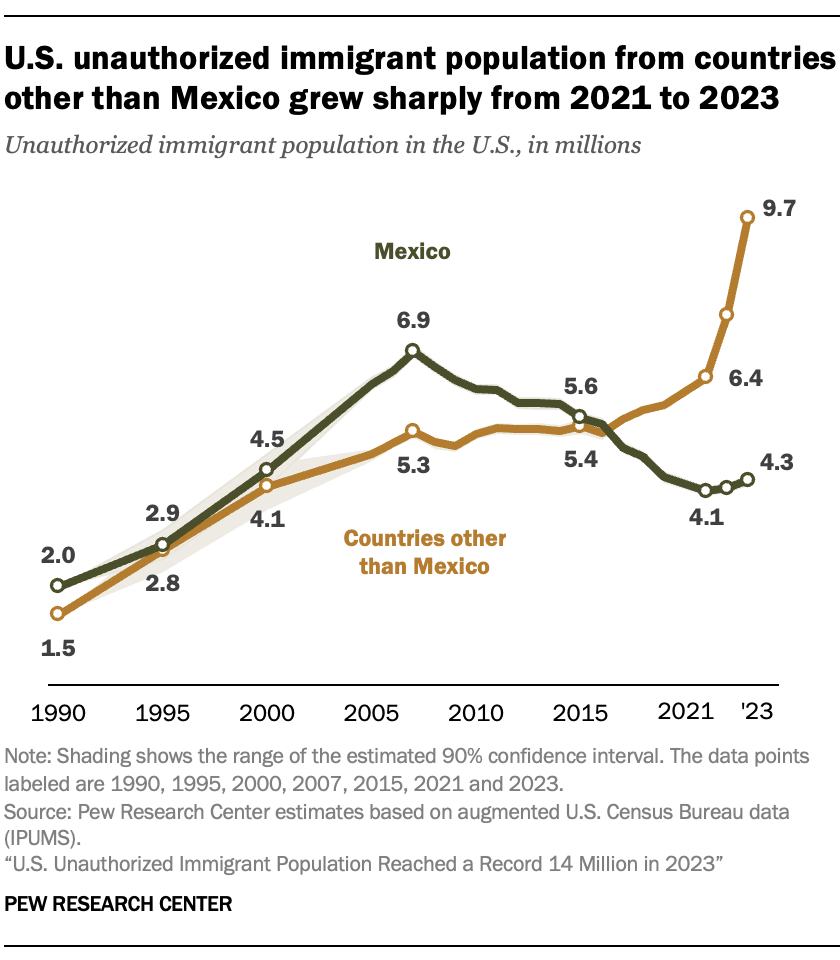
The number of U.S. unauthorized immigrants born in countries other than Mexico grew from 6.4 million in 2021 to 9.7 million in 2023.
By contrast, the unauthorized immigrant population born in Mexico grew only a little from 2021 to 2023, returning to its 2019 level of about 4.3 million.
Though Mexico remains the country where the most unauthorized immigrants in the U.S. are from, it accounted for 30% of the nation’s unauthorized immigrants living here in 2023. Mexicans represented a majority of unauthorized immigrants in the U.S. through 2016; their share in 2023 was by far the smallest share on record.
After Mexico, the countries with the largest unauthorized immigrant populations in the U.S. in 2023 were:
Guatemala (850,000)
El Salvador (850,000)
Honduras (775,000)
India (680,000)
In 2023, Venezuela was the country of birth for 650,000 U.S. unauthorized immigrants. This population has seen particularly fast growth, from 55,000 in 2007 to 195,000 in 2021 and 650,000 in 2023.
Other countries have also had large increases in the number of unauthorized immigrants in recent years. Totals from Venezuela, Cuba, Colombia, Nicaragua, Ecuador, Ukraine and Peru all more than doubled from 2021 to 2023.
The number of unauthorized immigrants from Cuba grew from less than 5,000 in 2019 to 100,000 in 2021 and 475,000 in 2023. This increase came after Cubans could no longer enter the U.S. legally without a visa, a change in policy made in 2017 under the Obama administration. Much of the recent growth in unauthorized immigrant populations from Cuba, Haiti, Nicaragua, Venezuela and Ukraine was due to parole programs instituted under President Joe Biden and that were ended by mid-2025.
El Salvador, India, China and the Philippines are the only countries to show no significant change in their U.S. unauthorized immigrant populations between 2021 and 2023 (among countries with more than 150,000 unauthorized immigrants).
World regions
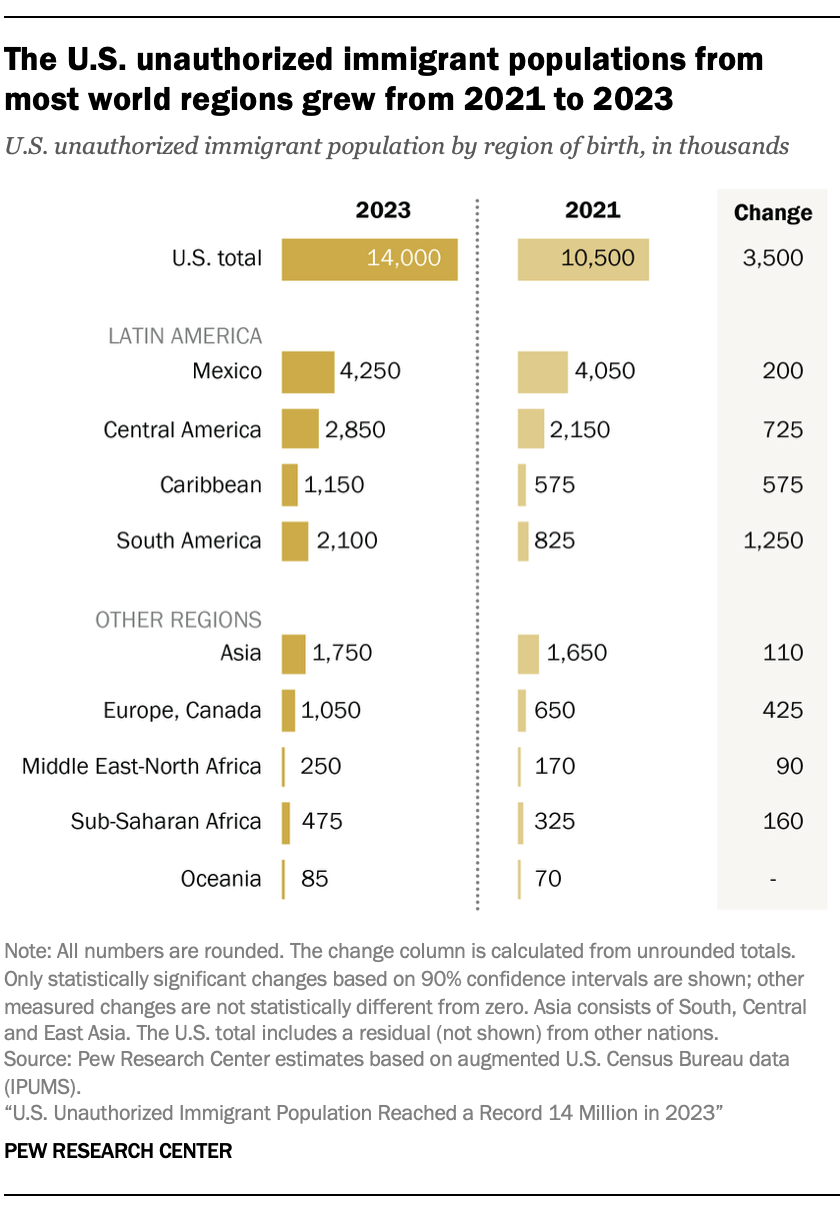
The number of unauthorized immigrants from almost every world region increased since 2021. The largest increases were from South America (1.3 million), Central America (725,000) and the Caribbean (575,000).
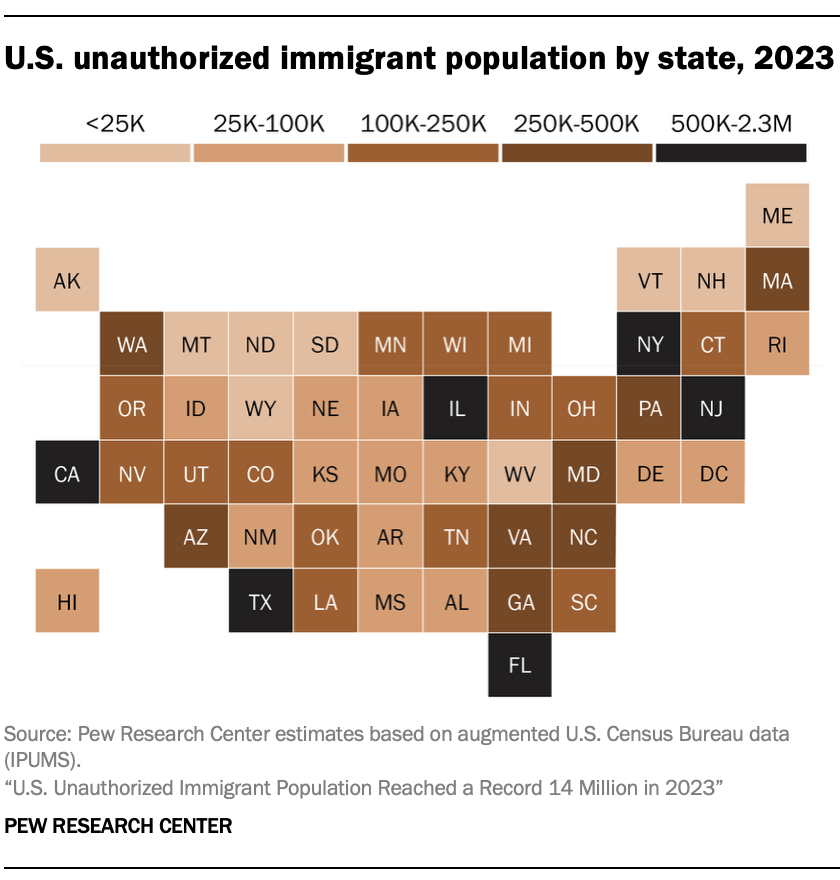
The six states with the largest unauthorized immigrant populations in 2023 were:
California (2.3 million)
Texas (2.1 million)
Florida (1.6 million)
New York (825,000)
New Jersey (600,000)
Illinois (550,000)
These states have consistently had the most unauthorized immigrants since at least 1980. However, in 2007, California had 1.2 million more unauthorized immigrants than Texas. Today, it has only about 200,000 more.
The U.S. unauthorized immigrant population has also become considerably less geographically concentrated over time. In 2023, the top six states were home to 56% of the nation’s unauthorized immigrants, down from 80% in 1990.
States where the unauthorized immigrant population grew the most
The unauthorized immigrant populations grew in 32 states from 2021 to 2023. The four states with the biggest growth were:
Florida (+700,000)
Texas (+450,000)
California (+425,000)
New York (+230,000)
Eight additional states had their unauthorized immigrant populations increase by 75,000 or more: New Jersey, Illinois, Georgia, North Carolina, Massachusetts, Pennsylvania, Maryland and Ohio.
Oregon is the only state with a population of more than 100,000 unauthorized immigrants where this group did not increase compared with 2021.
Even with these increases in recent years, six states had smaller unauthorized immigrant populations in 2023 than in 2007, the previous peak – Arizona, California, Nevada, New Mexico, New York and Oregon.
How many households include unauthorized immigrants?
A record 7.5 million U.S. households included unauthorized immigrants in 2023. They represented 5.6% of 133 million households nationwide. Overall, a total of 26 million people – including about 14 million unauthorized immigrants – lived in these households.
In 88% of these households, either the householder or their spouse was an unauthorized immigrant.
Almost 70% of these households are considered “mixed status,” meaning that they also contained U.S.-born residents or lawful immigrants. Most of the U.S.-born residents are children of unauthorized immigrants.
The share of households that include an unauthorized immigrant varies considerably across states. Nevada (10%) had the highest share in 2023, followed by California, Texas, Florida and New Jersey (9% each). In Montana, West Virginia and Vermont, about 1% of households included an unauthorized immigrant.
How many children in the U.S. have unauthorized immigrant parents?
About 4.6 million children under 18 born in the U.S. lived with an unauthorized immigrant parent in 2023, up from 4.0 million in 2021 and below the previous high of 4.9 million in 2016. As of 2023, these children accounted for about 75% of all minor children living with an unauthorized immigrant parent.
(In 2023, about 300,000 babies were born in the U.S. to an unauthorized immigrant, up from about 200,000 in 2021.)
In addition, about 1.5 million children under 18 were unauthorized immigrants in 2023. This group nearly doubled since 2021, and much of the rapid growth in the overall unauthorized immigrant population was due to families arriving in the U.S. with their foreign-born children. The 2023 total matches the previous high in 2005.
Another 1.4 million adults born in the U.S. lived with at least one parent who is an unauthorized immigrant in 2023, compared with 1.2 million in 2021 and only about 200,000 in 2005.2
How long have unauthorized immigrants lived in the U.S.?
A record number of unauthorized immigrants have been in the U.S. for a relatively short time due to the rapid growth in the overall unauthorized population since 2021. In 2023, more than 4.2 million unauthorized immigrant adults had been in the U.S. for less than five years, up from 1.8 million in 2021. The 2023 figure is more than double the number in any year from 2010 to 2019.
A similar number of unauthorized immigrant adults – 4.3 million – had lived in the U.S. for 18 years or more in 2023. This is up slightly from 2021, when the total was 4.1 million.
Another 3.8 million unauthorized immigrant adults had lived in the U.S. for 5 to 17 years in 2023, roughly the same as in 2021.
How many unauthorized immigrants are in the labor force?
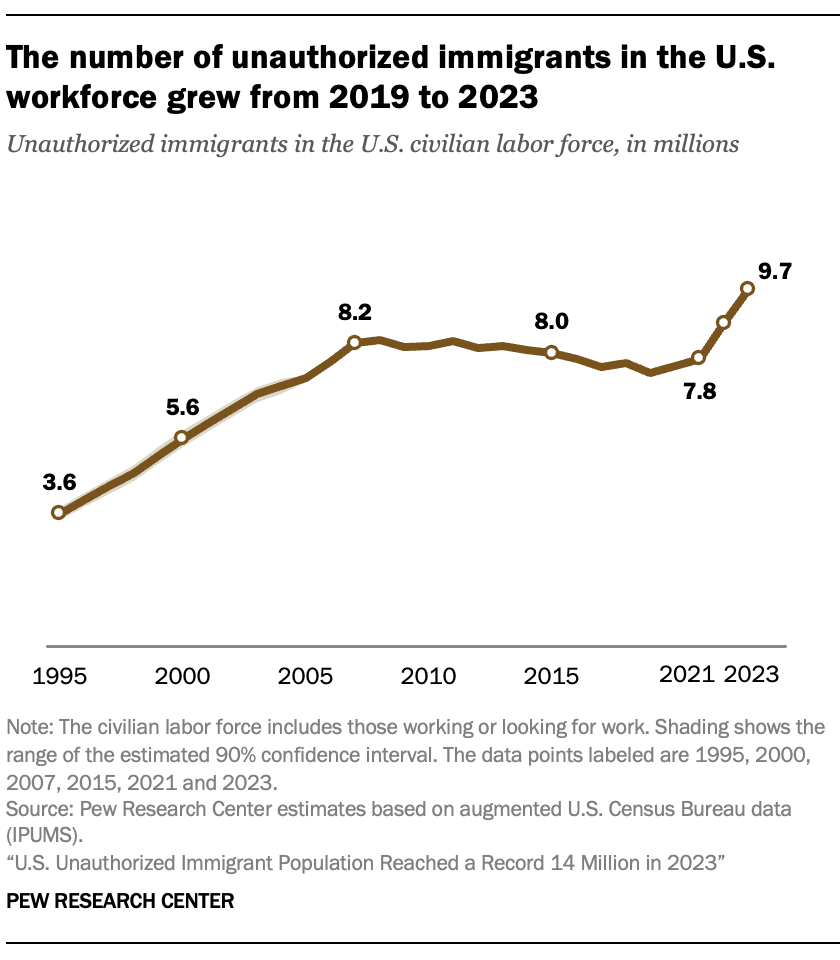
The number of unauthorized immigrants in the U.S. workforce grew from 7.8 million in 2021 to a record 9.7 million in 2023.
Unauthorized immigrants represented 5.6% of the U.S. workforce in 2023, a new high. The previous peak was 5.4% in 2007.
Since 2003, unauthorized immigrants have made up 4.4% to 5.6% of all U.S. workers, a relatively narrow range.
The share of the U.S. workforce made up of unauthorized immigrants is higher than their 4.1% share of the total U.S. population. That’s because the unauthorized immigrant population includes relatively few children or elderly adults, groups that tend not to be in the labor force.
The share of unauthorized immigrants in the workforce varied across states in 2023. Nevada (9%), Florida (9%), New Jersey (9%), Texas (9%), California (8%), Maryland (7%) and Massachusetts (7%) had the highest shares, while 1% or less of workers in Maine, Vermont, West Virginia and Montana were unauthorized immigrants.
What types of jobs do unauthorized immigrants have?
Unauthorized immigrants work in essentially every sector of the economy. The industries with the highest shares of unauthorized immigrants in their workforce in 2023 were construction (15%), agriculture (14%), leisure and hospitality (8%), other services (7%), and professional/business services (7%).
The major occupations with the highest shares of unauthorized immigrants were farming (24%), construction (19%) and service occupations (9%). There are no occupations where unauthorized immigrants represent a majority of workers. But in some detailed occupations, unauthorized immigrants represented 25% to about 40% of all workers in 2023. Most of these jobs are in the construction sector.
Note:The remaining two sections of this report provide a look ahead to what has happened since 2023, as well as additional context and details about the primary analysis above.
What has happened to the unauthorized immigrant population since 2023?
The nation’s unauthorized immigrant population is dynamic. The estimate of 14 million unauthorized immigrants in the United States as of July 2023 is based on the U.S. Census Bureau’s 2023 American Community Survey (ACS), the most recent version available. Since 2023, the population has continued to change. But surveys and other federal government data sources only give us a rough idea of what has happened to the unauthorized immigrant population in 2024 and 2025. Still, these sources do hint at some changes since July 2023.
Administrative data from the Department of Homeland Security (DHS) provides counts through November 2024 of entries of certain migrants that are considered part of the unauthorized immigrant population, specifically releases at the border and the entry of some parolees. DHS also has data on admission of lawful immigrants (LPRs) through December 2024. These two sources can track changes in the lawful foreign-born population and a large part of the unauthorized immigrant population.
The Census Bureau’s monthly Current Population Survey (CPS),3 used to measure unemployment, provides information on the size of the immigrant population. However, its sample is not large enough and the survey does not have the data needed to develop an estimate of the unauthorized immigrant population that is comparable to the ACS-based estimates. Still, a consistent series of monthly CPS data is available for July 2023 to December 2024 to track changes in the immigrant population. Similarly, the monthly CPS is also available for January 2025 through June 2025. But because of some methodological changes in the survey, the 2025 estimates cannot be compared directly with the 2024 estimates.
The U.S. unauthorized immigrant population likely continued to increase rapidly through at least mid-2024, reaching new highs, according to available government data. Growth continued in the second half of 2024 at a much slower pace and may have stopped entirely as inflows dropped dramatically due to Biden administration policy changes (described below).
From January to June 2025, the unauthorized immigrant population likely declined, possibly by as much as 1 million. However, as of July 2025, the unauthorized immigrant population almost surely remains higher than in July 2023, when we estimated that the population stood at 14 million. As more data is released, more precise estimates for 2024 and 2025 will be possible.
The sections below provide the details behind these conclusions. ...
Summary
There are about 6 million unauthorized immigrants with some degree of protection as of July 2023. The groups with temporary protection from deportation described above total just over 6.2 million individuals. However, some individuals can appear in more than one category. For example, some paroled into the U.S. (say, OAW Afghans) may also acquire another status like TPS. While exact overlap is not known, most newly arrived groups likely do not appear in multiple categories. We estimate about 250,000 migrants are counted more than once. This leaves a total of about 6 million unauthorized immigrants with some degree of protection from deportation.