Sun Tzu wrote that the supreme art of war is to subdue the enemy without fighting. President Trump is currently subduing two enemies with one strait.
The disruption in the Strait of Hormuz is being covered as an Iran story. However, it is also a China story, and almost nobody is talking about it.
Here is what the numbers show. China buys more than 80% of Iran’s crude oil exports, roughly 1.4 million barrels a day. Most of it is relabeled as Malaysian or Indonesian to dodge sanctions. In total, 45-50% of all Chinese oil imports pass through the Strait of Hormuz. If the Strait is blocked, Beijing loses more than Iranian crude. Saudi, Iraqi, Emirati, Omani, and Kuwaiti oil - all flow through the same waterway.
On April 19, the USS Spruance intercepted and disabled an Iranian-flagged cargo ship, the Touska, in the Gulf of Oman. Marines from the USS Tripoli boarded the vessel after a six-hour standoff. The Touska had previously made voyages to Chinese ports. The message wasn’t for Tehran alone. Beijing was watching too: the ships that carry Iranian oil to China now travel at American discretion.
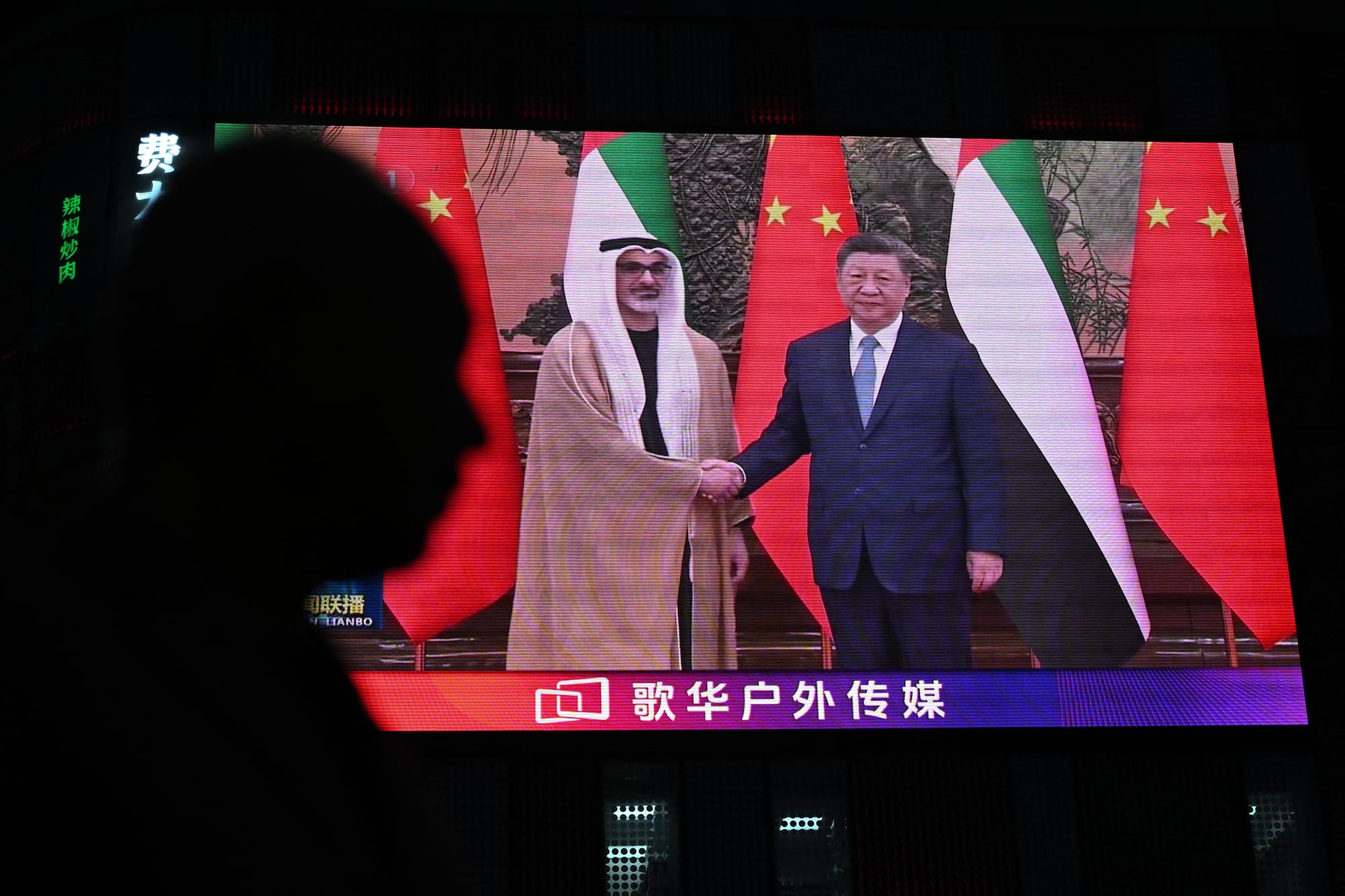
Xi Jinping’s response tells the story. On April 14, a day after the U.S. blockade began, he met the crown prince of Abu Dhabi in Beijing and warned against “the world falling back into the law of the jungle.” Days later, he called Saudi Crown Prince Mohammed bin Salman and urged that “normal passage” through the Strait be maintained. It was the first time Xi publicly called for reopening the Hormuz. He was protecting China's fuel supply, not making a stand for Iran.
Treasury Secretary Scott Bessent made the subtext explicit. On April 15, he said China would “pause” buying Iranian oil because of the blockade. A day earlier, he called China “an unreliable global partner” for continuing to hoard oil while the Strait was shut. An American Treasury Secretary announcing what China will do, and Beijing not contradicting him, clearly shows who holds the leverage.
China saw this coming and was prepared. It spent 2025 aggressively stockpiling oil, adding 1.1 million barrels a day to strategic reserves that now total nearly 1.4 billion barrels, more than three times the U.S. strategic petroleum reserve. That buys roughly 120 days of cover. But 120 days is not forever. And the blockade is already in its eighth week.
The sanctions are also tightening around the workarounds. China officially imports zero barrels from Iran. The trick is relabeling: China imported 1.3 million barrels a day of “Malaysian” crude in 2025. Malaysia only produces 535,000 barrels a day. Washington knows the math. New sanctions target the Chinese “teapot” refineries in Shandong province that process relabeled Iranian crude. And the shadow fleet that carries it is shrinking.
But the real squeeze is diplomatic. Trump’s state visit to China is scheduled for May 14. Xi wants that visit badly. It signals stability, respect, and a functioning relationship between the world’s two largest economies. Trump knows this, and he is using it.
Xi is caught. If he criticizes the blockade publicly, he risks Trump delaying or canceling the visit, as Washington has already done once, pushing it from March to May because of the Iran war. If he stays quiet, he watches his most important oil supplier get strangled while Chinese energy costs rise and his economy slows further. Trump took out Maduro in Venezuela in January, another Chinese oil partner. He struck Iran in February. In both instances, Xi said nothing of consequence.
Trump revealed on Fox Business that he wrote Xi a letter asking him not to supply weapons to Iran. Xi wrote back saying he wasn’t doing so. Then Trump posted on Truth Social: “President Xi will give me a big, fat, hug when I get there in a few weeks. We are working together smartly and very well!” He followed it with: “BUT REMEMBER, we are very good at fighting, if we have to.”
Trump isn't bluffing, and he wants Xi to know it.
The implications stretch beyond oil. Hormuz is a dress rehearsal for the Taiwan Strait. If the world’s most powerful navy cannot keep a 21-mile-wide waterway open against a battered regional power whose fleet has been reduced to speedboats, why would Xi believe the U.S. would risk carriers and submarines to break a Chinese blockade of Taiwan? Taiwan’s TSMC fabricates more than 90% of the world’s most advanced semiconductors. A Chinese blockade would sever the nervous system of the global tech economy, with estimated losses of $10 trillion. What happens in Hormuz doesn't stay in Hormuz. It tells Xi exactly what the U.S. will and won't do if a similar crisis pops up across the globe.
This moment has revealed something Washington understands and Beijing fears: Hormuz squeezes China just as hard as it squeezes Iran. One blockade, applied at one chokepoint, cuts Iran’s revenue and China’s energy supply at the same time.
Sun Tzu advised that the highest form of warfare is to attack the enemy’s strategy, not his army. The blockade of Hormuz attacks two strategies at once: Iran’s bid to outlast American pressure, and China’s bet that it can stay neutral while buying sanctioned oil on the cheap. Anyone watching from across the Pacific should be paying attention.

No comments:
Post a Comment
Note: Only a member of this blog may post a comment.